EconlibThe LibraryOther Sites |
Front Page Titles (by Subject) BOOK II. - On the Nature of the Gods
Return to Title Page for On the Nature of the GodsThe Online Library of LibertyA project of Liberty Fund, Inc.Search this Title:Also in the Library:
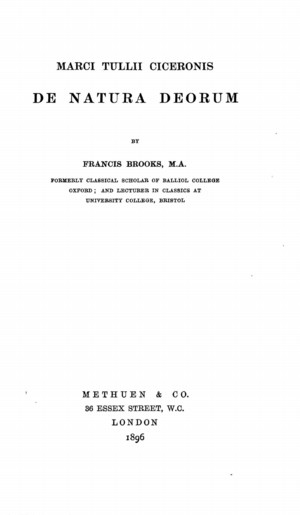
BOOK II. - Marcus Tullius Cicero, On the Nature of the Gods [45 BC]Edition used:De Natura Deorum (On the Nature of the Gods), trans. Francis Brooks (London: Methuen, 1896).
About Liberty Fund:Liberty Fund, Inc. is a private, educational foundation established to encourage the study of the ideal of a society of free and responsible individuals. Copyright information:The text is in the public domain. Fair use statement:This material is put online to further the educational goals of Liberty Fund, Inc. Unless otherwise stated in the Copyright Information section above, this material may be used freely for educational and academic purposes. It may not be used in any way for profit.
BOOK II.I.How very rash of me, said Velleius, when Cotta had finished, to have attempted to do battle with one who was at the same time an Academic and an orator! An Academic who could not speak, or an orator, however eloquent, who was a stranger to that philosophy, I should not have feared, finding nothing disconcerting either in a stream of empty words, or in exactness of argument when it is accompanied by barrenness of style. But you, Cotta, have shown yourself strong in both respects; it is only the audience and judges that have been wanting to you. However, we will consider what you have said at some other time; let us now, if he himself has no objection, hear Lucilius. For my part, replied the latter, I should have preferred to hear Cotta again, if he will only introduce the true gods with as much eloquence as he removed the false, for it is incumbent upon a philosopher and pontiff, and therefore upon Cotta, that his views with regard to the immortal gods should not shift and vary, like those of the Academics, but should be fixed and definite, like those of our own school. Now enough and to spare has been urged against Epicurus, but I want very much to hear what you, Cotta, believe yourself. Have you, answered Cotta, forgotten what I said at the outset, that I find it easier, especially on such a subject, to say what I do not believe than what I do? And if I possessed a definite conviction, I should still wish, after speaking so much myself, to listen to you in your turn. I am at your service, said Balbus, and I will speak as briefly as I can, for now that the errors of Epicurus have been exposed, my statement has been relieved of a lengthy topic. Generally speaking, our school divides the whole of this inquiry of yours with regard to the immortal gods into four parts. They show, first, that the gods exist; secondly, of what nature they are; next, that the world is under their charge; and lastly, that they take counsel for the affairs of men. Let us, however, in this discussion take the two points that come first; the third and fourth, as being more important, I think should be deferred to another occasion. By no means, said Cotta, for our time is our own, and besides we are engaged upon a subject which ought to be allowed precedence even over business. II.The first point, Lucilius then said, does not seem to even need discussion, for what can be clearer and more obvious, when we have lifted our eyes to the sky, and have gazed upon the heavenly bodies, than that there exists some divine power of exalted intelligence by which these are ruled? If it were not so, how could Ennius have said in words which meet with universal assent, Look upon yonder dazzling sky, which all address as Jove? Yes, and not only as Jove, but as lord of the universe, and as ruling all things by his nod, and as the father, as Ennius also says, of gods and men, and as a god swift to aid and very powerful. I certainly do not see why the man who doubted this should not also be capable of doubting whether there is, or is not, a sun. In what respect is the one thing more evident than the other? We know it as the perception and conviction of our minds; otherwise the belief would not endure with such stability, it would not be strengthened by lapse of time, nor could it have become fixed as the ages and generations of men advanced. We see that length of time has made other beliefs, that were false and groundless, decay. Who supposes that a Hippocentaur or Chimæra ever existed, or what old woman can be found foolish enough to tremble at those horrors in the world of the dead which used once to be believed in? Time destroys the figments of the imagination, while confirming the judgments of nature, and that is why both in our own nation and in others the worship of the gods and the holy observances of religion are increasing daily in extent and worthiness. Nor is this a casual or accidental result; there is, in the first place, this reason for it, that the gods frequently manifest their power in actual presence. At Regillus, for instance, in the war with the Latins, when Aulus Postumius, the dictator, was engaged in battle with Octavius Mamilius of Tusculum, Castor and Pollux were seen to fight in our lines on horseback, and within more recent memory the same sons of Tyndareus brought news of the defeat of Perseus. For Publius Vatinius, the grandfather of our young contemporary of that name, when coming to Rome by night from the prefecture of Reate, was told by two young men on white horses that Perseus had that day been taken captive. He carried the news to the senate, and was at first thrown into prison on the charge of having made an unfounded declaration on a matter of state importance; but afterwards, when a despatch sent by Paulus agreed in the same day, the senate granted him land and exemption from military service. It has also been handed down to memory that when the Locrians vanquished the people of Croton in a great battle by the river Sagra, the engagement was heard of that very day at the games at Olympia. The voices of the Fauns have often been heard, and the forms of the gods been seen, forcing the man who was neither destitute of perception, nor impious, to acknowledge the presence of divinity. III.And then predictions and premonitions of the future, what is it that they declare if not that the future is indicated, and foreshown, and portended, and predicted to man, whence the terms indications, foreshowings, portents, and prodigies?1 If, however, we believe that the stories told of Mopsus, Tiresias, Amphiaraus, Calchas, and Helenus were invented by the licence of fable, though even fable itself would not have accepted them as augurs if the facts were absolutely opposed to it, will not even the instances in our own history teach us to acknowledge the power of the gods? Shall we remain unimpressed by the tale of the presumptuous conduct of Publius Claudius in the first Punic war, who, when the sacred chickens, on being let out of the coop, refused to feed, ordered them to be plunged into the water, that they might, as he said, drink, since they would not eat? He only ridiculed the gods in jest, but the mockery cost him many a tear (for his fleet was utterly routed), and brought a great disaster upon the Roman people. And did not his colleague Junius in the same war lose his fleet by storm after disobeying the auspices? Claudius was in consequence condemned by the people, and Junius committed suicide. Cælius records that the disregard shown by Caius Flaminius for religion led to his overthrow at Trasimene, which entailed serious injury upon the state, and it may be understood from these men’s disastrous end that it was under the leadership of those who had observed the requirements of religion that the state became great. If, moreover, we care to make a comparison between our own characteristics and those of foreign nations, while the latter will be found equal, or even superior to us in other respects, in religion, that is, in the worship of the gods, we shall be found to far excel them. Is the crooked staff of Attus Navius to be despised with which he marked out the quarters of the vineyard in order to trace his pig? I should believe so, if King Hostilius had not waged great wars under his augury. But through the system of augury having been allowed to drop owing to the carelessness of the nobles,1 the real observance of auspices has come to be despised, and only the form has been retained. Consequently the most important departments of state, including war, on which the safety of the state depends, are administered without auspices. None are observed when crossing a river, none in connection with the spear points,1 and none when the men are summoned to action, so that the practice of making wills on the eve of battle has ceased.2 Indeed, the time at which our generals begin the conduct of wars is when they have laid down the right to take the auspices.3 Amongst our ancestors, on the other hand, the influence of religion was so great that some generals even offered up their own lives to the immortal gods on behalf of their country, veiling their heads and using a set form of speech. There are many instances which I could quote from the Sibylline prophecies and the answers of soothsayers, by which to establish a truth which ought to be doubtful to no one. IV.But in the case of the consuls Publius Scipio and Caius Figulus, the science both of our own augurs and of the soothsayers of Etruria was confirmed by actual facts. When Tiberius Gracchus during his second consulship was presiding at their election, the first polling-clerk, as he gave in their names, suddenly died upon the spot. Gracchus nevertheless completed the election, but feeling that the incident had roused religious scruples amongst the people, reported the matter to the senate. The senate decreed that it should be referred to the customary authorities, and the soothsayers, having been introduced, made answer that the holder of the election had not been properly qualified. Upon this, as I have heard my father tell, Gracchus exclaimed in hot anger, “What! I not properly qualified who, when I presided, was both consul, and augur, and had taken the auspices? And is it Tuscans and barbarians like you who control the Roman people’s system of augury, and can interpret the requirements of an election?” So he ordered them on that occasion to withdraw, but afterwards sent a letter to the college1 from his province, saying that when reading the augural books he remembered that his post of observation, which was the gardens of Scipio, had been improperly taken, because, after taking it, he had entered the city boundary line in order to preside at a meeting of the senate, and on his return, when crossing the boundary line again, had forgotten to take the auspices; there had therefore, he said, been a flaw in the election of the consuls. The augurs laid the matter before the senate, who decreed that the consuls should abdicate, which they did. What more striking instances do we seek? The wisest, and perhaps I might say the most eminent man of his time, preferred to confess his fault, though it might have been concealed, rather than that a sense of guilt should attach itself to the state, and the consuls preferred at once to lay down the highest office rather than retain it for an instant in defiance of religion. Would not a man who had these, and innumerable instances of the same kind, before his eyes, be forced to acknowledge the existence of the gods? For beings of whom there exist interpreters, must certainly exist themselves; interpreters of the gods do exist, so let us acknowledge that the gods exist. But it may be that not everything that is predicted comes to pass. Neither do all sick men recover, and therefore, I shall be told, there is no art of healing! Signs of future events are disclosed by the gods, and whenever any one has been mistaken in these, it is not the divine nature, but human conjecture that has been to blame. And so upon the main point all men of all nations are agreed, for the existence of the gods is an idea natural to all, and engraven, as it were, upon the mind. There are different opinions as to their nature, but no one denies that they exist. V.Now Cleanthes, who belongs to our own school, said that ideas of the gods had been formed in men’s minds owing to four causes. First he placed the cause just mentioned by me, which had had its origin in premonitions of the future; second, the one which we have found in the greatness of the advantages obtained from temperate climate, the fertility of the earth, and a plentiful number of other sources of benefit; third, the terror caused to the mind by lightning, tempest, storm-clouds, snow, hail, desert places, pestilence, the movements and frequent rumblings of the earth, showers of stones, rain-drops with the appearance of blood, landslips or sudden openings in the earth, monstrous human and animal portents, torch-like appearances in the sky, stars of the kind which the Greeks call cometæ, and our countrymen cincinnatæ,1 which in the recent struggle with Octavius2 were the precursors of great calamities, the phenomenon of a double sun, which I have heard from my father occurred during the consulship of Tuditanus and Aquilius, the very year in which the light of that other sun Publius Africanus was extinguished,—things which by the terror they inspired made men conceive the existence of some kind of divine and heavenly power. As the fourth and most important cause of all he names the uniformity of motion, the revolutions of the heavens, the grouping of the sun, and moon, and all the stars, their serviceableness, beauty, and order, the mere appearance of which things would be a sufficient indication that they were not the result of chance. Just as a man going into a house, or gymnasium, or market-place, would find it impossible, when he saw the plan, and scale, and arrangement of everything, to suppose that these things came into being uncaused, but would understand that there was some one who superintended and was obeyed, so in the case of such vast movements and alternations, in the orderly succession of phenomena so numerous and so mighty, in which the measureless and infinite extent of past time has never deceived expectation, it is much more inevitable that he should conclude that such great operations of nature are directed by some intelligence. VI.Chrysippus, again, speaks in a way which, though his own mind is a very keen one, he seems to have learnt direct from nature, rather than to have discovered himself. “For if,” he says, “there is something in nature which the mind, the reason, the strength, and the power of man would be unable to produce, surely that which does produce it is higher than man; now the heavenly bodies, and all those phenomena which observe an everlasting order, cannot be created by man; consequently that by which they are created is higher than man. And what could you say this was rather than God? For if there are no gods, there can be nothing higher in nature than man, since he alone possesses reason, and nothing can surpass reason in excellence. But that there should be a man who thinks that in the whole universe there is nothing higher than himself shows senseless arrogance. There is, then, something higher, and therefore there is assuredly a God.” Is it the fact that if you saw a large and beautiful house, you could not be persuaded, even if you did not see the master, that it had been built for the sake of mice and weasels,1 and would you not present the appearance of downright imbecility if you supposed that all this adornment of the world, all this diversity and beauty of the heavenly bodies, all this might and amplitude of sea and land, were a dwelling-place belonging to you and not to the immortal gods? Is not even this understood by us, that everything above is better, whereas the earth is lowest, and surrounded by the thickest air? For this very reason the same thing which we see to be also characteristic of certain districts and cities, namely an extra degree of sluggishness in the minds of the inhabitants owing to the denser quality of the atmosphere, has befallen the human race, through their having been placed upon the earth, that is, in the quarter of the world where the air is thickest.2 And yet, on the ground even of man’s intelligence, we ought to consider that there exists some mind of the universe, one that is keener than his and divine. “For whence,” as Socrates says in Xenophon, “did man get hold of the mind he has?” Why, if any one were to ask whence we derive the vital juices, the heat that is distributed through the body, even the earthy firmness of the flesh,1 and lastly the breath we draw, the answer is clear, that we have received one element from earth, another from water, another from fire, and another from the air which we take in with our breath. VII.And the element which surpasses all these, I mean reason, and if we care to express it by a variety of terms, intelligence, design, reflection, foresight, where did we find, whence did we secure it? Shall the universe possess all other qualities, and not this one which is of most importance? Yet surely in all creation there is nothing nobler than the universe, nothing more excellent and more beautiful. There not only is not, but there cannot even be imagined anything nobler, and if reason and wisdom are the noblest of qualities, it is inevitable that they should exist in that which we acknowledge to be supremely noble. Again, who can help assenting to what I say when he considers the harmonious, concordant, and unbroken connection which there is in things? Would the earth be able to have one and the same time for flowering, and then again one and the same time in which it lies rough? Or could the approach and departure of the sun be known, at the time of the summer and winter solstice, by so many objects spontaneously changing? Or the tides of the sea, and of narrow straits, be affected by the rising or setting of the moon? Or the dissimilar movements of the planets be maintained by the one revolution of the whole sky? It would be certainly impossible for these things to come to pass in this way, with such mutual harmony amongst all parts of the universe, if they were not held together by one divine and all-pervading spirit. And this position, if argued, as I intend to argue it, in a fuller and more flowing style, is better able to escape the cavilling of the Academics, whereas if expressed more briefly and concisely in syllogistic form, as it used to be by Zeno, it is more exposed to criticism. For just as it is either difficult or impossible for a running stream to be tainted, while this may easily happen to water that is confined, so the onward flow of argument sweeps away the detractions of the critic, while that which is confined within narrow limits has hard work to defend itself. These arguments, for instance, which are expanded by modern Stoics, used to be compressed by Zeno as follows:— VIII.“That which exercises reason is more excellent than that which does not exercise reason; there is nothing more excellent than the universe, therefore the universe exercises reason”. In the same way it may be proved that the universe is wise, blessed, and eternal, for all objects that possess these qualities are more excellent than those which do not possess them, and there is nothing of greater excellence than the universe. By this means it will be proved that the universe is divine. He has also the following: “No part can be sentient where the whole is not sentient; parts of the universe are sentient, therefore the universe is sentient”. He goes further and urges his point in more precise terms. “Nothing,” he says, “that is inanimate and without reason can produce from itself a being that is animate and possessed of reason; the universe produces beings that are animate and possessed of reason, therefore the universe is animate and possessed of reason.” He also, as his habit frequently was, stated the argument in the form of a comparison, which was to this effect: “If melodiously piping flutes sprang from the olive, would you doubt that a knowledge of flute-playing resided in the olive? And what if plane trees bore harps which gave forth rhythmical sounds? Clearly you would think in the same way that the art of music was possessed by plane trees. Why, then, seeing that the universe gives birth to beings that are animate and wise, should it not be considered animate and wise itself?” IX.Since, however, I have begun to treat the subject in a way different from what I announced at starting (for I said that this first part did not need discussion, as the existence of the gods was evident to all), I am now desirous that that point should nevertheless be itself confirmed by considerations of natural philosophy. The facts are these. Everything that receives nurture and increase contains within itself a principle of heat without which nurture and increase would be impossible. For everything in which heat and fire have a place is stirred and made active by a self-imparted movement; where there is nurture and increase, the movement is of a fixed and equable kind, and so long as it endures in us, so long do sensation and vitality endure, but when the heat is cooled and extinguished, we perish and are extinguished ourselves. This fact of the great power of heat in every organism is further enforced by Cleanthes with the following arguments. No food, he says, is so heavy as not to be digested1 in a night and a day, and even in those remnants of it which nature has rejected there is heat. Moreover, the veins and arteries are perpetually throbbing with a kind of fire-like movement, and it has often been observed that the heart of a living creature, when it has been torn out, beats with a rapidity which counterfeits the quick flickering of flame. Everything, therefore, which lives, whether animal or product of the earth, does so by virtue of the heat enclosed within it, which should make it understood that this principle of heat contains in itself a vital force extending through the whole universe. We shall discern this more easily if the whole of this all-pervading element of fire is described more precisely. All the divisions, then, of the universe (I will touch upon the most important) are maintained by the support of heat, as may be perceived first in the case of the element of earth. For we see that by the striking and rubbing together of stones fire is elicited; and that after recent digging the earth is hot and smokes, and that hot water is drawn even from perennial wells, this happening most of all in winter time, because, it is supposed, a great store of heat is held in the hollows of the earth, and in winter the earth, being more compact, holds the heat that has been implanted in it more tightly. X.A long exposition and many arguments might be employed in showing that all the seeds which the earth receives in its bosom, and all the things which it holds that have been spontaneously generated, and are attached by means of roots, owe their birth and increase to duly regulated heat. That there has also been an admixture of heat in water is proved, in the first place, simply by the fluidity of water, which would not be turned into ice by frost, or become fixed in the shape of snow and rime, if it did not also liquefy, and break up, and dissolve at the admixture of heat. For this reason moisture solidifies beneath a north wind, and at the application of the other kinds of cold, and is in turn warmed, and softened, and melted by heat. The way, moreover, in which the seas become warm when they have been disturbed by winds makes it easy to be understood that heat has been enclosed in those vast bodies of water, for the warmth in question is not to be regarded as external and acquired, but as evoked by disturbance from the inmost parts of the sea, a principle which operates also in our own bodies when they become heated by motion and exercise. Then again, air itself, which is naturally extremely cold, is by no means without a share of heat; in fact it has received a very considerable admixture of it, for it is itself the result of exhalation from water; that is, the kind of vapour which rises from water must be regarded as constituting air, and this vapour is caused by the movement of the heat which is contained in the water. We may perceive a counterpart to this in water bubbling up when fire has been placed under it. There remains the fourth division of the universe, which is both by nature altogether fiery itself, and bestows a healthful and lifegiving heat upon all other substances. In this way the conclusion is reached that, since all the divisions of the universe are maintained by heat, the long-continued preservation of the universe itself is also due to a like and equivalent principle, all the more so as we are to understand that in the intermingling of this hot and fiery element with every organism, the power to generate, and the cause of production, are resident in that element from which all animate things, and things whose roots are contained in the earth, necessarily derive their birth and increase. XI.There is, then, an element which holds together and maintains the entire universe, an element, moreover, which is not without sensation and reason. For it is necessary that every element which is not isolated or simple, but which is joined and linked with something else, should have in itself some ruling principle, as, for instance, mind in the case of man, and in the case of animals something similar to mind, which prompts their desires. In trees, and in things which spring from the earth, the ruling principle is supposed to be placed in their roots. By ruling principle I mean the principle which the Greeks call ἡγεμονικόν, which cannot but hold, and which ought to hold, the highest place in each genus. Consequently the thing in which the ruling principle of the whole of nature is contained, must in the same way be the most perfect of all, and the most worthy of power and dominion over all existence. Now we see that in parts of the universe (for there is nothing in the entire universe which is not a part of the whole), sensation and reason exist. These qualities must therefore exist, and exist more vividly and to a greater extent, in that part in which the ruling principle of the universe resides. Consequently the universe must be intelligent, and the element which holds all things in its embrace must excel in perfection of reason; the universe, therefore, must be divine, and so must the element by which the whole strength of the universe is held together. This fiery glow which the universe possesses is also far purer, clearer, and nimbler, and on that account better fitted to arouse sensation, than this heat of ours, by which the objects known to us are preserved and made strong. Since, then, men and animals are maintained by this heat, and through it possess motion and sensation, it is absurd to say that the universe is without sensation, when it is maintained by a burning heat which is unmixed, and free, and pure, and at the same time in the highest degree vivid and nimble, especially considering that the heat which belongs to the universe is moved by itself and its own action, and is not stirred by anything distinct from itself, or by impact from outside. For what can be mightier than the universe, so as to act upon and set in motion the heat by which the universe is to be held together? XII.Let us hear Plato on this question, Plato, the god of philosophers, as he may be called. He holds that there are two kinds of motion, one self-imparted and the other derived, and that a thing which is self-moved by its own action is more divine than that which is set in motion by impact from something else. The former kind of motion he declares to exist in soul alone, and he is of opinion that it was from soul that the first principle of motion was derived. Consequently since all motion arises from the heat possessed by the universe, and since that heat is moved by its own action, and not by impact from anything else, it must of necessity be soul, by which means it is proved that the universe is possessed of soul. It may also be understood that intelligence exists in the universe, from the fact that the universe is undeniably of greater excellence than any form of being. For just as there is no part of our body which is not less important than ourselves, so the whole universe must be more important than a part of the universe. If that is so, the universe must be intelligent, for if it were not, man, who is a part of the universe, would, as participating in reason, necessarily be of more importance than the entire universe. If, again, we wish to trace the advance from the first and rudimentary stages of being to the final and perfect, it is to a divine nature that we must come. For we observe that the first things maintained by nature are those which spring from the earth, to which nature has assigned nothing more than protection by means of nurture and development. To animals she has given sensation, movement, an impulse, combined with a certain desire, towards what is beneficial, and an avoidance of what is hurtful. To man she has given more in having added reason, which was meant to regulate the desires of the mind, at one time allowing them their way, and at another holding them in check. XIII.The fourth and highest stage consists of beings who are created naturally good and wise, in whom right reason in an unchanging form is innate from the beginning, that reason which must be regarded as more than human, and must be assigned to what is divine, that is, to the universe, in which this complete and perfect reason must needs exist. For it cannot be said that in any order of things there is not something final and perfect. Just as in the case of vines or cattle, we see that, unless some force interposes, nature arrives by a way of her own at perfection, and just as a certain attainment of consummate workmanship exists in painting and architecture and the other arts, so it is inevitable that in collective nature there should much more be a progress towards completion and perfection. Many external influences can prevent the other kinds of being from reaching perfection, but nothing can stand in the way of universal nature, because it itself limits and contains all kinds of being. That, therefore, must be the fourth and highest stage, which no force can come near. Now it is in that stage that universal nature has its place, and since it is the characteristic of that nature that all things should be inferior to it, and nothing able to stand in its way, it necessarily follows that the universe is intelligent, and more than that wise. Besides, what is more foolish than that the nature which embraces all things should not be declared supremely excellent, or that, being supremely excellent, it should not be in the first place animate, in the second possessed of reason and forethought, and lastly wise? In what other way can it be supremely excellent? For if it resembled plants, or even animals, it would not deserve to be considered of the highest degree of excellence, but rather of the lowest, while if it participated in reason, and yet were not wise from the beginning, the condition of the universe as compared with that of man would be the lower of the two. For man can become wise, but if the universe during the limitless course of past time has been destitute of wisdom, it will assuredly never acquire it, and will therefore be lower than man. Since that is absurd, the universe must be regarded as wise from the beginning, and as divine. XIV.It was, indeed, an ingenious remark of Chrysippus that just as the cover was created for the shield, and the sheath for the sword, so all other things with the exception of the universe were created for the sake of something else, the crops and fruits, for instance, which the earth produces, for the sake of animals, and animals for the sake of men, as the horse for carrying, the ox for ploughing, and the dog for hunting and keeping watch. As for man himself, he was born in order to observe and imitate the universe, being in no wise perfect, but a particle, so to speak, of that which is, for it is only the universe to which nothing is wanting, and which is knit together on every side, and is perfect and complete in all its numbers and parts. Now since the universe embraces all things, and there is nothing that is not contained within it, it is perfect at every point. How, then, can that which is of most excellence be lacking to it? There is nothing more excellent than mind and reason, so it is impossible that these should be lacking to the universe. Chrysippus, therefore, is again right when he declares, adding instances, that in what is matured and perfect everything is of higher excellence, in a horse, for example, than in a colt, in a dog than in a whelp, in a man than in a boy, and in like manner that whatever is best in the whole world, must reside in something that is perfect and complete. As there is nothing more perfect than the universe, and nothing more excellent than virtue, it follows that virtue is an attribute of the universe. Human nature is not indeed perfect, yet virtue is attained in man, so how much more easily in the universe! Virtue, then, does exist in the universe, which is therefore wise, and consequently divine. XV.Having thus ascertained the divinity of the universe, we must attribute the same quality to the heavenly bodies, which are created from the purest and most mobile portion of æther, without being intermingled with any other element, and are throughout glowing and transparent, so that it is with entire correctness that they too are described as animate, and as possessing feeling and intelligence. That they are throughout of a fiery nature Cleanthes thinks is confirmed by the testimony of two senses, those of touch and sight. For the brightness of the sun, considering how far and wide it shines notwithstanding the immensity of the universe, is more vivid than that of any flame, and its action is such as not only to warm, but often even to consume, neither of which effects would it have unless it were of a fiery nature. “Therefore,” he says, “since the sun is of a fiery nature, and is fed by the moisture of the sea, for no fire would be able to maintain itself without some nourishment, it must either resemble the fire which we employ for purposes of use and sustenance, or that which is contained in the bodies of animate beings. But this fire of ours, which is required by the uses of life, is the destroyer and consumer of all things, and wherever it moves works universal havoc and ruin. The fire, on the other hand, belonging to the body, which is life-promoting and healthful, preserves and nourishes and increases and sustains all things, and endows them with sensation.” He says, therefore, that there is no doubt which of these two fires the sun resembles, since it too causes all things to flourish and ripen, each in its own kind. Consequently, since the fire of the sun resembles the fire which is in the bodies of animate beings, the sun also must be animate, and so indeed must the other stars, as they have their origin in the celestial glow which is called æther or heaven. Now since some forms of life are developed upon the earth, others in the water, and others in the air, it is, according to Aristotle, absurd to suppose that no animate existence is produced in that part which is best fitted for the production of what is animate. But the stars occupy the region of æther, and since that is highly rarefied, always in motion, and of potent quality, it is inevitable that the animate existence which is produced in it should be of the keenest sensitiveness and the readiest mobility. Since, therefore, the stars are produced in that region, it follows consistently that they possess feeling and intelligence, and by this means it is proved that they ought to be ranked among the number of divine beings. XVI.We may, indeed, observe an intelligence more acute and quicker of comprehension in those who inhabit districts in which the air is pure and rare, than in those who breathe a thick and cloudy atmosphere; in fact it is even thought to make some difference to mental keenness, what it is that one uses as food. The stars, therefore, may be allowed to possess the highest intelligence, as they are placed in the part of the universe which belongs to æther, and are nourished by moisture from the sea and land, which the long distance between causes to rarefy. Their sentience and intelligence are, moreover, decisively declared by their order and regularity (for it would be impossible for anything to move by rule and measure without forethought), in which there is nothing random, variable, or fortuitous. Now the order of the stars and their regularity through all eternity do not point either to a working of nature,1 for such regularity is altogether rational, or to chance, which inclines to variety and abhors constancy. It follows, therefore, that they move voluntarily of themselves, of their own consciousness and divinity. Aristotle, indeed, is entitled to praise for having laid down that everything which moves does so either by nature, necessity, or choice; the sun, he says, and moon, and all the stars move, but things which move by nature are carried either downwards by their weight or upwards by their lightness, neither of which movements belongs to the stars, since their course is directed in a circle. And it certainly cannot be said that it is some more potent necessity which makes the stars move in a way unknown to nature, for what more potent necessity can there be? It remains, therefore, to conclude that the movement of the stars is voluntary, and the man who should look upon them would be acting impiously as well as foolishly, if he denied the existence of the gods. Whether he does that, or deprives them of all superintendence and action, makes, indeed, little difference, for a being who does nothing does not seem to me to exist at all. That the gods, then, do exist is so evident that I should scarcely regard the man who denied it as being of sound mind. XVII.It remains for us to consider what their nature is like, a subject on which it is of the utmost difficulty to disengage the intelligence from the habitual experience of the eyes.1 This difficulty made the general body of the uneducated, and philosophers who resembled them, unable to form any conception of the immortal gods except by assigning to them human shapes, a baseless belief which, as it has been refuted by Cotta, does not need to be discussed by me. The fact is that a firmly fixed idea gives us a preconception of god as being in the first place animate, and in the second place more exalted than anything in the whole of nature, and that being so, I see nothing by which I should sooner satisfy this preconception and idea of ours than by pronouncing, firstly, this universe itself, which nothing can surpass in excellence, to be animate and divine. Here let Epicurus jest as he will (he is not very well suited to the part, and savours but little of his country),1 and let him declare himself unable to understand what a round and whirling deity is like: for all that he will never move me from this position, which is one that even he himself admits. For he does believe in the existence of gods on the ground that there must necessarily be some exalted nature, which nothing transcends in excellence. Now there is certainly nothing more excellent than the universe, and it is undoubted that that which is animate, and possesses feeling, and reason, and intelligence, is more excellent than that which is without these qualities. It is thus proved that the universe is animate, and that it is endowed with feeling, intelligence, and reason, and hence the conclusion that the universe is divine. These facts will, however, be recognised more easily a little later on from the actual working of the universe. XVIII.Meanwhile, Velleius, do not, I entreat, parade in your own person the utter ignorance of your school on matters of science. You say that a cone and cylinder and pyramid appear more beautiful to you than a sphere, which even as an ocular judgment is a strange one. However, let it be granted that merely in appearance they are more beautiful, though I do not allow even that. For what is more beautiful than the figure which alone contains all other figures within itself,1 and which it is impossible should have any unevenness of outline, any point against which to impinge, any indentation in the form of angles or curves, any projection, or any depression? And since the globe, for so I propose to render σϕαɩ̂ρα, among solid figures, and the circle or orb, which is called in Greek κύκλος, among plane figures, are the two forms of greatest excellence, it is characteristic of these two forms alone that all their parts are precisely similar, and the circumference at every point equidistant from the centre, which provides the closest possible kind of interconnection. But if you are blind to these facts through never having handled the student’s dust,2 have you not even been able, as natural philosophers, to understand that this uniform motion and unchanging array of the stars could not have been maintained in connection with a different shape? Nothing, therefore, can show greater ignorance than the assertion which is commonly made by your school, your saying, I mean, that the roundness of this world itself is not beyond question, since it may possibly be of another shape, and since there are innumerable worlds in existence which differ in form. If Epicurus had learnt how much twice two was, he certainly would not speak in this way, but while he makes the palate his test of the highest good, he has not lifted his eyes to what Ennius calls “the palate of the sky”.1 XIX.For inasmuch as there are two kinds of stars, one of which moving in an unchangeable course from east to west never diverts one step of its path, while the other in the same tract and paths performs two unbroken revolutions,2 from each of these facts the rotatory movement of the universe, which would not be possible except in a body of spherical form, and the circular revolutions of the stars are recognised. Now in the first place the motion of the sun, which holds the chief place among the heavenly bodies, is such that after filling the world with abundant light, it leaves it again, first on one side and then on the other, in shade, for it is merely the earth’s shadow coming across the sun which causes night. There is the same regularity in the course of the sun by night as by day. Moreover, its alternate approach and withdrawal, through not being carried to an extreme, temper the degrees of cold and heat, for the describing of three hundred and sixty-five orbits by the sun, with about a quarter of a day added, make up the revolution of the year, and by turning its course now to the north, and now to the south, it brings about summer and winter, and the two seasons of which one has been placed after the decline of winter and the other after that of summer. From the changes of the four seasons the beginnings and causes of everything produced by land and sea are thus derived. The moon, again, in a month’s course equals a year’s revolution of the sun. Its nearest approach to the sun makes its light faintest, its farthest departure, in each case, fullest. Nor is it only its aspect and form which are changed, by its first waxing, and then returning by degrees of diminution to its original shape, but its quarter as well, which is at one time north and another south. There is in its course a kind of counterpart over again of the winter and summer solstice, and many influences distil and flow from it, through which living creatures obtain nurture and increase, and the things which spring from the earth grow and attain maturity. XX.But there is most matter for wonder in the movements of the five stars which are falsely called wandering; falsely, because nothing wanders which through all eternity preserves its forward and retrograde courses, and its other movements, constant and unaltered. And this is the more wonderful in the case of these stars of which we are speaking, as they are at one time concealed, and at another restored to view, at one time advancing, at another retreating, at one time preceding the sun, at another following it, sometimes moving with increased, sometimes with diminished speed, and sometimes not even moving at all, but remaining for a time stationary. On their dissimilar movements mathematicians have based what they call the Great Year, which is completed when the sun and moon and the five wandering stars, having accomplished their several courses, have come round again to the same relative positions. How long the revolution takes is a much disputed point, but that it is fixed and definite is a matter of necessity. For instance, the star which is farthest from the earth, which is known as the star of Saturn, and is called by the Greeks Φαίνων, accomplishes its course in about thirty years, and though in that course it does much that is wonderful, first preceding the sun, and then falling off in speed, becoming invisible at the hour of evening, and returning to view in the morning, it never through the unending ages of time makes any variation, but performs the same movements at the same times. Beneath it, and nearer to the earth, moves the planet of Jupiter, which is called in Greek Φαέθων; it completes the same round of the twelve signs in twelve years, and performs in its course the same variations as the planet of Saturn. The circle next below it is held by Πυρόεις, which is called the planet of Mars, and traverses the same round as the two planets above it in four and twenty months, all but, I think, six days. Beneath this is the planet of Mercury, which is called by the Greeks Στίλβων; it traverses the round of the zodiac in about the time of the year’s revolution, and never withdraws more than one sign’s distance from the sun, moving at one time in advance of it, and at another in its rear. The lowest of the five wandering stars, and the one nearest the earth, is the planet of Venus, which is called Φωσϕόρος in Greek, and Lucifer in Latin, when it is preceding the sun, but Ἕσπερος when it is following it; it completes its course in a year, traversing the zodiac both latitudinally and longitudinally, as is also done by the planets above it, and on whichever side of the sun it is, it never departs more than two signs’ distance from it. XXI.This constancy, then, among the stars, this marked agreement of times through the whole of eternity, though the movements are so various, I cannot understand as existing without mind and reason and forethought, and since we find that these qualities are possessed by the heavenly bodies, we cannot but assign to those bodies themselves their place among the number of divine beings. Nor indeed are what are called the fixed stars without indications of the same intelligence and foresight. Their revolution is a daily one, and is uniform and constant; their movement is neither caused by the æther, nor, as most writers say in their ignorance of natural science, is it bound up with the movement of the heavens. For the æther is not of such a nature as to envelop the stars and to urge them along by its own force; being rare, and transparent, and suffused with equable heat, it does not seem very well adapted for keeping them in place. The fixed stars have, then, a sphere of their own, which is distinct from the pervading æther, and free. Their movements, which are never-ending and unbroken, and marked by a wonderful and incredible harmony, make it so clear that a divine force and intelligence are resident in them, that the man who did not perceive that these very bodies are possessed of the force of divine beings would seem incapable of perceiving anything at all. In the heavens, then, there is no chance, irregularity, deviation, or falsity, but on the other hand the utmost order, reality, method, and consistency. The things which are without these qualities, phantasmal, unreal, and erratic, move in and around the earth below the moon, which is the lowest of all the heavenly bodies. Any one, therefore, who thinks that there is no intelligence in the marvellous order of the stars and in their extraordinary regularity, from which the preservation and the entire well-being of all things proceed, ought to be considered destitute of intelligence himself. Having laid this foundation, I shall not, I think, do wrong if I make the discussion of this question1 begin with him who led the way in the investigation of truth. XXII.Zeno, then, defines nature by saying that it is artistically working fire, which advances by fixed methods to creation. For he maintains that it is the main function of art to create and produce, and that what the hand accomplishes in the productions of the arts which we employ, is accomplished much more artistically by nature, that is, as I said, by artistically working fire, which is the master of the other arts. Indeed, on this principle every department of nature is artistic, since it has, so to speak, a path and prescribed course to follow. But in the case of the universe itself, which encloses and contains all things in its embrace, he says that the nature which exists in that is not only artistic, but in the fullest sense an artificer, taking counsel and provision for everything serviceable and advantageous. And just as it is by their own seeds that the other parts of nature are severally created and increased, and in their own seeds that they are contained, so all the movements which belong to universal nature, and its strivings and desires, which the Greeks call ὁρμαί, are self-imparted, and it fits these with corresponding actions in the same way that we ourselves do, who are moved by feelings and sensations. The mind of the universe being, then, of such a kind, may in consequence be rightly described either as foresight or providence, its Greek name being πρόνοια, and what it is mainly provident for, and chiefly busied with, is in the first place that the universe may be as well equipped as possible for permanence, and in the second that it may lack nothing, but may possess in the highest degree exquisite beauty and completeness of adornment. XXIII.We have discussed the universe as a whole, and also the stars, with the result that a multitude of divine beings is now almost apparent who are not idle, and yet perform what they do without laborious and oppressive toil. For they are not made up of veins and nerves and bones, they do not live upon such food or drink as to contract a too sharp or sluggish condition of the vital juices, and their bodies are not of a kind to make them dread a fall or a blow, or be afraid of illness as a consequence of fatiguing the limbs, possibilities the fear of which made Epicurus invent gods who existed only in outline, and did nothing. No; these gods are endowed with a form of the utmost beauty, and have their place in the purest region of the sky, and seem from their movements, and the way in which they direct their course, to have combined together for the preservation and protection of all things. But there are many other divinities to which on account of their great services a status and a name have been given, not without reason, both by the wisest men of Greece and by our own ancestors, for they thought that whatever conferred great advantage upon the human race did not come into existence except by divine benevolence towards men. And so they used sometimes to describe the object produced by the god by the name of the god himself, as when we speak of corn as Ceres, and wine as Liber, which is the origin of the line of Terence— Without Ceres and Liber Venus languishes. Sometimes, again, the actual quality in which some superior potency resides is itself called by the name of god, as in the case of Faith and Mind, both of which we see to have been enshrined upon the Capitol, on the latest occasion by Marcus Æmilius Scaurus, but before that Faith had been installed by Aulus Atilius Calatinus. You see the temple of Virtue, and the temple of Honour, the latter restored by Marcus Marcellus, and dedicated not many years before in the Ligurian war by Quintus Maximus. Why should I speak of those of Plenty, Safety, Concord, Liberty, and Victory? It was because the potency of each of these qualities was too strong to be controlled except by a god1 that the quality itself was given the title of god. Under this class the terms Cupido, Voluptas, and Venus Lubentina have been deified, qualities which, though Velleius thinks otherwise, are vicious and not according to nature; at the same time they are vices by which nature is often fiercely shaken. The greatness of the benefits was, then, the reason why the gods who produced the different benefits received divine rank, and the power residing in each god is indicated by these titles which have just been quoted. XXIV.Furthermore, the life and common practice of mankind have admitted of their exalting to the realms above, as the recipients of fame and gratitude, individuals who have excelled in well-doing. To this we owe Hercules, Castor, Pollux, Æsculapius, and also Liber,—I mean by him Liber the son of Semele, not the one whom our forefathers solemnly and piously consecrated in connection with Ceres and Libera, the nature of which consecration may be understood from the mysteries. It was in consequence of liberi being the term that we use of our own children that the children of Ceres were named Liber and Libera, a use which is retained in the case of Libera, but not so in that of Liber. To this we also owe Romulus, who is thought to be the same as Quirinus. These men, since their souls survived and enjoyed immortality, were rightly regarded as gods, for they were of the noblest nature and also immortal. There is, too, another method, and one moreover based upon natural science, from which a great number of gods have resulted, the clothing of whom in mortal form has supplied poets with stories, but has saturated human life with every kind of superstition. This subject has been treated by Zeno, and afterwards worked out more at length by Cleanthes and Chrysippus. For instance, a long-established belief prevailed over Greece that Cælus had been mutilated by his son Saturn, and Saturn himself bound by his son Jupiter, but in these impious stories a physical theory was contained which was not without point, for they meant that the element which holds the topmost position in the sky, the element of æther, or fire, which creates all things by its own agency, is without that part of the body which in order to generate needs the conjunction of a second part. XXV.By Saturn, again, they meant him who controlled the course and revolution of periods and times, the god who in Greek bears that actual name, for he is called Κρόνος, which is the same as χρόνος, that is, a period of time. And he was named Saturn because, it was supposed, he was “made full” (saturo) with years, for it is because time swallows up the periods of time, and is loaded, without being satisfied, with the years of the past, that Saturn is represented as having been accustomed to devour his own offspring, and it was in order that he might not have an unrestricted course, and that Jupiter might fetter him with the yoke of the stars,1 that he is represented as having been bound by Jupiter. Jupiter himself, that is, juvans pater, to whom, by a change of inflections, we give the name of Jove from juvare, is called by the poets “father of gods and men,” and by our forefathers “best and greatest,” “best,” indeed, that is, most beneficent, before “greatest,” because it is a greater, or at any rate a more acceptable thing, to be of universal benefit than to possess great power; well, he, as I said before, is described by Ennius in the following terms:— Look upon yonder dazzling sky, which all address as Jove, a clearer statement than when he says elsewhere:— Wherefore with all my might will I curse yonder shining sky, whatsoever that is. He is defined in the same way by our augurs, when they say, “when Jove lightens and thunders”.2 Euripides also made, as he often did, an admirable remark when he said:— You behold the boundless æther diffused on high, which with soft embrace encompasses the earth: consider this the highest god, hold this as Jove. XXVI.Air, again, which has its place between the sea and the sky, is, as the Stoics maintain, consecrated under the name of Juno, who is the sister and wife of Jove, because it has both a likeness to æther and the very closest connection with it. Their making it feminine and assigning it to Juno was due to the fact that there is nothing softer than air. As to the name Juno, I believe it to have been derived from juvare. Water and earth remained, so that there might according to the legends be a division into three kingdoms. To Neptune, therefore, who is, they say, one of the two brothers of Jove, the whole of the kingdom of the sea was given, and the name Neptunus was lengthened from nare, like Portunus from portus, the first letters being slightly changed. The whole principle and element of earth, on the other hand, was dedicated to father Dis, that is, Dives, “the wealthy god,” like Πλούτων1 amongst the Greeks, because all things return to the earth and proceed from it. His wife, they tell us, was Proserpina, a name which comes from the Greeks, for she is the goddess who is called in Greek Περσεϕόνη; they identify her with the corn-seed, and have a fancy that when she has been concealed in the ground her mother seeks for her. The name of the mother, derived from the bearing of corn (gerere), is Ceres, as though Geres, and the first letter, as it happened, was changed just as it was by the Greeks, for they on their side named her Δημήτηρ as the equivalent of Γημήτηρ. Mavors, again, was so called because he was the overturner of greatness (magna verteret), and Minerva either because she lessened (minueret) or threatened (minaretur). XXVII.Since, moreover, in all things the beginning and the end are of most importance, they assigned the first place in sacrifice to Janus, whose name is derived from ire, to go, the word from which a through way of passage is called janus, and the doors at the entrance of private houses januæ. As for Vesta,1 her name is taken from the Greeks, for she is the goddess who is styled by them Ἑστία. Her functions relate to altars and hearths, and consequently, as she is the guardian of what is most closely domestic, it is with her that all prayer and sacrifice conclude. Not far different from her functions are those of the Penates, whether so called from their name being derived from penus, which is the word used of everything that men eat, or from the fact that they have their abode far within (penitus), on which account they are also called by the poets penetrales. The name of Apollo, in the next place, is Greek, and they hold that he is Sol, while they think that Diana is the same as Luna, Sol being so called either because he alone (solus) of the heavenly bodies is of such a size, or because, when he has risen, all are obscured, and he alone is to be seen, and Luna being named from lucere, to shine, as appears from her other title being Lucina. Just as, therefore, among the Greeks it is Diana,2 with the added designation of Lucifera,3 that is invoked in child-birth, so among us it is Juno Lucina.1 The latter goddess is also known as Diana omnivaga, “the all-wandering,” not from hunting, but because she is reckoned amongst the seven apparently wandering stars, and having the name of Diana because it was felt she created a kind of day (dies) by night. And she is summoned at births because they are completed sometimes in seven, or generally in nine revolutions of the moon, which are called menses, months, because they accomplish a measured space (mensa spatia). There is a remark of Timæus which, like many of his, shows ingenuity; after saying in his history that the temple of the Ephesian Diana had been burnt down on the same night that Alexander was born, he added that that was by no means to be wondered at, since Diana wishing to be present at the delivery of Olympias had been absent from her home. As to Venus, she was so named by our countrymen as being the goddess who came to all things (veniret), and the word venustas, loveliness, is derived from her rather than Venus from venustas. XXVIII.Do you see, then, how from the right and useful discovery of natural phenomena a passage was made in thought to imaginary and fictitious deities?—a passage which gave rise to false beliefs, and frantic errors, and superstitions worthy almost of a beldame. For we are made acquainted with the forms, age, dress, and equipment of the gods, as also with their descents, marriages, relationships, and everything in them that has been reduced to the likeness of human frailty. Thus, they are brought before us with their minds a prey to disturbance, for we hear of their desires and sorrows and angers, and they have even, as the stories relate, had experience of wars and battles, not only, as in Homer, when they protected on one side or the other two opposing armies, but they have also waged their own personal wars, as with the Titans and Giants. These are things to which it is in the highest degree foolish to give either utterance or credit, and they abound in futility and the most utter triviality. Nevertheless, while we scorn and reject these stories, we shall be able to understand the being and character of the gods who extend through the nature of each thing, Ceres through the earth, Neptune through the sea, one god through one thing, and another through another, together with the name by which custom has designated them, and it is these gods1 whom we ought to reverence and worship. And the worship of the gods which is best, and also purest, and holiest, and most full of piety, is that we should always reverence them with a mind and voice that are without stain, and guiltless, and uncorrupt; for religion has been dissociated from superstition not only by philosophers but by our own ancestors as well. I may mention as to these two terms that men who used to spend whole days in prayer and sacrifice in order that their children might survive them (essent superstites), were called superstitiosus, a title which afterwards extended more widely, while such as heedfully repeated and, as it were, “regathered” (relegerent) everything that formed a part of divine worship, were named religiosus from relegere, in the same way that elegans is derived from eligere, diligens from diligere, and intellegens from intellegere, for in all these words the force of legere is the same as in religiosus. It was in this way that with the words superstitiosus and religiosus the one became the designation of a fault, the other of an excellence. I have, I think, sufficiently shown both the existence of the gods and their nature. XXIX.My next task is to point out that the universe is administered by divine providence. It is undeniably a wide subject, one which is debated by your school, Cotta, and it is of course with you that my whole contention is. For you Epicureans, Velleius, are less well acquainted with the meaning of one’s different statements, as you read only your own literature, giving your affection to that, and condemning every one else with their case unheard. For instance, you yourself said yesterday that the Stoics put forward a prophetic beldame πρόνοια, or providence. In this you spoke mistakenly through thinking that they make providence out to be a kind of distinct deity, who guides and controls the whole universe, whereas the expression is elliptical. Just as, if any one were to say that the state of the Athenians was ruled by the Council, the words “of Areopagus” would be understood, so you must consider that when we say that the universe is administered by providence, the words “of the gods” are understood, and you must take it that the full and complete expression is “that the universe is administered by the providence of the gods”. Do not, then, exhaust in ridiculing us the wit which your fraternity does not possess; in fact, if you listened to me, you would not even attempt the part, which does not become you, and has not been granted you, and of which you are incapable. Not indeed that this applies to you individually, who have been polished by our national culture and Roman grace, but it does apply to the rest of your school, and especially to the begetter of your system, a man without art or reading, who treated every one with insolence, and who had no acuteness, authority, or humour. XXX.I say, then, that the universe and all its parts both received their first order from divine providence, and are at all times administered by it. The discussion of this question is generally divided by our school into three parts. The first is contained in the arguments which declare the existence of the gods, for when that is granted it must be acknowledged that the universe is administered by their forethought. The second is that which shows that all existence is subject to a sentient nature1 by which everything is most exquisitely manipulated, since if that is established it follows that this nature was generated from living first principles.2 The third division is based upon the wonder which is felt at the phenomena of the earth and sky. Now, in the first place, either the existence of the gods must be denied, as Democritus by introducing his phantasms, and Epicurus his images, do more or less deny it, or those who grant their existence must acknowledge that they perform some function, and that function an exalted one; but there is nothing more exalted than the administration of the universe; consequently the universe is administered by the divine fore-thought. If that is not so, there must of course be something of some description which is more excellent and endowed with greater power than god, whether inanimate nature, or necessity speeding on with mighty force, and producing these most beautiful results which we see. The divine nature, then, if it is indeed subject to a power which, whether in the form of nature or necessity, controls the sky and sea and land, is supreme neither in might nor excellence; but there is nothing which surpasses god; the universe, therefore, must needs be controlled by him. God is not, then, obedient or subject to any natural power, consequently he controls the whole of nature himself. Indeed, if we grant that the gods are intelligent we grant that they are also provident, and provident for what is of most importance. Is it then that they are ignorant what things are of most importance, and in what way those things ought to be dealt with and cared for, or is it that they have not the strength with which to sustain and administer what is so vast? But ignorance of things is alien to the divine nature, and difficulty in sustaining a duty because of weakness is by no means consistent with the divine majesty. In this way that which we wish is proved, namely, that the universe is administered by the divine providence. XXXI.Now it is necessary, since the gods exist, granting, as is assuredly the case, that they do exist, that they should be animate, and not only animate but also possessed of reason, and bound together by a citizen-like unity and fellowship, ruling a single universe as though it were a corporate state and kind of city. It follows that there is the same reason in them as in the human race, the same truth in both, and the same law, which consists in the enjoining of good and the warding off of evil. From this it is understood that it was from the gods that prudence also and intelligence made their way to men, on which account intelligence, faith, virtue, and concord were, by the regulation of our ancestors, deified and publicly enshrined. How can we reasonably deny, considering that we worship the august and holy images of these qualities, that they belong to the gods? If, on the other hand, intelligence, faith, virtue, and concord exist in mankind, whence could they have descended upon the earth except from the powers above? And since forethought, and reason, and prudence do exist in us, it must needs be that the gods possess these same qualities on a greater scale, and not only possess them, but also employ them in connection with what is supremely great and excellent; but there is nothing greater or more excellent than the universe; the universe must, therefore, be administered by the forethought and providence of the gods. Lastly, since I have sufficiently shown the divinity of these objects whose signal might and brilliant appearance are before our eyes, I mean the sun, the moon, the wandering and fixed stars, the sky, the universe itself, and the multitude of things present in every part of the universe to the great profit and advantage of mankind, it is proved that everything is ruled by the divine intelligence and prudence. On the first part of the question enough has been said. XXXII.I have next to show that all things are subject to nature and are most exquisitely administered by it. But first it must be briefly explained what nature is itself, in order that what I wish to establish may be more easily intelligible. For some maintain that nature is a kind of irrational force producing compulsory movements in bodies, others that it is a force possessing reason and order, advancing, as it were, methodically, and showing clearly what it does to achieve each result, and what end it follows,—a force to whose skill no art, or handiwork, or artificer can attain by imitation. For such, they say, is the potency of seed that, although it be extremely small, nevertheless, if it has fallen into a substance which receives and encloses it, and has obtained material from which it can derive nurture and increase, it contrives and effects, each in its own kind, for some things to be simply nourished by their own roots, and for others to be further capable of impressions, feelings, instincts, and the creation from themselves of beings like themselves. Others, again, give the name of nature to the whole sum of things, like Epicurus, according to whose division all existence is made up of bodies, void, and the attributes of these. As for our own school, when we say that the universe is kept together and administered by nature, we do not say so as we would of a clod, or fragment of stone, or something of that kind, in which there is no principle of cohesion, but as we would of a tree or animal, in which there is nothing fortuitous, but in which order and something like art are manifest. XXXIII.But if the things which the earth maintains by means of roots owe their life and vigour to the handiwork of nature, surely the earth itself is maintained by the same power, seeing that after it has been impregnated by seed it produces and puts forth from itself all things, nourishes and increases their roots by its embrace, and is in turn nourished itself by the elements above which are external to it. Its own exhalations also nourish the air, æther, and everything on high. If, then, nature upholds and invigorates the earth, there is the same principle of action in the rest of the universe. For, while roots cleave to the earth, living things are sustained by being breathed upon by air, and it is air which aids us in seeing, hearing, and producing sound, for none of these things can be done without air. In fact it even aids us in movement, since wherever we go and wherever we move, it seems, as it were, to give way and yield. The substances, moreover, which are carried towards the centre of the universe, which is its lowest part, and upwards from the centre, and by a circular revolution round the centre,1 make the nature of the universe one and continuous. It is made continuous by the substances, of which there are four kinds, changing one into another, water being formed from earth, air from water, and æther from air, and in the reverse order again air from æther, water from air, and earth, which in position is the lowest, from water. In this way by the passage up and down, and backwards and forwards, of these elements, of which all things are composed, the connection of the parts of the universe is maintained. This connection must either be eternal, under the same form as this which we behold, or at any rate of very considerable duration, lasting on for a long and almost immeasurable time. Taking whichever view you please, it follows that the universe is administered by nature. For the sailing of a fleet, the arrangement of an army, or, to again compare the works of nature, the generating of a vine or tree, the figure, moreover, and formation of limbs of a living creature do not indicate so much skill on nature’s part as the universe itself. Either, then, there is nothing which is ruled by sentient nature, or it must be acknowledged that the universe is so ruled. How, indeed, can that which contains all other forms of nature and their seeds, fail to be itself administered by nature? If any one were to say that teeth, and the hair which is a sign of puberty, were created by nature, but that the man himself, in whom they were created, was not formed by nature, he would similarly fail to understand that the things which produce something from themselves possess a more perfect nature than the thing produced. XXXIV.Now of all the things which are administered by nature the universe is, so to speak, the originator, begetter, parent, rearer, and supporter, and it cherishes and contains them as members and parts of itself. But if the parts of the universe are administered by nature, the same must be the case with the universe itself; at any rate there is nothing in the administration of it which can be found fault with, for the best that could have been produced from the elements which there were has been produced. If that is denied, then let some one show that better could have been produced. But no one ever will show this, and whoever wishes to amend anything will either make it worse, or will be regretting the absence of that which could not have been attained. But if all the parts of the universe have been so ordered that they could not have been better adapted for use, or more beautiful as regards appearance, let us see whether they are the work of chance, or whether their arrangement is one in which they could not possibly have been combined except by the guidance of consciousness and the divine providence. If, then, the things achieved by nature are more excellent than those achieved by art, and if art produces nothing without making use of intelligence, nature also ought not to be considered destitute of intelligence. If at the sight of a statue or painted picture you know that art has been employed, and from the distant view of the course of a ship feel sure that it is made to move by art and intelligence, and if you understand on looking at a horologe, whether one marked out with lines,1 or working by means of water, that the hours are indicated by art and not by chance, with what possible consistency can you suppose that the universe which contains these same products of art, and their constructors, and all things, is destitute of forethought and intelligence? Why, if any one were to carry into Scythia or Britain the globe which our friend Posidonius has lately constructed, each one of the revolutions of which brings about the same movement in the sun and moon and five wandering stars as is brought about each day and night in the heavens, no one in those barbarous countries would doubt that that globe was the work of intelligence. XXXV.Yet the Epicureans doubt as to whether the universe, from which all things arise and are created, was itself the result of chance or some kind of necessity, or of intelligence and the divine mind, and they think that Archimedes did more in imitating the revolutions of the sphere than nature did in producing them, although the original was wrought with far more cunning than the imitation. Now the shepherd in Accius who had never before seen a ship, when he beheld from a mountain the divinely planned and newly built bark of the Argonauts in the distance, spoke in his first wonder and alarm as follows:— “So great a mass glides echoing from the deep with loud roar and blast. It rolls the waves before it, and raises eddies by its force, throws itself headlong, and scatters and blows back the sea. And so you might think, now that a deep-edged thunder-cloud was rolling on, now that some rock had been uprooted and was being driven on high by winds or tempests, or that round water-spouts were rising, beaten by the warring billows, unless it be that the sea is preparing ruin for the land, or that Triton, perchance, upheaving with his trident the caves beneath their foundations, far down in the surging waters, is casting up from the depths a rocky mass to the light of heaven.” He begins by being in doubt as to what this thing is, which he sees, but does not know, and afterwards when he catches sight of the young warriors, and hears the song of the rowers, “So,” he says, “do the swift eager dolphins noisily cleave a way with their snouts”. Many other fancies also occur to him. “Like to the strain of Silvanus is the song and the hearing it gives to the ears.” In the same way, then, that he, though thinking at the first glance that he beholds something inanimate and without consciousness, begins afterwards, upon surer indications, to suspect the nature of that upon which he had been in doubt, so ought philosophers, if the first view of the universe happened to perplex them, to have afterwards understood, when they saw its defined and uniform movements, and how everything was regulated by a settled order and unalterable fixity, that there was in this divine, celestial dwelling-place not only an inhabitant, but also a ruler, controller, and, so to speak, architect of a work and structure so vast. XXXVI.As it is, however, they do not seem to me to have even a conception of how wonderful are the things of earth and sky. The earth, in the first place, which is situated in the centre of the universe, is enveloped on every side by this aerial element which we breathe, the name of which is aer, a Greek word, it is true, but still one which use has made intelligible to our countrymen, for it is in common employment as a Latin word. This is in its turn surrounded by the boundless æther, which consists of the highest fire. I propose that we borrow this word as well, and that æther be Latinised just as much as aer, though Pacuvius translates it:— This that I speak of our countrymen call sky, the Greeks call æther. Just as though it was not a Greek that was making the remark. “But he is speaking in Latin,” you will say. There would be something in that if we were not listening to him in the character of a speaker of Greek. That that is so Pacuvius himself shows in another passage:— His very speech proclaims yonder Greek. However, let us return to what is of more importance. From æther, then, there proceed innumerable fiery stars of which the chief is the sun, which illumines all things with the brightest light, and is many times greater and larger than the whole earth, while the other stars, which are of untold magnitude, come next. And these fiery bodies, which are so great and numerous, not only do no harm to the earth and what is upon the earth, but are beneficial in this way, that if they were moved from their place the earth would inevitably be consumed by their intense heat, when it had ceased to be controlled and moderated. XXXVII.Must I not here express my wonder that any one should exist who persuades himself that there are certain solid and indivisible particles carried along by their own impulse and weight, and that a universe so beautiful and so admirably arrayed is formed from the accidental concourse of those particles? I do not understand why the man who supposes that to have been possible should not also think that if a countless number of the forms of the one and twenty letters, whether in gold or any other material, were to be thrown somewhere, it would be possible, when they had been shaken out upon the ground, for the annals of Ennius to result from them so as to be able to be read consecutively,—a miracle of chance which I incline to think would be impossible even in the case of a single verse. Yet, as the Epicureans assure us, it was from minute particles possessing neither colour, nor any kind of quality (what the Greeks call ποιότης), nor sensation, but coming together by chance and accident, that the world was produced, or rather that innumerable worlds are, within each instant of time, either coming into being or departing from it. But if a concourse of atoms is able to form the universe, why cannot they form a portico, or temple, or house, or city, things which are less, far less elaborate? Really, they talk such heedless nonsense on the subject of the universe as to give me at any rate the impression that they have never looked up to yonder marvellous ordering of the heavens which forms our next topic. We can understand now the excellence of Aristotle’s remark. “If,” he says, “there were men who had always lived underground in fine and well-lit houses which had been adorned with statues and paintings, and equipped with all the things which those who are considered well-to-do possess in abundance, who had, however, never come forth into the upper world, but had learned by fame and hearsay of the existence of certain divine powers and natures, and had then at some time, through the jaws of the earth being opened, been able to come forth from those hidden regions, and to pass into these parts which we inhabit,—when they had suddenly obtained a sight of the land and seas and sky, and had marked the vastness of the clouds, and the force of the winds, and had beheld the sun, and had marked not only its size and beauty, but also its power, since by diffusing light over the whole sky it caused day,—and when, again, after night had overshadowed the earth, they then perceived the whole sky studded and adorned with stars, and the change in the light of the moon as it alternately waxed and waned, and the rising and setting of all these bodies, and the fixity and unchangeableness of their courses through all eternity,—when they saw those things, they would assuredly believe both that the gods existed and that these mighty works proceeded from them.” XXXVIII.This is what Aristotle says. For our own part let us imagine a darkness as great as that which is said to have once, in consequence of an eruption of the fires of Ætna, obscured the neighbouring country to such a degree that for the space of two days no human being recognised another, and when the sun began to shine on the third day men felt then as though they had been restored to life. But what aspect would the heavens present if this same sudden view of the light were to come to us after an eternity of darkness? Through daily repetition, however, and constant ocular experience the mind becomes used to the sight; it feels no wonder, and does not look for the reasons of things which it always sees, just as though it were the novelty rather than the importance of things which ought to urge us to inquire into their causes. Why, who would ascribe the intelligence of a man to him who when he saw such regularity in the movements of the heavens, such stability in the order of the stars, such inter-connection and mutual coherence in all things, denied the presence of any reason in these, and described as the result of chance things which are administered with a skill to which we cannot by any skill attain? Or is it that when we see anything such as a globe, or horologe, or numerous other things, moving by means of some kind of mechanism, we make no question of their being the work of intelligence, and yet are sceptical, although we see the heavens rushing on with marvellous speed, and bringing about with the utmost regularity the yearly recurring changes of the seasons by their revolution, ensuring thereby the most complete well-being and preservation of all things,—are we, I say, sceptical as to such phenomena being the result not merely of intelligence, but of an intelligence which is exalted and divine? For we may now set aside the refinements of argument, and survey, as it were, with our eyes the beauty of the things which we say were instituted by the divine providence. XXXIX.And in the first place let us note the earth as a whole, which is situated in the central quarter of the universe, and is solid, spherical, gathered at every point into that shape by its own gravity,1 and clothed with flowers, herbs, trees, and fruits, the incredible multitude of all these being set off by a variety which cannot tire. Add to them the cool perennial springs, the liquid transparency of the rivers, the green covering of the banks, the vast hollows of the caves, the rugged rocks, the lofty overhanging mountains, and the boundless plains; add, too, the hidden veins of gold and silver, and the limitless wealth of marble. And what tribes of animals, there are, both tame and wild, and how various! what flights and songs of birds, what grazing of cattle, what forms of woodland life! How shall I next speak of the race of men, the appointed cultivators, as it were, of the earth, who neither allow it to become the lair of savage beasts, nor to be turned into a waste by a rough undergrowth, and whose handiwork makes bright the fields and islands and coasts, dotting them with houses and cities? If we could see these things with our eyes, as we can with our mind, no one, when he gazed upon the earth in its completeness, would doubt as to the divine intelligence. How beautiful, once more, is the sea! how glorious its appearance as a whole! what a number and variety of islands! what delightful shores and coasts! how numerous and dissimilar are the tribes of sea-creatures, some keeping to the depths, some floating and swimming, and some attached by their own shells to the rocks! The sea itself yearns for the earth, and the way in which it plays upon the shore makes it seem as though the two elements had been fused into one. Next to and adjoining the sea is air,1 which shows the contrast of day and night. Sometimes it expands, and rarefies, and mounts upward, sometimes it thickens, and is gathered into cloud, and by forming moisture fertilises the earth with showers, and sometimes by streaming to and fro it produces wind. It is, moreover, the cause of the yearly fluctuations of cold and heat, and it supports also the flight of birds, and through being inhaled with the breath nourishes and sustains the animate creation. XL.There remains, farthest and highest from our own dwelling place, and surrounding and enclosing all things, the belt of sky, which is also called æther,—the outermost edge and boundary of the universe, within which the fiery bodies take in so marvellous a manner their prescribed and ordered course. Of these the sun, which far exceeds the earth in size, revolves round the earth itself; by its rising and setting it causes day and night, and in its alternate approach and withdrawal it makes each year a double return in opposite directions from its extreme points; during the interval which is marked by these returns it is at one time contracting, so to speak, the earth’s face with gloom, and at another turning it to gladness, so that earth and sky seem to have been made joyful together. The moon, whose area, as mathematicians show, is more than the half part of the earth’s, moves over the same tract as the sun, but is sometimes drawing near to it, and sometimes turning from it; the light which it has received from the sun it sends upon the earth, and it has itself different gradations of light; at one time, moreover, when it is beneath the sun, and between it and the earth, it obscures the sun’s rays and brightness, at another, when it is in opposition with the sun,1 it comes itself under the shadow of the earth, and is suddenly eclipsed owing to the barrier and interposition of the earth. The wandering stars, as we call them, move round the earth in the same tract, and rise and set in the same way; their course sometimes quickens, sometimes slackens, and is often even brought to a standstill. No sight can be more marvellous or more beautiful. Next there comes the vast multitude of the fixed stars, whose grouping has been so arranged that their resemblance to familiar objects has found them names, and the way in which their constellations have been marked out indicates the presence of divine skill in these great designs. XLI.At this point Balbus looked at me and said, I will make use of those verses of Aratus which were translated by you when quite a youth, and which please me so much, being in Latin, that I retain many of them in memory. Well then, as our eyes constantly inform us, without any change or variation, “the rest of the heavenly bodies glide on with rapid course, and by day and night move together with the sky”. No one who wishes to mark the constancy of nature can tire of contemplating them. “And the very endmost tip of either axis is called the pole.” Round it move the two Bears, which never set. “Of these one is named amongst the Greeks Cynosura,2 the other is called Helice.”3 The stars of Helice, which are very bright, we see the whole night. “These our countrymen are wont to call Septentriones.”1 The small Cynosura also traverses the highest part of the sky with an equal number of stars similarly grouped. “In this the Phœnicians trust as a guide by night upon the deep. But Helice shines with stars more clearly marked, and at once after nightfall is seen far and wide, whereas the Cynosura is small, and yet of service to sailors, for it revolves in a narrow circle with its course nearer to the pole.” XLII.And to make the aspect of these stars more marvellous, “between them, like a river with rushing torrent, winds the grim Dragon, uncoiling itself above and beneath them, and forming its body into curving folds”. While its appearance as a whole is remarkable, the shape of its head and the brightness of its eyes are especially worthy of note. “Not one star alone shines as the adornment of its head, but its temples are marked with a double gleam, and two glowing lights blaze from its fierce eyes, and its chin is bright with one flashing star. Its head is slanted, drawn back from the rounded neck; you would say that it bent its gaze on the tail of the Greater Bear.” The rest of the Dragon’s body we have in view the whole night. “Its head yonder, sinking beneath the water, hides itself for a little where its risings and settings meet at one point.” Close to the Dragon’s head “there revolves a weary image as of one mourning, which the Greeks call Engonasin,2 because, they say, it moves supported on its knees. In its neighbourhood is placed the brilliant light of yonder Crown.” That is at its back, while by its head is Anguitenens, “whom the Greeks call Opiuchus,1 a bright-shining star. He grips the Snake with the double pressure of his hands, and remains himself bound by its coiling body, for the Snake girdles the man’s waist, creeping beneath his breast. Nevertheless he plants his steps heavily, straining hard, and treads with his feet the eyes and breast of the Scorpion.” The Greater Bear is followed by “Arctophylax,2 who is commonly called Bootes,3 because he drives the Bear before him as though yoked to a wain”. Beneath the breast of this Bootes “there is seen fixed a star with glittering rays, Arcturus of the famous name,” and underneath that moves “Virgo, lustrous in form, holding a bright ear of corn”. XLIII.Then comes the continuation of that passage. “And beneath the Bear’s head you will behold the Twins. Under the middle of the Bear is placed the Crab, and the mighty Lion, flashing from his body a quivering flame, is held by the Bear’s feet.” The Charioteer “will be found moving under cover of the Twins upon their left. The head of Helice with fierce gaze confronts him, the bright Goat holds the place of his left shoulder. Now the Goat has been given a great and brilliant sign, but the light which the Kids send forth for mortals is scanty.” Beneath the Charioteer’s feet “is the horned Bull toiling with strong body”. Its head is sprinkled with a cluster of stars. “These the Greeks are wont to call Hyades.” Our countrymen ignorantly call them Suculæ, as though they had been named from the word for pig and not from that for rain.4 Close in the rear of the Lesser Bear Cepheus follows with outstretched hands. “For he himself revolves behind the Bear Cynosura.” Preceding him is “Cassiepia with stars of dim aspect. By her moves Andromeda, bright of form, avoiding sadly her mother’s1 gaze. The Horse yonder, shaking his mane with a twinkling light, touches the top of Andromeda’s head with his belly, and one connecting star, eager to bind their constellations in eternal union, holds their twin forms in one radiance. Next is the fixed star of the Ram with twisted horns.” Near to it are “the Fish, one of which moves on a little in advance, and is visited more by the ruffling breath of the north wind”. XLIV.At the feet of Andromeda is the figure of Perseus; “him in the topmost quarter of the sky the blasts of the north wind buffet”. By his left knee “you will see the faint light of the Pleiades. The Lyre is placed next, and in aspect is slightly arched. Next under the broad cover of the sky is the winged Bird.” Close to the Horse’s head is the right hand of Aquarius and the whole of his body in succession. “Then in the great circle comes Capricorn, half animal in form, breathing icy cold from his strong breast. When the Sun has clothed him with continuous light, then at the time of the winter solstice he turns his chariot into another course.” Here, too, is seen “how the Scorpion shows itself rising high, drawing with its strong hinder part the bent Bow. Near to it2 the Bird revolves with straining wings. The Eagle with glowing body bears itself hard by.” Next comes the Dolphin. “Then Orion pushing on with body turned sideways.” Closely following him, “the fiery Dog yonder glows with its light of stars”. The Hare comes in its rear, “its weary body never slackening its course. By the Dog’s tail Argo glides slowly on. It1 is screened by the Ram and the scaly Fish, as it touches with shining breast the banks of the River.” The River you will see gliding in a long stream. “And you will behold the long Chains which hold back the Fish, placed in the region of their tails. Then, by the sting of the bright Scorpion, you will perceive the Altar, upon which the breath of the south wind softly blows.” Hard by the Centaur “moves on, hastening to join a horse’s limbs to the under part of the Claws. He advances stretching out his right hand, in which a huge beast is held, and sternly fells it at the shining Altar. Here, from the region below, the Hydra lifts itself.” Its body spreads far. “In its centre fold the gleaming Bowl shines out; its hinder parts the Raven, straining with feathered body, smites with its beak. Here, too, just beneath the Twins, behold Antecanis, who bears the name Προκύων in Greek.” Can any sane person think that all this grouping of the stars, and this vast ordering of the heavens, could have resulted from atoms coursing to and fro fortuitously and at random? Or could, indeed, any kind of nature that was destitute of mind and intelligence have produced these results, which not only needed intelligence in order to be produced, but which cannot be understood in their nature without a very considerable amount of intelligence? XLV.Nor are these things only deserving of our wonder, but there is no more important fact than this, that the universe is so stable, and so closely knit together with a view to permanence, that nothing can even be imagined more compact, all its parts upon every side inclining to the centre with a uniform pressure. Now composite bodies are most permanent when they seem to be bound together by a kind of chain which encircles them, and this is how that natural principle acts which permeates the entire universe, bringing all things to pass by means of intelligence and reason, and which hurries and diverts to the centre what is on the outside. Consequently, if the universe is round, and if for that reason all its parts, which are on every side uniform, are held together by a tendency of their own, the same must necessarily be the case with the earth, so that through all its parts seeking the centre, which in a sphere is the lowest part, there is no break of continuity by which this strong pressure of gravity and weight could be shaken. The sea in the same way, although it is above the earth, is nevertheless, in consequence of its tendency to the earth’s centre, gathered at every point into a uniformly globe-like shape, and never overflows or pours forth. Air, again, which adjoins the sea, notwithstanding that it is carried upwards by its lightness, diffuses itself none the less in all directions; it is, therefore, on the one hand in immediate connection and union with the sea, and yet is carried by its own nature to the sky, whose rarity and heat temper it, and cause it to provide animate beings with healthful, life-sustaining breath. Enclosing it is the highest part of the sky, which is named from æther, and which, while it keeps its own burning heat clear and unclogged by any admixture, is at the same time in contact with the outermost edge of air. XLVI.In the æther revolve the stars, which are made spherical by their own gravity, and are thereby held together, while they are maintained in their movements by their actual form and outline; for they are round, and forms of that kind, as I think I said before, are least able to be injured. The stars are of a fiery nature; they are, therefore, fed by those vapours from the earth, and sea, and other waters, which are drawn forth by the sun from soil which it has warmed, and from water, and they and the whole æther, after being fed and renewed by these, pour the same back and draw them again from the same source, so that scarcely anything perishes, or only the very little which the fire of the heavenly bodies and the flame of the æther consume. It is thought by our school that in consequence of this consumption the thing which one used to be told Panætius was inclined to doubt, will come to pass, I mean the final conflagration of the whole universe; for when moisture has been exhausted the earth could not be nourished, and there would be no returning stream of air, as its creation would be impossible when the water had all been used up; nothing, therefore, they say, is left except fire as the agency, vivifying and divine, by which the universe should be renewed again, and the same external order called into being. I do not wish to seem to you unduly prolix on the subject of the stars, and especially so on the subject of what are called the wandering stars; so great is their harmony, which is obtained from the most dissimilar movements, that while the planet of Saturn, which is the highest, causes cold, and the planet of Mars, which is in the middle, causes burning heat, the planet of Jupiter, which is placed between these, has a bright and moderating influence, the two planets1 under Mars move in obedience to the sun, the sun itself fills the whole world with its light, and the moon, which is lit up by the sun, brings pregnancy and parturition and the completed period of birth. The man who is not impressed by this connection between things, this solidarity of nature, conspiring, as it were, for the safety of the universe, has never, I am quite sure, taken any of these facts into consideration. XLVII.Well, to pass from the things of the sky to those of the earth, what do the latter contain in which the reason possessed by intelligent nature is not apparent? In the first place, the roots of the things which spring from the earth both give stability to what they sustain, and draw moisture from the earth by which the things maintained by their means may be nourished, while the trunks are covered by rind or bark in order that they may be safer from cold and heat. Vines, again, take hold of the props with tendrils which act like hands, and raise themselves up as though they were endowed with life. Indeed, it is even said that if cabbages have been planted near them, the vines shrink from them as from something deadly and injurious, and come nowhere into contact with them. Then, too, how great a variety of living creatures there are, and what provision is made for their preservation in their different species! Some of them are cased in hides, others clothed with hair, and others are rough and bristly; some we see covered with feathers, and others with scales, some armed with horns, and others possessing a means of escape in wings. As for their food, nature has provided, freely and abundantly, that which was suited to each. I could show in detail what arrangement of the parts there is in the forms of animals for the purpose of receiving and disposing of this food, how skilful and elaborate it is, and how marvellously the limbs are fashioned. Such, indeed, is the nature and position of all the parts enclosed within the body that there is not one of them superfluous, and not one that is not necessary for the maintenance of life. Nature has also given to the brutes both perception and appetite, that through the latter they might have the impulse to obtain their natural food, and through the former might distinguish what is noxious from what is beneficial. Some creatures, again, seek their sustenance by walking, others by crawling, others by flying, and others by swimming; in some cases they obtain hold of their food simply by means of the teeth and the open jaws, in others they seize it by means of tenacious claws or a hooked beak; some animals suck, others browse, some swallow whole, and some chew. Some, moreover, are of such low stature as to easily reach with their mouths the food that grows upon the ground, while those that are taller, such as geese, swans, cranes, and camels, are helped by their length of neck. A trunk was added to the elephant, because, owing to its size of body, it had a difficulty in approaching its food. XLVIII.To creatures, on the other hand, that subsisted by feeding upon those of another species, Nature gave either strength or speed. To some a certain power of contrivance and ingenuity was also given, as in the case of spiders, some of which weave a kind of net in order that they may despatch whatever becomes entangled in it, while others lie in wait, and unexpectedly clutch anything that falls into their hiding-place, and consume it. The pina1 (for so it is called in Greek), which has two large shells standing open, forms a kind of partnership for obtaining food with the small pea-crab, according to which it is warned by a bite of the pea-crab when little fish have swum into the open shell, and thereupon closes the valves. In this way food is sought in common by small creatures that are quite unlike each other, and one cannot but wonder in regard to this whether they were united by coming together themselves, or were originally united by Nature herself at the time of birth. There is some further cause for wonder in the aquatic creatures that are born upon the land; crocodiles, for instance, and river tortoises, and some serpents, though they were not born in the water, seek it as soon as they are first able to crawl. Indeed, we often place the eggs of ducks under hens, and the chicks produced from these are at first reared by the hens as though they were their mothers, the hens having hatched and tended them, but afterwards, upon the first sight that they have obtained of the water, which seems to them their natural home, they leave the hens, and run from them when they pursue them. So great is the heed for its own preservation that Nature has implanted in what is animate. XLIX.I have also read somewhere that there is a certain bird called the platalea, which seeks its food by flying upon birds of the diver kind, and that when these rise from the water with a fish, it continues to peck at and buffet their heads until they let go their prey, upon which it seizes itself. It is also recorded of this same bird that it is accustomed to fill itself with mussel shells, and to disgorge them after they have been digested by the heat of the stomach, and by that means1 to pick out in them what is edible. The seafrog, again, is said to be in the habit of concealing itself in the sand and moving close by the water, killing and eating the fish when they come up to it, which they do as though to a bait.2 Between the hawk and the crow there is a kind of natural enmity, in consequence of which they destroy each other’s eggs wherever they come across them. And who can help being struck by the fact observed, like so many others, by Aristotle, that cranes, when they cross the sea on their way to warmer climes, form themselves in the shape of a triangle? With its vertical angle they meet the air directly; then the two sides gradually diverge,3 and the course of the birds is aid |

Titles (by Subject)