EconlibThe LibraryOther Sites |
Front Page Titles (by Subject) BOOK I. - On the Nature of the Gods
Return to Title Page for On the Nature of the GodsThe Online Library of LibertyA project of Liberty Fund, Inc.Search this Title:Also in the Library:
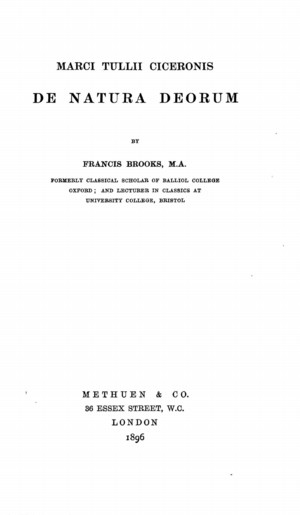
BOOK I. - Marcus Tullius Cicero, On the Nature of the Gods [45 BC]Edition used:De Natura Deorum (On the Nature of the Gods), trans. Francis Brooks (London: Methuen, 1896).
About Liberty Fund:Liberty Fund, Inc. is a private, educational foundation established to encourage the study of the ideal of a society of free and responsible individuals. Copyright information:The text is in the public domain. Fair use statement:This material is put online to further the educational goals of Liberty Fund, Inc. Unless otherwise stated in the Copyright Information section above, this material may be used freely for educational and academic purposes. It may not be used in any way for profit.
BOOK I.I.While there are many questions in philosophy which have not as yet been by any means satisfactorily cleared up, there is in particular, as you, Brutus, are well aware, much difficulty and much obscurity attaching to the inquiry with reference to the nature of the gods, an inquiry which is ennobling in the recognition which it affords of the nature of the soul, and also necessary for the regulation of religious practices. The opinions of the greatest thinkers with regard to it conflict and vary to an extent which should be taken as strong evidence that the cause of their doing so is ignorance, and that the Academics were wise in refusing to make positive assertions upon uncertain data. Is there anything, indeed, so discreditable as rashness, and is there anything rasher and more unworthy of the dignity and strength of character of a wise man than the holding of a false opinion, or the unhesitating defence of what has not been grasped and realised with proper thoroughness? In this inquiry, to give an instance of the diversity of opinion, the greater number of authorities have affirmed the existence of the gods; it is the most likely conclusion, and one to which we are all led by the guidance of nature; but Protagoras said that he was doubtful, and Diagoras the Melian and Theodorus of Cyrene thought that there were no such beings at all. Those, further, who have asserted their existence present so much diversity and disagreement that it would be tedious to enumerate their ideas separately. For a great deal is said about the forms of the gods, and about their locality, dwelling-places, and mode of life, and these points are disputed with the utmost difference of opinion among philosophers; while upon the question in which our subject of discussion is mainly comprised, the question whether the gods do nothing, project nothing, and are free from all charge and administration of affairs, or whether, on the other hand, all things were from the beginning formed and established by them, and are throughout infinity ruled and directed by them,—on this question, especially, there are great differences of opinion, and it is inevitable, unless these are decided, that mankind should be involved in the greatest uncertainty, and in ignorance of things which are of supreme importance. II.For there are and have been philosophers who thought that the gods had absolutely no direction of human affairs, and if their opinion is true, what piety can there be, and what holiness, and what obligation of religion? It is right that these should be accorded, in purity and innocence of heart, to the divinity of the gods, but only if the offering is observed by them, and if something has been accorded by the immortal gods to humanity. But if they have neither the power nor the wish to aid us, if they have no care at all for us and take no notice of what we do, if there is nothing that can find its way from them to human life, what reason is there for our rendering to them any worship, or honour, or prayers? On the other hand, in an empty and artificial pretence of faith piety cannot find a place any more than the other virtues; with piety it is necessary that holiness and religious obligation should also disappear, and when these are gone a great confusion and disturbance of life ensues; indeed, when piety towards the gods is removed, I am not so sure that good faith, and human fraternity, and justice, the chief of all the virtues, are not also removed. But there is another school of philosophers, and a great and high-minded one it is, who hold that the entire universe is ordered and ruled by the mind and the intelligence of the gods, and, more than this, that the gods also take counsel and forethought for the life of men; for they think that the crops and other produce of the earth, the variations in the weather, the succession of the seasons, and the changing phenomena of the sky, by means of which everything that the earth bears is ripened and comes to maturity, are gifts bestowed by the immortal gods upon mankind, and they adduce many instances which will be mentioned in the course of these books, and which are of such a kind as to almost make it seem that the immortal gods manufactured these precise things for the benefit of man! Against this school Carneades advanced many arguments, with the result of rousing men of intelligence to a desire for investigating the truth; for there is no question on which there is such marked disagreement, not only amongst the unlearned, but the learned as well, and the fact of their opinions being so various and so mutually opposed makes it of course possible, upon the one hand, that not one of them is true, and certainly impossible, upon the other, that more than one should be true. III.Now, with regard to my own works, which within a short space of time I have put forth in considerable number, I notice that a good deal of comment of different kinds has been spreading, proceeding partly from those who wondered whence I had acquired this sudden enthusiasm for philosophy, and partly from those who wished to know what definite convictions I held upon particular points. I have also been conscious that many regarded it as strange that that philosophy, rather than others, should commend itself to me, which, as they would say, robs us of the light and casts a kind of darkness over things, and that the defence of an abandoned and long-neglected system should have been unexpectedly undertaken by me. Well, upon these counts I can pacify friendly objectors and confute malignant fault-finders in a way which will make the latter repent of having taken me to task, and the former glad that they have learnt the truth, for those who admonish in a friendly spirit deserve to be instructed, while those who assail in an unfriendly spirit deserve to meet with a repulse. Now I have not turned suddenly to philosophy, and from an early period of life I have expended no little attention and care upon that study, and when I seemed least devoted to it I was in reality most so. This is shown by the frequency with which the opinions of philosophers occur in my speeches, and by my friendship with the learned, an honour which my house has always enjoyed, and by the fact of such leading men as Diodotus, Philo, Antiochus and Posidonius having been my teachers. If, moreover, all the precepts of philosophy have a bearing upon life, I consider that both in my public and private capacity I have carried out what reason and principle prescribed. IV.But if any one asks what considerations induced me to make, at so late a date, these contributions to letters, there is nothing I can more easily explain. It was at the time when I was feeling the languor of inaction, and the condition of the state necessitated its being directed by the will and guidance of one man, that I reflected that philosophy ought, in the first place for the state’s own sake, to be brought before our fellow-countrymen. For I thought that it nearly concerned our honour and glory as a nation that so important and exalted a study should have a place in the Latin literature as well, and I regret my undertaking the less as it is easy for me to perceive how many persons’ enthusiasm I have aroused, not only for learning, but also for exposition. The fact is that several who had been trained in the Greek school were kept from sharing their learning with their countrymen by a doubt whether the knowledge that they had received from the Greeks could be expressed in Latin, but in this department I seem to have been so far successful myself as not to be outdone by the Greeks even in abundance of vocabulary. A second inducement for betaking myself to these studies was my unhappiness of mind in consequence of a great and serious blow dealt me by fortune. If I could have found any greater relief for this unhappiness I would not have taken refuge in this form of it particularly, but there were no means by which I could better enjoy relief itself than by devoting myself not merely to the reading of books, but also to an examination of the whole of philosophy. And all its parts and members are most easily recognised when questions are followed out in all their bearings in writing, for there is in philosophy a notable kind of continuity and connection of subject, so that one part seems to depend upon another, and all to be fitted and joined together. V.As for those who ask to know my own opinion upon each point, they display more curiosity than is necessary, for in discussion it is not so much authorities as determining reasons that should be looked for. In fact the authority of those who stand forward as teachers is generally an obstacle in the way of those who wish to learn, for the latter cease to apply their own judgment, and take for granted the conclusions which they find arrived at by the teacher whom they approve. Nor am I in the habit of commending the custom of which we hear in connection with the Pythagoreans, of whom it is said that when they affirmed anything in argument, and were asked why it was so, their usual reply was “the master said it,” “the master” being Pythagoras, and the force of preconceived opinion being so great as to make authority prevail even without the support of reason. To those, again, who wonder at my having followed this school in preference to others, I think that a sufficient answer has been made in the four books of the Academica. Certainly it is no abandoned and neglected system that I have undertaken to defend, for opinions do not also perish because individuals die, though it may happen that they are denied the illumination which is given by an expositor. For instance the philosophical method in question, the method of meeting every position with criticism, and upon no point delivering a straightforward judgment, which started with Socrates, and was taken up again by Arcesilas, and placed upon a firm foundation by Carneades, continued to flourish down to our own times, and yet I see that at the present moment in Greece itself it is left almost in the condition of an orphan.1 This I think has come about not through the fault of the Academy, but as a consequence of men’s dulness, for if it is a formidable matter to make oneself master of single systems, how much more so is it to make oneself master of all, as must be done by those who look forward to speaking, with a view to the discovery of truth, both for all philosophers, and also against all philosophers. To the mastery of anything so high and difficult as that I do not profess to have attained, though I do make bold to say that I have endeavoured to attain. Still it is impossible that the school which proceeds on this method should have no principle to follow. This is a point which, it is true, has been more thoroughly discussed in another work, but there are some people so dull and unreceptive as to seem to need to be reminded of it frequently. Our school, then, is not one to which nothing seems to be true, but one which says that to all true sensations there are certain false ones attached, which are so like them that the true ones can show no unmistakable mark by which to be judged and accepted as true. From this comes our conclusion that there are many sensations probably true, by which, though they do not represent full perception, the life of a wise man may be directed because they have something marked and distinct in their appearance. VI.But now, in order to free myself from all odium, I will bring forward the opinions of philosophers with regard to the nature of the gods, and on this matter methinks the whole world should be summoned to determine which of the opinions is the true one, and I shall only regard the Academy as presumptuous in case either all philosophers prove to be agreed, or some one is discovered who has ascertained the truth. I feel inclined, then, to exclaim in the words of the Synephebi, “By heaven, I invoke and demand, beseech and entreat, weep for and implore the protection of all our fellow-countrymen, of all young men,” not in regard to some mere trifle, as the character in that play complains that “Capital crimes are being committed in the state, a light of love refuses to take money from her lover,” but in order that they may be present, and make inquiry, and take cognizance as to what our convictions ought to be with regard to religious obligation, and piety, and holiness, and ceremonial rites, and honour, and an oath, and with regard to temples, and shrines, and the stated sacrifices, and those very auspices over which our college presides,—for all these questions ought to be considered as connected with our present inquiry concerning the immortal gods. Surely even those who think that they possess some certain knowledge will be forced to begin to doubt by the marked difference of opinion, amongst those of most instruction, on a matter of such great importance. I have often noticed this difference on other occasions, but I did so most of all at the time of a remarkably thorough and careful discussion on the subject at the house of my friend Caius Cotta. I had gone there at the time of the Latin holidays, at his own request and summons, and found him sitting in a recess off the hall, engaged in discussion with Caius Velleius, a member of the senate, to whom the Epicureans assigned at that time the first place amongst our countrymen. There was also present Quintus Lucilius Balbus, who was so great a proficient in the philosophy of the Stoics as to be compared with the leading Greeks in that field. When Cotta saw me, You come, he said, very opportunely, for a dispute is arising between me and Velleius on a subject of importance, and considering your interest in such matters it is not inappropriate that you should be present at it. VII.I too, I said, think that I have come, as you say, opportunely, for here you are met together as the three chief members of three schools, and if Marcus Piso1 were present, not one of, at any rate, the most highly esteemed philosophies would be without a representative. If, replied Cotta, our excellent Antiochus speaks truth in the work which he has lately dedicated to Balbus here, there is no reason why you should regret the absence of your friend Piso, for according to Antiochus the Stoics agree with the Peripatetics in substance, and only differ from them in words. I should like to know what you think of this work, Balbus. What I think? said Balbus. I am surprised that a man of such remarkable acuteness as Antiochus should not have seen that there is a very great difference between the Stoics who separate things honourable from things advantageous not merely in title, but in their entire nature, and the Peripatetics who class them together, making them dissimilar in importance, and, as it were, gradation, but not in nature; for this is no slight difference in words, but a very considerable one in essence. However, that point let us discuss at some other time; for the present let us turn, if you have no objection, to what we had begun upon. I certainly have no objection, said Cotta; but in order that our friend here—looking at me—who came in upon us, may not be in the dark as to what is being discussed, let me explain that the subject was the nature of the gods, and that I, feeling it, as I always do, to be one of great obscurity, was inquiring from Velleius the opinion of Epicurus. So, if you do not mind, Velleius, let us have your first remarks again. I will certainly, he said, though our friend has not come as my auxiliary, but as yours, for you have both of you, he said with a smile, learnt from the same Philo to be sure of nothing. To which I replied: As for what we have learnt, that is Cotta’s business, but I do not wish you to think that I have come as his adherent, but as a hearer, an unbiassed one, moreover, free to judge, and under no obligation to defend, whether I wish it or not, some fixed opinion. VIII.Velleius then began, displaying, as is usual with his school, no lack of confidence, and afraid, beyond all things, of seeming to be in doubt upon any point, just as though he had that moment come down from the assembly of the gods and the inter-mundane spaces1 of Epicurus. Listen, he said, to no groundless and fanciful beliefs; no fabricator and builder of the world, like the god from Plato’s Timæus; no prophetic beldame like the πρόνοια of the Stoics (whom in our own language we may call providence); no world itself, either, endowed with mind and sensation, a round and glowing and whirling deity,—the prodigies and marvels of philosophers who do not reason but dream. Why, by what manner of means could Plato, your pet authority, have beheld the construction of this great work, the construction with which he represents the world as being put together and built by God? How was so vast a fabric set about? What were the tools, and levers, and machines, and agents employed in it? On the other hand how could air, fire, water, and earth have been obedient and submissive to the architect’s will? And whence did those five forms arise1 from which the other elements are formed, and which are so conveniently adapted for affecting the mind, and producing sensation?2 It would be tedious to remark upon all his theories, which have more the appearance of day dreams than of ascertained results, but the prize instance is the following: he represented the world not merely as having come into existence, but as having been almost turned out by hand, and yet asserted that it would be everlasting. Now do you think that a man like this, who thinks that anything that has come into being can be eternal, has put, as the saying is, even the surface of his lips to physiologia, in other words, to natural philosophy? For is there any agglomeration that cannot be dissolved, or anything that, having a beginning, has not also an end? As for your πρόνοια, Lucilius, if it is the same as the power we have been discussing, I ask, as I did just now, for the agents, machines, and all the planning and ordering of the entire work. If, on the other hand, it is something different, I ask why it made the world liable to perish,1 instead of making it everlasting, as was done by the god of Plato. IX.And from both of you2 I inquire why these powers suddenly appeared as constructors of the world, and why for innumerable ages they were asleep, for it does not follow, if there was no world, that there were no ages. By ages I do not now mean those that are made up of a number of days and nights by means of the yearly revolutions, for I acknowledge that ages in that sense could not have been attained without a rotatory movement of the heavens, but from infinitely far back there has existed an eternity, the nature of which in point of extent can be conceived, though it was not measured by periods of time.3 I ask, then, Balbus, why during that limitless extent of time your πρόνοια refrained from action. Was it labour that it shunned? But God was not affected by that, nor was there any, since all the elements, the air of heaven, the bodies composed of fire, the lands, and seas, were obedient to the divine will. What reason, again, was there why God should be desirous of decking the world, like an ædile, with figures and lights?4 If he did so in order that he himself might be better lodged, it is clear that for an infinite amount of time previously he had been living in all the darkness of a hovel. And do we regard him as afterwards deriving pleasure from the diversity with which we see heaven and earth adorned? What delight can that be to God? And if it were a delight, he would not have been able to go without it for so long. Or was this universe, as your school is accustomed to assert, established by God for the sake of men? Does that mean for the sake of wise men? In that case it was on behalf of but a small number that so vast a work was constructed. Or was it for the sake of the foolish? In the first place there was no reason why God should do a kindness to the bad, and in the second place what did he effect, seeing that the lot of all the foolish is undoubtedly a most miserable one? The chief reason for this is the fact that they are foolish, for what can we name as being more miserable than folly? and the second is the fact that there are so many ills in life that, while the wise alleviate them by a balance of good, the foolish can neither avoid their approach nor endure their presence. X.As for those1 who declared that the world itself was animate and wise, they were far from understanding to what kind of figure2 it is possible for the quality of rational intelligence to belong, a point on which I will myself speak a little later. For the present I will not go farther than to express my astonishment at the dulness of those who represent an animate being, that is immortal and also blessed, as round, because Plato says that there is no shape more beautiful than that. Yet I find more beauty in the shape either of a cylinder, a square, a cone, or a pyramid. And what kind of life is assigned to this round divinity? Why, a kind which consists in his being whirled along at a rate of speed, the like of which cannot even be conceived, and in which I do not see where a foothold can be found for a steadfast mind and blessed life. Why, again, should not that be considered painful in the case of God, which would be painful if it were evidenced1 to the slightest extent in our own bodies? For the earth, since it is a part of the world, is also of course a part of God. But we see vast tracts of the earth uninhabitable and uncultivated, some through being parched by the beating of the sun’s rays, and others through being bound with snow and frost owing to the distance to which the sun withdraws from them; and these, if the world is God, must, since they are parts of the world, be respectively described as glowing and frozen members of God! These, Lucilius, are the beliefs of your school, but to show what their character is I will retrace them from their farthest source in the past. Thales, then, of Miletus, who was the first to inquire into such subjects, said that water was the first principle of things, and that God was the mind that created everything from water. Now if there can be divinity without sensation, why did he mention mind in addition to water? On the other hand, if mind can exist by itself apart from matter, why did he mention water in addition to mind? Anaximander’s opinion is that the gods have come into being, emerging and disappearing at far distant intervals in the form of innumerable worlds; but how can we conceive of God except as immortal? Anaximenes, who lived later, declared that air was God, that it had come into existence, and that it was unmeasured, infinite, and always in motion; as though air could be God when it is without form, especially when we consider that it is fitting that God should possess not merely some kind of form, but the most beautiful, or as though mortality did not overtake everything that has known a beginning. XI.Next Anaxagoras, who derived his system from Anaximenes, was the first to hold that the order and measure of all things was planned and accomplished by the power and intelligence of an infinite mind, in saying which he failed to see that there can be no activity joined with, and allied to, sensation1 in what is infinite, and no sensation at all in anything that does not feel through its own nature being acted upon. In the next place, if he intended this mind of his to be some kind of living thing, there will be some inner part on the strength of which it may be called living; but there is no part more inward than mind; let mind, therefore, be surrounded with an outer body. Since he objects to this, what we get is pure, unbodied mind, with nothing added by means of which it may be able to receive sensation, a state of things which seems to surpass the powers of conception possessed by man’s understanding. Alcmæo of Croton, who assigned divinity to the sun, and moon, and other heavenly bodies, and also to the soul, was unaware that he was endowing the perishable1 with immortality. As for Pythagoras, who held that the whole nature of things was traversed and permeated by a soul, from which our own souls are taken, he failed to see that by this division into human souls the divine soul was rent and lacerated, and that when the human souls experienced pain, as most of them would,2 a portion of the divine soul also suffered, which is impossible. Why, moreover, should the human soul, if it were God, be ignorant of anything? and how, again, would this God, if he were nothing but soul, be either implanted in the universe, or infused into it? Then Xenophanes, who held that the infinite sum of things, combined with mind, constituted divinity, is subject, on the score of mind itself, to the same censure as the others, and to severer censure on the score of infinity, in which there can be no sensation and no connection with anything external.3 As to Parmenides, he evolves an imaginary something resembling a crown (his word for it is στεϕάνη), a bright ring of unbroken fire which girds the sky, and which he calls God, but in which no one can look for a divine form or for sensation. He is the parent, too, of many other extravagances, for he ranks under the head of divinity war, and strife, and desire, and the other principles of the same kind, which are liable to be brought to an end alike by illness, sleep, forgetfulness, or old age; he makes also the same claim in the case of the stars, but as that has been censured in another it need not now be dwelt upon in him. XII.Empedocles, in addition to many other blunders, goes most discreditably astray in his conception of the gods, for he would have the four natural elements, from which he believes that all things are compounded, to be divine, though it is clear that these come into being, and suffer extinction, and lack all sensation. Nor does Protagoras, who denies absolutely the possession of any definite conviction as to their existence, non-existence, or character, seem to have the faintest conception of the divine nature. As for Democritus, when at one moment he reckons among the number of the gods the images of things1 and their revolutions, at another the natural power that disperses these images and sends them forth, and at another our own apprehension and intelligence, is he not involved in the greatest error? And when he further declares positively that nothing is eternal, because nothing remains perpetually in the self-same state, does he not do away with divinity with a completeness which leaves no idea of it remaining? Then again, how can air, which Diogenes of Apollonia represents as being God, possess sensation or divine form? In the inconsistency of Plato we come to a subject which it would be tedious to discuss. He says in the Timæus that the father of this world cannot be named, and also lays down in the books of the Laws that no inquiry at all ought to be made into the nature of God, and yet both in the Timæus and the Laws he attributes divinity to the world, the sky, the stars, the earth, the souls of men, and the deities that we have received from the religious system of our forefathers, views which are clearly false in themselves and in direct opposition to each other. As to his belief that God exists without a body of any kind, that he is, as the Greeks say, ἀσώματος, it is impossible to conceive what such a condition could be like, for he must then be without sensation, forethought, and pleasure, all of which qualities we embrace in our idea of God. Xenophon, too, makes in fewer words very much the same mistakes. In the record that he has given of the sayings of Socrates he represents Socrates as arguing that the form of God ought not to be made a subject of inquiry, and at the same time asserting the divinity both of the sun and of the soul, and as speaking of God at one moment in the singular, and at another in the plural, which statements are involved in pretty much the same error as those which we quoted from Plato. XIII.Antisthenes, again, destroys the significance and essential nature of the gods when he declares in the work entitled “On Natural Philosophy,” that there are many gods believed in by the people, but only one that is known to nature. Nor is Speusippus far different; following in the steps of Plato, who was his uncle, he attempts to wrest from our minds our knowledge of the gods by describing the deity as a kind of living energy, by which all things are directed. Aristotle gives a most confused account, on the same lines as his master,1 in the third book of his treatise “On Philosophy,” where at one moment he ascribes absolute divinity to mind, at another represents the world itself as divine, at another places the world under the dominion of some other power, to which he assigns the function of guiding and preserving, by means of a kind of retrograde movement, the world’s motion, and at another speaks of the ethereal heaven as God, not understanding that the heaven is a part of that world to which he has himself given the title of God elsewhere. How, moreover, could the divine consciousness of the heaven be maintained when moving at such speed? and where will a place be found for the great number of other gods,1 if we also count the heaven as God? When he further declares that God is incorporeal, he deprives him of all consciousness, and also of forethought; besides, if God has no body, how can he be moved? on the other hand, if he is constantly in motion, how can he know peace and happiness? Nor is any more discernment in these matters shown by Aristotle’s fellow-pupil Xenocrates, in whose books on the nature of the gods there is no description of a divine form. His account is that there are eight gods, five whom we name in naming the wandering stars, and one formed from all the fixed stars that are in the sky, as though from a number of scattered limbs, whom we are to regard as a single god; for a seventh he adds the sun, and for an eighth the moon,—but how these deities can be conscious of happiness it is impossible to conceive. Heraclides of Pontus, who also belongs to Plato’s school, filled his books with childish stories, and believes at one moment in the divinity of the world, and at another in the divinity of mind; and he also assigns divinity to the wandering stars, thus depriving God of feeling and representing his form as variable, and yet again in the same book he enrols earth and sky among the gods. The inconsistency of Theophrastus is equally insufferable; in one place he ascribes sovereign divinity to mind, in another to the sky, and in another to the stars and constellations of the heavens. Nor does his pupil Strato, who is called the natural philosopher, deserve to be listened to; he holds that all divine force is resident in nature, which contains, he says, the principles of birth, increase, and decay, but which lacks, as we could remind him, all sensation and form. XIV.Zeno is of opinion, to come now to your school, Balbus, that the law of nature is divine, and that it fulfils its function by enjoining what is right, and forbidding what is wrong; we cannot understand, however, how he makes this law animate, which nevertheless is what we undoubtedly require God to be. He also speaks elsewhere of æther as God, if that is a conceivable God which is without feeling, and which never presents itself to us at the time of prayers, or petitions, or vows; in other works he supposes a certain reason that pervades the whole nature of things, to be endowed with divine power, and this attribute of divinity he further assigns to the stars, and also to the years, the months, and the different seasons of the year. But it is when he interprets Hesiod’s θεογονία, or “birth of the gods,” that he simply puts an end to the ordinary, well-apprehended ideas on the subject of the gods, for he does not include in their number either Jupiter, or Juno, or Vesta, or any one similarly addressed, but declares that these names were assigned with some sort of allegorical meaning to mute and inanimate objects. No less erroneous are the opinions of Zeno’s pupil Aristo, who holds that no form of God is conceivable, and denies him sensation, and is in a state of complete uncertainty as to whether he is, or is not, animate. Cleanthes, who studied under Zeno at the same time as the last-named writer, asserts at one moment that the world itself is God, at another bestows that title upon the mind and intelligence of nature as a whole, and at another finds an undoubted God in the farthest and highest fiery element, called by him æther, which extends in a circle on every hand, surrounding and enclosing the universe on the outside. In the volumes, moreover, which contain his inditement of pleasure, he seems to take leave of his senses, for in one place he delineates a kind of divine form and aspect, in another he ascribes divinity in its fullest sense to the stars, and in another declares that there is nothing so divine as reason, the result of which is that nowhere at all is that god disclosed whom our minds make known to us, and whom we wish to make correspond with the ideal in our soul, as though with an imprinted outline of himself. XV.Persæus, who also was a pupil of Zeno, says that it was men who had discovered some great aid to civilisation that were regarded as gods, and that the names of divinities were also bestowed upon actual material objects of use and profit, so that he is not even content to describe these as the creations of God, but makes out that they are themselves divine. Yet what can compare with the absurdity either of endowing mean and unshapely objects with the honours of divinity, or of ranking among the gods men already cut off by death, whose worship would have had to consist entirely in mourning? We come next to Chrysippus, who is considered the most skilful exponent of the fantastic notions of the Stoics, and who gathers together a large band of deities so utterly removed from knowledge that, although our mind seems able to picture in imagination anything whatever, we cannot even form an idea of them by conjecture. For he tells us that divine power resides in reason and in the soul and mind of nature taken as a whole, and then again he declares that the world itself is God and the universal outpouring of its soul, then that it is this same world’s guiding principle, operating in mind and reason, together with the common nature of things and the totality which embraces all existence, then the foreordained might and necessity of the future, then fire and the principle of æther that we have mentioned before, then those elements whose natural state is one of flux and transition, such as water, earth, and air, then the sun, the moon, the stars, the universal existence in which all things are contained, and also those human beings who have attained immortality. He further maintains that æther is that which men call Jove, and that the air which permeates the seas is Neptune, and that the earth is what is known by the name of Ceres, and he treats in similar style the titles of the other gods. He also identifies Jove with the power of uninterrupted, eternal law, the guide of life, as it may be called, and mistress of duty, which he also describes as fore-ordained necessity and the eternal truth of the future, though none of these qualities are such as to give an appearance of divine power being resident in them. All this is in his first book on the nature of the gods; in the second his aim is to harmonise the stories of Orpheus, Musæus, Hesiod, and Homer with what he has himself said on the subject of the immortal gods in the first book, so that even the oldest poets, who had not so much as a conception of such things, are made to seem to have been Stoics. Diogenes of Babylon follows in his steps in the work entitled De Minerva, where he removes from mythology the travail of Jupiter, and birth of the maiden goddess, and transfers them to natural philosophy. XVI.I have been setting forth what are more like the ravings of madmen than the judgments of philosophers. In fact, there is not much more absurdity in the utterances, the very attractiveness of which has been the cause of harm, that have been poured forth by the poets, when they have introduced the gods inflamed with anger and furious with desire, and have made us behold their wars, battles, contests, and wounds, their enmities, moreover, and feuds, and discords, their births and deaths, their complaints and lamentations, their passions expending themselves in unmeasured licence, their adulteries, their imprisonments, their unions with mankind, and the generation of a mortal progeny from an immortal being. And with the mistaken notions of the poets may be classed the extravagances of the magi, the delusions entertained on the same subject by the Egyptians, and also the beliefs of the common people, which from ignorance of the truth are involved in the greatest inconsistency. Any one who should reflect how unthinkingly and recklessly these ideas are advanced, ought to reverence Epicurus and place him among the number of those very beings that form the subject of this inquiry, for it was he alone who perceived, in the first place, the fact of the existence of the gods from the idea of them which nature herself had implanted in all men’s minds. For what nation or race of men is there that does not possess, independently of instruction, a certain preconception of them? It is this which Epicurus calls by the name of πρόληψις, that is, a certain idea of a thing formed by the mind beforehand, without which nothing can be understood, or investigated, or discussed; and we have learnt the purport and advantage of this exercise of the reason from that divine volume of his upon criterion and judgment. XVII.You see, then, that what constitutes the foundation of this inquiry is excellently well laid, for since the belief in question was determined by no ordinance, or custom, or law, and since a steadfast unanimity continues to prevail amongst all men without exception, it must be understood that the gods exist. For we have ideas of them implanted, or rather innate, within us, and as that upon which the nature of all men is agreed must needs be true, their existence must be acknowledged. Since their existence is pretty universally admitted not only among philosophers but also among those who are not philosophers, let us own that the following fact is also generally allowed, namely, that we possess a “preconception,” to use my former word, or “previous notion” of the gods (new designations that have to be employed when the objects of designation are new, just as Epicurus himself applied the term πρόληψις to what no one had described by that name before)—we possess, I say, a preconception which makes us think of them as blessed and immortal. For nature that gave us the idea of gods as such, has also engraved in our minds the conviction that they are blessed and eternal. If that is so, there was truth in the doctrine put forward by Epicurus, that what is blessed and eternal knows no trouble itself, and causes none to others, and is therefore unaffected by anger or favour, since, as he said, anything that is so affected is marked by weakness. Enough would have now been said, if our aim were only to worship the gods with piety, and to be freed from superstition, for a divine nature of this exalted kind, being eternal and supremely blessed, would receive the pious worship of mankind (everything that is of surpassing excellence inspiring a just reverence), and also all fear arising from the violence and anger of the gods would have been dispelled, now that it is understood that anger and favour have no place in a blessed and immortal nature, and that, when those feelings have been removed, no terrors threaten us from the powers above. However, in order to confirm this belief,1 the mind looks for form in God, and for active life, and the working of intelligence. XVIII.Now, with regard to form, we are partly prompted by natural instinct, and partly instructed by reason. So far as natural instinct is concerned, no one of us in any nation attributes to the gods any but a human aspect, for under what other shape do they ever present themselves to any one whether waking or asleep? We will not, however, refer everything to primary ideas, when the same declaration is made by reason itself. For since it seems appropriate that the nature which, whether as being blessed or eternal, is the most exalted, should also be the most beautiful, could any arrangement of limbs, or cast of feature, any outline or appearance be more beautiful than man’s? Your school, at any rate, Lucilius,—as for my friend Cotta, his opinions vary1 —is accustomed, when exhibiting the ingenuity of the divine handiwork, to point out how admirably everything in the human figure is contrived for purposes of beauty as well as use. Now if the human figure surpasses the form of any other animate being, and if God is animate, this figure which is the most beautiful of all, is assuredly possessed by him. Since, moreover, it is understood that the gods are supremely blessed, and since no being can be blessed without virtue, and virtue cannot exist without reason, or reason be found anywhere except in a human form, it must be admitted that the gods have the outward aspect of man, though this is not body, but quasibody,2 and does not contain blood, but quasi-blood. XIX.Though these speculations of Epicurus were too acute, and their exposition too subtle, for every one to be able to appreciate them, still my confidence in your intelligence leads me to state them with less fulness than the subject requires. Well, Epicurus tells us—for he was one who could not only bring obscure and highly recondite questions before his mind’s eye, but positively deals with them as though they were lying in his hands—that the essence and nature of the gods is such that, in the first place, it is perceived by mind and not by sense, and that it does not possess what we may call solidity, or maintain an unvarying self-identity, like the bodies which on account of their compactness he calls στερέμνια.1 His account is that through the images being perceived owing to their similarity and their passage before us, when an infinite series of very similar images is formed from innumerable atoms and streams towards us, our mind, intently fixed and concentrated upon these, arrives with the utmost joy at the conception of a blessed and immortal nature. And this mighty power of infinity, which so well deserves to be much and heedfully contemplated, must needs be conceived of as so constituted that each part in it is balanced by its equivalent, according to what Epicurus calls ἰσονομία, or equal distribution, the result of which distribution is that for a given number of mortal beings there is a no less number of immortal, and that if the agencies which destroy are innumerable, those which preserve must be also without limit.2 And then, Balbus, it is usual with your school to inquire from us what the life of the gods is like, and how they spend their days. In a way, you may be certain, which for blessedness and abundant possession of every good cannot be excelled even in imagination. For God does nothing, is involved in no occupations, and projects no works; he rejoices in his own wisdom and virtue, and is assured that his state will always be one of the highest felicity eternally prolonged. XX.We should be right in describing this God as blessed, but yours as a slave to toil. For if it is the world itself that is God, what can be less restful—and nothing that is not restful is blessed—than to revolve round the celestial axis without a moment’s pause and at a marvellous rate of speed? If, on the other hand, a god of some kind is resident in the world itself, who is to rule and direct it, to maintain the courses of the stars, and the changes of the seasons, and the ordered alternation of events, to have his eye upon lands and seas, and to guard the well-being and the lives of men, assuredly it is an oppressive and laborious task in which he is involved. We, on the contrary, make blessedness of life depend upon an untroubled mind, and exemption from all duties, for we were taught by him who taught us everything else, that the world was produced by the working of nature, without there having been any need for a process of manufacture, and that what your school declares to be capable of accomplishment only by means of divine intelligence is a thing so easy that nature will produce, and is producing, and has produced worlds innumerable. It is because you do not see how nature can accomplish this without the help of some kind of mind that, like the tragic poets, in your inability to bring the plot to a smooth conclusion, you have recourse to a god. Yet you would certainly feel no need for his agency if you had before your eyes the expanse of region, unmeasured and on every side unbounded, upon which the mind may fasten and concentrate itself, and where it may wander far and wide without seeing any farthermost limit upon which to be able to rest. Now in this immensity of length and breadth and height there floats an infinite quantity of innumerable atoms which, in spite of the intervening void, nevertheless join together, and through one seizing upon one, and another upon another, form themselves into connected wholes, by which means are produced those forms and outlines of the material world which your school is of opinion cannot be produced without bellows and anvils. You have therefore placed our necks beneath the yoke of a perpetual tyrant, of whom we are to go in fear by day and night, for who would not fear a god who foresaw everything, considered everything, noted everything, and looked upon himself as concerned in everything,—a busy and prying god? From this has come, in the first place, your idea of preordained necessity, which you call εἱμαρμένη, meaning by the term that every event that occurs had its origin in eternal truth and the chain of causation—(though what is to be thought of a philosophy that holds the ignorant old crone’s belief that everything happens by destiny?)—and secondly your art of μαντικὴ, or divinatio, as it is called in Latin, which, if we were willing to listen to you, would imbue us with such superstition that we should have to pay regard to soothsayers, augurs, diviners, prophets, and interpreters of dreams. From these terrors we have been released by Epicurus, and claimed for freedom; we do not fear beings of whom we understand that they neither create trouble for themselves, nor seek it for others, and we worship, in piety and holiness, a sublime and exalted nature. My enthusiasm, I fear, has led me into too great length, but it was difficult, although my proper character was rather that of a listener than a speaker, to leave so important and lofty a subject incomplete. XXI.To this Cotta replied, with his usual suavity, Nay, Velleius, if you had not said something yourself, you certainly would not have been able to hear anything at any rate from me, for the reasons why a thing should be true do not present themselves to my mind so readily as the reasons why it should be false, and this feeling, which I have experienced on many occasions, I experienced just now when listening to you. If you were to ask me what I thought the nature of the gods to be like, it is possible that I should make no reply, but if you were to inquire whether I supposed it to be like what you have just described it to be, I should say that nothing appeared to me less probable. However, before I come to the arguments that you have advanced, I will tell you what my feeling is about yourself. I have, I think, often heard your friend1 place you unhesitatingly above all our own countrymen, and compare with you only a few of the Epicureans of Greece, but as I perceived that he was very much attached to you, I used to think that there was some exaggeration in what he said, due to his friendliness. I myself, however, though I shrink from praising a man to his face, nevertheless deliver it as my opinion that you have discussed an obscure and difficult subject with clearness, and not only with a fulness of statement, but also with more elegance of diction than is usual with your school. When I was at Athens I frequently attended the lectures of Zeno, whom our own Philo used to call the leading Epicurean; in fact I attended them at Philo’s own suggestion, in order, I suppose, that I might be better able to judge how ably their tenets were refuted, when I had heard from the chief of the school the way in which they were put forth. Now Zeno did not speak as most Epicureans do, but in the same way that you did, clearly, weightily, and elegantly. Nevertheless there came to me a little while ago, when I was listening to you, the same feeling that I often had in his case, one, namely, of impatience that so much ability should have fallen, if you will forgive my saying so, into such trifling, not to say foolish, beliefs. At the same time I shall not now bring forward anything better myself, for, as I said a moment before, in almost all matters, but especially in matters of natural philosophy,1 I should more readily say what a thing is not, than what it is. XXII.If you were to ask me what God is, or of what nature, I should plead the authority of Simonides, who, when this same question was put to him by the tyrant Hiero, asked for one day’s deliberation; when the question was repeated on the morrow, he begged for two, and when Hiero, upon his constantly doubling the number of days, inquired wonderingly why he did so, Because, he replied, the longer I reflect, the more obscure does the matter seem to me. Now, in the case of Simonides, whom we hear of as having been not only a delightful poet, but a wise and cultivated man in other ways as well, it is my belief that it was the number of acute and subtle considerations that occurred to him which made him doubt which of them was the truest, and so despair of all truth, whereas your Epicurus, with whom rather than with yourself I prefer to carry on the discussion,—what does he say that would be worthy, I do not say of philosophy, but of ordinary intelligence? The first question in the inquiry which deals with the nature of the gods is whether they do, or do not exist. “Denial,” I shall be told, “is difficult.” I grant that it would be so if the question were put in a public assembly, but in a conversational gathering of this kind it is perfectly easy. Consequently I myself, though I am pontiff, and hold that the public rites and observances ought to be most piously maintained, should nevertheless be extremely glad to be convinced on this original point of the existence of the gods, not merely as an article of faith, but in accordance with the actual truth; for many disturbing thoughts present themselves to me, so that I am sometimes of opinion that they do not exist. But mark how handsomely I will deal with you. I will not touch upon the points which, like the present, are common to your school with the rest of philosophers; for almost every one, and myself among the foremost,1 allows the existence of the gods. I do not therefore dispute it, but I do think that the reason advanced by you is not sufficiently convincing. XXIII.You said that the fact of men of all races and nations being of that opinion was sufficiently good evidence to warrant us in acknowledging the existence of the gods, but the plea is not only trivial in itself, but also untrue. For in the first place how do you know that nations do hold that belief? I think myself that there are many races so barbarously savage as to be without any conception of such beings. And did not Diagoras, who was called ἄθεος, and after him Theodorus, openly do away with the idea of a divine nature? As for Protagoras of Abdera whom you mentioned just now, and who was quite the most eminent sophist of that time, it was in consequence of his stating at the beginning of his work, “With regard to the gods I am unable to say either that they exist or do not exist,”1 that he was banished by a decree of the Athenians from their city and territory, and his books burnt in the public assembly. This, in my opinion, made many people less inclined to confess to unbelief, after a case in which even the expression of doubt had not been able to escape punishment. Then, what are we to say of the sacrilegious, the impious, and the perjured? “If ever,” as Lucilius says, “Lucius Tubulus, or Lupus, or Carbo, true son of Neptune,”2 had believed in the existence of the gods, would they have been guilty of such perjury or impiety? Your reason, then, for establishing the conclusion that your wish is not so certainly made out as it seems, but as it is an argument common to other philosophers as well, I will for the present omit it, preferring to pass on to what is peculiar to your own school. I grant that the gods exist; do you, then, inform me of their origin and place of abode, and of what they are like in body, mind, and life, for these are the points on which I wish for knowledge. What you do is to press into your service on all occasions the arbitrary rule of the atoms, to which you refer the composition and creation of everything that, as the saying is, “turns up”. But in the first place there are no such things as atoms, for there is nothing [that can move except through a void; now a void is that] which is free from matter,1 and as every spot is encumbered with portions of matter,2 there can be no void and nothing that is indivisible. XXIV.These are the oracular utterances of men of science of which I am now delivering myself, whether true or false I know not, but possessing at any rate a greater air of truth than the utterances of your school. That monstrous assertion, for instance, of Democritus, or perhaps before him of Leucippus also, that there are a number of particles some smooth and others rough, some round and others angular and pyramidal, and some hook-shaped and with a kind of curve, from which the sky and earth were formed, not through the compulsion of any natural law, but through a certain accidental concourse,—that belief, Velleius, you have prolonged even to your present age, and you would be as easily diverted from the whole tenor of your life as from your acceptance of its authority. The fact is that you made up your mind that you must be an Epicurean before becoming acquainted with doctrines of that description, and you had, therefore, either to mentally assimilate these outrageous theories, or to forego the title of your adopted philosophy; for what would induce you to cease to be an Epicurean? “For my own part,” you say, “nothing would induce me to abandon truth and the means of a happy life.” Truth, then, is contained in your system? As to happiness of life I raise no contention, for you do not think that that is possessed even by God unless he is positively languid from inactivity. But where is truth resident? In the innumerable worlds, I suppose, of which, in each briefest instant of time, some are coming into being and others perishing. Or is it in the indivisible particles which form such admirable combinations without being directed by any natural law or intelligence? But I embrace too much, forgetting the generosity which I began just now to extend to you. That all things, then, are composed of atoms I will grant, but what has that to do with the question, when it is the nature of the gods into which we are inquiring? Let them by all means be formed from atoms, they are not therefore eternal. For that which is formed from atoms came at some time into being; if so, the gods had no existence anterior to birth, and having known a beginning they must also know an end, as you were urging, a short time back, in the case of Plato’s world. Where then are your attributes of blessedness and eternity, the two words by which you indicate God? When you wish to prove them, you seek the shelter of the thickets, as was shown by your saying that there was no body in God, but quasi-body, and no blood, but quasi-blood. XXV.This is a common practice of yours, when you have made some improbable statement, and wish to escape being taken to task for it, to support it by something which is absolutely impossible, with the result that it would have been better to have yielded the original point in dispute than to have shown such impudence in the defence of it. Epicurus, for instance, seeing that if the atoms were carried by their own weight in a downward direction, there would be nothing left in our own power, owing to their movement being fixed and inevitable, hit upon a means for avoiding necessity which we must suppose had not occurred to Democritus: he says that the atom, though its weight and gravity incline it directly downwards, swerves slightly aside, a statement which is more discreditable than to be unable to defend the position that he wishes. He meets the logicians in the same way. They have laid down that in all disjunctive propositions in which the formula, “either is or is not,” is employed, one of the two statements is true, but he was afraid, if a proposition of the following kind, “either Epicurus will be alive to-morrow, or he will not,” were to be admitted, that one of the alternatives would become necessary, and he therefore denied the necessary nature of the whole of the formula, “either is or is not”. Could anything have been said with less intelligence? Then again, there is the question on which Arcesilas used to assail Zeno, Arcesilas himself maintaining that all impressions produced upon the senses were false, and Zeno that some were false, but not all; Epicurus, fearing that none might be true if one were false, declared that all the senses reported what was true. None of these utterances displayed overwhelming adroitness, for he was laying himself open to a heavier blow in order to ward off a lighter one. His tactics are the same with regard to the divine nature; in the effort to avoid an accretion of indivisible particles, for fear it should be overtaken by dispersion and decay, he asserts that the gods have no body, but quasi-body, and no blood, but quasi-blood. XXVI.It seems marvellous that one soothsayer should not laugh at the sight of another, but it is more marvellous that you Epicureans should be able to keep from laughter among yourselves. “Not body, but quasi-body.” I should understand what this meant if it were applied to figures of wax or clay, but I cannot understand the meaning of quasi-body and quasi-blood as applied to God,—nor can you either, Velleius, only you do not like to own it. You repeat, as though it were a lesson in dictation, the dreamy maunderings of Epicurus, which he accompanied, as we see in his writings, by boasts that he had had no one for his teacher. Even if he did not proclaim the fact, I should nevertheless myself readily believe him, just as I should believe the boast of the owner of a badly built house that he had had no architect, for he does not present the slightest tincture of the Academy, the Lyceum, or even of the ordinary school-boy training. It was in his power to have heard Xenocrates,—and, great heavens, what a man he was!—and some people think that he did hear him, but he himself scouts the suggestion, and there is no one whose word I take more willingly. A certain Pamphilus, a pupil of Plato, he says was heard by him in Samos, for he lived there as a youth with his father and brothers, his father Neocles having gone there as a settler; the father became, however, a school-master, I suppose because his piece of land was not sufficient for his support. But Epicurus professes the utmost contempt for this follower of Plato, so great is his fear of seeming to have ever owed anything to instruction. In the case of Nausiphanes, the disciple of Democritus, he stands convicted, but though he does not deny having heard him, he assails him at the same time with every kind of abuse. Yet if he had not heard these lectures on Democritus, what was it that he had heard? What is there in the natural philosophy of Epicurus that does not come from Democritus? Some things, certainly, he changed, as in the case of the inclination of the atoms which I mentioned just now, but the greater number he keeps the same, atoms, void, images, infinite space, a countless number of worlds which come into being and depart from it, everything almost that constitutes the subject matter of natural science. But come, what do you understand by your “quasi-body” and “quasi-blood”? That you are better acquainted with such matters than myself is a fact which I not only acknowledge, but submit to with equanimity, but when they have once been stated, what reason is there why Velleius should be able to understand them, and Cotta should not? I understand, then, what body is and what blood is, but what quasi-body is, and quasi-blood, I simply do not understand at all. And it is not that you are keeping anything from me, as Pythagoras used to do from the uninitiated, or are speaking with intentional obscurity like Heraclitus, but if the remark may be allowed between us, you do not understand any better yourself. XXVII.I see that your contention is that the gods possess a kind of form which has no compactness, solidity, relief, or prominence, but is without admixture, and volatile, and transparent. Well, we will say of it what we say of the Venus of Cos. That figure is not a body, but resembles a body, that diffused glow intermingled with white is not blood, but a certain semblance of blood, and similarly we will say that in the god of Epicurus there is nothing real, but only the semblances of reality. Suppose me to be convinced of that which cannot even be understood, and acquaint me next with the forms and features of your shadowy deities. On this question there is not wanting an abundance of arguments by means of which you would be glad to prove that the gods are of human form; firstly, because our minds have formed an idea and preconception of them which makes the human form suggest itself to a man when he thinks of God; secondly, because the divine nature, since it excels in all respects, ought also to possess the most beautiful kind of form, and there is no form more beautiful than man’s; and thirdly, you bring forward the following argument,—because no other figure can be the abiding place of mind. Now I will ask you to consider the nature of each of these arguments in turn, for you seem to me to be arrogating to yourselves, as though in the exercise of a right that you possessed, an assumption that cannot by any means be allowed. Was there ever any one at all who looked upon the world with so blind an eye as not to see that these human figures of yours were attributed to the gods either designedly by wise men, in order that they might the more easily wean uninstructed minds from a degraded mode of life to the worship of the gods, or else in consequence of a superstitious desire for images, in paying homage to which men might believe that they were approaching the gods themselves? This same tendency, moreover, has been increased by the poets, painters, and workers in art, for it was not easy, in imitating other forms, to preserve the appearance of action and effort on the part of the gods. Perhaps, too, the feeling to which you referred contributed its share, man’s belief, I mean, in the superior beauty of man. But do you not see, my good natural philosopher, what an insinuating go-between, and, so to speak, pander to herself dame nature is? Or do you suppose that there is any creature in land or sea that is not most pleased by a creature of its own kind? If that were not the case, why should not a bull take pleasure in union with a mare, or a horse with a cow? Do you believe that an eagle, or lion, or dolphin prefers any shape to its own? And if in the same way nature has enjoined upon man that he should think nothing more beautiful than man, is it at all strange that this feeling should be the cause of our thinking the gods to be like men? Do you not believe that, if animals possessed reason, each species would have assigned pre-eminence to itself? XXVIII.Yet really, if I am to express my own sentiments, though not devoid of self-complacency, I do not for all that venture to affirm that I am more beautiful than the bull that carried Europa; for we are considering at this moment outline and form, and not intelligence, or the human faculty of speech. And if it were our pleasure to invent and combine forms for ourselves, should you object to being like the Triton of the deep, who is depicted as riding upon swimming sea-creatures that are attached to a human body? I am touching on difficult ground, for the force of nature is so great that no one who is a man wishes to be like anything but a man,—no, nor an ant, I presume, like anything but an ant! Still, like what kind of man? For it is only a few who are beautiful; when I was at Athens scarcely one would be found in each division of the ephebi.1 I understand why you smile, but nevertheless the fact is so. Besides, those of us who take pleasure, as the ancient philosophers allow us to do, in the society of youths, often find even their imperfections charming. “A mole on a boy’s finger delights Alcæus.” Yet it is a bodily defect. To Alcæus, however, it seemed an ornament. Quintus Catulus, the father of the Quintus Catulus who is our contemporary, and my friend and colleague,2 had a fondness for your fellow-townsman Roscius,3 to whom he also addressed the following verses:— I chanced to have stood doing reverence to the rising dawn, when suddenly Roscius rises on my left. Powers of heaven, with your leave may I say it, the mortal seemed to be fairer than the god. Fairer, that is, to him, though Roscius had, as he has to-day, a most pronounced squint. However, what did that matter, if his admirer found the squint itself attractive and becoming? But I return to the consideration of the gods. XXIX.Do we suppose that any of them, if not so cross-eyed as Roscius, have still got something of a cast, or are marked with moles, or are snub-nosed, flap-eared, beetle-browed, or top-heavy, defects which exist amongst ourselves? Or is everything in them perfect? Let it be granted to you that the latter is the case; have they also all of them the same aspect? If not, it is necessary that the aspect of one should be more beautiful than that of another, and consequently there is some god that falls short of supreme beauty. If they all have the same aspect, the Academy must needs be the popular school in the upper world, for if there is no difference between god and god, there is no scope amongst them for perception and cognition. And what, Velleius, if your assumption that, when we think of God, the only form that suggests itself to us is that of a man, is itself wholly false? Will you still defend these absurd ideas? To us, perhaps, the suggestion is as you say, for from our childhood we have known Jupiter, Juno, Minerva, Neptune, Vulcan, Apollo, and the other gods, under the aspect which painters and sculptors have laid down for us, and so with regard to their insignia, and age, and attire. But the Egyptians, the Syrians, and almost the whole of the uncivilised world have not so known them. You would find amongst them a firmer belief in certain animals than amongst us in the holiest temples and images of the gods, for many a shrine has, as we see, been plundered by our countrymen, and the images of the gods taken away from the holiest places, but no one has even so much as heard tell of a crocodile, or ibis, or cat having been dishonoured by an Egyptian. What, then, is your opinion? Is it not that Apis, the sacred ox of the Egyptians, is regarded by them as divine? Of course he is, as much as your Juno Sospita is by you, that Juno whom you never see even in your dreams without a goat-skin, a spear, a small shield, and shoes turned up at the toe. As, however, neither the Argive Juno, nor the Roman, is of that description, it follows that the goddess is known under different forms by the Argives, the Lanuvinians, and ourselves. The form, moreover, of our Jupiter of the Capitol is different from that of the Jupiter Hammon of the Africans. XXX.Are you not ashamed, then, as a man of science, that is, an explorer and pursuer of nature, to seek a testimony to truth in minds imbued with habit? At that rate it will be open to us to say that Jupiter is always bearded, and Apollo beardless, that Minerva has grey eyes, and Neptune blue. There is, too, at Athens a much admired statue of Vulcan by Alcamenes, a draped, standing figure, in which a lameness which does not amount to deformity is slightly indicated. We shall, therefore, since we have received that account of Vulcan, think of the god as lame. And then do we also represent the gods as having the same names as those by which we call them? Why, in the first place, there are as many names of the gods as there are languages among men, for Vulcan has not the same name in Italy, Africa, and Spain, in the same way that you, wherever you go, remain Velleius. In the second place, even in our pontifical books the number of names is not a large one, and yet you say that the number of gods is infinite. Are they without names? So you are bound to say, for what point is there in their possessing a variety of names, when their aspect is uniform? How much more becoming it would have been, Velleius, for you to have confessed your ignorance of things of which you were ignorant, than to have ejected the nonsense which you did, and aroused your own disgust. Or do you really think that God is like me or you? Of course you do not. Well? Am I to say that the sun, or moon, or sky is God? Is he therefore also blessed? What pleasures does he enjoy to make him so? Is he wise? How can wisdom reside in a block of that kind? These are objections which your own school urges.1 If, then, as I have shown, God does not possess a human aspect, nor, as you are convinced, any aspect of the kind just mentioned, what makes you hesitate to deny the existence of the gods? You do not dare to deny it, and there is wisdom in your not daring, although on an occasion like the present it is not the people of whom you are in fear, no, you are in fear of the gods themselves. I have known Epicureans who worshipped every little image, though I am aware that some people are of opinion that Epicurus, while he retained the gods in word, in order not to fall under the displeasure of the Athenians, in reality did away with them. Thus, amongst his short, selected maxims, which you call κυρίαι δόξαι, the first, I believe, runs as follows: That which is blessed and immortal neither knows trouble, nor does it cause trouble to any. XXXI.There are some who think that in this maxim thus expressed Epicurus produced designedly an impression which was due simply to his awkwardness of style; they misjudge a man who is devoid of artifice.2 It is, certainly, doubtful whether his words imply that some blessed and immortal nature does exist, or that, if it existed, it would be of the kind described, but his critics fail to notice that if he has spoken ambiguously in this passage, there are many others in which both he and Metrodorus have spoken as unmistakably as you did just now. The fact is that he believes in their existence, and I have never seen any one with a greater fear of what, according to him, did not need to be feared, I mean of death and the gods. The minds of all living men, he cries, are overcome with terror at what ordinary people do not find so particularly disquieting. So many thousands commit highway robbery with the penalty of death before them, and others plunder all the shrines that they can, terrified, I suppose, respectively by the fear either of death or of religion! Since, however, you do not dare—and I will address myself now to Epicurus himself—to deny the existence of the gods, what is there that should hinder you from reckoning amongst their number either the sun, or world, or some ever-enduring intelligence? “I have never seen,” he says, “a mind possessed of reason and fore-thought in any but a human form.” Well? Have you ever seen anything like the sun, or moon, or the five wandering stars? The sun bounds his course by the two extreme points of one circle, and accomplishes revolutions of a year’s duration; the moon receives light from his rays, and completes a similar passage over this circle in the space of one month; the five stars observe the same orbit, and some at a less, some at a greater distance from the earth, traverse the same space from the same starting-point in different times. Have you seen anything like it, Epicurus? Then let there be no sun, no moon, or stars, since there can be nothing except what we have touched or seen. Have you seen God himself? Why, then, do you believe him to exist? At that rate let us reject all the fresh facts presented to us by history or science, a principle which leads inland peoples to disbelieve in the existence of the sea. What great poverty of conception this shows! You, for instance, if you had been born in Seriphus, and had never left the island in which you had been in the habit of seeing small hares and foxes, would refuse to believe, when they were described to you, in the existence of lions and panthers, and if any one were to speak of an elephant, you would think that you were being nothing short of trifled with. Can anything, to still pursue the same point, be named that would be more childish than for us to deny the existence of the different kinds of animals that are produced in the Red Sea, or in India? Why, the inquiries of even the keenest investigators do not enable them to hear of all the multitudes of creatures that exist in land and sea, in marshes and rivers; let us, then, deny their existence since we have never seen them. Yes, and you, Velleius, exchanging your ordinary methods for those of the logicians, with whose processes you and your fraternity are absolutely unacquainted, have drawn up your argument in the form of a syllogism. You have assumed that the gods are blessed, which I allow. And that no one can be blessed without virtue. XXXII.I grant that too, and grant it willingly. Next you have assumed that virtue cannot exist without reason, which also must needs be admitted. And reason, you go on to say, is only to be found in a human form. Who do you think will grant you that? If it were a fact, what need would there have been for you to make your way to it step by step? You would have had a right to assume it. And what is the nature of this step by step process? I see that you have advanced by its means from beings that are blessed to virtue, and from virtue to reason, but how do you get from reason to the human form? There you take not the next step downwards, but a flying leap. Besides, I do not understand why Epicurus chose to speak of the gods as being like men, rather than of men as being like the gods. You will ask what the difference is, for if one thing, you will say, is like another, the other is like the first. I recognise that, but what I mean is that the gods did not derive their outline of form from man, for the gods have always been, and never came into being, that is, if they are to be eternal. Men, on the other hand, did come into being, and consequently the human form existed before men existed in that form which belonged to the immortal gods. It is not, therefore, the latter’s form which should be called human, but ours which should be called divine. However, that shall be as you will. I now ask what extraordinary working of fortune there was, for in nature you allow nothing to have happened by design,—I ask, I say, omitting that question, what was this triumph of chance? How did there come to be so opportune a combination of atoms as to result in the sudden creation of men in the form of the gods? Are we to suppose that the seed of the gods fell down upon the earth from above, and that in that way men were born resembling their progenitors? I should like you to say so; kinship with the gods I should acknowledge not unwillingly, but instead of anything of that kind you say that our likeness to the gods was the work of chance. And yet arguments are to be sought by which this may be refuted! I wish I could find the discovery of truth as easy as the exposure of error. XXXIII.How easily error can be exposed I will proceed to show. You enumerated accurately and fully, so that I was fain to wonder at the presence of such knowledge in a Roman, the opinions of philosophers, from Thales of Miletus downwards, with respect to the divine nature. Did you regard them all as madmen for deciding that God could exist without hands and feet? When you take into consideration the special usefulness and serviceableness of the limbs in a man’s body, does not even that incline you to the conclusion that human limbs are not required by the gods? What need is there for feet without walking, and for hands if nothing is to be grasped, and for all the other parts of the bodily system, that system in which there is nothing idle, or undesigned, or superfluous? God, then, will possess a tongue, and will not speak; he will possess, without any use for them, teeth, and palate, and throat; the organs with which nature has supplied the body for generative purposes he will possess in vain; and so it will be not only with the outer parts, but the inner as well, the heart, the lungs, the liver, and the rest. And if the usefulness of the latter is taken away, what do they possess in the way of charm? I ask the question because it is with a view to beauty that you require the presence of these organs in God.1 Was it trusting to such dreams as these that not only Epicurus and Metrodorus and Hermarchus spoke against Pythagoras and Plato and Empedocles, but even the courtezan Leontium1 ventured to write against Theophrastus? She did so, it is true, in a neat and Attic style, but still—. Such was the licence assumed by the Garden of Epicurus, yet it is a common thing for you to complain on your own behalf, and Zeno actually went to law.2 Of Albucius it is unnecessary for me to speak. As for Phædrus, though nothing could have exceeded his refinement and urbanity, the old man used to become angry if I said anything at all trenchant, although Epicurus made a most scurrilous attack upon Aristotle, was shamefully abusive to Phædo, the disciple of Socrates, devoted whole volumes to the dissection of Timocrates, the brother of his own intimate companion Metrodorus, because he differed from him upon some point in philosophy, showed ingratitude even towards Democritus, of whom he was a follower, and bore very hardly upon his instructor Nausiphanes, from whom he never would allow that he had learnt anything. XXXIV.Zeno, indeed, not only used to assail his contemporaries, Apollodorus, Silus, and the rest, with abuse, but used to say of Socrates himself, the father of philosophy, that he had been the Attic scurra—using the Latin word—and of Chrysippus he never used to speak except as Chrysippa.3 You yourself a little while ago, when calling over the names, so to say, of the philosophic senate, kept describing men of the utmost eminence as idiots, fools, and madmen. Yet if none of these men apprehended the truth as to the nature of the gods, it is to be feared that no such nature exists at all. As for your own utterances, they are absolute fictions, scarcely worthy to be discussed by old women over their evening work, for you do not realise how much you would have to become liable for if you obtained our consent to an identity of form between men and the gods. All the ways of attending to and managing the body will have to be observed in the same way by God as by man,—walking, running, reclining, stooping, sitting, holding, and lastly, also, the faculty of speech and discourse. I need not discuss your division of the gods into male and female, for you see what follows from that. For my own part I cannot sufficiently wonder how it was that your founder came to entertain such ideas. But your constant cry is that the blessedness and immortality of God must be retained. Well, what prevents his being blessed, if he were something else than a biped? Or why is not this quality, whether we are to call it beatitas or beatitudo—both of them, it is true, harsh-sounding terms,1 but it is for us to make words smooth by using them—why is it not, under whatever name, attributable to the sun above, or to this world of ours, or to some ever-enduring intelligence that is without form and bodily parts? All that you say is, “I have never seen a sun or world that was blessed”. Well, have you ever seen a world besides this one? You will say no. Why did you venture to say, then, not that there were some hundreds of thousands, but a countless number of worlds? “Reason taught me.” And will not reason, considering that what is being sought is a nature of supreme excellence, which is at the same time blessed and eternal, for only a nature with those attributes is divine, teach you that just as we are surpassed by such a nature in immortality, so we are surpassed in excellence of mind, and as in excellence of mind, so also in excellence of body? Why, then, seeing that we are inferior in other respects, are we equal in the matter of form? It was the virtue of man rather than his figure that came nearest to a likeness to God. XXXV.But how thoroughly beside the point the argument from resemblance, with which you are so mightily charmed, is in itself. Is not a dog like a wolf? And, as Ennius says:— How like to us is the degraded ape! Yet the character in both cases is different. Amongst beasts there is none more sagacious than the elephant, yet what other beast is so unwieldy? I am considering animals, but amongst men themselves is not an unlike character attached to very similar exteriors, and a different exterior to the same character? Why, if we once admit that kind of argument, Velleius, mark where it leads to. You assumed that reason can only exist in the human form. Some one else will assume that it can only exist in a being of this earth, in a being that has been born, that has grown, that has received instruction, that is made up of mind and a frail and feeble body—in short, in a man and a mortal. But if in the case of all these attributes you stand your ground,1 why should the single attribute of form shake you? You have seen reason and intelligence in man accompanied by all these attributes that I have mentioned, yet when they are taken away you say that you still recognise God if the features do but remain. This is not to weigh your utterances, but to choose them blindfold, unless, indeed, you have even failed to observe that in man and tree alike whatever is superfluous, or has no use, is better away. What an affliction it is to have one finger too many! And why? Because the five do not need another either for use or ornament. But it is not one finger that your God has in excess, it is head, throat, neck, flanks, belly, back, knees, hands, feet, thighs, and legs. If it be said that he possesses these in order to ensure his immortality, I ask how far these members, and the face itself, are important to life? The brain, the heart, the lungs, and the liver are more important, for they are the seats of life, whereas the cast of the face has nothing to do with vitality. XXXVI.And yet you were abusing those who, judging from results so magnificent and glorious, when they looked upon the universe itself, and upon its parts, the sky, the lands, and the seas, and upon their ornaments, the sun, the moon, and the stars, and when they marked the maturing of the seasons, and their changes and alternations, conceived the existence of a sublime, exalted power that had created these things, and moved, and controlled, and directed them. Even though they stray from the path of true conjecture, still I can understand what principles they follow; but you—come, what great and notable work, with the appearance of having been produced by divine intelligence, can you point to as a foundation for your belief in the existence of the gods? “I had,” you say, “a kind of preconception of God implanted in my mind.” Yes, and of a bearded Jupiter, and helmeted Minerva, but do you then suppose that they answer to that description? How much better this question is treated by the ignorant multitude, who not only assign human limbs to God, but a use for those limbs as well, for they provide bow, arrows, spear, shield, trident, and thunderbolt, and if their vision does not extend to the actions of the gods, at any rate they cannot conceive of God as inactive. Even the much ridiculed Egyptians never deified an animal except with reference to some benefit which they derived from it. For instance, the ibis, being a tall bird, with legs that do not bend, and a long beak of horn, destroys a vast number of serpents; in killing and eating the winged snakes that are brought in by the south-west wind from the Libyan desert, it preserves Egypt from plague, the snakes being thus prevented from causing harm by their bite when living, or by their smell when dead. I could speak of services rendered by the ichneumenon, the crocodile, and the cat, but I do not wish to be lengthy, and will conclude by saying that it was at least in return for benefits that animals were deified by the barbarians, whereas on the part of your gods there not only exists no beneficent action, but not even action of any kind. God has nothing to do, says Epicurus, thinking, we must suppose, like a spoilt child that there is nothing better than idleness. XXXVII.Yet even children, even when idle, amuse themselves with some active sport, and do we wish that God’s holiday-keeping should be one of such languid inertia as to make us fear that, if he moved, it would be impossible for him to be happy? Statements of that kind not only deprive the gods of motion and divine activity, but lead to inertness in men as well, if, that is, even God cannot be happy when engaged in action of any kind. However, let it by all means be granted that God is, as you wish, the image and counterpart of man. What is his dwelling-place, his abode, his sphere? In the next place, what is his course of life? What are the things which make him blessed, as you require him to be? I ask because, to be blessed, one must use and enjoy one’s possessions. With regard to place, even the elements that are without life have each a special place of their own, the earth occupying the lowest, the water flowing over the earth, the upper region being assigned to air, and the topmost to the fires of æther. Of animals, again, some belong to the earth, others to the water, and others with a kind of double nature live in both worlds. There are also some which are believed to be created from fire, and are often seen darting to and fro in blazing furnaces. I ask, then, first, where your God dwells? secondly, what is the cause which leads him to change his position, if indeed he ever does change it? next, what does he seek after, for it is the characteristic of animate beings to seek after something suited to their nature? lastly, to what end does he exercise mental activity and reason? and in conclusion, what is the nature of his blessedness and his immortality? Whichever of these points you touch upon, you touch a sore place, for reasoning so ill grounded as yours can arrive at no result. You were saying, for example, that the form of God is perceived by mind and not by sense, that it possesses no solidity and no unvarying self-identity, that the apprehension of it consists in its being discerned by means of the resemblance of the images and their passage before us, and in there being a never-failing addition, from amongst the countless sum of atoms, of similar images, with the result that our minds, which are intently fixed upon these images, believe the nature in question to be blessed and immortal. XXXVIII.Now what, in the name of those very gods of whom we are speaking, does this mean? If they can only impress the thinking faculty, and if their form possesses no solidity or relief, we might as well meditate on a Centaur as on God, for every mental conception of that kind is what other philosophers call a creation of the fancy, though you say that it results from images coming in contact with and entering the mind. In the same way, then, that I, when I seem to see Tiberius Gracchus haranguing in the Capitol, and presenting the urn that is to settle the order of voting on the question of Marcus Octavius, say that that is a creation of the fancy, while you say that the images of Gracchus and Octavius remain in existence, and that after betaking themselves1 to the Capitol they are then carried to my mind,—so, according to you, it is with God, whose aspect constantly impinges on the mind, and who is thus recognised as blessed and eternal. But granting that there are images which impinge upon the mind, it is only some description of form that they indicate to us; do they also indicate why that form should be blessed and eternal? And what is the nature and origin of these images of yours? It is true that this fantastic notion was started by Democritus, but many have blamed him for it, you yourselves can reach no result, and the whole argument limps and totters. Is there anything, indeed, which it is so little possible to accept? Think of the images of all mankind coming before me, Homer, Archilochus, Romulus, Numa, Pythagoras, Plato, and not coming either in the form in which they lived!1 How, then, do those characters suggest themselves to me? And whose are the images which do come? Aristotle tells us that there never existed a poet Orpheus, and it is a tradition of the Pythagoreans that the Orphic poem which we know was the work of one Cercops, yet Orpheus, that is, according to you, his image, presents himself to my mind frequently. And what do you say to the fact that different images of the same man present themselves to my mind and to yours, and that images present themselves of things which never existed at all, and could not have existed, such as Scylla and the Chimæra, and of persons, places, and cities that we have never seen, and that images appear the moment that I wish, and come without being summoned even when one is asleep? The whole thing is a delusion, Velleius, and yet not content with thrusting the images upon our eyes, you thrust them upon our minds as well. So little do you care what nonsense you talk. XXXIX.And how extravagant you are! “There is,” you say, “a stream of phenomena constantly passing before us, the multitude of which results in one phenomenon being perceived.” I should be ashamed to say that I did not understand this statement, if you who defend it understood it yourselves. For how do you prove a continuous succession of images? Or, granting that they are continuous, how are they eternal? “There exists,” we are told, “a countless supply of atoms.” Will that, then, make everything immortal? You take refuge in the theory of equilibrium, by which term we will, if you have no objection, render ἰσονομία, and you say that since there is a mortal nature, there must also be an immortal. According to that argument, since men are mortal, some men would be immortal, and since men are born upon the earth, some men would be born upon the water. “And since there are some agencies which destroy, there are others which preserve.” Let there be such by all means, but let them preserve things that are in existence, which I do not perceive your gods to be. In any case, how are all these counterparts of objects formed from indivisible particles? Even if these particles existed, which they do not, though they might perhaps be able to strike against one another, and to be set in motion amongst themselves by the impact, they would not be able to supply form, or outline, or colour, or life. In no way, then, do you prove the immortality of God. XL.Now let us consider his blessedness. That certainly is altogether impossible without virtue; but virtue is active, and your God does nothing; he is, therefore, without virtue, and so without blessedness either. What, then, is his life? “An abundance of goods,” you say, “without any intervening ills.” Well, of what kind of goods? Of pleasures, I presume, and of course of those relating to the body, for you are acquainted with no mental pleasure that does not arise from and refer back to the body. I do not look upon you, Velleius, as resembling the rest of the Epicureans in the shame which they feel at certain utterances of Epicurus, in which he avers that he has not even a conception of any good that is unconnected with voluptuous and sensual pleasures, all of which in fact he enumerates by name without a blush. Tell me, then, with what food and drink, or with what different sounds or flowers, or with what appeals to the sense of touch and smell will you ply the gods so as to steep them in pleasures—in the same way that the poets provide banquets, and either Hebe or Ganymede serving the cups. But what will you do, Epicurus? For I do not see either where your god is to get such things from, or how he is to make use of them. Consequently, man’s nature, since it enjoys a greater variety of pleasures, is better equipped for a life of blessedness than God’s. You reply that you regard these as the more trivial pleasures, by which a kind of “titillation,” for so Epicurus calls it, is applied to the senses. How far will you carry your trifling? Why, our own Philo was just as unable as I am to endure from the mouth of the Epicureans a repudiation of effeminate and voluptuous pleasures. He used with marvellous memory to recite, in the very words in which they had been written, a long string of the maxims of Epicurus, while from Metrodorus, who is Epicurus’ colleague in wisdom, he used to quote several utterances of a more shameless kind. For Metrodorus takes his own brother Timocrates to task for hesitating to make the belly the standard in everything relating to blessedness of life, and expresses himself in that way not once only, but many times. I see that you assent, for the facts are known to you; if you denied them, I should produce the book. Nor in thus speaking am I finding fault with you for referring everything to pleasure, which is a different question; what I do urge is that your gods are without pleasure, and therefore, by your own judgment, without blessedness also. XLI.But they have no pain, you say. Is that enough to constitute this supremely blessed life which overflows with good? God constantly reflects, we are told, having nothing else to occupy his thoughts, upon his blessedness. Picture then in your mind, and summon before your eyes a God whose only reflection through all eternity is “Capital berth this!” and “Blessed am I!” Yet I do not see how the God who enjoys this blessedness is not afraid of perishing, seeing that he is uninterruptedly beaten and shaken by the never-ending storm of atoms, and that images are constantly emanating from himself. It is thus shown that your God is neither blessed nor eternal. But Epicurus, it will be said, has also written books on holiness and on piety towards the gods. He has, but how does he speak in these books? In a way which would make you say that you were listening to Tiberius Coruncanius or Publius Scævola, the chief pontiffs, not to the man who did away altogether with all religion, and who overturned with his reasonings, instead of, like Xerxes, with his hands, the temples and altars of the immortal gods. For what ground have you for saying that men ought to pay regard to the gods, when the gods not only show no regard for men, but do not care for or do anything at all? You reply that they possess a nature of a supremely excellent and exalted kind which ought of itself to attract the worship of a wise man. Now can there be anything supremely excellent in a nature which luxuriates in its own well being, and which never has, never does, and never will perform an action? And what piety is owed to a being from whom you have received nothing? What in fact can be owed at all to one from whom no benefit proceeds? Piety is right dealing towards the gods, but what question of right can there be between us and them, when man has no community with God? Holiness, again, consists in the knowledge of how to worship the gods, but why they should be worshipped when no good is either received or expected from them, I do not understand. XLII.And what reason is there for our reverencing the gods out of admiration for a nature in which we see nothing excellent? As for the freedom from superstition, of which you are in the habit of boasting, that is easily attained when you have deprived the gods of all their power, unless, indeed, you think it possible that Diagoras or Theodorus, who absolutely denied their existence, should have been superstitious. I do not think myself that that could have been the case even with Protagoras, who was neither satisfied that they existed, nor that they did not exist. The truth is that the opinions of all these men do away not only with superstition, which involves an irrational fear of the gods, but also with religion, which consists in the pious worship of the same. And did not those who declared that the whole belief in immortal gods was manufactured by wise men for purposes of state, in order that those who could not be led to duty by reason might be led by religion, put an end altogether to all religion? How much of it did Prodicus of Ceos leave remaining, who said that it was the things which were serviceable to human life that had been regarded as gods? Are not those, moreover, without a vestige of it who tell us that brave, or famous, or powerful men attained after death to the rank of gods, and that it is these very men whom we are accustomed to worship, and pray to, and venerate? This theory was made most use of by Euhemerus, and his chief expounder and follower has been our own countryman Ennius. Now when Euhemerus proves the death and burial of the gods, does he seem to have established religion, or to have absolutely and wholly done away with it? I will not refer to Eleusis, that august and holy city, Where the world’s farthest nations are initiated. Nor will I stop to consider Samothrace, or those rites which at Lemnos Are celebrated in secret with approach by night, close hid in leafy covert. When these are explained and placed upon a basis of reason, it is rather the nature of the material universe than that of the gods with which we are made acquainted.1 XLIII.To me, indeed, even that pre-eminently great man Democritus, from whose springs Epicurus watered his own little “garden,”2 seems to waver on the question of the divine nature. At one time he declares that images endowed with divinity exist in the universal whole; at another he describes as divine the elements of mind, which are contained in the same whole; at another images possessed of life, which are accustomed either to benefit or injure us; and at another certain huge images whose size is so vast that they enclose the whole world externally, all of which statements are more worthy of the birth-place of Democritus1 than of Democritus himself. For who can form an idea of these images? Who can admire them, and regard them as worthy of worship or observance? But it was when he deprived the immortal gods of the attributes of help and benevolence that Epicurus tore religion from men’s hearts by the roots. Although he says that the divine nature is supremely high and excellent, he nevertheless denies the existence of benevolence in God, taking away that which is the most essential characteristic of a supremely high and excellent nature, for there is nothing higher or more excellent than kindness and beneficence. When you assert that God does not possess this, you assert that no one, god or man, is dear to God, that no one is loved by him, and no one esteemed, from which it follows that the gods are not only regardless of men, but are in their own persons mutually regardless of one another. XLIV.What a much better account is given by the Stoics, whom you and your school take to task. Why, they maintain that one wise man is friendly to another even when he does not know him. There is, in truth, nothing more lovable than virtue, and the man who has attained to that will possess our affection in whatever part of the world he is. But what harm you yourselves do in describing friendly action and friendly feeling as due to weakness! Putting the question of the divine nature and attributes aside, do you believe that even men would have shown no beneficence and good-will, if it were not for their weakness? Is not one good man naturally dear to another? The word “dear” is in itself a term of affection (verbum amoris), and it is from the latter word that amicitia, or friendship, is derived; if we make it tend to our own advantage instead of to the good of the person to whom we are attached, it will not in that case be friendship, but a kind of self-interested traffic. To meadows and fields and herds of cattle we are attached in that way, because advantages are derived from them, but the affection and friendship of men are given freely. How much more, then, is this the case with the gods, who have no needs, and who are both attached to one another and heedful for the welfare of men. If it were not so, why do we reverence and pray to them? Why do pontiffs preside over the sacred rites, and augurs over the auspices? What is it that we hope from the immortal gods? What is the meaning of our vows? But there is also a book by Epicurus upon holiness. He is trifling with us, not that he is a humorist so much as a man who abandons himself freely to reckless writing. For what holiness can there be if the gods have no care for human affairs? And what animate nature can there be that has no care for anything? Undoubtedly, then, there is more truth in what our common friend Posidonius urged in his fifth book on the nature of the gods, that Epicurus has no belief in their existence, and that what he said on the subject of the immortal gods he said for the sake of deprecating odium. He would not, surely, have been so foolish as to imagine a god resembling a mere mortal, with only surface features and an unsubstantial body, possessing all the limbs of a man without even the slightest use for them, a kind of attenuated, transparent being who has no consideration for any one, performs no service for any one, cares for nothing at all, and does nothing at all. In the first place the existence of such a nature is impossible, and Epicurus, seeing that, in reality does away with the gods, while verbally retaining them. In the second place, if the main characteristic of God is his emancipation from beneficence and love for man, good-bye to him! Why should I say, “May he be gracious”? He cannot be that to any one, for according to you all service and love arise from weakness. [1 ]Through the death of the Academic Philo. [1 ]Representing the Peripatetics. [1 ]In which Epicurus supposed the gods to reside. [1 ]The reference is to the Timæus. The “five forms” are the five solids, and the “other elements” are those just mentioned, earth, air, fire, and water, which are represented in the Timæus as resulting from the impression of the figures of four of the solids upon original matter. The universe itself was the result of the application of the fifth solid. [2 ]According to the explanation of sensation which is given in the Timæus, the soul and the organs of perception are themselves composed of the same elements of air, fire, etc., as the material objects of perception, so that “like is known by like”. [1 ]An allusion to the cyclic conflagration of the universe in which the Stoics believed. [2 ]i.e., Balbus and Plato. [3 ]MSS. here give: Quod ne in cogitationem quidem cadit, ut fuerit tempus aliquod, nullum cum tempus esset. The words are bracketed in Mayor’s text, but he would now restore them, accepting the rendering of A. Goethe in his German ed. (1887), “But it is impossible to conceive that the |

Titles (by Subject)