EconlibThe LibraryOther Sites |
Front Page Titles (by Subject) Note in answer to the Archbishop of Aix's Letter. - A Discourse on the Love of Our Country
Return to Title Page for A Discourse on the Love of Our CountryThe Online Library of LibertyA project of Liberty Fund, Inc.Search this Title:Also in the Library:
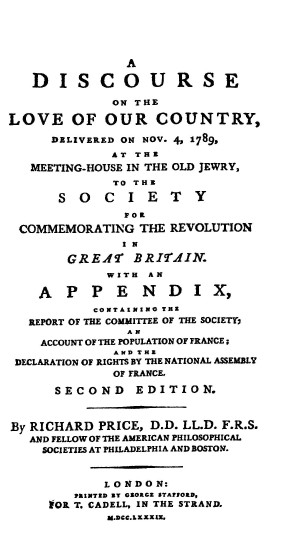
Note in answer to the Archbishop of Aix’s Letter. - Richard Price, A Discourse on the Love of Our Country [1789]Edition used:A Discourse on the Love of Our Country, delivered on Nov. 4, 1789, at the Meeting-House in the Old Jewry, to the Society for Commemorating the Revolution in Britain. With an Appendix. Second edition (London: T. Cadell, 1789).
About Liberty Fund:Liberty Fund, Inc. is a private, educational foundation established to encourage the study of the ideal of a society of free and responsible individuals. Copyright information:The text is in the public domain. Fair use statement:This material is put online to further the educational goals of Liberty Fund, Inc. Unless otherwise stated in the Copyright Information section above, this material may be used freely for educational and academic purposes. It may not be used in any way for profit.
Note in answer to the Archbishop ofAix’sLetter.The members of the Revolution Society in London request the Archbishop of Aix’s acceptance of their best thanks for the letter which he has directed to Earl Stanhope their Chairman, and for conveying to them the Vote of the National Assembly of France. They could scarcely have received a higher satisfaction than has been given them by the Archbishop’s letter, and the condescending notice with which the National Assembly has been pleased to honour their Congratulatory Address. They feel particularly the justice which this august assembly has done them, by imputing their address to the influence of those principles of universal benevolence which ought in all countries to bind together the friends of human liberty and happiness. Their hearts are warmed with these principles; and they desire nothing so earnestly as that the time may soon come when they shall so possess every human heart as to put an end to all jealousies between nations, exterminate oppression and slavery, and cause wars, those dreadful errors of governments, to cease in all the earth. They exult in the prospect of such a time, which seems to be opening, and with which the proceedings of the National Assembly of France promise to bless mankind. The Revolution Society cannot avoid taking this occasion to add, that among the important benefits of the Revolution in France, they reckon its tendency to afford a salutary instruction to Kings. They learn with pleasure that the People of France are happy in a King who has encouraged them by his virtues in recovering their rights, and been on this account justly crowned with the title of the Restorer of French Liberty. This elevates him to the highest pinnacle of glory. The despots of the world must now see their folly. This example must shew them that they can never be so great or happy, or truly powerful, as by renouncing despotic power, and being placed (like the Kings of France and England) at the head of an enlightened people and free constitutions of government? Signed by Earl Stanhope, in the name of the Society. |

Titles (by Subject)