Econlib

The Library

Other Sites

Front Page arrow Titles (by Subject) arrow SOCIETY for commemorating the Glorious Revolution of 1668. - A Discourse on the Love of Our Country

Return to Title Page for A Discourse on the Love of Our Country

Search this Title:

Also in the Library:

Subject Area: Political Theory
Debate: The Debate about the French Revolution

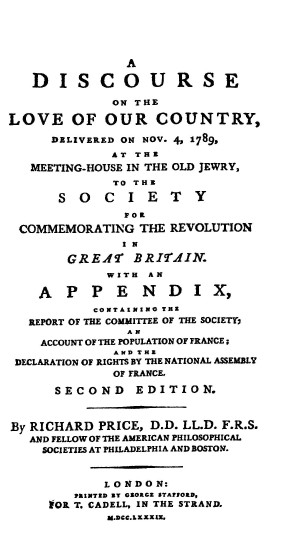
SOCIETY for commemorating the Glorious Revolution of 1668. - Richard Price, A Discourse on the Love of Our Country [1789]

Edition used:

A Discourse on the Love of Our Country, delivered on Nov. 4, 1789, at the Meeting-House in the Old Jewry, to the Society for Commemorating the Revolution in Britain. With an Appendix. Second edition (London: T. Cadell, 1789).

About Liberty Fund:

Liberty Fund, Inc. is a private, educational foundation established to encourage the study of the ideal of a society of free and responsible individuals.


SOCIETY for commemorating the Glorious Revolution of 1668.

At the Anniversary Meeting of this Society, held at the London Tavern, Nov. 4, 1789,

The Rt. Hon. Earl Stanhope in the Chair,

A Report from the Commitee was brought up, from which the following is an extract:

“Your Committee are persuaded, that by the union of the friends of freedom, their rights are ascertained and established; and trusting that it will be highly honourable to avow ourselves, in the most explicit manner, advocates for the pure and genuine principles of civil and religious liberty, they have with this view prepared a book, in which those gentlemen who are inclined to let their names be transmitted to posterity, as the friends of the great and glorious Revolution of 1688, may insert them after the following preamble, and a declaration of assent to the three following propositions.

PREAMBLE.

This Society, sensible of the important advantages arising to this country by its deliverance from popery and arbitrary power, and conscious that, under God, we owe that signal blessing to the Revolution, which seated our deliverer King William the Third on the throne; do hereby declare our firm attachment to the civil and religious principles which were recognized and established by that glorious event, and which has preserved the succession in the protestant line; and our determined resolution to maintain, and, to the utmost of our power, to perpetuate, those blessings to the latest posterity.

Three Propositionscontaining the fundamental principles of the Society:

1. That all civil and political authority is derived from the people.

2. That the abuse of power justifies resistance.

3. That the right of private judgment, liberty of conscience, trial by jury, the freedom of the press, and the freedom of election, ought ever to be held sacred and inviolable.

The Committee farther resolved,

That in order to cause the principles of the Revolution to be well understood, extensively propagated, and firmly maintained; and to preserve the glorious fabric of the British Constitution; and to transmit the invaluable blessings of public freedom to posterity, unimpaired and improved, it becomes the people to establish societies throughout the kingdom upon Revolution principles, to maintain a correspondence with each other, and to form that grand concentrated union of the true friends of public liberty, which may be necessary to maintain its existence.

The Committee concluded their Report with congratulating the members of the Society, as Britons, and citizens of the world, upon that noble spirit of civil and religious liberty which had, since the last meeting, so conspicuously shone forth on the continent, more especially on the glorious success of the French Revolution; and with expressing their ardent wishes that the influence of so glorious an example may be felt by all mankind, until tyranny and despotism shall be swept from the face of the globe, and universal liberty and happiness prevail.

Dr. Price then moved, and it was unanimously resolved, that the following Congratulatory Address to the National Assembly of France, be transmitted to them, signed by the Chairman:

‘The Society for commemorating the Revolution in Great Britain, disdaining national partialities, and rejoicing in every triumph of liberty and justice over arbitrary power, offer to the National Assembly of France their congratulations on the Revolution in that country, and on the prospect it gives to the two first kingdoms in the world, of a common participation in the blessings of civil and religious liberty.

‘They cannot help adding their ardent wishes of an happy settlement of so important a Revolution, and at the same time expressing the particular satisfaction, with which they reflect on the tendency of the glorious example given in France to encourage other nations to assert the unalienable rights of mankind, and thereby to introduce a general reformation in the governments of Europe, and to make the world free and happy.

‘STANHOPE’

Published by the same Author,

And printed for T. Cadell, in the Strand.

I. OBSERVATIONS on Reversionary Payments; on Schemes for providing Annuities for Widows, and for Persons in Old Age; on the Method of calculating the Values of Assurances on Lives; and on the National Debt. To which are added, Four Essays on different Subjects in the Doctrine of Life Annuities and Political Arithmetick. The Fourth Edition, enlarged into Two Volumes by Additional Notes and Effays, a Collection of New Tables, a History of the Sinking Fund, a State of the Public Debts in January 1783, and a Postscript on the Population of the Kingdom. Price 15s. bound.

II. Two Tracts on Civil Liberty, the War with America, and the Debts and Finances of the Kingdom; with a General Introduction and Supplement. The 8th Edition. Price 6s. bound.

III. A Review of the principal Questions and Difficulties in Morals. Particularly, those relating to the Original of our Ideas of Virtue, its Nature, Foundation, Reference to the Deity, Obligation, Subject-Matter, and Sanctions. The 3d Edition. With an Appendix: containing Additional Notes, and a Dissertation on the Being and Attributes of the Deity. Price 6s.

IV.Four Dissertations.—I. On Providence.—II. On Prayer.—III. On the Reasons for expecting that virtuous Men should meet after Death in a State of Happiness.—IV. On the Importance of Christianity, the Nature of Historical Evidence, and Miracles. The 4th Edition. Price 6s.

V. An Appeal to the Public, on the Subject of the National Debt. The 2d Edition; with an Appendix, containing Explanatory Observations and Tables; and an Account of the present State of Population in Norfolk. Price 2s.

VI.A Sermon delivered to a Congregation of Protestant Dissenters, at Hackney, on the 10th of Feb. 1779, being the Day appointed for a General Fast. The 2d Edition. To which are added, Remarks on a Passage in the Bishop of London’s Sermon on Ash-Wednesday, 1779. Price 1s.

VII.A Discourse addressed to a Congregation at Hackney, on February 21, 1781, being the Day appointed for a Public Fast. Price 1s.

VIII. An Essay on the Population of England, from the Revolution to the present Time. With an Appendix, containing Remarks on the Account of the Population, Trade, and Resources of the Kingdom, in Mr. Eden’s Letters to Lord Carlisle. The 2d Edition. Price 2s.

IX. The Evidence for a future Period of Improvement in the State of Mankind, with the Means and Duty of promoting it represented, in a Discourse delivered the 25th of April, 1787, at the Meeting-House in the Old Jewry, London, to the Supporters of a New Academical Institution among Protestant Dissenters.

X.Sermons on the Christian Doctrine, as received by the different Denominations of Christians. To which are added, Sermons on the Security and Happiness of a Virtuous Course; on the Goodness of God, and the Resurrection of Lazarus. The 2d Edition, corrected. With an Appendix, occasioned by Dr. Priestley’s Letters to the Author.

XI.Observations on the Importance of the American Revolution; and the Means of making it a Benefit to the World. To which is added, A Letter to the Author, from M. Turgot, late Comptroller General of the Finances of France. With an Appendix, containing a Translation of the Will of M. Fortune Ricard; lately published in France.

Printed for Mr. Johnson, in St. Paul’s Church-Yard.

XII.A Free Discussion of the Doctrines of Materialism and Philosophical Necessity, in a Correspondence between Dr. Price and Dr. Priestley.

ADDITIONS TO Dr. PRICE’s DISCOURSE ON THE LOVE OF OUR COUNTRY,

CONTAINING COMMUNICATIONS FROM FRANCE occasioned by the CONGRATULATORY ADDRESS of the REVOLUTION SOCIETY to the NATIONAL ASSEMBLY OF FRANCE, with THE ANSWERS TO THEM.

Additions to the Appendix.

AT the Anniversary Meeting of the Society for commemorating the Revolution in Great Britain held at the London Tavern, Nov. 4, 1789, Dr. Price moved, and it was unanimously resolved, that the following Congratulatory Address to the National Assembly of France, be transmitted to them, signed by the Chairman:

‘The Society for commemorating the Revolution in Great Britain, disdaining national partialities, and rejoicing in every triumph of liberty and justice over arbitrary power, offer to the National Assembly of France their congratulations on the Revolution in that country, and on the prospect it gives to the two first kingdoms in the world, of a common participation in the blessings of civil and religious liberty.

‘They cannot help adding their ardent wishes of a happy settlement of so important a Revolution, and at the same time expressing the particular satisfaction, with which they reflect on the tendency of the glorious example given in France to encourage other nations to assert the unalienable rights of mankind, and thereby to introduce a general reformation in the governments of Europe, and to make the world free and happy.

In pursuance of the resolution of the Society, this Congratulatory Address was conveyed to the Duke of Rochefoucauld at Paris, with a letter requesting him to present it to the National Assembly, and at the same time imtimating, that the Society considered the National Assembly as acting for the world as well as for the great kingdom it represented, and therefore hoped that their Address was not an improper intrusion; or, if it was, that it would be excused as an effusion of zeal in the cause of general liberty and human happiness which no considerations of impropriety had been able to suppress.

The following communications and letters will shew how highly the Society has been gratified by the favourable reception of its Address.