EconlibThe LibraryOther Sites |
Front Page Titles (by Subject) I.: Right of The State and Constitutional Law. - The Philosophy of Law: An Exposition of the Fundamental Principles of Jurisprudence as the Science of Right
Return to Title Page for The Philosophy of Law: An Exposition of the Fundamental Principles of Jurisprudence as the Science of RightThe Online Library of LibertyA project of Liberty Fund, Inc.Search this Title:Also in the Library:
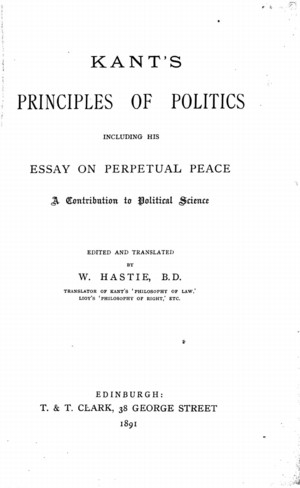
I.: Right of The State and Constitutional Law. - Immanuel Kant, The Philosophy of Law: An Exposition of the Fundamental Principles of Jurisprudence as the Science of Right [1796]Edition used:The Philosophy of Law: An Exposition of the Fundamental Principles of Jurisprudence as the Science of Right, by Immanuel Kant, trans. W. Hastie (Edinburgh: Clark, 1887).
About Liberty Fund:Liberty Fund, Inc. is a private, educational foundation established to encourage the study of the ideal of a society of free and responsible individuals. Copyright information:The text is in the public domain. Fair use statement:This material is put online to further the educational goals of Liberty Fund, Inc. Unless otherwise stated in the Copyright Information section above, this material may be used freely for educational and academic purposes. It may not be used in any way for profit.
I.Right of The State and Constitutional Law.(Jus Civitatis.) 44.Origin of the Civil Union and Public Right.It is not from any Experience prior to the appearance of an external authoritative Legislation, that we learn of the maxim of natural violence among men, and their evil tendency to engage in war with each other. Nor is it assumed here that it is merely some particular historical condition or fact, that makes public legislative constraint necessary; for however well-disposed or favourable to Right men may be considered to be of themselves, the rational Idea of a state of Society not yet regulated by Right, must be taken as our starting-point. This Idea implies that before a legal state of Society can be publicly established, individual Men, Nations and States can never be safe against violence from each other; and this is evident from the consideration that every one of his own Will naturally does what seems good and right in his own eyes, entirely independent of the opinion of others. Hence, unless the institution of Right is to be renounced, the first thing incumbent on men is to accept the Principle that it is necessary to leave the state of Nature, in which every one follows his own inclinations, and to form a union of all those who cannot avoid coming into reciprocal communication, and thus subject themselves in common to the external restraint of public compulsory Laws. Men thus enter into a Civil Union, in which every one has it determined by Law what shall be recognised as his; and this is secured to him by a competent external Power distinct from his own individuality. Such is the primary Obligation, on the part of all men, to enter into the relations of a Civil State of Society. The natural condition of mankind need not, on this ground, be represented as a state of absolute Injustice, as if there could have been no other relation originally among men but what was merely determined by force. But this natural condition must be regarded, if it ever existed, as a state of society that was void of regulation by Right (status justitiæ vacuus), so that if a matter of Right came to be in dispute (jus controversum), no competent judge was found to give an authorized legal decision upon it. It is therefore reasonable that any one should constrain another by force, to pass from such a non-juridical state of life and enter within the jurisdiction of a civil state of Society. For, although on the basis of the ideas of Right held by individuals as such, external things may be acquired by Occupancy or Contract, yet such acquisition is only provisory so long as it has not yet obtained the sanction of a Public Law. Till this sanction is reached, the condition of possession is not determined by any public Distributive Justice, nor is it secured by any Power exercising Public Right.
45.The Form of the State and its Three Powers.A State (Civitas) is the union of a number of men under juridical Laws. These Laws, as such, are to be regarded as necessary à priori,—that is, as following of themselves from the conceptions of external Right generally,—and not as merely established by Statute. The Form of the State is thus involved in the Idea of the State, viewed as it ought to be according to pure principles of Right; and this ideal Form furnishes the normal criterion of every real union that constitutes a Commonwealth. Every State contains in itself three Powers, the universal united Will of the People being thus personified in a political triad. These are the Legislative Power, the Executive Power, and the Judiciary Power.—1. The Legislative Power of the Sovereignty in the State, is embodied in the person of the Lawgiver; 2. the Executive Power is embodied in the person of the Ruler who administers the Law; and 3. the Judiciary Power, embodied in the person of the Judge, is the function of assigning every one what is his own, according to the Law (Potestas legislatoria, rectoria et judiciaria). These three Powers may be compared to the three propositions in a practical Syllogism:—the Major as the sumption laying down the universal Law of a Will, the Minor presenting the command applicable to an action according to the Law as the principle of the subsumption, and the Conclusion containing the Sentence or judgment of Right in the particular case under consideration. 46.The Legislative Power and the Members of the State.The Legislative Power, viewed in its rational Principle, can only belong to the united Will of the People. For, as all Right ought to proceed from this Power, it is necessary that its Laws should be unable to do wrong to any one whatever. Now, if any one individual determines anything in the State in contradistinction to another, it is always possible that he may perpetrate a wrong on that other; but this is never possible when all determine and decree what is to be Law to themselves. ‘Volenti non fit injuria.’ Hence it is only the united and consenting Will of all the People—in so far as Each of them determines the same thing about all, and All determine the same thing about each—that ought to have the power of enacting Law in the State. The Members of a Civil Society thus united for the purpose of Legislation, and thereby constituting a State, are called its Citizens; and there are three juridical attributes that inseparably belong to them by Right. These are—1. Constitutional Freedom, as the Right of every Citizen to have to obey no other Law than that to which he has given his consent or approval; 2. Civil Equality, as the Right of the Citizen to recognise no one as a Superior among the people in relation to himself, except in so far as such a one is as subject to his moral power to impose obligations, as that other has power to impose obligations upon him; and 3. Political Independence, as the Right to owe his existence and continuance in Society not to the arbitrary Will of another, but to his own Rights and Powers as a Member of the Commonwealth; and, consequently, the possession of a Civil Personality, which cannot be represented by any other than himself.
47.Dignities in the State and the Original Contract.All these three Powers in the State are Dignities; and as necessarily arising out of the Idea of the State and essential generally to the foundation of its Constitution, they are to be regarded as political Dignities. They imply the relation between a universal Sovereign as Head of the State—which according to the laws of freedom can be none other than the People itself united into a Nation—and the mass of the individuals of the Nation as Subjects. The former member of the relation is the ruling Power, whose function is to govern (imperans); the latter is the ruled Constituents of the State, whose function is to obey (subditi). The act by which a People is represented as constituting itself into a State, is termed the original Contract. This is properly only an outward mode of representing the idea by which the rightfulness of the process of organizing the Constitution, may be made conceivable. According to this representation, all and each of the people give up their external Freedom in order to receive it immediately again as Members of a Commonwealth. The Commonwealth is the people viewed as united altogether into a State. And thus it is not to be said that the individual in the State has sacrificed a part of his inborn external Freedom for a particular purpose; but he has abandoned his wild lawless Freedom wholly, in order to find all his proper Freedom again entire and undiminished, but in the form of a regulated order of dependence, that is, in a Civil state regulated by laws of Right. This relation of Dependence thus arises out of his own regulative law-giving Will. 48.Mutual Relations and Characteristics of the Three Powers.The three Powers in the State, as regards their relations to each other, are, therefore—(1) co-ordinate with one another as so many Moral Persons, and the one is thus the Complement of the other in the way of completing the Constitution of the State; (2) they are likewise subordinate to one another, so that the one cannot at the same time usurp the function of the other by whose side it moves, each having its own Principle, and maintaining its authority in a particular person, but under the condition of the Will of a Superior; and, further, (3) by the union of both these relations, they assign distributively to every subject in the State his own Rights. Considered as to their respective Dignity, the three Powers may be thus described. The Will of the Sovereign Legislator, in respect of what constitutes the external Mine and Thine, is to be regarded as irreprehensible; the executive Function of the supreme Ruler is to be regarded as irresistible; and the judicial Sentence of the Supreme Judge is to be regarded as irreversible, being beyond appeal. 49.Distinct Functions of the Three Powers. Autonomy of the State.1. The Executive Power belongs to the Governor or Regent of the State, whether it assumes the form of a Moral or Individual Person, as the King or Prince (rex, princeps). This Executive Authority, as the Supreme Agent of the State, appoints the Magistrates, and prescribes the Rules to the people, in accordance with which individuals may acquire anything or maintain what is their own conformably to the Law, each case being brought under its application. Regarded as a Moral Person, this Executive Authority constitutes the Government. The Orders issued by the Government to the People and the Magistrates as well as to the higher Ministerial Administrators of the State (gubernatio), are Rescripts or Decrees, and not Laws; for they terminate in the decision of particular cases, and are given forth as unchangeable. A Government acting as an Executive, and at the same time laying down the Law as the Legislative Power, would be a Despotic Government, and would have to be contradistinguished from a patriotic Government. A patriotic Government, again, is to be distinguished from a paternal Government (regimen paternale) which is the most despotic Government of all, the Citizens being dealt with by it as mere children. A patriotic Government, however, is one in which the State, while dealing with the Subjects as if they were Members of a Family, still treats them likewise as Citizens, and according to Laws that recognise their independence, each individual possessing himself and not being dependent on the absolute Will of another beside him or above him. 2. The Legislative Authority ought not at the same time to be the Executive or Governor; for the Governor, as Administrator, should stand under the authority of the Law, and is bound by it under the supreme control of the Legislator. The Legislative Authority may therefore deprive the Governor of his power, depose him, or reform his administration, but not punish him. This is the proper and only meaning of the common saying in England, ‘The King—as the Supreme Executive Power—can do no wrong.’ For any such application of Punishment would necessarily be an act of that very Executive Power to which the supreme Right to compel according to Law pertains, and which would itself be thus subjected to coercion; which is self-contradictory. 3. Further, neither the Legislative Power nor the Executive Power ought to exercise the judicial Function, but only appoint Judges as Magistrates. It is the People who ought to judge themselves, through those of the Citizens who are elected by free Choice as their Representatives for this purpose, and even specially for every process or cause. For the judicial Sentence is a special act of public Distributive Justice performed by a Judge or Court as a constitutional Administrator of the Law, to a Subject as one of the People. Such an act is not invested inherently with the power to determine and assign to any one what is his. Every individual among the people being merely passive in this relation to the Supreme Power, either the Executive or the Legislative Authority might do him wrong in their determinations in cases of dispute regarding the property of individuals. It would not be the people themselves who thus determined, or who pronounced the judgments of ‘guilty’ or ‘not guilty’ regarding their fellow-citizens. For it is to the determination of this issue in a cause, that the Court has to apply the Law; and it is by means of the Executive Authority, that the Judge holds power to assign to every one his own. Hence it is only the People that properly can judge in a cause—although indirectly—by Representatives elected and deputed by themselves, as in a Jury.—It would even be beneath the dignity of the Sovereign Head of the State to play the Judge; for this would be to put himself into a position in which it would be possible to do Wrong, and thus to subject himself to the demand for an appeal to a still higher Power (a rege male informato ad regem melius informandum). It is by the co-operation of these three Powers—the Legislative, the Executive, and the Judicial—that the State realizes its Autonomy. This Autonomy consists in its organizing, forming, and maintaining itself in accordance with the Laws of Freedom. In their union the Welfare of the State is realized. Salus reipublicæ suprema lex. By this is not to be understood merely the individual well-being and happiness of the Citizens of the State; for—as Rousseau asserts—this End may perhaps be more agreeably and more desirably attained in the state of Nature, or even under a despotic Government. But the Welfare of the State as its own Highest Good, signifies that condition in which the greatest harmony is attained between its Constitution and the Principles of Right,—a condition of the State which Reason by a Categorical Imperative makes it obligatory upon us to strive after. |

Titles (by Subject)