EconlibThe LibraryOther Sites |
Front Page Titles (by Subject) E.: Strict Right may be also represented as the possibility of a universal reciprocal Compulsion in harmony with the Freedom of all according to universal Laws. - The Philosophy of Law: An Exposition of the Fundamental Principles of Jurisprudence as the Science of Right
Return to Title Page for The Philosophy of Law: An Exposition of the Fundamental Principles of Jurisprudence as the Science of RightThe Online Library of LibertyA project of Liberty Fund, Inc.Search this Title:Also in the Library:
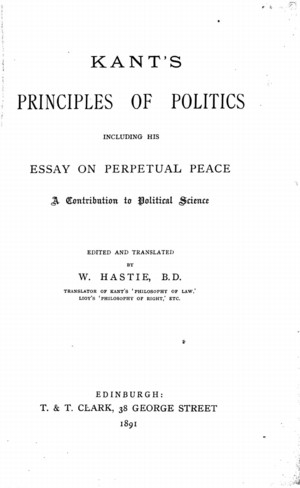
E.: Strict Right may be also represented as the possibility of a universal reciprocal Compulsion in harmony with the Freedom of all according to universal Laws. - Immanuel Kant, The Philosophy of Law: An Exposition of the Fundamental Principles of Jurisprudence as the Science of Right [1796]Edition used:The Philosophy of Law: An Exposition of the Fundamental Principles of Jurisprudence as the Science of Right, by Immanuel Kant, trans. W. Hastie (Edinburgh: Clark, 1887).
About Liberty Fund:Liberty Fund, Inc. is a private, educational foundation established to encourage the study of the ideal of a society of free and responsible individuals. Copyright information:The text is in the public domain. Fair use statement:This material is put online to further the educational goals of Liberty Fund, Inc. Unless otherwise stated in the Copyright Information section above, this material may be used freely for educational and academic purposes. It may not be used in any way for profit.
E.Strict Right may be also represented as the possibility of a universal reciprocal Compulsion in harmony with the Freedom of all according to universal Laws.This proposition means that Right is not to be regarded as composed of two different elements—Obligation according to a Law, and a Title on the part of one who has bound another by his own free choice, to compel him to perform. But it imports that the conception of Right may be viewed as consisting immediately in the possibility of a universal reciprocal Compulsion, in harmony with the Freedom of all. As Right in general has for its object only what is external in actions, Strict Right, as that with which nothing ethical is intermingled, requires no other motives of action than those that are merely external; for it is then pure Right, and is unmixed with any prescriptions of Virtue. A strict Right, then, in the exact sense of the term, is that which alone can be called wholly external. Now such Right is founded, no doubt, upon the consciousness of the Obligation of every individual according to the Law; but if it is to be pure as such, it neither may nor should refer to this consciousness as a motive by which to determine the free act of the Will. For this purpose, however, it founds upon the principle of the possibility of an external Compulsion, such as may co-exist with the freedom of every one according to universal Laws. Accordingly, then, where it is said that a Creditor has a right to demand from a Debtor the payment of his debt, this does not mean merely that he can bring him to feel in his mind that Reason obliges him to do this; but it means that he can apply an external compulsion to force any such one so to pay, and that this compulsion is quite consistent with the Freedom of all, including the parties in question, according to a universal Law. Right and the Title to compel, thus indicate the same thing.
|

Titles (by Subject)