Econlib

The Library

Other Sites

Front Page arrow Titles (by Subject) arrow Book III: Of Morals - A Treatise of Human Nature

Return to Title Page for A Treatise of Human Nature

Search this Title:

Also in the Library:

Topic: Spontaneous Order
Subject Area: Philosophy
Topic: Property
Collection: Banned Books

Book III: Of Morals - David Hume, A Treatise of Human Nature [1739]

Edition used:

A Treatise of Human Nature by David Hume, reprinted from the Original Edition in three volumes and edited, with an analytical index, by L.A. Selby-Bigge, M.A. (Oxford: Clarendon Press, 1896).

About Liberty Fund:

Liberty Fund, Inc. is a private, educational foundation established to encourage the study of the ideal of a society of free and responsible individuals.


Book III: Of Morals

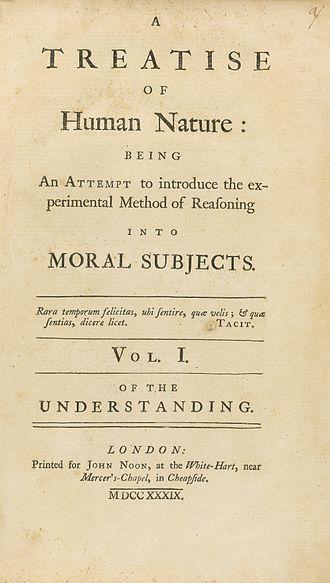
A TREATISE OF Human Nature: BEING An Attempt to introduce the experimental Method of Reasoning into MORAL SUBJECTS.

Duræ semper virtutis amator, Quære quid est virtus, et posce exemplar honesti.

Lucan.

Book III.

OF MORALS.

with an APPENDIX.

Wherein some Passages of the foregoing Volumes are illustrated and explain’d.

LONDON, Printed for Thomas Longman, at the Ship in Pater-noster-Row, M DCC XL.

PART I.

of virtue and vice in general.

SECTION I.

Moral Distinctions not deriv’d from Reason.

There is an inconvenience which attends all abstruse reasoning, that it may silence, without convincing an antagonist, and requires the same intense study to make us sensible of its force, that was at first requisite for its invention. When we leave our closet, and engage in the common affairs of life, its conclusions seem to vanish, like the phantoms of the night on the appearance of the morning; and ’tis difficult for us to retain even that conviction, which we had attain’d with difficulty. This is still more conspicuous in a long chain of reasoning, where we must preserve to the end the evidence of the first propositions, and where we often lose sight of all the most receiv’d maxims, either of philosophy or common life. I am not, however, without hopes, that the present system of philosophy will acquire new force as it advances; and that our reasonings concerning morals will corroborate whatever has been said concerning the understanding and the passions. Morality is a subject that interests us above all others: We fancy the peace of society to be at stake in every decision concerning it; and ’tis evident, that this concern must make our speculations appear more real and solid, than where the subject is, in a great measure, indifferent to us. What affects us, we conclude can never be a chimera; and as our passion is engag’d on the one side or the other, we naturally think that the question lies within human comprehension; which, in other cases of this nature, we are apt to entertain some doubt of. Without this advantage I never should have ventur’d upon a third volume of such abstruse philosophy, in an age, wherein the greatest part of men seem agreed to convert reading into an amusement, and to reject every thing that requires any considerable degree of attention to be comprehended.

It has been observ’d, that nothing is ever present to the mind but its perceptions; and that all the actions of seeing, hearing, judging, loving, hating, and thinking, fall under this denomination. The mind can never exert itself in any action, which we may not comprehend under the term of perception; and consequently that term is no less applicable to those judgments, by which we distinguish moral good and evil, than to every other operation of the mind. To approve of one character, to condemn another, are only so many different perceptions.

Now as perceptions resolve themselves into two kinds, viz. impressions and ideas, this distinction gives rise to a question, with which we shall open up our present enquiry concerning morals, Whether ’tis by means of our ideas or impressions we distinguish betwixt vice and virtue, and pronounce an action blameable or praise-worthy? This will immediately cut off all loose discourses and declamations, and reduce us to something precise and exact on the present subject.

Those who affirm that virtue is nothing but a conformity to reason; that there are eternal fitnesses and unfitnesses of things, which are the same to every rational being that considers them; that the immutable measures of right and wrong impose an obligation, not only on human creatures, but also on the Deity himself: All these systems concur in the opinion, that morality, like truth, is discern’d merely by ideas, and by their juxta-position and comparison. In order, therefore, to judge of these systems, we need only consider, whether it be possible, from reason alone, to distinguish betwixt moral good and evil, or whether there must concur some other principles to enable us to make that distinction.

If morality had naturally no influence on human passions and actions, ’twere in vain to take such pains to inculcate it; and nothing wou’d be more fruitless than that multitude of rules and precepts, with which all moralists abound. Philosophy is commonly divided into speculative and practical; and as morality is always comprehended under the latter division, ’tis supposed to influence our passions and actions, and to go beyond the calm and indolent judgments of the understanding. And this is confirm’d by common experience, which informs us, that men are often govern’d by their duties, and are deter’d from some actions by the opinion of injustice, and impell’d to others by that of obligation.

Since morals, therefore, have an influence on the actions and affections, it follows, that they cannot be deriv’d from reason; and that because reason alone, as we have already prov’d, can never have any such influence. Morals excite passions, and produce or prevent actions. Reason of itself is utterly impotent in this particular. The rules of morality, therefore, are not conclusions of our reason.

No one, I believe, will deny the justness of this inference; nor is there any other means of evading it, than by denying that principle, on which it is founded. As long as it is allow’d, that reason has no influence on our passions and actions, ’tis in vain to pretend, that morality is discover’d only by a deduction of reason. An active principle can never be founded on an inactive; and if reason be inactive in itself, it must remain so in all its shapes and appearances, whether it exerts itself in natural or moral subjects, whether it considers the powers of external bodies, or the actions of rational beings.

It would be tedious to repeat all the arguments, by which I have prov’d1 , that reason is perfectly inert, and can never either prevent or produce any action or affection. ’Twill be easy to recollect what has been said upon that subject. I shall only recall on this occasion one of these arguments, which I shall endeavour to render still more conclusive, and more applicable to the present subject.

Reason is the discovery of truth or falshood. Truth or falshood consists in an agreement or disagreement either to the real relations of ideas, or to real existence and matter of fact. Whatever, therefore, is not susceptible of this agreement or disagreement, is incapable of being true or false, and can never be an object of our reason. Now ’tis evident our passions, volitions, and actions, are not susceptible of any such agreement or disagreement; being original facts and realities, compleat in themselves, and implying no reference to other passions, volitions, and actions. ’Tis impossible, therefore, they can be pronounced either true or false, and be either contrary or conformable to reason.

This argument is of double advantage to our present purpose. For it proves directly, that actions do not derive their merit from a conformity to reason, nor their blame from a contrariety to it; and it proves the same truth more indirectly, by shewing us, that as reason can never immediately prevent or produce any action by contradicting or approving of it, it cannot be the source of moral good and evil, which are found to have that influence. Actions may be laudable or blameable; but they cannot be reasonable or unreasonable: Laudable or blameable, therefore, are not the same with reasonable or unreasonable. The merit and demerit of actions frequently contradict, and sometimes controul our natural propensities. But reason has no such influence. Moral distinctions, therefore, are not the offspring of reason. Reason is wholly inactive, and can never be the source of so active a principle as conscience, or a sense of morals.

But perhaps it may be said, that tho’ no will or action can be immediately contradictory to reason, yet we may find such a contradiction in some of the attendants of the action, that is, in its causes or effects. The action may cause a judgment, or may be obliquely caus’d by one, when the judgment concurs with a passion; and by an abusive way of speaking, which philosophy will scarce allow of, the same contrariety may, upon that account, be ascrib’d to the action. How far this truth or falshood may be the source of morals, ’twill now be proper to consider.

It has been observ’d, that reason, in a strict and philosophical sense, can have an influence on our conduct only after two ways: Either when it excites a passion by informing us of the existence of something which is a proper object of it; or when it discovers the connexion of causes and effects, so as to afford us means of exerting any passion. These are the only kinds of judgment, which can accompany our actions, or can be said to produce them in any manner; and it must be allow’d, that these judgments may often be false and erroneous. A person may be affected with passion, by supposing a pain or pleasure to lie in an object, which has no tendency to produce either of these sensations, or which produces the contrary to what is imagin’d. A person may also take false measures for the attaining his end, and may retard, by his foolish conduct, instead of forwarding the execution of any project. These false judgments may be thought to affect the passions and actions, which are connected with them, and may be said to render them unreasonable, in a figurative and improper way of speaking. But tho’ this be acknowledg’d, ’tis easy to observe, that these errors are so far from being the source of all immorality, that they are commonly very innocent, and draw no manner of guilt upon the person who is so unfortunate as to fall into them. They extend not beyond a mistake of fact, which moralists have not generally suppos’d criminal, as being perfectly involuntary. I am more to be lamented than blam’d, if I am mistaken with regard to the influence of objects in producing pain or pleasure, or if I know not the proper means of satisfying my desires. No one can ever regard such errors as a defect in my moral character. A fruit, for instance, that is really disagreeable, appears to me at a distance, and thro’ mistake I fancy it to be pleasant and delicious. Here is one error. I choose certain means of reaching this fruit, which are not proper for my end. Here is a second error; nor is there any third one, which can ever possibly enter into our reasonings concerning actions. I ask, therefore, if a man, in this situation, and guilty of these two errors, is to be regarded as vicious and criminal, however unavoidable they might have been? Or if it be possible to imagine, that such errors are the sources of all immorality?

And here it may be proper to observe, that if moral distinctions be deriv’d from the truth or falshood of those judgments, they must take place wherever we form the judgments; nor will there be any difference, whether the question be concerning an apple or a kingdom, or whether the error be avoidable or unavoidable. For as the very essence of morality is suppos’d to consist in an agreement or disagreement to reason, the other circumstances are entirely arbitrary, and can never either bestow on any action the character of virtuous or vicious, or deprive it of that character. To which we may add, that this agreement or disagreement, not admitting of degrees, all virtues and vices wou’d of course be equal.

Shou’d it be pretended, that tho’ a mistake of fact be not criminal, yet a mistake of right often is; and that this may be the source of immorality: I would answer, that ’tis impossible such a mistake can ever be the original source of immorality, since it supposes a real right and wrong; that is, a real distinction in morals, independent of these judgments. A mistake, therefore, of right may become a species of immorality; but ’tis only a secondary one, and is founded on some other, antecedent to it.

As to those judgments which are the effects of our actions, and which, when false, give occasion to pronounce the actions contrary to truth and reason; we may observe, that our actions never cause any judgment, either true or false, in ourselves, and that ’tis only on others they have such an influence. ’Tis certain, that an action, on many occasions, may give rise to false conclusions in others; and that a person, who thro’ a window sees any lewd behaviour of mine with my neighbour’s wife, may be so simple as to imagine she is certainly my own. In this respect my action resembles somewhat a lye or falshood; only with this difference, which is material, that I perform not the action with any intention of giving rise to a false judgment in another, but merely to satisfy my lust and passion. It causes, however, a mistake and false judgment by accident; and the falshood of its effects may be ascribed, by some odd figurative way of speaking, to the action itself. But still I can see no pretext of reason for asserting, that the tendency to cause such an error is the first spring or original source of all immorality1 .

Thus upon the whole, ’tis impossible, that the distinction betwixt moral good and evil, can be made by reason; since that distinction has an influence upon our actions, of which reason alone is incapable. Reason and judgment may, indeed, be the mediate cause of an action, by prompting, or by directing a passion: But it is not pretended, that a judgment of this kind, either in its truth or falshood, is attended with virtue or vice. And as to the judgments, which are caused by our judgments, they can still less bestow those moral qualities on the actions, which are their causes.

But to be more particular, and to shew, that those eternal immutable fitnesses and unfitnesses of things cannot be defended by sound philosophy, we may weigh the following considerations.

If the thought and understanding were alone capable of fixing the boundaries of right and wrong, the character of virtuous and vicious either must lie in some relations of objects, or must be a matter of fact, which is discovered by our reasoning. This consequence is evident. As the operations of human understanding divide themselves into two kinds, the comparing of ideas, and the inferring of matter of fact; were virtue discover’d by the understanding; it must be an object of one of these operations, nor is there any third operation of the understanding, which can discover it. There has been an opinion very industriously propagated by certain philosophers, that morality is susceptible of demonstration; and tho’ no one has ever been able to advance a single step in those demonstrations; yet ’tis taken for granted, that this science may be brought to an equal certainty with geometry or algebra. Upon this supposition, vice and virtue must consist in some relations; since ’tis allow’d on all hands, that no matter of fact is capable of being demonstrated. Let us, therefore, begin with examining this hypothesis, and endeavour, if possible, to fix those moral qualities, which have been so long the objects of our fruitless researches. Point out distinctly the relations, which constitute morality or obligation, that we may know wherein they consist, and after what manner we must judge of them.

If you assert, that vice and virtue consist in relations susceptible of certainty and demonstration, you must confine yourself to those four relations, which alone admit of that degree of evidence; and in that case you run into absurdities, from which you will never be able to extricate yourself. For as you make the very essence of morality to lie in the relations, and as there is no one of these relations but what is applicable, not only to an irrational, but also to an inanimate object; it follows, that even such objects must be susceptible of merit or demerit. Resemblance, contrariety, degrees in quality, and proportions in quantity and number; all these relations belong as properly to matter, as to our actions, passions, and volitions. ’Tis unquestionable, therefore, that morality lies not in any of these relations, nor the sense of it in their discovery1 .

Shou’d it be asserted, that the sense of morality consists in the discovery of some relation, distinct from these, and that our enumeration was not compleat, when we comprehended all demonstrable relations under four general heads: To this I know not what to reply, till some one be so good as to point out to me this new relation. ’Tis impossible to refute a system, which has never yet been explain’d. In such a manner of fighting in the dark, a man loses his blows in the air, and often places them where the enemy is not present.

I must, therefore, on this occasion, rest contented with requiring the two following conditions of any one that wou’d undertake to clear up this system. First, As moral good and evil belong only to the actions of the mind, and are deriv’d from our situation with regard to external objects, the relations, from which these moral distinctions arise, must lie only betwixt internal actions, and external objects, and must not be applicable either to internal actions, compared among themselves, or to external objects, when placed in opposition to other external objects. For as morality is supposed to attend certain relations, if these relations cou’d belong to internal actions consider’d singly, it wou’d follow, that we might be guilty of crimes in ourselves, and independent of our situation, with respect to the universe: And in like manner, if these moral relations cou’d be apply’d to external objects, it wou’d follow, that even inanimate beings wou’d be susceptible of moral beauty and deformity. Now it seems difficult to imagine, that any relation can be discover’d betwixt our passions, volitions and actions, compared to external objects, which relation might not belong either to these passions and volitions, or to these external objects, compar’d among themselves.

But it will be still more difficult to fulfil the second condition, requisite to justify this system. According to the principles of those who maintain an abstract rational difference betwixt moral good and evil, and a natural fitness and unfitness of things, ’tis not only suppos’d, that these relations, being eternal and immutable, are the same, when consider’d by every rational creature, but their effects are also suppos’d to be necessarily the same; and ’tis concluded they have no less, or rather a greater, influence in directing the will of the deity, than in governing the rational and virtuous of our own species. These two particulars are evidently distinct. ’Tis one thing to know virtue, and another to conform the will to it. In order, therefore, to prove, that the measures of right and wrong are eternal laws, obligatory on every rational mind, ’tis not sufficient to shew the relations upon which they are founded: We must also point out the connexion betwixt the relation and the will; and must prove that this connexion is so necessary, that in every well-disposed mind, it must take place and have its influence; tho’ the difference betwixt these minds be in other respects immense and infinite. Now besides what I have already prov’d, that even in human nature no relation can ever alone produce any action; besides this, I say, it has been shewn, in treating of the understanding, that there is no connexion of cause and effect, such as this is suppos’d to be, which is discoverable otherwise than by experience, and of which we can pretend to have any security by the simple consideration of the objects. All beings in the universe, consider’d in themselves, appear entirely loose and independent of each other. ’Tis only by experience we learn their influence and connexion; and this influence we ought never to extend beyond experience.

Thus it will be impossible to fulfil the first condition required to the system of eternal rational measures of right and wrong; because it is impossible to shew those relations, upon which such a distinction may be founded: And ’tis as impossible to fulfil the second condition; because we cannot prove a priori, that these relations, if they really existed and were perceiv’d, wou’d be universally forcible and obligatory.

But to make these general reflexions more clear and convincing, we may illustrate them by some particular instances, wherein this character of moral good or evil is the most universally acknowledged. Of all crimes that human creatures are capable of committing, the most horrid and unnatural is ingratitude, especially when it is committed against parents, and appears in the more flagrant instances of wounds and death. This is acknowledg’d by all mankind, philosophers as well as the people; the question only arises among philosophers, whether the guilt or moral deformity of this action be discover’d by demonstrative reasoning, or be felt by an internal sense, and by means of some sentiment, which the reflecting on such an action naturally occasions. This question will soon be decided against the former opinion, if we can shew the same relations in other objects, without the notion of any guilt or iniquity attending them. Reason or science is nothing but the comparing of ideas, and the discovery of their relations; and if the same relations have different characters, it must evidently follow, that those characters are not discover’d merely by reason. To put the affair, therefore, to this trial, let us chuse any inanimate object, such as an oak or elm; and let us suppose, that by the dropping of its seed, it produces a sapling below it, which springing up by degrees, at last overtops and destroys the parent tree: I ask, if in this instance there be wanting any relation, which is discoverable in parricide or ingratitude? Is not the one tree the cause of the other’s existence; and the latter the cause of the destruction of the former, in the same manner as when a child murders his parent? ’Tis not sufficient to reply, that a choice or will is wanting. For in the case of parricide, a will does not give rise to any different relations, but is only the cause from which the action is deriv’d; and consequently produces the same relations, that in the oak or elm arise from some other principles. ’Tis a will or choice, that determines a man to kill his parent; and they are the laws of matter and motion, that determine a sapling to destroy the oak, from which it sprung. Here then the same relations have different causes; but still the relations are the same: And as their discovery is not in both cases attended with a notion of immorality, it follows, that that notion does not arise from such a discovery.

But to chuse an instance, still more resembling; I would fain ask any one, why incest in the human species is criminal, and why the very same action, and the same relations in animals have not the smallest moral turpitude and deformity? If it be answer’d, that this action is innocent in animals, because they have not reason sufficient to discover its turpitude; but that man, being endow’d with that faculty, which ought to restrain him to his duty, the same action instantly becomes criminal to him; should this be said, I would reply, that this is evidently arguing in a circle. For before reason can perceive this turpitude, the turpitude must exist; and consequently is independent of the decisions of our reason, and is their object more properly than their effect. According to this system, then, every animal, that has sense, and appetite, and will; that is, every animal must be susceptible of all the same virtues and vices, for which we ascribe praise and blame to human creatures. All the difference is, that our superior reason may serve to discover the vice or virtue, and by that means may augment the blame or praise: But still this discovery supposes a separate being in these moral distinctions, and a being, which depends only on the will and appetite, and which, both in thought and reality, may be distinguish’d from the reason. Animals are susceptible of the same relations, with respect to each other, as the human species, and therefore wou’d also be susceptible of the same morality, if the essence of morality consisted in these relations. Their want of a sufficient degree of reason may hinder them from perceiving the duties and obligations of morality, but can never hinder these duties from existing; since they must antecedently exist, in order to their being perceiv’d. Reason must find them, and can never produce them. This argument deserves to be weigh’d, as being, in my opinion, entirely decisive.

Nor does this reasoning only prove, that morality consists not in any relations, that are the objects of science; but if examin’d, will prove with equal certainty, that it consists not in any matter of fact, which can be discover’d by the understanding. This is the second part of our argument; and if it can be made evident, we may conclude, that morality is not an object of reason. But can there be any difficulty in proving, that vice and virtue are not matters of fact, whose existence we can infer by reason? Take any action allow’d to be vicious: Wilful murder, for instance. Examine it in all lights, and see if you can find that matter of fact, or real existence, which you call vice. In which-ever way you take it, you find only certain passions, motives, volitions and thoughts. There is no other matter of fact in the case. The vice entirely escapes you, as long as you consider the object. You never can find it, till you turn your reflexion into your own breast, and find a sentiment of disapprobation, which arises in you, towards this action. Here is a matter of fact; but ’tis the object of feeling, not of reason. It lies in yourself, not in the object. So that when you pronounce any action or character to be vicious, you mean nothing, but that from the constitution of your nature you have a feeling or sentiment of blame from the contemplation of it. Vice and virtue, therefore, may be compar’d to sounds, colours, heat and cold, which, according to modern philosophy, are not qualities in objects, but perceptions in the mind: And this discovery in morals, like that other in physics, is to be regarded as a considerable advancement of the speculative sciences; tho’, like that too, it has little or no influence on practice. Nothing can be more real, or concern us more, than our own sentiments of pleasure and uneasiness; and if these be favourable to virtue, and unfavourable to vice, no more can be requisite to the regulation of our conduct and behaviour.

I cannot forbear adding to these reasonings an observation, which may, perhaps, be found of some importance. In every system of morality, which I have hitherto met with, I have always remark’d, that the author proceeds for some time in the ordinary way of reasoning, and establishes the being of a God, or makes observations concerning human affairs; when of a sudden I am surpriz’d to find, that instead of the usual copulations of propositions, is, and is not, I meet with no proposition that is not connected with an ought, or an ought not. This change is imperceptible; but is, however, of the last consequence. For as this ought, or ought not, expresses some new relation or affirmation, ’tis necessary that it shou’d be observ’d and explain’d; and at the same time that a reason should be given, for what seems altogether inconceivable, how this new relation can be a deduction from others, which are entirely different from it. But as authors do not commonly use this precaution, I shall presume to recommend it to the readers; and am persuaded, that this small attention wou’d subvert all the vulgar systems of morality, and let us see, that the distinction of vice and virtue is not founded merely on the relations of objects, nor is perceiv’d by reason.

SECTION II.

Moral distinctions deriv’d from a moral sense.

Thus the course of the argument leads us to conclude, that since vice and virtue are not discoverable merely by reason, or the comparison of ideas, it must be by means of some impression or sentiment they occasion, that we are able to mark the difference betwixt them. Our decisions concerning moral rectitude and depravity are evidently perceptions; and as all perceptions are either impressions or ideas, the exclusion of the one is a convincing argument for the other. Morality, therefore, is more properly felt than judg’d of; tho’ this feeling or sentiment is commonly so soft and gentle, that we are apt to confound it with an idea, according to our common custom of taking all things for the same, which have any near resemblance to each other.

The next question is, Of what nature are these impressions, and after what manner do they operate upon us? Here we cannot remain long in suspense, but must pronounce the impression arising from virtue, to be agreeable, and that proceeding from vice to be uneasy. Every moment’s experience must convince us of this. There is no spectacle so fair and beautiful as a noble and generous action; nor any which gives us more abhorrence than one that is cruel and treacherous. No enjoyment equals the satisfaction we receive from the company of those we love and esteem; as the greatest of all punishments is to be oblig’d to pass our lives with those we hate or contemn. A very play or romance may afford us instances of this pleasure, which virtue conveys to us; and pain, which arises from vice.

Now since the distinguishing impressions, by which moral good or evil is known, are nothing but particular pains or pleasures; it follows, that in all enquiries concerning these moral distinctions, it will be sufficient to shew the principles, which make us feel a satisfaction or uneasiness from the survey of any character, in order to satisfy us why the character is laudable or blameable. An action, or sentiment, or character is virtuous or vicious; why? because its view causes a pleasure or uneasiness of a particular kind. In giving a reason, therefore, for the pleasure or uneasiness, we sufficiently explain the vice or virtue. To have the sense of virtue, is nothing but to feel a satisfaction of a particular kind from the contemplation of a character. The very feeling constitutes our praise or admiration. We go no farther; nor do we enquire into the cause of the satisfaction. We do not infer a character to be virtuous, because it pleases: But in feeling that it pleases after such a particular manner, we in effect feel that it is virtuous. The case is the same as in our judgments concerning all kinds of beauty, and tastes, and sensations. Our approbation is imply’d in the immediate pleasure they convey to us.

I have objected to the system, which establishes eternal rational measures of right and wrong, that ’tis impossible to shew, in the actions of reasonable creatures, any relations, which are not found in external objects; and therefore, if morality always attended these relations, ’twere possible for inanimate matter to become virtuous or vicious. Now it may, in like manner, be objected to the present system, that if virtue and vice be determin’d by pleasure and pain, these qualities must, in every case, arise from the sensations; and consequently any object, whether animate or inanimate, rational or irrational, might become morally good or evil, provided it can excite a satisfaction or uneasiness. But tho’ this objection seems to be the very same, it has by no means the same force, in the one case as in the other. For, first, ’tis evident, that under the term pleasure, we comprehend sensations, which are very different from each other, and which have only such a distant resemblance, as is requisite to make them be express’d by the same abstract term. A good composition of music and a bottle of good wine equally produce pleasure; and what is more, their goodness is determin’d merely by the pleasure. But shall we say upon that account, that the wine is harmonious, or the music of a good flavour? In like manner an inanimate object, and the character or sentiments of any person may, both of them, give satisfaction; but as the satisfaction is different, this keeps our sentiments concerning them from being confounded, and makes us ascribe virtue to the one, and not to the other. Nor is every sentiment of pleasure or pain, which arises from characters and actions, of that peculiar kind, which makes us praise or condemn. The good qualities of an enemy are hurtful to us; but may still command our esteem and respect. ’Tis only when a character is considered in general, without reference to our particular interest, that it causes such a feeling or sentiment, as denominates it morally good or evil. ’Tis true, those sentiments, from interest and morals, are apt to be confounded, and naturally run into one another. It seldom happens, that we do not think an enemy vicious, and can distinguish betwixt his opposition to our interest and real villainy or baseness. But this hinders not, but that the sentiments are, in themselves, distinct; and a man of temper and judgment may preserve himself from these illusions. In like manner, tho’ ’tis certain a musical voice is nothing but one that naturally gives a particular kind of pleasure; yet ’tis difficult for a man to be sensible, that the voice of an enemy is agreeable, or to allow it to be musical. But a person of a fine ear, who has the command of himself, can separate these feelings, and give praise to what deserves it.

Secondly, We may call to remembrance the preceding system of the passions, in order to remark a still more considerable difference among our pains and pleasures. Pride and humility, love and hatred are excited, when there is any thing presented to us, that both bears a relation to the object of the passion, and produces a separate sensation related to the sensation of the passion. Now virtue and vice are attended with these circumstances. They must necessarily be plac’d either in ourselves or others, and excite either pleasure or uneasiness; and therefore must give rise to one of these four passions; which clearly distinguishes them from the pleasure and pain arising from inanimate objects, that often bear no relation to us: And this is, perhaps, the most considerable effect that virtue and vice have upon the human mind.

It may now be ask’d in general, concerning this pain or pleasure, that distinguishes moral good and evil, From what principles is it derived, and whence does it arise in the human mind? To this I reply, first, that ’tis absurd to imagine, that in every particular instance, these sentiments are produc’d by an original quality and primary constitution. For as the number of our duties is, in a manner, infinite, ’tis impossible that our original instincts should extend to each of them, and from our very first infancy impress on the human mind all that multitude of precepts, which are contain’d in the compleatest system of ethics. Such a method of proceeding is not conformable to the usual maxims, by which nature is conducted, where a few principles produce all that variety we observe in the universe, and every thing is carry’d on in the easiest and most simple manner. ’Tis necessary, therefore, to abridge these primary impulses, and find some more general principles, upon which all our notions of morals are founded.

But in the second place, should it be ask’d, Whether we ought to search for these principles in nature, or whether we must look for them in some other origin? I wou’d reply, that our answer to this question depends upon the definition of the word, Nature, than which there is none more ambiguous and equivocal. If nature be oppos’d to miracles, not only the distinction betwixt vice and virtue is natural, but also every event, which has ever happen’d in the world, excepting those miracles, on which our religion is founded. In saying, then, that the sentiments of vice and virtue are natural in this sense, we make no very extraordinary discovery.

But nature may also be opposed to rare and unusual; and in this sense of the word, which is the common one, there may often arise disputes concerning what is natural or unnatural; and one may in general affirm, that we are not possess’d of any very precise standard, by which these disputes can be decided. Frequent and rare depend upon the number of examples we have observ’d; and as this number may gradually encrease or diminish, ’twill be impossible to fix any exact boundaries betwixt them. We may only affirm on this head, that if ever there was any thing, which cou’d be call’d natural in this sense, the sentiments of morality certainly may; since there never was any nation of the world, nor any single person in any nation, who was utterly depriv’d of them, and who never, in any instance, shew’d the least approbation or dislike of manners. These sentiments are so rooted in our constitution and temper, that without entirely confounding the human mind by disease or madness, ’tis impossible to extirpate and destroy them.

But nature may also be opposed to artifice, as well as to what is rare and unusual; and in this sense it may be disputed, whether the notions of virtue be natural or not. We readily forget, that the designs, and projects, and views of men are principles as necessary in their operation as heat and cold, moist and dry: But taking them to be free and entirely our own, ’tis usual for us to set them in opposition to the other principles of nature. Shou’d it, therefore, be demanded, whether the sense of virtue be natural or artificial, I am of opinion, that ’tis impossible for me at present to give any precise answer to this question. Perhaps it will appear afterwards, that our sense of some virtues is artificial, and that of others natural. The discussion of this question will be more proper, when we enter upon an exact detail of each particular vice and virtue1 .

Mean while it may not be amiss to observe from these definitions of natural and unnatural, that nothing can be more unphilosophical than those systems, which assert, that virtue is the same with what is natural, and vice with what is unnatural. For in the first sense of the word, Nature, as opposed to miracles, both vice and virtue are equally natural; and in the second sense, as oppos’d to what is unusual, perhaps virtue will be found to be the most unnatural. At least it must be own’d, that heroic virtue, being as unusual, is as little natural as the most brutal barbarity. As to the third sense of the word, ’tis certain, that both vice and virtue are equally artificial, and out of nature. For however it may be disputed, whether the notion of a merit or demerit in certain actions be natural or artificial, ’tis evident, that the actions themselves are artificial, and are perform’d with a certain design and intention; otherwise they cou’d never be rank’d under any of these denominations. ’Tis impossible, therefore, that the character of natural and unnatural can ever, in any sense, mark the boundaries of vice and virtue.

Thus we are still brought back to our first position, that virtue is distinguished by the pleasure, and vice by the pain, that any action, sentiment or character gives us by the mere view and contemplation. This decision is very commodious; because it reduces us to this simple question, Why any action or sentiment upon the general view or survey, gives a certain satisfaction or uneasiness, in order to shew the origin of its moral rectitude or depravity, without looking for any incomprehensible relations and qualities, which never did exist in nature, nor even in our imagination, by any clear and distinct conception. I flatter myself I have executed a great part of my present design by a state of the question, which appears to me so free from ambiguity and obscurity.

PART II.

of justice and injustice.

SECTION I.

Justice, whether a natural or artificial virtue?

I have already hinted, that our sense of every kind of virtue is not natural; but that there are some virtues, that produce pleasure and approbation by means of an artifice or contrivance, which arises from the circumstances and necessity of mankind. Of this kind I assert justice to be; and shall endeavour to defend this opinion by a short, and, I hope, convincing argument, before I examine the nature of the artifice, from which the sense of that virtue is derived.

’Tis evident, that when we praise any actions, we regard only the motives that produced them, and consider the actions as signs or indications of certain principles in the mind and temper. The external performance has no merit. We must look within to find the moral quality. This we cannot do directly; and therefore fix our attention on actions, as on external signs. But these actions are still considered as signs; and the ultimate object of our praise and approbation is the motive, that produc’d them.

After the same manner, when we require any action, or blame a person for not performing it, we always suppose, that one in that situation shou’d be influenc’d by the proper motive of that action, and we esteem it vicious in him to be regardless of it. If we find, upon enquiry, that the virtuous motive was still powerful over his breast, tho’ check’d in its operation by some circumstances unknown to us, we retract our blame, and have the same esteem for him, as if he had actually perform’d the action, which we require of him.

It appears, therefore, that all virtuous actions derive their merit only from virtuous motives, and are consider’d merely as signs of those motives. From this principle I conclude, that the first virtuous motive, which bestows a merit on any action, can never be a regard to the virtue of that action, but must be some other natural motive or principle. To suppose, that the mere regard to the virtue of the action, may be the first motive, which produc’d the action, and render’d it virtuous, is to reason in a circle. Before we can have such a regard, the action must be really virtuous; and this virtue must be deriv’d from some virtuous motive: And consequently the virtuous motive must be different from the regard to the virtue of the action. A virtuous motive is requisite to render an action virtuous. An action must be virtuous, before we can have a regard to its virtue. Some virtuous motive, therefore, must be antecedent to that regard.

Nor is this merely a metaphysical subtilty; but enters into all our reasonings in common life, tho’ perhaps we may not be able to place it in such distinct philosophical terms. We blame a father for neglecting his child. Why? because it shews a want of natural affection, which is the duty of every parent. Were not natural affection a duty, the care of children cou’d not be a duty; and ’twere impossible we cou’d have the duty in our eye in the attention we give to our offspring. In this case, therefore, all men suppose a motive to the action distinct from a sense of duty.

Here is a man, that does many benevolent actions; relieves the distress’d, comforts the afflicted, and extends his bounty even to the greatest strangers. No character can be more amiable and virtuous. We regard these actions as proofs of the greatest humanity. This humanity bestows a merit on the actions. A regard to this merit is, therefore, a secondary consideration, and deriv’d from the antecedent principle of humanity, which is meritorious and laudable.

In short, it may be establish’d as an undoubted maxim, that no action can be virtuous, or morally good, unless there be in human nature some motive to produce it, distinct from the sense of its morality.

But may not the sense of morality or duty produce an action, without any other motive? I answer, It may: But this is no objection to the present doctrine. When any virtuous motive or principle is common in human nature, a person, who feels his heart devoid of that motive, may hate himself upon that account, and may perform the action without the motive, from a certain sense of duty, in order to acquire by practice, that virtuous principle, or at least, to disguise to himself, as much as possible, his want of it. A man that really feels no gratitude in his temper, is still pleas’d to perform grateful actions, and thinks he has, by that means, fulfill’d his duty. Actions are at first only consider’d as signs of motives: But ’tis usual, in this case, as in all others, to fix our attention on the signs, and neglect, in some measure, the thing signify’d. But tho’, on some occasions, a person may perform an action merely out of regard to its moral obligation, yet still this supposes in human nature some distinct principles, which are capable of producing the action, and whose moral beauty renders the action meritorious.

Now to apply all this to the present case; I suppose a person to have lent me a sum of money, on condition that it be restor’d in a few days; and also suppose, that after the expiration of the term agreed on, he demands the sum: I ask, What reason or motive have I to restore the money? It will, perhaps, be said, that my regard to justice, and abhorrence of villainy and knavery, are sufficient reasons for me, if I have the least grain of honesty, or sense of duty and obligation. And this answer, no doubt, is just and satisfactory to man in his civiliz’d state, and when train’d up according to a certain discipline and education. But in his rude and more natural condition, if you are pleas’d to call such a condition natural, this answer wou’d be rejected as perfectly unintelligible and sophistical. For one in that situation wou’d immediately ask you, Wherein consists this honesty and justice, which you find in restoring a loan, and abstaining from the property of others? It does not surely lie in the external action. It must, therefore, be plac’d in the motive, from which the external action is deriv’d. This motive can never be a regard to the honesty of the action. For ’tis a plain fallacy to say, that a virtuous motive is requisite to render an action honest, and at the same time that a regard to the honesty is the motive of the action. We can never have a regard to the virtue of an action, unless the action be antecedently virtuous. No action can be virtuous, but so far as it proceeds from a virtuous motive. A virtuous motive, therefore, must precede the regard to the virtue; and ’tis impossible, that the virtuous motive and the regard to the virtue can be the same.

’Tis requisite, then, to find some motive to acts of justice and honesty, distinct from our regard to the honesty; and in this lies the great difficulty. For shou’d we say, that a concern for our private interest or reputation is the legitimate motive to all honest actions; it wou’d follow, that wherever that concern ceases, honesty can no longer have place. But ’tis certain, that self-love, when it acts at its liberty, instead of engaging us to honest actions, is the source of all injustice and violence; nor can a man ever correct those vices, without correcting and restraining the natural movements of that appetite.

But shou’d it be affirm’d, that the reason or motive of such actions is the regard to publick interest, to which nothing is more contrary than examples of injustice and dishonesty; shou’d this be said, I wou’d propose the three following considerations, as worthy of our attention. First, public interest is not naturally attach’d to the observation of the rules of justice; but is only connected with it, after an artificial convention for the establishment of these rules, as shall be shewn more at large hereafter. Secondly, if we suppose, that the loan was secret, and that it is necessary for the interest of the person, that the money be restor’d in the same manner (as when the lender wou’d conceal his riches) in that case the example ceases, and the public is no longer interested in the actions of the borrower; tho’ I suppose there is no moralist, who will affirm, that the duty and obligation ceases. Thirdly, experience sufficiently proves, that men, in the ordinary conduct of life, look not so far as the public interest, when they pay their creditors, perform their promises, and abstain from theft, and robbery, and injustice of every kind. That is a motive too remote and too sublime to affect the generality of mankind, and operate with any force in actions so contrary to private interest as are frequently those of justice and common honesty.

In general, it may be affirm’d, that there is no such passion in human minds, as the love of mankind, merely as such, independent of personal qualities, of services, or of relation to ourself. ’Tis true, there is no human, and indeed no sensible, creature, whose happiness or misery does not, in some measure, affect us, when brought near to us, and represented in lively colours: But this proceeds merely from sympathy, and is no proof of such an universal affection to mankind, since this concern extends itself beyond our own species. An affection betwixt the sexes is a passion evidently implanted in human nature; and this passion not only appears in its peculiar symptoms, but also in inflaming every other principle of affection, and raising a stronger love from beauty, wit, kindness, than what wou’d otherwise flow from them. Were there an universal love among all human creatures, it wou’d appear after the same manner. Any degree of a good quality wou’d cause a stronger affection than the same degree of a bad quality wou’d cause hatred; contrary to what we find by experience. Men’s tempers are different, and some have a propensity to the tender, and others to the rougher, affections: But in the main, we may affirm, that man in general, or human nature, is nothing but the object both of love and hatred, and requires some other cause, which by a double relation of impressions and ideas, may excite these passions. In vain wou’d we endeavour to elude this hypothesis. There are no phænomena that point out any such kind affection to men, independent of their merit, and every other circumstance. We love company in general; but ’tis as we love any other amusement. An Englishman in Italy is a friend: A Europæan in China; and perhaps a man wou’d be belov’d as such, were we to meet him in the moon. But this proceeds only from the relation to ourselves; which in these cases gathers force by being confined to a few persons.

If public benevolence, therefore, or a regard to the interests of mankind, cannot be the original motive to justice, much less can private benevolence, or a regard to the interests of the party concern’d, be this motive. For what if he be my enemy, and has given me just cause to hate him? What if he be a vicious man, and deserves the hatred of all mankind? What if he be a miser, and can make no use of what I wou’d deprive him of? What if he be a profligate debauchee, and wou’d rather receive harm than benefit from large possessions? What if I be in necessity, and have urgent motives to acquire something to my family? In all these cases, the original motive to justice wou’d fail; and consequently the justice itself, and along with it all property, right, and obligation.

A rich man lies under a moral obligation to communicate to those in necessity a share of his superfluities. Were private benevolence the original motive to justice, a man wou’d not be oblig’d to leave others in the possession of more than he is oblig’d to give them. At least the difference wou’d be very inconsiderable. Men generally fix their affections more on what they are possess’d of, than on what they never enjoy’d: For this reason, it wou’d be greater cruelty to dispossess a man of any thing, than not to give it him. But who will assert, that this is the only foundation of justice?

Besides, we must consider, that the chief reason, why men attach themselves so much to their possessions is, that they consider them as their property, and as secur’d to them inviolably by the laws of society. But this is a secondary consideration, and dependent on the preceding notions of justice and property.

A man’s property is suppos’d to be fenc’d against every mortal, in every possible case. But private benevolence is, and ought to be, weaker in some persons, than in others: And in many, or indeed in most persons, must absolutely fail. Private benevolence, therefore, is not the original motive of justice.

From all this it follows, that we have no real or universal motive for observing the laws of equity, but the very equity and merit of that observance; and as no action can be equitable or meritorious, where it cannot arise from some separate motive, there is here an evident sophistry and reasoning in a circle. Unless, therefore, we will allow, that nature has establish’d a sophistry, and render’d it necessary and unavoidable, we must allow, that the sense of justice and injustice is not deriv’d from nature, but arises artificially, tho’ necessarily from education, and human conventions.

I shall add, as a corollary to this reasoning, that since no action can be laudable or blameable, without some motives or impelling passions, distinct from the sense of morals, these distinct passions must have a great influence on that sense. ’Tis according to their general force in human nature, that we blame or praise. In judging of the beauty of animal bodies, we always carry in our eye the œconomy of a certain species; and where the limbs and features observe that proportion, which is common to the species, we pronounce them handsome and beautiful. In like manner we always consider the natural and usual force of the passions, when we determine concerning vice and virtue; and if the passions depart very much from the common measures on either side, they are always disapprov’d as vicious. A man naturally loves his children better than his nephews, his nephews better than his cousins, his cousins better than strangers, where every thing else is equal. Hence arise our common measures of duty, in preferring the one to the other. Our sense of duty always follows the common and natural course of our passions.

To avoid giving offence, I must here observe, that when I deny justice to be a natural virtue, I make use of the word, natural, only as oppos’d to artificial. In another sense of the word; as no principle of the human mind is more natural than a sense of virtue; so no virtue is more natural than justice. Mankind is an inventive species; and where an invention is obvious and absolutely necessary, it may as properly be said to be natural as any thing that proceeds immediately from original principles, without the intervention of thought or reflexion. Tho’ the rules of justice be artificial, they are not arbitrary. Nor is the expression improper to call them Laws of Nature; if by natural we understand what is common to any species, or even if we confine it to mean what is inseparable from the species.

SECTION II.

Of the origin of justice and property.

We now proceed to examine two questions, viz. concerning the manner, in which the rules of justice are establish’d by the artifice of men; and concerning the reasons, which determine us to attribute to the observance or neglect of these rules a moral beauty and deformity. These questions will appear afterwards to be distinct. We shall begin with the former.

Of all the animals, with which this globe is peopled, there is none towards whom nature seems, at first sight, to have exercis’d more cruelty than towards man, in the numberless wants and necessities, with which she has loaded him, and in the slender means, which she affords to the relieving these necessities. In other creatures these two particulars generally compensate each other. If we consider the lion as a voracious and carnivorous animal, we shall easily discover him to be very necessitous; but if we turn our eye to his make and temper, his agility, his courage, his arms, and his force, we shall find, that his advantages hold proportion with his wants. The sheep and ox are depriv’d of all these advantages; but their appetites are moderate, and their food is of easy purchase. In man alone, this unnatural conjunction of infirmity, and of necessity, may be observ’d in its greatest perfection. Not only the food, which is requir’d for his sustenance, flies his search and approach, or at least requires his labour to be produc’d, but he must be possess’d of cloaths and lodging, to defend him against the injuries of the weather; tho’ to consider him only in himself, he is provided neither with arms, nor force, nor other natural abilities, which are in any degree answerable to so many necessities.

’Tis by society alone he is able to supply his defects, and raise himself up to an equality with his fellow-creatures, and even acquire a superiority above them. By society all his infirmities are compensated; and tho’ in that situation his wants multiply every moment upon him, yet his abilities are still more augmented, and leave him in every respect more satisfied and happy, than ’tis possible for him, in his savage and solitary condition, ever to become. When every individual person labours a-part, and only for himself, his force is too small to execute any considerable work; his labour being employ’d in supplying all his different necessities, he never attains a perfection in any particular art; and as his force and success are not at all times equal, the least failure in either of these particulars must be attended with inevitable ruin and misery. Society provides a remedy for these three inconveniences. By the conjunction of forces, our power is augmented: By the partition of employments, our ability encreases: And by mutual succour we are less expos’d to fortune and accidents. ’Tis by this additional force, ability, and security, that society becomes advantageous.

But in order to form society, ’tis requisite not only that it be advantageous, but also that men be sensible of these advantages; and ’tis impossible, in their wild uncultivated state, that by study and reflexion alone, they should ever be able to attain this knowledge. Most fortunately, therefore, there is conjoin’d to those necessities, whose remedies are remote and obscure, another necessity, which having a present and more obvious remedy, may justly be regarded as the first and original principle of human society. This necessity is no other than that natural appetite betwixt the sexes, which unites them together, and preserves their union, till a new tye takes place in their concern for their common offspring. This new concern becomes also a principle of union betwixt the parents and offspring, and forms a more numerous society; where the parents govern by the advantage of their superior strength and wisdom, and at the same time are restrain’d in the exercise of their authority by that natural affection, which they bear their children. In a little time, custom and habit operating on the tender minds of the children, makes them sensible of the advantages, which they may reap from society, as well as fashions them by degrees for it, by rubbing off those rough corners and untoward affections, which prevent their coalition.

For it must be confest, that however the circumstances of human nature may render an union necessary, and however those passions of lust and natural affection may seem to render it unavoidable; yet there are other particulars in our natural temper, and in our outward circumstances, which are very incommodious, and are even contrary to the requisite conjunction. Among the former, we may justly esteem our selfishness to be the most considerable. I am sensible, that, generally speaking, the representations of this quality have been carried much too far; and that the descriptions, which certain philosophers delight so much to form of mankind in this particular, are as wide of nature as any accounts of monsters, which we meet with in fables and romances. So far from thinking, that men have no affection for any thing beyond themselves, I am of opinion, that tho’ it be rare to meet with one, who loves any single person better than himself; yet ’tis as rare to meet with one, in whom all the kind affections, taken together, do not over-balance all the selfish. Consult common experience: Do you not see, that tho’ the whole expence of the family be generally under the direction of the master of it, yet there are few that do not bestow the largest part of their fortunes on the pleasures of their wives, and the education of their children, reserving the smallest portion for their own proper use and entertainment. This is what we may observe concerning such as have those endearing ties; and may presume, that the case would be the same with others, were they plac’d in a like situation.

But tho’ this generosity must be acknowledg’d to the honour of human nature, we may at the same time remark, that so noble an affection, instead of fitting men for large societies, is almost as contrary to them, as the most narrow selfishness. For while each person loves himself better than any other single person, and in his love to others bears the greatest affection to his relations and acquaintance, this must necessarily produce an opposition of passions, and a consequent opposition of actions; which cannot but be dangerous to the new-establish’d union.

’Tis however worth while to remark, that this contrariety of passions wou’d be attended with but small danger, did it not concur with a peculiarity in our outward circumstances, which affords it an opportunity of exerting itself. There are three different species of goods, which we are possess’d of; the internal satisfaction of our minds, the external advantages of our body, and the enjoyment of such possessions as we have acquir’d by our industry and good fortune. We are perfectly secure in the enjoyment of the first. The second may be ravish’d from us, but can be of no advantage to him who deprives us of them. The last only are both expos’d to the violence of others, and may be transferr’d without suffering any loss or alteration; while at the same time, there is not a sufficient quantity of them to supply every one’s desires and necessities. As the improvement, therefore, of these goods is the chief advantage of society, so the instability of their possession, along with their scarcity, is the chief impediment.

In vain shou’d we expect to find, in uncultivated nature, a remedy to this inconvenience; or hope for any inartificial principle of the human mind, which might controul those partial affections, and make us overcome the temptations arising from our circumstances. The idea of justice can never serve to this purpose, or be taken for a natural principle, capable of inspiring men with an equitable conduct towards each other. That virtue, as it is now understood, wou’d never have been dream’d of among rude and savage men. For the notion of injury or injustice implies an immorality or vice committed against some other person: And as every immorality is deriv’d from some defect or unsoundness of the passions, and as this defect must be judg’d of, in a great measure, from the ordinary course of nature in the constitution of the mind; ’twill be easy to know, whether we be guilty of any immorality, with regard to others, by considering the natural, and usual force of those several affections, which are directed towards them. Now it appears, that in the original frame of our mind, our strongest attention is confin’d to ourselves; our next is extended to our relations and acquaintance; and ’tis only the weakest which reaches to strangers and indifferent persons. This partiality, then, and unequal affection, must not only have an influence on our behaviour and conduct in society, but even on our ideas of vice and virtue; so as to make us regard any remarkable transgression of such a degree of partiality, either by too great an enlargement, or contraction of the affections, as vicious and immoral. This we may observe in our common judgments concerning actions, where we blame a person, who either centers all his affections in his family, or is so regardless of them, as, in any opposition of interest, to give the preference to a stranger, or mere chance acquaintance. From all which it follows, that our natural uncultivated ideas of morality, instead of providing a remedy for the partiality of our affections, do rather conform themselves to that partiality, and give it an additional force and influence.

The remedy, then, is not deriv’d from nature, but from artifice; or more properly speaking, nature provides a remedy in the judgment and understanding, for what is irregular and incommodious in the affections. For when men, from their early education in society, have become sensible of the infinite advantages that result from it, and have besides acquir’d a new affection to company and conversation; and when they have observ’d, that the principal disturbance in society arises from those goods, which we call external, and from their looseness and easy transition from one person to another; they must seek for a remedy, by putting these goods, as far as possible, on the same footing with the fix’d and constant advantages of the mind and body. This can be done after no other manner, than by a convention enter’d into by all the members of the society to bestow stability on the possession of those external goods, and leave every one in the peaceable enjoyment of what he may acquire by his fortune and industry. By this means, every one knows what he may safely possess; and the passions are restrain’d in their partial and contradictory motions. Nor is such a restraint contrary to these passions; for if so, it cou’d never be enter’d into, nor maintain’d; but it is only contrary to their heedless and impetuous movement. Instead of departing from our own interest, or from that of our nearest friends, by abstaining from the possessions of others, we cannot better consult both these interests, than by such a convention; because it is by that means we maintain society, which is so necessary to their well-being and subsistence, as well as to our own.

This convention is not of the nature of a promise: For even promises themselves, as we shall see afterwards, arise from human conventions. It is only a general sense of common interest; which sense all the members of the society express to one another, and which induces them to regulate their conduct by certain rules. I observe, that it will be for my interest to leave another in the possession of his goods, provided he will act in the same manner with regard to me. He is sensible of a like interest in the regulation of his conduct. When this common sense of interest is mutually express’d, and is known to both, it produces a suitable resolution and behaviour. And this may properly enough be call’d a convention or agreement betwixt us, tho’ without the interposition of a promise; since the actions of each of us have a reference to those of the other, and are perform’d upon the supposition, that something is to be perform’d on the other part. Two men, who pull the oars of a boat, do it by an agreement or convention, tho’ they have never given promises to each other. Nor is the rule concerning the stability of possession the less deriv’d from human conventions, that it arises gradually, and acquires force by a slow progression, and by our repeated experience of the inconveniences of transgressing it. On the contrary, this experience assures us still more, that the sense of interest has become common to all our fellows, and gives us a confidence of the future regularity of their conduct: And ’tis only on the expectation of this, that our moderation and abstinence are founded. In like manner are languages gradually establish’d by human conventions without any promise. In like manner do gold and silver become the common measures of exchange, and are esteem’d sufficient payment for what is of a hundred times their value.

After this convention, concerning abstinence from the possessions of others, is enter’d into, and every one has acquir’d a stability in his possessions, there immediately arise the ideas of justice and injustice; as also those of property,right, and obligation. The latter are altogether unintelligible without first understanding the former. Our property is nothing but those goods, whose constant possession is establish’d by the laws of society; that is, by the laws of justice. Those, therefore, who make use of the words property, or right, or obligation, before they have explain’d the origin of justice, or even make use of them in that explication, are guilty of a very gross fallacy, and can never reason upon any solid foundation. A man’s property is some object related to him. This relation is not natural, but moral, and founded on justice. ’Tis very preposterous, therefore, to imagine, that we can have any idea of property, without fully comprehending the nature of justice, and shewing its origin in the artifice and contrivance of men. The origin of justice explains that of property. The same artifice gives rise to both. As our first and most natural sentiment of morals is founded on the nature of our passions, and gives the preference to ourselves and friends, above strangers; ’tis impossible there can be naturally any such thing as a fix’d right or property, while the opposite passions of men impel them in contrary directions, and are not restrain’d by any convention or agreement.

No one can doubt, that the convention for the distinction of property, and for the stability of possession, is of all circumstances the most necessary to the establishment of human society, and that after the agreement for the fixing and observing of this rule, there remains little or nothing to be done towards settling a perfect harmony and concord. All the other passions, beside this of interest, are either easily restrain’d, or are not of such pernicious consequence, when indulg’d. Vanity is rather to be esteem’d a social passion, and a bond of union among men. Pity and love are to be consider’d in the same light. And as to envy and revenge, tho’ pernicious, they operate only by intervals, and are directed against particular persons, whom we consider as our superiors or enemies. This avidity alone, of acquiring goods and possessions for ourselves and our nearest friends, is insatiable, perpetual, universal, and directly destructive of society. There scarce is any one, who is not actuated by it; and there is no one, who has not reason to fear from it, when it acts without any restraint, and gives way to its first and most natural movements. So that upon the whole, we are to esteem the difficulties in the establishment of society, to be greater or less, according to those we encounter in regulating and restraining this passion.

’Tis certain, that no affection of the human mind has both a sufficient force, and a proper direction to counter-balance the love of gain, and render men fit members of society, by making them abstain from the possessions of others. Benevolence to strangers is too weak for this purpose; and as to the other passions, they rather inflame this avidity, when we observe, that the larger our possessions are, the more ability we have of gratifying all our appetites. There is no passion, therefore, capable of controlling the interested affection, but the very affection itself, by an alteration of its direction. Now this alteration must necessarily take place upon the least reflection; since ’tis evident, that the passion is much better satisfy’d by its restraint, than by its liberty, and that in preserving society, we make much greater advances in the acquiring possessions, than in the solitary and forlorn condition, which must follow upon violence and an universal licence. The question, therefore, concerning the wickedness or goodness of human nature, enters not in the least into that other question concerning the origin of society; nor is there any thing to be consider’d but the degrees of men’s sagacity or folly. For whether the passion of self-interest be esteemed vicious or virtuous, ’tis all a case; since itself alone restrains it: So that if it be virtuous, men become social by their virtue; if vicious, their vice has the same effect.

Now as ’tis by establishing the rule for the stability of possession, that this passion restrains itself; if that rule be very abstruse, and of difficult invention; society must be esteem’d, in a manner, accidental, and the effect of many ages. But if it be found, that nothing can be more simple and obvious than that rule; that every parent, in order to preserve peace among his children, must establish it; and that these first rudiments of justice must every day be improv’d, as the society enlarges: If all this appear evident, as it certainly must, we may conclude, that ’tis utterly impossible for men to remain any considerable time in that savage condition, which precedes society; but that his very first state and situation may justly be esteem’d social. This, however, hinders not, but that philosophers may, if they please, extend their reasoning to the suppos’d state of nature; provided they allow it to be a mere philosophical fiction, which never had, and never cou’d have any reality. Human nature being compos’d of two principal parts, which are requisite in all its actions, the affections and understanding; ’tis certain, that the blind motions of the former, without the direction of the latter, incapacitate men for society: And it may be allow’d us to consider separately the effects, that result from the separate operations of these two component parts of the mind. The same liberty may be permitted to moral, which is allow’d to natural philosophers; and ’tis very usual with the latter to consider any motion as compounded and consisting of two parts separate from each other, tho’ at the same time they acknowledge it to be in itself uncompounded and inseparable.

This state of nature, therefore, is to be regarded as a mere fiction, not unlike that of the golden age, which poets have invented; only with this difference, that the former is describ’d as full of war, violence and injustice; whereas the latter is painted out to us, as the most charming and most peaceable condition, that can possibly be imagin’d. The seasons, in that first age of nature, were so temperate, if we may believe the poets, that there was no necessity for men to provide themselves with cloaths and houses as a security against the violence of heat and cold. The rivers flow’d with wine and milk: The oaks yielded honey; and nature spontaneously produc’d her greatest delicacies. Nor were these the chief advantages of that happy age. The storms and tempests were not alone remov’d from nature; but those more furious tempests were unknown to human breasts, which now cause such uproar, and engender such confusion. Avarice, ambition, cruelty, selfishness, were never heard of: Cordial affection, compassion, sympathy, were the only movements, with which the human mind was yet acquainted. Even the distinction of mine and thine was banish’d from that happy race of mortals, and carry’d with them the very notions of property and obligation, justice and injustice.

This, no doubt, is to be regarded as an idle fiction; but yet deserves our attention, because nothing can more evidently shew the origin of those virtues, which are the subjects of our present enquiry. I have already observ’d, that justice takes its rise from human conventions; and that these are intended as a remedy to some inconveniences, which proceed from the concurrence of certain qualities of the human mind with the situation of external objects. The qualities of the mind are selfishness and limited generosity: And the situation of external objects is their easy change, join’d to their scarcity in comparison of the wants and desires of men. But however philosophers may have been bewilder’d in those speculations, poets have been guided more infallibly, by a certain taste or common instinct, which in most kinds of reasoning goes farther than any of that art and philosophy, with which we have been yet acquainted. They easily perceiv’d, if every man had a tender regard for another, or if nature supplied abundantly all our wants and desires, that the jealousy of interest, which justice supposes, could no longer have place; nor would there be any occasion for those distinctions and limits of property and possession, which at present are in use among mankind. Encrease to a sufficient degree the benevolence of men, or the bounty of nature, and you render justice useless, by supplying its place with much nobler virtues, and more valuable blessings. The selfishness of men is animated by the few possessions we have, in proportion to our wants; and ’tis to restrain this selfishness, that men have been oblig’d to separate themselves from the community, and to distinguish betwixt their own goods and those of others.

Nor need we have recourse to the fictions of poets to learn this; but beside the reason of the thing, may discover the same truth by common experience and observation. ’Tis easy to remark, that a cordial affection renders all things common among friends; and that married people in particular mutually lose their property, and are unacquainted with the mine and thine, which are so necessary, and yet cause such disturbance in human society. The same effect arises from any alteration in the circumstances of mankind; as when there is such a plenty of any thing as satisfies all the desires of men: In which case the distinction of property is entirely lost, and every thing remains in common. This we may observe with regard to air and water, tho’ the most valuable of all external objects; and may easily conclude, that if men were supplied with every thing in the same abundance, or if every one had the same affection and tender regard for every one as for himself; justice and injustice would be equally unknown among mankind.

Here then is a proposition, which, I think, may be regarded as certain, that ’tis only from the selfishness and confin’d generosity of men, along with the scanty provision nature has made for his wants, that justice derives its origin. If we look backward we shall find, that this proposition bestows an additional force on some of those observations, which we have already made on this subject.

First, we may conclude from it, that a regard to public interest, or a strong extensive benevolence, is not our first and original motive for the observation of the rules of justice; since ’tis allow’d, that if men were endow’d with such a benevolence, these rules would never have been dreamt of.

Secondly, we may conclude from the same principle, that the sense of justice is not founded on reason, or on the discovery of certain connexions and relations of ideas, which are eternal, immutable, and universally obligatory. For since it is confest, that such an alteration as that above-mention’d, in the temper and circumstances of mankind, wou’d entirely alter our duties and obligations, ’tis necessary upon the common system, that the sense of virtue is deriv’d from reason, to shew the change which this must produce in the relations and ideas. But ’tis evident, that the only cause, why the extensive generosity of man, and the perfect abundance of every thing, wou’d destroy the very idea of justice, is because they render it useless; and that, on the other hand, his confin’d benevolence, and his necessitous condition, give rise to that virtue, only by making it requisite to the publick interest, and to that of every individual. ’Twas therefore a concern for our own, and the publick interest, which made us establish the laws of justice; and nothing can be more certain, than that it is not any relation of ideas, which gives us this concern, but our impressions and sentiments, without which every thing in nature is perfectly indifferent to us, and can never in the least affect us. The sense of justice, therefore, is not founded on our ideas, but on our impressions.

Thirdly, we may farther confirm the foregoing proposition, that those impressions, which give rise to this sense of justice, are not natural to the mind of man, but arise from artifice and human conventions. For since any considerable alteration of temper and circumstances destroys equally justice and injustice; and since such an alteration has an effect only by changing our own and the publick interest; it follows, that the first establishment of the rules of justice depends on these different interests. But if men pursu’d the publick interest naturally, and with a hearty affection, they wou’d never have dream’d of restraining each other by these rules; and if they pursu’d their own interest, without any precaution, they wou’d run head-long into every kind of injustice and violence. These rules, therefore, are artificial, and seek their end in an oblique and indirect manner; nor is the interest, which gives rise to them, of a kind that cou’d be pursu’d by the natural and inartificial passions of men.

To make this more evident, consider, that tho’ the rules of justice are establish’d merely by interest, their connexion with interest is somewhat singular, and is different from what may be observ’d on other occasions. A single act of justice is frequently contrary to public interest; and were it to stand alone, without being follow’d by other acts, may, in itself, be very prejudicial to society. When a man of merit, of a beneficent disposition, restores a great fortune to a miser, or a seditious bigot, he has acted justly and laudably, but the public is a real sufferer. Nor is every single act of justice, consider’d apart, more conducive to private interest, than to public; and ’tis easily conceiv’d how a man may impoverish himself by a signal instance of integrity, and have reason to wish, that with regard to that single act, the laws of justice were for a moment suspended in the universe. But however single acts of justice may be contrary, either to public or private interest, ’tis certain, that the whole plan or scheme is highly conducive, or indeed absolutely requisite, both to the support of society, and the well-being of every individual. ’Tis impossible to separate the good from the ill. Property must be stable, and must be fix’d by general rules. Tho’ in one instance the public be a sufferer, this momentary ill is amply compensated by the steady prosecution of the rule, and by the peace and order, which it establishes in society. And even every individual person must find himself a gainer, on ballancing the account; since, without justice, society must immediately dissolve, and every one must fall into that savage and solitary condition, which is infinitely worse than the worse situation that can possibly be suppos’d in society. When therefore men have had experience enough to observe, that whatever may be the consequence of any single act of justice, perform’d by a single person, yet the whole system of actions, concurr’d in by the whole society, is infinitely advantageous to the whole, and to every part; it is not long before justice and property take place. Every member of society is sensible of this interest: Every one expresses this sense to his fellows, along with the resolution he has taken of squaring his actions by it, on condition that others will do the same. No more is requisite to induce any one of them to perform an act of justice, who has the first opportunity. This becomes an example to others. And thus justice establishes itself by a kind of convention or agreement; that is, by a sense of interest, suppos’d to be common to all, and where every single act is perform’d in expectation that others are to perform the like. Without such a convention, no one wou’d ever have dream’d, that there was such a virtue as justice, or have been induc’d to conform his actions to it. Taking any single act, my justice may be pernicious in every respect; and ’tis only upon the supposition, that others are to imitate my example, that I can be induc’d to embrace that virtue; since nothing but this combination can render justice advantageous, or afford me any motives to conform my self to its rules.

We come now to the second question we propos’d, viz. Why we annex the idea of virtue to justice, and of vice to injustice. This question will not detain us long after the principles, which we have already establish’d. All we can say of it at present will be dispatch’d in a few words: And for farther satisfaction, the reader must wait till we come to the third part of this book. The natural obligation to justice, viz. interest, has been fully explain’d; but as to the moral obligation, or the sentiment of right and wrong, ’twill first be requisite to examine the natural virtues, before we can give a full and satisfactory account of it.

After men have found by experience, that their selfishness and confin’d generosity, acting at their liberty, totally incapacitate them for society; and at the same time have observ’d, that society is necessary to the satisfaction of those very passions, they are naturally induc’d to lay themselves under the restraint of such rules, as may render their commerce more safe and commodious. To the imposition then, and observance of these rules, both in general, and in every particular instance, they are at first induc’d only by a regard to interest; and this motive, on the first formation of society, is sufficiently strong and forcible. But when society has become numerous, and has encreas’d to a tribe or nation, this interest is more remote; nor do men so readily perceive, that disorder and confusion follow upon every breach of these rules, as in a more narrow and contracted society. But tho’ in our own actions we may frequently lose sight of that interest, which we have in maintaining order, and may follow a lesser and more present interest, we never fail to observe the prejudice we receive, either mediately or immediately, from the injustice of others; as not being in that case either blinded by passion, or byass’d by any contrary temptation. Nay when the injustice is so distant from us, as no way to affect our interest, it still displeases us; because we consider it as prejudicial to human society, and pernicious to every one that approaches the person guilty of it. We partake of their uneasiness by sympathy; and as every thing, which gives uneasiness in human actions, upon the general survey, is call’d Vice, and whatever produces satisfaction, in the same manner, is denominated Virtue; this is the reason why the sense of moral good and evil follows upon justice and injustice. And tho’ this sense, in the present case, be deriv’d only from contemplating the actions of others, yet we fail not to extend it even to our own actions. The general rule reaches beyond those instances, from which it arose; while at the same time we naturally sympathize with others in the sentiments they entertain of us. Thus self-interest is the original motive to the establishment of justice: but a sympathy with public interest is the source of the moral approbation, which attends that virtue.

Tho’ this progress of the sentiments be natural, and even necessary, ’tis certain, that it is here forwarded by the artifice of politicians, who, in order to govern men more easily, and preserve peace in human society, have endeavour’d to produce an esteem for justice, and an abhorrence of injustice. This, no doubt, must have its effect; but nothing can be more evident, than that the matter has been carry’d too far by certain writers on morals, who seem to have employ’d their utmost efforts to extirpate all sense of virtue from among mankind. Any artifice of politicians may assist nature in the producing of those sentiments, which she suggests to us, and may even on some occasions, produce alone an approbation or esteem for any particular action; but ’tis impossible it should be the sole cause of the distinction we make betwixt vice and virtue. For if nature did not aid us in this particular, ’twou’d be in vain for politicians to talk of honourable or dishonourable, praiseworthy or blameable. These words wou’d be perfectly unintelligible, and wou’d no more have any idea annex’d to them, than if they were of a tongue perfectly unknown to us. The utmost politicians can perform, is, to extend the natural sentiments beyond their original bound