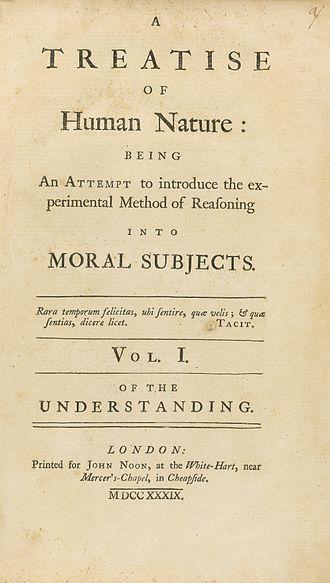
SECTION V.: Of the effects of custom. - David Hume, A Treatise of Human Nature [1739]
Edition used:
A Treatise of Human Nature by David Hume, reprinted from the Original Edition in three volumes and edited, with an analytical index, by L.A. Selby-Bigge, M.A. (Oxford: Clarendon Press, 1896).
About Liberty Fund:
Liberty Fund, Inc. is a private, educational foundation established to encourage the study of the ideal of a society of free and responsible individuals.
Copyright information:
The text is in the public domain.
Fair use statement:
This material is put online to further the educational goals of Liberty Fund, Inc. Unless otherwise stated in the Copyright Information section above, this material may be used freely for educational and academic purposes. It may not be used in any way for profit.
- Editor’s Preface.
- Book I: Of the Understanding
- Introduction.
- Part I.: Of Ideas, Their Origin, Composition, Connexion, Abstraction, &c.
- Section I.: Of the Origin of Our Ideas.
- Section II.: Division of the Subject.
- Section III.: Of the Ideas of the Memory and Imagination.
- Section IV.: Of the Connexion Or Association of Ideas.
- Section V.: Of Relations.
- Section VI.: Of Modes and Substances.
- Section VII.: Of Abstract Ideas.
- Part II.: Of the Ideas of Space and Time.
- Section I.: Of the Infinite Divisibility of Our Ideas of Space and Time.
- Section II.: Of the Infinite Divisibility of Space and Time.
- Section III.: Of the Other Qualities of Our Ideas of Space and Time.
- Section IV.: Objections Answer’d.
- Section V.: The Same Subject Continu’d.
- Section VI.: Of the Idea of Existence, and of External Existence.
- Part III.: Of Knowledge and Probability.
- Section I.: Of Knowledge.
- Section II.: Of Probability; and of the Idea of Cause and Effect.
- Section III.: Why a Cause Is Always Necessary.
- Section IV.: Of the Component Parts of Our Reasonings Concerning Cause and Effect.
- Section. V.: Of the Impressions of the Senses and Memory.
- Section VI.: Of the Inference From the Impression to the Idea.
- Section VII.: Of the Nature of the Idea Or Belief.
- Section VIII.: Of the Causes of Belief.
- Section IX.: Of the Effects of Other Relations and Other Habits.
- Section X.: Of the Influence of Belief.
- Section XI.: Of the Probability of Chances.
- Section XII.: Of the Probability of Causes.
- Section XIII.: Of Unphilosophical Probability.
- Section XIV.: Of the Idea of Necessary Connexion.
- Section XV.: Rules By Which to Judge of Causes and Effects.
- Section XVI.: Of the Reason of Animals.
- Part IV.: Of the Sceptical and Other Systems of Philosophy.
- Section I.: Of Scepticism With Regard to Reason.
- Section II.: Of Scepticism With Regard to the Senses.
- Section III.: Of the Antient Philosophy.
- Section IV.: Of the Modern Philosophy.
- Section V.: Of the Immateriality of the Soul.
- Section VI.: Of Personal Identity.
- Section VII.: Conclusion of This Book.
- Book II: Of the Passions
- Part I.: Of Pride and Humility.
- Section I.: Division of the Subject.
- Section II.: Of Pride and Humility; Their Objects and Causes.
- Section III.: Whence These Objects and Causes Are Deriv’d.
- Section IV.: Of the Relations of Impressions and Ideas.
- Section V.: Of the Influence of These Relations On Pride and Humility.
- Section VI.: Limitations of This System.
- Section VII.: Of Vice and Virtue.
- Section VIII.: Of Beauty and Deformity.
- Section IX.: Of External Advantages and Disadvantages.
- Section X.: Of Property and Riches.
- Section XI.: Of the Love of Fame.
- Section XII.: Of the Pride and Humility of Animals.
- Part II.: Of Love and Hatred.
- Section I.: Of the Objects and Causes of Love and Hatred.
- Section II.: Experiments to Confirm This System.
- Section III.: Difficulties Solv’d.
- Section IV.: Of the Love of Relations.
- Section V.: Of Our Esteem For the Rich and Powerful.
- Section VI.: Of Benevolence and Anger.
- Section VII.: Of Compassion.
- Section VIII.: Of Malice and Envy.
- Section IX.: Of the Mixture of Benevolence and Anger With Compassion and Malice.
- Section X.: Of Respect and Contempt.
- Section XI.: Of the Amorous Passion, Or Love Betwixt the Sexes.
- Section XII.: Of the Love and Hatred of Animals.
- Part III.: Of the Will and Direct Passions.
- Section I.: Of Liberty and Necessity.
- Section II.: The Same Subject Continu’d.
- Section III.: Of the Influencing Motives of the Will.
- Section IV.: Of the Causes of the Violent Passions.
- Section V.: Of the Effects of Custom.
- Section VI.: Of the Influence of the Imagination On the Passions.
- Section VII.: Of Contiguity, and Distance In Space and Time.
- Section VIII.: The Same Subject Continu’d.
- Section IX.: Of the Direct Passions.
- Section X.: Of Curiosity, Or the Love of Truth.
- Book III: Of Morals
- Part I.: Of Virtue and Vice In General.
- Section I.: Moral Distinctions Not Deriv’d From Reason.
- Section II.: Moral Distinctions Deriv’d From a Moral Sense.
- Part II.: Of Justice and Injustice.
- Section I.: Justice, Whether a Natural Or Artificial Virtue?
- Section II.: Of the Origin of Justice and Property.
- Section III.: Of the Rules, Which Determine Property.
- Section IV.: Of the Transference of Property By Consent.
- Section V.: Of the Obligation of Promises.
- Section VI.: Some Farther Reflexions Concerning Justice and Injustice.
- Section VII.: Of the Origin of Government.
- Section VIII.: Of the Source of Allegiance.
- Section IX.: Of the Measures of Allegiance.
- Section X.: Of the Objects of Allegiance.
- Section XI.: Of the Laws of Nations.
- Section XII.: Of Chastity and Modesty.
- Part III.: Of the Other Virtues and Vices.
- Section I.: Of the Origin of the Natural Virtues and Vices.
- Section II.: Of Greatness of Mind.
- Section III.: Of Goodness and Benevolence.
- Section IV.: Of Natural Abilities.
- Section V.: Some Farther Reflexions Concerning the Natural Virtues.
- Section VI.: Conclusion of This Book.
- Appendix.
SECTION V.
Of the effects of custom.
But nothing has a greater effect both to encrease and diminish our passions, to convert pleasure into pain, and pain into pleasure, than custom and repetition. Custom has two original effects upon the mind, in bestowing a facility in the performance of any action or the conception of any object; and afterwards a tendency or inclination towards it; and from these we may account for all its other effects, however extraordinary.
When the soul applies itself to the performance of any action, or the conception of any object, to which it is not accustom’d, there is a certain unpliableness in the faculties, and a difficulty of the spirit’s moving in their new direction. As this difficulty excites the spirits, ’tis the source of wonder, surprize, and of all the emotions, which arise from novelty; and is in itself very agreeable, like every thing, which inlivens the mind to a moderate degree. But tho’ surprize be agreeable in itself, yet as it puts the spirits in agitation, it not only augments our agreeable affections, but also our painful, according to the foregoing principle, that every emotion, which precedes or attends a passion, is easily converted into it. Hence every thing, that is new, is most affecting, and gives us either more pleasure or pain, than what, strictly speaking, naturally belongs to it. When it often returns upon us, the novelty wears off; the passions subside; the hurry of the spirits is over; and we survey the objects with greater tranquillity.
By degrees the repetition produces a facility, which is another very powerful principle of the human mind, and an infallible source of pleasure, where the facility goes not beyond a certain degree. And here ’tis remarkable that the pleasure, which arises from a moderate facility, has not the same tendency with that which arises from novelty, to augment the painful, as well as the agreeable affections. The pleasure of facility does not so much consist in any ferment of the spirits, as in their orderly motion; which will sometimes be so powerful as even to convert pain into pleasure, and give us a relish in time for what at first was most harsh and disagreeable.
But again, as facility converts pain into pleasure, so it often converts pleasure into pain, when it is too great, and renders the actions of the mind so faint and languid, that they are no longer able to interest and support it. And indeed, scarce any other objects become disagreeable thro’, custom; but such as are naturally attended with some emotion or affection, which is destroy’d by the too frequent repetition. One can consider the clouds, and heavens, and trees, and stones, however frequently repeated, without ever feeling any aversion. But when the fair sex, or music, or good cheer, or any thing, that naturally ought to be agreeable, becomes indifferent, it easily produces the opposite affection.
But custom not only gives a facility to perform any action, but likewise an inclination and tendency towards it, where it is not entirely disagreeable, and can never be the object of inclination. And this is the reason why custom encreases all active habits, but diminishes passive, according to the observation of a late eminent philosopher. The facility takes off from the force of the passive habits by rendering the motion of the spirits faint and languid. But as in the active, the spirits are sufficiently supported of themselves, the tendency of the mind gives them new force, and bends them more strongly to the action.