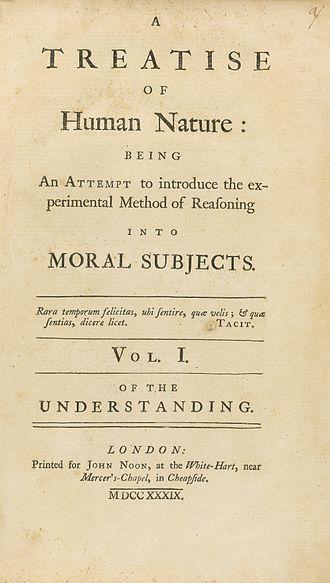
SECTION VI.: Of modes and substances. - David Hume, A Treatise of Human Nature [1739]
Edition used:
A Treatise of Human Nature by David Hume, reprinted from the Original Edition in three volumes and edited, with an analytical index, by L.A. Selby-Bigge, M.A. (Oxford: Clarendon Press, 1896).
About Liberty Fund:
Liberty Fund, Inc. is a private, educational foundation established to encourage the study of the ideal of a society of free and responsible individuals.
Copyright information:
The text is in the public domain.
Fair use statement:
This material is put online to further the educational goals of Liberty Fund, Inc. Unless otherwise stated in the Copyright Information section above, this material may be used freely for educational and academic purposes. It may not be used in any way for profit.
- Editor’s Preface.
- Book I: Of the Understanding
- Introduction.
- Part I.: Of Ideas, Their Origin, Composition, Connexion, Abstraction, &c.
- Section I.: Of the Origin of Our Ideas.
- Section II.: Division of the Subject.
- Section III.: Of the Ideas of the Memory and Imagination.
- Section IV.: Of the Connexion Or Association of Ideas.
- Section V.: Of Relations.
- Section VI.: Of Modes and Substances.
- Section VII.: Of Abstract Ideas.
- Part II.: Of the Ideas of Space and Time.
- Section I.: Of the Infinite Divisibility of Our Ideas of Space and Time.
- Section II.: Of the Infinite Divisibility of Space and Time.
- Section III.: Of the Other Qualities of Our Ideas of Space and Time.
- Section IV.: Objections Answer’d.
- Section V.: The Same Subject Continu’d.
- Section VI.: Of the Idea of Existence, and of External Existence.
- Part III.: Of Knowledge and Probability.
- Section I.: Of Knowledge.
- Section II.: Of Probability; and of the Idea of Cause and Effect.
- Section III.: Why a Cause Is Always Necessary.
- Section IV.: Of the Component Parts of Our Reasonings Concerning Cause and Effect.
- Section. V.: Of the Impressions of the Senses and Memory.
- Section VI.: Of the Inference From the Impression to the Idea.
- Section VII.: Of the Nature of the Idea Or Belief.
- Section VIII.: Of the Causes of Belief.
- Section IX.: Of the Effects of Other Relations and Other Habits.
- Section X.: Of the Influence of Belief.
- Section XI.: Of the Probability of Chances.
- Section XII.: Of the Probability of Causes.
- Section XIII.: Of Unphilosophical Probability.
- Section XIV.: Of the Idea of Necessary Connexion.
- Section XV.: Rules By Which to Judge of Causes and Effects.
- Section XVI.: Of the Reason of Animals.
- Part IV.: Of the Sceptical and Other Systems of Philosophy.
- Section I.: Of Scepticism With Regard to Reason.
- Section II.: Of Scepticism With Regard to the Senses.
- Section III.: Of the Antient Philosophy.
- Section IV.: Of the Modern Philosophy.
- Section V.: Of the Immateriality of the Soul.
- Section VI.: Of Personal Identity.
- Section VII.: Conclusion of This Book.
- Book II: Of the Passions
- Part I.: Of Pride and Humility.
- Section I.: Division of the Subject.
- Section II.: Of Pride and Humility; Their Objects and Causes.
- Section III.: Whence These Objects and Causes Are Deriv’d.
- Section IV.: Of the Relations of Impressions and Ideas.
- Section V.: Of the Influence of These Relations On Pride and Humility.
- Section VI.: Limitations of This System.
- Section VII.: Of Vice and Virtue.
- Section VIII.: Of Beauty and Deformity.
- Section IX.: Of External Advantages and Disadvantages.
- Section X.: Of Property and Riches.
- Section XI.: Of the Love of Fame.
- Section XII.: Of the Pride and Humility of Animals.
- Part II.: Of Love and Hatred.
- Section I.: Of the Objects and Causes of Love and Hatred.
- Section II.: Experiments to Confirm This System.
- Section III.: Difficulties Solv’d.
- Section IV.: Of the Love of Relations.
- Section V.: Of Our Esteem For the Rich and Powerful.
- Section VI.: Of Benevolence and Anger.
- Section VII.: Of Compassion.
- Section VIII.: Of Malice and Envy.
- Section IX.: Of the Mixture of Benevolence and Anger With Compassion and Malice.
- Section X.: Of Respect and Contempt.
- Section XI.: Of the Amorous Passion, Or Love Betwixt the Sexes.
- Section XII.: Of the Love and Hatred of Animals.
- Part III.: Of the Will and Direct Passions.
- Section I.: Of Liberty and Necessity.
- Section II.: The Same Subject Continu’d.
- Section III.: Of the Influencing Motives of the Will.
- Section IV.: Of the Causes of the Violent Passions.
- Section V.: Of the Effects of Custom.
- Section VI.: Of the Influence of the Imagination On the Passions.
- Section VII.: Of Contiguity, and Distance In Space and Time.
- Section VIII.: The Same Subject Continu’d.
- Section IX.: Of the Direct Passions.
- Section X.: Of Curiosity, Or the Love of Truth.
- Book III: Of Morals
- Part I.: Of Virtue and Vice In General.
- Section I.: Moral Distinctions Not Deriv’d From Reason.
- Section II.: Moral Distinctions Deriv’d From a Moral Sense.
- Part II.: Of Justice and Injustice.
- Section I.: Justice, Whether a Natural Or Artificial Virtue?
- Section II.: Of the Origin of Justice and Property.
- Section III.: Of the Rules, Which Determine Property.
- Section IV.: Of the Transference of Property By Consent.
- Section V.: Of the Obligation of Promises.
- Section VI.: Some Farther Reflexions Concerning Justice and Injustice.
- Section VII.: Of the Origin of Government.
- Section VIII.: Of the Source of Allegiance.
- Section IX.: Of the Measures of Allegiance.
- Section X.: Of the Objects of Allegiance.
- Section XI.: Of the Laws of Nations.
- Section XII.: Of Chastity and Modesty.
- Part III.: Of the Other Virtues and Vices.
- Section I.: Of the Origin of the Natural Virtues and Vices.
- Section II.: Of Greatness of Mind.
- Section III.: Of Goodness and Benevolence.
- Section IV.: Of Natural Abilities.
- Section V.: Some Farther Reflexions Concerning the Natural Virtues.
- Section VI.: Conclusion of This Book.
- Appendix.
SECTION VI.
Of modes and substances.
I wou’d fain ask those philosophers, who found so much of their reasonings on the distinction of substance and accident, and imagine we have clear ideas of each, whether the idea of substance be deriv’d from the impressions of sensation or reflexion? If it be convey’d to us by our senses, I ask, which of them; and after what manner? If it be perceiv’d by the eyes, it must be a colour; if by the ears, a sound; if by the palate, a taste; and so of the other senses. But I believe none will assert, that substance is either a colour, or sound, or a taste. The idea of substance must therefore be deriv’d from an impression or reflexion, if it really exist. But the impressions of reflexion resolve themselves into our passions and emotions; none of which can possibly represent a substance. We have therefore no idea of substance, distinct from that of a collection of particular qualities, nor have we any other meaning when we either talk or reason concerning it.
The idea of a substance as well as that of a mode, is nothing but a collection of simple ideas, that are united by the imagination, and have a particular name assigned them, by which we are able to recall, either to ourselves or others, that collection. But the difference betwixt these ideas consists in this, that the particular qualities, which form a substance, are commonly refer’d to an unknown something, in which they are supposed to inhere; or granting this fiction should not take place, are at least supposed to be closely and inseparably connected by the relations of contiguity and causation. The effect of this is, that whatever new simple quality we discover to have the same connexion with the rest, we immediately comprehend it among them, even tho’ it did not enter into the first conception of the substance. Thus our idea of gold may at first be a yellow colour, weight, malleableness, fusibility; but upon the discovery of its dissolubility in aqua regia, we join that to the other qualities, and suppose it to belong to the substance as much as if its idea had from the beginning made a part of the compound one. The principle of union being regarded as the chief part of the complex idea, gives entrance to whatever quality afterwards occurs, and is equally comprehended by it, as are the others, which first presented themselves.
That this cannot take place in modes, is evident from considering their nature. The simple ideas of which modes are formed, either represent qualities, which are not united by contiguity and causation, but are dispers’d in different subjects; or if they be all united together, the uniting principle is not regarded as the foundation of the complex idea. The idea of a dance is an instance of the first kind of modes; that of beauty of the second. The reason is obvious, why such complex ideas cannot receive any new idea, without changing the name, which distinguishes the mode.