Econlib

The Library

Other Sites

Front Page arrow Titles (by Subject) arrow CHAPTER FORTY–FIVE. - Magna Carta: A Commentary on the Great Charter of King John, with an Historical Introduction

Return to Title Page for Magna Carta: A Commentary on the Great Charter of King John, with an Historical Introduction

Search this Title:

Also in the Library:

Collection: Goodrich Seminar Room
Subject Area: Law
Collection: Classics of Liberty

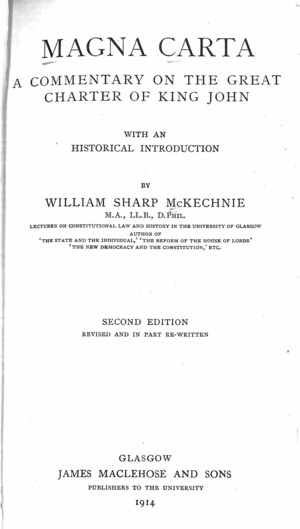
CHAPTER FORTY–FIVE. - William Sharp McKechnie, Magna Carta: A Commentary on the Great Charter of King John, with an Historical Introduction [1215]

Edition used:

Magna Carta: A Commentary on the Great Charter of King John, with an Historical Introduction, by William Sharp McKechnie (Glasgow: Maclehose, 1914).

About Liberty Fund:

Liberty Fund, Inc. is a private, educational foundation established to encourage the study of the ideal of a society of free and responsible individuals.


CHAPTER FORTY–FIVE.

Nos non faciemus justiciarios, constabularios, vicecomites vel ballivos, nisi de talibus qui sciant legem regni et eam bene velint observare.

We will appoint as justices, constables, sheriffs, or bailiffs only such as know the law of the realm and mean to observe it well.

The object of this plainly worded clause was to prevent the appointment of unsuitable men to responsible posts under the Crown. The list of officers is a comprehensive one—justices, sheriffs, constables and bailiffs—embracing all royal ministers and agents, both of the central and of the local government, from the chief justiciar down to the humblest serjeant.3 This clause was directed in particular against John’s foreign favourites such as the Poitevin Bishop of Winchester, Peter des Roches, who had wielded the authority of chief justiciar in 1214 when the King was abroad,4 or such as Engelard de Cigogné, stigmatized by name in a later part of Magna Carta.5 Such men had no interests at stake in England, and little love for its customs and free traditions. In future John must choose a different type of servants, avoiding all such unscrupulous men, whether Englishmen or foreigners, as were ready to break the law in their master’s interests or their own. But what class were to fill their places?

Bishop Stubbs credits the framers of the Charter with an intention to secure the appointment of men well versed in legal science: “on this principle the steward of a court–leet must be a learned steward.”1 The clause of Magna Carta, however, refers to royal nominees, not to the officers appointed by mesne lords to preside over their feudal courts. The barons appointed their own stewards and bailiffs, and had no wish to hamper their own freedom of choice; but only that of the King. Further, the barons did not desire that John should employ men steeped in legal lore, but plain Englishmen with a rough–and–ready knowledge of insular usage, who would avoid arbitrary acts condemned by the law. The barons at Runnymede desired precisely what the council of St. Albans had desired on 4th August, 1213, when it issued formal writs to sheriffs and foresters to observe the laws of Henry I. and abstain from unjust exactions;2 and these laws of Henry were but the laws of Edward Confessor (or, in reality, of Canute) slightly amended.

The attitude of John’s barons was the same as that of Henry’s barons, when the latter declared, in 1234, in emphatic terms, that they did not wish the laws of England to be changed.3 They were far from desiring to be governed by ministers deeply versed in the science and literature of jurisprudence, since these would necessarily have been churchmen and civilians.

This well–meaning provision of Magna Carta disappeared in 1216 (without any comment in the so–called “respiting clause”). Even if it had remained intact, it would not have effected much, in the absence of adequate machinery to ensure its enforcement. In promising the appointment of such ministers as knew the law and meant to keep it, John remained sole judge of the men appointed and their intentions. The clause indicated no standard of fitness, no neutral arbitrator to decide between fit and unfit,4 and no sanction to enforce compliance on an unwilling King. Half a century later, the Provisions of Oxford gave proof of some advance in political theory. They contained an expedient, crude enough it is true, for constraining royal officials to keep the law: forms of an oath of office to be taken by castellans and ministers of all grades were carefully provided.1 Even this was only a first step towards settling a problem not completely solved until the modern doctrine of ministerial responsibility was firmly established.2

[3 ]Constable and bailiff are discussed supra, c. 24, and shown to include forest magistrates, supra, c. 44.

[4 ]See supra, p. 30, and cf. Blackstone, Great Charter, viii.

[5 ]See c. 50.

[1 ]Const. Hist., I. 578 n.

[2 ]Cf. supra, p. 28.

[3 ]Nolunt leges Anglie mutare que usitate sunt et approbate.” See Statute of Merton, c. 9.

[4 ]It would have been a notable anticipation of modern constitutional theory if the barons in 1215 had referred such questions to the decision of the Commune Concilium summoned as in c. 14 (q.v.).

[1 ]See Select Charters, 388–391, and Madox, II. 149, with authorities there cited.

[2 ]Prof. Adams seems to make too much of this chapter (Origin, 259–260). It is only a vague promise to employ honest officials: it confers no constitutional veto upon anyone. Had the function of defining fit ministers been conferred on the Common Council, it would have been a notable innovation.