EconlibThe LibraryOther Sites |
Front Page Titles (by Subject) PART III.: MAGNA CARTA: ITS FORM AND CONTENTS. - Magna Carta: A Commentary on the Great Charter of King John, with an Historical Introduction
Return to Title Page for Magna Carta: A Commentary on the Great Charter of King John, with an Historical IntroductionThe Online Library of LibertyA project of Liberty Fund, Inc.Search this Title:Also in the Library:
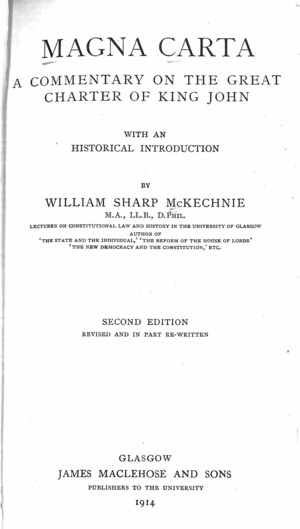
PART III.: MAGNA CARTA: ITS FORM AND CONTENTS. - William Sharp McKechnie, Magna Carta: A Commentary on the Great Charter of King John, with an Historical Introduction [1215]Edition used:Magna Carta: A Commentary on the Great Charter of King John, with an Historical Introduction, by William Sharp McKechnie (Glasgow: Maclehose, 1914).
About Liberty Fund:Liberty Fund, Inc. is a private, educational foundation established to encourage the study of the ideal of a society of free and responsible individuals. Copyright information:The text is in the public domain. Fair use statement:This material is put online to further the educational goals of Liberty Fund, Inc. Unless otherwise stated in the Copyright Information section above, this material may be used freely for educational and academic purposes. It may not be used in any way for profit.
PART III.MAGNA CARTA: ITS FORM AND CONTENTS.I.Its Prototypes: Earlier Charters.The traditional view makes Magna Carta the direct descendant of Henry Beauclerk’s Coronation Charter, which is, in turn, regarded as merely an amplification of the old coronation oath sworn by the Conqueror and his sons, in terms borrowed from a long line of Anglo–Saxon kings, stretching back from Edward Confessor to Edgar, Alfred and Egbert, until its origin is lost in the mists of antiquity. According to this time–honoured view, which insists on an exclusively Anglo–Saxon pedigree for the charters of Norman and Angevin kings, the charters of Henry I. and John were regarded as confirmations to the nation at large of the essential principles of the old laws of Alfred and of Edward, thus bridging over, alike in form and substance, the gulf of the Norman Conquest. The accuracy of these preconceptions has of late years been rudely questioned. The simple formula for solving all problems of English constitutional origins by assuming an unmixed Anglo–Saxon ancestry, has been challenged from more sides than one. Magna Carta, like the Constitution itself, is of mixed parentage, tracing its descent not entirely from Teutonic, but partly from Norman, and even Danish and Celtic sources. In the first place, John’s Charter derives some of its vital clauses from documents not couched in charter form. The Constitutions of Clarendon of 1164 and the Forma Procedendi of 1194 are as undoubtedly antecedents of Magna Carta as is the Coronation Charter of Henry itself. The same is true of many grants made by successive kings of England to the Church, to London and other cities, and to individual prelates and barons. (In a sense, the whole previous history of England went to the making of Magna Carta.) Then, again, the exclusively Anglo–Saxon origin of the antecedents of Henry’s Charter is by no means left unchallenged. A recent American writer, attacking the older theories as advanced by Bishop Stubbs, has formulated these three propositions: that Henry’s charter was feudal in character rather than constitutional or national, promising “a regulated feudal government” purged of Rufus’ misdeeds rather than a return to a “national” type of government; that its substance was derived from Norman innovations rather than from the Confessor’s or Canute’s laws; and that its form was founded on continental models, possibly on some Norman borough charter, and by no means on the old coronation oath.1 These iconoclastic theories require to be modified: the claims of Magna Carta, on its formal side, at least, to an Anglo–Saxon ancestry have found a powerful advocate in Mr. W. H. Stevenson,2 who holds that the Anglo–Norman charters of liberties “are developments of the Anglo–Norman writ charter, and that in its turn is . . . merely the Anglo–Saxon writ translated into Latin.”3 Looking both to the contents and the formalities of execution of John’s Great Charter, the safer opinion would seem to be, that, like the English Constitution, it is of mixed origin, deriving elements from ancestors of more races than one; but that the traditional line of descent from the oaths and writs of Anglo–Saxon kings, through the Charter of Henry I., is one that cannot be neglected. The promises of good government that connect King John with the old kings of Wessex are thus the outcome of an essential feature of the ancient monarchy, and of the rules that regulated succession to the Crown. Two rival principles, the elective and the hereditary, from an early date, had struggled for the mastery. In an unsettled state of society, nations cannot allow the sceptre to pass to an infant or a weakling. When a king died, leaving a son of tender age and a brother of mature ability, the magnates of the kingdom, the so–called Witan, claimed the right to choose a fitting successor. The exact relations between the elective and the hereditary principles were never laid down with absolute precision: the practice usually followed by the Witenagemot was to select some near kinsman of the late king competent for the post. The king–elect had still to be solemnly anointed, and this gave to the Church an important share in deciding who should be king. Not later than the days of Edgar, it became the practice for the officiating archbishop to exact an oath of good government from the new sovereign before his final coronation. The terms of this oath became stereotyped; and, as administered by Dunstan to King Ethelred, they are still extant.1 This may be analyzed into three promises—peace to God’s Church and people; repression of violence in men of every rank; justice and mercy in all judgments. When William I., anxious in all things to fortify the legality of his title, took the oath in solemn form, he created a precedent of tremendous importance, although he may have regarded it at the moment as an empty formality.2 The quasi–elective character of the kingship, the need for coronation by the Church, and this tripartite oath were all preserved. This was of vital moment, because limits were thereby placed, in theory at least, to prerogatives that threatened to become absolute. The power of the Norman kings might almost be described as irresponsible despotism, tempered by fear of rebellion. Three forces, indeed, acted as curbs: the necessity for consulting the Curia Regis; the restraining influence of the Church; the growth of a body of public opinion, confined as yet to the upper classes. These elements counted for something, but failed to restrain sufficiently even an average king; while they were powerless against a strong ruler, like William I. The moment at which the Crown might be taken at disadvantage was during the interregnum that followed a king’s death. Thus, William Rufus, anxious to prevent his elder brother Robert from making good his claim to the English throne, succeeded chiefly through the friendship of Lanfranc. To gain this, he was compelled to make promises of good government, taking oath in the ancient form. In the same reign, began the practice of supplementing verbal promises by sealed charters. No such charter was indeed issued either by Rufus or his father when they were crowned; but the younger William, at a critical period in his reign, granted a short Charter of Liberties, the text of which has not come down to us. By a treaty made at Caen in 1091, Duke Robert and Rufus agreed that each should constitute the other his heir. Thus, at Rufus’ death, Henry was, in a sense, a usurper, and this made it necessary for him to bid high for influential support.1 It is to this doubtful title that Englishmen owe the first Charter of Liberties that has come down to us.2 Roger of Wendover relates how “as many charters were made as there are counties in England, and by the King’s command they were deposited in the abbeys of every county as a memorial,” and this is confirmed by an analysis of the copies still preserved.1 Henry’s coronation charter was the price paid for support in his candidature for the Crown. Its terms contain, however unconsciously, an indictment of his brother Rufus’ government and, perhaps, in part also of his father’s. The new king was merely “playing to the gallery”: when his purpose was served, his promises were broken.2 On the bearing of these promises there is room for diversity of opinion. Dr. Stubbs’ contention that Henry “definitely commits himself to the duties of a national king”3 has been rejected, as already explained, by recent critics. The more modern view is strengthened by an analysis of the Charter, revealing important concessions to the barons and the Church, while those to the people at large were few and vague. Of the fourteen chapters into which it is usually divided, chapter one proceeds on the narrative that the kingdom had been oppressed by unjust exactions. Henry, in the first place, makes free the holy Church of God, “so that I shall neither sell nor farm out nor, on the death of archbishop, or bishop or abbot, accept anything from the demesne of the church or from its feudal–tenants until a successor has been inducted to it.” It seems doubtful whether the regrettably vague phraseology of the qualifying clause is intended merely to apply the generalities of the church’s “freedom” to specific instances, or whether it must be taken as a deliberate restriction. The prohibition of selling has been read as referring to the simoniacal practice of taking money from aspirants to episcopal preferments; but more probably it was meant to prohibit the alienation of the property of a vacant see, a practice that must have been often resorted to, if we judge from the efforts at recovery made by successive archbishops, notably by Becket. This reading is the more probable from the fact that “selling” is here coupled with “farming out,” an expedient clearly inapplicable to prelatical appointments and referring to the Crown’s practice of granting leases of the lands of vacant sees for nominal annual returns in consideration of a heavy grassum paid to the Treasury at the commencement of the lease. The rest of the clause is best interpreted as a renunciation of the claim to exact either a “relief” from a prelate on his appointment or payments in lieu of relief from tenants of a vacant see or royal abbey.1 The last clause of the chapter abrogates evil customs whereby the kingdom was unjustly oppressed, and then proceeds to define them—a process that occupies the remaining thirteen chapters of the document. Chapter 2 promises that reliefs of feudal tenants should be “just and legitimate.”2 Chapters 3 and 4 guard against abuse of the feudal incidents of marriage and wardship.3 Chapter 5 abolishes as an innovation “the common mintage” (an exaction levied by the mints when the coinage was altered),4 and enjoined the punishment of any one taken with false money—provisions finding no echo in John’s Charter. Chapter 6 remits a number of arrears, reliefs, and penalties due to Rufus at his death. Chapter 7 confirms crown–tenants in the right to dispose of their personal estate by will, and provides for the division of the property of intestates among their wives, children, relations, and vassals, and for the good of their own souls.5 Chapter 8 seems to promise the total abolition of the Norman system of forfeitures and amercements (in respect of petty offences, as opposed to treasons and crimes) and a return to the Anglo–Saxon system of a fixed tariff of bots and wites.6 Chapter 9 is concerned with the “murdrum” fine—a payment exacted by the Norman kings from all the inhabitants of a hundred in which a corpse had been found, where the slayer remained undiscovered and the dead man’s identity as a person of English birth could not be proved. “Murder” was thus primarily secret slaying, in the sense that the perpetrator was not known, and, secondarily, the fine exacted on that account. This heavy fine, whose original amount is variously given as 40 or 46 marks, was intended as a protection to Normans against the native Englishry they oppressed. Henry remitted all “murder–fines” incurred before his coronation, and promised that those incurred after that date should be “justly” paid for “in accordance with the law of King Edward”—a clause difficult to reconcile with the recognized opinion that the murdrum was unknown in England prior to 1066, unless on the supposition that the draftsman of the Charter of 1100 was strangely ignorant of the usages of thirty–four years earlier. Perhaps the “murder–fine” was not an invention of the Conqueror and his sons, but an old English institution put by the Normans to new uses. An alternative suggestion may be hazarded that here (as perhaps elsewhere in the charter) the reference to the good laws of Edward was a mere tag or “common form,” meant to please his subjects without committing the King to anything in particular. Chapter 10 contains no concession (unless it be an implied renunciation of Rufus’ encroachments), but, on the contrary, a blunt intimation that Henry, with his barons’ consent, would retain the forests as his father had had them. The barons’ consent may be partly explained by their expectation to enjoy, as more or less habitually in attendance upon Henry, a share in the pleasures of the hunt of which the King was “master.” By chapter II., Henry concedes “proprio dono meo to knights holding their lands per loricas [that is, by knight’s service] to have the lands of their demesne ploughs quit of all gelds and of every [non–military] service, in order that, as being relieved by so great a relief, so they might effectually provide themselves with horses and arms for my service and the defence of my kingdom.” In thus exempting Crown–tenants holding by the “hauberk” (that is to say his “barons,” in the wider sense of the word) from Danegeld, on the distinct understanding that they should keep in readiness an efficient military equipment, Henry aimed at making hard–and–fast an old and fluctuating rule that prohibited Crown–tenants from being subjected to a double set of burdens. The lands of knights and churchmen, who already served the King in other ways, were not expected to contribute Danegeld in respect of their home–farms. Holders of knight’s fees, however, must keep proper weapons and armour for themselves and their horses—an obligation involving an expenditure constantly increasing with every advance in the art of war. The chapter thus recognizes a contrast between land subject to military service and land subject to geld; “the inland and warland of old English fiscal arrangements, the dominium and terra geldabilis respectively of the Geld Roll of 1084.”1 The fact that Henry’s Charter draws so sharp a line between the two, suggests that the barons may have made this a condition of their support of his claims against those of Robert. Henry’s promise, however, was never strictly carried out: the practice continued to fluctuate. Under Henry II., only the barons of the Exchequer and a few privileged religious persons enjoyed exemption.2 Gradually the distinction between inland and warland became extinct. The remaining clauses of the Charter of Henry I. are mainly of a formal character. Chapter 12 declares a firm peace for the future throughout his kingdom—thus marking the end of the interregnum consequent on his brother’s death. Chapter 13, on the strength of which wide–reaching theories have sometimes been built, seems to be merely an amplification of the purely formal chapter that precedes it: it restores the law of Edward, with the reforms his father had effected with the barons’ consent. The old law was vague; the innovations definite and well known. Chapter 14 proclaims terms and conditions of indemnity, extended to those guilty of acts of spoliation during the interregnum now brought to an end. These provisions, taken as a whole, contain little to justify Henry’s claim to rank as a constitutional or national sovereign. The bulk of the concessions are made to the barons. The Church, it is true, obtains a definite promise in chapter one: but the individuals who would chiefly benefit were newly–appointed prelates, who became feudal vassals on entering upon the lands of their sees. Chapters 2 and 4 confine their benefits to Crown–tenants and sub–tenants, and are therefore purely feudal and not “national” in their range. They may be compared with the clauses of John’s Charter that extend some of its provisions to sub–tenants. Chapters 12 and 13, with their vague affirmation of a firm peace, and of the old English law, now half–forgotten (undefined and declared valid only so far as unaltered by William I.), are the only grants “to the people at large.” The baronial element clearly triumphs over the “national,” in the tenor and outlook of the famous coronation charter.1 There are three intermediate links in the chain of charters connecting those of Henry I. and John, namely, the two charters of Stephen and that of Henry II.2 The circumstances of the accession of the earlier King were peculiar. Henry I. had nominated his only child Matilda as his heir: his nephew, Stephen, and all the English barons had done homage to her as their future liege lady. Stephen, however, taking advantage of Matilda’s absence and unpopularity, and of the barons’ reluctance to be ruled by a woman, made a bold dash for the Crown. From the moment of the old King’s death, “the Norman barons treated the succession as an open question”: in these words of Stubbs,1 Dr. Round finds2 the keynote of the reign. Stephen was prepared to bid higher for support than Henry had felt compelled to do: like William of Orange, five centuries later, he agreed to become “king upon conditions.” A Charter of Liberties and a solemn oath securing “the liberty of the Church” together formed the price of Stephen’s consecration; and this price was not perhaps too high when we remember that “election was a matter of opinion, coronation a matter of fact.”3 The process by which he built up a title to the Crown culminated in the Easter of 1136, when he secured the support of Matilda’s half–brother Robert, Earl of Gloucester, whose lead was quickly followed by influential nobles who, however, performed homage under an important reservation; their future loyalty would be strictly conditional on the treatment extended to them by Stephen. These transactions took place at Oxford;4 at the same time the King issued his second or Oxford Charter, which combined the provisions of the oath to the Church and of the vague earlier charter, with the conditions extorted by Earl Robert and his followers. The opening words contain a laboured attempt to set forth a valid title to the throne. All reference to predecessors is avoided, and Stephen declares himself king “by appointment of the clergy and people, by consecration of the Archbishop and papal legate, and by the Pope’s confirmation.5 Perhaps its chief provisions are those in favour of the Church, supplementing a vague declaration that the Church should be “free” by specific promises that the bishops should have exclusive jurisdiction and power over ecclesiastics and their goods, with the sole right to superintend their distribution after death. Here was a clear confirmation of the right of the Courts Christian to a monopoly of all pleas affecting the clergy or their property. Stephen also renounced wardship over church lands during vacancies—a surrender never dreamt of by Henry I. or Henry II. Grants to the people at large followed. A general clause promising peace and justice was supplemented by specific concessions of more practical value, namely, a promise to extirpate all exactions, unjust practices, and “miskennings” by sheriffs and others, and to observe good, ancient, and just customs in respect of murder–fines, pleas, and other causes. Strangely enough, there is only one provision specially benefiting feudal magnates, the King’s renunciation of all tracts of land afforested since the time of the two Williams. The omission of further feudal concessions must not be attributed either to Stephen’s strength, or to any spirit of moderation or self–sacrifice in the magnates. Each baron of sufficient importance had already extorted a private charter, more valued than a general provision in favour of all and sundry. Such grants often included the right to maintain a feudal stronghold, whose owner would enjoy a position of practical independence. It is instructive to compare these wide promises of Stephen with the meagre words of the charter granted by Henry of Anjou at or soon after his coronation.1 Henry II. omits all mention of Stephen and his charters, not because he did not wish to acknowledge a usurper, but because of that usurper’s lavish grants to the Church. Henry had no intention to confirm “benefit of clergy” in so sweeping a form, or to renounce wardship over vacant sees. To the Church, as to the barons, Henry confirms only what his grandfather had already conceded. Even compared with the charter of Henry I., that of the younger Henry is shorter and less explicit—features that justified Stephen Langton in his preference for the older document. If Henry II. granted a short and grudging charter, neither of his sons, at their coronations, granted any charter at all. Reasons for the omission readily suggest themselves; the Crown had grown strong enough to dispense with this unwelcome formality, partly because of the absence of rival competitors for the throne, and partly because of the perfection to which the machinery of government had been brought. The utmost the Church could extract from Richard and John, as the price of their consecration, was the renewal of the three vague promises contained in the oath, now taken as a pure formality. John, however, was not to be allowed to shake himself free from the obligations of his oath. Stephen Langton, before absolving him in 1213, compelled him to swear it anew.1 Not only were the terms of the ancient oath riveted anew on John’s conscience, but, as has been shown, the coronation Charter of Henry I., exhibited by the Primate in times of crisis to the nobles, and used in preparing the schedules that formed the rough drafts of the Articuli Baronum, was made a curb for royal caprice. It is thus impossible to neglect the importance of the sequence of coronation oaths and charters as contributors both to the form and substance of Magna Carta, although that is only one of the many lines of descent through which the Great Charter can trace its ancestry. II.Magna Carta: its Form and Juridical Nature.The juridical nature of the document to which John set his seal at Runnymede will be differently estimated according as it is judged by present–day or by medieval standards. (1) The Modern Point of View. Much ingenuity has been expended in the effort to discover which particular category of modern jurisprudence most accurately describes the Great Charter. Is it an enacted law, or a treaty; the royal answer to a petition; or a declaration of rights? Is it a simple pact, bargain, or agreement between contracting parties? Or is it a combination of two or more of these? Something has been said in favour of almost every possible view, perhaps more to the bewilderment than to the enlightenment of students of history uninterested in legal subtleties. The claim of Magna Carta to rank as a formal act of legislation has been supported on the ground that it was promulgated in what was practically a commune concilium. King John, it is maintained, met in a national assembly all the estates of his realm who had any political rights, and these concurred with him in the grant. The consent of all who claimed a share in the making of laws—archbishops, bishops, abbots, earls, and crown–tenants, great and small—entitles the Charter to rank as a statute. Against this view, however, technical informalities may be urged. Both the composition of the Council and the procedure adopted there, were irregular. No formal writs of summons had been issued, and, therefore, the meeting was never properly constituted. Further, the whole proceedings were tumultuary; the barons, assembled in military array, compelled the consent of John by show of force. On these grounds, modern jurisprudence, if appealed to, would reject the claim of the Charter to be enrolled as an ordinary statute. It may be argued also that Magna Carta, while something less than a law, is also something more. A law made by the king in one national assembly might be repealed by the king in another; whereas the Great Charter was intended by the barons to be unchangeable. It was granted to them and their heirs for ever; and, in return, a price had been paid, namely, the renewal of their allegiance.1 Magna Carta has also been described as a treaty. Such is the verdict of Dr. Stubbs.2 “The Great Charter, although drawn up in the form of a royal grant, was really a treaty between the King and his subjects. . . . It is the collective people who really form the other high contracting party in the great capitulation.”3 This view receives some support from words contained in chapter 63 of the Charter: “Juratum est autem tam ex parte nostra quam ex parte baronum, quod haec omnia supradicta bona fide et sine malo ingenio observabuntur.” There is, however, a radical objection. A treaty is a public act between two contracting powers, who must, to meet the requirements of modern jurisprudence, be independent States or their accredited agents; while John and his opponents were fragments of one State, torn asunder by mutual jealousies. For other authorities, Magna Carta is a contract, pact, or private agreement. M. Emile Boutmy is of this opinion:—“Le caractère de cet acte est aisé à définir. Ce n’est pas précisément un traité, puisqu’il n’y a pas ici deux souverainetés légitimes ni deux nations en présence; ce n’est pas non plus une loi; elle serait entachée d’irrégularité et de violence; c’est un compromis ou un pacte.”1 Thus considered, the proudest act of the national drama would take its place in the legal category which includes the hire of a waggon or the sale of a load of corn. There are, however, objections to this theory also. It is difficult to see how the plea of “force,” if sufficient (as M. Boutmy urges) to render null the enactment of a public law, would not be even more effective in reducing a private agreement. If Magna Carta has no other basis than the consent of the contracting parties, it seems safer to describe it as a public treaty than a private pact. Other theories also are possible; as, for example, that the Great Charter is of the nature of a Declaration of Rights, such as have played so prominent a part in France and the United States; while a recent American writer on English constitutional development regards it as a code, creating a formal constitution for England—in a rude and embryonic form, it is true:—“If a constitution has for its chief object the prevention of encroachments and the harmonizing of governmental institutions, Magna Carta answers to that description, at least in part.”2 It would be easy to cite compromises between these competing theories. Thus, a high authority declares that “the Great Charter is partly a declaration of rights, partly a treaty between Crown and people.”1 The essential nature of what took place at Runnymede, in June, 1215, is plain, when stripped of legal subtleties. A bargain was struck, between the King and his rebel magnates, that, in return for a renewal of fealty and homage, John would grant “to the freemen of England and their heirs for ever” the liberties enumerated in sixty–three chapters. No one thought of asking whether the transaction thus concluded was a “treaty” or a private “contract.” The terms had to be drawn up in legal form, so as to bear record to the exact nature of the provisions, and also to the authenticity of John’s consent. It was, therefore, reduced to writing, and the resulting document was naturally couched in the form invariably used for all irrevocable grants intended to descend from father to son, namely, a feudal charter, authenticated by the impression of the granter’s seal—just as in the case of a grant of land, and with many of the clauses appropriate to such a grant.2 John grants to the freemen of England and their heirs certain specified rights and liberties, as though these were so many hides of land.3 The legal effect of such a grant is hard to determine; and insuperable difficulties beset any attempt to expound its legal consequences in terms of modern law.4 In truth, the form and substance of Magna Carta are badly mated. Its substance consists of a number of legal enactments and political and civil rights; its form is borrowed from the feudal lawyer’s book of styles for conferring a title to landed estate.1 The results of this part of the inquiry seem, then, to be mainly negative. It is misleading to describe phenomena of the thirteenth century in modern phraseology which would have been unintelligible to contemporaries. Yet, if it is necessary to make the attempt, Magna Carta may perhaps be regarded as an agreement partaking of the natures alike of a statute and a royal grant, of a public treaty and a private contract, yet identical with no one of these, but (in any view) enacting or proclaiming a number of rules and customs as binding in England, and reducing them to writing in the unsuitable form of a feudal charter granted by King John to the freemen of England and their heirs.2 (2) The Contemporary Standpoint. It is perhaps more profitable to enquire under what category of medieval jurisprudence Magna Carta would have fallen, if its contemporaries had consciously attempted its classification. In Dr. Vinogradoff’s phrase: “The best way to solve these problems is perhaps to locate our document in the pigeon–holes of medieval and not of modern rubrication.”3 Answering his own question, he proceeds to range it, partly as a unilateral grant by John to his subjects and partly as of the nature of the medieval expedient known to the continent of Europe as an “establishment” (stabilimentum or établissement). No exact definition of a stabilimentum need be expected from an age accustomed to a vague use of words; but its essence seems to have been a legislative act, more or less of an institutional and exceptional nature, affecting the general welfare of the country, and thus requiring collective action by all classes or estates. The elements of authority dispersed among the various participants in legislative or sovereign power had to be concentrated round the King, somewhat as the consent of all first–class States has to be obtained at the present day for effecting a change in the rules of International Law observed by civilized nations.1 Legislative acts similar to the établissements of Capetian Kings were not unknown in England. The main purport of the Statute of York (1322), for instance, according to its latest interpreter,2 would seem to be that consent of “the community” (or “commonalty,” as it is usually rendered), as well as of the prelates, earls and barons, should be needed for any change of the nature of an “establishment,” which thus means an alteration in the framework of government. Magna Carta contemplated in chapter 61 an institutional innovation, parallels to which may be found in the more or less oligarchical schemes of 1244, 1258, 1264 and 1311. The historical importance of such restrictions upon the method of legislation required for changing the framework of government, lies in their bearing on the development of a system of Estates and of the future Parliament of the three Estates.3 III.Magna Carta: its Contents and Characteristics.The rights enumerated in the sixty–three chapters of the Charter, representing the price paid by John for renewed allegiance, are fully discussed in the main part of the present volume: a brief description of their more prominent characteristics, when viewed as a collective whole, is, therefore, all that is here required. As to externals, the want of orderly, logical arrangement has often been noted. As John Reeves4 says: “The whole is strung together in a disorderly manner, with very little regard to the subject matter”; while a recent writer maintains that “no portion of this famous document can possibly be described as a good piece of drafting.”1 Thirteenth–century standards, however, were different from our own; and the lengthy document, with its specific remedies for many abuses, contains evidence of a carefully weighed scheme and of a deep–rooted conviction of the need of reform. The barons and royal officials who helped in framing it were ignorant of the abstract principles of political science. Their ideas, it has been truly said,2 “seem to have been concrete and practical, and in their remedies they went no further than the correction of the specific abuses from which they suffered.” The framers of the document observed (with few exceptions) great legal accuracy in defining the traditional rights of the Crown, proceeding with praiseworthy moderation and scrupulous fairness towards John.3 Three closely connected characteristics of the document, as a whole, will be brought out in the succeeding analysis: Magna Carta is feudal, contractual, and (in parts, at least) reactionary in tone. Professor Adams of Yale, giving voice to opinions now widely admitted by historians, emphasizes the crucial place occupied by “the feudal contract” as the basis alike of Magna Carta and of the medieval English constitution;4 and maintains that, from the narrower point of view of 1215, the essence of John’s Charter “in spirit, in method, and in principle,” was reaction.5 In the attempt to analyze the leading provisions, various principles of classification have been adopted: the chapters may be arranged according to the functions of the central government they were intended to limit; according to their own nature as progressive, reactionary, or declaratory; and, finally, according to the classes of the community which reaped the greatest benefit. I. Provisions classified according to the prerogatives affected. Dr. Gneist1 arranges the chapters in five groups according as they place restraints (1) on the military power of the Crown, (2) on its judicial power, (3) on its police power, (4) on its financial power, or (5) furnish a legal sanction for the enforcement of the whole. In spite of Dr. Gneist’s high authority, it is doubtful whether an analysis of Magna Carta upon these somewhat arbitrary lines throws much light on its main objects or results. Such a division is founded on distinctions not clearly formulated in the thirteenth century, when the various functions of government were still undifferentiated.2 II. Provisions classified according as they are of a progressive, reactionary, or declaratory nature. Blackstone,3 writing in 1759, expresses the generally accepted views: “It is agreed by all our historians that the Great Charter of King John was for the most part compiled from the ancient customs of the realm, or the laws of King Edward the Confessor, by which they usually mean the common law, which was established under our Saxon princes, before the rigours of feudal tenures and other hardships were imported from the continent.” Substantially the same doctrine has been enunciated only the other day, by our highest authority. “On the whole, the charter contains little that is absolutely new. It is restorative. John in these last years has been breaking the law; therefore the law must be defined and set in writing.”4 This view seems, on the whole, a correct one: the insurgents in 1215 professed to be demanding nothing new. Yet the Great Charter contained much that was unknown to the days of the Confessor and had no place in the promises of Henry I. Thus it is not sufficient to describe Magna Carta merely as a declaratory enactment: it is necessary to distinguish between the different sources of what it declared. A fourfold division may be suggested. (1) Magna Carta handed on some of the usages of the old English law unchanged by the Conqueror or his successors, now confirmed and purified from abuses. (2) In defining feudal incidents and services, it confirmed many rules of the feudal law brought into England by the Normans after 1066. (3) It also embodied many provisions of which William I. and even Henry I. knew no more than did the Anglo–Saxon kings—innovations introduced for his own purposes by Henry of Anjou, but, after half a century of experience, now accepted loyally even by the most bitter opponents of the Crown. In the words of Mr. Prothero, “We find . . . the judicial and administrative system established by Henry II. preserved almost intact in Magna Carta, though its abuse was carefully guarded against.”1 Finally, (4) in some few points, the Charter aimed at going farther than Henry II. had intended to go: to mention only two particulars, the petty assizes are to be taken four times a year, while sheriffs are prohibited from holding pleas of the Crown. History, indeed, has proved that a purely declaratory enactment is impossible: the mere lapse of time, by producing an altered context, changes the purport of any statute re–enacted in a later age. It is no unusual device for innovators to render their reforms more palatable by presenting them disguised as returns to the past. Further, it is important to bear in mind the nature of the provisions confirmed. A re–statement of some of the reforms of Henry II. leads logically to progress rather than to mere stability; while the confirmation of Anglo–Saxon usages or of ancient feudal customs, fast disappearing under the new régime, may imply retrogression rather than standing still. Chapters 34 and 39 of Magna Carta, for example, really demand a return to the system in vogue prior to the innovations of Henry of Anjou, when they favour feudal jurisdictions. Thus, some of the provisions of the Great Charter which, at a casual glance, appear declaratory, are, in reality, innovations; while others tend towards reaction. III. Provisions classified according to the estates of the community in whose favour they were conceived. Here we are face to face with a fundamental question of immense importance: Does the Great Charter really, as the orthodox view so vehemently asserts, protect the rights of the whole mass of humble Englishmen equally with those of the proudest noble? Or is it rather a series of concessions to feudal selfishness wrung from the King by a handful of powerful aristocrats? On such questions, learned opinion is sharply divided, although an overwhelming majority of authorities range themselves on the popular side, from Coke down to writers of the present day. Lord Chatham, in one of his great orations,1 insisted that the barons who wrested the Charter from John established claims to the gratitude of posterity because they “did not confine it to themselves alone, but delivered it as a common blessing to the whole people”; and Sir Edward Creasy2 caps these words with more ecstatic words of his own, declaring that one effect of the Charter was “to give and to guarantee full protection for property and person to every human being that breathes English air.” Staid lawyers and historians like Blackstone and Hallam use similar expressions. “An equal distribution of civil rights to all classes of freemen forms the peculiar beauty of the charter”; so we are told by Hallam.3 Bishop Stubbs unequivocally enunciated the same doctrine. “Clause by clause the rights of the commons are provided for as well as the rights of the nobles. . . . This proves, if any proof were wanted, that the demands of the barons were no selfish exactions of privilege for themselves.”4 “The rights which the barons claimed for themselves,” says John Richard Green,5 “they claimed for the nation at large.” It would be easy to add to this “cloud of witnesses,” but enough has been said to prove that it has been a common boast of Englishmen, for many centuries, that the provisions of the Great Charter were intended to secure, and did secure, the liberties of every class and individual, not merely those of the feudal magnates. It is a usual corollary to this theory, to attribute credit to Stephen Langton for broad–minded statesmanship: the so–called “Articles of the Barons” are really, it would seem, articles of the archbishop. In Miss Norgate’s words, the original articles “are obviously not the composition of the barons mustered under Robert Fitz–Walter,” who could never have risen to “the lofty conception embodied in the Charter—the conception of a contract between King and people which should secure equal rights to every class and every individual in the nation.”1 It is not safe, however, to accept, without a careful consideration of the evidence, opinions cited even from such high authorities. “Equality” is essentially a modern ideal: for many centuries after the thirteenth, class legislation maintained its prominent place on the Statute Rolls, and the interests of the various classes were by no means always identical. A vigorous minority has always protested against the popular view of Magna Carta. “It has been lately the fashion,” Hallam confesses, “to depreciate the value of Magna Charta, as if it had sprung from the private ambition of a few selfish barons, and redressed only some feudal abuses.”2 Two different parts of the Charter have a bearing on this question: chapter 1, which explains to whom the rights were granted; and chapter 61, which declares by whom they were to be enforced. The liberties were confirmed “to all freemen of my kingdom and their heirs for ever.” This opens the question—who were freemen in 1215? An enthusiasm that seeks to enhance the merits of Magna Carta by extending its provisions as widely as possible, has led commentators to stretch the meaning of “freeman” to embrace the entire population of England, including not only churchmen, merchants, and yeomen, but even villeins. Now, homo in medieval law–Latin, was originally synonymous with baro—all feudal vassals being described as “men” or “barons.” Magna Carta is a feudal grant, and the presumption is in favour of the technical feudal meaning. The word, indeed, occasionally bore a looser, wider sense; but any room for ambiguity seems to be precluded by the use of the qualifying word “free.” No villein was fully a “liber homo.” In chapter 34, for example, the “liber homo” is assumed to be a landowner with a manorial court. Even a burgess might not be reckoned for all purposes as “free”; for the Dialogus de Scaccario discusses how far a miles or other liber homo might lose his status by engaging in commerce in order to make money.1 The word “freeman,” it would appear, as used in the Charter is synonymous with “freeholder”; and therefore only a limited class could, as grantees or the heirs of such, make good a legal claim to share in the liberties secured by it.2 To the question, who had authority to enforce its provisions, the Great Charter has likewise a definite answer, namely, a quasi–committee of twenty–five barons. It is clear that no support for democratic interpretations of Magna Carta can be founded on the choice of executors; since these formed a distinctly aristocratic body. Magna Carta, indeed, contains positive evidences which point to the existence of class legislation. At the beginning and end of the Charter, clauses are inserted to secure to the Church its “freedom” and privileges. Many chapters, again, have no value except to landowners; a few affect tradesmen and townsmen exclusively; while chapters 20 to 22 adopt distinct sets of rules for the amercement of the ordinary freeman, the churchman, and the earl or baron respectively. A distinction is made (for example, in chapter 20) between the freeman and the villein, and the latter was carefully excluded from many of the benefits conferred on others by Magna Carta.1 (1) The Feudal Aristocracy. A casual glance at the clauses of the Great Charter shows how prominently feudal rights and obligations bulked in the eyes of its promoters. Provisions of this type must be considered chiefly as concessions to the feudal aristocracy—although the relief, primarily intended for them, indirectly benefited other classes as well. (2) Ecclesiastics. The position of the Church is easily understood when we neglect the privileges enjoyed by its great men quâ barons rather than quâ prelates. The special Church clauses found no place whatsoever in the Articles of the Barons, but bear every appearace of having been added as an after–thought, due probably to the influence of Stephen Langton.2 Further, they are mainly confirmatory of the separate Charter already twice granted within the few preceding months. (3) Tenants and Mesne Lords. When compelling John to grant Magna Carta by parade of armed might, the barons were obliged to rely on the support of their own freeholders. It was necessary that these under–tenants should receive some recognition of their claims, and concessions in their favour are contained in two clauses (couched apparently in no generous spirit), chapters 15 and 60. The former limits the number of occasions on which aids might be extorted from sub–tenants to the same three as were recognized in the Crown’s case. Chapter 60 provides generally that all customs and liberties which John agrees to observe towards his vassals shall be observed by mesne lords, whether prelates or laymen, towards their sub–vassals. This provision has met with a chorus of applause from modern writers. Dr. Hannis Taylor1 declares that, “animated by a broad spirit of generous patriotism, the barons stipulated in the treaty that every limitation imposed for their protection upon the feudal rights of the king should also be imposed upon their rights as mesne lords in favour of the under–tenants who held of them.”2 A vague general clause, however, affords little protection in a rude age and might readily be infringed when occasion arose. The barons were compelled to do something, or to pretend to do something, for their under–tenants. Apparently they did as little as they, with safety or decency, could. (4) Something was also done for the merchant and trading classes. The existing privileges of London were confirmed in the Articles of the Barons; and some slight additions were made. An attentive examination suggests, however, that these privileges were refined away in the final form of Magna Carta. The right to tallage London and other towns was reserved to the Crown, while the rights of trading granted to foreigners were inconsistent with the policy of monopoly dear to the hearts of the Londoners. A mere confirmation of existing customs, already bought and paid for at a great price, seems a poor return for support given to the movement of insurrection at a critical moment, when their adherence was sufficient to turn the scale. The marvel is that so little was done for them.3 (5) The relation of the villein to the benefits of the Charter has been hotly discussed. Coke claims for him, in regard to chapter 39 at least, that he must be regarded as a liber homo, and therefore as a participant in the advantages of the clause.1 This contention, it has been already shown, is not well founded. Yet the villein, it may be argued, though excluded from participating in the rights of freemen, has certain rights secured to him in his own name. For example, in chapter 20, John promises that he will not so cruelly amerce villeins—other people’s villeins at least—as to leave them utterly destitute. The villein was protected, however, not as the acknowledged subject of legal rights, but because he formed a valuable asset of his lord.2 This attitude is illustrated by a somewhat peculiar expression used in chapter 4, which prohibited injury to the estate of a ward by “waste of men or things.” For a guardian to raise a villein to the status of a freeman was to benefit the enfranchised peasant at the expense of his young master.3 Other clauses of John’s Charter and of the various reissues show scrupulous care to avoid infringing the rights of property enjoyed by manorial lords over their villeins. The King could not amerce other people’s villeins harshly, although those on his own farms might be amerced at his discretion. Chapter 16, while carefully prohibiting any arbitrary increase of service from freehold property, leaves by inference all villein holdings unprotected. The “farms” or rents of ancient demesne might be raised by the Crown,4 and tallages might be arbitrarily taken (measures likely to press hardly on the villein class). The villein was deliberately left exposed to the worst forms of purveyance, from which chapters 28 and 30 rescued his betters. The horses and implements of the villanus were still at the mercy of the Crown’s purveyors. The reissue of 1217 confirms this view: while demesne waggons were protected, those of villeins were left exposed.1 Again, the chapter that takes the place of the famous chapter 39 of 12152 makes it clear that lands held in villeinage are not to be protected from arbitrary disseisin or dispossession. The villein was left by the common law merely a tenant–at–will—subject to arbitrary ejectment by his lord—whatever meagre measure of protection he might obtain under the “custom of the manor” as interpreted by the court of the lord who oppressed him. When taken together, the significance of these somewhat trivial points is clear. The bulk of the English peasantry were protected by Magna Carta merely because they formed valuable assets of their lords. The Charter viewed them as “villeins regardant”—as chattels attached to a manor, not as members of an English commonwealth.3 The conclusion derived from this survey is that the baronial leaders are scarcely entitled to the excessive laudation they have sometimes received. The rude beginnings of features prominent later on (such as the conceptions of patriotism, nationality, equality before the law, and tender regard for the rights of the humble) may possibly be found in germ in parts of the completed Charter; but the Articles of the Barons were what their name implies, a baronial manifesto, seeking chiefly to redress the private grievances of the promoters, and mainly selfish in motive. Yet, when all deductions have been made, the Great Charter stands out as a prominent landmark in the sequence of events that have led, in an unbroken chain, to the consolidation of the English nation, and to the establishment of a free and constitutional form of polity upon a basis so enduring that, after many centuries of growth, it still retains—or, until a few years ago, did retain—the vigour and buoyancy of youth. IV.Magna Carta: an Estimate of its Value.The importance of the Charter for the men of 1215 did not lie in what forms its main value for the constitutional theorists of to–day. To the barons at Runnymede its merit was that it was something definite and utilitarian—a legal document with specific remedies for current evils. To English lawyers and historians of a later age it became something intangible and ideal, a symbol for the essential principles of the English Constitution, a palladium of English liberties. To trace the growth of these modern estimates lies outside the scope of the present treatise; but it should be noted that admiration for John’s Charter and its numerous reissues and confirmations was more measured among contemporaries than among its votaries of the seventeenth or nineteenth centuries; and that, for a long interventing period, it suffered almost complete neglect. There is some reason to suppose that the Carta Libertatum or Carta Baronum (as it is usually cited by contemporary authorities) was first described as “great” in the reign of Henry III., and that it was then “great” mainly in a material sense, a “large” charter as contrasted with a certain parva carta granted by Henry in 1237.1 When, after many confirmations, the Charter had established itself as a permanent part of the law of the land, it seems to have fallen into the background of men’s thoughts. It played no conscious or conspicuous part in the “constitutional experiments” of the Yorkist kings; and friends of popular liberties under the Tudors seem to have made few appeals to its authority; Shakespeare’s King John has nothing to say of Runnymede or what happened there.2 It was during the struggles of Parliament with the first two Stewart Kings and in part through the influence of Coke, with his strange combination of black–letter lore and enthusiasm for the old Constitution as interpreted by him, that the Charter, now “great” in a sense higher than material, took hold of the popular imagination. Thereafter estimates of its worth steadily expanded. In many a time of national crisis, Magna Carta has been appealed to as a fundamental law too sacred to be altered—as a talisman containing some magic spell, capable of averting national calamity. Are these modern estimates of its value justified by facts, or are they gross exaggerations? Did it really create an epoch in English history? If so, wherein did its importance exactly lie? The numerous factors which contributed towards the worth of Magna Carta may be distinguished as of two kinds, inherent and accidental. (a) Its intrinsic value depends on the nature of its own provisions. The reforms demanded by the barons were just and moderate: avoidance of extremes tended towards a permanent settlement. Its aims were practical as well as moderate; the language in which they were framed, clear and straightforward. A high authority has described the Charter as “an intensely practical document.”1 This practicability is an English characteristic, and strikes the key–note of almost every great movement for reform which has succeeded in English history. Closely connected with this is another feature, the markedly legal nature of the Charter. As Magna Carta, after Coke’s day, was rarely absent from the thoughts of statesmen, a practical and legal direction was thus given to the efforts of Englishmen in many ages.2 Therein lies another English characteristic. While democratic enthusiasts in France and America have often sought to found their liberties on a lofty but unstable basis of philosophical theory embodied in Declarations of Rights; Englishmen have occupied lower but surer ground, aiming at practical remedies for actual wrongs, rather than enunciating theoretical platitudes with no realities to correspond. Further, the nature of the provisions bears witness to the broad basis on which the edifice was intended to be built. The Charter, notwithstanding the prominence given to feudal grievances, redressed other grievances as well. Another intrinsic merit was that it made definite what had been vague before. Definition is a valuable protection for the weak against the strong: vagueness favours the tyrant who can interpret while he enforces the law. Misty rights were now reduced to a tangible form, and could no longer be broken with impunity. Where previously the vagueness of the law lent itself to evasion, its clear re–statement in 1215 pinned down the King to a definite issue. He could no longer plead that he sinned in ignorance; he must either keep the law, or openly defy it—no middle course was possible. (b) Part of the value of Magna Carta may be traced to extrinsic causes; to its vivid historical setting. The importance of its provisions is emphasized by the object–lessons that accompanied its inauguration. Christendom was amazed by the spectacle of a King obliged to surrender at discretion to his subjects. The fact that John was compelled to accept the Charter meant a loss of royal prestige, and great encouragement to future rebels. What once had happened, might happen again: the King’s humiliation was stamped as a powerful image on the minds of future generations. A separate treatise would be required for any serious attempt to discuss the various estimates formed of Magna Carta as viewed in successive centuries and in different aspects. Some commentators have concerned themselves mainly with individual clauses; others have treated it as one whole. Historians look mainly to its immediate effects; lawyers and publicists to its ultimate consequences, as it affected the development of the English law and Constitution. (1) Value of Individual Provisions. To judge from the reforms that attracted the notice of the only contemporary chronicler1 whose opinion has come down to us, the clauses considered of most importance in his day were those treating of the “disparagement” of women, loss of life or member for killing beasts of the forest, reliefs, the restoration of seignorial jurisdiction (“hautes justices”) and the appointment and powers of the twenty–five barons over the King’s government and over the appointment of bailiffs. Some at least of these clauses are among those usually considered reactionary, and there seems little doubt that the barons in 1215 were deeply interested in the restoration of their feudal franchises, which Henry and his sons were taking away from them. In the words of the French historian, who was perhaps the first to sound the reaction from the “traditional” view of Magna Carta: “The barons had no suspicion that they would one day be called the founders of English liberty. . . . They were guided by a crowd of small and very practical motives in extorting this form of security from John Lackland.”2 Of modern writers’ estimates of the relative importance of particular clauses it seems unnecessary to speak, as their number and variety are great.3 (2) Its Legal Value. The value of the Charter as a whole, however, is more than a mere sum of the values of its separate parts. Its great importance lay, not in the exact terms of any or all of its provisions, but in the fact that it enunciated a definite body of law, claiming to be above the King’s will and admitted as such by John. As our supreme authorities say of Magna Carta: “For in brief it means this, that the King is, and shall be below the law.”4 The King, by granting the Charter, admitted that he was not an absolute ruler—that he had a master in the laws he had often violated, but which he now swore to obey. Magna Carta has thus been truly said to enunciate “the reign of law” or “rule of law” in the phrase made famous by Professor Dicey.1 This conception of the existence of a definite body of clearly formulated rights (now set down in the Charter in black and white under John’s seal), which the King was bound to observe, was supplemented by the King’s acceptance of the barons’ claim to a right of compulsion. This was a principle of abiding value, apart from any or all of the clauses redressing specific grievances. “In the slowly developing crisis of Henry III.’s reign, what men saw in the charter in its bearing on their differences with the King was not a body of specific law, but that the King’s action was bound and limited, and that the community possessed the right to coerce him.”2 (3) Its Value for the future Development of the Constitution. Magna Carta marks the commencement of a new grouping of political forces in England; indeed, without such a rearrangement, the winning of the Charter would have been impossible. Throughout the reign of Richard I. the unity of interests between King and lower classes had been endangered by the heavy drain of taxation; but the actual break–up of the old tacit alliance only came in the crisis of John’s reign. Henceforward can be traced a change in the balance of parties in the commonwealth. No longer are Crown and people united, in the name of law and order, against the baronage, standing for feudal disintegration. The mass of humble freemen and the Church form a league with the barons, in the name of law and order, against the Crown, now the chief law–breaker. Such an alliance involved the adoption of a new baronial policy. Hitherto each great baron had aimed at his own independence, striving to gain new franchises for himself, and to keep the King outside. This policy, which succeeded both in France and Scotland, had before John’s reign already failed in England; and the English barons, now admitting the hopelessness of the struggle for feudal independence, substituted a more progressive policy. The King, whose interference they could no longer hope completely to shake off, must at least be taught to interfere justly and according to rule; he must walk by law and custom, not by the caprices of his evil heart. The barons sought to control henceforward the royal power they could not exclude: they desired some share in the national councils, if they could no longer hope to create little nations of their own within the four corners of their fiefs. Magna Carta was the fruit of this new policy. It has been often repeated, and with truth, that the Great Charter marks also a stage in the growth of national unity or nationality. Here, however, it is necessary to guard against exaggeration. It marks merely a stage in a process, rather than a final achievement. It is necessary somewhat to discount the Charter’s claims to be “the first documentary proof of the existence of a united English nation” and the often–quoted words of Dr. Stubbs, that “the Great Charter is the first great public act of the nation, after it has realised its own identity.”1 A united English nation, whether conscious or unconscious of its identity, cannot be said to have existed in 1215, except under several qualifications. The conception of “nationality,” in the modern sense, is of recent origin, and requires that the lower as well as the higher classes should be comprehended within its bounds. Further, the coalition which wrested the Charter from the royal tyrant was essentially of a temporary nature, and quickly fell to pieces. Even while the alliance continued, the interests of the various classes, as has been already shown, were far from identical. Political rights were treated as the monopoly of the few;1 and civil rights were far from universally distributed. The leaders of the “national” movement gave no political rights to the despised villeins, who comprised more than three quarters of the population of England; while their civil rights were almost completely ignored in the provisions of the Charter. Magna Carta marked an important step, in the process by which England became a nation; but that step was neither the first nor yet the final one.2 In treating of the juridical nature of Magna Carta as partly of the type of legislation known on the Continent as an établissement, requiring all participants in political power to be assembled round the King in order that they might give consent, it has already been suggested that what took place at Runnymede may have had an influence on the development of the conception of a series of estates and therefore on the genesis of the modern Parliament.3 The Charter’s greatest contribution, however, to constitutional advance lay undoubtedly in its admission (tacitly implied in its every clause) that the royal prerogative was limited by the customary feudal rights of the barons (if not of other classes as well). In a sense there was nothing new in this: the feudal relation, with its inherent conceptions of mutual, contractual obligations and the rights of diffidatio and rebellion, needed no official proclamation: it was known to all. But the formal embodiment of a great mass of feudal custom in a document, destined to be consulted and reinterpreted in future ages, created, as it were, a bridge between the older monarchy, limited by medieval, feudal restraints, and the modern, constitutional monarchy, limited by a national law enforced by Parliament. This is the main thesis upon which Professor Adams so emphatically insists, “the unintended result” of Magna Carta.1 In light of it, he claims to have located the origin of the English Constitution in Magna Carta, and in these two principles of it which assert the limitations of the King’s prerogative and the barons’ right to compel him to respect the rights of others. These estimates of the rôle played by Magna Carta would seem to be somewhat excessive and to attempt to find too simple an origin for a system of which complexity and compromise between conflicting elements are the very essence. On the one hand, there is more in the English Constitution than the mere principle of limited monarchy: on the other, the main line by which that monarchy has progressed from medieval to modern ideals has not been by the method, unsuccessfully attempted in 1215, 1244, 1258, 1265 and 1311 (to name only the best–known instances), of subjecting the King to the dictation of a Committee of his adversaries; but rather the method of using the counsellors of his own appointment to curb his own caprice, while making it progressively difficult for him to appoint any minister of whom the national council did not approve. The revolutionary expedient of the Committee of twenty–five was not destined to be on the direct line of development that led, through the doctrine of ministerial responsibility, to the Cabinet system of government that reached and perhaps passed its highest point of achievement in the nineteenth century. (4) Its Moral or Sentimental Value. After every allowance has been made for the great and beneficent influence of Magna Carta, it may still be doubted whether the belief of enthusiasts in its excessive importance has been fully justified. Many other triumphs, almost equally important, have been won in the cause of liberty; and statutes have been passed embodying them. Why then should Magna Carta be extolled as the palladium of English liberties? Is not, when all is said, the extreme merit attributed to it mainly of a sentimental or imaginative nature? Such questions must be answered partly in the affirmative. Much of its value does depend on sentiment. Yet all government is, in a sense, founded upon sentiment—sometimes affection, sometimes fear: psychological considerations are all–powerful in the practical affairs of life. Intangible and even unreal phenomena have played an important part in the history of nations. The tie that binds the British colonies at the present day to the Mother Country is largely one of sentiment; yet the troopers from Canada and New Zealand who responded to the call of Britain in her hour of need produced practical results of an obvious nature. The element of sentiment in politics can never be ignored. It is no disparagement of Magna Carta, then, to confess that part of its power has been read into it by later generations, and lies in the halo, almost of romance, that has gathered round it in the course of centuries. It became a battle cry for future ages, a banner, a rallying point, a stimulus to the imagination. For a King, thereafter, openly to infringe the promises contained in the Great Charter, was to challenge public opinion—to put himself palpably in the wrong. For an aggrieved man, however humble, to base his rights upon its terms was to enlist the sympathy of all. Time and again, from the Barons’ War against Henry III. to the days of John Hampden and Oliver Cromwell, the possibility of appealing to the words of Magna Carta has afforded a practical ground for opposition; an easily intelligible principle to fight for; a fortified position to hold against the enemies of national freedom. To explain the exact way in which this particular document—dry as its details at first sight may seem—has fired the popular imagination, is a task that lies rather within the sphere of psychology than of history, as usually conceived. However difficult it may be to explain this phenomenon, there is no doubt of its existence. The importance of the Great Charter has increased, as traditions, associations, and aspirations have clustered more thickly round it. Thus Magna Carta, in addition to its legal and political value, has a moral value of an equally emphatic kind. Apart from and beyond the salutary effect of the useful laws it contains, its moral influence has contributed to an advance in the national spirit, and therefore in the national liberties. Such considerations justify enthusiasts, who hold that the granting of Magna Carta was the turning–point in English history. V.Magna Carta. Its defects.The great weakness of the Charter was the absence of an adequate sanction. The only expedient for compelling the King to keep his promises was clumsy and revolutionary; quite worthless as a working scheme of government. Indeed, it was devised not so much to prevent the King from breaking faith as to punish him when he had done so. In other words, instead of constitutional machinery to turn the theories of Magna Carta into realities, “a right of legalized rebellion” was conferred on an executive committee of twenty–five of the King’s enemies.1 This is the chief defect, but not the only one. Many minor faults and omissions may be traced to a similar root. Constitutional principles are conspicuously absent. The importance of a council or embryo parliament, framed on national lines; the right of such a body to influence the King’s policy in normal times as well as in times of crisis; the doctrine of ministerial responsibility; the need of distinguishing the various functions of government, legislative, judicial, and administrative—all these cardinal principles are completely ignored. Only five of the sixty–three chapters can be said to bear directly on the subject of constitutional (as opposed to purely legal) machinery, and these do so only incidentally, namely, chapters 14, 21, 39, 52, and 61. The Commune Concilium is indeed mentioned; and its composition and mode of summons are defined in chapter 14. But this chapter appears as an afterthought—an appendix to chapter 12: it has no counterpart in the Articles of the Barons. The rebel magnates were interested in the narrow question of scutage, not in the wide possibilities involved in the existence of a national council. The Commune Concilium was dragged into the Charter, not on its own merits, but merely as a convenient method of preventing arbitrary increase of feudal exactions. This is further proved by the omission of the Council from the reissue of 1217, when an alternative way of checking the increase of scutage had been devised. If the framers of John’s Magna Carta had possessed the grasp of constitutional principles, with which they have been sometimes credited, they would have seized the opportunity afforded them by the mention of the Common Council, in chapters 12 and 14, to define carefully the powers they claimed for it. On the contrary, no list of its functions is drawn up; nor do the words of the Charter contain anything to suggest that it exercised powers other than that of consenting to scutages and aids. Not a word is said of any right to a share in legislation, to control or even to advise the Executive, or to concur in choosing the great ministers of the Crown. Neither deliberative, administrative, nor legislative powers are secured to it, while its control over taxation is strictly limited to scutages and aids—that is to say, it only extends over the exactions that affected the military tenants of the Crown. It is true that chapters 21 and 39 may possibly be read as confirming the judicial power of the Council in a certain limited group of cases. Earls and barons are not to be amerced except by their peers (per pares suos), and the natural place for these “equals” of a Crown vassal to assemble for this purpose would be the Commune Concilium. This, however, is matter of inference; chapter 21 makes no mention of the Council; and it is equally possible that its requirements would be met by the presence among the officials of the Exchequer of a few Crown tenants.1 Similar reasoning applies to the provisions of chapter 39 (protecting persons and property of freemen, by insisting on the necessity of a “trial by peers”) so far as they affect earls and barons. It is clear that the leaders of the opposition in 1215 did not consider the constitutional powers of a national Parliament to be the best safeguard of the rights and liberties theoretically guaranteed by the Charter. They relied rather on the revolutionary powers of the twenty–five barons to be appointed under chapter 61. The same inability to devise practical remedies may be traced in minor clauses of the Charter.1 When John promised in chapter 16 that no one should be compelled to do greater service than was due, no attempt was made to provide machinery to define such service; while chapter 45, providing that only men who knew the law and meant to keep it, should be made justiciars, sheriffs and bailiffs, laid down no criterion of fitness, and contained no suggestion of the way in which so laudable an ambition might be realized. Thoughtful and statesmanlike as were many of the provisions of Magna Carta, and wide as was the ground they covered, important omissions can be pointed out. Some crucial questions seem not to have been foreseen; others, for example the liability to foreign service, were deliberately shelved2 —thus leaving room for future misunderstandings. The praise, justly earned, by its framers for the care and precision with which they defined a long list of the more crying abuses, must be qualified in view of the failure to provide procedure to prevent their recurrence. Men had not yet learned the force of the maxim, so closely identified with all later reform movements in England, that a right is valueless without an appropriate remedy to enforce it.3 V.Magna Carta: Value of Traditional Interpretations.The Great Charter has formed a favourite theme for orators and politicians, partly from its intrinsic merit, partly from its dramatic background, but chiefly because it has been, from the time of its inception to the present day, a rallying cry and a bulwark in every crisis that threatened to endanger the national liberties. The uses to which it has been put, and the interpretations read into it, are so numerous and varied, that they would require a separate treatise to describe them all. Not only was Magna Carta frequently reissued and confirmed, but its provisions have been asserted and reasserted times without number in Parliament, in the courts of justice, and in institutional works on jurisprudence. Its influence has thus been threefold; and any attempt to explain its bearing on the subsequent history of English liberties would require to distinguish between these three separate and equally important aspects:—(1) It proved a powerful weapon in the hands of politicians, especially of the parliamentary leaders in the seventeenth century, when waging the battle of constitutional freedom against the Stewart dynasty. (2) Its legal aspect has been equally important as its political one: in the course of legal debate and in judicial opinions, it has been the subject of many and conflicting interpretations, some of them accurate and some erroneous.1 (3) Finally, it has been discussed in many commentaries either exclusively devoted to its elucidation or treating of it incidentally in the course of general expositions of the law of England. In light of the part played by Magna Carta throughout centuries of English history, it is not surprising that an increasing veneration has tended at times to overstep all bounds. It is unfortunate, however, that it has been more frequently described in terms of inflated rhetoric than of sober methodical analysis.2 Nor has this tendency to unthinking adulation been confined to popular writers; judges and institutional authors, even Sir Edward Coke, have too often lost the faculty of critical and exact scholarship when confronted with the virtues of the Great Charter. There is scarcely one great principle of the modern English constitution calculated to win the esteem of mankind, which has not been read by commentators into Magna Carta. The political leaders of the seventeenth century discovered among its chapters every reform they desired to introduce into England, disguising revolutionary projects by dressing them in the garb of the past. Instances of constitutional principles and institutions erroneously credited to the Great Charter will be expounded under appropriate chapters of the sequel. It will be sufficient, in the meantime, to enumerate trial by jury; Habeas Corpus; abolition of arbitrary imprisonment; prohibition of monopolies; the close tie between taxation and representation; equality before the law; a matured conception of nationality: all these, and more, have been discovered in various clauses of the Great Charter.1 If these tendencies to excessive and sometimes ignorant praise have been unfortunate from one point of view, they have been most fortunate from another. The legal and political aspects must be sharply contrasted. If the vague and inaccurate words of Coke have obscured the bearing of many chapters, and diffused false notions of the development of English law, the service these very errors have done to the cause of constitutional progress is measureless. If political bias has coloured interpretation, the ensuing benefit has accrued to the cause of national progress in its widest and best developments. Thus the historian of Magna Carta, while bound to correct errors, cannot afford to despise traditional interpretations. The meanings read into it by learned men have had a potent effect whether they were historically well or ill founded. The stigma of being banned by the Great Charter was something to excite dread. If the belief prevailed that an abuse was really prohibited by Magna Carta, the most arbitrary king had difficulty in finding judges to declare it legal, or ministers to enforce it. The prevalence of such a belief was the main point; whether it was well or ill founded was, for political purposes, immaterial. The greatness of Magna Carta lies not so much in what it was to its framers in 1215, as in what it afterwards became to the political leaders, to the judges and lawyers, and to the entire mass of the men of England in later ages. VII.Magna Carta. Its traditional relation to Trial by Jury.One persistent error, adopted for many centuries, and even now hard to dispel, is that the Great Charter guaranteed trial by jury.1 This belief is now held by all competent authorities to be unfounded. Not one of the three forms of a modern jury trial had taken definite shape in 1215, although the root principle from which all three subsequently grew had been in use since the Norman Conquest.2 Jury trial in each of the three forms in which it is known to modern English law (the grand jury, the petty criminal jury, and the jury of civil pleas) is able to trace an unbroken pedigree (though by three distinct lines of descent) from the same ancestor, that principle known as recognitio or inquisitio, which was introduced into England by the Normans, and was simply the practice whereby the Crown obtained information on local affairs from the sworn testimony of local men. While thus postulating a foreign origin, we are afforded some consolation by remembrance of a fact which modern authorities are inclined to neglect, namely, that the soil was prepared by Anglo–Saxon labour for its planting.1 The old English institution of frithborh—the practice of binding together little groups of neighbours for preservation of the peace—and the custom of sending representatives of the villages to the Hundred Courts, had accustomed the natives to corporate action, and formed precedents for asking them to give evidence on local matters jointly and on oath. Further, one form of the jury—the jury of accusation—is clearly foreshadowed by the directions given to the twelve senior thegns of each Wapentake by a well–known law of Ethelred. Yet the credit of establishing the jury system as a fundamental institution in England is undoubtedly due to the Norman and Angevin kings, although they had no clear vision of the consequences of what they did. The uses to which Inquisitio was put by William and his sons in framing Domesday Book, collecting information, and dispensing justice, have already been discussed.2 It was reserved for Henry II. to start the institution on a further career of development: he thus laid the foundations of the modern jury system not merely in one of its forms, but in all three of them. (1) In reorganizing machinery for the suppression and punishment of crime by the Assizes of Clarendon and Northampton, he established the principle that criminal trials should (in the normal case) begin with indictment of the accused by a representative body of neighbours sworn to speak the truth.1 This was merely a systematic enforcement of one of the many forms of inquisitio already in use: criminal prosecution was not to be begun on mere suspicion or irresponsible complaints. The jury of accusation (or presentment), instituted in 1166, has continued in use ever since, passing by an unbroken development into the grand jury of the present day.2 (2) By insisting that ordeal should supersede compurgation as the test of guilt or innocence, Henry unconsciously prepared the way for a second form of jury. When the fourth Lateran Council in the very year of Magna Carta forbade priests to countenance ordeal by their presence or blessing, a death–blow was dealt to that form of procedure or “test,” since it depended for its authority on superstition. A canon of the Church had struck away the pivot on which Henry had made his criminal system to revolve. Some substitute was urgently required and so the petty jury (or its rude antecedent) came into existence. The man publicly accused as presumably guilty was asked if he would stand or fall by reference to the verdict of a second jury of neighbours. This second verdict, then, was the new “test” or “law” substituted, if the accused man agreed, for his old right of proving himself innocent by ordeal. By obscure steps, on which those best entitled to speak with authority are not yet agreed, this jury, giving a second and final verdict, gradually developed into the criminal jury of twelve, the petty jury of to–day, which has had so important an influence on the development of constitutional liberties in England, and even on the national character. Another expedient of Henry’s invention aided the movement towards the criminal jury, namely, the writ de odio et atia by applying for which a man “appealed” of a crime might substitute what was practically a jury’s verdict for the “battle” which had previously followed “appeal” as matter of course.1 (3) The Civil Jury owes its origin to quite a different set of reforms, though inaugurated by the same reformer. Among the evil legacies from Stephen’s reign, not the least troublesome were the claims advanced by rival magnates to estates and franchises which had been bestowed with lavish prodigality by Matilda and Stephen. Henry realized the urgent need of protecting vested interests by a more rational expedient than trial by combat. Here again he had recourse to a new development of “inquisition.” In such cases an option was given to the tenant (the man in possession) to refer the question at issue to the verdict of local recognitors. This new expedient was applied at first only to a few special cases. It was used to settle claims of ultimate title—the out–and–out ownership of land—and then it was known as the Grand Assize; it was also used to settle a few well–defined groups of pleas of disputed possession, and then it was known as a Petty Assize (of which there were three distinct varieties).2 The King by a high–handed act of power deprived the demandant of that remedy which was his right by feudal law, the resort to the legal duel. It was because the new procedure was founded on a royal Ordinance, that the name “Assize” was applied to it. By consent of both parties, however, disputes of almost every description might be similarly determined; being referred (under supervision of the King’s judges) to the verdict of local recognitors, usually twelve in number, who were then known as a jurata (not an assisa). While the assisa was narrowly confined to a few types of cases, the jurata was a flexible remedy capable of indefinite expansion, and thus soon became the more popular and the more important of the two. Sometimes the twelve recognitors, summoned as an assisa by the King’s command, were by consent of both litigants turned into a jurata to try a broader issue that had unexpectedly arisen. This explains the phrase, assisa vertitur ad juratam. The assisa and jurata, always closely connected and resembling each other in essential features, can both claim to be ancestors of the modern civil “jury,”—the name of the more popular institution having survived. Magna Carta, in providing for the frequent holding of the three petty assizes, marked a stage in the development of the Civil Jury; while, by enforcing the criminal procedure of Henry Plantagenet, and guarding it from abuse, the Charter had also a vital bearing on the genesis of the Grand Jury and the Petty Jury alike. These tentative measures, however, still vague and unconsolidated, must not be identified with the definite procedure into which at a later date they coalesced: Magna Carta did not promise “trial by jury” to anyone. [1 ]See Dr. H. L. Cannon’s article, Amer. Hist. Rev., XX. 37. Some of his theories, however, had been anticipated (see, e.g. Prothero, S. de Montfort, 16), and others have not been substantiated. [2 ]Engl. Hist. Rev., XXVII. 1–8. Dr. R. L. Poole is also an advocate of the traditional view: see ibid., XXVIII. 444. [3 ]Ibid., XXVII. 4. Mr. Stevenson explains further that “the Anglo–Saxon writ was in its origin a letter from the King to a shire–moot, and this characteristic clung closely to the Anglo–Norman writ–charter o |

Titles (by Subject)