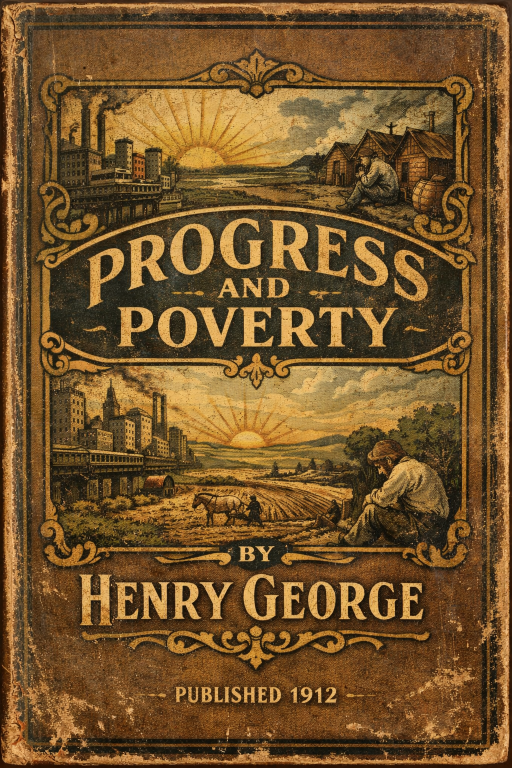
Chapter II The True Remedy - Henry George, Progress and Poverty [1879]
Edition used:
Progress and Poverty: An Inquiry into the Cause of Industrial Depressions and of Increase of Want with Increase of Wealth, The Remedy (Garden City, NY: Doubleday, Page, & Co. 1912).
About Liberty Fund:
Liberty Fund, Inc. is a private, educational foundation established to encourage the study of the ideal of a society of free and responsible individuals.
Copyright information:
The text is in the public domain.
Fair use statement:
This material is put online to further the educational goals of Liberty Fund, Inc. Unless otherwise stated in the Copyright Information section above, this material may be used freely for educational and academic purposes. It may not be used in any way for profit.
Chapter II
The True Remedy
We have traced the unequal distribution of wealth which is the curse and menace of modern civilization to the institution of private property in land. We have seen that so long as this institution exists no increase in productive power can permanently benefit the masses; but, on the contrary, must tend still further to depress their condition. We have examined all the remedies, short of the abolition of private property in land, which are currently relied on or proposed for the relief of poverty and the better distribution of wealth, and have found them all inefficacious or impracticable.
There is but one way to remove an evil—and that is to remove its cause. Poverty deepens as wealth increases, and wages are forced down while productive power grows, because land, which is the source of all wealth and the field of all labor, is monopolized. To extirpate poverty, to make wages what justice commands they should be, the full earnings of the laborer, we must therefore substitute for the individual ownership of land a common ownership. Nothing else will go to the cause of the evil—in nothing else is there the slightest hope.
This, then, is the remedy for the unjust and unequal distribution of wealth apparent in modern civilization, and for all the evils which flow from it:
We must make land common property.
We have reached this conclusion by an examination in which every step has been proved and secured. In the chain of reasoning no link is wanting and no link is weak. Deduction and induction have brought us to the same truth—that the unequal ownership of land necessitates the unequal distribution of wealth. And as in the nature of things unequal ownership of land is inseparable from the recognition of individual property in land, it necessarily follows that the only remedy for the unjust distribution of wealth is in making land common property.
But this is a truth which, in the present state of society, will arouse the most bitter antagonism, and must fight its way, inch by inch. It will be necessary, therefore, to meet the objections of those who, even when driven to admit this truth, will declare that it cannot be practically applied.
In doing this we shall bring our previous reasoning to a new and crucial test. Just as we try addition by subtraction and multiplication by division, so may we, by testing the sufficiency of the remedy, prove the correctness of our conclusions as to the cause of the evil.
The laws of the universe are harmonious. And if the remedy to which we have been led is the true one, it must be consistent with justice; it must be practicable of application; it must accord with the tendencies of social development and must harmonize with other reforms.
All this I propose to show. I propose to meet all practical objections that can be raised, and to show that this simple measure is not only easy of application; but that it is a sufficient remedy for all the evils which, as modern progress goes on, arise from the greater and greater inequality in the distribution of wealth—that it will substitute equality for inequality, plenty for want, justice for injustice, social strength for social weakness, and will open the way to grander and nobler advances of civilization.
I thus propose to show that the laws of the universe do not deny the natural aspirations of the human heart; that the progress of society might be, and, if it is to continue, must be, toward equality, not toward inequality; and that the economic harmonies prove the truth perceived by the Stoic Emperor—
”We are made for co-operation—like feet, like hands, like eyelids, like the rows of the upper and lower teeth.“
Book VII
Justice of The Remedy
- Chapter I. Injustice of Private Property in Land
- Chapter II. The Enslavement of Laborers the Ultimate Result of Private Property in Land
- Chapter III. Claim of Land Owners to Compensation
- Chapter IV. Property in Land Historically Considered
- Chapter V. Of Property in Land in the United States
Justice is a relation of congruity which really subsists between two things. This relation is always the same, whatever being considers it, whether it be God, or an angel, or lastly a man.
—Montesquieu.