Econlib

The Library

Other Sites

Front Page arrow Titles (by Subject) arrow LETTER THE FOURTH. ON THE RIGHT OF PROPERTY IN LAND. - The Natural and Artificial Right of Property Contrasted

Return to Title Page for The Natural and Artificial Right of Property Contrasted

Search this Title:

Also in the Library:

Subject Area: Political Theory
Collection: Classics of Liberty
Topic: Natural Law and Natural Rights
Topic: Property

LETTER THE FOURTH. ON THE RIGHT OF PROPERTY IN LAND. - Thomas Hodgskin, The Natural and Artificial Right of Property Contrasted [1832]

Edition used:

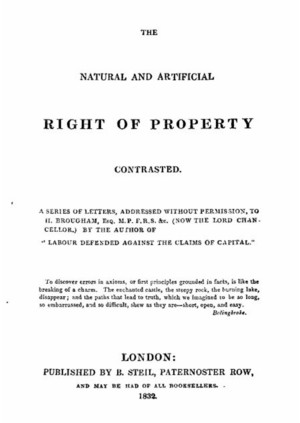
The Natural and Artificial Right of Property Contrasted. A Series of Letters, addressed without permission to H. Brougham, Esq. M.P. F.R.S. (London: B. Steil, 1832).

About Liberty Fund:

Liberty Fund, Inc. is a private, educational foundation established to encourage the study of the ideal of a society of free and responsible individuals.


LETTER THE FOURTH.
ON THE RIGHT OF PROPERTY IN LAND.

Origin of the right of property in land.—Changes which it is undergoing.—The quantity of land required to raise subsistence gradually diminishes.—Important principle overlooked by Mr. Malthus and his followers.—Appropriation of land in Europe.

TO H. BROUGHAM, ESQ. M. P. F.R.S. &c.

Sir,

The right of property in land is now to be briefly examined, and you will readily believe that I reject no conclusions because they militate, as the very principle I shall borrow from Mr. Locke, seems to militate against the power assumed by modern governments, over the soil. He says accurately, “as much land as a man tills, plants, and improves, cultivates, and can use, the product of so much is his property.”—“This is the measure of property in land, which nature has well set by the extent of man's labour, and the conveniences of life; no man's labour could subdue or appropriate all, nor could his enjoyment consume more than a small part, so that it would be impossible in this way to intrench on the right of another, or acquire to himself a property to the injury of his neighbours. Unfortunately, however, this admirable principle has not the smallest influence over legislators in dealing out that which, by the bye, is not theirs, the land of new colonies. It is merely an harmonious agreement, remarked by this excellent philosopher, between the physical powers of man and the principles of justice, which the most depraved acknowledge even when they violate them; but except in the very infancy of society it has seldom been acted on. It is rather a principle which, in the long run, will guide the conduct of mankind, rather the prophetic announcement, as it were, of a future fact, than the exact description of a fact which has already existed, or of a principle on which men have already acted.

There are many things about the right of property in land, which those who study it only in codes of human laws, never can comprehend, but which ought to be deeply meditated by those who, like you, aspire to influence the opinions and the destinies of their fellow men. You must be sensible, for example, that the quantity of land necessary for each individual, according to the principle just quoted from Mr. Locke, must vary with the qualities and situation of the soil with the skill and knowledge of the people; and, in short, with the successive changes in the condition of mankind. It is a fact of some importance in this inquiry, that the same power which has established a right of property in what individuals create or produce, has also provided for the continual multiplication of the species, which multiplication affects the right of property in land. It is plain and obvious, that a species of appropriation (suitable to the period when only a few human beings wandered over the earth) must be injurious when every part of it is crowded with our fellow creatures. In fact, the sort of appropriation adapted to a nation of hunters, would be impossible in a nation of manufacturers and agriculturists. What sort of a subsistence, for example, could a hunter obtain within twelve miles of St. Paul's? In the multiplication of mankind, therefore, in improvements in skill and knowledge, as well as in diversities of soil and climate, we find principles which continually modify the appropriation of land, and alter the quantity to which a man can properly devote his labour. They extend their influence over the future, as well as over the past. The manner in which the multiplication of mankind thus makes a species of appropriation, once sanctioned by their circumstances and condition, now injurious to their welfare, is deserving the serious attention of the legislator.

In the earliest known periods mankind were few in numbers, and equally ignorant and destitute. From the beginning of history to the present day,—from Mount Ararat to Melville Island, the first known condition of society is that of scattered and wandering savages; destitute of arts, of knowledge, and of skill Man was everywhere originally, if ancient history, and modern voyages are to be credited, a wild hunter, or fisher, contending with beasts as ferocious as himself, for a scanty subsistence. He had no fixed habitation, and wherever he was driven by his necessities, or tempted by the probability of obtaining the means of subsistence, thither he wandered. When the earth was thinly inhabited, each individual, or each tribe, like the Esquimaux, and other savages, at present, or like Abraham and Lot, when one drove his flocks to the right hand, and the other to the left,—might travel over many square leagues of land, using the whole of its produce, if he did not till and plant it, without encountering any other individual or tribe, and of course without infringing on any other person's rights. Under such circumstances, though no individual could possibly care much for any particular spot of ground, yet to each one it must have appeared,—and in fact it was,—necessary to have an extensive district, wherefrom to obtain wild animals, or wild fruits. In the early stages of society, all men must have found, just as the Indians of America now find, that hunting grounds, which we know to be large enough to subsist many thousand agriculturists, were necessary to supply a few hunters with the means of subsistence; and, like the Indians, being in a similar condition of society, they might appropriate, as theirs, all the land over which they roamed and hunted. A right of property in land, on the principle of each individual having as much as he can use the product of, must then have been very differently modified, as it was dictated by very different circumstances, from such a right at present. Each individual would then require more square acres than he now requires square feet.

From rude and savage hunters, men became shepherds, feeding flocks and herds which they had previously tamed; but even in this condition they required extensive territories, though not equal to those required by the hunters, to nourish their cattle and themselves. They accordingly roamed over such districts, each of which was limited by some almost impassable mountain, ocean, or desart: but like the Tartars of our own time, they did not fix their habitation in any one spot within their impassable boundaries. The German tribes, at the time when history first records their appearance, living in moveable houses or wagons, will undoubtedly recur to you as an illustration. In this state of society, the right of property in land would not be limited by the quantity which a man could dig and cultivate, but by the quantity necessary for the pasturage of his cattle, including a large portion to lie continually fallow, and recover its natural herbage.

Subsequently men became agriculturists, and then a comparatively small space sufficed to supply each one with the means of subsistence. They fixed their habitations, and around them they fixed landmarks, each one appropriating as much land as he was able consistently with the rudeness of original agriculture, to till, plant, and cultivate, and as he deemed necessary to supply his family with food. Of course, the agriculturist not only required a less spot of ground than the shepherd, or the hunter, but, in order to prosecute his art, he was obliged to remain in one spot. That spot, within which he limited his labours; that small spot, which he and his family cultivated, he called his; and then the right of property over land, became more absolute as it was more restricted, than when men were hunters or shepherds. Each individual found a decreasing extent of surface suffice to supply his wants, as the condition of mankind was changed from that of hunters to shepherds, and from that of shepherds to agriculturists. No person can deny the almost universality of these great and successive changes in the condition of our species; and, looked at in this comprehensive manner,—extending our view over many ages and countries,—we learn this most important truth; namely, that as the condition of man changed from a shepherd to a hunter, and from that to an agriculturist so the quantity of land required to supply him with the means of subsistence, became less and less.

But it is also obvious, that skilful agriculture obtains more produce from a given space than rude agriculture. Thus, as agriculture is improved, the quantity of land necessary to supply each individual with the means of subsistence diminishes. As mankind have multiplied, and as time has flowed on, knowledge has been extended, and the arts improved. Agriculture sharing the general fate, has also been improved, and is continually improving; so that a less and less quantity of land gradually suffices for the maintenance of individuals. The same process, then, after the introduction of agriculture, goes on as before, and the same principle is found continually to operate, it being dependant on the increase of mankind.

I need not inform you, in corroboration of this statement, that the population of all Europe has, continually increased since the beginning of history; and that the population of the countries in which improvements in agriculture have of late been most conspicuous, has also much augmented. Formerly, much ground was allowed to remain fallow every third year, which is now regularly tilled, and sowed with some green crop. The tillage of the third year is a third more labour vested in any particular spot. This is a specimen of the manner in which, as knowledge is extended, and as men become skilful agriculturists, and as the quantity of land which each one requires to provide him with the means of subsistence is gradually diminished, so more labour is gradually required for any given space. Agricultural processes are, however gradually simplified; man performs his task with less muscular exertion; the instruments he uses are improved; but the increase of his skill, which enables him to labour more effectually, and to produce more within a given space, also compels him to restrict his operations to a narrowing surface. As he requires a less space to supply him with food, he will naturally and necessarily confine his labours to that, and the right of each individual to own land, on Mr. Locke's principle, ought to be gradually limited to an ever narrowing, ever decreasing space.

Perhaps you may suppose, that the collecting of many small farms into the hands of one farmer,—a process which for some years was going on in this country, though it appears now to have stopped,—is an exception to these remarks. I am speaking, however, of the quantity of land from which increasing skill obtains a sufficient quantity of subsistence, and of the decreasing surface to which, as labour becomes skilful, it will be necessarily confined, not of the quantity of land which a capitalist, or farmer, commanding the service of any given number of labourers, finds it at present most convenient to hire. The size farms ought to be of, in the present condition of society, is quite a distinct question from the quantity of land necessary to supply an individual with the means of subsistence, and therefore determining the natural right of property in land; but, I apprehend, that even the same rule will hold with regard to farms. As more labour is required for any given surface, it becomes necessary that the persons having farms should limit their business of inspection and management to diminishing spaces. Where skill is carried to a great extent, as in horticulture, and much labour is required, as in the neighbourhood of large towns—wherever the population is dense, and garden cultivation introduced, and such a cultivation is gradually extending itself from every town throughout this country, aye, and throughout the continent, the quantity of land which each master-gardener can conveniently manage, is small, compared to the quantity a man may with propriety farm in a remote part of Northumberland. A few hundred acres, at the utmost, and very generally much less than a hundred, (most gardens not being above five or ten acres), is the extent of any gardener's, or nurseryman's possession, in the neighbourhood of the metropolis; but farms of one, two, three, or four thousand acres are not unknown in parts of the country distant from the metropolis.

As mankind have, in general passed, or are passing, through the stages of hunters and shepherds, and have become agriculturists—as agriculture, wherever we know any thing of it—that is, throughout Europe, has been gradually improved, and is continually improving; and as European knowledge of all kinds, with all the arts of Europe, including agriculture, are extending themselves over the globe, giving us reason to believe that the same process of improvement will be everywhere gone through, it may be supposed that Nature, with her wonted benevolence, has provided, that, as men are multiplied, and knowledge and skill increase, which take place universally, and conjointly, a less and less quantity of land shall suffice to supply each individual with the means of subsistence.

Adopting Mr. Locke's rule, then, for the appropriation of land,—“the extent of man's labour, and the conveniences of life,” it may also be inferred, that the property of each individual in land, will, by the laws of nature, be gradually contracted within a diminishing surface. That seems to be the natural rule of appropriation. It is effected on a great scale in America, where a few Indians are making way for millions of the descendants of Europeans, and on a smaller scale in all Europe, where property in land is continually subdivided. The legal appropriation and division of land have not, indeed, taken place, on Mr. Locke's principle, or the natural rule; on the contrary, the object of the law, generally speaking, has been, and is, to prevent the natural principles from which the rule of appropriation is deduced, from coming into full operation. For example, the lawglver has continually tried by the law of primogeniture, to prevent the division of land. In relation, however, to the prevalent doctrines concerning population, and also in relation to every law regulating the right of property in land, I take the general rule inferred on a large scale, from the successive changes in the condition of mankind, and the successive improvements in agriculture, viz. that a diminishing surface suffices to supply man with food as population multiplies, to be one of the most important to which society can have its attention directed.

It ought to be remembered in conjunction with the rule just mentioned, being also of great importance, that when the land of Europe was appropriated, many of the facts from which I have inferred the rule, had not been called into existence, and could not possibly be known. There was an incipient species of agriculture in the Roman empire, but the then prevalent existence of slavery prevented those continual improvements in agriculture, which form one great element of the deduction. It should also be recollected that the rude tribes, who, on the destruction of the Roman empire, overran and appropriated Europe, knew much less of agriculture than the Romans; they were ignorant too of the successive changes which had previously taken place in the condition of man, and they could not possibly have had any knowledge of the important rule for the appropriation of land, to which I have alluded. Knowing very little of agriculture, their ideas of property in land were derived, from a state of society in which men were hunters or shepherds, and when each man required a comparatively large quantity of land to provide the means of subsistence.

Dr. Smith remarks, “that laws,”—and we may extend his remark to customs—“are continued long after the circumstances which first gave occasion to them, and could render them reasonable, are no more.” The rule, concerning the appropriation of land, just mentioned, not only could not possibly have been known when the land of Europe was appropriated, but those northern and wandering tribes, who appropriated it successively, from the first to the tenth century, must have acted on a rule that was borrowed from a previous state of society in which agriculture was scarcely in existence. Land was accordingly appropriated on the principles and habits of their wandering shepherd ancestors. Even at this day this rule is not generally acknowledged, nor are its consequences attended to. The mind is slow in getting rid of the habits of thought dictated by any pre-existing circumstances, and an opinion derived from times when men were hunters and shepherds, viz. that a considerable quantity of land is a great benefit, and necessary to enable each man to provide himself with the means of subsistence, even now dictates our conduct. Be all these things, however, as they may, it necessarily happened, because there could not be cultivation without appropriation, that the land of Europe was all appropriated when agriculture was in its infancy, and when the great truth I have just brought under your notice had not been developed to the understanding.

Accordingly, “when the German and Scythian nations overran the western provinces of the Roman empire, the chiefs and principal leaders of those nations acquired or usurped to themselves the greater part of the land of those countries. A great part of them was uncultivated, but no part of them, whether cultivated or uncultivated, was left without a proprietor.” Can it be supposed that these barbarians followed a rule in appropriating the land that was consistent with the present state of agriculture and of society? And must we tenaciously adhere to the rules which they in their ignorance did follow? They appropriated the land by a rule borrowed from previous habits of life; that is, in large portions, not at all adapted to the present state of population, of the arts, and of knowledge; and not at all adapted to the present state of society, but admirably adapted to the wild life they and their ancestors had led. Accustomed to hunting, first as a means of obtaining subsistence, and afterwards keeping up the custom as an amusement, each head of a family needed a large tract, that he might not come into hostile conflict with other members of his own tribe. Deriving their chief nourishment from herds of cattle, and from swine, each chief required a large space to supply himself and his family and followers with food. Accordingly all Europe was parcelled out by the German tribes, in what are now become princely portions. The followers of Alboin in Italy, of Theodoric in Spain, of Clovis in France, of Hengist in England, and subsequently of William the Conqueror, appropriated the land, not according to what quantity each man could dig by his hand, but rather according to the quantity his horse could gallop round. The appropriation of the land in such large portions was, for our subject the original sin; but I do not accuse the appropriators of meditating evil. If they had known the rule above alluded to, they would not have encumbered their descendants with so much superfluous care. If they had foreseen the great change which has now taken place, they would undoubtedly have been more anxious to make them mortgagees than mortgagors of the land, and would at once have given them, after the fashion of the long-sighted clergy, a claim on a certain definite proportion of the annual produce, as a more efficacious instrument of power, than land. If they had been endowed with prescience, they would probably have selected, as even better than tithes, a large share of the taxes, and made them holders of a national debt. They wished to obtain wealth, and secure power, and the rule they acted on to accomplish their wish, was dictated by the habits of a previous pastoral, and rude state of existence.

The persons who thus appropriated the soil of Europe, did so by a right of conquest. They did not lay down the sword the instant they had overrun the land, they kept it drawn in their hand, and engraved with it laws for the conquered. The countries they overran had been previously cultivated by slaves in a rude manner. In appropriating the soil, they appropriated its inhabitants, reduced some to slavery, and continued the slavery of others. Power so acquired, and privileges so established, were the basis of the present political and legal, not social, edifice of Europe. These conquerors were the first legislators. By an almost uninterrupted succession, the power of legislation has continued in the hands of their descendants to the present day. If other conquerors have on some occasions overcome them, it has only been to succeed to their places. Whatever names, Danes, Normans, or Saxons, they may have borne, is not of the slightest consequence,—the principle is the same; on conquest all the legislation of Europe is founded, and conquerors and their descendants have been the law-makers.

“Almost all governments,” Hume correctly observes, “which exist at present, or of which there remains any record, have been founded originally on usurpation or conquest, or both.” “The laws,” says a writer in the Quarterly Review, “in relation to the inferior classes of society, were throughout all European governments, made by the strong against the weak, the natural consequence of government founded on oppression.” “The first materials,” it is stated in the Edinburgh Review, “of the laws of England, were little more than the schemes of avarice and aggrandizement, or the ebullitions of revenge. The text, though written often upon sand, was written with the sword. The practice, indeed, afforded an evil commentary, but the law itself was the parent crime.” And this law, founded on oppression, upheld by force and fraud, intended solely to preserve ill-gotten power, or ill-gotten wealth, to maintain the dominion of an aristocracy, and the supremacy of a priesthood, to perpetuate the slavery, ignorance, and poverty of the great body of the people, the political writers of our day, call on all mankind to obey, as the only means of social salvation. Obedience to such law is the master-folly of mankind; and this folly is inculcated with as much pertinacity by those who have apparently no interest in making men fools and slaves, as if their own bread, and their own breath, hung on the doctrine.

The great and important fact, which it is necessary to promulgate far and wide then is, that all European legislation was originally founded on oppression. But the oppressors and their descendants have never ceased to be in possession of the power of legislation. The authors I have just quoted may wish to except from the general principles they lay down the legislation of their own age and country, but I can make no such exception. Seeing that conquerors have always been the legislators, and knowing that they have always endeavoured to preserve their own power, I cannot avoid concluding, that the law has always been made with a view to preserve, as much as possible, that appropriation of the soil, that artificial right of property, and that system of government, which the northern barbarians, under the blind impulse of previous habits, utterly ignorant of the form society was destined to assume, and utterly ignorant of that rule for the appropriation of land. I have quoted from Mr. Locke, and illustrated by a brief view of the changes of our condition,—originally estab lished. It is not for me to condemn habits which were too general, not to be the result of natural general laws. Neither is it for me to enquire into what good purpose those habits were ultimately destined to promote; but as they were general, I cannot refuse to believe that they were necessary parts of the great scheme of creation, and intended finally to subserve the happiness of our species. I am less anxious to investigate final causes, than to state general facts; and it is such a fact, that all the laws of Europe have been made with a view to maintain and preserve by force an artificial right of property, a scheme of appropriating the land, and a system of political power, all of which were originally established by the sword. It is another such fact, that the laws have not accomplished this object. This fact, however, is not so plain and palpable as the former; and to make it evident with a view of shewing how nugatory and how vain have been the efforts to set aside the natural right of property, is one of the principal objects I have in view. I shall postpone pursuing it to another letter; and at present remain.

Your obedient servant,

A Labourer.

[]Of Civil Government, sec. 36, book ii.

[]For the condition of mankind in the earliest periods of the world, consult Goguet, Origin of Laws, &c., Vol. I.: For the condition of the seal-hunting Esquimaux, see Captain Parry's voyages.

[]Are not the complaints, which are now continually made by political economists, and which are not unfrequently heard in the legislature, of the subdivision of land in Ireland, directed against a part of the inevitable and beneficial progress mentioned in the text? If the subdivision in Ireland is vicions, that is easily accounted for by the whole structure of political society in that country being vicious. I would also ask, if the outcry of landlords and political economists against the subdivision of land, is not an example of that condemnation of every novelty in society, which does not grow directly from the will of the legislator, to which allusion is made in page 39. Is it not rather a blind prejudiced attachment to things that are past, instead of a just appreciation of the present and the future? This remark may show the reader, however abstract the principle stated in the text may appear, that it is not destitute of practical application.

[]Wealth of Nations, book iii, chap. 2.

[]As a specimen of what is stated in the text, I transcribe an extract from Smollett's History of England, relative to the appropriation of our country by William the Conqueror. “He bestowed upon his uterine brother Robert, the county of Cornwall, comprehending 288 manors, besides 558 which he possessed in other provinces. The next brother Odo, was created count palatine of Kent, and high justiciary of England, with above 400 fiefs in different provinces. William Fitzosborne's services were compensated with the whole county of Hereford. William's nephew, Hugh Loup, was presented with the county palatine of Chester, to be held with all the rights of regality, as independent of the crown. His son-in-law, Alaiu Fergeant, Duke of Bretagne, was put in possession of all the estates formerly belonging to Count Morcar, with the same right of regality. To Roger de Montgomery, he gave, first of all, the towns of Arundel and Chichester, and afterwards the county of Salop. Walter Giffard obtained the county of Buckingham, and that of Surrey fell to the share of William Warren. Eudes, Count of Blois, received the lordship of Holderness. Raoul de Guair, of Bretagne, was created count, or Earl of Norfolk and Suffolk, and Lord of Norwick. Henry de Ferrieres was complimented with the castle of Tutbury. And Geoffry, bishop of Coutance, justiciary of England, possessed 280 manors, which he bequeathed at his death to his nephew Robert de Mowbray.” Vol. i. page 409.

[]Essays. Of the original contract.

[]No. 74.

[]For May, 1826. “Government, to define it de facto according to modern prudence) is an art whereby some man, or some few men, subject a city, or a nation, and rule it according to his or their private interest; which, because the laws in such cases are made according to the interest of a man, or of some few families, may be said to be the empire of men and not of laws.”—Oceana. The Preliminaries, &c.