Econlib

The Library

Other Sites

Front Page arrow Titles (by Subject) arrow LETTER THE FIRST. INTRODUCTORY. - The Natural and Artificial Right of Property Contrasted

Return to Title Page for The Natural and Artificial Right of Property Contrasted

Search this Title:

Also in the Library:

Subject Area: Political Theory
Collection: Classics of Liberty
Topic: Natural Law and Natural Rights
Topic: Property

LETTER THE FIRST. INTRODUCTORY. - Thomas Hodgskin, The Natural and Artificial Right of Property Contrasted [1832]

Edition used:

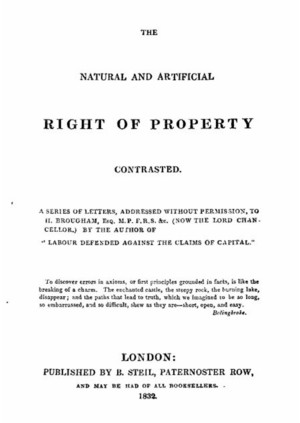
The Natural and Artificial Right of Property Contrasted. A Series of Letters, addressed without permission to H. Brougham, Esq. M.P. F.R.S. (London: B. Steil, 1832).

About Liberty Fund:

Liberty Fund, Inc. is a private, educational foundation established to encourage the study of the ideal of a society of free and responsible individuals.


LETTER THE FIRST.
INTRODUCTORY.

Reasons for addressing Mr. Brougham. His Law commission—Its inutility. The necessity of inquiry into first principles—The right of property is one of these principles, and the foundation of the political edifice. Important difference of opinion between Mr. Locke and Mr. Bentham, as to the origin of this right.

TO H. BROUGHAM, ESQ. M.P. F.R.S. &c.

Sir,

The only circumstance I can allege as an excuse for addressing you, is the conspicuous manner in which you some time ago stepped forward as a reformer of the law. Every such attempt involves the safety of our property and the security of our persons, and gives every man in the kingdom a title to canvass your proceedings. If they are right, we are bound to aid, and if wrong, to oppose you. He who has not access to your ear, may adopt this method of reaching your understanding, and pleading in face of the public, he cannot be met by a nonsuit. Your power rests on your reputation, and having assumed the character of a leader to conduct us out of the quagmire of law, you can neither reject our assistance, nor escape from our opposition. I do not confront you however as an antagonist, I am merely an inquirer, who wish, having at heart, like yourself—the welfare of man—to point out some of the obstacles in your path, and to suggest that it does not lead to the firm ground and pleasant fields we desire to reach. That I may add to the confusion—many voices now vociferating different counsel—is not improbable; but I have set before me a grand object which conceals every thing else from my view, and makes me indifferent whether I promote your views or lessen your fame.

I find, with astonishment, on looking back at dates, that it was so long ago as February 7th, 1828, that you made your celebrated speech on the present state of the law. You then moved “That an humble address be presented to His Majesty, praying that he will be graciously pleased to issue a commission for inquiring into the defects occasioned by time and otherwise in the laws of this realm, and into the measures necessary for removing the same.” Your motion was only half granted, because those who have more power than you have, are opposed to improvement: but if you thought that it would produce any good, except, as your speech justifies, the general disrepute into which the law has fallen, you are no doubt by this time satisfied that you were mistaken. Your motion was founded in error. It implies, contrary even to the tenor of some of your arguments, that the law was once appropriate and excellent. Ill-adapted as it is to the present state of society, the law never was abstractedly so good nor so well administered as in the reign of George IV. It has been carried forward by the progress of society. Time has not occasioned defects, but improvements, in the laws, though the legislator who always aims at preserving the institutions of a past age, has not suffered the laws to keep pace with society. The latter has extended and improved more rapidly than the former, suggesting the important truth that your laws have not regulated its course, and do not preserve social order. It has out-run and out-grown all the cunning political devices of men, teaching us that the institutions which are now supposed to be wise and which the lawgiver struggles to make consistent, will, ere long, like those that have already passed away—like monachism and the trial by ordeal—become the mockery and scorn of mankind. Sir, the vital principle of society which distinguishes it from every other part of the earthly creation, that of steady progression in improvement, carrying with it all that pertains to it, prevents time from corrupting laws as it destroys neglected buildings. Either your motion was founded on a mistake, or you wished, like other law makers and law interpreters, to mystify mankind and cherish their veneration for the ignorant legislator, by ascribing follies, of which he alone is the author, to a pure abstraction. A motion founded on such an error can be of no benefit except to the commissioners appointed to inquire and report. Should their recommendations be useful, they will hardly be carried into effect for two or three generations; and in the mean time such pompous investigations into evils of which men have a practical conviction, merely substitute the hope of improvement for impatience under legal vexations. They serve to foil public indignation, turning it aside, and blunting the appetite for reform. That they will lead to any substantial good, can only be believed by those who deny the authority of experience, and conceive the law, which has always been acknowlegedly mischievous in practice to be admirable in principle.

I am disposed to think that the inquiries and recommendations of your commissioners are more likely to do harm than good; and I shall explain why I think so. Your late friend and preceptor, Mr. Stewart, whose bland manners, eloquent language, and humane disposition, obtained for him a greater reputation as a philosopher than he deserved, turning away dismayed, as he frequently, did from the search after truth, because he was afraid, like many other purblind, timid mortals, of its consequences;—Mr. Dugald Stewart remarks that “in order to lay a solid foundation for the science of politics, the first step ought to be, to ascertain that form of society which is perfectly agreeable to nature and to justice, and what are the principles of legislation necessary for maintaining it.” He had previously said that “it is easy for the statesman to form to himself a distinct and steady idea of the ultimate objects at which a wise legislator ought to aim, and to foresee that modification of the social order to which human affairs have of themselves a tendency to approach.” He adds that “they are to be the most (the only) successful statesmen who paying all due regard to past experience, search for the rules of their conduct chiefly in the peculiar circumstances of their own times, and in an enlightened anticipation of the future history of mankind.” You admit, Sir, that society has a course of its own which legislation is compelled to follow, and every statesman, every law maker, every law promoter, must do mischief who does not frame his enactments by an “enlightened anticipation” of that course in future. Every new law must of necessity be injurious which is not adapted to “that form of society which is per fectly agreeable to nature and justice.” Every one of your commissioners then must work evil if he have not a distinct and steady idea of the “ultimate objects at which a wise legislator ought to aim.” Among these gentlemen I do not recognize one who has made the principles which regulate the progress of society the object of his study. They are, I believe, men of detail, men profoundly versed in all the technicalities of conveyancing, profoundly attached even, it is to be apprehended, to those technicalities which are to them a means of attaining reputation and wealth, but among them there is not I believe one philosopher. Their recommendations I take it, will only go to amend some of these technicalities,—some trifling discrepancies of detail—and they will assume as correct that principle which science teaches to be an error. As far as their authority can go, they will recommend the continuance of error, and they will contribute to perpetuate it, by pruning away some of its most revolting consequences.

There is one means indeed by which they may do good. All men are instinctively obedient to public opinion. The force of circumstances operates upon all mankind. It influences the sentiments, and even fashions the minds, of the most dignified members of the Bench and the Bar, as well of the meanest of our species. Under the influence of circumstances, and in obedience to public opinion, your commissioners, forgetting the details of their profession, may perchance endeavour to bring our anomalous law into accord with the prevalent feelings of the age: but their respect for it will not allow them to go so far as even present cimcumstances dictate, and still less will their recommendations be guided by an enlightened anticipation of the future. The laws enacted by their advice, will only be so many additional noxious statutes imposed on mankind by authority, to be swept out of existence at the first convenient opportunity.

I might quote many other authorities besides your own and that of Mr. Stewart, to prove that society has a course of its own, and that it is the highest duty of the legislator to study that course, and ascertain the laws which guide it, before he frames new statutes; but I am convinced by the passage of your speech, which I have just referred to, that you are already satisfied of this important truth, and I know that you have a high respect for the authority of your late venerable teacher. But being convinced of this important fact, have you ever examined the first principles of legislation, in relation to the natural laws which give birth to society and carry it onward to perfection. “Have you,” to use the language of Lord Bolingbroke, “and deceive neither yourself nor me, have you in the course of these thirty years once examined the first principles, and fundamental facts on which all these questions depend, with an absolute indifference of judgment and with a scrupulous exactness? With the same that you have employed in dealing with the various consequences drawn from them, and the different opinions about them? Have you not taken principles for granted in the whole course of your proceedings? Or if you have looked now and then on the state of the proofs brought to maintain them, have you not done it as a mathematician looks over a demonstration formerly made, to refresh his memory, not to satisfy any doubt? If, as I am afraid, from your multifarious pursuits, though you have sometimes left politics and law to court philosophy, your answer must be in the negative—what assurance can even you supply, that another costly commission, and other remedies for legal errors, will not in a few months or years be required? What guarantee can you give us that all this expense, all this fretfulness and feverishness of change, will not be suffered in vain?

But if you have not studied the natural principles which regulate society, do you believe that the bankers and merchants, whose lives are passed in a counting-house—that country gentlemen, who are minutely acquainted with horses and dogs, with good living, and the duty of punishing poachers—that treasury clerks, who by performing sundry mechanical evolutions, come at length to sit on the treasury benches—that captains and colonels who are great at manœuvring a ship or a regiment—that lords of the bed-chamber, whose lives are passed amidst the frivolous dissipation of London and Paris—do you believe that the members of the motley group, which, when collected at Westminster, the public honours as the legislature of this country, have meditated night and day on these principles, and on the great interests they continually try to model after their own image of perfection? With one or two exceptions, they are so ignorant that they have yet to learn the existence of any natural laws regulating society. They believe that it is held together by the statutes at large; and they know no other laws which influence its destiny than those decreed by themselves and interpreted by the judges. If the legislature have not examined these principles, have they been examined by the practical lawyers engaged in the commission, whose whole soul is engrossed by the details of their profession? Has this work been done even by the public, who eagerly call for new regulations and who worship an idol under the name of law, more extensively mischievous than the Moloch of antiquity? For the public there is much excuse. Continually occupied in providing for their own animal wants, and the craving wants of the state, they have no time for deep investigation: and they are only to blame for relying implicitly on others, who, though, at least, as ignorant as themselves, arrogantly claim to govern and instruct them. If neither the public nor the legislature be acquainted with the ultimate objects at which the latter ought to aim, how is it possible that our tinkering mode of making laws, merely fastening together the links which time is continually snapping, can adapt our corroded and worn-out system to the future form and condition of society? Never were the discrepancies between the state of the law and the condition of society greater than at present. Never was the conviction so general that the laws must now be extensively altered and amended. Rapidly therefore as the gentlemen at Westminster work, making three or four hundred laws per year, repeating their tasks session after session—actively as they multiply restraints, or add patch after patch, they invariably find that the call for their labours is continually renewed. The more they botch and mend, the more numerous are the holes. Knowing nothing of natural principles, they seem to fancy that society—the most glorious part of creation, if individual man be the noblest of animals—derives its life and strength only from them. They regard it as a baby, whom they must dandle and foster into healthy existence; but while they are scheming how to breed and clothe their pretty fondling—lo! it has become a giant, whom they can only control as far as he consents to wear their fetters.

Look for a moment at the consequences of the legislature being ignorant of the principles by which it ought to make laws. I merely turn to the heads of your speech, and I find “the courts are in conflict with each other, that one is overloaded with business while another has nothing to do, that there are different laws for different persons, that principles and practices are in opposition, that pleadings are inconsistent and incomprehensible,” and as the sum of a mass of incongruities, “that justice can rarely or never be attained.” Because we have continually altered our laws piecemeal, paying no regard to principles, or setting out from an erroneous one, that has never since been revised, we are now lost in a vast wilderness of fictions and absurdities. The law, instead of being “the staff of honesty and the shield of innocence, is a two-edged sword of craft and oppression,” which, but for the large shield of the public press which the law has in vain endeavoured to break, would back society asunder. To remedy these monstrous evils, vitiating the whole social compact we must begin at first principles. To stop the flowing of the volcanic and sulphureous stream, which, though shining and sparkling with promise, like the fertilizing waters of the earth, withers the heart of the land, we must go to the fountain head. Convinced, by the every day practices of our legistators, that they never study first principles, though they continually and vainly try to modify results, and convinced by the present state of the law that they cannot begin the study too soon. I propose to call your attent on to one of those principles, THE RIGHT OF PROPERTY—some of the consequences of which are now undergoing investigation by two sets of commissioners.

I am aware, indeed, that nothing is more irk-some to legislators than to stop them short in their career, by any demands for previous investigation.—It is so much easier and shorter to decree than inquire, and so much more flattering to self-love to dictate than examine, that both indolence and vanity combine to make the law-giver act before he understands. He takes no comprehensive view of society; he grubs forward under the influence of his passions and animal instincts, like the mole, and is quite as blind. If any of those instincts had for their object the welfare of society, I should join the crowd and huzza him on. Unfortunately for his pretentions, his instincts, his passions, his desires—like those of all animals—have no other object than the preservation and welfare of the individual. Till, therefore, some incarnation of social instincts be made manifest, I, for one, must insist that the legislator is bound to inquire into the natural laws which regulate society, before he tries to bind society down to his own short-sighted views. Self-interest, too, should now dictate inquiry: for mankind are every where becoming the critics of his actions; and he will command their respect and obedience, no longer than he guides his conduct by the natural principles to which society owes its rise, progress, and continued existence.

The legislator is probably afraid that inquiry might lessen his authority. He would blush to ap pear ignorant of any thing before other men. He may be too apprehensive of learning that his power is not quite so beneficial as he wishes to believe it. He may be aware that inquiry would strike at its root. A philosopher, indeed, might say, inquire into what? Into the past condition of society? Legislators would not surely make laws for that. Into the future condition of society? There are no means for conducting the inquiry with success The progress of the past may cast its shadow before, so that you may have a rough notion that society is to go on increasing in people, in wealth, and in knowledge, as it has increased in past time; but what shape that increase is to take, how rapid is to be the progress, and what are to be the new relations, both among individuals and among nations, it will call into existence—what new trades, what new arts, may arise—what new habits, manners, customs, and opinions, will be formed—what is the precise outline society will assume, with all the fillings-in of the picture to the most minute touches;—all these things, to which laws ought to be adapted, cannot possibly be known: and inquiry into them, with a view of making laws to accord with them, must necessarily make the whole business of legislation appear in its true character to mankind—a mockery of their interests, and a fraud on their understandings. Will legislators inquire, then, into the present? It is a line without breadth—the negation both of the past and the future—one of which passes into the other, while you are talking of inquiring, and before you can make your laws to catch it. Inquiry either into the past, the future, or the present, is adverse to the principles of legislation; and it is not, therefore, extraordinary that legislators should decree, as they always have done, without previous investigation.

Although I am convinced that all legislation must be injurious, till all the natural principles which govern society be investigated, yet I have no intention, on this occasion, of extending my researches so far. I aim not at laying “a solid foundation for the art of politics,” by ascertaining all the principles of legislation necessary to maintain “that form of society which is most agreeable to nature;” I am contented with a far humbler task, and mean to confine my remarks to one only of these natural principles, and to one only of the branches of legislation. That one, however, you are aware, is of vital importance. Political organization depends very much on the mode in which property is distributed. Wherever the right of property is placed on a proper foundation, slavery, with all its hateful consequences, is unknown:—wherever this foundation is rotten, freedom cannot exist, nor justice be administered.—Moreover, we have Mr. Locke's authority for saying—others, as Cicero, having said the same thing before—“That the great and chief end of men's uniting into commonwealths, and putting themselves under government, is the preservation of their property, to which, in the state of nature, there are many things wanting. A yet living writer, for whose authority you also profess great respect, Mr. Bentham, tells M. Dumont to express his opinion in these words—“Pour mieux sentir le bienfait de la loi, cherchons à nous faire une idée nette de la propriété. Nous verrons qu'il n'y a point de propriéte naturelle, qu'elle est uniquement l'ouvrage des lois.”—“L'idee de la propriété consiste dans une attente ètablie, dans la persuasion de pouvoir retirer tel ou tel avantage de la chose selon la nature du cas. Or, cette attente, cette persuasion ne peuvent être que l'ouvrage de la loi. Je né puis compter sur la jouissance de ce que je regarde comme mien, que sur la promesse de la loi qui me le garantit.” “La propriété et la loi sont nées ensemble et mouront en semble. Avant les lois, point de propriété. Otez les lois toute propriété cesse

The vast importance of the right of property, in Mr. Bentham's opinion, is also expressed in this passage. “C'est ce droit qui a vaincu l'aversion naturelle du travail, qui a donné à l'homme l'empire de la terre, qui a fait cesser la vie errante des peuples, qui a formé l'amour de la patrie et celui de la posterité. Jouir promptement, jouir sans peine, voilá le desir universel des hommes. C'est ce desir qui est terrible, puisqu' il armeroit tous ceux qui n'ont rien contre ceux qui ont quelque chose. Mais le droit qui restreint ce desir est le plus beau triomphe de l'humanité sur elle même.”

The benefits here ascribed to the right of property as created by law, are much exaggerated; but the passage, which has been adopted by several authors of distinction, as well as the one I shall now quote from Mr. Mill's writings, shews distinctly that in their opinion the right of property is the key-stone of society. “The end, says Mr. Mill, to be obtained through government as the means, is to make that distribution of the scanty materials of happiness, which would ensure the greatest sum of it to the members of the community, taken altogether, preventing every individual or combination of individuals from interfering with that distribution, or making any man to have less than his share.” You will find in the article “Jurisprudence,” also written by this gentleman for the Supplement to the Encyclopædia Brittanica, that he like Mr. Locke, says that the object of the social union is “to secure to the weak their share of the good things of life;” and he actually describes all rights as consisting in “the shares of good things allotted by the legislator.” If we were to adopt his opinions to the fullest extent, in discussing the right of property we should discuss all the principles of society; but though we go not this length, we cannot doubt the general accuracy of his views as to the importance, but only as to the importance, of the great principle I call on you to examine.

The slightest observation too must satisfy you, that in practice, as well as in theory, this right is now of pre-eminent importance. Throughout Europe there is a contest between governments and their subjects; and what, I would ask, is its object? The growth of humanity, the general love of liberty, and the general hatred of oppression, prevent the existence of any odious and revolting cruelty in any part of Europe; but avarice and profusion are yet unchecked; and the contest, a very ignoble one, is simply who shall have most riches. There are no heroes on the thrones of Europe, but many extortioners. Great generals or great inventors, no longer take, as in the olden times, the lead in the affairs of government: but money-scriveners. Our leaders invent nothing but new taxes, and conquer nothing but the pockets of their subjects. The contest now raging, whether it break out into open rebellion or glide into notice, in the form of a smuggler, on the frontiers and shores of kingdoms—whether it be simply heard in a demand for a reduction of taxation, or come in the thunder of popular indignation, hurling princes from their thrones, is merely a contest to obtain wealth. When this is the case between governments and their subjects, you will readily believe that it is also the case between different classes of the people. The peasant hates the noble, and the noble fleeces the peasant, because the one desires to keep and the other to get wealth. The priest grasps at and thinks of it alone, while he holds up his idol-god; for the God of our priests is not the God of nature—not that great Being, who fills and sustains all, who spreads life and happiness throughout creation—but a malicious and revengeful being, born of the barbarous fancies of a cruel and barbarous people; and while the priest holds up the idol-god of a foreign and a despised race, to terrify the vulgar, he makes searching demands on our pockets. If he did not, if there were no tithes, no hierarchy, no splendid colleges to be sustained, no man would trouble himself either to uphold or gainsay the dogmas, in the name of which the priest fleeces the people. As the contests between individuals, between classes, and between subjects and their rulers, all relate to wealth, you may be sure, that no topic can in practise, be pregnant with more important results—The right of property, which is now arming the land-owner and the capitalist against the peasant and the artizan, will, in truth, be the one great subject of contention for this and the next generation; before which, it needs no prophetic vision to foretel, the squabbles of party politicians, and the ravings of intolerant fanatics will die away unnoticed and unheard.

But though the Westminster philosophers, and you also, agree with Mr. Locke, in attributing to the right of property the utmost importance, making it the basis of the political edifice, they differ from him, fundamentally and totally, as to the origin of this right. Mr. Locke lays it down, that the preservation of property is the object for which men unite into a commonwealth. For this purpose, they put themselves under government. Property therefore, according to Mr. Locke, existed antecedently to government, and government was established for the protection of an antecedently existing right of property. On the contrary, both Mr. Mill and M. Dumont, describe the right of property to be the offspring of law. Mr. Mill says, “the end of government is to make a distribution of wealth,” or create such a right. M. Dumont expressly says, that the right of property is altogether the work or creation of the legislator, or the law. This difference of opinion is pregnant with momentous consequences. If a right of property be a natural right, not created by legislation, if it be a principle of society, derived immediately and directly from the laws of the universe, all its results will be determined, at all times, by those laws; and the legislator ought to ascertain these results, before he dreams of making decrees, to enforce them. Before he takes any steps to protect the right of property, he must, on Mr. Locke's principles, find out in what it consists. If, on the other hand, a right of property be altogether the creature and work of laws, as the legislator seems to suppose, he may at all times determine all its consequences. He will have no occasion to inquire into any circumstances foreign to his own enactments; he will only have to frame his decrees with logical accuracy from the principles he lays down. One system looks on the legislator as an ally, in enforcing the laws of nature, to do which he must know them; the other denies that there are any such laws, which in fact its authors do in express terms, and they look on enactments as determining the welfare and destiny of mankind. A more important difference of opinion cannot exist. Either principle lies at the very foundation of the whole political edifice. Mr. Locke's view is, in my opinion, more correct than Mr. Bentham's, though at present among legislators, and those who aspire to be legislators, the latter is by far the most prevalent. Practical men universally adopt it; for they always decree, and never inquire into the laws of nature. The prevalence of Mr. Bentham's opinion, makes it necessary to illustrate and enforce that of Mr. Locke, in so far as it is limited to asserting that a right of property is not the offspring of legislation.

I cannot, however, pass by the opinion, that all the rights of man are derived from the legislator, without noticing its absurdity. This is the main principle—the incorrect and insecure foundation of all the logical consequences, called the system of Mr. Bentham, of which I am afraid neither you nor the world in general is aware,—and which being removed, the whole of that unsightly fabric tumbles valueless to the ground. The materials of this vast building, its crabbed deductions from false premises—are of such a rude and uncouth description, that no other edifice can be constructed out of them; and when once the foundation is removed, there they will lie till time sweeps them away, encumbering a portion of the mind of society which might, but for these errors, have borne the choicest fruits, or served for the erection of a splendid temple of truth.

Without attempting to describe the vast number of rights, such as those said to be dictated by humanity, and acknowledged to exist in the negroes, and in all men, which have obviously not been decreed by any legislator,—such as those we call domestic, and which, with their corresponding duties, are mutually recognised by parents and children, by wives and husbands, by friends and neighbours, and even by strangers and enemies, and which no law-giver has ever yet thought of dictating;—without attempting to notice numberless decrees issued by him, such as those prohibiting certain branches of traffic, those protecting game and granting tithes; which, though he has enforced them by all the means at his command, have completely failed to create in men any corresponding ideas of rights and duties, those decrees being only obeyed of necessity, and violated without the least remorse, whenever that can be done;—without now insisting on the well-known fact, that the ideas men have of rights and duties,—as, for example, of the right of one man to personal freedom, and of the duty of another not to make him a slave,—which have at all times over-ruled the decrees of the law-giver, shewing distinctly that lie does not create, and has not created, the great stream of our rights and duties, which springs from a higher source than his decrees, carrying with it the little rivulet of legal rights he in vain endeavours to force in a different direction:—without referring to authorities to show “that the law on which right and wrong depend is older than the ages of nations, and is contemporary with the very eternity of God,”—I shall confine myself to briefly proving, by some of the deductions from Mr. Bentham's favourite dogma, that no principle, ever embraced by a thinking man, was, than this, more menstrously absurd.

Other philosophers have wisely represented government and law as necessary evils, imposing—for some imagined, though incomprehensible, general good—restrictions on the natural rights and natural freedom of individuals, which they might dispense with as they grew enlightened and wise: but Messrs. Bentham and Mill, both being eager to exercise the power of legislation, represent it as a beneficent deity which curbs our naturally evil passions and desires (they adopting the doctrine of the priests, that the desires and passions of man are naturally evil)—which checks ambition, sees justice done, and encourages virtue. Delightful characteristics! which have the single fault of being contradicted by every page of history. Hitherto, it has been generally supposed that the whole world was given to the human race, with dominion over all other created things, for them to use and enjoy in every way, abstaining from nothing—restricted in nothing consistent with their own happiness—bound mutually to share the blessings provided for them, because mutual assistance begets mutual love—supplies physical wants easier and better, and promotes moral and intellectual improvement;—that the rights and duties of men grow out of the great scheme of creation, which is sometimes misinterpreted, and rarely understood, by human sagacity,—sometimes marred, and never mended, by human wisdom. But, now, in compliment to political power, and to Mr. Bentham's theory, that we may find an apology for our own infirm and base submission, we must believe that men had naturally no right to pick up cockles on the beach or gather berries from the hedge—no right to cultivate the earth, to invent and make comfortable clothing, to use instruments to provide more easily for their enjoyments—no right to improve and adorn their habitations—nay, no right to have habitations—no right to buy or sell, or move from place to place—till the benevolent and wise law-giver conferred all these rights on them. If the principle be true in one case it must be universally true; and, according to it, parents had no right to the love and respect of their offspring, and infants no right to draw nourishment from the breasts of their mothers, until the legislator—foreseeing, fore-calcula ing the immense advantages to the human race of establishing the long list of rights and duties which grow out of our affections, and constitute our happiness—had established them by his decrees. With an extraordinary species of quaker-like humility, these reasoners assume, as the basis of their system, the principle which all spirited men, and even other philosophers, contemptuously reject—not merely “questioning,” as Mr. Burke says, marking it with his detestation—“whether man has any rights by nature,” but broadly and boldly asserting that he has none; and “that all the property he enjoys is the alms of government, and life itself derived from its favor and indulgence.” “La loi,” says M. Dumont, in the true spirit of these doctrines, “me defend-elle de vous tuer? Elle m' impose l'obligation de ne pas vous tuer; elle vous accorde le droit de n'etre pas tué par moi.” Men, therefore, according to the system which affirms that there are no natural laws and natural rights, had no right even to life—that blessed gift of a bounteous Creator!—and no one was under an obligation not to kill another till the legislator created this right, and imposed this duty.—Mothers, according to the same dogma, might devour their offspring, and children, if their parents would allow them to grow to maturity might eat up their parents—if he should, unhappily, forget to prohibit so unhallowed a feast! Poor human beings! How were you cast away—thrust out from the protection of Divine Providence, which extends its fostering care to the meanest things of creation, till that better divinity, a decree-manufacturer, took you under his charge! Such deductions would be shocking, if they were not eminently absurd; and yet, Sir, you, who know on what principles Mr. Bentham reasons, must admit that they are the legitimate results of a system denominated, from the seat and centre of civilization, the Philosophy of Westminster.

To me, this system appears as mischievous as it is absurd. The doctrines accord too well with the practice of law-givers, they cut too securely all the gordian knots of legislation, not to be readily adopted by all those who, however discontented they may be with a distribution of power, in which no share falls to them, are anxious to become the tutelary guardians of the happiness of mankind. They lift legislation beyond our reach, and secure it from censure. Man, having naturally no rights, may be experimented on, imprisoned, expatriated or even exterminated, as the legislator pleases. Life and property being his gift, he may resume them at pleasure; and hence he never classes the executions and wholesale slaughters, he continually commands, with murder—nor the forcible appropriation of property he sanctions, under the name of taxes, tithes, &c., with larceny or high-way robbery. Filmer's doctrine of the divine right of kings was rational benevolence, compared to the monstrous assertion that “all right is factitious, and only exists by the will of the law-maker.” But though this may be comfortable doctrine for legislators, it will not satisfy the people; and in spite of false theories and unreasonable practices, events are now teaching mankind to place a just value on law-making. Day does not follow day, without increasing our knowlege of the consequences of actions; and it is fast becoming apparent, that the wise men, such as Cicero and Seneca, as Bacon and Locke, and as Burke and Smith, who have advocated a totally different system from that of Messrs. Bentham and Mill and their arrogant disciples, have not cast the seeds of their faith in nature, on a barren and ungrateful soil.

Your obedient servant,

A LABOURER.

[]Elements of the Philosophy of the Human Mind, by Mr. Stewart. Vol. I, page 251, 2nd ed.

[]Ibid.

[]Mr. Brougham's speech on the present state of the Law.—Authentic edition, p. 109.

[]Mr. John Campbell is reported to have said of Lord Eldon and this may be said of all lawyers, that they are so well acquainted with what the law is, that they have no conception of what it ought to be.

[]Since the observations of the text were written, the commissioners have published two reports, and you are well aware—though you have praised them—that they do not falsify my predictions. They recommend the tinkering up of some of the defects of the law, but they throw no light on its principles. These, the commissioners—good easy men—take for granted.

[]“Of the true use of Retirement and Study,” with one or two verbal alterations.

[]Mr. Brougham's Speech on the Present State of the Law, delivered February 7th, 1828.

[]De Offic. Lib. ii. cap. 21.

[]On Civil Government, p 124.

[]See Mr. Brougham's Speech.—Note to page 84.

[]Traités de Legislation—Tom. I, page 179, 2nd ed.—M. Dumont's “Je regarde comme mien” obviously applies to that which he now regards as his, which is, probably, not naturally his own.

[]Ibid, page 182.

[]Article Government in the Supplement to the Encyclopœdia Britannica.—“His share,” I take it implies that a man has a share without the government making the distribution, and with reference to that gentleman's opinions this remark you will find to be important.

[]See both Mr. Bentham's “Introduction to Morals and Legislation” and M. Dumont's “Traités.”

[]Letter on the Affairs of America.

[]Traités de Legislation—pr. edit.

[]See Mr. Mill's article on Jurisprudence: Supp. to the Ency. Brit.

[]Much has of late been very needlessly written about the greatest happiness principle, the basis of all Mr. Bentham's philosophy. There can be no doubt that the Deity wills the greatest happiness—no doubt that the legislator, whenever he speaks of the good of the country, pretends to mean the greatest happiness of the greatest number of inhabitants; and no doubt that the faculties of individuals, admirably adapted to secure their own preservation, are not competent to measure the happiness of nations. Admitting therefore that the legislator ought to look at the general good, the impossibility that any individual can ascertain that which will promote it, leads directly to the conclusion that there ought to be no legislation. If the greatest happiness principle, be the only one that justifies law-making, and if that principle be suitable only to Omniscience—man, having no means of measuring it, there can be no justification of all Mr. Bentham's nicely adapted contrivances, which he calls civil and penal laws.