Econlib

The Library

Other Sites

Front Page arrow Titles (by Subject) arrow CHAP. XII.: Limited Service. - An Essay on Naval Discipline

Return to Title Page for An Essay on Naval Discipline

Search this Title:

Also in the Library:

Subject Area: Political Theory
Subject Area: War and Peace

CHAP. XII.: Limited Service. - Thomas Hodgskin, An Essay on Naval Discipline [1813]

Edition used:

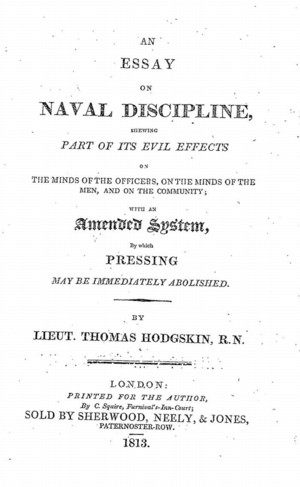
An Essay on Naval Discipline, Shewing Part of its evil Effects on the Minds of the Officers, on the Minds of the Men, and on the Community; with an Amended System, by which Pressing may be immediately abolished, by Lieut. Thomas Hodgskin, R.N. (London: Printed for the Author, by C. Squire, Furnival’s-Inn-Court, sold by Sherwood, Neely & Jones, Paternoster-Row 1813).

About Liberty Fund:

Liberty Fund, Inc. is a private, educational foundation established to encourage the study of the ideal of a society of free and responsible individuals.


CHAP. XII.

Limited Service.

As pressing appears to exist for no other reason, but, (as children say) because it does, it wants nothing to make it totally unnecessary but a simple declaration on the part of the legislature, that it is so; and reconciling the naval service to our ideas of justice and happiness. I have shown how the last may be easily accomplished by the establishment of tribunals, deserving our confidence, and by taking from captains the power of punishment. More fully to accomplish the first, a legislative enactment should immediately take place, abolishing pressing, and establishing the improvements mentioned; and, as a farther inducement for Britons to serve their country, limited service should be authorised under the following regulations:

A twelvemonth after this legislative enactment, all the men who had served their country twenty-one years, from and after the age of twenty, should be entitled (if they pleased) to their immediate discharge, and should, at their own choice, be entitled to and receive the in or out pension of Greenwich Hospital. If the funds of that place are not rich enough (but I believe they are) to answer this purpose, and others afterwards mentioned, they must be made adequate by the country. If these men were pleased to continue at sea, and I think every one would, whose health and strength permitted, they should be allowed to do so, if fit for service; but no farther reward than one of the pensions of the hospital should be given them, whenever they chose to retire; twenty-one years after the age of twenty is long enough for the country to claim of any man; and few men are fit for much active service, as a sailor, at that period of life.

I have no means of ascertaining what number of men of this description there are in the service; but I should not suppose they can exceed the complement of one frigate; and should the voluntary service not cause many to enter before the end of a year, the deficiency of disposable force from this class of men would be very small; therefore, from trying such an experiment, no injury would result to the country. From a twelvemonth, as before stated, all the men who had served fourteen years and upwards, from and after the age of twenty, should be entitled to their immediate discharge, but without any sort of reward, it being left to themselves to stay or go, and, of course, having the same claims as the first-mentioned class of men, after their period of twenty-one years servitude. I do not wish strictly to confine the benefits of Greenwich to men who have served twenty-one years, but certainly no men should be admitted to them, who had served less than fourteen years, unless he had received some injury in the service.

Under the improved system of discipline few men who had served fourteen years would quit the service without a pension, when, by remaining in it, they would be sure to receive one at the end of seven years, and should also receive it at any period between the fourteen and twenty-one years, when they might, from a survey of medical men, be deemed unfit for service. These men should also, for a reason, and in a proportion, to be afterwards assigned, receive an increase of pay. From these inducements to remain in the service, I should apprehend but a very small loss of men from this class; but I am wholly unable to estimate the amount.

By the end of two years, from this legislative enactment, experience will clearly shew whether our people will voluntarily serve their country or not; if they would not, perhaps the safety of the country might make it absolutely necessary, that no more men should be discharged; but of this I have not the slightest fear, and if they did voluntarily come forward at the end of two years, all the men who had served ten years, from and after the age of twenty, should then be entitled to their discharge without any reward, staying if they pleased. At the end of three years, all the men who had served seven years, from and after the age of twenty, should, in like manner, be entitled to their discharge. This should include all the boys and young men now serving, who should, when they arrived at their twenty-seventh year, (if the war continued so long) be entitled to their discharge.

With a voluntary service, no man not brought up as a sailor should be permitted to enter, for the first time, after the age of twenty five. I do not even apprehend, at the commencement of a war, there would be any occasion to deviate from this; for, under a better system of discipline, the inducements to enter would be so strong, that there would be always an abundance of young men; neither should men, brought up to the sea, be permitted to enter the service, for the first time, after the age of thirty; there might be a necessity to break through this regulation at the commencement of a war, but at no other time. We absolutely bring our service into disrepute by holding it ourselves so cheap, as admitting the aged, the lame, the halt, and the blind into it, when it possesses advantages superior to any private service for labouring men in the community.

It would not be advisable to adopt recruiting parties for the navy; they are an immense expence, and, I should think, perfectly useless. If the broad principle of population is at all true, that countries are always fully peopled up to the means of their subsistence, there will always be just as many men to eat the naval provisions, with a voluntary service, as now, and, indeed, more, unless it can possibly be supposed, that the increased pleasure, which will result to men from a voluntary service, should prevent, instead of inducing them to serve. The government, therefore, only require the means of providing these provisions, and they may safely rely upon the courage and zeal of our countrymen going to sea to consume them. As men, who have the slightest hope of bettering their condition, from coming to London, always find their way, those who wished to enter the service from any inland parts of the country, would certainly find their own way to the nearest naval depot; and, doubtless, many bosoms would ardently wish it, as an honour, instead of thinking it, as they now do, the last refuge from despair. Naval depots are already established at all the principal sea-ports of the united kingdom, and would want no alteration, except being deprived of their prisons. Care should be taken to spread a knowledge of these depots throughout the kingdom. I shall afterwards point out a proper means of doing it; but I just wish to call the attention of the public to the immense expence which arises, in very part of our military service, in every part of our country, from this utter want of confidence the government have of the people, arising, apparently, from that most base, most destructive of all motives for human actions,—fear. Such a want of confidence is contradicted by every event of our history, by every sort of experience, and, therefore, cannot be produced by reflection, nor is it supported by reason. I defy any man to find one instance, in the history of our country, that can be urged as a proof of a want of will in our countrymen zealously to defend it, or zealously to support that glorious constitution so much our pride; but this expence is the exalted policy there is in injustice. These are the sublime effects of that incomprehensibility of conduct in our great men which lesser folks cannot understand; this is what is peculiarly denominated policy, which requires a man’s whole life to learn, and then he knows it but imperfectly. To me it appears a vile submission to the worst passions of our nature, uninstructed by experience, and unenlightened by reflection, where that green-eyed monster,—jealousy, fear, pale and trembling, wrinkled anxious avarice, and violent and stormy anger, alone direct the actions; and policy will become infinitely more perfect when the common rules of morality, when the simple, but sublime precepts of the gospel, to fear God, but love our neighbour, shall direct the actions of our great men; neither do the ill effects of this want of confidence stop at the greater waste it causes of our pecuniary means, but it wastes our physical strength.

All the recruiting parties now employed in the united kingdom, had our rulers reposed confidence in us, might have been aiding Marquis Wellington; indeed, I should say, that three-fourths of our militia, as they are, apparently, embodied but to keep us in awe, might have been employed in the same service; proper means being taken to influence their opinions, they would have voluntarily gone; the remainder of our people could have defended our country from invasion. Do we not live secure, protected by the efforts of our gallant sailors; and where is the Briton, who, having a musquet or a rifle placed in his hands by the government, would not have been inspired to exertion by such confidence; who would not have manned a battery, or flown to a post assigned him, at a moment of danger, and died in defence of that liberty such confidence would have given him a double pleasure in? The immense expence which now attends our military, and with confidence in us, a useless staff-establishment at home, joined with that caused by recruiting, would have furnished Marquis Wellington’s military chest, and have placed him, without any additional taxes upon the people, at the head of 150,000 brave English troops; with such a force he would long since have cleared the peninsula.

The Emperor of the French, vast as his means are, must have given his attention at home, when assailed by these troops, joined by the Spanish nation. He could not have reposed confidence in his people; for he governs them but by the terror of military authority. The Emperor of Russia might have remained quietly at peace, with honour, or repressed insults, with a certainty of success, while England, exalted upon a throne of just confidence in her people, and supported by morality and virtue, might have dealt out liberty and comparative happiness to all mankind; might have been regarded with reverence, as the arbitress of the fate of the world; might long since have given mankind the blessings of peace, and thus have promoted the purposes of its God. But all this is prevented by a simple want of confidence in the people, which is as absurd as it is pernicious. For what, or for whom, let me ask, do we fight? Is it for the sake of the happiness which may accrue to the soil that we defend it? or is it, that we may enjoy its produce and its blessings? Can it be for our rulers we are called upon to shed our blood? There has not been, for years, many public men who, at once, have commanded my reverence and esteem by their talents and integrity. To say I am to fight for such people, is to tell me I am to commit murder; it is neither the soil then, nor our rulers, for whom we contend, but it is for our people; and it is evidently their interest to defend themselves; is it not, then, as absurd as it is pernicious to suppose men will not attend to their own interest?

To return to our naval subject; no man should be permitted to enter for less than three years or more than seven; as some little time is necessary to learn men their duties, they cannot be taken for less than three years, neither would it do for foreign stations.

There is a hopelessness attends mankind when they look forward to a long period, without a prospect of change, that impedes exertion; and this is very strong at sea, for our attention is not occupied by a thousand little daily improvements, and daily wants, which people on shore have, and can gratify; therefore I would not permit a longer period than seven years at one time. Bounties, as at present, should be given to all men at their first entrance into the service. If experience should prove that they were wanted, to induce men a second time to enter the service, they should again be given; but I think, with the increased pay not to be proposed, bounties at the second entering would not be wanted. It may, perhaps, be said, that our country cannot afford greater pecuniary rewards for the seamen; those who support such an opinion are interested men. When they, satisfied with the pleasure possessing power gives, shall serve their country for nothing, instead of taking many thousands to themselves and bequeathing them in reversion to their descendants, I shall think they have a right to compel the lower classes of the people to labour for nothing; to fight for and defend their country, and be satisfied with their food.

The principal employment of sailors is common labour, it requires little abilities and no knowledge but what the most common people possess. Therefore the wages of labour in other parts of our society should be the criterion for paying seamen. These are good when they permit a labourer to bring up a family, have the necessaries of life and some few of its luxuries. No man who knows how abject poverty debases mankind, who loves his country, would wish that they should ever have less. In estimating how seamen are to be paid, it is to be remembered, that food and lodging, those principal necessaries of life, are provided for them. Their present pay provides a single man comfortable clothes, and some even of the luxuries of life. But as it is evidently for the good of society that our labouring people should, with economy, be enabled to rear a small family, a sailor’s situation as they belong to the labouring class of people, should also be made able to do it. They want something of this kind to attach them to their country and make them citizens as well as sailors. I should therefore say that the pay is enough for the first seven years, they might serve their country; after being twenty years of age, the next seven it should be increased one-half; after serving fourteen it should be doubled, and not farther augmented. The seaman’s pay is now about eighteen pounds a year. Then after serving his country fourteen years it would amount to thirty-six pounds, not a very great sum, but sufficient, with an industrious wife, to rear a small family.

As a farther encouragement for men to volunteer for the service, those situations they now look up to as rewards should be made better. The time necessarily occupied by the seamen in labour must prevent their acquiring that knowledge I deem so indispensable to make a man a good captain; this is a situation therefore that should not be open to the sailor’s ambition:* but those that are should be improved and filled with no persons but them. No disappointed midshipmen should receive warrant officers’ situations, they should wholly be filled with men from before the mast.

Warrant officers are men raised from amongst workmen to direct their efforts, and they have a large portion of responsibility: as they cannot fill these situations till they have arrived at mature years, I think they should have sufficient pay to enable them to rear decently a small family, and as they have much responsibility their pay ought to be increased at least one-half in every rate of what they now receive.

The boatswains’ mates when not made the instruments of punishment, will be petty officers highly respected, and their situations will be much desired; they should have a small pecuniary increase, and should look up to the situation of a warrant officer as their reward, which captains coxwains, (alias their extra servant) should no longer be allowed to fill. These are the men whom I should say ought to have the greater part of the duty to do, which is now the portion of the lieutenant. For to me it appears absurd to take men into the service, educate them as and associate them with gentlemen, and then give them the duties of upper workmen to do.

The consequence is that the gentleman requires as much as four of these upper workmen, and the service is made more expensive without being so efficient; and what now is received with dissatisfaction by gentlemen sent into the service by the influence of property, would amply satisfy not only these upper workmen, but the warrant officers.

When the number of lieutenants were reduced, their duties should comprise all that requires education; they should attend to signals, to the ship’s navigation; they should arrange all the stations of the men, and perform many duties too minute to need enumeration. The boatswains mates should not be deprived of their places by their captain, as that would be a power of punishment; but such a mark of disgrace might with propriety be ordered by the legislature to be inflicted, should they be guilty of any of the second class of offences. But in all vacancies captains should fill them from their own people, uncontrouled by any authority in their appointments; but never permitted to give these situations to any man but one who had served his country at least three years. The other petty officers should have their pay increased like the men’s, in proportion to their service.

Besides making men petty officers the captain has another way of rewarding people.

As the same distinction of landsmen, able, and ordinary seamen would exist then as now, he might make men from one to the other, which would be a much greater incitement to them diligently to learn their duties than all the terror that can be employed. The captain will not trespass too much on this power of rewarding, as, should he make too many, he would be liable to lose a part of his best seamen. Instead of the captain being then, as he now is, the source of terror, be would be the fountain of honour; and as the hope of good is more powerful than the fear of evil, he would be as much more respected.

As a still farther encouragement for men to serve in the fleet, and not a very expensive one, all fathers who might be obliged to receive support from their parish, and who had lost in their country’s service a son, who might probably have rescued his old age from painful or dishonourable dependance, should have a right to receive, at his own option, the in or out pension of Greenwich. All wives, whose husbands had perished in the service, should in like manner receive a pension from Greenwich. All children, who had lost their fathers in the service, should have a positive right to national assistance. I know they already can receive parish support, and the charity of my country has provided other funds for them, but the first of those is deservedly dishonourable, the other is dependant, and their support should be neither. There may be many people who will say it is impossible to do these things, they will be liable to a multitude of impositions. To them I can answer, if there was a certainty of their fears being realised, it cannot make the practice of justice on the part of my country less necessary, or less a virtue to punish those who impose upon you, but on that account do not unjustly punish all.

With these encouragements to voluntary service should our people be negligent in coming forward, the first departure from liberty should be to abridge the luxury of few, not take every blessing of existence from many.

The legislature should forbid any man, except for agricultural or manufactural purposes to keep more than two men servants; and they should prevent any man able to work from receiving parish support. From these things an abundance of men would be in idleness, who, rather than commit crimes or starve, would voluntarily serve their country. If after this, men were still wanted, pressing applied indiscriminately to every man in the nation might be just; till then, I shall never cease to think it alike unjust and unnecessary, as alike destructive of morality and freedom.

To the system of limited service, it will be objected, that our ships from changing their men will never be disciplined; and that we shall never have any good seamen; they will always be in the merchant service.

The first objection now frequently exists. By desertion and other causes ships have often been known to have nearly changed their whole companies in a twelve month; yet these ships have not been found undisciplined when the officers have been disposed to attend to their duties.

This objection will have less force when applied to limited and voluntary service, and one system of regulations throughout the fleet, than it has at present. But if we consider what discipline is intended to produce, it can have no force at all. The end of discipline is to conquer the enemies of our country. The will to do this, and the courage that can do it, already exists on the part of the people; and the only thing they want effectually to do it is simultaneous exertion, without which ships cannot be properly managed. This, (in opposition to a general opinion in the navy,) I say may be learnt complete in six months. If a man is at liberty to think, and placed in situations requiring the exercise of this thought, and instructed by the example of others, he may be an excellent sailor in six months. With one system of regulations, a willing Briton will, with attention and direction on the part of his superiors, learn all the duties of a man of war’s sailor, more perfectly to produce simultaneous exertion than they now do in that time. At present, men going on board ship, sulky and ignorant as possible (from the manner in which they are forced), if they are not far advanced in life, acquire all the knowledge that is wanted for an active sailor in that time. The principal things wanted in sailors are a will to work, a zeal that prompts to exertion, (it should be remembered that zeal is the legitimate offspring of hope alone), and a command of mind in a moment of danger; the two first will be the produce of a voluntary service and encouragement, the last will be most speedily acquired by thinking and practice; and a young mind soon acquired it: besides from the mode of suffering all seamen to be gradually discharged, from the encouragement we have mentioned for their remaining, there will always be a sufficiency of old seamen to encourage the young ones by their example to daily, as well as extraordinary duties. Officers, in judging of men’s capabilities of learning these duties, will form their opinions from the existing character of the seamen, now when exposed to slavery, not what they will be, under a voluntary service and rational laws, when ardent hope shall bear down every difficulty before them.

Like what has been called the occult sciences, like any branch of knowledge confined to a particular set of men, our profession has been veiled in a cloud, and said to be difficult of acquisition; but when did the comprehensive minds exist, that planned, or taught the seamen their duties; they never have, there never was a branch of knowledge where less mind has been employed than at sea; and the difficulties of learning a sailor’s duty cannot be many. We see, that in the present day, landsmen are capable of contending for and acquiring victory at sea; our navy is at this time more than half manned with men who never went to sea in their youth, and they have not sacrificed the honour of their country. The French ship Rivoli contended five hours against (in point of quality) one of the best manned ships in our service, while her people were the most wretched heterogeneous collection of men ever met in a ship. Clear proofs, I apprehend, that landsmen are capable of contending for victory, and in our service, of gaining it at sea; consequently though we permit our sailors to enter for a limited time, discipline will be in existence, and its ends be always accomplished. The first objection has, therefore, no force; and since these clever seamen, as they are called, are not so particularly wanted, and may be made in a few months, the second objection will not avail the advocates of injustice much.

In my opinion, the increase of pay, after years of service; the certainty of honourable provision in old age or misfortune; the liberty of leaving the service at the end of their time; the chance of prize money, and the love of praise, will be inducements enough for English seamen to prefer their country’s, to the merchant service. There is great curiosity in every young man’s bosom, which would have prompted many to go to sea in the merchants’ service, had pressing never existed. That being abolished, many will go; a free competition being opened, merchants will naturally give the least possible quantity of money for which they can get sailors; and in the end, the wages of merchant ships will, I should expect, not exceed the wages in men of war. Therefore neither of these objections ought to make us hesitate a moment to allow our seamen voluntary and limited service.

It has also been objected against the system of voluntary service, that the slow progress of inlistment could never man our fleets so rapidly as the fleets of our neighbours might be manned by that despotic power the governors of every other European country possess. That consequently our country might be exposed to danger, before we had power to defend ourselves; and that at the breaking out of a war suddenly commenced, our country would be certain to receive injury even unto ruin. To this objection, I reply, that there is no event in modern history which gives the slightest reason to suppose, that a war can be first thought of, and commenced in a day, by any power however despotic. To save appearances, negotiation is necessary, and preparations are essentially requisite. Our country and our commerce, unassailable but by sea, can only be attacked by ships. To fit fleets time is necessary; they cannot be made ready in a day or a week, and our rulers must be more ignorant or more negligent than I suppose them, if they are unacquainted, during a peace, with any naval preparations in any of the ports of Europe. It has been a custom constantly among the European nations, to remonstrate against any increased warlike preparations, and to enquire for what they are intended. Therefore the most despotic power could not assail us (to injure us) under the lapse of some weeks from the beginning of their preparations. Now with our existing naval superiority, we, at present, possess (of one kind or other) more men of war than the whole of the rest of Europe united. It will be a dreadful dereliction from public duty, for our governors ever to let this relative superiority decrease. Now from the extension of our commerce, we have also more merchant ships and more seamen than the whole of the remainder of the European world. I must grant, that from the barbarous injustice, the wretched policy, our country has adopted, two-thirds of the men who man our merchant ships are foreigners, solely because the existing cruelty of our naval laws prevents Englishmen becoming sailors; these men prevent the growth of so many Englishmen, and of course take from our country that exact same number of subjects bound to us by habit and the ties of affection, and their place is supplied by these men, who from habit and education are our enemies, who are tied to other soils by different affections. Yet after a peace of any continuance, supposing our commerce to preserve its present relative superiority, which I see no reason to doubt; these foreigners will be in their own country, and our ships will be manned with our countrymen. With this relative superiority of numbers, both in ships and men, let our rulers but come to the people with a just cause for war in their hands, let the government of our country but sanction a larger force being equipped, by providing the means of paying and provisioning them, let the proposed increase of pay take place, let our navy be rationally governed, let the same glory as now attach to its service, let our seamen be informed, that in a just cause, our country has need of their services, and there will be no want of an embargo to be ordered by the government to prevent our merchant vessels proceeding to sea, they would be universally forsook. The lively energies of freedom and the love of fame will, in our ports, equip a fleet in half the time that any power in Europe could send one to sea. At the breaking out of war, there is the additional inducements of a chance of much prize money, and there is a vast deal of increased danger of being taken prisoner, by going to sea in a merchant vessel, that so far from wanting men at its commencement, (though we should entirely trust to the slow progress of enlistment) we should see the plough forsook, the loom laid aside, and the merchant ships lying idle in our ports; for our people would crowd to defend that liberty of which they are so deservedly proud, to share the praise of society, and to grasp at the honours of war.

But what can be the amount of the evil stated in the objection, granting that an enemy’s force might partly destroy our commerce before we were ready to defend it, that they might make an attempt and succeed in capturing some of our islands; and that they might even land in our country, and make partial depredations and commit some few atrocities; these, I apprehend, are the worst possible evils that can happen to trusting to our feelings, unassailed by force to man our ships. What is their amount?—A few deaths, a loss of a little money, while it must be balanced by national feelings smarting under injustice and eagerly asking vengeance, who would not wish such a frame of mind to commence a war with, for that will speedily conclude it? Can these evils be balanced against the existing miseries of pressing and coercion, the destruction of a wish to serve their country in our population, and the debasement of mankind, which is consequent upon terror being employed to compel men to do as their rulers wish them? They are but as feathers weighed aginst lead; but pressing will not remedy the evil imagined; it only makes men skulk, hide themselves away, and submit to every species of privation rather than serve their country; it would prevent, more than procure, men for the service, even at the commencement of a war.— But what is the objection that is made more than the vain speculations of an idle fear, the imagination of evils that can never arrive, but like all our bantlings, it gives pleasure as our own produce; we give more force to the suggestions of a vain imagination, than to the records of experience. When a nation can be pointed out to me, who when called upon by their governors, have refused promptly to support them in a just war, I may believe there may be a possibility of our people requiring to be pressed to defend their homes. Many instances can be produced of nations contending for slavery the most vile, simply because they had been long in the habit of submitting to it, and the blessings of freedom will have as much more power to incite us to defend it, as here is superior enjoyment in it.

But granting that this objection was real, and that pressing might temporarily remove it; I say, that pressing ought not to be adopted, for it is acknowledgedly unjust, it breaks through a principle that ought always to be held sacred, that no evil should be done, in expectation of good to come of it. For man may implicitly rely, from the known attributes of the Deity, from the well known laws of nature, good never ultimately came of committing evil, injustice never was of benefit to a country.

By a limited service, the strength of the only cause I can discover for the vices imputed to seamen, that arise solely from going to sea, will be considerably diminished. The prospect a young man may have then of again returning to his native spot with whatever he may save, will teach him economy, frugality, and care. The same prospect will prevent many early marriages, and send many young men to sea, whom the hopelessness of unlimited service, the injustice of pressing, and the cruelty in existence, precipitates into an early marriage, to have a stronger hold on those about him for protection. Limited service would spread the knowledge of ships through every part of the community, and the necessity there is for our national preservation and national glory that we should have ships, would make us a nation of sailors.

The reasonable prospect sailors might then entertain of comfortably providing for a wife and family, and certain, under misfortunes, of leaving them to the care of a grateful nation, would entwine the love of their country with the strongest affections of their hearts; it would make them better citizens and excellent men: then in their old days telling the tales of their youth to their children or neighbours, they would inspire them to defend, as they had done, the honour and glory of old England. Alas! how different is it now. From the very sufferings they have themselves undergone, the cruelties they have been subject to, they must persuade all their connections, all their friends from ever entering the service; they must tell them to defend their country is bitterly painful, and they must feel, by their stripes, it is dishonourable. Here again, by the operation of this present system, the growth of a virtue essentially necessary to the well being of the state is effectually checked, if not entirely smothered; there can exist no greater evil.

The commencement of a peace in our country, has been generally marked by numerous crimes and atrocious murders; and nothing but a recapitulation of such things widely extended, can be anticipated at the commencement of another. From the character of our seamen being so much degraded by a mixture of foreigners and felons, from their every manly sentiment, indeed from their every thought being destroyed by the long continuance of existing injustice, the dreaded evils of a peace are truly alarming. Unhappiness, miseries, and crimes alone, can be expected to ensue from turning loose upon the community so large a body of men as our seamen, unprovided with the means of an immediate subsistence, and unconnected with society by any one affection, whose passions are undirected by any principles of morality, and who are suddenly deprived of that terror of their immediate superiors, which has long been their only motive for action. Were the evils that have always taken place at a peace, the pure result of long protracted war, were they the result of any other laws of nature, but those which expressly say no injustice of man shall pass without its merited reward; so miserable would be the lot of our country, that war, for ever continued, would be better than the justly dreaded evils of a peace, that would at once disband our seamen. As the injustice that is done, then, is the main cause of this destruction of their affections and degradation of their characters — the justice of a limited and voluntary service, can alone preserve the one and exalt the other. With a voluntary service, naval laws approximating to the institutions of our country, the sailors will become habituated to the same motives for action as the remainder of our people, they will be connected with society by their best and dearest interests, and they will learn to live on shore in peace and good order; then, and not till then, will a peace promote either the happiness or security of our country.

With a limited and voluntary service, we shall no more hear of men amputating their own limbs to avoid defending their country; we shall no more witness them jumping overboard and preferring death to the slavery and misery of the navy. Naval officers will no longer be annoyed with men totally deaf without a cause; with others whose rheumatisms incapacitate them from exertions; and with impostures too numerous to describe, too disgusting to think about; and if to be happy is the legitimate end of all our exertions, they are not enough criminal to deserve censure.

Perhaps, no more ready and efficacious mode of spreading knowledge among the lowest classes of the Irish could be adopted than to permit the sailors and soldiers of that part of the community again to reside in their native spots. With a limited service and a just discipline, they would learn to imbibe our ideas as well as share our glory, to which they have so materially contributed.

They certainly have much to learn of us yet, and, encouraged to learn by the hope of benefit, instead of being repelled by terror, they would spread a love of the other parts of the community, which they could not fail to imbibe from intimately mixing with them; we should then, much sooner than there is now a prospect of, become one people, from a consolidation of opinions, an equality of rights, and a greater similarity of manners.

With a limited and voluntary service, as there would be no fear of desertion, a certain portion of the men, not less than one-eighth, should daily be permitted to go on shore; and the sanction of so great an authority as a captain’s, whom the sailors should, at all times, be accustomed to respect, if not to revere, should not, by permitting so great a vice as promiscuous intercourse, which religion teaches us to avoid, be set up in opposition to the early principles of instruction. We may, with propriety, deplore the depravity of opinion that leads to its commission; and though we cannot subdue it by penal enactments, it is surely highly wrong to encourage it with the countenance of authority.

It is curious to observe to what despotism is obliged to have recourse, even when aided by all its terrors, to keep up obedience. The injustice of tearing men away from their homes, and constantly confining them on board ship, has made it necessary to flatter them into obedience, by encouraging their vices; hence the permission given to drunkenness; hence the sanction of promiscuous intercourse. Surely, no man who reasons can approve these things, but, like the other evils of the system, they have resulted from unmanly fear.

With a voluntary service, we shall not go to war with America about pressing seamen; we shall have so many, that we may, without a sentiment of regret, resign every thing like the right of search for them; indeed, from the high reputation of our fleet, it wants but a rational system of government to seduce, if we pleased to accept, the services of all the seamen of the civilized world.

Another effect of the voluntary service will be preventing wars. Public opinion of their necessity must always precede their being entered into; and, I trust, we shall never again be plunged in all their calamities from an imaginary right of a few merchants, the birth of avarice, or from a suppositious possession of a spot of ground not worth a day’s labour of the meanest workman. Respected in peace, from being known to possess the dreadful energies of liberty in war, if our country gets through the present arduous contest, she will long remain the rallying point for every thing that is virtuous and honourable among men, till the value of liberty being stamped upon every man’s bosom, opinion shall triumph over fear, and mankind no longer submit to the terror of a military despotism.

[*]It is not meant that the country should not, in a public manner, reward signal services in the seamen by this promotion; indeed, I think they should, but when they do it, they should tell it officially to all the nation. There now exists a custom in the navy of captains and admirals promoting favourite quarter-masters and coxwains to the rank of midshipmen and lieutenants; it is this which should be utterly forbid, as the reward is not bestowed for services that benefit the country, but some that have gratified the individual; neither are these rewards made public, they consequently excite no diligence nor produce any emulation.