Econlib

The Library

Other Sites

Front Page arrow Titles (by Subject) arrow CHAP. X.: Naval Punishments and Rewards. - An Essay on Naval Discipline

Return to Title Page for An Essay on Naval Discipline

Search this Title:

Also in the Library:

Subject Area: Political Theory
Subject Area: War and Peace
Collection: ePub Pilot Project

CHAP. X.: Naval Punishments and Rewards. - Thomas Hodgskin, An Essay on Naval Discipline [1813]

Edition used:

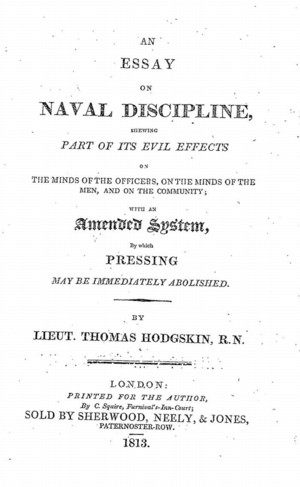
An Essay on Naval Discipline, Shewing Part of its evil Effects on the Minds of the Officers, on the Minds of the Men, and on the Community; with an Amended System, by which Pressing may be immediately abolished, by Lieut. Thomas Hodgskin, R.N. (London: Printed for the Author, by C. Squire, Furnival’s-Inn-Court, sold by Sherwood, Neely & Jones, Paternoster-Row 1813).

About Liberty Fund:

Liberty Fund, Inc. is a private, educational foundation established to encourage the study of the ideal of a society of free and responsible individuals.


CHAP. X.

Naval Punishments and Rewards.

The first class of crimes should consist of those to which capital punishments were annexed. These should be cognizable by no other tribunal than a superior court martial. About these offences, I apprehend but little difference of opinion can exist; they occur so seldom, that I feel indifferent what punishment they have annexed to them. They are known in the present naval code as mutiny, spies, pillaging, or evil treating captured persons, neglecting to fight, or neglecting to encourage others, cowardice, suffering enemies to escape, not doing the utmost to assist friends and allies, and hindering the service on any pretence of injury. With a voluntary and limited service, it might be just to punish desertion capitally; but the flagrant injustice of now doing it, must be apparent to every man; concealing traiterous or mutinous designs, murder, unnatural crimes, striking a superior, disobedience to positive commands, with a permission of remonstrating if they are thought improper or illegal. If disrespect and contempt are to be punished when exhibited, it is absolutely necessary that the crimes should be defined; and if their exhibition is of so much injury to society, the conduct that causes them must be more so, and should meet an equal severity of punishment.

Since possessing power has ever led to oppression, and since there is nothing attended with more baneful consequences to the community, from the hatred, contempt, and disrespect which must invariably follow unmerited punishment, more positive laws, than now exist, should punish all superiors who may, in any instance, be guilty of cruelty or oppression. Their various shades might be visited with various degrees of severity, from a simple reprimand by a court martial to death. There are many other crimes which might be classed with the first part; but the whole seldom occur, and are never punished but by a court martial; and they are so little productive of flogging, that I do not mean farther to enlarge upon them. What I have said is sufficient to shew what is meant by dividing the code into parts, and its intention is more speedily to promote the execution of justice.

The great fault of our present naval laws is a want of minuteness; as, for instance, what a variety of faults come under the head of negligently performing your duty, which, by the present code, has a penalty of death affixed to it; or to be punished according to the judgment of a court martial. A sailor neglects some trifle of his daily business, the captain reads this article of war to him; inflicts upon him one or two dozen lashes, and obtains a reputation as a merciful man. Now if these common daily neglects are to be classed as crimes, and so severely punished, then the punishment should be affixed by the legislature, the degree and mode, and every thing relative to it. They should mark the guilt there is in neglecting well to polish the iron allotted to this man to brighten, or in having failed to make a hammock look white, or a deck look clean. But I am convinced every reasonable man must smile at legislative enactments, or any others being wanted to accomplish such objects as these. If they are not, then their omission should not be classed, or punished as crimes, at the will of captains. As well might legislative enactments be demanded, by husbands, to compel their wives to wash their dishes, polish their kettles, or whiten their thresholds: as well might they be punished by the laws for omitting to do them.

The minuteness of discrimination that is wanted in the naval code, will best be learnt from professional men; and the legislature taking these to their assistance, should mark out one form of punishments and rewards for the whole service; they should be the same in every ship, so that men, who had once served his majesty, might know that what they had then seen punished, would again be punished on its commission. These punishments and rewards should extend to every action likely to injure the health, prevent simultaneous exertion, or destroy order and regularity. Perhaps it may be thought that this minute provision of the legislature will interfere with the power of governing the military force, which our constitution vests, exclusively, in the hands of the first magistrate.

I have already made a distinction between the power of commanding and of punishing. The first essentially belongs to the chief magistrate, the second may be divided into two parts,—the power of declaring what ought to be punished, which belongs entirely to the legislature, and the power of determining whether a man has trespassed against what the legislature have declared to be wrong; which is committed in every part of our country to a jury of a man’s equals. As well as give the chief magistrate the power of making laws for the military force, why not entrust him with the power of making them for the whole country, since its good equally requires that his orders, when agreeable to law, should be obeyed by every civilian, as well as every military man?

Among the crimes which professional men could point out to the legislature as deserving punishment, as now frequently causing it, and as wanting their degree of guilt discriminated and repressed, are drunkenness; want of personal and general cleanliness; want of alacrity; of diligence; of attention; and an aversion to work, when such work does not involve their reputation. These, and such things, are what should form the second class of offences; they might be punished with solitary confinement, not exceeding a month, by wearing a clog, not exceeding a month; was there ever an obstinate and hardened man, a determined and repeated offender, he might be punished by flogging, with any number of lashes not exceeding fifty; and as sailors are so much alive to fame, labels, descriptive of their offences, might be affixed to them, for any length of time not exceeding a month; but none of these punishments should, as now, be inflicted by the individual captain. The sentence of one of the courts martial, alone, should sanction their being inflicted; and they might all be put in immediate execution on board the ship where the man had been guilty. If there ever was a necessity of inflicting corporeal punishment, the executioner should not, as now, be a boatswain’s mate, who is, and ought to be, a respectable petty officer, having authority, and commanding obedience and respect. The executioner should be a man, or men, who had been guilty of the crime for which corporeal punishment was ordered to be inflicted; and the power of ordering men to do it, might be left to the captain to be inflicted as a punishment, for any of the third class of offences; holding this execution up as a shameful office, and the punishment never being inflicted without the sentence of a court martial, would immediately make the punishment itself shameful and dishonourable, instead of, as now, being regarded as a misfortune, and exciting our pity instead of our abhorrence.

As the existence, in a large proportion of this second class of offences, is made the excuse for the captain’s being entrusted with the power of punishment, I shall shew how they may be repressed or produced without this power.

And is it not already evident that these things, which now are the occasion of so much flogging, are, with the exception of sobriety, the distinguishing virtues of our countrymen; and are not our sailors our countrymen; or are they so contaminated, by a mixture with the scum of every other nation, that the character of Britons is no longer distinguishable amongst them? It still exists; as Trafalgar, Aboukir, and many such places have loudly attested; our superior national health, though we live in crowded cities, is a demonstrative proof of our national habits of cleanliness. The various arts which, at once, adorn and enrich our country, are proofs that we are not a phlegmatic nation, and that the versatility of our national genius is not less than the variableness of our climate.

This alacrity of mind, or of temper, has ever been, and still is a distinguishing characteristic of liberty; and it belongs equally to the sailors, as having been free in their early life; no terror can then be wanted to produce that which already exists. Our national industry is proverbial; it pervades every class of society; the English merchant ships are distinguished as working with less men than any other nation; and this virtue would equally belong to the sailor of the men of war, but that he is early taught to love fame, and work, on board men of war, is made disgraceful. This national industry is produced by individual interest, which gets its daily pecuniary rewards; and sailors have a fixed pay, whether industrious or not. But I have before shewn, that sailors have a great individual interest in keeping their ships in order, as that alone can ensure them fame, and which can only be done by means of industry; and this individual interest, opposed as it is by absurd laws, every officer knows now operates in making seamen proud of their ships; in making them emulous to excel whenever permitted, and not compelled, and already produces many beneficial regulations that promote willing industry. As these national characteristics may not be so clear to others as they are to me, I shall now point out some more easily discoverable modes of accomplishing order on board ship; where the evident interest of the sailors shall prompt them to quiet and ready obedience, and the equally apparent interest of the officers incite them to promote order, by attention to regulations. Experience, that fruitful parent of wisdom, has shewn, that the most effectual means of maintaining the much-admired cleanliness that leads to health; the quiet obedience that promotes regularity, and the ardent simultaneous exertions on the parts of the inferiors, which is immediately instrumental to victory, are best promoted by a firm and impartial administration of justice on the part of the superiors, and by their most constantly and vigilantly requiring all these duties on the parts of the inferiors. The one set of virtues are as necessary on the part of the officers as the others are on that of the men; they should, therefore, be equally enforced with legislative enactments, punishments, and rewards.

Now no distinction is made between him who maintains order, by regularity and attention, and him who, given up to idle pleasures, produces its semblance by dreadful coercion.

If there ever have been distinctions made, the rewards have most frequently been given to the latter; for they have generally been found amongst the young men of interest, whose vices have been flattered from their infancy; who, feeling fully assured they would be promoted, have never taken any pains to deserve it; who have wanted every rational motive for the acquisition of knowledge, or the practice of virtue.

These have been the men who have always had the finest ships, the finest stations, and, from the admiralty,—the only judges of their methods of attaining order,—the greatest recompense; these are the men that are employed when they ask it, while many of our naval captains, who have promoted order, by their example and attention, are left to pine in inactivity and obscurity.

I shall be told that, to gain promotion and reward by interest, is the necessary and just influence of property: in my opinion, it is taking from virtues that are essentially necessary, for the good of the country, the rewards appropriated to them by her, and with them encouraging vice; it is giving a bounty on idleness, cruelty, and oppression; and repressing, with a golden heavy hand, industry, justice, and mercy.

How our rulers can expect order to be promoted when they thus encourage vice, I am at a loss to know; for it unfortunately happens, that this encouragement is not subdued by the censure of society. Though interest may procure a man a situation on shore, he is so watched by all his neighbours; so open to the correcting hand of the press, that he generally makes some efforts to qualify himself for his situation. Not so the naval captain, he is above any such controul; the only praise society bestows upon him is given when he is a fortunate commander. Now, with some exceptions, most of the naval combats have generally commenced from some fortunate combination of circumstances, over which the commander had no controul, and, consequently, he can deserve no praise. The innate courage of our sailors has ensured the victory, but he has received the reward. Society knows nothing about his habits of regularity or order, whether they may be good or bad; if he is fortunate, he receives all the praise society has to bestow. When this shall be altered; when attention to these duties on the parts of the officers shall be enforced by laws, they must acquire knowledge: indeed, with the power of punishment taken from them, they must have recourse to such means to accomplish order, as their reputations, which is their interest, will then materially depend upon their abilities.

Drunkenness, the first and the most prominent of the second class of crimes, which is now, occasionally, allowed, and sometimes severely punished, should, at all times, be repressed, with some of the punishments marked out for it, but never without the sanction of a court martial. From its being thus constantly punished, men would have a firmer conviction that it was a vice, and ought to be abstained from; and no officers should be allowed to encourage it by granting to the seamen liberty-liquor as an indulgence.

There is, sometimes, a difficulty in proving drunkenness by any other means than a positive oath; therefore, any man whom the officers suspected of being drunk should be submitted to the examination of the surgeon, whose evidence, unless opposed by very numerous witnesses, or very strong circumstances, should, at all times, be decisive. But, under a better system of laws, where drunkenness was never encouraged by the same authority that afterwards punished it, if the allowance of grog was somewhat reduced, or, at least, care taken to dilute it on going from a cold climate to a warm one, as the stimulating effect of heat is frequently sufficient, with their allowance of grog, to produce intoxication in a whole ship, I certainly think drunkenness would seldom be witnessed among seamen.

There is no place in the world where personal safety is so much endangered by intoxication as at sea; and self-preservation has been said to be the strongest law of nature; no place where the necessity of sobriety is so apparent to every man; the safety of the ship, and all that she contains; his own and his country’s honour and reputation, of which no sailor was ever yet regardless, depends upon his sobriety. With such powerful motives for abstaining from drunkenness, if sailors were left to the common feelings of our nature, unperverted by despotism, but enlightened by being permitted to think, sobriety would be one of the distinguishing characteristics of the sailor.

If, after all, drunkenness should not disappear, the admiralty might order the captains to select some man from each ship, who had been distinguished for his sobriety, and, as we know, that praise misplaced is powerful enough to create the most glaring absurdities; as its love is particularly strong in seamen, it may, surely, with propriety, be made the auxiliary of so necessary a virtue as sobriety; medals, or some meed of the admiralty’s approbation, should be bestowed upon these men. A knowledge of this should be circulated in every ship in the service; and their being held up to naval society for imitation, would do more for sobriety than all the flogging that can be used. The remainder of the second class of crimes should also be similarly punished, and their opposite virtues induced in the exact same way.

The want of cleanliness, so much complained of, is solely engendered by the sloth attendant on a state of mind bordering on despair. A voluntary and limited service, with rational laws, would make this be heard of no more; but if it did exist, it could be subdued, and cleanliness encouraged by the same means employed in quelling drunkenness. That want of alacrity, which is displayed in not reefing, or not furling their sails well, and which, when it exists, is visible in every manœuvre of their ships, arises from the sullen temper, conscious of injuries impossible to be redressed; limited and voluntary service is the effectual cure for this. The simultaneous exertion necessary in all evolutions with ships to do them well, must have its source in the cheerful alacrity of voluntary obedience; and, to arrive at any sort of perfection, must flow from regulations on the part of the officers; if, after that, and a proportionable quantity of practice, any particular ship was complained of, as generally negligent in performing her necessary duties; as this want of alacrity generally prevails through the whole ship’s company, any number of captains might be ordered by the admiral or admiralty (to whom ever the complaint might have been made) to inspect the modes of doing the duty in the ship complained of. If their report went to censure the officer’s negligence, and this is the most general cause of want of alacrity, after the evil temper produced by pressing, I think it would be right they should be tried by a court martial. If to condemn the people, the ship’s company should, by the admiralty or admiral, be reprimanded in public orders, and these read to every ship’s company in the fleet; they should be held up as unprofitable servants to their country, and as deservedly incurring disgrace. In this manner might all these deficiencies of duty be remedied, if they should exist, with a voluntary service; my own opinion is, that then they would never be experienced.

The necessity of the opposite virtues, like sobriety, must be apparent to every man. It is as clear as possible, that, without cleanliness, ships cannot be healthy, nor can any man experience a moment’s ease; that, without the other excellencies, ships must frequently be captured or destroyed. Never was there a place where obedience to one person, directing all their efforts for the common good, is so visibly necessary as at sea; from the frequent squalls and sudden gales of wind, encountered there, whose ill effects, if not prevented, must destroy the ship,—never was there a situation which so much required diligence and alacrity. To these paramount necessities, and the well-known character of our countrymen, aided by the slightest attention to regularity on the part of the officers, might seamen be implicitly left to produce all the virtues at present so rare.

There is, in most ships, a written set of orders for the daily direction of the seamen’s duty and conduct; from some of these a code of regulations should be formed, and any person trespassing on them, the captain should be permitted to punish; but the manner should be exactly prescribed to him, and should be known to all. These punishments should never exceed ordering a man to inflict corporeal punishment when necessary, and adjudged by a court martial, wearing a label for the day descriptive of the offence; a day’s privation of food or grog; a day’s solitary confinement, or wearing a clog; being separately messed from the unoffending part of the people; and, by all these means, held up to shame, no man would be found to trespass on laws that were well known, and whose punishments were certain; for, on board ship, detection is so sure, that no fallacious hopes of escape could intice men to commit crimes.

And this power is all that is necessary for a captain; is all that can benefit the service, or promote the good of the country; or, indeed, ultimately produce his own happiness. There is another way of leading to virtue in the seamen, whose effects are admirable, but not sufficiently extended; it is that of having daily, weekly, or monthly bulletins from the captain, admiral, or admiralty, in proportion to their importance. These bulletins, or public orders, should exist in every ship; every man that was promoted to be a warrant officer, with the particular virtue he was promoted for; every punishment that was inflicted by a court martial, and what was the crime, should be told the seamen in these; and they should be encouraged by the language of commendation, or of censure, to practise the one and avoid the other. All national concerns should certainly be told them in these bulletins; was a victory gained, authority should tell it them in the language of exultation, tempered with gratitude to the giver of all good; was a defeat suffered, they should be informed of it, but without despair, relying on their ardent courage to retrieve its ill effects. What has been called an esprit de corps will also operate powerfully on the sailors to practise virtues the individual would never think of; were they in these bulletins, as occasions offered, distinctly made to understand how individual virtue or vice honoured or disgraced their profession; were they convinced that their own vices were, in some measure, the reason assigned for keeping up a system of severity so disgraceful to themselves and their country; were they encouraged to take an interest in the concerns of that country, I know no virtues sailors might not be taught to practise through influencing their opinions.

But there is a miserable ambition among our superiors of governing too much; it sees not the means of producing the obedience that springs from opinion, and has hitherto stepped in and destroyed all the virtues the seamen’s situation would produce. Aiming at making them mere machines, it has reduced them below the level of human beings, and caused those evils it was its professed intention to prevent.

They have been insensible to the superior dignity there is in governing men to governing machines; and they care not how despicable they may make our people, that their small portion of virtue and abilities may fit them to be our rulers. When the captain was deprived of the power of inflicting any but the lesser degrees of punishment; when tribunals were established congenial with the feelings and character of our countrymen; when what is called discipline was made agreeable to the dictates of reason, was the navy then to receive as much praise as it has hitherto done? Instead of being obliged to press men to man our fleets, we should have to reject the services of many; instead of taking Africans, and all sorts of rabble, we should have stout, able, and willing Britons. Combining these alterations with a limited service, the government might get over their fears, and rely upon the long-tried valour and zeal of our countrymen voluntarily to defend themselves. If they will not, then their country is not worthy of being defended. The pain of her being captured and destroyed, by her worst enemy, is not equal to the anguish which ensues from pressing and flogging: the one would cause a terrible, but a momentary pain; the other is a never-ceasing, heart-destroying misery; but I feel from my own heart, and a knowledge of my countrymen, that they would defend her; such an opinion is supported by every event in our history, and they are the vile calumniators of my country who doubt it; they are the base assassins of that by which she is eminent among nations,—her moral reputation; they are the people who seek to build up a throne of despotism, upon the altars of that vice they encourage, by supposing us capable of committing it.

Under the impression of such opinions, I shall propose a scheme of limited service that will give the seamen their liberty without unmanning our fleets. If the rulers of our country will not adopt it, let my countrymen be but convinced there is truth and reason in it, and the knowledge that is fast spreading its beneficial effects throughout the community, will give sufficient strength to the gradual progress of opinion, to make it or something like it be adopted. I shall first of all devote a few pages to the better education of our officers.