Econlib

The Library

Other Sites

Front Page arrow Titles (by Subject) arrow CHAP. VII.: A Definition of Discipline; with the Modes by which the present System destroys it. - An Essay on Naval Discipline

Return to Title Page for An Essay on Naval Discipline

Search this Title:

Also in the Library:

Subject Area: Political Theory
Subject Area: War and Peace

CHAP. VII.: A Definition of Discipline; with the Modes by which the present System destroys it. - Thomas Hodgskin, An Essay on Naval Discipline [1813]

Edition used:

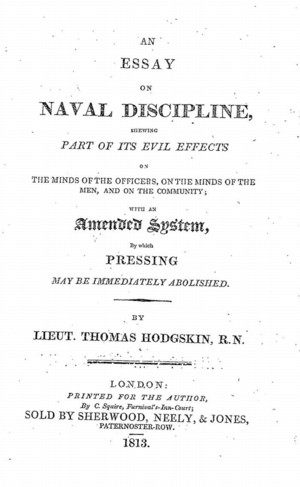
An Essay on Naval Discipline, Shewing Part of its evil Effects on the Minds of the Officers, on the Minds of the Men, and on the Community; with an Amended System, by which Pressing may be immediately abolished, by Lieut. Thomas Hodgskin, R.N. (London: Printed for the Author, by C. Squire, Furnival’s-Inn-Court, sold by Sherwood, Neely & Jones, Paternoster-Row 1813).

About Liberty Fund:

Liberty Fund, Inc. is a private, educational foundation established to encourage the study of the ideal of a society of free and responsible individuals.


CHAP. VII.

A Definition of Discipline; with the Modes by which the present System destroys it.

Before we can verify the assertion made in the last chapter, that the present naval laws and customs are destructive of real discipline, it is necessary to enquire what discipline is.

This word has been so wrapped up in the mantle of prejudice, so obscured from our view by the terror that surrounds it. Civilians have so entirely committed it to military men, and military men have so entirely neglected it, that it would be difficult to find out what it means; but it fortunately happens that we know, distinctly, the purpose for which men of war are built and manned; and that whatever best promotes that purpose must be discipline. The sole end of men of war is by conquering the enemies of our country, to permit us to enjoy peace and security. Now, as this end is to be obtained by the concurring efforts of a large number of men, whatever excites them to a zealous co-operation must be good discipline. But as every person knows that, however zealously disposed men may be, amongst many there will be many different modes of accomplishing the same end. It is, therefore, necessary that this zeal should have but one object, and one directing mind. Good discipline may then be defined a something, whether a code of laws or customs, that animates a large body of men with one-mind, and impels them zealously to pursue the same end. The detail of the means used on board ship to accomplish this end must, I apprehend, have convinced every body that they are really destructive of it. Zeal never yet was produced by terror; and the animating spirit that has, at all times, led our seamen to pursue the end of discipline, (or conquering the enemies of our country) has been the desire of praise. This can not be at all owing to that system of laws and customs which I have detailed, and whose effects are to make gaolers of the officers, and prisoners of the men, which must produce mutual distrust and dislike; when, to promote the end of discipline, there ought to exist nothing but unanimity, confidence, and obedience; and whose other effects are to set the marines in array against the seamen, and the seamen against the marines. It is the pride of the present mode to keep these bodies as distinct as possible, remembering the old maxim, of divide to govern. I know that this feeling does not exist at a moment of exigence; it is then swallowed up in their ardent love for the country, and their desire of praise; but this is to the credit of our national customs, and belongs not to the present system.

It is probable that our naval successes may be advanced as proofs, that the present discipline has effectually obtained its end; that to them, men may be exultingly referred as proofs of its efficacy and goodness; but I positively deny that these victories have ever, in any one instance, been the result of the present system of discipline. It never inspired one Englishman with courage,—the means of achieving victory, or ever made one Frenchman tremble. Our naval victories have been always owing to our superior national character; to our sailors own innate, unequalled, unconquerable, courage: one consequence of liberty is courage; and of slavery, fear; from this it is just as wise to assert that the present patriotic spirit, evinced by the Spaniards, is owing to the inquisition, as that our seamen’s courage, which has gained us victory, is the result of naval discipline. So conscious are naval officers, even the greatest disciplinarians, of the inefficacy of this system to produce courage that, in a moment requiring exertion, it is laid aside: then the captain becomes all affability; then it is what their country expects of them; it is then the reflection, that they will be praised that excites them to every effort. Victory has always attended the English, before this system was established. Neither our Harry’s, our Edward’s, our Alfred’s, nor our Blake’s, nor even our Nelson, ever wanted or had recourse to such a diabolical plan to conquer the enemies of their country.

It is a strange truth that the profession, which was adorned by the abilities of Lord Nelson, and which he carried to a height that never before was equalled, is the only part of the community that in any manner doubts his having been a great man; and this wholly from his neglecting to use the means generally employed to accomplish order. His lordship had no character as being a strict disciplinarian; a character which officers have heard so much praised, that they think it contains every thing that is needful.

That the present laws and customs are destructive of discipline is clear; from the well-known remark, that great disciplinarians have seldom been successful commanders. Nor can it be otherwise; no man, under their command, feels any zeal, it is destroyed by terror; no man does any thing but what he is commanded. He who makes use of those severities which, (though the laws may sanction) create hatred in the minds of the people, has a conviction within him which must unnerve all courage.

The effects of what is now called discipline, are also clearly seen in the loss of the Africaine, Hermione, and Danae, all commanded by wonderful disciplinarians. Captain Corbett was particularly known as one of these characters; and when the Africaine was taken, it was declared the people refused to fight, from the cruelties they had suffered. It was even rumoured he fell by one of them; whether this is true or not I cannot pretend to say, but such a rumour being in existence, is a strong proof of a general opinion of the destructive qualities of the present system of discipline.*

The inefficacy of a power to punish, or what is now called discipline, was forcibly shewn among the troops while retreating to Corunna; and the superiority of national character, in accomplishing the ends of discipline, was strongly evinced when there. While retreating, which they were conscious was discreditable and would obtain them no praise, they were all disorder; the utmost efforts of their officers could procure no kind of respect or obedience; but immediately they knew they were to fight, they were all alacrity and attention; on no occasion in the world did our countrymen shine forth with more brilliant lustre, it was only to be regretted it was under such inauspicious circumstances.

I trust I have now clearly convinced my readers that the main principles of naval discipline, as it now stands, viz. Pressing, compelling men to do their duty by terror, and permitting captains to employ that at their pleasure, are as destructive of real discipline, as they are of morality; that they are not less opposed by the feelings of the heart than they are condemned by the dictates of reason; and that they are alike destructive of the energy of our national character and of individual virtue. The main spring of the coercion in existence is, the power the captains possess of making what they please customs, and punishing them at their pleasure; part of its ill effects are now before the public in a tangible shape, and it is for them to support or abolish it. To have called the attention of the public to the sufferings of an individual would have been trifling with its majesty; but the same principle that has deeply injured me, is now inflicting thousands of cruelties on the seamen; and the mischief it may cause to the community, from the destruction of our national character, is quite incalculable. Was it of importance, or did I, as an individual, ask the support of my country? I could, demonstratively, prove that I violated none of the existing laws of the navy; and that I acted in their true spirit when I remonstrated against an existing injustice. But I cannot avoid knowing that, in daring to step aside from a custom unsanctioned by laws, I offended against the mis-begotten, ill-directed, feelings of the pride of my superiors. That I opposed men who were cursed with the power of punishing, and who are accustomed to measure the feelings of our nature by the exaltation of our rank, who are themselves in the habit of tolerating and acquiescing in the Billingsgate language of a commander-in-chief; who have patiently, in their own progress through the service, borne with every contumely; and were, therefore, excessively displeased that a lieutenant, unknown to the world, destitute of fortune, or of rank, should dare to lift up the brow of honest indignation against destructive injustice, unmerited insult, and vulgar abuse. The propriety of this principle must not be left for military men to decide on, for they are so pleased with the power it confers, so prejudiced in its favour, from the pleasure its possession bestows, that they never will support opinions that will abolish it. To be properly examined it must not be called a military question, for its continuance conspicuously affects the whole community. The time may not be far off, if the present contest in the north should be unfavourable to us, when Bonaparte may man his ships with his victorious legions, who, animated with victory, and incited by their former fame, may (when contending against the foreigners who man our fleets) hope for victory on the ocean; the pressing may then be extended to all, we may have to contend upon our own shores for our national existence. And how will men, who have till then enjoyed all the blessings of liberty, submit to this system, when the longest habits of obedience never yet reconciled it to one human being? That it has not, at all times, produced all the cruelties and all the ill effects I have mentioned I am well aware; but the acknowledgement that these are bad, and the instances in existence, where order has been accomplished without them, is the strongest argument that can be used, that the power of producing them should not be entrusted to any man. The end of all the cruelties which I have detailed is never good for the service, though such is always made the cloak; they are never used to repress what education has taught me to call crimes; but their sole end is to enforce unnecessary labour, that the captain may enjoy a momentary reputation as a smart officer. It is here necessary to make a wide distinction between a smart officer and a good officer. Lord Nelson was a good officer; but a smart officer is a man whose merit is apparent to every body’s eye, but foreign to every body’s heart; whose ship displays wonderful alacrity in all the minutiæ of her duty; whose appearance attracts every body’s admiration and every body’s applause, who does not enquire how it is attained. If this be all these cruelties are used for, there can be no motive for their continuance, but as the power that occasions them flatters and engenders the officers’ pride; but as it elevates a few beings above others, to a situation where otherwise neither their fortune nor abilities would have placed them; and can this be a motive for continuing them? Every reasoning man must object to it. This is one point where the misplaced praise of society has done the naval service much injury: had no comparisons ever been made between ships sufficiently clean for the purposes of health; sufficiently well ordered to be enabled to fight the battles of their country; and those delicately clean, and too gay to be useful: had the last not received unqualified praise, and the first unmerited censure, the naval service would not have been annoyed with so many smart officers as have plagued it; whose smartness is productive of hatred, and whose gay appearance is the occasion of strife.

In endeavouring to pluck down so noble an edifice as naval discipline has been called, I should imagine myself little better than a destroyer, were I unable to collect, from its ruins, materials for erecting a better; one that shall accord with the present state of the feelings and knowledge of mankind, and that shall be consistent with our national character; where it shall not be necessary for the ideas and actions of the man, to be contrary to the received instructions of the boy; and where, as in other parts of our society, terror shall repress vice, and shame excite emulation. Was I unable to sketch the outline of a system that shall have for its objects,—To make my profession honourable for its professor, as well as useful to my country: To make that country infinitely more just, and not lessen her prosperity: To help to deliver her down to future ages as a wise, as well as a great, nation.

Let it not be said that no reformation is wanted, our seamen do not complain: in every reasoning mind there must be a conviction of existing injustice; and it is an observation of Lord Holland’s that cannot too often be repeated, that “wherever injustice is known to exist, though not complained of, it is a positive duty in legislators to amend it.” Our seamen have frequently complained, and they have never been able to punish men, guilty of the greatest enormities, till they have become tired of complaining.

Can any man be on board ship for an hour, and not think there is a spirit of dissatisfaction and discontent existing? Every officer of the navy knows, as well as myself, that there is, and every man must be satisfied there is very just cause. This discontent is now regarded with satisfaction as a symptom of the seamen’s perfect subjection, afraid to speak out. It is known with that same pleasure with which we hear the distant summer’s thunder, conscious that it brings refreshing showers to the thirsty earth, forgetting that it may in a moment become the lightning’s tremendous flash, that destroys too suddenly to permit resistance.

Sailors know not how to advocate their own cause. Carrying arms in their hands, they are wisely forbidden to deliberate, because they possess a power which could not be resisted; but can that be urged as a reason why they should be stirred up by oppression to use it. It ought rather to convince men, that there is a necessity for doing sailors every justice. Let us not forget that the lion was quietly at rest till provoked by his worryers, but when unable longer to endure them, he arose and crushed them.

Some reformation is becoming most essentially necessary, for every means is now taken to give information to every class of the people; and while you are teaching them that these things are wrong, can there be a greater absurdity than to continue to practise them? Can any rational being think that, when sailors are convinced of the uselessness, as well as the injustice, of this system, they will submit to it? It is impossible to keep this conviction from them; it is therefore absolutely requisite this system should be abolished. It is in vain to think, while you are teaching people to know right from wrong, that they will submit to a system of laws whose basis are injustice and terror; whose supporters are immorality and vice; and whose end, if persevered in, must be destruction.

[*]Upon the appointment of Captain Corbett to the Africaine, and prior to her going abroad, the ship’s company wrote to the admiralty requesting to have their captain changed, so well established was his reputation; offering, if Captain Raggett was returned to the ship, their services in any climate, or to serve a twelvemonth without pay. So great was their love for their country; so great was their hatred of tyranny.