Econlib

The Library

Other Sites

Front Page arrow Titles (by Subject) arrow CHAP. III.: section first.An Account of some of the Naval Laws and Customs, and of the Coercion used on board Ship to establish Order. - An Essay on Naval Discipline

Return to Title Page for An Essay on Naval Discipline

Search this Title:

Also in the Library:

Subject Area: Political Theory
Subject Area: War and Peace

CHAP. III.: section first.An Account of some of the Naval Laws and Customs, and of the Coercion used on board Ship to establish Order. - Thomas Hodgskin, An Essay on Naval Discipline [1813]

Edition used:

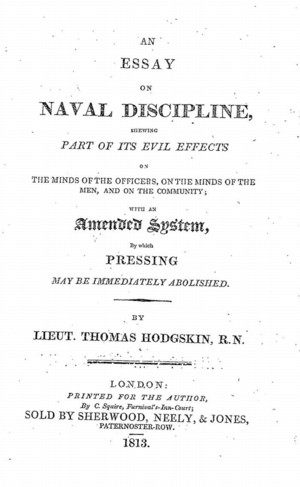
An Essay on Naval Discipline, Shewing Part of its evil Effects on the Minds of the Officers, on the Minds of the Men, and on the Community; with an Amended System, by which Pressing may be immediately abolished, by Lieut. Thomas Hodgskin, R.N. (London: Printed for the Author, by C. Squire, Furnival’s-Inn-Court, sold by Sherwood, Neely & Jones, Paternoster-Row 1813).

About Liberty Fund:

Liberty Fund, Inc. is a private, educational foundation established to encourage the study of the ideal of a society of free and responsible individuals.


CHAP. III.

section first.
An Account of some of the Naval Laws and Customs, and of the Coercion used on board Ship to establish Order.

Out of this imagined necessity, of pressing, there has grown up in the navy a set of laws and customs sufficiently repugnant to the feelings of an Englishman, to his ideas of justice and liberty, to make him forget the principle of resistance so common in human nature, neglect the gratification of fame, and risk every disaster, even to starving, rather than voluntarily serve his country.

These laws and customs, like pressing, are defended on the score of inevitable necessity, arising from the bad character of the seamen. As they are also acknowledgedly unjust, it becomes their supporters clearly to show the existing necessity, distinctly to prove this bad character of the seamen, or amend the execution of these laws; but I think I can satisfactorily prove, that this necessity does not exist; that the frequent crimes and bad character they are made the vehicles of punishing they themselves occasion.

When, from a thorough conviction of its absurdities, I am about to condemn what is called naval discipline, or the means used on board ship to establish order, it is necessary I should assert, that no man is more a friend of order than myself; no person has a stronger conviction than I have of the necessity there is for a quiet and ready obedience, for the utmost attention to cleanliness and health, for the greatest alacrity in every minutia of duty, and for prompt and stimultaneous efforts in every class of men of war to produce victory. The facts that will follow are not well authenticated ones, borrowed from others, but what I have myself seen; and the reasoning is the result of my own experience. In detailing these facts, I beg to be distinctly understood as making no reflections on any individuals; they are the genuine offspring of a dreadful system of laws, which corrupts the officers and debases the men; which, by tolerating and praising, encourages oppression; which furnishes principles of action directly opposite to the religious instructions of our youth; and which perverts those feelings of the heart that, under the guidance of these instructions, give birth to every virtue.

The men who have legislated for the navy appear to have been ignorant of the characters of, and of the crimes likely to be committed by seamen; they have not only been ignorant, but they have been negligent in enquiry, or they might have ascertained what are the chief crimes, what is their cause, and what is their proper remedy. From this ignorance and this negligence, no moderate punishment is affixed to the thousand little deviations which sailors may commit, and which, from their confined situation, must be known to their superiors. These trifles are all left to the captains to punish; and he punishes whatever he thinks errors, and in nearly whatever way he thinks proper. He is sanctioned in doing it by the following article, which concludes those articles of war by which the navy is governed. It says, “All other crimes, not capital, committed by any person or persons in the fleet, which are not mentioned in this act, for which no punishment is hereby directed to be inflicted, shall be punished according to the laws and customs, in such cases, used at sea.”

Dr. Paley has asserted, in his Moral Philosophy, vol. I. page 5, “That it is tyranny in the legislature leaving to magistrates the power of defining what the laws intended to punish;” but our legislature has left to the captains the power of punishing according to custom; has left them the power of making customs equal to laws; has made them, when they form courts martial, the only judges of these customs, and they have the power of condemning to punishment: in short, they are legislators, they are judges, they are juries, and they are very often parties and executioners. This is, according to the dictionary, despotic power, and therefore these expressions are strictly true, and no apology, I should think, can be expected for using them in other parts of this essay. The entrusting arbitrary power to any governor or governors is not less destructive of his or their happiness than it may be of all the men governed; that this unhappiness to both is the fruit of arbitrary power being in the possession of any men, experience must show to all; that its fruits are the same in the navy, I am convinced from experience; it is as pernicious to the happiness of officers, through making them distrustful and jealous, instead of their having confidence and attachment, as it is to the seamen’s happiness, through the cruelty that is exercised upon them. If it is so destructive of this happiness, what reason can be found for continuing it, since the happiness derived can be the only test of the utility of any law?

In consequence of entrusting such a power to captains, complaints are frequently made, and with too much occasion, that justice cannot be obtained at courts martial. Whenever the culprit is a junior officer, or a common seaman; whenever he may have violated any of the laws; whenever he may have offended the feelings of antipathy of an admiral or a captain, it is as rational to expect justice from a court martial as from a Turkish Cadhi; both possess the same power, and both are subject to the influence of that power through their passions upon their judgment.

To the mind accustomed to reflect, that ideas of right and wrong are, like all other ideas, not engraved upon our minds by the hand of our Maker, but are acquired from education (in the most enlarged sense of the term), what a sanction does this possession of power, this article of war, give to a captain for the persevering in any cruelties he may ever have seen inflicted or adopted as customs, by any of his superiors, in his progress through the subordinate stations of the service! Unfortunately, the infliction of severity of punishment comes recommended to the young officer with all the fascinating charms of success; it has often produced, and will again produce, great simultaneous, but temporary exertions. Its future consequences, in corrupting the mind of the sailor and of the community, in producing a still greater degree of hatred, which must, eventually, end in destruction, can never be attended to by men whose limited education prevents them knowing these future consequences.

It is this before-mentioned article of war which reconciles to every captain’s conscience the infliction of severity of punishment, that neither the immorality, the unhappiness accruing, nor the importance of the crime ever call for; it is this which convinces him that he acts perfectly just; and when the approbation of courts martial (the highest naval tribunal) has been bestowed upon bad customs—when, from beneficial but temporary effects, these bad customs have excited the applause of men, supposed to be excellent judges, whose lives have been spent in the service, whose years of experience entitle their opinions to much respect, but who have never known human nature, and possessed little knowledge beyond their ships; this article has then had additional force in perverting the ideas of right and wrong, which naval officers might acquire from their communications with other parts of society. Such customs have been sanctioned which deserve condemnation; such applause has been bestowed upon actions for the support, as it would be called, of discipline, from which the unsophisticated and enlarged mind of an Englishman recoils, as horrid and atrocious.

The opinion, that this article of war really perverts people’s ideas of right and wrong, is not the fancied speculations of a man covered with the dust of a library, but the result of experience. I served a considerable time with a captain deservedly celebrated, whose whole mind was occupied with a desire of being distinguished, and who has performed several actions that have justly acquired him much reputation. He had, unfortunately, served all the early part of his life with officers denominated “smart;” he had seen men whom he had early been taught to fear and respect adopt many bad customs, with temporary success, in producing alacrity, but never having enlarged his mind with much reading, or much communication with society, nothing told him that following these customs was improper. This captain was a religious man, and a man, whom I believe, most firmly thought himself conscientiously just, and that, in committing numberless cruelties, he was promoting the good of the service, by keeping in order a set of men whom he was accustomed to consider as notorious rascals. My situation permitted me, and I took particular pains to find out his motives for the severity of his discipline, and I am fully convinced they all centered in benefitting his majesty’s service, and in acquiring for himself, what has been much an object of naval society’s praise, the reputation of a “smart officer.” I have seen this captain flog, I think, twenty-six men, part of them by candle-light, at both gangways, because their hammocks were not properly cleaned . The only time the men were allowed for scrubbing was one hour and a half during the night; in this time they had their hammocks, half a week’s dirty clothes, and, perhaps, a bag to scrub. It was not because they had not been scrubbed at all, but because they did not look well: I should say, it was flogging men for impossibilities. It was in a warm climate, and, in a warm climate before, this captain had seen such things done; he would allow of no relaxation whatever, justly observing, if he began to relax, he knew not where to stop. The observation is extremely good, but the application most wretched; for there exists a wide difference between relaxation from order and relaxation from the cruel means used to accomplish it. Part of the men so punished were some of the best men in the ship; but old or young, good or bad, they had disobeyed orders in not having their hammocks perfectly clean; they had merited punishment, and they were punished.

This incident forms a part of the customs used at sea, and what is more, this formed a part of a system of discipline, which system had received not only the sanction of a court martial, but its praise; it was said to be honourable and praiseworthy to the captain. I almost fear, from the known humanity of the English nation, that I hazard my credit with them in stating this fact, but it is nevertheless true.

A consequence of entrusting to captains this power of punishing what they think proper is, that instead of one system pervading every ship, the discipline of each ship depends upon what is called the captain’s natural disposition; so that both officers and men, at changing their ships or their captains, are often obliged to change every mode to which they have been accustomed. From being allowed to live in all kinds of indolence, they are suddenly required to assume a large portion of activity, and very often the want of this activity, encouraged by the indolence of a former captain, is imputed to them as a crime, and endeavoured to be conquered by flogging. From discipline depending on a captain’s natural disposition, a naval life becomes a series of different educations; knowledge not established upon principles, is vague and useless, and the time that might be employed in improvements is devoted to the changing of modes. Surely this is miscalled a system, it is a collection of as many systems as there are different individuals; what is tolerated in one ship is in another a crime; what is in one applauded is in another punished; it is only a general system as it entrusts a power to men who have notoriously abused it.

Now it unfortunately happens, that the captains who feel the greatest predeliction for ships, and are, consequently, best acquainted with them, despise other knowledge, and therefore know little else but of their ships. These are the men most likely to be employed where merit is alone the question; these are the men most likely to have the education of our young men of interest, who are sure of promotion; and these are the men most certain to perpetuate all the errors and all the cruelties of custom.

The power entrusted to captains over the men was without any sort of controul until April, 1811, when punishment had then caused such frequent complaints from the seamen, and it had been proved they had borne with patience, and complained with justice, that the admiralty found it necessary to interfere; and they issued an order, that quarterly returns should be made to them of the number of men flogged in each ship; their crimes, age, time they were confined, quantity of punishments, &c. &c. but still leaving to the captain the power of inflicting punishment. Now it must be obvious to every man, that the same interest which can, in violation of every principle of justice, and of every incitement to officers for exertion, make a captain of a man, comparatively just come to sea, while thousands are toiling, and have been for years destitute of hope, must be sufficient to soften and completely obviate every censure the admiralty might be inclined to bestow on a captain - who should inflict, under the name of good for the service, unmerited or cruel punishment. As these returns are known only to the admiralty themselves, they are, therefore, responsible to nothing but their consciences for their conduct* and every man knows how easily conscience is influenced by interest. It is also rendered perfectly useless by the captains employing other means of punishment; therefore this order, though evincing the necessity there is for some check, is wholly ineffectual.

It is not my intention to point out and comment upon the effects of every one of the articles of war, or every one of the customs of the navy. Many of them are a perfect dead letter: I wish not to wake them from their dread repose, but just to direct the public attention to the most prominent figures in the picture of naval discipline, I believe they will find all its characters, all its shades, of the same dark hue, unenlightened by knowledge, untinged with mercy or benevolence, and reflecting the heaviest gloom over the character of man. Yet there are some articles of war which deserve notice, as likely to moderate the cruelty of customs, and stop tyranny and oppression. It is enacted, by the thirty-third of these articles, “that if any officer shall be convicted before a court martial of behaving in a scandalous, infamous, cruel, oppressive, or fraudulent manner, unbecoming the character of an officer, he shall be dismissed his majesty’s service.”

This might be supposed to ameliorate or prevent cruelty; but as all cruelty is relative, and as a captain is tried by captains, who all, like himself, have witnessed cruelties existing as customs, and since they have all occasionally practised them, they are all ready, from similar feelings, to make every allowance for a man who states, and probably believes, he was only promoting the good of the service when he trespassed on humanity. Experience shews, that there is no punishment for a captain who does this, that nine hundred and ninety-nine instances out of a thousand escape; besides, a prosecution is not a simple business, few are the seamen that have knowledge sufficient to conduct it, for every effort is employed to keep them in ignorance; fewer still dare oppose an authority which they are habituated to reverence from terror, and when they do still fewer succeed.

The first article of war might also be supposed to produce good, since it recalls men’s minds to the Deity; but it is so little observed, and so frequently violated, that I fear its tendency is the direct reverse. It is ordered by it “That all commanders, captains, and officers, in or belonging to any of his majesty’s ships or vessels of war, shall cause the public worship of Almighty God, according to the liturgy of the church of England, established by law, to be solemnly, orderly, and reverently performed in their respective ships, and shall take care that prayers and preaching, by the chaplains in holy orders of the respective ships, be performed diligently, and the Lord’s day be observed according to law.” But so far is Sunday from being observed as a religious day, that it is generally devoted to some particular employments without the slightest necessity. I have seen forges set to work, rigging set up, ships painted, and all manner of work performed, from no other motive but that paramount one on board ship,—the captain’s pleasure.

I am not so determined a bigot as to condemn working on Sundays as a crime when the country’s service calls for it; but I think a whole code of laws are likely to be much more respected by the body of the people if they see no open violations of any part of them by men, their superiors, whom they are accustomed to obey and respect. This law stands first in the naval code; it is solemnly and impressively worded, and it is one that the lowest class of the people are accustomed to regard with attention; for the respect due to Sunday is enforced in millions of penny pamphlets in our country, and it ministers to their pleasure and their ease; therefore its total violation, which frequently takes place on board ship, must serve to bring the whole body of the laws into contempt, exclusive of its bad effects in destroying, by the ill example of their superiors, all attention to religion in the minds of the men; thus perverting the only source of morality, and thus assisting to produce the bad character attributed to the seamen.

There is another law which has also the effect of bringing the whole code into contempt; it is the first part of the 27th article, which enacts, “That no person shall sleep upon his watch, upon pain of death or otherwise, as a court martial shall think fit.” But times have so altered since this was made, or it was made with so little knowledge of the seaman’s situation, that he is now permitted and encouraged to go to sleep. An obsolete or a contradictory law is of no consequence on shore, where people never hear of it, but on board ship this law is read, with the others, probably, once a month, with equal solemnity, and has equal force with others, to which the most rigid obedience is exacted.

CHAP. III.

section second.

Whenever, what is called, the natural disposition of the captain is severe; whenever he has a strong love of fame, and is careless or ignorant of the legitimate means of acquiring it, terror, from its temporary success, is made the means of promoting that activity in the minutia of duty which has been thought to deserve, and has received much praise. Custom sanctions flogging in all cases when the captain thinks fit; and the particular article of war that sanctions it for wanting activity is a part of the 27th, which says, “No person shall negligently perform the duty imposed upon him under pain of death, or as a court martial shall think fit.” Captains are the sole judges of what is negligence, and the duty to be imposed has been interpreted by them as an obligation on all beneath them to do every thing in what ever manner they may think fit; and who can affix any other interpretation but captains? Any opposition to their will, any hesitation in obedience, and want of alacrity in fulfilling it, is punished by flogging. Some of the captains have insisted upon their people’s flying, but not having the genius of a Kali, have enforced obedience by flogging. Lest the reader may be too much alarmed, it is necessary to state, flying, in sea language, means running up and down the rigging, in and out upon the yards, with breathless haste.

A great part of the punishments I have witnessed on board ship is classed under this head of neglect of duty; and when the punishment annexed to the offence is stated at from one to three dozen, it will, doubtless, be inferred, that there must have been some egregious inattention, some neglect, by which the ship has been endangered, or some want of exertion, by which an enemy has escaped. No such thing: such instances are very rare; but the captain has imposed some duty upon them which could not interest them; exertions have been required when no zeal existed, but this never was when an enemy was to be encountered. Some accident has happened from hurry, which it was the duty of the unfortunate culprit to prevent; perhaps his anxious wish to beat another ship, when they have been exercising together, and frightened by the terror-striking voice of his captain, or first lieutenant, has made him neglect it.

I have heard it has been avowed as a principle, by an officer of the highest reputation in his majesty’s service, and I have seen it acted upon, “that no such thing as an accident could happen;” consequently, any misfortune must have arisen in some person’s neglect, and some person must be punished to prevent its recurrence. To this, as a principle, between man and his Creator, I have no objection; in his all-seeing eye it is probable all the misfortunes of the human race may justly be imputed to themselves; but surely, man’s fellow-creature, though his superior, is not his God. To continue the enumeration of those things that are punished as the neglect of duty:—Some of the iron allotted to a man to polish does not shine well; his hammock has not been clean scrubbed; his clues have not been blacked; his clothes have wanted mending; his shirt has been dirty; or, perhaps, he may have neglected the captain’s stock, or the wardroom dinner: These, and a thousand similar trifles, are what seamen are flogged for, as neglect of duty. The captain’s orders have made doing these things their duty; and custom sanctions his inflicting flogging for their neglect. No person who reads over these items for which sailors are flogged, whether sailor or not, but must know greater part of them have no real value in themselves; they have a beginning in the captain’s will, and when he is pleased their utility ends. Those that are necessary or useful, must flow from regulations, and their being made honourable and praise-worthy should be the stimulus to conformity. Those polishings, &c. that are of no real use with a better system of discipline would not be wanted; for now they are adopted, as the means of employing the people, so averse to our common feelings is naval discipline, so dreadful are the means used to establish order, that, for a sailor to have a moment’s leisure is, by many officers, dreaded more than a pestilence. As the real duties of a ship can never occupy the time of half of the men employed, the captain has recourse to his invention to find the seamen work; for so conscious are the officers that the seamen cannot reflect without being sensible that they have been unmeritedly punished, that they have received almost unlimited injury, that they are fearful reflection should make them compare their situation with the rest of their countrymen, with what they themselves once were, and that this reflection should rouse them to vengeance for oppression. What a thread is this for the existence of our country to depend upon? And not only our country, but every thing that can be dear to the reflecting part of civilized Europe.

It is those things which, in themselves, are indifferent, which have never been objects of praise, and which there exists no motive for doing, but the arbitrary will of a captain, or some capricious superior, that flogging is employed to produce. A seaman never neglects his duty in time of action, for success then has been an object of praise. In any time of trouble or of danger, whenever great energy, noble courage, or manly fortitude, are wanted, terror, in any of its branches, is never applied to call them forth. In such times is the seaman’s greatest glory and his highest pleasure; then he feels that his efforts will entitle him to praise; then, cheered with the smiles of his officers* and the prospect of fame, death only limits his endeavours.

Once, indeed, I have seen an instance of British seamen’s backwardness in a time of danger, when they were heartless, pusillanimous, and cowardly, but this was in a ship where a severity of flogging, and all the niceties of discipline were carried to a greater extent than I ever before witnessed; where the captain never permitted any other motive for action but fear of him; where, if the men were disposed to do well in their own way, but, from other motives, they were not permitted; and where every action was prescribed by regulations, and enforced by terror; but, in a moment of danger, no terror could be employed, and, consequently, no exertion took place. By the operation of this terror, the men were deprived of every lawful and pleasing mode of excitement; they were debased into slaves, and slaves are incapable of energy. This circumstance is a strong proof, how much more powerful the hope of good is in promoting human labours than the fear of evil; for here no chance existed that was known to the seamen, but that they would be punished when fine weather should again return; and, if the fear of evil could excite men, I know no evil greater than flogging, and none was more certain of being realized. I have before observed, that from the power that is entrusted to captains, different things are punished, as crimes, by different individuals, and the same individual is, at times, so unlike himself, that what he once punished he is now inclined to applaud. This is so much so on board ship, that the seamen scarcely know themselves what will be punished and what will not. No principle, therefore, shorter in its duration, or more transient in its good effects, than fear of capricious man, can be applied to govern men.

I have once, and but once, heard of an instance of the seamen feeling any thing but pleasure at going into action. This took place, in a ship recently manned, in the West Indies, where scoundrels of every denomination are gladly accepted and classed with British seamen. The men were mostly foreigners, and very soon after leaving port, this ship fell in with an enemy of much superior size to herself. Her appearance frightened these men; the captain was informed of it by the few Englishmen on board, and with such base minds as these people possessed, punishment was effectual in exciting courage*

Another customary mode of forcing men’s labour in men of war sometime ago in use, though now gradually and very happily going out of fashion, was to flog the whole of the men stationed to perform a particular service, such as the main-topsail-yard men, &c. if they were last at executing a part of their duty, or if, in the captain’s opinion, they stood conspicuous for neglect. This custom, though now growing into disuse, had, and yet has the evil effect of begetting hatred to the service in the minds of the community; it has deterred Englishmen from voluntarily resigning the blessings of existence, by submitting to such horrors, though prompted by the love of fame. In compliance with this custom, not many years have passed since I saw all the men stationed on the main topsail-yard severely flogged for their dilatoriness.

This wholesale mode of punishment, this darling of what is called the St. Vincent system, was the pride and glory of discipline; its effects were exultingly pointed out to you in the superior alacrity with which men so punished performed their duty on the next occasion. Happily, public opinion has tended to eradicate this glory of discipline.

section third.

The second article of war is, “All flag-officers, “and all persons in or belonging to his majesty’s ships and vessels of war, being guilty of profane oaths, cursings, execrations, drunkenness, uncleanness, or other scandalous actions, in derogation of God’s honour, and corruption of good manners, shall incur such punishment as a court martial shall think fit to impose, and the nature and degree of their offence shall deserve.”

Of all the crimes mentioned in this article, and which, with the others, is read to the seamen once a month, drunkenness is the only one for which custom sanctions the infliction of much flogging; of the other crimes mentioned here, cursings, execrations, &c. are known to exist in immense quantities, and are never noticed: indeed, it is a general opinion in the navy, that his majesty’s service cannot be carried on without (on the part of the officers) cursings and execrations. As for uncleanness and other scandalous actions, they are tolerated, allowed, and encouraged; why these words are permitted to exist in the same article with drunkenness, occasionally so much the object of abhorrence, and flogging, can only be accounted for in the ignorance of the people who made these laws, or in the changes to which the affairs of men are liable.

Of all the crimes that frequently meet with severity of punishment on board ship, and which are the cause of much flogging, drunkenness stands pre-eminent for the enormity of its consequences; for, whenever suffered, it can cause nothing less than destruction to every ennobling sentiment, of every regularity that can keep up order or preserve health. It deserves no palliation, and must, by some means or other, be repressed; but with the advocates of discipline I cannot agree, that flogging, inflicted at the will of an individual, is the proper mode of repressing it. This vice is as condemnable, in a moral point of view, as it is from its effects on order on board ship, and, consequently, habits of it ought never to be tolerated or allowed; but in the navy they are frequently encouraged and praised.

In the opinion of many officers, a sailor is not worthy of his name who goes on shore (though it is very seldom this is permitted) and fails to get drunk. A knowledge of this opinion, and a desire for the praise consequent on it, and in being deemed a good hearty fellow, prompts sailors to get, as fast as possible, rid of their sobriety whenever they set foot on land. When there, the civil inhabitants of our country give strength to this opinion, and act as if they were in a conspiracy to undermine the morality of our seamen; they are encouraged, by their smiles, to commit all sorts of excesses. Poor fellows, it is said, after their labours, indulgence is necessary: thus a most brutal state of intoxication is called an indulgence; and what general opinion pronounces an indulgence will be eagerly sought for, without any conviction of the pleasure arising from committing it. Who, that has ever been in a sea port, has not seen drunkenness encouraged in this way, and drunken sailors cheered and applauded while doing all sorts of mischief? But the privilege of getting drunk, as an indulgence, does not stop here; in many ships it is given to seamen, when in harbour, as a compensation for their other numerous privations. They are allowed to purchase liquor in certain proportions, but generally sufficient, with the usual allowance of spirits or beer, to produce intoxication. As this is always granted as a favour, it, of course, is an indulgence, and is sought after as a pleasure. Whenever this permission is given, all attempts to preserve any kind of order are perfectly fruitless. The horrid, the brutal scenes which I have known ensue from this indulgence, will not bear minute description: Mutinous expressions, horrid blasphemies, and perpetual fighting, distinguish the evenings of the days devoted to intoxication.

It is from this forbearance and indulgence at one time, together with a greater allowance of spirits than is necessary, that habits of drunkenness are produced among seamen of men of war, which, afterwards, the utmost severity of discipline can scarcely subdue, and can never destroy; yet the drunkenness produced in this way, is made the principal argument for the necessity of severity. Like other crimes, it is left to the captain to punish or not; it is encouraged or repressed; punished lightly or severely, just as he may be indolently good natured or diligently severe. Can there be a more effectual means of destroying the distinctions between vice and virtue, (remember that they are not innate) which it is the business of religion and education forcibly to impress on the mind, which it is one great business of laws to make, than in thus making convenience alone the test of guilt, than in thus reducing the eternal and immutable principles of morality to the narrow and vibrating scale of this man or that man’s pleasure; than in superiors punishing at one time what at another they practise, encourage, and applaud. Goaded once to madness, by severities, the seamen mutinied, and, like other beings in their situation, they knew not, exactly, what to claim as their due; they thought more grog would drown every care, and hence, that greater allowance of spirits which they receive than is necessary for their health, and which is sufficient, under some circumstances, to produce intoxication.

Here was one instance, out of many, that might be produced, that where justice is not done, something that is not justice, will be obtained. When ever the seamen shall become sensible of their present situation; and, from the wide diffusion of knowledge, they are fast arriving at it, they will obtain, from the fears of their superiors, more than justice; they may, perhaps, (I fear it) hurl destruction on their country.

Reflecting, that men’s characters are, in general, formed from the institutions of their country, or the immediate society in which they live, combined with the influence of climate, I formed an opinion that it was probable drunkenness in men of war, arose wholly from their existing institutions, and I enquired of many captains of merchantmen, if they found seamen to be frequently drunk with them; the answer invariably was, “not particularly, not more than the other inhabitants of our country, of their class, unless,” it was rejoined, “they had been in a man of war.” And more than one instance has been related to me, of sober, young men, who had been pressed, returning to their former employ at the peace, corrupted, drunkards, and unfit to be trusted; and after some short period of good example and seclusion from grog, returning again to habits of sobriety and decency.

I have witnessed many instances of young men just pressed, never being in the daily habit of drinking spirits, but in a man of war, aided by example, they have soon become drunkards.—But the fact, that the system of discipline which exists in a man of war corrupts a man, is too notorious to need much elucidation.

section fourth.

The nineteenth article of war orders contempt to be punished as a court martial shall think fit, but custom sanctions the captain’s inflicting corporeal punishment for whatever he may deem contempt. And there is an article of the printed naval instructions, which without affixing any punishment to disrespect, vests, through the medium of custom, a power in courts martial to punish it in any way they may deem fit.

Two such indeterminate words as these, left to naval captains to interpret, are very sufficient means; and they are made ample use of in inflicting punishment by men whose anger is roused by the slightest opposition. These things are thought the first steps to mutiny, and they are, therefore, repressed with what is even in the navy thought severity of flogging. Three or four dozen I have generally seen inflicted for what a captain, or a midshipman, a boy just from his mother’s arms, might deem disrespect or contempt. It is here to be observed, that those beings whose conduct they themselves are conscious is creative both of disrespect and contempt, are the very people who inflict, and have most frequent occasion to do it, the greatest severity of punishment for these two things miscalled crimes. If the meaning of these two words is to be taken in its proper acceptation, they can mean nothing but that sentiment which arises in the mind, at feeling pain from the actions of others, at witnessing absurdity, folly, or vice; the greater a man’s knowledge is, the greater his love for virtue; the stronger must be his sentiments of contempt and disrespect for actions vicious, foolish, or absurd. Now, as the Almighty has evidently bestowed upon man a power of producing, by his praise, those actions in others which may promote his own happiness, and of repressing, by his contempt or censure, whatever may injure him; to entrust captains or admirals with a power to injure a man, and then punish him for feeling contempt at such an injury, what is it but to punish us for the possession of feelings the Almighty has implanted in us for the most beneficial purpose, that we may be able to repress actions that injure us.

In my opinion, to punish any man’s contempt of a vice that injures him, is to give a bounty upon vice, and to employ all the terrors of law in repressing virtue; it is to destroy all the boundaries of vice and virtue in the mind; it is to repress those sentiments of pleasure we feel at witnessing virtue, and which would lead us to imitate it; it is an endeavour to substitute pleasure, instead of that pain we feel at the sight of vice, and which would teach us to avoid it. Before the enactment of such a law, our legislators should have taken care thoroughly to convince us of their infallibility, then it is probable we should have submitted to the pain they inflicted, and thought it pleasure: but now, unfortunately, every day’s experience only adds to our conviction, that they are more prone to errors than other men.

From the indefinite nature of these two words, it is not uncommon in the navy for looks to be punished as contempt, for a claim to justice, as a right belonging to every member of society, for a protestation of innocence, particularly if supported by reasoning, against the rash intuitive convictions of a superior, to be punished at this enlightened period of the world as disrespect.

The two words themselves, as applied to actions, are dreadfully indeterminate and ill defined; for no two human beings agree about what is the exact measure of respect. In the navy, with many, it is positive servility or unlimited obedience to any commands, however absurd: with others, it is simple obedience to positive and legal commands.

section fifth.

It must be evident to every person, that the crime which fills most of our gaols, which causes most punishment in the community, and against which most of our penal statutes are directed, is thieving. As our ships are generally manned with our countrymen, it might be supposed that this would also cause the greater part of the punishments on board ship, but it is not so; thieving in any of its branches is very little known there. The chief causes of this may be a certainty of detection, and the ample gratification which the seamen receive of the desire of praise. As I apprehend that, (some how or other) the desire of praise is the remote cause of greater part of the thieving in society; for to enjoy distinction is the chief motive for the acquisition of wealth, it seldom proceeds from positive want. We do occasionally meet with a few incorrigible thieves, but they are generally men who have been sent from the hulks or gaols, as a compromise for transportation or imprisonment. This custom is said to be abolished, and it was high time, for never was there a more absurd one, than thus taking from the seamen what is their only reward for all their privations, what is the only remuneration for all the injuries they suffer,—the respect and praise of society. It was adding the bitterest insult to the most violent injury. It is not more reprehensible in a moral point of view, than it is when contemplated as it may ultimately affect the pockets of the community; for if you take from the honourable feelings of the seamen, and degrade them in the estimation of society, they will necessarily require greater pecuniary rewards.

This would have been an admirable plan to have brought any thing into disrepute; that had been the organ of a minister, a burden to the country, or a useless expence to society. The navy possesses none of these characteristics, it is of supreme national importance, and can only be supported by the feelings of respect which ought to belong to it, and which the country must encourage by its praise.

Thieving, in any of its branches, forms but a small part of the punishments inflicted upon seamen. Yet, as society has marked it as a crime, it is punished on board ship with an additional severity; and as custom sanctions this punishment, being inflicted at the will of an individual without a trial, without an opportunity of a man’s defending himself, as his judge possesses no feelings in common with those which led him to commit the crime, but is unassailed by temptation, it is high time the custom was abolished, and that thieving on board ship should not be punished till the man was convicted by trial.

Fighting and quarrelling are also occasionally met with on board ship, and, like the before-mentioned items, are repressed by flogging, which custom sanctions the captain inflicting at his will.

These are mostly the crimes for which seamen are severely flogged. I have not stated the number flogged, nor have I any means of determining the average amount, except by memory. In one ship where the complement consisted of 195 people, 15 of whom, from their rank, were not liable to corporeal punishment, the average number of men flogged was never less than 5 a week, this is speaking much within bounds. Yet, at the end of a year, 80 more men had been punished than the whole number amounted to, who were liable to corporeal punishment: a proportion how infinitely great when compared with the number of persons who are even brought to trial in the rest of the community. As some of this ship’s company were never punished in the twelvemonth, many of the others were punished repeatedly, which shows the inefficacy of flogging; indeed the remark is very general, that a man once flogged, is sure to give occasion for it again. For it has been applied by many officers so indiscriminately; the old and the young, the good and the bad, have been so alike subjected to the disgrace that, like every thing else which is the common property of all, it has ceased to have any value, it has ceased to be disgraceful; instead of his shipmates regarding the man with abhorrence, who has been flogged, they look upon it as a misfortune to which all are inevitably subject, and from the common sympathies of our nature they share his distress and relieve his pain, they shake hands with him, they console him with pity, and even share their grog with him; this last part of their mistaken kindness has made me frequently witness the man punished at noon, put in irons again at night for drunkenness. If nothing else could be said, this inefficacy of flogging is a sufficient reason for its immediate abolition at the will of a captain.

The number of lashes inflicted is seldom less than one dozen, I do not think I have ever seen above two or three instances of its being less, and frequently it amounts to three dozen. The smallest average number of men I have ever witnessed being flogged, certainly amounted to one a fortnight: out of such a complement as I have before-mentioned, this lowest average amounts to 26 out of 180 in a year, or a seventh part of the whole people, and this takes place amongst a set of men notoriously free from a great part of the crimes committed by the other parts of the community. Now is there any thing equal to the seventh part of our population ever brought even to trial in a twelvemonth? I cannot ascertain the number, but I should suppose it can never exceed the five hundredth part of the people who, from their age, are amenable to justice.

From conversation with other officers, and from observing that they express no sort of surprise at frequent punishments, I am inclined to think this last account of what men are punished on board ship, may be rather below the average number punished throughout the fleet in a year. I have not taken the mean of the two extremes I have witnessed, because I have generally served with officers denominated smart. I believe there are a few individual instances of much less punishment; but this can only be brought as an argument to prove the folly and absurdity, the cruelty and injustice there is in entrusting any man with the power of punishing another, when experience so fully proves that such a power never yet was possessed without being abused.

section sixth.

In the last section I pretended to no kind of accuracy as to the average number of men punished. Now, it is probable, the side of the question I have taken, and the well known passions of our nature, may have led me to mistakes. However, the proportion of men punished in the navy is much greater than in civil society. Those who wish to make accurate calculations on the subject, may have recourse to the punishment lists now transmitted to the admiralty; but it is to be observed, that this transmission is a late regulation, and it is probable the number of punishments may have considerably decreased since the captains have known their superiors would see their works; and since corporeal punishment has been lately much an object of public conversation, public execration, and parliamentary enquiry. Besides the punishments stated in these public returns, there are other customs on board ship of punishing seamen, other more heart-breaking modes of compelling obedience. These modes and customs are only partially countenanced; the admiralty, I believe, disapprove of them, but courts martial do not punish them.

The most prominent of these customs is what is called starting, that is one man beating another with a piece of rope as hard as he can hit him; the other being perfectly defenceless, and forbid even to look displeased, as that is contempt or disrespect. No register is kept of this as of the floggings at the gangway; no account is rendered to any superior, the captain being responsible for his inflicting this punishment to nothing but a naval captain’s conscience.

I am aware that this punishment is so dreadful, so hostile to the feelings and ideas of every Briton, unpolluted by naval discipline, that it is going fast out of practice; but I have seen it administered in 1812, and heard the captain alledge, for doing it, he should be ashamed of transmitting his punishment list, it would be so crouded was he to flog every man whom he thought deserved it. As one, design of this essay is to explain the effects of discipline on the minds of the community at large, in deterring them from serving their country, it cannot be improper to mention this mode of punishment, as the knowledge that it is growing into disuse cannot yet have travelled far into the community; neither can it be wrong to state, that though now totally in disuse, it formerly was the custom for every lieutenant, and even for the boatswain and his mates, to have recourse to starting, to quicken men’s efforts.

Starting is more generally used for want of alacrity than for any other crime. I have witnessed its being practised in the following manner:

In hoisting the topsails to the mast-head, hoisting boats in and out, hoisting in beer and water, and such like duties, when they were not done with smartness, the captain stationed the boatswain’s mates at different parts of the deck, each with a rope’s end, with orders to beat every man as he passed them. The proportion of boatswain’s mates to ships is two to the first hundred men, and one to every hundred afterwards. In performing all these little pieces of duty, every man almost, as he ran and pulled upon the rope, had to pass these boatswain’s mates, who, of course, according to the captain’s orders, beat them. Thus, whether good or bad, whether old or young, whether sailor or marine, whether exerting himself or not, nearly every man in the ship got a beating. This depended upon the time they were performing their duty. Sometimes these evolutions were frequently repeated for the sake of exercise and order; and I have seen them last so long, that, when done, the whole ship’s company were lying about the decks like so many hard-hunted greyhounds: let me observe, that the men were not started at every time of performing their task, but only at those times when the captain might deem them particularly slow. These modes of starting have been sanctioned by custom, and have been, from their temporary beneficial effects, denominated, by courts martial, praise-worthy and honourable.

The other modes of punishing seamen, sanctioned by custom, consist in stopping their grog, confining them in irons, making them stay hours in the rigging, walk the decks with crow-bars on their shoulders, perform extra work, &c. and when work is thus made a punishment, instead of being made honourable, captains feel angry with their men because they take no pleasure in doing work (alias being punished). Here they bring a virtue into disrepute, than which none is more necessary to the existence of society, whether on board ship or on shore, forgetting, that though the Almighty has condemned the human race, for their sins, to eat bread by the sweat of their brow, he has made labour the means of bringing happiness, subsistence, and health to all; it is, therefore, as impolitic as it is unwise to make so necessary a virtue a disgrace. The end proposed, by all these punishments, is to produce simultaneous exertion. From this results the execution of a greater given quantity of work in a given time, by which means, at the end of days, weeks, or months, the ship’s company have, probably, some idle time; and, as reflection might hurt his majesty’s service, it gives occasion to the inventive genius of the captain to find them employment: this employment is, probably, similar exercises.

Having now stated the most prominent features of naval discipline, or the means used on board ship to accomplish order, I shall endeavour to point out some of their effects on the officers, seamen, and on the community.

[]The number of men is stated from memory, as not thinking, at that time, it would ever become a duty to state it, and reason upon it to the public; and not being a spy upon any man’s actions, I made no notes of the affair, however I might think it cruel; neither do I remember the amount of the lashes, but I am certain they were not less than one dozen each man.

[*]I beg leave to be understood as not alluding to any particular board of admiralty, but that it is a general effect of interest on every conscience.

[*]I believe some people may be found who will support the system of terror by saying, that an officer always good natured, who bestows his smiles on all occasions, will have no stimulus to rouse men to exertions when required. I do not envy such a calculator, but he should remember, no kind of stimulus is wanted for the ordinary occasions of life; and to prostitute it at such times, whether praise or anything else is bestowing, the rewards of exertion upon indifference.

[*]This occurred to Captain Conway Shipley (while commanding the Hippomenes). In his early death the country and his friends suffered a severe loss: he was a man who only wanted to be known, to be loved, admired, and imitated; as genuinely pious as he was brave; he was as honourable and humane as he was ardently courageous. From such principles, with a mind highly informed, every action was noble; combining all the manly improvements of modern times, with the gallantry of ancient chivalry, it may truly be said of him, that, like the Chevalier Bayard, “he was a captain without fear and without reproach.” To weep for him now would be fruitless; to follow his example meritorious.