EconlibThe LibraryOther Sites |
Front Page Titles (by Subject) CHAP. II.: On the Love of Fame. - An Essay on Naval Discipline
Return to Title Page for An Essay on Naval DisciplineThe Online Library of LibertyA project of Liberty Fund, Inc.Search this Title:Also in the Library:
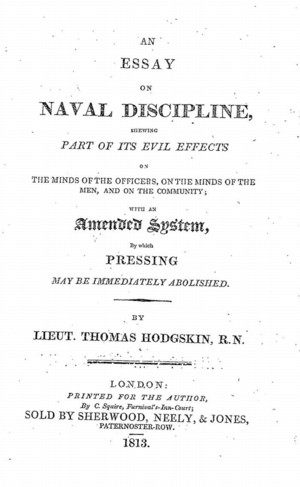
CHAP. II.: On the Love of Fame. - Thomas Hodgskin, An Essay on Naval Discipline [1813]Edition used:An Essay on Naval Discipline, Shewing Part of its evil Effects on the Minds of the Officers, on the Minds of the Men, and on the Community; with an Amended System, by which Pressing may be immediately abolished, by Lieut. Thomas Hodgskin, R.N. (London: Printed for the Author, by C. Squire, Furnival’s-Inn-Court, sold by Sherwood, Neely & Jones, Paternoster-Row 1813).
About Liberty Fund:Liberty Fund, Inc. is a private, educational foundation established to encourage the study of the ideal of a society of free and responsible individuals. Copyright information:The text is in the public domain. Fair use statement:This material is put online to further the educational goals of Liberty Fund, Inc. Unless otherwise stated in the Copyright Information section above, this material may be used freely for educational and academic purposes. It may not be used in any way for profit.
CHAP. II.On the Love of Fame.By fame, to which, I have said, every Briton’s bosom is alive, I do not mean that applause which posterity bestows, but that praise which makes a man feel a conscious superiority. For my part, I cannot distinguish any difference between a love of fame and a love of praise, except that the first is the unwilling resource of those men whose efforts have been directed, without success, to the acquisition of the last. They console themselves by thinking, that a more enlightened, or more virtuous generation will arise than the present, and that then they shall get their full share of applause. I believe both proceed from the same principle, which has been said to be natural to the heart of man,—a desire of superiority; for praise is an acknowledgment of this superiority; we bestow it on what we ourselves, or others do not possess. Like every passion, which has been called natural, we can only be certain from consciousness of its existence in ourselves, but suppose it to exist in others from visible effects. I can assert I feel such a desire very strong myself, and I conclude, from analogy, others do also; and that, consequently, it is a general passion implanted in us for great and beneficent purposes by the hand of the Almighty. Other social passions are strong in proportion to the pleasure we derive from them; all are productive of pleasure, but they are variously modified by various circumstances; they are of different strength in different individuals, but still they exist in all. I apprehend the strongest proofs of the desire of praise, being a universal passion, are to be found in every man’s bosom; and no man need be ashamed of acknowledging it for an inmate. It is equally as virtuous a motive for action as any other of the social passions; it is only when its desire induces actions, which we know to be destructive of our own and others welfare, that it ought to excite shame. Taking, therefore, for granted, that the love of praise, or superiority, is a general passion of our nature, it will be stronger in our country than in any other; for it is one conspicuous effect of that liberty we enjoy to afford room for the gratification of, and consequently to excite, every human desire. It is an observation of Mr. Locke’s, that you have only to praise an action to produce an hundred imitators; he instances the acquisition of wit, the telling good stories, &c. And, what but the praise that has been bestowed upon the possessors of fine houses, fine gardens, and all the fine things that belong to riches, could induce the English merchant, already in possession of every real comfort, to continue his toils, in order to enjoy these fine things,—nothing: had they never been praised, they never would have been sought after. Can any other cause than the love of praise be assigned for many of our noblemen’s wish to figure as superior drivers of four in hand vehicles; for their wish to be distinguished as the patrons of pugilism? Had fine horses and coaches, fine driving, and fine fighting, never been objects of society’s praise; had they never collected thousands of individuals to gaze at and admire them, these and a thousand such absurdities might have had a momentary existence, but a moment would have been the extent of their duration. Is not the desire of praise the cause of scandal being so much a topic of conversation in country places? There many cannot be distinguished for their riches, and still fewer for their abilities; but, as all superiority is relative, a desire of distinction makes them debase their neighbours, that they may stand conspicuous amidst the ruins. Why have fine clothes been so much sought after by the lowest classes, since warm ones are all that is wanted for bodily comfort, but that fine clothes have been a mark of distinction, have had much respect paid them, and been much an object of praise. Why is skill sought for amongst the lowest classes of the people, in running, racing, &c.— but because it is an object of praise, for it requires exertion, and rather takes from than adds to bodily comforts. I believe that the praise which is bestowed is more the cause of the production of ingenuity in a man’s profession than the solid comforts it brings. Now for all these methods of seeking praise, the English nation is more celebrated than any other; consequently, the desire that prompts to them must be stronger in our society than in others. It is notoriously well known, that this love of praise pervades the very vilest parts of society; that a great thief, or a daring robber, becomes a greater thief, or a more daring robber, by a desire for the praise of his profligate companions. Thus many people have lived in the more open commission of every crime than their neighbours dared, simply because they would be distinguished. But (to my subject of paramount importance) what can animate our armies to those great military achievements but the love of praise; at reading the Gazettes, what heart but feels a momentary glow to share with them their toils and their praises; and what can stimulate the sailor in his arduous labours, but the praise he knows his country is ready to bestow on his success; for, like every other military exertion, praise is almost their only reward. Placed in a situation where the sailor is sensible the eyes of the whole community are turned for protection, he feels his consequence, and labours to surpass himself, well knowing he must exceed people’s expectations to obtain much praise. On such a subject the authority of so profound a moralist as Dr. Johnson must be allowed much weight. He says,
The English nation were brave then, and they are brave still; and that very bravery may be brought as a proof of the force and love of praise. Our country, placed in a situation of almost constant war, has praised the military virtues beyond any other; and every man knows to what an extent they exist: witness the plains of Salamanca, the heights of Corunna, the glorious victory at Trafalgar, and a thousand others. As the acquisition of wit, telling good stories, &c. are produced by praise, so is courage; it is acquired by exactly the same means. Practice is required in all to produce perfection; but the stimulus to practice is the desire of, and the reward of execution, praise. It is the observation of some great man, that when ever a virtue is much wanted, it will be produced; and why is it, but that, like every thing else in repute, people give a good price for it; but no pecuniary rewards can excite to virtue, it is generally praise; and, it is praise plentifully, but judiciously bestowed, that produces whatever virtue is wanted. As courage and conduct in naval affairs, and, as an attachment to the sea is absolutely necessary, in a large portion of the people, for the safety of the whole community, I have no doubt these virtues would always be produced if they were permitted; it will hereafter be shewn by what means they are destroyed. From all the foregoing observations I conclude, and I trust they are strong enough to induce others to come to the same conclusion, that the love of fame or praise still animates every English bosom; it therefore becomes an immediate question, why the mass of our people, who can scarcely procure themselves food, will not voluntarily enter a service where it is provided in abundance, and where this strong desire of praise receives ample gratification? This question comes with still more force when curiosity is considered a passion, very strong in every young man’s breast, which promises much gratification from going to sea, and which, it is well known, has rather been excited than repressed, by all the miraculous escapes from shipwreck which have been related to the world. It has been observed, that Robinson Crusoe made more sailors than any desire of wealth; and as sailors are so beneficial to our country, it is probable Daniel de Foe did more benefit to the community than half the men whose names have descended to us as the greatest of mankind. This question cannot better be answered than by detailing part of the laws and customs which have followed from putting in execution an imagined necessity of pressing. This shall be the subject of the following chapter. It is, perhaps, misplaced, but I cannot help observing, what a means this love of praise, so universal in mankind, so powerful in Englishmen, affords of conducing to virtue. It is infinitely more powerful than millions of penal statutes, in as much as every man hopes to receive the prizes in the lottery of life, and not one expects the blanks. Praise is the prize mankind bestow on virtue; the punishment of the laws are the blanks. What a heavy responsibility belongs to those writers, or men in authority, that praise, either by word or deed, any thing but virtue; for, it is probable, ambition would not now have been desolating the European world had not the names of those destroyers of the human race, Alexander and Cæsar, come down to us loaded with praise, and encircled with laurels for the victories which they had gained, while many of the real benefactors of mankind are not known, or known and not imitated. It is stretching the opinion too far to assert, that misplaced praise has caused all the evils of society; but to it we certainly owe a vast number. No laws can restrain actions that find praise in society; and to build them on bases opposed to the praise mankind are willing to bestow, must be absurd, for it can only tend to bring the whole body of such laws into ridicule and disrepute. May not this love of praise, so clearly discoverable in every man, be adduced as a proof of the value, if not of the authenticity of the gospel, from this general principle being so perfectly in unison with its doctrines. There we are taught, as principles of action, to fear God, and to love our neighbour; the inconsistency of men is displayed when they make the bases of our actions the fear of men and their laws. Every day’s experience shew that this fear of men produces a thousand absurdities of action; that it is this which is employed by every tyrant, and with too much success, to produce that slavery which, by debasing others, exalts himself. Love to our neighbour is, probably, sufficiently strong in every man to produce all the good which is necessary for the happiness of society; for when this love shows itself in assisting our fellow-creatures, it immediately receives an ample reward from their praise; and where reward is certain, efforts to procure it will not be wanted, and this reward is confessedly one of the sweetest gratifications of the human heart. We should, probably, approach somewhat nearer that perfection of society, which it is the end of legislation to seek, were these two principles, as they form the foundation of our education, made somewhat more than they are,—the bases of our laws. The idea of arriving at perfection has been very undeservedly ridiculed; we can yet make infinite improvement in our society, but how much our progress is prevented by entertaining an opinion of its impossibility must, from the authority of opinion, be obvious to every man. Seeing this love of praise is so intensely strong in every man’s bosom; seeing that the Almighty has vested the power in every man of bestowing or withholding it, to excite actions that promote his happiness, or repress those that injure him; and being firmly of a conviction, it would have had sufficient force (had it been properly directed from the beginning) to produce every kind of virtue; since it alone produces military courage, acknowledgedly requiring arduous exertions; since its force is sufficiently strong to make men violate all kinds of laws, as in our country, where no penal statutes can repress libels, I cannot be satisfied with those deductions of civilians that vest the power of life and death in the hands of any society. The claiming this power is only justified by the necessity there is, that society should have the means of producing its own benefit or perfection; but the love of praise is much stronger than the fear of death; therefore praise and censure, under all their modifications, are stronger as well as better powers, and appear to be what our governors may justly claim to exercise, to prevent vice and encourage virtue. |

Titles (by Subject)