EconlibThe LibraryOther Sites |
Front Page Titles (by Subject) SECOND BOOK: THE THEORY - The National System of Political Economy
Return to Title Page for The National System of Political EconomyThe Online Library of LibertyA project of Liberty Fund, Inc.Search this Title:Also in the Library:
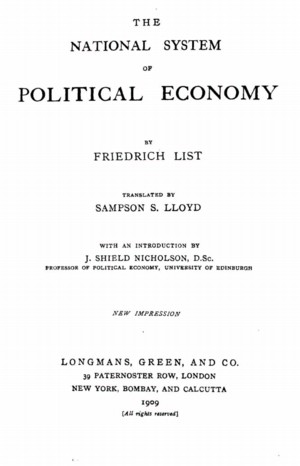
SECOND BOOK: THE THEORY - Friedrich List, The National System of Political Economy [1841]Edition used:The National System of Political Economy by Friedrich List, trans. Sampson S. Lloyd, with an Introduction by J. Shield Nicholson (London: Longmans, Green and Co., 1909).
About Liberty Fund:Liberty Fund, Inc. is a private, educational foundation established to encourage the study of the ideal of a society of free and responsible individuals. Copyright information:The text is in the public domain. Fair use statement:This material is put online to further the educational goals of Liberty Fund, Inc. Unless otherwise stated in the Copyright Information section above, this material may be used freely for educational and academic purposes. It may not be used in any way for profit.
SECOND BOOKTHE THEORYChapter XIPOLITICAL AND COSMOPOLITICAL ECONOMY.BEFORE Quesnay and the French economists there existed only a practice of political economy which was exercised by the State officials, administrators, and authors who wrote about matters of administration, occupied themselves exclusively with the agriculture, manufactures, commerce, and navigation of those countries to which they belonged, without analysing the causes of wealth, or taking at all into consideration the interests of the whole human race. Quesnay (from whom the idea of universal free trade originated) was the first who extended his investigations to the whole human race, without taking into consideration the idea of the nation. He calls his work 'Physiocratie, ou du Gouvernement le plus avantageux au Genre Humain,' his demands being that we must imagine that the merchants of all nations formed one commercial republic. Quesnay undoubtedly speaks of cosmopolitical economy, i.e. of that science which teaches how the entire human race may attain prosperity; in opposition to political economy, or that science which limits its teaching to the inquiry how a given nation can obtain (under the existing conditions of the world) prosperity, civilisation, and power, by means of agriculture, industry, and commerce. Adam Smith66 treats his doctrine in a similarly extended sense, by making it his task to indicate the cosmopolitical idea of the absolute freedom of the commerce of the whole world in spite of the gross mistakes made by the physiocrates against the very nature of things and against logic. Adam Smith concerned himself as little as Quesnay did with true political economy, i.e. that policy which each separate nation had to obey in order to make progress in its economical conditions. He entitles his work, 'The Nature and Causes of the Wealth of Nations' (i.e. of all nations of the whole human race). He speaks of the various systems of political economy in a separate part of his work solely for the purpose of demonstrating their non-efficiency, and of proving that 'political' or national economy must be replaced by 'cosmopolitical or world-wide economy.' Although here and there he speaks of wars, this only occurs incidentally. The idea of a perpetual state of peace forms the foundation of all his arguments. Moreover, according to the explicit remarks of his biographer, Dugald Stewart, his investigations from the commencement are based upon the principle that 'most of the State regulations for the promotion of public prosperity are unnecessary, and a nation in order to be transformed from the lowest state of barbarism into a state of the highest possible prosperity needs nothing but bearable taxation, fair administration of justice, and peace.' Adam Smith naturally understood under the word 'peace' the 'perpetual universal peace' of the Abbé St. Pierre. J. B. Say openly demands that we should imagine the existence of a universal republic in order to comprehend the idea of general free trade. This writer, whose efforts were mainly restricted to the formation of a system out of the materials which Adam Smith had brought to light, says explicitly in the sixth volume (p. 288) of his 'Economie politique pratique': 'We may take into our consideration the economical interests of the family with the father at its head; the principles and observations referring thereto will constitute private economy. Those principles, however, which have reference to the interests of whole nations, whether in themselves or in relation to other nations, form public economy (l'économie publique). Political economy, lastly, relates to the interests of all nations, to human society in general.' It must be remarked here, that in the first place Say recognises the existence of a national economy or political economy, under the name 'économie publique,' but that he nowhere treats of the latter in his works; secondly, that he attributes the name political economy to a doctrine which is evidently of cosmopolitical nature; and that in this doctrine he invariably merely speaks of an economy which has for its sole object the interests of the whole human society, without regard to the separate interests of distinct nations. This substitution of terms might be passed over if Say, after having explained what he calls political economy (which, however, is nothing else but cosmopolitical or world-wide economy, or economy of the whole human race), had acquainted us with the principles of the doctrine which he calls 'économie publique,' which however is, properly speaking, nothing else but the economy of given nations, or true political economy. In defining and developing this doctrine he could scarcely forbear to proceed from the idea and the nature of the nation, and to show what material modifications the 'economy of the whole human race' must undergo by the fact that at present that race is still separated into distinct nationalities each held together by common powers and interests, and distinct from other societies of the same kind which in the exercise of their natural liberty are opposed to one another. However, by giving his cosmopolitical economy the name political, he dispenses with this explanation, effects by means of a transposition of terms also a transposition of meaning, and thereby masks a series of the gravest theoretical errors. All later writers have participated in this error. Sismondi also calls political economy explicitly 'La science qui se charge du bonheur de l'espèce humaine.' Adam Smith and his followers teach us from this mainly nothing more than what Quesnay and his followers had taught us already, for the article of the 'Revue Méthodique' treating of the physiocratic school states, in almost the same words: 'The well-being of the individual is dependent altogether on the well-being of the whole human race.' The first of the North American advocates of free trade, as understood by Adam Smith—Thomas Cooper, President of Columbia College—denies even the existence of nationality; he calls the nation 'a grammatical invention,' created only to save periphrases, a nonentity, which has no actual existence save in the heads of politicians. Cooper is moreover perfectly consistent with respect to this, in fact much more consistent than his predecessors and instructors, for it is evident that as soon as the existence of nations with their distinct nature and interests is recognised, it becomes necessary to modify the economy of human society in accordance with these special interests, and that if Cooper intended to represent these modifications as errors, it was very wise on his part from the beginning to disown the very existence of nations. For our own part, we are far from rejecting the theory of cosmopolitical economy, as it has been perfected by the prevailing school; we are, however, of opinion that political economy, or as Say calls it 'économie publique,' should also be developed scientifically, and that it is always better to call things by their proper names than to give them significations which stand opposed to the true import of words. If we wish to remain true to the laws of logic and of the nature of things, we must set the economy of individuals against the economy of societies, and discriminate in respect to the latter between true political or national economy (which, emanating from the idea and nature of the nation, teaches how a given nation in the present state of the world and its own special national relations can maintain and improve its economical conditions) and cosmopolitical economy, which originates in the assumption that all nations of the earth form but one society living in a perpetual state of peace. If, as the prevailing school requires, we assume a universal union or confederation of all nations as the guarantee for an everlasting peace, the principle of international free trade seems to be perfectly justified. The less every individual is restrained in pursuing his own individual prosperity, the greater the number and wealth of those with whom he has free intercourse, the greater the area over which his individual activity can exercise itself, the easier it will be for him to utilise for the increase of his prosperity the properties given him by nature, the knowledge and talents which he has acquired, and the forces of nature placed at his disposal. As with separate individuals, so is it also the case with individual communities, provinces, and countries. A simpleton only could maintain that a union for free commercial intercourse between themselves is not as advantageous to the different states included in the United States of North America, to the various departments of France, and to the various German allied states, as would be their separation by internal provincial customs tariffs. In the union of the three kingdoms of Great Britain and Ireland the world witnesses a great and irrefragable example of the immeasurable efficacy of free trade between united nations. Let us only suppose all other nations of the earth to be united in a similar manner, and the most vivid imagination will not be able to picture to itself the sum of prosperity and good fortune which the whole human race would thereby acquire. Unquestionably the idea of a universal confederation and a perpetual peace is commended both by common sense and religion.67 If single combat between individuals is at present considered to be contrary to reason, how much more must combat between two nations be similarly condemned? The proofs which social economy can produce from the history of the civilisation of mankind of the reasonableness of bringing about the union of all mankind under the law of right, are perhaps those which are the clearest to sound human understanding. History teaches that wherever individuals are engaged in wars, the prosperity of mankind is at its lowest stage, and that it increases in the same proportion in which the concord of mankind increases. In the primitive state of the human race, first unions of families took place, then towns, then confederations of towns, then union of whole countries, finally unions of several states under one and the same government. If the nature of things has been powerful enough to extend this union (which commenced with the family) over hundreds of millions, we ought to consider that nature to be powerful enough to accomplish the union of all nations. If the human mind were capable of comprehending the advantages of this great union, so ought we to venture to deem it capable of understanding the still greater benefits which would result from a union of the whole human race. Many instances indicate this tendency in the spirit of the present times. We need only hint at the progress made in sciences, arts, and discoveries, in industry and social order. It may be already foreseen with certainty, that after a lapse of a few decades the civilised nations of the earth will, by the perfection of the means of conveyance, be united as respects both material and mental interchange in as close a manner as (or even closer than) that in which a century ago the various counties of England were connected. Continental governments possess already at the present moment in the telegraph the means of communicating with one another, almost as if they were at one and the same place. Powerful forces previously unknown have already raised industry to a degree of perfection hitherto never anticipated, and others still more powerful have already announced their appearance. But the more that industry advances, and proportionately extends over the countries of the earth, the smaller will be the possibility of wars. Two nations equally well developed in industry could mutually inflict on one another more injury in one week than they would be able to make good in a whole generation. But hence it follows that the same new forces which have hitherto served particularly for production will not withhold their services from destruction, and will principally favour the side of defence, and especially the European Continental nations, while they threaten the insular State with the loss of those advantages which have been gained by her insular position for her defence. In the congresses of the great European powers Europe possesses already the embryo of a future congress of nations. The endeavours to settle differences by protocol are clearly already prevailing over those which obtain justice by force of arms. A clearer insight into the nature of wealth and industry has led the wiser heads of all civilised nations to the conviction that both the civilisation of barbarous and semi-barbarous nations, and of those whose culture is retrograding, as well as the formation of colonies, offer to civilised nations a field for the development of their productive powers which promises them much richer and safer fruits than mutual hostilities by wars or restrictions on trade. The farther we advance in this perception, and the more the uncivilised countries come into contact with the civilised ones by the progress made in the means of transport, so much more will the civilised countries comprehend that the civilisation of barbarous nations, of those distracted by internal anarchy, or which are oppressed by bad government, is a task which offers to all equal advantages—a duty incumbent on them all alike, but one which can only be accomplished by unity. That the civilisation of all nations, the culture of the whole globe, forms a task imposed on the whole human race, is evident from those unalterable laws of nature by which civilised nations are driven on with irresistible power to extend or transfer their powers of production to less cultivated countries. We see everywhere, under the influence of civilisation, population, powers of mind, material capital attaining to such dimensions that they must necessarily flow over into other less civilised countries. If the cultivable area of the country no longer suffices to sustain the population and to employ the agricultural population, the redundant portion of the latter seeks territories suitable for cultivation in distant lands; if the talents and technical abilities of a nation have become so numerous as to find no longer sufficient rewards within it, they emigrate to places where they are more in demand; if in consequence of the accumulation of material capital, the rates of interest fall so considerably that the smaller capitalist can no longer live on them, he tries to invest his money more satisfactorily in less wealthy countries. A true principle, therefore, underlies the system of the popular school, but a principle which must be recognised and applied by science if its design to enlighten practice is to be fulfilled, an idea which practice cannot ignore without getting astray; only the school has omitted to take into consideration the nature of nationalities and their special interests and conditions, and to bring these into accord with the idea of universal union and an everlasting peace. The popular school has assumed as being actually in existence a state of things which has yet to come into existence. It assumes the existence of a universal union and a state of perpetual peace, and deduces therefrom the great benefits of free trade. In this manner it confounds effects with causes. Among the provinces and states which are already politically united, there exists a state of perpetual peace; from this political union originates their commercial union, and it is in consequence of the perpetual peace thus maintained that the commercial union has become so beneficial to them. All examples which history can show are those in which the political union has led the way, and the commercial union has followed.68 Not a single instance can be adduced in which the latter has taken the lead, and the former has grown up from it. That, however, under the existing conditions of the world, the result of general free trade would not be a universal republic, but, on the contrary, a universal subjection of the less advanced nations to the supremacy of the predominant manufacturing, commercial, and naval power, is a conclusion for which the reasons are very strong and, according to our views, irrefragable. A universal republic (in the sense of Henry IV. and of the Abbé St. Pierre), i.e. a union of the nations of the earth whereby they recognise the same conditions of right among themselves and renounce self-redress, can only be realised if a large number of nationalities attain to as nearly the same degree as possible of industry and civilisation, political cultivation, and power. Only with the gradual formation of this union can free trade be developed, only as a result of this union can it confer on all nations the same great advantages which are now experienced by those provinces and states which are politically united. The system of protection, inasmuch as it forms the only means of placing those nations which are far behind in civilisation on equal terms with the one predominating nation (which, however, never received at the hands of Nature a perpetual right to a monopoly of manufacture, but which merely gained an advance over others in point of time), the system of protection regarded from this point of view appears to be the most efficient means of furthering the final union of nations, and hence also of promoting true freedom of trade. And national economy appears from this point of view to be that science which, correctly appreciating the existing interests and the individual circumstances of nations, teaches how every separate nation can be raised to that stage of industrial development in which union with other nations equally well developed, and consequently freedom of trade, can become possible and useful to it. The popular school, however, has mixed up both doctrines with one another; it has fallen into the grave error of judging of the conditions of nations according to purely cosmopolitical principles, and of ignoring from merely political reasons the cosmopolitical tendency of the productive powers. Only by ignoring the cosmopolitical tendency of the productive powers could Malthus be led into the error of desiring to restrict the increase of population, or Chalmers and Torrens maintain more recently the strange idea that augmentation of capital and unrestricted production are evils the restriction of which the welfare of the community imperatively demands, or Sismondi declare that manufactures are things injurious to the community. Their theory in this case resembles Saturn, who devours his own children—the same theory which allows that from the increase of population, of capital and machinery, division of labour takes place, and explains from this the welfare of society, finally considers these forces as monsters which threaten the prosperity of nations, because it merely regards the present conditions of individual nations, and does not take into consideration the conditions of the whole globe and the future progress of mankind. It is not true that population increases in a larger proportion than production of the means of subsistence; it is at least foolish to assume such disproportion, or to attempt to prove it by artificial calculations or sophistical arguments, so long as on the globe a mass of natural forces still lies inert by means of which ten times or perhaps a hundred times more people than are now living can be sustained. It is mere narrow-mindedness to consider the present extent of the productive forces as the test of how many persons could be supported on a given area of land. The savage, the hunter, and the fisherman, according to his own calculation, would not find room enough for one million persons, the shepherd not for ten millions, the raw agriculturist not for one hundred millions on the whole globe; and yet two hundred millions are living at present in Europe alone. The culture of the potato and of food-yielding plants, and the more recent improvements made in agriculture generally, have increased tenfold the productive powers of the human race for the creation of the means of subsistence. In the Middle Ages the yield of wheat of an acre of land in England was fourfold, to-day it is ten to twenty fold, and in addition to that five times more land is cultivated. In many European countries (the soil of which possesses the same natural fertility as that of England) the yield at present does not exceed fourfold. Who will venture to set further limits to the discoveries, inventions, and improvements of the human race? Agricultural chemistry is still in its infancy; who can tell that to-morrow, by means of a new invention or discovery, the produce of the soil may not be increased five or ten fold? We already possess, in the artesian well, the means of converting unfertile wastes into rich corn fields; and what unknown forces may not yet be hidden in the interior of the earth? Let us merely suppose that through a new discovery we were enabled to produce heat everywhere very cheaply, and without the aid of the fuels at present known: what spaces of land could thus be utilised for cultivation, and in what an incalculable degree would the yield of a given area of land be increased? If Malthus' doctrine appears to us in its tendency narrow-minded, it is also in the methods by which it could act an unnatural one, which destroys morality and power, and is simply horrible. It seeks to destroy a desire which nature uses as the most active means for inciting men to exert body and mind, and to awaken and support their nobler feelings—a desire to which humanity for the greater part owes its progress. It would elevate the most heartless egotism to the position of a law; it requires us to close our hearts against the starving man, because if we hand him food and drink, another might starve in his place in thirty years' time. It substitutes cold calculation for sympathy. This doctrine tends to convert the hearts of men into stones. But what could be finally expected of a nation whose citizens should carry stones instead of hearts in their bosoms? What else than the total destruction of all morality, and with it of all productive forces, and therefore of all the wealth, civilisation, and power of the nation? If in a nation the population increases more than the production of the means of subsistence, if capital accumulates at length to such an extent as no longer to find investment, if machinery throws a number of operatives out of work and manufactured goods accumulate to a large excess, this merely proves, that nature will not allow industry, civilisation, wealth, and power to fall exclusively to the lot of a single nation, or that a large portion of the globe suitable for cultivation should be merely inhabited by wild animals, and that the largest portion of the human race should remain sunk in savagery, ignorance, and poverty. We have shown into what errors the school has fallen by judging the productive forces of the human race from a political point of view; we have now also to point out the mistakes which it has committed by regarding the separate interests of nations from a cosmopolitical point of view. If a confederation of all nations existed in reality, as is the case with the separate states constituting the Union of North America, the excess of population, talents, skilled abilities, and material capital would flow over from England to the Continental states, in a similar manner to that in which it travels from the eastern states of the American Union to the western, provided that in the Continental states the same security for persons and property, the same constitution and general laws prevailed, and that the English Government was made subject to the united will of the universal confederation. Under these suppositions there would be no better way of raising all these countries to the same stage of wealth and cultivation as England than free trade. This is the argument of the school. But how would it tally with the actual operation of free trade under the existing conditions of the world? The Britons as an independent and separate nation would henceforth take their national interest as the sole guide of their policy. The Englishman, from predilection for his language, for his laws, regulations, and habits, would whenever it was possible devote his powers and his capital to develop his own native industry, for which the system of free trade, by extending the market for English manufactures over all countries, would offer him sufficient opportunity; he would not readily take a fancy to establish manufactures in France or Germany. All excess of capital in England would be at once devoted to trading with foreign parts of the world. If the Englishman took it into his head to emigrate, or to invest his capital elsewhere than in England, he would as he now does prefer those more distant countries where he would find already existing his language, his laws, and regulations, rather than the benighted countries of the Continent. All England would thus be developed into one immense manufacturing city. Asia, Africa, and Australia would be civilised by England, and covered with new states modelled after the English fashion. In time a world of English states would be formed, under the presidency of the mother state, in which the European Continental nations would be lost as unimportant, unproductive races. By this arrangement it would fall to the lot of France, together with Spain and Portugal, to supply this English world with the choicest wines, and to drink the bad ones herself: at most France might retain the manufacture of a little millinery. Germany would scarcely have more to supply this English world with than children's toys, wooden clocks, and philological writings, and sometimes also an auxiliary corps, who might sacrifice themselves to pine away in the deserts of Asia or Africa, for the sake of extending the manufacturing and commercial supremacy, the literature and language of England. It would not require many centuries before people in this English world would think and speak of the Germans and French in the same tone as we speak at present of the Asiatic nations. True political science, however, regards such a result of universal free trade as a very unnatural one; it will argue that had universal free trade been introduced at the time of the Hanseatic League, the German nationality instead of the English would have secured an advance in commerce and manufacture over all other countries. It would be most unjust, even on cosmopolitical grounds, now to resign to the English all the wealth and power of the earth, merely because by them the political system of commerce was first established and the cosmopolitical principle for the most part ignored. In order to allow freedom of trade to operate naturally, the less advanced nations must first be raised by artificial measures to that stage of cultivation to which the English nation has been artificially elevated. In order that, through that cosmopolitical tendency of the powers of production to which we have alluded, the more distant parts of the world may not be benefited and enriched before the neighbouring European countries, those nations which feel themselves to be capable, owing to their moral, intellectual, social, and political circumstances, of developing a manufacturing power of their own must adopt the system of protection as the most effectual means for this purpose. The effects of this system for the purpose in view are of two kinds: in the first place, by gradually excluding foreign manufactured articles from our markets, a surplus would be occasioned in foreign nations, of workmen, talents, and capital, which must seek employment abroad; and secondly, by the premium which our system of protection would offer to the immigration into our country of workmen, talents, and capital, that excess of productive power would be induced to find employment with us, instead of emigrating to distant parts of the world and to colonies. Political science refers to history, and inquires whether England has not in former times drawn from Germany, Italy, Holland, France, Spain, and Portugal by these means a mass of productive power. She asks: Why does the cosmopolitical school, when it pretends to weigh in the balance the advantages and the disadvantages of the system of protection, utterly ignore this great and remarkable instance of the results of that system? Chapter XIITHE THEORY OF THE POWERS OF PRODUCTION AND THE THEORY OF VALUES.ADAM SMITH'S celebrated work is entitled, 'The Nature and Causes of the Wealth of Nations.' The founder of the prevailing economical school has therein indicated the double point of view from which the economy of nations, like that of private separate individuals, should be regarded. The causes of wealth are something totally different from wealth itself. A person may possess wealth, i.e. exchangeable value; if, however, he does not possess the power of producing objects of more value than he consumes, he will become poorer. A person may be poor; if he, however, possesses the power of producing a larger amount of valuable articles than he consumes, he becomes rich. The power of producing wealth is therefore infinitely more important than wealth itself; it insures not only the possession and the increase of what has been gained, but also the replacement of what has been lost. This is still more the case with entire nations (who cannot live out of mere rentals) than with private individuals. Germany has been devastated in every century by pestilence, by famine, or by civil or foreign wars; she has, nevertheless, always retained a great portion of her powers of production, and has thus quickly reattained some degree of prosperity; while rich and mighty but despot- and priest-ridden Spain, notwithstanding her comparative enjoyment of internal peace,69 has sunk deeper into poverty and misery. The same sun still shines on the Spaniards, they still possess the same area of territory, their mines are still as rich, they are still the same people as before the discovery of America, and before the introduction of the Inquisition; but that nation has gradually lost her powers of production, and has therefore become poor and miserable. The War of Independence of the United States of America cost that nation hundreds of millions, but her powers of production were immeasurably strengthened by gaining independence, and it was for this reason that in the course of a few years after the peace she obtained immeasurably greater riches than she had ever possessed before. If we compare the state of France in the year 1809 with that of the year 1839, what a difference in favour of the latter! Nevertheless, France has in the interim lost her sovereignty over a large portion of the European continent; she has suffered two devastating invasions, and had to pay milliards of money in war contributions and indemnities. It was impossible that so clear an intellect as Adam Smith possessed could altogether ignore the difference between wealth and its causes and the overwhelming influence of these causes on the condition of nations. In the introduction to his work, he says in clear words in effect: 'Labour forms the fund from which every nation derives its wealth, and the increase of wealth depends first on the productive power of labour, namely, on the degree of skill, dexterity, and judgment with which the labour of the nation is generally applied, and secondly, on the proportion between the number of those employed productively and the number of those who are not so employed.' From this we see how clearly Smith in general perceived that the condition of nations is principally dependent on the sum of their productive powers. It does not, however, appear to be the plan of nature that complete sciences should spring already perfected from the brain of individual thinkers. It is evident that Smith was too exclusively possessed by the cosmopolitical idea of the physiocrats, 'universal freedom of trade,' and by his own great discovery, 'the division of labour,' to follow up the idea of the importance to a nation of its powers of production. However much science may be indebted to him in respect of the remaining parts of his work, the idea 'division of labour' seemed to him his most brilliant thought. It was calculated to secure for his book a name, and for himself posthumous fame. He had too much worldly wisdom not to perceive that whoever wishes to sell a precious jewel does not bring the treasure to market most profitably by burying it in a sack of wheat, however useful the grains of wheat may be, but better by exposing it at the forefront. He had too much experience not to know that a débutant (and he was this as regards political economy at the time of the publication of his work) who in the first act creates a furore is easily excused if in the following ones he only occasionally raises himself above mediocrity; he had every motive for making the introduction to his book, the doctrine of division of labour. Smith has not been mistaken in his calculations; his first chapter has made the fortune of his book, and founded his authority as an economist. However, we on our part believe ourselves able to prove that just this zeal to put the important discovery 'division of labour' in an advantageous light, has hindered Adam Smith from following up the idea 'productive power' (which has been expressed by him in the introduction, and also frequently afterwards, although merely incidentally) and from exhibiting his doctrines in a much more perfect form. By the great value which he attached to his idea 'division of labour' he has evidently been misled into representing labour itself as the 'fund' of all the wealth of nations, although he himself clearly perceives and also states that the productiveness of labour principally depends on the degree of skill and judgment with which the labour is performed. We ask, can it be deemed scientific reasoning if we assign as the cause of a phenomenon that which in itself is the result of a number of deeper lying causes? It cannot be doubted that all wealth is obtained by means of mental and bodily exertions (labour), but yet from that circumstance no reason is indicated from which useful conclusions may be drawn; for history teaches that whole nations have, in spite of the exertions and of the thrift of their citizens, fallen into poverty and misery. Whoever desires to know and investigate how one nation from a state of poverty and barbarism has attained to one of wealth and prosperity, and how another has fallen from a condition of wealth and well-being into one of poverty and misery, has always, after receiving the information that labour is the cause of wealth and idleness the cause of poverty (a remark which King Solomon made long before Adam Smith), to put the further question, what are the causes of labour, and what the causes of idleness? It would be more correct to describe the limbs of men (the head, hands, and feet) as the causes of wealth (we should thus at least approach far nearer to the truth), and the question then presents itself, what is it that induces these heads, arms, and hands to produce, and calls into activity these exertions? What else can it be than the spirit which animates the individuals, the social order which renders their energy fruitful, and the powers of nature which they are in a position to make use of? The more a man perceives that he must provide for the future, the more his intelligence and feelings incite him to secure the future of his nearest connections, and to promote their well-being; the more he has been from his youth accustomed to forethought and activity, the more his nobler feelings have been developed, and body and mind cultivated the finer examples that he has witnessed from his youth, the more opportunities he has had for utilising his mental and bodily powers for the improvement of his condition, also the less he has been restrained in his legitimate activity, the more successful his past endeavours have been, and the more their fruits have been secured to him, the more he has been able to obtain public recognition and esteem by orderly conduct and activity, and the less his mind suffers from prejudices, superstition, false notions, and ignorance, so much the more will he exert his mind and limbs for the object of production, so much the more will he be able to accomplish, and so much the better will he make use of the fruits of his labour. However, most depends in all these respects on the conditions of the society in which the individual has been brought up, and turns upon this, whether science and arts flourish, and public institutions and laws tend to promote religious character, morality and intelligence, security for person and for property, freedom and justice; whether in the nation all the factors of material prosperity, agriculture, manufactures, and trade, have been equally and harmoniously cultivated; whether the power of the nation is strong enough to secure to its individual citizens progress in wealth and education from generation to generation, and to enable them not merely to utilise the natural powers of their own country to their fullest extent, but also, by foreign trade and the possession of colonies, to render the natural powers of foreign countries serviceable to their own. Adam Smith has on the whole recognised the nature of these powers so little, that he does not even assign a productive character to the mental labours of those who maintain laws and order, and cultivate and promote instruction, religion, science, and art. His investigations are limited to that human activity which creates material values. With regard to this, he certainly recognises that its productiveness depends on the 'skill and judgment' with which it is exercised; but in his investigations as to the causes of this skill and judgment, he does not go farther than the division of labour, and that he illustrates solely by exchange, augmentation of material capital, and extension of markets. His doctrine at once sinks deeper and deeper into materialism, particularism, and individualism. If he had followed up the idea 'productive power,' without allowing his mind to be dominated by the idea of 'value,' 'exchangeable value,' he would have been led to perceive that an independent theory of the 'productive power,' must be considered by the side of a 'theory of values' in order to explain the economical phenomena. But he thus fell into the mistake of explaining mental forces from material circumstances and conditions, and thereby laid the foundation for all the absurdities and contradictions from which his school (as we propose to prove) suffers up to the present day, and to which alone it must be attributed that the doctrines of political economy are those which are the least accessible to the most intelligent minds. That Smith's school teaches nothing else than the theory of values, is not only seen from the fact that it bases its doctrine everywhere on the conception of 'value of exchange,' but also from the definition which it gives of its doctrine. It is (says J. B. Say) that science which teaches how riches, or exchangeable values, are produced, distributed, and consumed. This is undoubtedly not the science which teaches how the productive powers are awakened and developed, and how they become depressed and destroyed. M'Culloch calls it explicitly 'the science of values,' and recent English writers 'the science of exchange.' Examples from private economy will best illustrate the difference between the theory of productive powers and the theory of values. Let us suppose the case of two fathers of families, both being landed proprietors, each of whom saves yearly 1,000 thalers and has five sons. The one puts out his savings at interest, and keeps his sons at common hard work, while the other employs his savings in educating two of his sons as skilful and intelligent landowners, and in enabling the other three to learn a trade after their respective tastes; the former acts according to the theory of values, the latter according to the theory of productive powers. The first at his death may prove much richer than the second in mere exchangeable value, but it is quite otherwise as respects productive powers. The estate of the latter is divided into two parts, and every part will by the aid of improved management yield as much total produce as the whole did before; while the remaining three sons have by their talents obtained abundant means of maintenance. The landed property of the former will be divided into five parts, and every part will be worked in as bad a manner as the whole was heretofore. In the latter family a mass of different mental forces and talents is awakened and cultivated, which will increase from generation to generation, every succeeding generation possessing more power of obtaining material wealth than the preceding one, while in the former family stupidity and poverty must increase with the diminution of the shares in the landed property. So the slaveholder increases by slavebreeding the sum of his values of exchange, but he ruins the productive forces of future generations. All expenditure in the instruction of youth, the promotion of justice, defence of nations, &c. is a consumption of present values for the behoof of the productive powers. The greatest portion of the consumption of a nation is used for the education of the future generation, for promotion and nourishment of the future national productive powers. The Christian religion, monogamy, abolition of slavery and of vassalage, hereditability of the throne, invention of printing, of the press, of the postal system, of money, weights and measures, of the calendar, of watches, of police, the introduction of the principle of freehold property, of means of transport, are rich sources of productive power. To be convinced of this, we need only compare the condition of the European states with that of the Asiatic ones. In order duly to estimate the influence which liberty of thought and conscience has on the productive forces of nations, we need only read the history of England and then that of Spain. The publicity of the administration of justice, trial by jury, parliamentary legislation, public control of State administration, self-administration of the commonalties and municipalities, liberty of the press, liberty of association for useful purposes, impart to the citizens of constitutional states, as also to their public functionaries, a degree of energy and power which can hardly be produced by other means. We can scarcely conceive of any law or any public legal decision which would not exercise a greater or smaller influence on the increase or decrease of the productive power of the nation.70 If we consider merely bodily labour as the cause of wealth, how can we then explain why modern nations are incomparably richer, more populous, more powerful, and prosperous than the nations of ancient times? The ancient nations employed (in proportion to the whole population) infinitely more hands, the work was much harder, each individual possessed much more land, and yet the masses were much worse fed and clothed than is the case in modern nations. In order to explain these phenomena, we must refer to the progress which has been made in the course of the last thousand years in sciences and arts, domestic and public regulations, cultivation of the mind and capabilities of production. The present state of the nations is the result of the accumulation of all discoveries, inventions, improvements, perfections, and exertions of all generations which have lived before us; they form the mental capital of the present human race, and every separate nation is productive only in the proportion in which it has known how to appropriate these attainments of former generations and to increase them by its own acquirements, in which the natural capabilities of its territory, its extent and geographical position, its population and political power, have been able to develop as completely and symmetrically as possible all sources of wealth within its boundaries, and to extend its moral, intellectual, commercial, and political influence over less advanced nations and especially over the affairs of the world. The popular school of economists would have us believe that politics and political power cannot be taken into consideration in political economy. So far as it makes only values and exchange the subjects of its investigations, this may be correct; we can define the ideas of value and capital, profit, wages, and rent; we can resolve them into their elements, and speculate on what may influence their rising or falling, &c. without thereby taking into account the political circumstances of the nation. Clearly, however, these matters appertain as much to private economy as to the economy of whole nations. We have merely to consider the history of Venice, of the Hanseatic League, of Portugal, Holland, and England, in order to perceive what reciprocal influence material wealth and political power exercise on each other. The school also always falls into the strangest inconsistencies whenever this reciprocal influence forces itself on their consideration. Let us here only call to mind the remarkable dictum of Adam Smith on the English Navigation Laws.71 The popular school, inasmuch as it does not duly consider the nature of the powers of production, and does not take into account the conditions of nations in their aggregate, disregards especially the importance of developing in an equal ratio agriculture, manufactures and commerce, political power and internal wealth, and disregards especially the value of a manufacturing power belonging specially to the nation and fully developed in all its branches. It commits the error of placing manufacturing power in the same category with agricultural power, and of speaking of labour, natural power, capital, &c. in general terms without considering the differences which exist between them. It does not perceive that between a State devoted merely to agriculture and a State possessing both agriculture and manufactures, a much greater difference exists than between a pastoral State and an agricultural one. In a condition of merely agricultural industry, caprice and slavery, superstition and ignorance, want of means of culture, of trade, and of transport, poverty and political weakness exist. In the merely agricultural State only the least portion of the mental and bodily powers existing in the nation is awakened and developed, and only the least part of the powers and resources placed by nature at its disposal can be made use of, while little or no capital can be accumulated. Let us compare Poland with England: both nations at one time were in the same stage of culture; and now what a difference. Manufactories and manufactures are the mothers and children of municipal liberty, of intelligence, of the arts and sciences, of internal and external commerce, of navigation and improvements in transport, of civilisation and political power. They are the chief means of liberating agriculture from its chains, and of elevating it to a commercial character and to a degree of art and science, by which the rents, farming profits, and wages are increased, and greater value is given to landed property. The popular school has attributed this civilising power to foreign trade, but in that it has confounded the mere exchanger with the originator. Foreign manufactures furnish the goods for the foreign trade, which the latter conveys to us, and which occasion consumption of products and raw materials which we give in exchange for the goods in lieu of money payments. If, however, trade in the manufactures of far distant lands exercises admittedly so beneficial an influence on our agricultural industry, how much more beneficial must the influence be of those manufactures which are bound up with us locally, commercially, and politically, which not only take from us a small portion, but the largest portion of their requirements of food and of raw materials, which are not made dearer to us by great costs of transport, our trade in which cannot be interrupted by the chance of foreign manufacturing nations learning to supply their own wants themselves, or by wars and prohibitory import duties? We now see into what extraordinary mistakes and contradictions the popular school has fallen in making material wealth or value of exchange the sole object of its investigations, and by regarding mere bodily labour as the sole productive power. The man who breeds pigs is, according to this school, a productive member of the community, but he who educates men is a mere non-productive. The maker of bagpipes or jews-harps for sale is a productive, while the great composers and virtuosos are non-productive simply because that which they play cannot be brought into the market. The physician who saves the lives of his patients does not belong to the productive class, but on the contrary the chemist's boy does so, although the values of exchange (viz. the pills) which he produces may exist only for a few minutes before they pass into a valueless condition. A Newton, a Watt, or a Kepler is not so productive as a donkey, a horse, or a draught-ox (a class of labourers who have been recently introduced by M'Culloch into the series of the productive members of human society). We must not believe that J. B. Say has remedied this defect in the doctrine of Adam Smith by his fiction of 'immaterial goods' or products; he has thus merely somewhat varnished over the folly of its results, but not raised it out of its intrinsic absurdity. The mental (immaterial) producers are merely productive, according to his views, because they are remunerated with values of exchange, and because their attainments have been obtained by sacrificing values of exchange, and not because they produce productive powers.72 They merely seem to him an accumulated capital. M'Culloch goes still further; he says that man is as much a product of labour as the machine which he produces, and it appears to him that in all economical investigations he must be regarded from this point of view. He thinks that Smith comprehended the correctness of this principle, only he did not deduce the correct conclusion from it. Among other things he draws the conclusion that eating and drinking are productive occupations. Thomas Cooper values a clever American lawyer at 3,000 dollars, which is about three times as much as the value of a strong slave. The errors and contradictions of the prevailing school to which we have drawn attention, can be easily corrected from the standpoint of the theory of the productive powers. Certainly those who fatten pigs or prepare pills are productive, but the instructors of youths and of adults, virtuosos, musicians, physicians, judges, and administrators, are productive in a much higher degree. The former produce values of exchange, and the latter productive powers, some by enabling the future generation to become producers, others by furthering the morality and religious character of the present generation, a third by ennobling and raising the powers of the human mind, a fourth by preserving the productive powers of his patients, a fifth by rendering human rights and justice secure, a sixth by constituting and protecting public security, a seventh by his art and by the enjoyment which it occasions fitting men the better to produce values of exchange. In the doctrine of mere values, these producers of the productive powers can of course only be taken into consideration so far as their services are rewarded by values of exchange; and this manner of regarding their services may in some instances have its practical use, as e.g. in the doctrine of public taxes, inasmuch as these have to be satisfied by values of exchange. But whenever our consideration is given to the nation (as a whole and in its international relations) it is utterly insufficient, and leads to a series of narrow-minded and false views. The prosperity of a nation is not, as Say believes, greater in the proportion in which it has amassed more wealth (i.e. values of exchange), but in the proportion in which it has more developed its powers of production. Although laws and public institutions do not produce immediate values, they nevertheless produce productive powers, and Say is mistaken if he maintains that nations have been enabled to become wealthy under all forms of government, and that by means of laws no wealth can be created. The foreign trade of a nation must not be estimated in the way in which individual merchants judge it, solely and only according to the theory of values (i.e. by regarding merely the gain at any particular moment of some material advantage); the nation is bound to keep steadily in view all these conditions on which its present and future existence, prosperity, and power depend. The nation must sacrifice and give up a measure of material property in order to gain culture, skill, and powers of united production; it must sacrifice some present advantages in order to insure to itself future ones. If, therefore, a manufacturing power developed in all its branches forms a fundamental condition of all higher advances in civilisation, material prosperity, and political power in every nation (a fact which, we think, we have proved from history); if it be true (as we believe we can prove) that in the present conditions of the world a new unprotected manufacturing power cannot possibly be raised up under free competition with a power which has long since grown in strength and is protected on its own territory; how can anyone possibly undertake to prove by arguments only based on the mere theory of values, that a nation ought to buy its goods like individual merchants, at places where they are to be had the cheapest—that we act foolishly if we manufacture anything at all which can be got cheaper from abroad—that we ought to place the industry of the nation at the mercy of the self-interest of individuals—that protective duties constitute monopolies, which are granted to the individual home manufacturers at the expense of the nation? It is true that protective duties at first increase the price of manufactured goods; but it is just as true, and moreover acknowledged by the prevailing economical school, that in the course of time, by the nation being enabled to build up a completely developed manufacturing power of its own, those goods are produced more cheaply at home than the price at which they can be imported from foreign parts. If, therefore, a sacrifice of value is caused by protective duties, it is made good by the gain of a power of production, which not only secures to the nation an infinitely greater amount of material goods, but also industrial independence in case of war. Through industrial independence and the internal prosperity derived from it the nation obtains the means for successfully carrying on foreign trade and for extending its mercantile marine; it increases its civilisation, perfects its institutions internally, and strengthens its external power. A nation capable of developing a manufacturing power, if it makes use of the system of protection, thus acts quite in the same spirit as that landed proprietor did who by the sacrifice of some material wealth allowed some of his children to learn a productive trade. Into what mistakes the prevailing economical school has fallen by judging conditions according to the mere theory of values which ought properly to be judged according to the theory of powers of production, may be seen very clearly by the judgment which J. B. Say passes upon the bounties which foreign countries sometimes offer in order to facilitate exportation; he maintains that 'these are presents made to our nation.' Now if we suppose that France considers a protective duty of twenty-five per cent. sufficient for her not yet perfectly developed manufactures, while England were to grant a bounty on exportation of thirty per cent., what would be the consequence of the 'present' which in this manner the English would make to the French? The French consumers would obtain for a few years the manufactured articles which they needed much cheaper than hitherto, but the French manufactories would be ruined, and millions of men be reduced to beggary or obliged to emigrate, or to devote themselves to agriculture for employment. Under the most favourable circumstances, the present consumers and customers of the French agriculturists would be converted into competitors with the latter, agricultural production would be increased, and the consumption lowered. The necessary consequence would be diminution in value of the products, decline in the value of property, national poverty and national weakness in France. The English 'present' in mere value would be dearly paid for in loss of power; it would seem like the present which the Sultan is wont to make to his pashas by sending them valuable silken cords. Since the time when the Trojans were 'presented' by the Greeks with a wooden horse, the acceptance of 'presents' from other nations has become for the nation which receives them a very questionable transaction. The English have given the Continent presents of immense value in the form of subsidies, but the Continental nations have paid for them dearly by the loss of power. These subsidies acted like a bounty on exportation in favour of the English, and were detrimental to the German manufactories.73 If England bound herself to-day to supply the Germans gratuitously for years with all they required in manufactured articles, we could not recommend them to accept such an offer. If the English are enabled through new inventions to produce linen forty per cent. cheaper than the Germans can by using the old process, and if in the use of their new process they merely obtain a start of a few years over the Germans, in such a case, were it not for protective duties, one of the most important and oldest branches of Germany's industry will be ruined. It will be as if a limb of the body of the German nation had been lost. And who would be consoled for the loss of an arm by knowing that he had nevertheless bought his shirts forty per cent. cheaper? If the English very often find occasion to offer presents to foreign nations, very different are the forms in which this is done; it is not unfrequently done against their will; always does it behove foreign nations well to consider whether or not the present should be accepted. Through their position as the manufacturing and commercial monopolists of the world, their manufactories from time to time fall into the state which they call 'glut,' and which arises from what they call 'overtrading.' At such periods everybody throws his stock of goods into the steamers. After the elapse of eight days the goods are offered for sale in Hamburg, Berlin, or Frankfort, and after three weeks in New York, at fifty per cent. under their real value. The English manufacturers suffer for the moment, but they are saved, and they compensate themselves later on by better prices. The German and American manufacturers receive the blows which were deserved by the English—they are ruined. The English nation merely sees the fire and hears the report of the explosion; the fragments fall down in other countries, and if their inhabitants complain of bloody heads, the intermediate merchants and dealers say, 'The crisis has done it all!' If we consider how often by such crisis the whole manufacturing power, the system of credit, nay the agriculture, and generally the whole economical system of the nations who are placed in free competition with England, are shaken to their foundations, and that these nations have afterwards notwithstanding richly to recompense the English manufacturers by higher prices, ought we not then to become very sceptical as to the propriety of the commercial conditions of nations being regulated according to the mere theory of values and according to cosmopolitical principles? The prevailing economical school has never deemed it expedient to elucidate the causes and effects of such commercial crises. The great statesmen of all modern nations, almost without exception, have comprehended the great influence of manufactures and manufactories on the wealth, civilisation, and power of nations, and the necessity of protecting them. Edward III. comprehended this like Elizabeth; Frederick the Great like Joseph II.; Washington like Napoleon. Without entering into the depths of the theory, their foreseeing minds comprehended the nature of industry in its entirety, and appreciated it correctly. It was reserved for the school of physiocrats to regard this nature from another point of view in consequence of a sophistical line of reasoning. Their castle in the air has disappeared; the more modern economical school itself has destroyed it; but even the latter has also not disentangled itself from the original errors, but has merely advanced somewhat farther from them. Since it did not recognise the difference between productive power and mere values of exchange, and did not investigate the former independently of the latter, but subordinated it to the theory of values of exchange, it was impossible for that school to arrive at the perception how greatly the nature of the agricultural productive power differs from the nature of the manufacturing productive power. It does not discern that through the development of a manufacturing industry in an agricultural nation a mass of mental and bodily powers, of natural powers and natural resources, and of instrumental powers too (which latter the prevailing school terms 'capital'), is brought to bear, and brought into use, which had not previously been active, and would never have come into activity but for the formation and development of an internal manufacturing power; it imagines that by the establishment of manufacturing industry these forces must be taken away from agriculture, and transferred to manufacture, whereas the latter to a great extent is a perfectly new and additional power, which, very far indeed from increasing at the expense of the agricultural interest, is often the means of helping that interest to attain a higher degree of prosperity and development. Chapter XIIITHE NATIONAL DIVISION OF COMMERCIAL OPERATIONS AND THE CONFEDERATION OF THE NATIONAL PRODUCTIVE FORCES.THE school is indebted to its renowned founder for the discovery of that natural law which it calls 'division of labour,' but neither Adam Smith nor any of his successors have thoroughly investigated its essential nature and character, or followed it out to its most important consequences. The expression 'division of labour' is an indefinite one, and must necessarily produce a false or indefinite idea. It is 'division of labour' if one savage on one and the same day goes hunting or fishing, cuts down wood, repairs his wigwam, and prepares arrows, nets, and clothes; but it is also 'division of labour' if (as Adam Smith mentions as an example) ten different persons share in the different occupations connected with the manufacture of a pin: the former is an objective, and the latter a subjective division of labour; the former hinders, the latter furthers production. The essential difference between both is, that in the former instance one person divides his work so as to produce various objects, while in the latter several persons share in the production of a single object. Both operations, on the other hand, may be called with equal correctness a union of labour; the savage unites various tasks in his person, while in the case of the pin manufacture various persons are united in one work of production in common. The essential character of the natural law from which the popular school explains such important phenomena in social economy, is evidently not merely a division of labour, but a division of different commercial operations between several individuals, and at the same time a confederation or union of various energies, intelligences, and powers on behalf of a common production. The cause of the productiveness of these operations is not merely that division, but essentially this union. Adam Smith well perceives this himself when he states, 'The necessaries of life of the lowest members of society are a product of joint labour and of the co-operation of a number of individuals.'74 What a pity that he did not follow out this idea (which he so clearly expresses) of united labour. If we continue to consider the example of the pin manufacture adduced by Adam Smith in illustration of the advantages of division of labour, and seek for the causes of the phenomenon that ten persons united in that manufacture can produce an infinitely larger number of pins than if every one carried on the entire pin manufacture separately, we find that the division of commercial operations without combination of the productive powers towards one common object could but little further this production. In order to create such a result, the different individuals must co-operate bodily as well as mentally, and work together. The one who makes the heads of the pins must be certain of the co-operation of the one who makes the points if he does not want to run the risk of producing pin heads in vain. The labour operations of all must be in the proper proportion to one another, the workmen must live as near to one another as possible, and their co-operation must be insured. Let us suppose e.g. that every one of these ten workmen lives in a different country; how often might their co-operation be interrupted by wars, interruptions of transport, commercial crises, &c.; how greatly would the cost of the product be increased, and consequently the advantage of the division of operation diminished; and would not the separation or secession of a single person from the union, throw all the others out of work? The popular school, because it has regarded the division of operation alone as the essence of this natural law, has committed the error of applying it merely to the separate manufactory or farm; it has not perceived that the same law extends its action especially over the whole manufacturing and agricultural power, over the whole economy of the nation. As the pin manufactory only prospers by the confederation of the productive force of the individuals, so does every kind of manufacture prosper only by the confederation of its productive forces with those of all other kinds of manufacture. For the success of a machine manufactory, for instance, it is necessary that the mines and metal works should furnish it with the necessary materials, and that all the hundred different sorts of manufactories which require machines, should buy their products from it. Without machine manufactories, a nation would in time of war be exposed to the danger of losing the greater portion of its manufacturing power. In like manner the entire manufacturing industry of a State in connection with its agricultural interest, and the latter in connection with the former, will prosper the more the nearer they are placed to one another, and the less they are interrupted in their mutual exchanges with one another. The advantages of their confederation under one and the same political Power in times of war, of national differences, of commercial crises, failure of crops, &c., are not less perceptible than are the advantages of the union of the persons belonging to a pin manufactory under one and the same roof. Smith affirms that the division of labour is less applicable to agriculture than to manufactures.75 Smith had in view only the separate manufactory and the separate farm. He has, however, neglected to extend his principle over whole districts and provinces. Nowhere has the division of commercial operations and the confederation of the productive powers greater influence than where every district and every province is in a position to devote itself exclusively, or at least chiefly, to those branches of agricultural production for which they are mostly fitted by nature. In one district corn and hops chiefly thrive, in another vines and fruit, in a third timber production and cattle rearing, &c. If every district is devoted to all these branches of production, it is clear that its labour and its land cannot be nearly so productive as if every separate district were devoted mainly to those branches of production for which it is specially adapted by nature, and as if it exchanged the surplus of its own special products for the surplus produce of those provinces which in the production of other necessaries of life and raw materials possess a natural advantage equally peculiar to themselves. This division of commercial operations, this confederation of the productive forces occupied in agriculture, can only take place in a country which has attained the greatest development of all branches of manufacturing industry; for in such a country only can a great demand for the greatest variety of products exist, or the demand for the surplus of agricultural productions be so certain and considerable that the producer can feel certain of disposing of any quantity of his surplus produce during this or at least during next year at suitable prices; in such a country only can considerable capital be devoted to speculation in the produce of the country and holding stocks of it, or great improvements in transport, such as canals and railway systems, lines of steamers, improved roads, be carried out profitably; and only by means of thoroughly good means of transport can every district or province convey the surplus of its peculiar products to all other provinces, even to the most distant ones, and procure in return supplies of the peculiar products of the latter. Where everybody supplies himself with what he requires, there is but little opportunity for exchange, and therefore no need for costly facilities of transport. We may notice how the augmentation of the powers of production in consequence of the separation of occupations and the co-operation of the powers of individuals begins in the separate manufactory and extends to the united nation. The manufactory prospers so much the more in proportion as the commercial operations are divided, the more closely the workmen are united, and the more the co-operation of each person is insured for the whole. The productive powers of every separate manufactory are also increased in proportion as the whole manufacturing power of the country is developed in all its branches, and the more intimately it is united with all other branches of industry. The agricultural power of production is so much greater the more intimately a manufacturing power developed in all its branches is united locally, commercially, and politically with agriculture. In proportion as the manufacturing power is thus developed will the division of the commercial operations and the co-operation of the productive powers in agriculture also develop themselves and be raised to the highest stage of perfection. That nation will therefore possess most productive power, and will consequently be the richest, which has cultivated manufacturing industry in all branches within its territory to the highest perfection, and whose territory and agricultural production is large enough to supply its manufacturing population with the largest part of the necessaries of life and raw materials which they require. Let us now consider the opposite side of this argument. A nation which possesses merely agriculture, and merely the most indispensable industries, is in want of the first and most necessary division of commercial operations among its inhabitants, and of the most important half of its productive powers, indeed it is in want of a useful division of commercial operations even in the separate branches of agriculture itself. A nation thus imperfect will not only be merely half as productive as a perfect nation, but with an equal or even with a much larger territory, with an equal or a much larger population, it will perhaps scarcely obtain a fifth, probably scarcely a tenth, part of that material wealth which a perfect nation is able to procure; and this for the same reason owing to which in a very complicated manufactory ten persons produce not merely ten times more, but perhaps thirty times more, than one person, or a man with one arm cannot merely work half as little, but infinitely less, than a man with two arms. This loss in productive power will be so much greater, the more that the manufacturing operations can be furthered by machinery, and the less that machinery can be applied in agriculture. A part of the productive power which the agricultural nation thus loses, will fall to the lot of that nation which exchanges its manufactured goods for agricultural products. This will, however, be a positive loss only in case the agricultural nation has already reached that stage of civilisation and political development which is necessary for the establishment of a manufacturing power. If it has not yet attained that stage, and still remains in a barbarous or half-civilised state, if its agricultural power of production has not yet developed itself even from the most primitive condition, if by the importation of foreign fabrics and the exportation of raw products its prosperity nevertheless increases considerably from year to year, and its mental and social powers continue to be awakened and increased, if such commerce as it can thus carry on is not interrupted by foreign prohibition of importation of raw products, or by wars, or if the territory of the agricultural nation is situated in a tropical climate, the gain on both sides will then be equal and in conformity with the laws of nature, because under the influence of such an exchange of the native products for foreign fabrics, a nation so situated will attain to civilisation and development of its productive powers more quickly and safely than when it has to develop them entirely out of its resources. If, however, the agricultural nation has already reached the culminating point of its agricultural development, as far as that can be attained by the influence of foreign commerce, or if the manufacturing nation refuses to take the products of the agricultural nation in exchange for its manufactured goods, and if nevertheless, owing to the successful competition of the manufacturing nation in the markets of the agricultural nation, no manufactures can spring up in the latter, in such a case the agricultural productive power of the agricultural nation is exposed to the danger of being crippled. By a crippled state of agriculture we mean that state of things in which, from want of a powerful and steadily developing manufacturing industry, the entire increase of population tends to throw itself on agriculture for employment, consumes all the surplus agricultural production of the country, and as soon as it has considerably increased either has to emigrate or share with the agriculturists already in existence the land immediately at hand, till the landed property of every family has become so small that it produces only the most elementary and necessary portion of that family's requirements of food and raw materials, but no considerable surplus which it might exchange with the manufacturers for the manufactured products which it requires. Under a normal development of the productive powers of the State, the greater part of the increase of population of an agricultural nation (as soon as it has attained a certain degree of culture) should transfer itself to manufacturing industry, and the excess of the agricultural products should partly serve for supplying the manufacturing population with provisions and raw materials, and partly for procuring for the agriculturists the manufactured goods, machines, and utensils which they require for their consumption, and for the increase of their own production. If this state of things sets in at the proper time, agricultural and industrial productive power will increase reciprocally, and indeed ad infinitum. The demand for agricultural products on the part of the industrial population will be so great, that no greater number of labourers will be diverted to agriculture, nor any greater division of the existing land be made, than is necessary to obtain the greatest possible surplus produce from it. In proportion to this surplus produce the population occupied in agriculture will be enabled to consume the products of the workmen employed in manufacturing. A continuous increase of the agricultural surplus produce will occasion a continuous increase of the demand for manufacturing workmen. The excess of the agricultural population will therefore continually find work in the manufactories, and the manufacturing population will at length not only equal the agricultural population in numbers, but will far exceed it. This latter is the condition of England; that which we formerly described is that of part of France and Germany. England was principally brought to this natural division of industrial pursuits between the two great branches of industry, by means of her flocks of sheep and woollen manufactures, which existed there on a large scale much sooner than in other countries. In other countries agriculture was crippled mainly by the influence of feudalism and arbitrary power. The possession of land gave influence and power, merely because by it a certain number of retainers could be maintained which the feudal proprietor could make use of in his feuds. The more vassals he possessed, so many more warriors he could muster. It was besides impossible, owing to the rudeness of those times, for the landed proprietor to consume his income in any other manner than by keeping a large number of servants, and he could not pay these better and attach them to his own person more surely than by giving them a bit of land to cultivate under the condition of rendering him personal service and of paying a smaller tax in produce. Thus the foundation for excessive division of the soil was laid in an artificial manner; and if in the present day the Government seeks by artificial means to alter that system, in so doing it is merely restoring the original state of things. In order to restrain the continued depreciation of the agricultural power of a nation, and gradually to apply a remedy to that evil in so far as it is the result of previous institutions, no better means exists (apart from the promotion of emigration) than to establish an internal manufacturing power, by which the increase of population may be gradually drawn over to the latter, and a greater demand created for agricultural produce, by which consequently the cultivation of larger estates may be rendered more profitable, and the cultivator induced and encouraged to gain from his land the greatest possible amount of surplus produce. The productive power of the cultivator and of the labourer in agriculture will always be greater or smaller according to the degree in which the exchange of agricultural produce for manufactures and other products of various kinds can proceed more or less readily. That in this respect the foreign trade of any nation which is but little advanced can prove in the highest degree beneficial, we have shown in another chapter by the example of England. But a nation which has already made considerable advances in civilisation, in possession of capital, and in population, will find the development of a manufacturing power of its own infinitely more beneficial to its agriculture than the most flourishing foreign trade can be without such manufactures, because it thereby secures itself against all fluctuations to which it may be exposed by war, by foreign restrictions on trade, and by commercial crises, because it thereby saves the greatest part of the costs of transport and commercial charges incurred in exporting its own products and in importing manufactured articles, because it derives the greatest advantages from the improvements in transport which are called into existence by its own manufacturing industry, while from the same cause a mass of personal and natural powers hitherto unemployed will be developed, and especially because the reciprocal exchange between manufacturing power and agricultural power is so much greater, the closer the agriculturist and manufacturer are placed to one another, and the less they are liable to be interrupted in the exchange of their various products by accidents of all kinds. In my letters to Mr. Charles J. Ingersoll, President of the Society for Promoting Arts and Industries in Philadelphia, of the year 1828 (entitled, 'Outlines of a New System of Political Economy'), I tried to explain the advantages of a union of the manufacturing power with agriculture in one and the same country, and under one and the same political power, in the following manner. Supposing you did not understand the art of grinding corn, which has certainly been a great art in its time; supposing further that the art of baking bread had remained unknown to you, as (according to Anderson) the real art of salting herrings was still unknown to the English in the seventeenth century; supposing, therefore, that you had to send your corn to England to be ground into flour and baked into bread, how large a quantity of your corn would not the English retain as pay for the grinding and baking; how much of it would the carters, seamen, and merchants consume, who would have to be employed in exporting the corn and importing the bread; and how much would come back into the hands of those who cultivated the corn? There is no doubt that by such a process the foreign trade would receive a considerable impetus, but it is very doubtful whether this intercourse would be specially advantageous to the welfare and independence of the nation. Consider only in case of a war breaking out between your country (the United States) and Great Britain, what would be the situation of those who produced corn for the English mills and bakehouses, and on the other hand the situation of those who had become accustomed to the taste of the English bread. Just as, however, the economical prosperity of the corn-cultivating interest requires that the corn millers should live in its vicinity, so also does the prosperity of the farmer especially require that the manufacturer should live close to him, so also does the prosperity of a flat and open country require that a prosperous and industrial town should exist in its centre, and so does the prosperity of the whole agriculture of a country require that its own manufacturing power should be developed in the highest possible degree. Let us compare the condition of agriculture in the vicinity of a populous town with its condition when carried on in distant provinces. In the latter case the farmer can only cultivate for sale those products which can bear a long transport, and which cannot be supplied at cheaper prices and in better quality from districts lying nearer to those who purchase them. A larger portion of his profits will be absorbed by the costs of transport. He will find it difficult to procure capital which he may employ usefully on his farm. From want of better examples and means of education he will not readily be led to avail himself of new processes, of better implements, and of new methods of cultivation. The labourer himself, from want of good example, of stimulus to exertion, and to emulation in the exercise of his productive powers, will only develop those powers inefficiently, and will indulge himself in loitering about and in idleness. On the other hand, in the proximity of the town, the farmer is in a position to use every patch of land for those crops which best suit the character of the soil. He will produce the greatest variety of things to the best advantage. Garden produce, poultry, eggs, milk, butter, fruit, and especially articles which the farmer residing at a distance considers insignificant and secondary things, will bring to the farmer near the town considerable profit. While the distant farmer has to depend mainly on the mere breeding of cattle, the other will make much better profits from fattening them, and will thereby be led to perfect his cultivation of root crops and fodder. He can utilise with much profit a number of things which are of little or no use to the distant farmer; e.g. stone, sand, water power, &c. The most numerous and best machines and implements as well as all means for his instruction, are close at hand. It will be easy for him to accumulate the capital necessary for the improvement of his farm. Landed proprietors and workmen, by the means of recreation which the town affords, the emulation which it excites among them, and the facility of making profits, will be incited to exert all their mental and bodily powers for the improvement of their condition. And precisely the same difference exists between a nation which unites agriculture and manufactures on its own territory, and a nation which can only exchange its own agricultural products for foreign manufactured goods. The whole social state of a nation will be chiefly determined by the principle of the variety and division of occupations and the cooperation of its productive powers. What the pin is in the pin manufactory, that the national well-being is to the large society which we term 'the nation.' The most important division of occupations in the nation is that between the mental and material ones. Both are mutually dependent on one another. The more the mental producers succeed in promoting morality, religion, enlightenment, increase of knowledge, extension of liberty and of perfection of political institutions—security of persons and property within the State, and the independence and power of the nation externally—so much greater will be the production of material wealth. On the other hand, the more goods that the material producers produce, the more will mental production be capable of being promoted. The most important division of occupations, and the most important co-operation of productive powers in material production, is that of agriculture and manufacture. Both depend mutually upon one another, as we have shown. As in the pin manufactory, so also in the nation does the productiveness of every individual—of every separate branch of production—and finally of the whole nation depend on the exertions of all individuals standing in proper relation to one another. We call this relation the balance or the harmony of the productive powers. It is possible for a nation to possess too many philosophers, and literati, and too few skilled artisans, merchants, and seamen. This is the consequence of highly advanced and learned culture which is not supported by a highly advanced manufacturing power and by an extensive internal and external trade; it is as if in a pin manufactory far more pin heads were manufactured than pin points. The surplus pin heads in such a nation are: a mass of useless books, subtle theoretical systems, and learned controversies, through which the mind of the nation is more obscured than cultivated, and is withdrawn from useful occupations; consequently its productive powers are retarded in their progress almost as much as if it possessed too many priests and too few instructors of youth, too many soldiers and too few politicians, too many administrators and too few judges and defenders of justice and right. A nation which only carries on agriculture, is an individual who in his material production lacks one arm. Commerce is merely the medium of exchange between the agricultural and the manufacturing power, and between their separate branches. A nation which exchanges agricultural products for foreign manufactured goods is an individual with one arm, which is supported by a foreign arm. This support may be useful to it, but not so useful as if it possessed two arms itself, and this because its activity is dependent on the caprice of the foreigner. In possession of a manufacturing power of its own, it can produce as much provisions and raw materials as the home manufacturers can consume; but if dependent upon foreign manufacturers, it can merely produce as much surplus as foreign nations do not care to produce for themselves, and which they are obliged to buy from another country. As between the different districts of one and the same country, so does the division of labour and the co-operation of the productive powers operate between the various nations of the earth. The former is conducted by internal or national, the latter by international commerce. The international co-operation of productive powers is, however, a very imperfect one, inasmuch as it may be frequently interrupted by wars, political regulations, commercial crises, &c. Although it is the most important in one sense, inasmuch as by it the various nations of the earth are connected with one another, it is nevertheless the least important with regard to the prosperity of any separate nation which is already far advanced in civilisation. This is admitted by writers of the popular school, who declare that the home market of a nation is without comparison more important than its foreign market. It follows from this, that it is the interest of every great nation to make the national confederation of its productive powers the main object of its exertions, and to consider their international confederation as second in importance to it. Both international and national division of labour are chiefly determined by climate and by Nature herself. We cannot produce in every country tea as in China, spices as in Java, cotton as in Louisiana, or corn, wool, fruit, and manufactured goods as in the countries of the temperate zone. It would be folly for a nation to attempt to supply itself by means of national division of labour (i.e. by home production) with articles for the production of which it is not favoured by nature, and which it can procure better and cheaper by means of international division of labour (i.e. through foreign commerce). And just as much does it betoken a want of national intelligence or national industry if a nation does not employ all the natural powers which it possesses in order to satisfy its own internal wants, and then by means of the surplus of its own productions to purchase those necessary articles which nature has forbidden it to produce on its own territory. The countries of the world most favoured by nature, with regard to both national and international division of labour, are evidently those whose soil brings forth the most common necessaries of life of the best quality and in the largest quantity, and whose climate is most conducive to bodily and mental exertion, and these are the countries of the temperate zone; for in these countries the manufacturing power especially prospers, by means of which the nation not merely attains to the highest degree of mental and social development and of political power, but is also enabled to make the countries of tropical climates and of inferior civilisation tributary in a certain measure to itself. The countries of the temperate zone therefore are above all others called upon to bring their own national division of labour to the highest perfection, and to use the international division of labour for their enrichment. Chapter XIVPRIVATE ECONOMY AND NATIONAL ECONOMY.WE have proved historically that the unity of the nation forms the fundamental condition of lasting national prosperity; and we have shown that only where the interest of individuals has been subordinated to those of the nation, and where successive generations have striven for one and the same object, the nations have been brought to harmonious development of their productive powers, and how little private industry can prosper without the united efforts both of the individuals who are living at the time, and of successive generations directed to one common object. We have further tried to prove in the last chapter how the law of union of powers exhibits its beneficial operation in the individual manufactory, and how it acts with equal power on the industry of whole nations. In the present chapter we have now to demonstrate how the popular school has concealed its misunderstanding of the national interests and of the effects of national union of powers, by confounding the principles of private economy with those of national economy. 'What is prudence in the conduct of every private family,' says Adam Smith,76 'can scarce be folly in that of a great kingdom.' Every individual in pursuing his own interests necessarily promotes thereby also the interests of the community. It is evident that every individual, inasmuch as he knows his own local circumstances best and pays most attention to his occupation, is far better able to judge than the statesman or legislator how his capital can most profitably be invested. He who would venture to give advice to the people how to invest their capital would not merely take upon himself a useless task, but would also assume to himself an authority which belongs solely to the producer, and which can be entrusted to those persons least of all who consider themselves equal to so difficult a task. Adam Smith concludes from this: 'Restrictions on trade imposed on the behalf of the internal industry of a country, are mere folly; every nation, like every individual, ought to buy articles where they can be procured the cheapest; in order to attain to the highest degree of national prosperity, we have simply to follow the maxim of letting things alone (laisser faire et laisser aller).' Smith and Say compare a nation which seeks to promote its industry by protective duties, to a tailor who wants to make his own boots, and to a bootmaker who would impose a toll on those who enter his door, in order to promote his prosperity. As in all errors of the popular school, so also in this one does Thomas Cooper go to extremes in his book77 which is directed against the American system of protection. 'Political economy,' he alleges, 'is almost synonymous with the private economy of all individuals; politics are no essential ingredient of political economy; it is folly to suppose that the community is something quite different from the individuals of whom it is composed. Every individual knows best how to invest his labour and his capital. The wealth of the community is nothing else than the aggregate of the wealth of all its individual members; and if every individual can provide best for himself, that nation must be the richest in which every individual is most left to himself.' The adherents of the American system of protection had opposed themselves to this argument, which had formerly been adduced by importing merchants in favour of free trade; the American navigation laws had greatly increased the carrying trade, the foreign commerce, and fisheries of the United States; and for the mere protection of their mercantile marine millions had been annually expended on their fleet; according to his theory those laws and this expense also would be as reprehensible as protective duties. 'In any case,' exclaims Mr. Cooper, 'no commerce by sea is worth a naval war; the merchants may be left to protect themselves.' Thus the popular school, which had begun by ignoring the principles of nationality and national interests, finally comes to the point of altogether denying their existence, and of leaving individuals to defend them as they may solely by their own individual powers. How? Is the wisdom of private economy, also wisdom in national economy? Is it in the nature of individuals to take into consideration the wants of future centuries, as those concern the nature of the nation and the State? Let us consider only the first beginning of an American town; every individual left to himself would care merely for his own wants, or at the most for those of his nearest successors, whereas all individuals united in one community provide for the convenience and the wants of the most distant generations; they subject the present generation for this object to privations and sacrifices which no reasonable person could expect from individuals. Can the individual further take into consideration in promoting his private economy, the defence of the country, public security, and the thousand other objects which can only be attained by the aid of the whole community? Does not the State require individuals to limit their private liberty according to what these objects require? Does it not even require that they should sacrifice for these some part of their earnings, of their mental and bodily labour, nay, even their own life? We must first root out, as Cooper does, the very ideas of 'State' and 'nation' before this opinion can be entertained. No; that may be wisdom in national economy which would be folly in private economy, and vice versâ; and owing to the very simple reason, that a tailor is no nation and a nation no tailor, that one family is something very different from a community of millions of families, that one house is something very different from a large national territory. Nor does the individual merely by understanding his own interests best, and by striving to further them, if left to his own devices, always further the interests of the community. We ask those who occupy the benches of justice, whether they do not frequently have to send individuals to the tread-mill on account of their excess of inventive power, and of their all too great industry. Robbers, thieves, smugglers, and cheats know their own local and personal circumstances and conditions extremely well, and pay the most active attention to their business; but it by no means follows therefrom, that society is in the best condition where such individuals are least restrained in the exercise of their private industry. In a thousand cases the power of the State is compelled to impose restrictions on private industry.78 It prevents the shipowner from taking on board slaves on the west coast of Africa, and taking them over to America. It imposes regulations as to the building of steamers and the rules of navigation at sea, in order that passengers and sailors may not be sacrificed to the avarice and caprice of the captains. In England certain rules have recently been enacted with regard to shipbuilding, because an infernal union between assurance companies and shipowners has been brought to light, whereby yearly thousands of human lives and millions in value were sacrificed to the avarice of a few persons. In North America millers are bound under a penalty to pack into each cask not less than 198 lbs. of good flour, and for all market goods market inspectors are appointed, although in no other country is individual liberty more highly prized. Everywhere does the State consider it to be its duty to guard the public against |

Titles (by Subject)