Econlib

The Library

Other Sites

Front Page arrow Titles (by Subject) arrow The Economics of Professor Robbins - The Economic Point of View

Return to Title Page for The Economic Point of View

Search this Title:

Also in the Library:

Collection: IHS Studies in Economic Theory
Subject Area: Economics

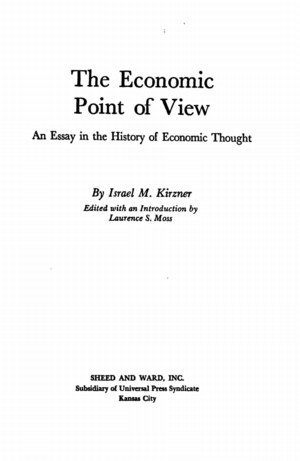
The Economics of Professor Robbins - Israel M. Kirzner, The Economic Point of View [1960]

Edition used:

The Economic Point of View: An Essay in the History of Economic Thought, ed. with an Introduction by Laurence S. Moss (Kansas City: Sheed Andrews McMeel, 1976).

About Liberty Fund:

Liberty Fund, Inc. is a private, educational foundation established to encourage the study of the ideal of a society of free and responsible individuals.


The Economics of Professor Robbins

“Economics,” wrote Professor Robbins, “is the science which studies human behavior as a relationship between ends and scarce means which have alternative uses.”1

From the point of view of the economist, the conditions of human existence exhibit four fundamental characteristics. The ends are various. The time and the means for achieving these ends are limited and capable of alternative application. At the same time the ends have different importance. Here we are, sentient creatures with bundles of desires and aspirations, with masses of instinctive tendencies all urging us in different ways to action. But the time in which these tendencies can be expresed is limited. The external world does not offer full opportunities for their complete achievement. Life is short. Nature is niggardly. Our fellows have other objectives. Yet we can use our lives for doing different things, our materials and the services of others for achieving different objectives.

Now by itself the multiplicity of ends has no necessary interest for the economist. If I want to do two things, and I have ample time and ample means with which to do them, and I do not want the time or the means for anything else, then my conduct assumes none of those forms which are the subject of economic science ...

Nor is the mere limitation of means by itself sufficient to give rise to economic phenomena. If means of satisfaction have no alternative use, then they may be scarce, but they cannot be economised ...

Nor again is the alternative applicability of scarce means a complete condition of the existence of the kind of phenomena we are analysing. If the economic subject has two ends and one means of satisfying them, and the two ends are of equal importance, his position will be like the position of the ass in the fable, paralysed halfway between the two equally attractive bundles of hay.

But when time and the means for achieving ends are limited and capable of alternative application, and the ends are capable of being distinguished in order of importance, then behavior necessarily assumes the form of choice. Every act which involves time and scarce means for the achievement of one end involves the relinquishment of their use for the achievement of another. It has an economic aspect.2

Several highlights stand out in Robbins' conception of the nature of economic affairs. Central to the whole idea is the concept of scarcity. The limitations that prevent the attainment of the desired ends fundamentally affect the character of all activity directed towards these ends. The importance of the role assigned to scarcity as a governing condition of realizing ends makes possible the rejection of the idea that economics is concerned with specific kinds of ends. Robbins' definition rejects the identification of economics with certain kinds of behavior; it attempts, on the other hand, to bring out the economic aspect of behavior of all kinds. All kinds of behavior that occurs under the shadow of inadequate means present such an economic aspect to the observer.

In fact, the recognition that there can be distinguished in human actions a pattern of behavior that depends for its uniqueness, not on any one type of end pursued, but on the economizing aspect of actions directed at ends in general, led Robbins several years later to take yet a further step. Having emancipated economics from the bonds that tied it to particular ends, Robbins was led to suggest that the “economic” motive refers precisely to actions that are not directed to any particular ends. By saying

that a man's motive in doing a certain thing is wholly economic, what we really mean is simply that he regards it only as a way of securing means for satisfying his ends in general. If he does it with only one end in mind, we do not regard his motive as economic; we regard it as having the character of the end to which it is specific. But if he does it with the desire to increase his power to satisfy ends in general, then we regard it as economic ... 3

The core of Robbins' conception is thus the act of economizing scarce means with regard to numerous, differently valued ends. A considerable body of literature has grown up in the past few decades in which this central concept has been subjected to careful scrutiny by economists generally, and economic methodologists in particular. The implications of these ideas for the substantive content of economic science have been thoroughly investigated; and the minute dissection of Robbins' definition has provided several distinct topics for debate. In this chapter we shall proceed to survey the area covered by this literature, after briefly glancing at some earlier ideas to which Robbins' definition owes its source.

[[1]]L. Robbins, The Nature and Significance of Economic Science (2nd ed.; Macmillan & Co.), p. 16.

[[2]]Ibid., pp. 12–14.

[[3]]L. Robbins, The Economic Causes of War (London: Jonathan Cape, 1939), pp. 117–118. This point is discussed further in a later section of this chapter.