EconlibThe LibraryOther Sites |
Front Page Titles (by Subject) Economics and Mechanics - The Economic Point of View
Return to Title Page for The Economic Point of ViewThe Online Library of LibertyA project of Liberty Fund, Inc.Search this Title:Also in the Library:
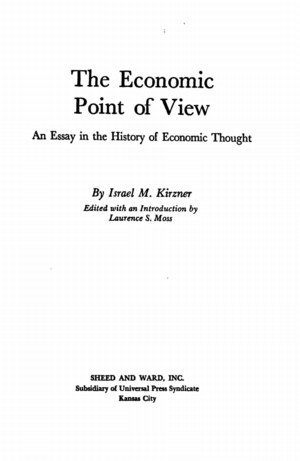
Economics and Mechanics - Israel M. Kirzner, The Economic Point of View [1960]Edition used:The Economic Point of View: An Essay in the History of Economic Thought, ed. with an Introduction by Laurence S. Moss (Kansas City: Sheed Andrews McMeel, 1976).
About Liberty Fund:Liberty Fund, Inc. is a private, educational foundation established to encourage the study of the ideal of a society of free and responsible individuals. Copyright information:This work is copyrighted by the Institute for Humane Studies, George Mason University, Fairfax, Virginia, and is put online with their permission. Fair use statement:This material is put online to further the educational goals of Liberty Fund, Inc. Unless otherwise stated in the Copyright Information section above, this material may be used freely for educational and academic purposes. It may not be used in any way for profit.
Economics and MechanicsOne further aspect of the class of definitions of economics dealt with in this chapter remains to be discussed. Both the conception of economic activity as the pecuniary operations of self-centered economic man and its conception as the process of getting the most for the least facilitate the analysis of such activity by (the same) mathematical methods. In the previous chapter mention was made of a number of passages in the writings of eighteenth-century thinkers in which the force of self-interest in human affairs was likened to the force of gravitation in the physical world. Economists of the nineteenth century who stressed self-interest or the maximization principle in economic affairs were in a position to pursue this analogy far more thoroughly. Thus, Senior, who, as we have seen, stressed the maximization of wealth as an essential element in economic activity, describes this element, like “gravitation...in Physics,” as “the ultimate fact beyond which reasoning cannot go, and of which almost every other proposition is merely an illustration.”39 For the earlier classical economists, who thought of economics as concerned with wealth understood in a more or less material sense, self-interest was an impersonal force that extracted this wealth from the factors of production and propelled it through the distributive channels of the economy. The greater stress laid by later writers on the force of self-interest itself as the core of economics and the consequent emphasis on maximization-patterns of behavior tended to enhance the attraction of the analogy to mechanics. Jevons’ “mechanics of utility and self-interest” and the “Economic Calculus” of Edgeworth, which investigates the equilibrium of a system of hedonic forces each tending to maximum individual utility, are typical examples. It seems no accident that both Jevons and Edgeworth were early users of mathematical methods in economics. The emphasis that both writers laid on self-interest goes hand in hand with a desire to turn economics into a “science” like mechanics. This required the postulation of a pervading force manipulating “wealth” into various configurations susceptible of analysis through the use of maximization formulae from the calculus. Self-interest was seized upon with avidity from the classical system as providing just such a plausible “force.” In Italy Pantaleoni (who has been compared to Edgeworth in a number of respects) stressed both the maximization principle in economic activity and the mathematical exposition of the theorems of economics. “Economic problems, in a broad sense, are, e.g., those which constitute the mathematical doctrine known by the generic term: de maximis et minimis...”40 “Economics,” in its broadest sense, meant for Pantaleoni making the most of limited means in any and every connection. In order to delineate the scope of “economic science,” Pantaleoni finds it necessary to limit himself to the consideration of “wealth,” hedonism, and egoism.41 Pantaleoni’s countryman, Benedetto Croce, was later to criticize him for this,42 vigorously asserting the freedom of the economic act from hedonistic or egoistic elements. But according to Pantaleoni, just as to Edgeworth, economic science described the maximization of pleasure, and the phenomena of the market adjust themselves, as it were automatically, under the play of the force tending in that direction. This mechanical conception of economic phenomena clearly relegated man, the source of economic activity, to the background. It is somewhat ironical that the construction of the concept of a self-centered economic man, a development that led to an increase in the attention paid to the role of the human agent, should have tended to lead to a position in which the objective phenomena of economic life can be viewed as if they occurred automatically. Certainly the most extreme result of the mechanical view of economics in this respect is to be seen in Schumpeter’s early conception of economic science. In his first book, Das Wesen und der Hauptinhalt der theoretischen Nationalökonomie (1908), Schumpeter made an attempt to place economics on a definitive scientific basis, to rear an edifice of impregnable logic grounded on foundations free of the shifting sands of metaphysical speculation. This he was able to do only by directing attention to “goods,” which were to be viewed as if undergoing operations that are not the results of human action.43 Schumpeter’s position seems in many respects like something of a return to classical ideas. Whereas his immediate predecessors had been gradually advancing towards the conception of economics as precisely an aspect of human behavior, Schumpeter found it necessary to carefully exclude human activity from economic investigation. Schumpeter’s view of economics was a conscious effort to see economic affairs from the point of view of mechanics. In mechanics we start with given masses located in a given spatial configuration and attempt to determine the changes in mass and in configuration at future points in time. In economics, Schumpeter explains, we have “economic quantities” of goods undergoing mutually determined changes that admit of being expressed by means of mathematical functions. It is these objective, measurable things possessed by men that make up the Schumpeterian economic system. It is the existence of these functional relationships between all these quantities that makes economic science possible. Indeed, it is these relationships themselves that constitute the whole of the subject matter of that science.44 Although Schumpeter’s lack of interest in the behavior of men and his stress on the impersonal changes in “quantities of goods” are reminiscent of the classical approach, his economics is far from identical with their science of wealth. Schumpeter does not recognize “wealth” as constituting in itself a subject of investigation by virtue of its character as wealth, but simply postulates the presence of mathematical interdependence between the quantities of various “goods” possessed by members of the Volkswirtschaft. It is the exposition of this mutual dependence of goods, rather than the investigation of goods or wealth as such, that constitutes the sum and substance of Schumpeter’s economics. Yet the absence of man from Schumpeter’s economics remains a classical feature. This effort to exempt, or rather interdict, the economist, qua economist, from investigating the behavior of man as an economic agent stems from, or at least runs parallel to, Schumpeter’s dream of replacing the concept of causality or pur- pose in economics by the type of relationship expressed by the mathematical function.45 Here Schumpeter’s enthusiasm for the mathematical method in economics and for the physical sciences generally46 is undoubtedly responsible for his explicit rejection of teleology as in any way essential to the conception of economic phenomena. The category of purpose has no place in a positivist system from which all but functional relationships have been carefully exorcised. A criticism that Croce addressed to Pareto (whose position bears a number of points of resemblance to that of Schumpeter)47 would probably have been applicable to Schumpeter as well. While recognizing the service that mathematicians have rendered economics by “reviving in it the dignity of abstract analysis, darkened...by the mass of anecdotes of the Historical School,” Croce complains that they have introduced their own professional prejudices into economics. They take up with regard to economics “which is the science of man, of a form of the conscious activity of man,” the same attitude that they “rightly take up in relation to the empirical natural sciences.”48 The roots of the mechanical conception of economics against which Croce was crusading go back as far as the ascendency of self-interest in economics and its translation into the maximization-pattern of behavior in a form amenable to mathematical treatment. The mechanical conception of economics may thus fairly be regarded as an outgrowth of the conceptions of economics dealt with in this chapter. 4Economics, the Market, and SocietyThe definition to which economic writers have yielded a more general assent than to any other...is “the science of exchanges.” A. S. Bolles (1878) ...that definition of Political Economy which calls it the science of exchanges, is absurd. Franklin H. Giddings (1887) The present chapter groups together definitions that see economic affairs as in one way or another necessarily connected with the act of exchange as a social phenomenon. Two groups of these definitions may be distinguished. The one explicitly raises exchange to the first place in economics, regarding the very notion of a distinct economic sphere as revolving around a more or less carefully defined concept of exchange. The other definitions do not stress the phenomenon of exchange itself, but focus attention on such ideas as the market, the economic system, and the “economy” as an aspect of the larger concept of society. These ideas, too, depend in the last analysis on a fusion of individual activities into a social “system” through some form of the exchange relationship. Both groups of definitions provide a fresh and distinctive outlook on economic phenomena, which at the same time reveals a number of points of contact with many of the alternative conceptions. [[39]]N. Senior, An Outline of the Science of Political Economy (London: George Allen & Unwin, 1938), p. 28. One recalls, in connection with this analogy, Gossen's claim to qualify as the Copernicus of economics. [[40]]M. Pantaleoni, Pure Economics (1889; English translation, London, 1898), p. 5. (The term “mathematical economics” thus had for Pantaleoni an unusual meaning, for he gave it the task of solving “the problem of inscribing in a given triangle a rectangle of maximum dimensions, or that of circumscribing a given sphere with a minimum cone.”) See also I. Little, Welfare Economics (1950), p. 21. [[41]]See Pantaleoni, op. cit., pp. 7, 19. See also M. Pantaleoni, “An Attempt to Analyse the Concepts of ‘Strong and Weak’ in their Economic Connection,” Economic Journal, 1898. [[42]]See B. Croce, “On the Economic Principle I,” in International Economic Papers, No. 3, p. 177. [[43]]See J. Schumpeter, Das Wesen und der Hauptinhalt der theoretischen Nationalökonomie (Leipzig, 1908), p. 86, for the explicit view that the economist must consider the changes in “economic quantities” as if they were caused automatically, without paying attention to the human beings who may have been involved in the appearance of such changes. [[44]]Schumpeter's outlook on economics may be related to the influence which Mach in Vienna was exerting at the time on scientific thought. For a characterization of mechanics parallel to Schumpeter's view of economics, see Ernst Mach, The Science of Mechanics (Chicago, 1919), pp. 256 f. It is to be remarked that Schumpeter was surprisingly reticent about precisely what he understood under his güter. (See op. cit., p. 80 n.) At least one of his critics seems to have understood Schumpeter to include all that is meant by “utility.” (See A. Amonn, Objekt und Grundbegriffe der theoretische Nationalökonomie, 1911, p. 129.) [[45]]J. Schumpeter, Wesen und Hauptinhalt, pp. xvi, xvii, 47, 64. [[46]]See, e.g., Schumpeter's paper “Über die mathematische Methode der theoretischen Okonomie,” Zeitschrift für Volkswirtschaft, Sozialpolitik, und Verwaltung, XV (1908), 30–49. [[47]]For the similarity of Pareto's position to that of Schumpeter, see his “On the Economic Phenomenon,” in International Economic Papers, No. 3, p. 184, and his “Anwendungen der Mathematik auf Nationalökonomie,” in Encyclopädie der mathematischen Wissenschaften, 1902, pp. 1107–1108. For a recent example of the hardiness of the Schumpeter view, see Boulding, The Skills of the Economist, pp. 28–29. [[48]]B. Croce, “On the Economic Principle II,” in International Economic Papers, No. 3, p. 197. |

Titles (by Subject)