Econlib

The Library

Other Sites

Front Page arrow Titles (by Subject) arrow The Economic Point of View and the Scope of Economics - The Economic Point of View

Return to Title Page for The Economic Point of View

Search this Title:

Also in the Library:

Collection: IHS Studies in Economic Theory
Subject Area: Economics

The Economic Point of View and the Scope of Economics - Israel M. Kirzner, The Economic Point of View [1960]

Edition used:

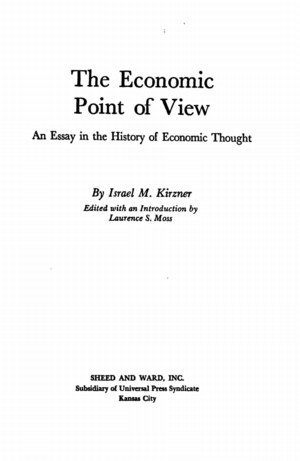
The Economic Point of View: An Essay in the History of Economic Thought, ed. with an Introduction by Laurence S. Moss (Kansas City: Sheed Andrews McMeel, 1976).

About Liberty Fund:

Liberty Fund, Inc. is a private, educational foundation established to encourage the study of the ideal of a society of free and responsible individuals.


The Economic Point of View and the Scope of Economics

The formulation of the nature of the economic point of view is, of course, intimately related to discussions concerning the scope of economics. The problem of the scope of economics, however, has frequently involved questions with which this essay has nothing to do, and it is perhaps worthwhile to make this clear at the outset. Marshall once wrote to John Maynard Keynes: “It is true of almost every science that, the longer one studies it, the larger its scope seems to be: though in fact its scope may have remained almost unchanged. But the subject matter of economics grows apace...”1

This growth in the subject matter of economics of which Marshall writes is typical of those aspects of the question with which we are not concerned. A perusal of a list of courses offered in the economics department of any university or a cursory examination of the catalogue of the economics room in a large library will easily convince one of the luxuriance of this growth. It is clear that “economics” covers a body of facts, figures, theories and opinions embracing a vast range of phenomena related to one another only in the most tenuous way—often merely by historical accident. At least one outside observer of the controversies concerning the scope of economics has hinted darkly that they represent simply a way of claiming the exclusive right to teach certain subject matter in the universities.2 Dealing, over half a century ago, with the “economic” interpretation of history, Benedetto Croce wrote:

When it is asserted, that in interpreting history we must look chiefly at the economic factors, we think at once of technical conditions, of the distribution of wealth, of classes and subclasses bound together by definite common interests, and so on. It is true these different representations cannot be reduced to a single concept, but no matter, there is no question of that; here we are in an entirely different sphere from that in which abstract questions are discussed.3

Discussions concerning the scope of economics frequently involve these “different representations” that cannot be reduced to a single concept. Our own inquiry, on the other hand, concerns that entirely different sphere in which abstract questions are discussed. And in this sphere it does indeed matter whether or not the term “economic” is understood as being reducible to a single concept; whether, in other words, it is understood as connoting a distinct “point of view.”4

Our problem, then, relates not to the scope of the subject “economics,” but to “economic theory.” When we speak of the point of view of the economist, we shall have him specifically in mind, either as a theorist or as the applier of theory. For ordinary purposes, as Cannan remarked,5 it may well be true that economic things can best be described as economic. The emergence of a voluminous literature attempting to define the economic point of view is not, however, to be dismissed as unfruitful pedantry; it is rather the expression of concern with the epistemological character of economic theory to an extent that goes far beyond that sufficient for ordinary purposes.6

The point can perhaps be expressed somewhat more succinctly by the use of the terminology of the logician. Definitions in general lend themselves fundamentally to classification as either nominal definitions or real definitions.7 The former relate to “names” and attempt to interpret given symbols, verbal or otherwise. Real definitions, on the other hand, try to define “things,” to expose in some way the “essence” and “nature” of the thing defined. The formulations of the economic point of view that are of interest to us in this essay do not content themselves with providing a translation of the word “economic”; they seek to reveal to us the “nature” of the definiendum—which in this case is a concept, a “point of view.” The fascinating variety of these formulations reflects, as we shall see, the numerous, quite distinct operations that logicians have discovered to have been actually performed when men have set out to seek real definitions.

[[1]]Memorials of Alfred Marshall, ed. A. C. Pigou (London: Macmillan & Co., 1925), p. 499.

[[2]]R. Robinson, Definition (Oxford, 1950), p. 15.

[[3]]B. Croce, Historical Materialism and the Economics of Karl Marx (English ed.; London: Macmillan & Co., 1915), p. 29.

[[4]]These considerations will account for the absence of references in this essay to the achievements in recent years in mathematical programming, input–output analysis, and game theory. Rivett has suggested, in “The Definition of Economics,” Economic Record, November, 1955, pp. 229–230, that progress in linear programming might one day require review of the borderlines of economics. Apart from its special relevance to Rivett's own definition of economics, this suggestion can refer only to the scope of the subject, not at all to the delineation of the economic point of view. On this point see especially W. J. Baumol, “Activity Analysis in One Lesson,” American Economic Review, December, 1958, p. 837.

[[5]]E. Cannan, Wealth (3rd ed.; London, 1945), p. 4.

[[6]]For examples of the specific restriction of definitions of economics to “economic theory,” or even more narrowly to “price theory,” see J. A. Schumpeter, History of Economic Analysis (New York, 1954), pp. 535–536; F. H. Knight, “The Nature of Economic Science in Some Recent Discussion,” American Economic Review, Vol. XXIV, No. 2 (June, 1934), p. 226.

[[7]]On the distinction between real and nominal definitions, see, e.g., J. S. Mill, A System of Logic (10th ed.; London, 1879), I, 162 f.; L. S. Stebbing, A Modern Introduction to Logic (6th ed.; London, 1948), p. 426; C. K. Ogden and I. A. Richards, The Meaning of Meaning (3rd ed. revised; London, 1930), p. 109 n.