Econlib

The Library

Other Sites

Front Page arrow Titles (by Subject) arrow \Illth.\ - Fabian Essays in Socialism

Return to Title Page for Fabian Essays in Socialism

Search this Title:

\"Illth.\" - George Bernard Shaw, Fabian Essays in Socialism [1889]

Edition used:

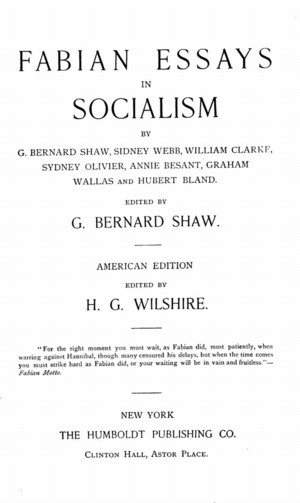
Fabian Essays in Socialism, ed. G. Bernard Shaw, American Edition Ed. by H.G. Wilshire, (New York: The Homboldt Publishing Co., 1891).

About Liberty Fund:

Liberty Fund, Inc. is a private, educational foundation established to encourage the study of the ideal of a society of free and responsible individuals.


"Illth."

It is sometimes said that during this grotesquely hideous march of civilization from bad to worse, wealth is increasing side by side with misery. Such a thing is eternally impossible: wealth is steadily decreasing with the spread of poverty. But riches are increasing, which is quite another thing. The total of the exchange values produced in the country annually is mounting perhaps by leaps and bounds. But the accumulation of riches, and consequently of an excessive purchasing power, in the hands of a class, soon satiates that class with socially useful wealth, and sets them offering a price for luxuries. The moment a price is to be had for a luxury, it acquires exchange value, and labor is employed to produce it. A New York lady, for instance, having a nature of exquisite sensibility, orders an elegant rosewood and silver coffin, upholstered in pink satin, for her dead dog. It is made; and meanwhile a live child is prowling barefooted and hunger-stunted in the frozen gutter outside. The exchange-value of the coffin is counted as part of the national wealth; but a nation which cannot afford food and clothing for its children cannot be allowed to pass as wealthy because it has provided a pretty coffin for a dead dog. Exchange value itself, in fact, has become bedeviled like everything else, and represents, no longer utility, but the cravings of lust, folly, vanity, gluttony, and madness, technically described by genteel economists as "effective demand." Luxuries are not social wealth: the machinery for producing them is not social wealth: labor skilled only to manufacture them is not socially useful labor: the men, women, and children who make a living by producing them are no more self-supporting than the idle rich for whose amusement they are kept at work. It is the habit of counting as wealth the exchange values involved in these transactions that makes us fancy that the poor are starving in the midst of plenty. They are starving in the midst of plenty of jewels, velvets, laces, equipages, and racehorses; but not in the midst of plenty of food. In the things that are wanted for the welfare of the people we are abjectly poor; and England's social policy to-day may be likened to the domestic policy of those adventuresses who leave their children half-clothed and half-fed in order to keep a carriage and deal with a fashionable dressmaker. But it is quite true that while wealth and welfare are decreasing, productive power is increasing; and nothing but the perversion of this power to the production of socially useless commodities prevents the apparent wealth from becoming real. The purchasing power that commands luxuries in the hands of the rich, would command true wealth in the hands of all. Yet private property must still heap the purchasing power upon the few rich and withdraw it from the many poor. So that, in the end, the subject of the one boast that private property can make—the great accumulation of so-called "wealth" which it points so proudly to as the result of its power to scourge men and women daily to prolonged and intense toil, turns out to be a simulacrum. With all its energy, its Smilesian "self-help," its merchant-princely enterprise, its ferocious sweating and slave-driving, its prodigality of blood, sweat and tears, what has it heaped up, over and above the pittance of its slaves? Only a monstrous pile of frippery, some tainted class literature and class art, and not a little poison and mischief.

This, then, is the economic analysis which convicts Private Property of being unjust even from the beginning, and utterly impossible as a final solution of even the individualist aspect of the problem of adjusting the share of the worker in the distribution of wealth to the labor incurred by him in its production. All attemps yet made to con struct true societies upon it have failed: the nearest things to societies so achieved have been civilizations, which have rotted into centers of vice and luxury, and eventually been swept away by uncivilized races. That our own civilization is already in an advanced stage of rottenness may be taken as statistically proved. That further decay instead of improvement must ensue if the institution of private property be maintained, is economically certain. Fortunately, private property in its integrity is not now practicable. Although the safety valve of emigration has been furiously at work during this century, yet the pressure of population has forced us to begin the restitution to the people of the sums taken from them for the ground landlords, holders of tenant right, and capitalists, by the imposition of an income tax, and by compelling them to establish out of their revenues a national system of education, besides imposing restrictions—as yet only of the forcible-feeble sort—on their terrible power of abusing the wage contract. These, however, are dealt with by Mr. Sidney Webb in his historic essay. I should not touch upon them at all, were it not that experience has lately convinced all economists that no exercise in abstract economics, however closely deduced, is to be trusted unless it can be experimentally verified by tracing its expression in history. It is true that the process which I have presented as a direct development of private property between free exchangers had to work itself out in the Old World indirectly and tortuously through a struggle with political and religious institutions and survivals quite antagonistic to it. It is true that cultivation did not begin in Western Europe with the solitary emigrant pre-empting his private property, but with the tribal communes in which arose subsequently the assertion of the right of the individual to private judgment and private action against the tyranny of primitive society. It is true that cultivation has not proceeded by logical steps from good land to less good; from less good to bad; and from bad to worse: the exploration of new countries and new regions, and the discovery of new uses for old products, has often made the margin of cultivation more fruitful than the center, and, for the moment (while the center was shifting to the margin), turned the whole movement of rent and wages directly counter to the economic theory. Nor is it true that, taking the world as one country, cultivation has yet spread from the snowline to the water's edge. There is free land still for the poorest East End match-box maker if she could get there, reclaim the wilderness there, speak the language there, stand the climate there, and be fed, clothed, and housed there while she cleared her farm; learned how to cultivate it; and waited for the harvest. Economists have been ingenious enough to prove that this alternative really secures her independence; but I shall not waste time in dealing with that. Practically, if there is no free land in England, the economic analysis holds good of England, in spite of Siberia, Central Africa, and the Wild West. Again, it is not immediately true that men are governed in production solely by a determination to realize the maximum of exchange value. The impulse to production often takes specific direction in the first instance; and a man will insist on producing pictures or plays although he might gain more money by producing boots or bonnets. But, his specific impulse once gratified, he will make as much money as he can. He will sell his picture or play for a hundred pounds rather than for fifty. In short, though there is no such person as the celebrated "economic man," man being willful rather than rational, yet when the willful man has had his way he will take what else he can get; and so he always does appear, finally if not primarily, as the economic man. On the whole, history, even in the Old World, goes the way traced by the economist. In the New World the correspondence is exact. The United States and the Colonies have been peopled by fugitives from the full-blown individualism of Western Europe, pre-empting private property precisely as assumed in this investigation of the conditions of cultivation. The economic relations of these cultivators have not since put on any of the old political disguises. Yet among them, in confirmation of the validity of our analysis, we see all the evils of our old civilizations growing up; and though with them the end is not yet, still it is from them to us that the great recent revival of the cry for nationalization of the land has come, articulated by a man who had seen the whole tragedy of private property hurried through its acts with unprecedented speed in the mushroom cities of America.

On Socialism the analysis of the economic action of Individualism bears as a discovery, in the private appropriation of land, of the source of those unjust privileges against which Socialism is aimed. It is practically a demonstration that public property in land is the basic economic condition of Socialism. But this does not involve at present a literal restoration of the land to the people. The land is at present in the hands of the people: its proprietors are for the most part absentees. The modern form of private property is simply a legal claim to take a share of the produce of the national industry year by year without working for it. It refers to no special part or form of that produce; and in process of consumption its revenue cannot be distinguished from earnings, so that the majority of persons, accustomed to call the commodities which form the income of the proprietor his private property, and seeing no difference between them and the commodities which form the income of a worker, extend the term private property to the worker's subsistence also, and can only conceive an attack on private property as an attempt to empower everybody to rob everybody else all round. But the income of a private proprietor can be distinguished by the fact that he obtains it unconditionally and gratuitously by private right against the public weal, which is incompatible with the existence of consumers who do not produce. Socialism involves discontinuance of the payment of these incomes, and addition of the wealth so saved to incomes derived from labor. As we have seen, incomes derived from private property consist partly of economic rent; partly of pensions, also called rent, obtained by the subletting of tenant rights; and partly of a form of rent called interest, obtained by special adaptations of land to production by the application of capital: all these being finally paid out of the difference between the produce of the worker's labor and the price of that labor sold in the open market for wages, salary, fees, or profits.98 The whole, except economic rent, can be added directly to the incomes of the workers by simply discontinuing its exaction from them. Economic rent, arising as it does from variations of fertility or advantages of situation, must always be held as common or social wealth, and used, as the revenues raised by taxation are now used, for public purposes, among which Socialism would make national insurance and the provision of capital matters of the first importance.

The economic problem of Socialism is thus solved; and the political question of how the economic solution is to be practically applied does not come within the scope of this essay. But if we have got as far as an intellectual conviction that the source of our social misery is no eternal well-spring of confusion and evil, but only an artificial system susceptible of almost infinite modification and readjustment—nay, of practical demolition and substitution at the will of Man, then a terrible weight will be lifted from the minds of all except those who are, whether avowedly to themselves or not, clinging to the present state of things from base motives. We have had in this century a stern series of lessons on the folly of believing anything for no better reason than that it is pleasant to believe it. It was pleasant to look round with a consciousness of possessing a thousand a year, and say, with Browning's David, "All's love; and all's law." It was pleasant to believe that the chance we were too lazy to take in this world would come back to us in another. It was pleasant to believe that a benevolent hand was guiding the steps of society; overruling all evil appearances for good; and making poverty here the earnest of a great blessedness and reward hereafter. It was pleasant to lose the sense of worldly inequality in the contemplation of our equality before God. But utilitarian questioning and scientific answering turned all this tranquil optimism into the blackest pessimism. Nature was shown to us as "red in tooth and claw": if the guiding hand were indeed benevolent, then it could not be omnipotent; so that our trust in it was broken: if it were omnipotent, it could not be benevolent; so that our love of it turned to fear and hatred. We had never admitted that the other world, which was to compensate for the sorrows of this, was open to horses and apes (though we had not on that account been any the more merciful to our horses); and now came Science to show us the corner of the pointed ear of the horse on our own heads, and present the ape to us as our blood relation. No proof came of the existence of that other world and that benevolent power to which we had left the remedy of the atrocious wrongs of the poor: proof after proof came that what we called Nature knew and cared no more about our pains and pleasures than we know or care about the tiny creatures we crush underfoot as we walk through the fields. Instead of at once perceiving that this meant no more than that Nature was unmoral and indifferent, we relapsed into a gross form of devil worship, and conceived Nature as a remorselessly malignant power. This was no better than the old optimism, and infinitely gloomier. It kept our eyes still shut to the truth that there is no cruelty and selfishness outside Man himself; and that his own active benevolence can combat and vanquish both. When the Socialist came forward as a meliorist on these lines, the old school of political economists, who could see no alternative to private property, put forward in proof of the powerlessness of benevolent action to arrest the deadly automatic production of poverty by the increase of population, the very analysis I have just presented. Their conclusions exactly fitted in with the new ideas. It was Nature at it again—the struggle for existence—the remorseless extirpation of the weak—the survival of the fittest99 —in short, natural selection at work. Socialism seemed too good to be true: it was passed by as merely the old optimism foolishly running its head against the stone wall of modern science. But Socialism now challenges individualism, skepticism, pessimism, worship of Nature personified as a devil, on their own ground of science. The science of the production and distribution of wealth is Political Economy. Socialism appeals to that science, and, turning on Individualism its own guns, routs it in incurable disaster. Henceforth the bitter cynic who still finds the world an eternal and unimprovable doghole, with the placid person of means who repeats the familiar misquotation, "the poor ye shall have always with you," lose their usurped place among the cultured, and pass over to the ranks of the ignorant, the shallow, and the superstitious. As for the rest of us, since we were taught to revere proprietary respectability in our unfortunate childhood, and since we found our childish hearts so hard and unregenerate that they secretly hated and rebelled against respectability in spite of that teaching, it is impossible to express the relief with which we discover that our hearts were all along right, and that the current respectability of to-day is nothing but a huge inversion of righteous and scientific social order weltering in dishonesty, uselessness, selfishness, wanton misery, and idiotic waste of magnificent opportunities for noble and happy living. It was terrible to feel this, and yet to fear that it could not be helped—that the poor must starve and make you ashamed of your dinner—that they must shiver and make you ashamed of your warm overcoat. It is to economic science—once the Dismal, now the Hopeful—that we are indebted for the discovery that though the evil is enormously worse than we knew, yet it is not eternal—not even very long lived, if we only bestir ourselves to make an end of it.

The Organization of Society

Property under Socialism
by Graham Wallas,
M.A., Oxford

IN the early days of Socialism no one who was not ready with a complete description of Society as it ought to be, dared come forward to explain any point in the theory. Each leader had his own method of organizing property, education, domestic life, and the production of wealth. Each was quite sure that mankind had only to fashion themselves after his model in order, like the prince and princess in the fairy story, to live happily ever after. Every year would then be like the year before; and no more history need be written. Even now a thinker here and there like Gronlund or Bebel1 sketches in the old spirit an ideal commonwealth; though he does so with an apology for attempting to forecast the unknowable. But Socialists generally have become, if not wiser than their spiritual fathers, at least less willing to use their imagination. The growing recognition, due in part to Darwin, of causation in the development of individuals and societies; the struggles and disappointments of half a century of agitation; the steady introduction of Socialistic institutions by men who reject Socialist ideas, all incline us to give up any expectation of a final and perfect reform. We are more apt to regard the slow and often unconscious progress of the Time spirit as the only adequate cause of social progress, and to attempt rather to discover and proclaim what the future must be, than to form an organization of men determined to make the future what it should be.

But the new conception of Socialism has its dangers as well as the old. Fifty years ago Socialists were tempted to exaggerate the influence of the ideal, to expect everything from a sudden impossible change of all men's hearts. Nowadays we are tempted to undervalue the ideal—to forget that even the Time Spirit itself is only the sum of individual strivings and aspirations, and that again and again in history changes which might have been delayed for centuries or might never have come at all, have been brought about by the persistent preaching of some new and higher life, the offspring not of circumstance but of hope. And of all the subjects upon which men require to be brought to a right mind and a clear understanding, there is, Socialists think, none more vital to-day than Property.

The word Property has been used in nearly as many senses as the word Law. The best definition I have met with is John Austin's: "Any right which gives to the entitled party such a power or liberty of using or disposing of the subject.... as is merely limited generally by the rights of all other persons."2 This applies only to private property. It will be convenient in discussing the various claims of the State, the municipality, and the individual, to use the word in a wider sense to denote not only the "power or liberty" of the individual, but also the "rights of all other persons." In this sense I shall speak of the property of the State, or municipality. I shall also draw a distinc tion, economic perhaps rather than legal, between property in things, or the exclusive right of access to defined material objects, property in debts and future services, and property in ideas (copyright and patent right).

The material things in which valuable property rights can exist, may be roughly divided into means of production and means of consumption. Among those lowest tribes of savages who feed on fruit and insects, and build themselves at night a rough shelter with boughs of trees, there is little distinction between the acts of production and consumption. But in a populous and civilized country very few even of the simplest wants of men are satisfied directly by nature. Nearly every commodity which man consumes is produced and renewed by the deliberate application of human industry to material objects. The general stock of materials on which such industry works is "Land." Any materials which have been separated from the general stock or have been already considerably modified by industry, are called capital if they are either to be used to aid production or are still to be worked on before they are consumed. When they are ready to be consumed they are "wealth for consumption." Such an analysis, though generally employed by political economists, is of necessity very rough. No one can tell whether an object is ready for immediate consumption or not, unless he knows the way in which it is to be consumed. A pine forest in its natural condition is ready for the consumption of a duke with a taste for the picturesque; for he will let the trees rot before his eyes. Cotton wool, a finished product in the hands of a doctor, is raw material in the hands of a spinner. But still the statement that Socialists work for the owning of the means of production by the community and the means of consumption by individuals, represents fairly enough their practical aim. Not that they desire to prevent the community from using its property whenever it will for direct consumption, as, for instance, when a piece of common land is used for a public park, or the profits of municipal waterworks are applied to keep up a municipal library. Nor do they contemplate any need for preventing individuals from working at will on their possessions in such a way as to make them more valuable. Even Gronlund, with all his hatred of private industry, could not, if he would, prevent any citizen from driving a profitable trade by manufacturing bread into buttered toast at the common fire. But men are as yet more fit for association in production, with a just distribution of its rewards, than for association in the consumption of the wealth produced. It is true indeed that the economies of associated consumption promise to be quite as great as those of associated production; and it was of these that the earlier Socialists mainly thought. They believed always that if a few hundred persons could be induced to throw their possessions and earnings into a common stock to be employed according to a common scheme, a heaven on earth would be created. Since then, an exhaustive series of experiments has proved that in spite of its obvious economy any system of associated consumption as complete as Fourier's "Phalanstère" or Owen's "New Hampshire" is, except under very unusual conditions, distasteful to most men as they now are. Our picture galleries, parks, workmen's clubs, or the fact that rich people are beginning to live in flats looked after by a common staff of servants, do indeed show that associated consumption is every year better understood and enjoyed; but it remains true that pleasures chosen by the will of the majority are often not recognized as pleasures at all.

As long as this is so, private property and even private industry must exist along with public property and public production. For instance, each family now insists on having a separate home, and on cooking every day a separate series of meals in a separate kitchen.3 Waste and discomfort are the inevitable result; but families at present prefer waste and discomfort to that abundance which can only be bought by organization and publicity. Again, English families constitute at present isolated communistic groups, more or less despotically governed. Our growing sense of the individual responsibility and individual rights of wives and children seems already to be lessening both the isolation of these groups and their internal coherency; but this tendency must go very much further before society can absorb the family life, or the industries of the home be managed socially. Thus, associated production of all the means of family life may be developed to a very high degree before we cease to feel that an Englishman's home should be his castle, with free entrance and free egress alike forbidden. It is true that the ground on which houses are built could immediately become the property of the community; and when one remembers how most people in England are now lodged, it is obvious that they would gladly inhabit comfortable houses built and owned by the State. But they certainly would at present insist on having their own crockery and chairs, books and pictures, and on receiving a certain proportion of the value they produce in the form of a yearly or weekly income to be spent or saved as they pleased. Now whatever things of this kind we allow a man to possess, we must allow him to exchange, since exchange never takes place unless both parties believe themselves to benefit by it. Further, bequest must be allowed, since any but a moderate probate duty on personalty would, unless supported by a strong and searching public opinion, certainly be evaded. Moreover, if we desire the personal independence of women and children, then their property, as far as we allow property at all, must for a long time to come be most carefully guarded.4

There would remain, therefore, to be owned by the community the land in the widest sense of the word, and the materials of those forms of production, distribution, and consumption, which can conveniently be carried on by associations larger than the family group. Here the main problem is to fix in each case the area of ownership. In the case of the principal means of communication and of some forms of industry, it has been proved that the larger the area controlled the greater is the efficiency of management; so that the postal and railway systems, and probably the materials of some of the larger industries, would be owned by the English nation until that distant date when they might pass to the United States of the British Empire or the Federal Republic of Europe. Land is perhaps generally better held by smaller social units. The rent of a town or an agricultural district depends only partly on those natural advantages which can be easily estimated once for all by an imperial commissioner. The difference in the rateable value of Warwick and of Birmingham is due, not so much to the sites of the two towns, as to the difference in the industry and character of their inhabitants. If the Birmingham men prefer, on the average, intense exertion resulting in great material wealth, to the simpler and quieter life lived at Warwick, it is obviously as unjust to allow the Warwick men to share equally in the Birmingham ground rents, as it would be to insist on one standard of comfort being maintained in Paris and in Brittany.

At the same time, those forms of natural wealth which are the necessities of the whole nation and the monopolies of certain districts, mines for instance, or harbors, or sources of water-supply, must be "nationalized." The salt and coal rings of to-day would be equally possible and equally inconvenient under a system which made the mining populations absolute joint owners of the mines. Even where the land was absolutely owned by local bodies, those bodies would still have to contribute to the national exchequer some proportion of their income. The actual size of the units would in each case be fixed by convenience; and it is very likely that the development of the County Government Act and of the parochial and municipal systems will soon provide us with units of government which could easily be turned into units of ownership.

The savings of communities—if I may use the word community to express any Social Democratic unit from the parish to the nation—would probably take much the same form that the accumulation of capital takes nowadays: that is to say, they would consist partly of mills, machinery, railways, schools, and the other specialized materials of future industry, and partly of a stock of commodities such as food, clothing, and money by which workers might be supported while performing work not immediately remunerative. The savings of individuals would consist partly of consumable commodities or of the means of such industry as had not been socialized, and partly of deferred pay for services rendered to the community, such pay taking the form of a pension due at a certain age, or of a sum of commodities or money payable on demand.

Voluntary associations of all kinds, whether joint stock companies, religious corporations, or communistic groups would, in the eyes of the Social Democratic State, consist simply of so many individuals possessing those rights of property which are allowed to individuals. They might perform many very useful functions in the future as in the past; but the history of the city companies, of the New River company, the Rochdale Pioneers, or the Church of England shows the danger of granting perpetual property rights to any association not co-extensive with the community, although such association may exist for professedly philanthropic objects. Even in the case of universities, where the system of independent property-owning corporations has been found to work best, the rights of the State should be delegated and not surrendered.

On this point the economic position of modern Social Democrats differs widely from the transfigured joint stockism of the present coöperative movement or from the object of the earlier Socialists, for whose purposes complete community was always more important than complete inclusiveness. Even Socialist writers of to-day do not always see that the grouping of the citizens for the purpose of property holding must be either on the joint stock basis or on the territorial basis. Gronlund, in spite of contradictory matter in other parts of his Coöperative Commonwealth,"5 still declares that "each group of workers will have the power of distributing among themselves the whole exchange value of their work," which either means that they will, as long as they are working, be the absolute joint owners of the materials which they use, or means nothing at all. Now the proposal that any voluntary association of citizens should hold absolute and perpetual property rights in the means of production, seems to be not a step toward Social Democracy, but a negation of the whole Social Democratic idea. This of course brings us to the following difficulty. If our communities even when originally inclusive of the whole population are closed: that is, are confined to original members and their descendants, new comers will form a class like the plebeians in Rome, or the "metœci" in Athens, without a share in the common property though possessed of full personal freedom; and such a class must be a continual social danger. On the other hand, if all newcomers receive at once full economic rights, then any country in which Socialism or anything approaching it is established will be at once overrun by proletarian immigrants from those countries in which the means of production are still strictly monopolized. If this were allowed, then, through the operation of the law of diminishing return and the law of population based on it, the whole body of the inhabitants even of a Socialist State, might conceivably be finally brought down to the bare means of subsistence.6 It does not seem necessary to conclude that Socialism must be established over the whole globe if it is to be established anywhere. What is necessary is that we face the fact, every day becoming plainer, that any determined attempt to raise the condition of the proletariat in any single European country must be accompanied by a law of aliens considerate enough to avoid cruelty to refugees, or obstruction to those whose presence would raise our intellectual or industrial average, but stringent enough to exclude the unhappy "diluvies gentium," the human rubbish which the military empires of the continent are so ready to shoot upon any open space. Such a law would be in itself an evil. It might be unfairly administered; it might increase national selfishness and would probably endanger international good will; it would require the drawing of a great many very difficult lines of distinction; but no sufficient argument has been yet advanced to disprove the necessity of it.7

On the question of private property in debts, the attitude of the law in Europe has changed fundamentally in historical times. Under the old Roman law, the creditor became the absolute owner of his debtor. Nowadays, not only may a man by becoming bankrupt and surrendering all his visible property repudiate his debts and yet retain his personal liberty; but in Factory Acts, Employers' Liability Acts, Irish Land Acts, etc., certain contracts are illegal under all circumstances. With the growth of Socialism, this tendency would be quickened. The law would look with extreme jealousy upon any agreement by which one party would be reduced even for a time to a condition of slavery, or the other enabled to live even for a time without performing any useful social function. And since it has been clearly recognized that a certain access to the means of industry is a first condition of personal freedom, the law would refuse to recognize any agreement to debar a man from such access, or deprive him of the results of it. No one would need to get into debt in order to provide himself with the opportunity of work, nor would anyone be allowed to give up the opportunity of work in order to obtain a loan. This, by making it more difficult for creditors to recover debts, would also make it more difficult for would-be debtors to obtain credit. The present homestead law would, in fact, be extended to include everything which the State thought necessary for a complete life. But as long as private industry and exchange go on to such an extent as to make a private commercial system convenient, so long will promises to pay circulate, and, if necessary, be legally enforced under the conditions above marked out.

To whatever extent private property is permitted, to that same extent the private taking of Rent and Interest must be also permitted. If you allow a selfish man to own a picture by Raphael, he will lock it up in his own room unless you let him charge something for the privilege of looking at it. Such a charge is at once Interest. If we wish all Raphael's pictures to be freely accessible to everyone, we must prevent men not merely from exhibiting them for payment, but from owning them.

This argument applies to other things besides Raphael's pictures. If we allow a man to own a printing press, or a plow, or a set of bookbinders' tools, or a lease of a house or farm, we must allow him so to employ his possession that he may, without injuring his neighbor, get from it the greatest possible advantage. Otherwise, seeing that the community is not responsible for its intelligent use, any interference on the part of the community may well result in no intelligent use being made of it at all; in which event all privately owned materials of industry not actually being used by their owners would be as entirely wasted as if they were the subjects of a chancery suit. It is easy to see that the Duke of Bedford is robbing the community of the rent of Covent Garden. It is not so easy to see that the owners of the vacant land adjoining Shaftesbury Avenue have been robbing the community for some years past of the rent which ought to have been made out of the sites which they have left desolate. I know that it has been sometimes said by Socialists: "Let us allow the manufacturer to keep his mill and the Duke of Argyll to keep his land, as long as they do not use them for exploitation by letting them out to others on condition of receiving a part of the wealth created by those others." Then, we are told, the manufacturer or Duke will soon discover that he must work hard for a living. Such sentiments are seldom ill received by men in the humor to see dukes and capitalists earning, as painfully as may be, their daily bread. Unluckily, there are no unappropriated acres and factory sites in England sufficiently advantageous to be used as efficient substitutes for those upon which private property has fastened; and the community would be wise if it paid the Duke of Argyll and Mr. Chamberlain anything short of the full economic rent of their properties rather than go further and fare worse. Therefore, if we refused either to allow these gentlemen to let their property to those who would use it, or hesitated to take and use it for ourselves, we should be actually wasting labor. The progressive socialization of land and capital must proceed by direct transference of them to the community through taxation of rent and interest and public organization of labor with the capital so obtained: not solely by a series of restrictions upon their use in private exploitation. Such concurrent private exploitation, however unrestricted, could not in any case bring back the old evils of capitalism; for any change in the habits of the people or in the methods of industry which made associated production of any commodity on a large scale convenient and profitable, would result at once in the taking over of that industry by the State exactly as the same conditions now in America result at once in the formation of a ring.

It is because full ownership is necessary to the most intelligent and effective use of any materials, that no mere system of taxation of Rent and Interest, even when so drastic as Mr. Henry George's scheme of universal State absentee landlordism, is likely to exist except as a transition stage toward Social Democracy. Indeed the anarchist idea which allows the State to receive Rent and Interest, but forbids it to employ labor, is obviously impracticable. Unless we are willing to pay every citizen in hard cash a share of the State Rent of the future, it, like the taxes of to-day, must be wholly invested in payments for work done. It would always be a very serious difficuly for a Socialist legislature to decide how far communities should be allowed to incur debts or pay interest. Socialism once established, the chief danger to its stability would be just at this point. We all know the inept attack on Socialism which comes from a debating-society orator who considers the subject for the first time, or from the cultured person who has been brought up on the Saturday Review. He tells us that if property were equally divided to-morrow, there would be for the next ten years forty men out of every hundred working extremely hard, and the other sixty lazy. After that time, the sixty would have to work hard and keep the forty, who would then be as lazy as the sixty were before. It is very easy to explain that we do not want to divide all property equally; but it is not so easy to guard against any result of that tendency in human nature on which the argument is grounded. Men differ so widely in their comparative appreciation of present and future pleasures, that wherever life can be supported by four hours' work a day, there will always be some men anxious to work eight hours in order to secure future benefits for themselves or their children, and others anxious to avoid their four hours' work for the present by pledging themselves or their children to any degree of future privation. As long as this is so, communities as well as individuals will be tempted to avail themselves of the freely offered services of the exceptionally energetic and farsighted, and to incur a common debt under the excuse that they are spreading the payment of such services over all those benefited by them. The Municipalities, Boards of Works, School Boards, etc., of England have already created enormous local debts; and unless men grow wiser in the next few months the new County Councils will probably add to the burden. As we sit and think, it may seem easy to prevent any such trouble in the future by a law forbidding communities to incur debts under any circumstances. But in the case of a central and supreme government such a law would, of course, be an absurdity. No nation can escape a national debt or any other calamity if the majority in that nation desire to submit to it. It is reassuring to see how the feeling that national governments should pay their way from year to year grows stronger and stronger. National debts no longer even in France go up with the old light-hearted leaps and bounds. But local debts still increase. In Preston the local debt is said to amount to seven times the annual rating valuation. And although at present (November, 1888), since the "surf at the edge of civilization" is only thundering to the extent of three small colonial wars, our own national debt is slowly going down; still if war were declared to-morrow with any European State no ministry would dare to raise all the war expenses by immediate taxation either on incomes or on property. It may be objected that no such danger would arise under Socialism; for there would be no fund from which a loan could be offered that would not be equally easily reached by a direct levy. But if we are speaking of society in the near future there would certainly be plenty of members of non-Socialist States, or English holders of property in them, ready to lend money on good security to a timid or desperate or dishonest Socialist government. Again, in times of extreme stress a government might believe itself to require even personal possessions; and it might be difficult under such circumstances not to offer to restore them with or without interest. In any case there would be no more economic difference between the new fund-holders and the old landlords than between Lord Salisbury as owner of the Strand district and Lord Salisbury now that he has sold his slums and bought consols. Perhaps the most serious danger of the creation of a common debt would arise from the earnings of exceptional ability. Modern Socialists have learned, after a long series of coöperative experiments and failures, that the profits of private adventure will withdraw men of exceptional business talent from communal service unless work of varying scarcity and intensity is paid for at varying rates. How great this variation need be in order to insure full efficiency can only be decided by experience; and as the education and moralization of society improves, and industry becomes so thoroughly socialized that the alternative of private enterprise will be less practicable, something like equality may at last be found possible. But, meanwhile, comparatively large incomes will be earned by men leading busy and useful lives, but often keenly anxious to secure leisure and comfort for their old age and aggrandizement for their family.8 I have already suggested that some of the earnings of a man employed by the community might be left for a time in the common treasury to accumulate without interest. Now, it would suit both these men and the lazier of their contemporaries that the reward of their services should be fixed at a very high rate, and be left to the next generation for payment; while the next generation might prefer a small permanent charge to any attempt to pay off the capital sum. It is often hinted that one way to obviate this would be for each generation to cultivate a healthy indifference to the debts incurred on its behalf by its forefathers. But the citizens of each new generation attain citizenship not in large bodies at long intervals, but in small numbers every week. One has only to warn sanguine leaders that veiled repudiations may always be effected in such emergencies by a judicious application of the Income Tax, and to hope that the progress of education under Socialism would tend to produce and preserve on such matters a certain general minimum of common sense. If this minimum is sufficient to control the central government the debts of local bodies can be easily and sternly restricted.

Property in services means of course property in future services. The wealth which past services may have produced can be exchanged or owned; but the services themselves cannot. Now all systems of law which we know have allowed private persons to contract with each other for the future performance of certain services, and have punished, or allowed to be punished, the breach of such contracts. Here as in the case of debts, our growing respect for personal liberty has made the law look jealously on all onerous agreements made either by the citizen himself or for him by others. In fact, as Professor Sidgwick points out: "In England hardly any engagement to render personal service gives the promisee a legal claim to more than pecuniary damages—to put it otherwise, almost all such contracts, if unfulfilled, turn into mere debts of money so far as their legal force goes."9 The marriage contract forms the principal exception to this rule; but even in this case there seems to be a tendency in most European countries to relax the rigidity of the law.

On the other hand the direct claims of the State to the services of its citizens show at present no signs of diminishing. Compulsory military service and compulsory attendance at school already take up a not inconsiderable share of the life of every male inhabitant of France and Germany. So far in England the compulsion of grown men to serve in any capacity has been condemned for a century past, because it is considered wasteful and oppressive as compared with the free contract system of the open market. Most English Socialists seem inclined to believe that all work for the State should be voluntarily engaged and paid for out of the produce of common industry.

In considering how far the State has a claim upon the services of its members, we come upon the much larger question—How far are we working for Socialism; and how far for Communism? Under pure Socialism, to use the word in its narrowest sense, the State would offer no advantage at all to any citizen except at a price sufficient to pay all the expenses of producing it. In this sense the Post Office, for example, is now a purely Socialistic institution. Under such conditions the State would have no claim at all on the services of its members; and compulsion to work would be produced by the fact that if a man chose not to work he would be in danger of starvation. Under pure Communism, on the other hand, as defined by Louis Blanc's dictum: "From every man according to his powers: to every man according to his wants," the State would satisfy without stint and without price all the reasonable wants of any citizen. Our present drinking fountains are examples of the numerous cases of pure communism which surround us. But since nothing can be made without labor, the commodities provided by the State must be produced by the services, voluntary or forced, of the citizens. Under pure communism, if any compulsion to work were needed, it would have to be direct. Some communistic institutions we must have; and as a matter of fact there is an increasing number of them already in England. Indeed, if the whole or any part of that Rent Fund which is due to the difference between the best and worst materials of industry in use be taken for the State, by taxation or otherwise, it, or rather the advantages produced by its expenditure, can hardly be distributed otherwise than communistically. For, as men are now, saturated with immoral principles by our commercial system, the State would have to be exceedingly careful in deciding what wants could be freely satisfied without making direct compulsion to labor necessary. It would cost by no means an impossible sum to supply a tolerable shelter with a bed, and a sufficient daily portion of porridge, or bread and cheese, or even of gin and water, to each citizen; but no sane man would propose to do so in the existing state of public morals. For more than a century the proletarians of Europe have been challenged by their masters to do as little work as they can. They have been taught by the practical economists of the Trades Unions, and have learned for themselves by bitter experience, that every time any of them in a moment of ambition or goodwill does one stroke of work not in his bond, he is increasing the future unpaid labor not only of himself but of his fellows. At the same time every circumstance of monotony, ugliness, and anxiety has made the work as wearisome and disgusting as possible. All, almost without exception, now look upon the working day as a period of slavery, and find such happiness as they can get only in the few hours or minutes that intervene between work and sleep. For a few, that happiness consists in added toil of thought and speech in the cause of themselves and their comrades. The rest care only for such rough pleasures as are possible to men both poor and overworked. There would be plenty of excuse if under these circumstances they dreamt, as they are accused of dreaming, of some universal division of the good things of the earth—of some means of being utterly at leisure, if only for a week or two.

But there are products of labor which the workmen in their time of triumph might freely offer each other without causing the weakest brother to forego any form of useful social work. Among such products are those ideas which we have brought under the dominion of private property by means of copyright and patent right. Luckily for us the dominion is neither complete nor permanent. If the Whig landlords who are responsible for most of the details of our glorious constitution had been also authors and inventors for profit, we should probably have had the strictest rights of perpetual property or even of entail' in ideas; and there would now have been a Duke of Shakspeare to whom we should all have had to pay two or three pounds for the privilege of reading his ancestor's works, provided that we returned the copy uninjured at the end of a fortnight. But even for the years during which copyright and patents now last, the system which allows an author or inventor a monopoly in his ideas is a stupid and ineffective way either of paying for his work or of satisfying the public wants. In each case the author or inventor obtains a maximum net return by leaving unsatisfied the wants, certainly of many, probably of most of those who desire to read his book or use his invention. We all know that the public got a very good bargain when it paid the owners of Waterloo Bridge more than they could possibly have made by any scheme of tolls. In the same way it is certain that any government which aimed at the greatest happiness of the greatest number could afford to pay a capable artist or author possibly even more than he gets from the rich men who are his present patrons, and certainly more than he could get by himself selling or exhibiting his productions in a society where few possessed wealth for which they had not worked. Although the State could thus afford to pay an extravagantly large reward for certain forms of intellectual labor, it does not, therefore, follow that it would be obliged to do so in the absence of any other important bidder.

There would always remain the sick, the infirm, and the school children, whose wants could be satisfied from the general stock without asking them to bear any part of the general burden. In particular, it would be well to teach the children by actual experience the economy and happiness which arise in the case of those who are fitly trained from association applied to the direct satisfaction of wants, as well as from association in the manufacture of material wealth. If we wish to wean the children from the selfish isolation of the English family, from the worse than savage habits produced by four generations of capitalism, from that longing for excitement, and incapacity for reasonable enjoyment, which are the natural results of workdays spent in English factories, and English Sundays spent in English streets, then we must give freely and generously to our schools. If this generation were wise it would spend on education not only more than any other generation has ever spent before, but more than any generation would ever need to spend again. It would fill the school buildings with the means not only of comfort, but even of the higher luxury; it would serve the associated meals on tables spread with flowers, in halls surrounded with beautiful pictures, or even, as John Milton proposed, filled with the sound of music; it would seriously propose to itself the ideal of Ibsen, that every child should be brought up as a nobleman. Unfortunately, this generation is not wise.10

In considering the degree in which common owning of property would be possible among a people just at that stage of industrial and moral development at which we now find ourselves, it is expedient to dwell, as I have dwelt, rather upon the necessary difficulties and limitations of Socialism, than upon its hopes of future development. But we must always remember that the problems which Socialism attempts to solve, deal with conditions which themselves are constantly changing. Just as anything like what we call Socialism would be impossible in a nation of individualist savages like the Australian blacks, and could not, perhaps, be introduced except by external authority among a people like the peasants of Brittany, for whom the prospect of absolute property in any portion of land, however small, is at once their strongest pleasure and their only sufficient incentive to industry; so among a people further advanced, socially and industrially, than ourselves, a social condition would be possible which we do not now dare to work for or even try to realize. The tentative and limited Social-Democracy which I have sketched is the necessary and certain step to that better life which we hope for. The interests which each man has in common with his fellows tend more and more to outweigh those which are peculiar to himself. We see the process even now beginning. Already, as soon as a public library is started, the workman finds how poor a means for the production of happiness are the few books on his own shelf, compared with the share he has in the public collection, though that share may have cost even less to produce. In the same way the score or two of pounds which a workman may possess are becoming daily of less and less advantage in production; so that the man who a few years ago would have worked by himself as a small capitalist, goes now to work for wages in some great business, and treats his little savings as a fund to provide for a few months of sickness or years of old age. He will soon see how poor a means for the production of food is his own fire when compared with the public kitchen; and he will perhaps at last not only get his clothes from the public store, but the delight of his eyes from the public galleries and theaters, the delight of his ears from the public opera, and it may be, when our present anarchy of opinion shall be overpast, the refreshment of his mind from the publicly chosen teacher. Then at last such a life will be possible for all as not even the richest and most powerful can live to-day. The system of property holding which we call Socialism is not in itself such a life any more than a good system of drainage is health, or the invention of printing is knowledge. Nor indeed is Socialism the only condition necessary to produce complete human happiness. Under the justest possible social system we might still have to face all those vices and diseases which are not the direct result of poverty and over-work; we might still suffer all the mental anguish and bewilderment which are caused, some say by religious belief, others by religious doubt; we might still witness outbursts of national hatred and the degradation and extinction of weaker peoples; we might still make earth a hell for every species except our own. But in the households of the five men out of six in England who live by weekly wage, Socialism would indeed be a new birth of happiness. The long hours of work done as in a convict prison, without interest and without hope; the dreary squalor of their homes; above all that grievous uncertainty, that constant apprehension of undeserved misfortune which is the peculiar result of capitalist production:11 all this would be gone; and education, refinement, leisure, the very thought of which now maddens them, would be part of their daily life. Socialism hangs above them as the crown hung in Bunyan's story above the man raking the muck heap—ready for them if they will but lift their eyes. And even to the few who seem to escape and even profit by the misery of our century, Socialism offers a new and nobler life, when full sympathy with those about them, springing from full knowledge of their condition, shall be a source of happiness, and not, as now, of constant sorrow—when it shall no longer seem either folly or hypocrisy for a man to work openly for his highest ideal. To them belongs the privilege that for each one of them the revolution may begin as soon as he is ready to pay the price. They can live as simply as the equal rights of their fellows require: they can justify their lives by work in the noblest of all causes. For their reward, if they desire any, they, like the rest, must wait.

Industry under Socialism
by Annie Besant

THERE are two ways in which a scheme for a future organization of industry may be constructed. Of these, by far the easier and less useful is the sketching of Utopia, an intellectual gymnastic in which a power of coherent and vivid imagination is the one desideratum. The Utopist needs no knowledge of facts: indeed such a knowledge is a hindrance: for him the laws of social evolution do not exist. He is a law unto himself; and his men and women are not the wayward, spasmodic, irregular organisms of daily life, but automata, obeying the strings he pulls. In a word, he creates, he does not construct: he makes alike his materials and the laws within which they work, adapting them all to an ideal end. In describing a new Jerusalem, the only limits to its perfection are the limits of the writer's imagination.

The second way is less attractive, less easy, but more useful. Starting from the present state of society, it seeks to discover the tendencies underlying it; to trace those tendencies to their natural outworking in institutions; and so to forecast, not the far-off future, but the next social stage. It fixes its gaze on the vast changes wrought by evolution, not the petty variations made by catastrophes; on the Revolutions which transform society, not the tran sient riots which merely upset thrones and behead kings. This second way I elect to follow; and this paper on industry under Socialism therefore starts from William Clarke's exposition of the industrial evolution which has been in progress during the last hundred and fifty years. In thus building forward—in thus forecasting the transitions through which society will probably pass, I shall scarcely touch on the ideal Social State that will one day exist; and my sketch must lay itself open to all the criticisms which may be leveled against a society not ideally perfect. It is therefore necessary to bear in mind that I am only trying to work out changes practicable among men and women as we know them; always seeking to lay down, not what is ideally best, but what is possible; always choosing among the possible changes that which is on the line toward the ideal, and will render further approach easier. In fact this paper is an attempt to answer the "How?" so often heard when Socialism is discussed. Large numbers of people accept, wholly or in part, the Socialist theory: they are intellectually convinced of its soundness or emotionally attracted by its beauty; but they hesitate to join in its propaganda, because they "don't see where you are going to begin," or "don't see where you are going to stop." Both difficulties are disposed of by the fact that we are not "going to begin." There will never be a point at which a society crosses from Individualism to Socialism.12 The change is ever going forward; and our society is well on the way to Socialism. All we can do is consciously to coöperate with the forces at work, and thus render the transition more rapid than it would otherwise be.

The second Fabian essay shows us the success of capitalism bringing about a position which is at once intolerable to the majority, and easy of capture by them. At this point the destruction of the small industries has broken down most of the gradations which used to exist between the large employer and the hired laborer, and has left in their place a gulf across which a few capitalists and a huge and hungry proletariat face each other. The denial of human sympathy by the employer in his business relations with his "hands" has taught the "hands" to regard the employer as outside the pale of their sympathy. The "respect of the public conscience for the rights of property," which was at bottom the private interest of each in his own little property, has diminished since the many lost their individual possessions, and saw property accumulate in the hands of the few: it is now little more than a tradition inherited from a former social state. The "public conscience" will soon condone, nay, it will first approve, and then demand, the expropriation of capital which is used anti-socially instead of socially, and which belongs to that impersonal abstraction, a company, instead of to our next door neighbor. To the average person it is one thing for the State to seize the little shop of James Smith who married our sister, or the thriving business of our Sam who works early and late for his living; and quite another when James and Sam, ruined by a big Company made up of shareholders of whom nobody knows anything but that they pay low wages and take high dividends, have been obliged to become hired servants of the Company, instead of owning their own shops and machinery. Whose interest will it be to protest against the State taking over the capital, and transforming James and Sam from wage-slaves at the mercy of a foreman, into shareholders and public functionaries, with a voice in the managemeut of the business in which they are employed?

Let us suppose, then, that the evolution of the capitalist system has proceeded but a little further along the present lines, concentrating the control of industry, and increasingly substituting labor-saving machinery for human beings. It is being accompanied, and must continue to be accompanied, by a growth of the numbers of the unemployed. These numbers may ebb and flow, as some of the waves of a rising tide run forward some feet and then a few touch a lower level; but as the tide rises despite the fluctuations of the ripples, so the numbers of the unemployed will increase despite transient mountings and fallings. With these, probably, will begin the tentative organization of industry by the State; but this organization will soon be followed by the taking over by the community of some of the great Trusts.

The division of the country into clearly defined areas, each with its elected authority, is essential to any effective scheme of organization. It is one of the symptoms of the coming change, that, in perfect unconsciousness of the nature of his act, Mr. Ritchie has established the Commune. He has divided England into districts ruled by County Councils, and has thus created the machinery without which Socialism was impracticable. True, he has only made an outline which needs to be filled in; but Socialists can fill in, whereas they had no power to outline. It remains to give every adult a vote in the election of Councilors; to shorten their term of office to a year; to pay the Councilors, so that the public may have a right to the whole of their working time; to give the Councils power to take and hold land—a reform already asked for by the Liberal and Radical Union, a body not consciously Socialist; and to remove all legal restrictions, so as to leave them as free to act corporately as an individual is to act individually. These measures accomplished, the rapidity with which our institutions are socialized depends on the growth of Socialism among the people. It is essential to the stability of the changed forms of industry that they shall be made by the people, not imposed upon them: hence the value of Mr. Ritchie's gift of Local Government, enabling each locality to move swiftly or slowly, to experiment on a comparatively small scale, even to blunder without widespread disaster. The mot d' ordre for Socialists now is, "Convert the electors; and capture the County Councils." These Councils, administering local affairs, with the national Executive administering national affairs, are all destined to be turned into effective industrial organizers; and the unit of administration must depend on the nature of the industry. The post, the telegraph, the railways, the canals, and the great industries capable of being organized into Trusts, will, so far as we can see now, be best administered each from a single center for the whole kingdom. Tramways, gas-works, water-works, and many of the smaller productive industries, will be best managed locally. In marking the lines of division, convenience and experience must be our guides. The demarkations are of expediency, not of principle.

The first great problem that will press on the County Council for solution will be that of the unemployed.13 Wisely or unwisely, it will have to deal with them: wisely, if it organizes them for productive industry; unwisely, if it opens "relief works," and tries, like an enlarged Bumble, to shirk the difficulty by enforcing barren and oppressive toil upon outlawed wretches at the expense of the rest of the community. Many of the unemployed are unskilled laborers: a minority are skilled. They must first be registered as skilled and unskilled, and the former enrolled under their several trades. Then can begin the rural organization of labor on county farms, held by the County Councils. The Council will have its agricultural committee, charged with the administrative details; and this committee will choose well-trained, practical agriculturists, as directors of the farm business. To the County Farm will be drafted from the unemployed in the towns the agricultural laborers who have wandered townward in search of work, and many of the unskilled laborers. On these farms every advantage of machinery, and every discovery in agricultural science, should be utilized to the utmost. The crops should be carefully chosen with reference to soil and aspect—cereals, fruit, vegetables—and the culture adapted to the crop, the one aim being to obtain the largest amount of produce with the least expenditure of human labor. Whether land is most profitably cultivated in large or small parcels depends on the crop; and in the great area of the County Farm, la grande and la petite culture might each have its place. Economy would also gain by the large number of laborers under the direction of the head farmer, since they could be concentrated when required at any given spot, as in harvest time, and dispersed to work at the more continuous kinds of tillage when the seasonal task was over.

To these farms must also be sent some skilled laborers from among the unemployed, shoemakers, tailors, smiths, carpenters, &c.; so that the County Farm may be self-supporting as far as it can be without waste of productive power. All the small industries necessary in daily life should be carried on in it, and an industrial commune thus built up. The democracy might be trusted to ordain that an eight hours' day, and a comfortable home, should be part of the life-conditions on the County Farm. Probably each large farm would soon have its central store, with its adjacent railway station, in addition to the ordinary farm buildings; its public hall in the center of the farm village to be used for lectures, concerts, and entertainments of all sorts; its public schools, elementary and technical; and soon, possibly from the outset, its public meal-room, saving time and trouble to housewives, and, while economizing fuel and food, giving a far greater choice and variety of dishes. Large dwellings, with suites of rooms, might perhaps replace old-fashioned cottages; for it is worth noting, as showing the tendency already existing among ourselves to turn from isolated self-dependence to the advantages of associated living, that many modern flats are being built without servants' rooms, the house-cleaning, &c., being done by persons engaged for the whole block, and the important meals being taken at restaurants, so as to avoid the trouble and expense of private cooking. It will surely be well in initiating new organizations of industry to start on the most advanced lines, and take advantage of every modern tendency toward less isolated modes of living. Socialists must work hard to make municipal dealings with the unemployed avenues to the higher life, not grudging utilization of pauper labor.14 And as they know their aim, and the other political parties live but from hand to mouth, they ought to be able to exercise a steady and uniform pressure, which, just because it is steady and uniform, will impress its direction on the general movement.

The note of urban industrial organization, as of all other, must be that each person shall be employed to do what he can do best, not what he does worst. It may be desirable for a man to have two trades; but watch-making and stone-breaking are not convenient alternative occupations. Where the skilled unemployed belong to trades carried on everywhere, such as baking, shoemaking, tailoring, etc., they should be employed at their own trades in municipal workshops, and their products garnered in municipal stores. These workshops will be under the direction of foremen, thoroughly skilled workmen, able to superintend and direct as though in private employment. The working-day must be of eight hours, and the wages, for the present, the Trades Union minimum. Then, instead of tailors and shoemakers tramping the streets ragged and barefoot, the tailors will be making clothes and the shoemakers boots and shoes; and the shoemaker with the wages he earns will buy the tailor's products, and the tailor the shoemaker's. Then, instead of supporting the unemployed by rates levied on the employed, they will be set to work to supply their own necessities, and be producers of the wealth they consume instead of consuming, in enforced idleness or barren penal exercises in the stoneyard, the wealth produced by others. Masons, bricklayers, plumbers, carpenters, etc., might be set to work in building decent and pleasant dwellings—in the style of the blocks of flats, not of the barracks called model dwellings—for the housing of the municipal industrial army. I lay stress on the pleasantness of the dwellings. These places are to be dwellings for citizens, not prisons for paupers; and there is no possible reason why they should not be made attractive. Under Socialism the workers-are to be the nation, and all that is best is for their service; for, be it remembered, our faces are set toward Socialism, and our organization of labor is to be on Socialist lines.

It is very likely that among the unemployed some will be found whose trade can only be carried on by large numbers, and is not one of the industries of the town into which their unlucky fate has drifted them. These should be sent into municipal service in the towns where their trade is the staple industry, there to be employed in the municipal factory.

Concurrently with this rural and urban organization of non-centralized industries will proceed the taking over of the great centralized industries, centralized for us by capitalists, who thus unconsciously pave the way for their own supersession. Everything which has been organized into a Trust, and has been worked for a time in the Trust fashion, is ripe for appropriation by the community. All minerals would be most properly worked in this centralized way15 ; and it will probably be found most convenient to work all the big productive industries—such as the textile—in similar fashion. It is idle to say. that it cannot be done by the State when it is being done by a ring of capitalists: a Local Board, an Iron Board, a Tin Board, can as easily be responsible to the nation as to a casual crowd of share-holders. There need be no dislocation of production in making the transference: the active organizers and directors of a Trust do not necessarily, or even usually, own the capital invested in it. If the State finds it convenient to hire these organizers and directors, there is nothing to prevent its doing so for as long or as short a period as it chooses. The temporary arrangements made with them during the transition period must be governed by expediency.

Let us pause for a moment to estimate the position so far. The unemployed have been transformed into communal workers—in the country on great farms, improvements of the Bonanza farms in America—in the towns in various trades. Public stores for agricultural and industrial products are open in all convenient places, and filled with the goods thus communally produced. The great industries, worked as Trusts, are controlled by the State instead of by capitalist rings. The private capitalist, however, will still be in business, producing and distributing on his own account in competition with the communal organizations, which at present will have occupied only part of the industrial field. But apart from a pressure which will be recognized when we come to deal with the remuneration of labor, these private enterprises will be carried on under circumstances of ever-increasing difficulty. In face of the orderly communal arrays, playing into each other's hands, with the credit of the country behind them, the ventures of the private capitalist will be at as great a disadvantage as the cottage industries of the last century in face of the factory industries of our own period. The Trusts have taught us how to drive competing capitals out of the market by associated capitals. The Central Boards or County Councils will be able to utilize this power of association further than any private capitalists. Thus the economic forces which replaced the workshop by the factory, will replace the private shop by the municipal store and the private factory by the municipal one. And the advantages of greater concentration of capital and of association of labor will not be the only ones enjoyed by the communal workers. All waste will be checked, every labor-saving appliance utilized to the utmost, where the object is the production of general wealth and not the production of profit to be appropriated by a class; for in the one case it is the interest of the producers to produce—inasmuch as their enjoyment depends on the productivity of their labor—whereas in the other it is their interest to sterilize their labor as far as they dare in order to render more of it necessary and so keep up its price. As the organization of the public industry extends, and supplants more and more the individualist producer, the probable demand will be more easily estimated, and the supply regulated to meet it. The Municipalities and Central Boards will take the place of the competing small capitalists and the rings of large ones; and production will become ordered and rational instead of anarchical and reckless as it is to-day. After awhile the private producers will disappear, not because there will be any law against individualist production, but because it will not pay. No one will care to face the worries, the harassments, the anxieties, of individual struggling for livelihood, when ease, freedom, and security can be enjoyed in the communal service.

The best form of management during the transition period, and possibly for a long time to come, will be through the Communal Councils, which will appoint committees to superintend the various branches of industry.16 These committees will engage the necessary manager and foreman for each shop, factory, etc., and will hold the power of dismissal as of appointment. I do not believe that the direct election of the manager and foreman by the employees would be found to work well in practice, or to be consistent with the discipline necessary in carrying on any large business undertaking. It seems to me better that the Commune should elect its Council—thus keeping under its own control the general authority—but should empower the Council to select the officials, so that the power of selection and dismissal within the various sub-divisions should lie with the nominees of the whole Commune instead of with the particular group immediately concerned.

There is no practical difficulty in the way of the management of the ordinary productive industries, large or small. The Trusts and Coöperation have, between them, solved, or put us in the way of solving, all problems connected with these. But there are difficulties in connection with the industries concerned in the production of such commodities as books and newspapers. During the transitional stage these difficulties will not arise; but when all industries are carried on by the Commune, or the Nation, how will books and newspapers be produced? I only throw out the following suggestions. Printing, like baking, tailoring, shoemaking, is a communal rather than a national industry. Suppose we had printing offices controlled by the Communal Council. The printing committee might be left free to accept any publication it thought valuable, as a private firm to-day may take the risk of publication, the arrangement with the author being purchase outright, or royalty on copies sold, in each case so much to be put to his credit at the Communal Bank. But there are many authors whose goods are desired by no one: it would be absurd to force the community to publish all minor poetry. Why not accept the principle that in every case where the printing committee declines to print at the communal risk, the author may have his work printed by transferring from his credit at the Communal Bank to the account of the printing committee sufficient to cover the cost of printing? The committee should have no power to refuse to print, where the cost was covered. Thus liberty of expression would be guarded as a constitutional right, while the community would not be charged with the cost of printing every stupid effusion that its fond composer might deem worthy of publicity.

Newspapers might be issued on similar terms; and it would always be open to individuals, or to groups of individuals, to publish anything they pleased on covering the cost of publication.17 With the comparative affluence which would be enjoyed by each member of the community, anyone who really cared to reach the public ear would be able to do so by diminishing his expenditure in other directions.

Another difficulty which will meet us, although not immediately, is the competition for employment in certain pleasanter branches of industry. At present an unemployed person would catch eagerly at the chance of any well-paid work he was able to perform. If he were able both to set type and to stitch coats, he would not dream of grumbling if he were by chance offered the job he liked the less of the two: he would be only too glad to get either. But it is quite possible that as the vast amelioration of life-conditions proceeds, Jeshurun will wax fat and kick if, when he prefers to make microscope lenses, he is desired to make mirrors. Under these circumstances, Jeshurun will, I fear, have to accommodate himself to the demand. If the number of people engaged in making lenses suffices to meet the demand for lenses, Jeshurun must consent to turn his talents for the time to mirror-making. After all, his state will not be very pitiable, though Socialism will have failed, it is true, to make 2+2=5.

This, however, hardly solves the general question as to the apportioning of laborers to the various forms of labor, but a solution has been found by the ingenious author of "Looking Backward, from a. d. 2,000." Leaving young men and women free to choose their employments, he would equalize the rates of volunteering by equalizing the attractions of the trades. In many cases natural bent, left free to develop itself during a lengthened educational term, will determine the choice of avocation. Human beings are fortunately very varied in their capacities and tastes: that which attracts one repels another. But there are unpleasant and indispensable forms of labor which, one would imagine, can attract none—mining, sewer-cleaning, etc. These might be rendered attractive by making the hours of labor in them much shorter than the normal working-day of pleasanter occupations. Many a strong, vigorous man would greatly prefer a short spell of disagreeable work to a long one at a desk. As it is well to leave the greatest possible freedom to the individual, this equalizing of advantages in all trades would be far better than any attempt to perform the impossible task of choosing an employment for each. A person would be sure to hate any work into which he was directly forced, even though it were the very one he would have chosen had he been left to himself.

Further, much of the most disagreeable and laborious work might be done by machinery, as it would be now if it were not cheaper to exploit a helot class. When it became illegal to send small boys up chimneys, chimneys did not cease to be swept: a machine was invented for sweeping them. Coal-cutting might now be done by machinery, instead of by a man lying on his back, picking away over his head at the imminent risk of his own life; but the machine is much dearer than men, so the miners continue to have their chests crushed in by the falling coal. Under Socialism, men's lives and limbs will be more valuable than machinery; and science will be tasked to substitute the one for the other.

In truth the extension of machinery is very likely to solve many of the problems connected with differential advantages in employment; and it seems certain that, in the very near future, the skilled worker will not be the man who is able to perform a particular set of operations, but the man who has been trained in the use of machinery. The difference of trade will be in the machine rather than in the man: whether the produce is nails or screws, boots or coats, cloth or silk, paper-folding or type-setting, will depend on the internal arrangements of the mechanism and not on the method of applying the force. What we shall probably do will be to instruct all our youth in the principles of mechanics and in the handling of machines; the machines will be constructed so as to turn the force into the various channels required to produce the various articles; and the skilled workman will be the skilled mechanic, not the skilled printer or bootmaker. At the present time a few hours', or a few days', study will make the trained mechanician master of any machine you can place before him. The line of progress is to substitute machines for men in every department of production: let the brain plan, guide, control; but let iron and steel, steam and electricity, that do not tire and cannot be brutalized, do the whole of the heavy toil that exhausts human frames to-day. There is not the slightest reason to suppose that we are at the end of an inventive era. Rather are we only just beginning to grope after the uses of electricity; and machinery has before it possibilities almost undreamed of now, the men produced by our system being too rough-handed for the manipulation of delicate and complicated contrivances. I suggest this only as a probable simplification of balancing the supply and demand in various forms of labor in the future: our immediate method of regulation must be the equalizing of advantages in them.

One may guess that in each nation all the Boards and communal. authorities will ultimately be represented in some central Executive, or Industrial Ministry; that the Minister of Agriculture, of Mineral Industries, of Textile Industries, and so on, will have relations with similar officers in other lands; and that thus, internationally as well as nationally, coöperation will replace competition. But that end is not yet.

We now approach a yet more thorny subject than the organization of the workers. What should be the remuneration of labor—what the share of the product taken respectively by the individual, the municipality, and the State?

The answer depends on the answer to a previous question. Is the organization of the unemployed to be undertaken in order to transform them into self-supporting, self-respecting citizens; or is it to be carried on as a form of exploitation, utilizing pauper labor for the production of profit for non-paupers? The whole matter turns on this point; and unless we know our own minds, and fight for the right method and against the wrong from the very beginning, the organization of the unemployed will be a buttress for the present system instead of a step toward a better.18 Already there is talk of establishing labor colonies in connection with workhouses; and there is no time to be lost if we are to take advantage of the good in the proposal and exclude the bad. The County Councils also will lead to an increase of municipal employment; and the method of that employment is vital.

The ordinary vestryman, driven by the force of circumstances into organizing the unemployed, will try to extract a profit to the ratepayers from pauper farms by paying the lowest rates of wages. He would find this way of proceeding very congenial, and would soon, if permitted, simply municipalize slave-driving. In this way the municipal and rural organization of labor, even when its necessity and its advantages are realized, can do nothing but change the form of exploitation of labor if the workers in public employ are to be paid a wage fixed by the competition of the market, and the profits of their labor used only for the relief of the rates. Under such circumstances we should have the whole of the rates paid by the communal workers, while the private employers would go free. This would not be a transition to Socialism, but only a new way of creating a class of municipal serfs, which would make our towns burlesques of the ancient Greek slaveholding"democracies." We shall find surer ground by recalling and applying the principle of Socialism that the laborers shall enjoy the full product of their toil. It seems to me that this might be worked out somewhat in the following way:

Out of the value of the communal produce must come rent of land payable to the local authority, rent of plant needed for working the industries, wages advanced and fixed in the usual way, taxes, reserve fund, accumulation fund, and the other charges necessary for the carrying on of the communal business. All these deducted, the remaining value should be divided among the communal workers as a "bonus." It would be obviously inconvenient, if not impossible, for the district authority to sub-divide this value and allot so much to each of its separate undertakings—so much left over from gas-works for the men employed there, so much from the tramways for the men employed on them, and so on. It would be far simpler and easier for the municipal employees to be regarded as a single body, in the service of a single employer, the local authority; and that the surplus from the whole of the businesses carried on by the Communal Council should be divided without distinction among the whole of the communal employees. Controversy will probably arise as to the division: shall all the shares be equal; or shall the workers receive in proportion to the supposed dignity or indignity of their work? Inequality, however, would be odious; and I have already suggested (p. 199) a means of adjusting different kinds of labor to a system of equal division of net product. This meets the difficulty of the varying degrees of irksomeness without invidiously setting up any kind of socially useful labor as more honorable than any other.—a distinction essentially unsocial and pernicious. But since in public affairs ethics are apt to go to the wall, and appeals to social justice too often fall on deaf ears, it is lucky that in this case ethics and convenience coincide. The impossibility of estimating the separate value of each man's labor with any really valid result, the friction which would arise, the jealousies which would be provoked, the inevitable discontent, favoritism and jobbery that would prevail: all these things will drive the Communal Council into the right path, equal remuneration of all workers. That path once entered on, the principle of simplification will spread; and presently it will probably be found convenient that all the Communal Councils shall send in their reports to a Central Board, stating the number of their employees, the amount of the values produced, the deductions for rent and other charges, and their available surplus. All these surpluses added together would then be divided by the total number of communal employees, and the sum thus reached would be the share of each worker. The national trusts would at first be worked separately on lines analogous to those sketched for the Communes; but later these would be lumped in with the rest, and still further equalize the reward of labor. As private enterprises dwindle, more and more of the workers will pass into communal employ, until at last the Socialist ideal is touched of a nation in which all adults are workers, and all share the national product. But be it noted that all this grows out of the first organization of industry by Municipalities and County Councils, and will evolve just as fast or just as slowly as the community and its sections choose. The values dealt with, and the numbers employed at first, would not imply as much complexity of detail as is involved in many of the great businesses now carried on by individuals and by companies. The same brains will be available for the work as are now hired by individuals; and it is rather the novelty of the idea than the difficulty of its realization which will stand in the way of its acceptance.

It is probable, however, that for some time to come, the captains of industry will be more highly paid than the rank and file of the industrial army, not because it is just that they should receive higher remuneration, but because they, having still the alternative of private enterprise, will be able to demand their ordinary terms, at which it will pay the community better to engage them than to do without them—which would be indeed impossible. But their remuneration will fall as education spreads:19 their present value is a scarcity value, largely dependent on their monopoly of the higher education; and as the wider training is thrown open to all, an ever-increasing number will become qualified to act as organizers and directors.

The form in which the worker's share is paid to him is not a matter of primary importance. It would probably be convenient to have Communal Banks, issuing checks like those of the Check Bank; and these banks could open credits to the workers to the amount of their remuneration. The way in which each worker expended his wealth would of course be his own business.

The above method of dealing with the surplus remaining from communal labor after rent and other charges had been paid to the Municipality, would prove the most potent factor in the supersession of private enterprises. The amounts produced by the communal organizations would exceed those produced under individualist control; but even if this were not so, yet the shares of the communal workers, as they would include the produce now consumed by idlers, would be higher than any wage which could be paid by the private employer. Hence competition to enter the communal service, and a constant pressure on the Communal Councils to enlarge their undertakings.

It should be added that children and workers incapacitated by age or sickness should receive an equal share with the communal employees. As all have been children, are at times sick, and hope to live to old age, all in turn would share the advantage; and it is only just that those who have labored honestly in health and through maturity should enjoy the reward of labor in sickness and through old age.

The share of individuals and of Municipalities being thus apportioned, there remains only a word to say as to the Central National Council—the "State" par excellence. This would derive the revenues necessary for the discharge of its functions,from contributions levied on the Communal Councils. It is evident that in the adjustment of these contributions could be effected the "nationalization" of any special natural resources, such as mines, harbors, etc., enjoyed by exceptionally well situated Communes. The levy would be, in fact, of the nature of an income tax.

Such a plan of Distribution—especially that part of it which equalizes the shares in the product—is likely to provoke the question: "What will be the stimulus to labor under the proposed system? Will not the idle evade their fair share of labor, and live in clover on the industry of their neighbors?"

The general stimulus to labor will be, in the first place, then as now, the starvation which would follow the cessation of labor. Until we discover the country in which jamrolls grow on bushes, and roasted sucking-pigs run about crying "Come eat me!" we are under an imperious necessity to produce. We shall work because, on the whole, we prefer work to starvation. In the transition to Socialism, when the organization of labor by the Communal Councils begins, the performance of work will be the condition of employment; and as non-employment will mean starvation—for when work is offered, no relief of any kind need be given to the healthy adult who refuses to perform it—the strongest possible stimulus will force men to work. In fact "work or starve" will be the alternative set before each communal employee; and as men now prefer long-continued and ill-paid work to starvation, they will certainly, unless human nature be entirely changed, prefer short and well-paid work to starvation.20 The individual shirker will be dealt with much as he is to-day: he will be warned, and, if he prove incorrigibly idle, discharged from the communal employ. The vast majority of men now seek to retain their employment by a reasonable discharge of their duty: why should they not do the same when the employment is on easier conditions? At first, discharge would mean being flung back into the whirlpool of competition, a fate not likely to be challenged. Later, as the private enterprises succumbed to the competition of the Commune, it would mean almost hopelessness of obtaining a livelihood. When social reorganization is complete, it would mean absolute starvation. And as the starvation would be deliberately incurred and voluntarily undergone, it would meet with no sympathy and no relief.

The next stimulus would be the appetite of the worker for the result of the communal toil, and the determination of his fellow-workers to make him take his fair share of the work of producing it. It is found at the present time that a very small share of the profits arising from associated labor acts as a tremendous stimulus to each individual producer. Firms which allot a part of their profits for division among their employees find the plan profitable to themselves. The men work eagerly to increase the common product, knowing that each will have a larger bonus as the common product is larger: they become vigilant as to waste in production; they take care of the machinery; they save gas, etc. In a word, they lesson the cost as much as they can, because each saving means gain to them. We see from the experiments of Leclaire and Godin that inventiveness also is stimulated by a share in the common pro duce. The workers in these businesses are ever trying to discover better methods, to improve their machinery, in a word to progress, since each step forward brings improvement of their lot. Inventions come from a desire to save trouble, as well as from the impulse of inventive genius, the joy in accomplishing an intellectual triumph, and the delight of serving the race. Small inventions are continually being made by clever workmen to facilitate their operations, even when they are not themselves personally gainers by them; and there is no reason to fear that this spontaneous exercise of inventiveness will cease when the added productivity of labor lightens the task or increases the harvest of the laborer. Is it to be argued that men will be industrious, careful, and inventive when they get only a fraction of the result of their associated labor, but will plunge into sloth, recklessness and stagnation when they get the whole? that a little gain stimulates, but any gain short of complete satisfaction would paralyze? If there is one vice more certain than another to be unpopular in a Socialist community, it is laziness. The man who shirked would find his mates making his position intolerable, even before he suffered the doom of expulsion.

But while these compelling motives will be potent in their action on man as he now is, there are others, already acting on some men, which will one day act on all men. Human beings are not the simple and onesided organisms they appear to the superficial glance of the Individualist—moved only by a single motive, the desire for pecuniary gain—by one longing, the longing for wealth. Under our present social system, the struggle for riches assumes an abnormal and artificial development: riches mean nearly all that makes life worth having—security against starvation, gratification of taste, enjoyment of pleasant and cultured society, superiority to many temptations, self-respect, consideration, comfort, knowledge, freedom, as far as these things are attainable under existing conditions. In a society where poverty means social discredit, where misfortune is treated as a crime, where the prison of the workhouse is the guerdon of failure, and the bitter carking harassment of daily wants unmet by daily supply is ever hanging over the head of each worker, what wonder that money seems the one thing needful, and that every other thought is lost in the frenzied rush to escape all that is summed up in the one word Poverty?

But this abnormal development of the gold-hunger would disappear upon the certainty for each of the means of subsistence. Let each individual feel absolutely secure of subsistence—let every anxiety as to the material wants of his future be swept away; and the longing for wealth will lose its leverage. The daily bread being certain, the tyranny of pecuniary gain will be broken; and life will begin to be used in living and not in struggling for the chance to live. Then will come to the front all those multifarious motives which are at work in the complex human organism even now, and which will assume their proper importance when the basis of physical life is assured. The desire to excel, the joy in creative work, the longing to improve, the eagerness to win social approval, the instinct of benevolence: all these will start into full life, and will serve at once as the stimulus to labor and the reward of excellence. It is instructive to notice that these very forces may already be seen at work in every case in which subsistence is secured, and they alone supply the stimulus to action. The soldier's subsistence is certain, and does not depend on his exertions. At once he becomes susceptible to appeals to his patriotism, to his esprit de corps, to the honor of his flag: he will dare anything for glory, and value a bit of bronze, which is the "reward of valor," far more than a hundred times its weight in gold. Yet many of the private soldiers come from the worst of the population; and military glory and success in murder are but poor objects to aim at. If so much can be done under circumstances so unpromising, what may we not hope from nobler aspirations? Or take the eagerness, self-denial, and strenuous effort, thrown by young men into their mere games! The desire to be captain of the Oxford eleven, stroke of the Cambridge boat, victor in the footrace or the leaping—in a word, the desire to excel—is strong enough to impel to exertions which often ruin physical health. Everywhere we see the multiform desires of humanity assert themselves when once livelihood is secure. It is on the devotion of these to the service of Society, as the development of the social instincts teaches men to identify their interests with those of the community, that Socialism must ultimately rely for progress; but in saying this we are only saying that Socialism relies for progress on human nature as a whole, instead of on that mere fragment of it known as the desire for gain. If human nature should break down, then Socialism will break down; but at least we have a hundred strings to our Socialist bow, while the Individualist has only one.

But Humanity will not break down. The faith which is built on it is faith founded on a rock. Under healthier and happier conditions, Humanity will rise to hights undreamed of now; and the most exquisite Utopias, as sung by the poet and idealist, shall, to our children, seem but dim and broken lights compared with their perfect day. All that we need are courage, prudence, and faith. Faith, above all, which dares to believe that justice and love are not impossible; and that more than the best that men can dream of shall one day be realized by men.

The Transition to Social Democracy

Transition21
by G. Bernard Shaw

WHEN the British Association honored me by an invitation to take part in its proceedings, I proposed to do so by reading a paper entitled "Finishing the Transition to Social Democracy." The word "finishing" has been, on consideration, dropped. In modern use it has gathered a certain sudden and sinister sense which I desire carefully to dissociate from the process to be described. I suggested it in the first instance only to convey in the shortest way that we are in the middle of the transition instead of shrinking from the beginning of it; and that I propose to deal with the part of it that lies before us rather than that which we have already accomplished. Therefore, though I shall begin at the beginning, I shall make no apology for traversing centuries by leaps and bounds at the risk of sacrificing the dignity of history to the necessity for coming to the point as soon as possible.

Briefly, then, let us commence by glancing at the Middle Ages. There you find, theoretically, a much more orderly England than the England of to-day. Agriculture is organized on an intelligible and consistent system in the feudal manor or commune: handicraft is ordered by the guilds of the towns. Every man has his class, and every class its duties. Payments and privileges are fixed by law and custom, sanctioned by the moral sense of the community, and revised by the light of that moral sense whenever the operation of supply and demand disturbs their adjustment. Liberty and Equality are unheard of; but so is Free Competition. The law does not suffer a laborer's wife to wear a silver girdle: neither does it force her to work sixteen hours a day for the value of a modern shilling. Nobody entertains the idea that the individual has any right to trade as he pleases without reference to the rest. When the townsfolk, for instance, form a market, they quite understand that they have not taken that trouble in order to enable speculators to make money. If they catch a man buying goods solely in order to sell them a few hours later at a higher price, they treat that man as a rascal; and he never, as far as I have been able to ascertain, ventures to plead that it is socially beneficent, and indeed a pious duty, to buy in the cheapest market and sell in the dearest. If he did, they would probably burn him alive, not altogether inexcusably. As to Protection, it comes naturally to them.

This Social Order, relics of which are still to be found in all directions, did not collapse because it was unjust or absurd. It was burst by the growth of the social organism. Its machinery was too primitive, and its administration too naïve, too personal, too meddlesome to cope with anything more complex than a group of industrially independent communes, centralized very loosely, if at all, for purely political purposes. Industrial relations with other countries were beyond its comprehension. Its grasp of the obligations of interparochial morality was none of the surest: of international morality it had no notion. A Frenchman or a Scotchman was a natural enemy: a Muscovite was a foreign devil: the relationship of a negro to the human race was far more distant than that of a gorilla is now admitted to be. Thus, when the discovery of the New World began that economic revolution which changed every manufacturing town into a mere booth in the world's fair, and quite altered the immediate objects and views of producers, English adventu