EconlibThe LibraryOther Sites |
Front Page Titles (by Subject) Wages. - Fabian Essays in Socialism
Return to Title Page for Fabian Essays in SocialismThe Online Library of LibertyA project of Liberty Fund, Inc.Search this Title:Also in the Library:
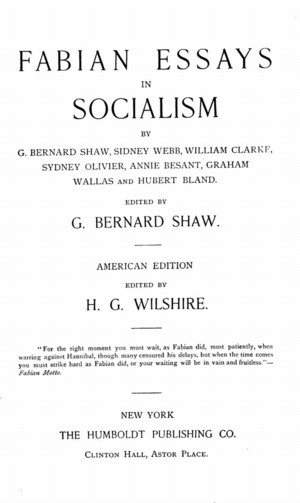
Wages. - George Bernard Shaw, Fabian Essays in Socialism [1889]Edition used:Fabian Essays in Socialism, ed. G. Bernard Shaw, American Edition Ed. by H.G. Wilshire, (New York: The Homboldt Publishing Co., 1891).
About Liberty Fund:Liberty Fund, Inc. is a private, educational foundation established to encourage the study of the ideal of a society of free and responsible individuals. Copyright information:The text is in the public domain. Fair use statement:This material is put online to further the educational goals of Liberty Fund, Inc. Unless otherwise stated in the Copyright Information section above, this material may be used freely for educational and academic purposes. It may not be used in any way for profit.
Wages.I now ask you to pick up the dropped subject of the spread of cultivation. We had got as far as the appearance in the market of a new commodity—of the proletarian man compelled to live by the sale of himself! In order to realize at once the latent horror of this, you have only to apply our investigation of value, with its inevitable law that only by restricting the supply of a commodity can its value be kept from descending finally to zero. The commodity which the proletarian sells is one over the production of which he has practically no control. He is himself driven to produce it by an irresistible impulse. It was the increase of population that spread cultivation and civilization from the center to the snowline, and at last forced men to sell themselves to the lords of the soil: it is the same force that continues to multiply men so that their exchange value falls slowly and surely until it disappears altogether—until even black chattel slaves are released as not worth keeping in a land where men of all colors are to be had for nothing. This is the condition of our English laborers to-day: they are no longer even dirt cheap: they are valueless, and can be had for nothing. The proof is the existence of the unemployed, who can find no purchasers. By the law of indifference, nobody will buy men at a price when he can obtain equally serviceable men for nothing. What then is the explanation of the wages given to those who are in employment, and who certainly do not work for nothing? The matter is deplorably simple. Suppose that horses multiplied in England in such quantities that they were to be had for the asking, like kittens condemned to the bucket. You would still have to feed your horse—feed him and lodge him well if you used him as a smart hunter—feed him and lodge him wretchedly if you used him only as a drudge. But the cost of keeping would not mean that the horse had an exchange value. If you got him for nothing in the first instance—if no one would give you anything for him when you were done with him, he would be worth nothing, in spite of the cost of his keep. That is just the case of every member of the proletariat who could be replaced by one of the unemployed to-day. Their wage is not the price of themselves; for they are worth nothing: it is only their keep. For bare subsistence wages you can get as much common labor as you want, and do what you please with it within the limits of a criminal code which is sure to be interpreted by a proprietary-class judge in your favor. If you have to give your footman a better allowance than your wretched hewer of match-wood, it is for the same reason that you have to give your hunter beans and a clean stall instead of chopped straw and a sty.95 [95.]When one of the conditions of earning a wage is the keeping up of a certain state, subsistence wages may reach a figure to which the term seems ludicrously inappropriate. For example, a fashionable physician in London cannot save out of £1,000 a year; and the post of Lord Lieutenant of Ireland can only be filled by a man who brings considerable private means to the aid of his official salary of £20,000. |

Titles (by Subject)