Econlib

The Library

Other Sites

Front Page arrow Titles (by Subject) arrow The Disintegration of the Old Synthesis. - Fabian Essays in Socialism

Return to Title Page for Fabian Essays in Socialism

Search this Title:

The Disintegration of the Old Synthesis. - George Bernard Shaw, Fabian Essays in Socialism [1889]

Edition used:

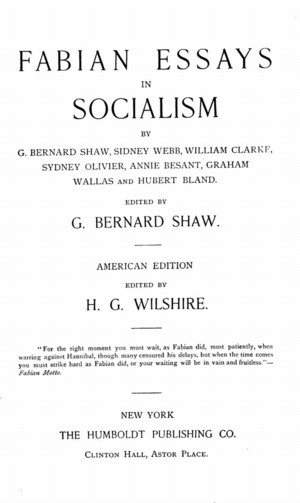
Fabian Essays in Socialism, ed. G. Bernard Shaw, American Edition Ed. by H.G. Wilshire, (New York: The Homboldt Publishing Co., 1891).

About Liberty Fund:

Liberty Fund, Inc. is a private, educational foundation established to encourage the study of the ideal of a society of free and responsible individuals.


The Disintegration of the Old Synthesis.

At the middle of the last century Western Europe was still organized on a system of which the basis was virtually a surviving feudalism. The nexus between man and man was essentially a relation of superiority and inferiority. Social power still rested either with the monarch, or with the owners of large landed estates. Some inroads had already been made in the perfect symmetry of the organization, notably by the growth of towns, and the rise of the still comparatively small trading class; but the bulk of the population was arranged in an hierarchical series of classes, linked to one another by the bond of Power.

We are apt to think of England as differing in this respect from continental Europe, and to imagine that our popular freedom was won in 1688, if not in 1648, or even as far back as Magna Charta itself. But as regards the people at large, this was, in the main, merely a difference in political form. In England the aristocratic oligarchy had prevailed over the monarch: In France the King had defeated the Fronde. For the mass of the people in either country there was nothing but obedience.

Even in England the whole political administration was divided between the king and the great families; and not one person in 500 possessed so much as a vote. As lately as 1831 one hundred and fifty persons returned a majority of the House of Commons (Molesworth, History of the Reform Bill, p. 347). The Church, once a universal democratic organization of international fraternity, had become a mere appanage of the landed gentry. The administration of justice and of the executive government was entirely in their hands, while Parliament was filled with their leaders or nominees. No avenue of advancement existed for even exceptionally gifted sons of the people; and the masses found themselves born into a position of lifelong dependence upon a class of superior birth.

The economic organization was of a similar character. Two-thirds of the population tilled the soil, and dwelt in lonely hamlets scattered about the still sparsely inhabited country. Though possessing the remnants of ancient communal rights, they were practically dependent on the farmers of the parish, who fixed their wages by a constant tacit conspiracy.8 The farmers themselves were the obedient serfs of the large proprietors, to whom they paid a customary rent. Though nominally free to move, both farmers and laborers were practically fettered to the manor by their ignorance and their poverty9 ; and though the lord had lost the criminal jurisdiction of his manorial courts, his powers as Justice of the Peace formed a full equivalent. His unrestrained ownership of the land enabled him to take for himself as rent the whole advantage of all but the very worst of the soils in use; and the lingering manorial rights gave him toll even from that worst. Throughout the country-side his word was law and his power irresistible. It was a world whose nexus was might, economic and political, tempered only by custom and lack of stimulus to change. The poor were not necessarily worse off in material matters than they are now: the agricultural laborer, indeed, was apparently better off in 1750 than at any other time between 145010 and 1850.11 But it was a world still mainly mediæval in political, in economic, and in social relations: a world of status and of permanent social inequalities not differing essentially from the feudalism of the past.

The system had, however, already begun to decay. The rise of the towns by the growth of trade gradually created new centers of independence and new classes who broke the bonds of innate status. The intrusion of the moneyed city classes and the Indian "Nabobs" into the rural districts tended to destroy the feudal idea. The growth of new sects in religion made fresh points of individual resistance, degenerating often into spiritual anarchy or unsocial quietism. The spread of learning built up a small but active disintegrating force of those who had detected the shams around them. But the real Perseus who was to free the people from their political bondage was Newcomen or Watt, Hargreaves or Crompton, Kay or Arkwright, whichever may be considered to have contributed the main stroke toward the Industrial Revolution of the last century.12 From the inventions of these men came the machine industry with its innumerable secondary results—the Factory System and the upspringing of the Northern and Midland industrial towns,13 and the evangelization of the waste places of the earth by the sale of gray shirtings. Throughout one-third of England the manor gave way to the mill or the mine; and the feudal lord had to slacken his hold of political and social power in order to give full play to the change which enriched him with boundless rents and mining royalties. And so it happened in England that the final collapse of Mediævalism came, not by the Great Rebellion nor by the Whig Treason of 1688, nor yet by the rule of the Great Commoner, but by the Industrial Revolution of the eighteenth century, which created the England of to-day. Within a couple of generations the squire faded away before the mill-owner; and feudalism lingered thenceforth only in the rapidly diminishing rural districts, and in the empty remnants of ceremonial organization. The mediæval arrangement, in fact, could not survive the fall of the cottage industry; and it is, fundamentally, the use of new motors which has been for a generation destroying the individualist conception of property. The landlord and the capitalist are both finding that the steam-engine is a Frankenstein which they had better not have raised; for with it comes inevitably urban Democracy, the study of Political Economy, and Socialism.

The event which brought to a head the influences making for political change was the French Revolution. The fall of the Bastille was hailed by all who had been touched by the new ideas. "How much the greatest event it is that ever happened in the world; and how much the best!" wrote Charles James Fox.14 It showed, or seemed to show, to men that a genuine social reconstruction was not only desirable but possible. The National Assem bly, respectable old oligarchy as it was, pointed the way to legislative fields not even yet completely worked out.

When the rulers of England perceived that in France at least Humpty Dumpty was actually down, the effect at first was to tighten the existing organization. The mildest agitation was put down with a cruelly strong hand. The Whig party in the House of Commons sank to half-a-dozen members. Prices were kept up and wages down, while the heaviest possible load of taxation was imposed on the suffering people. Then came the Peace, and Castlereagh's "White Terror," culminating in the "massacre of Peterloo" (1819) and Lord Sidmouth's infamous "Six Acts." But the old order was doomed. The suicide of Castlereagh was not only the end of the man but also the sign of the collapse of the system. With a series of political wrenches there came the Repeal of the Test and Corporation Acts (1828), Catholic Emancipation (1829), the beginnings of legal and administrative reform, and finally the great Reform Bill of 1832, by which the reign of the middle class superseded aristocratic rule. But the people were no more enfranchised than they had been before. The Factory had beaten the Manor for the benefit, not of the factory hand, but of the mill-owner. Democracy was at the gates; but it was still on the wrong side of them. Its entry, however, was only a matter of time. Since 1832 English political history is the record of the reluctant enfranchisement of one class after another, by mere force of the tendencies of the age. None of these enfranchised classes has ever sincerely desired to admit new voters to share the privileges and submerge the power which it had won; but each political party in turn has been driven to "shoot Niagara" in order to compete with its opponents. The Whig Bill of 1832 enfranchised the middle-class for Parlia ment: the Municipal Corporations Act of 1835 gave them the control of provincial towns. After a generation of agitation, it was ultimately the Tory party which gave the townspeople in 1867 Household Suffrage. Eleven years later a Conservative majority passed Sir Charles Dilke's Act enfranchising the tenement occupier (1878). In 1885 the Liberals, intending permanently to ruin their opponents, gave the vote to the agricultural laborer; and last year (1888) it was the Tories, not to be outdone, who gave him the control of the local administration of the counties, and placed the government of London in the hands of a popularly elected council. Neither party can claim much credit for its reform bills, extorted as they have been, not by belief in Democracy, but by fear of the opposing faction. Even now the citizen is tricked out of his vote by every possible legal and administrative technicality; so that more than one-third of our adult men are unenfranchised,15 together with the whole of the other sex. Neither the Conservative party nor the self-styled "Party of the Masses" gives proof of any real desire to give the vote to this not inconsiderable remnant; but both sides pay lip-homage to Democracy; and every one knows that it is merely a waiting race between them as to which shall be driven to take the next step. The virtual completion of the political revolution is already in sight; and no more striking testimony can be given of the momentum of the new ideas which the Fall of the Bastille effectually spread over the world than this democratic triumph in England, within less than a century, over the political medievalism of ten centuries' growth.

The full significance of this triumph is as yet unsuspected by the ordinary politician. The industrial evolution has left the laborer a landless stranger in his own country. The political evolution is rapidly making him its ruler. Samson is feeling for his grip on the pillars.

[8.]Referred to in a celebrated passage by Adam Smith, Wealth of Nations, book I, chap. viii.

[9.]Not to mention the restrictions imposed by the law of "Settlement" (13 and 14 Charles II., chap. 12), which enabled two justices summarily to send back to his village any migrating laborer.

[10.]This ought to be 1550. Says Prof. Rogers (Work and Wages, p. 326. Am. ed.): "I have stated more than once that the fifteenth century and the first quarter of the sixteenth were the golden age of the English laborer, if we are to interpret the wages which he earned by the cost of the necessaries of life. At no time were wages, relatively speaking, so high, and at no time was food so cheap."—(Note by Amer. Editor).

[11.]This was noticed by Malthus, Principles of Political Economy, p. 225; see also Professor Thorold Rogers, History of Agriculture and Prices, and six Centuries of Work and Wages.

[12.]Further detail will be found in the following essay. See also Arnold Toynbee's Industrial Revolution. (Humboldt Pub. Co.)

[13.]Between 1801—1845 the population of Manchester grew 109 per cent., Glasgow 108 per cent., Liverpool 100 per cent., and Leeds 99 per cent. (Report of Commissioners on State of Health of Large Towns, 1843-5).

[14.]W. J. Lecky, History of the Eighteenth Century, vol. v., p. 453.

[15.]The number of registered electors at the date of the last Election (1886) was 5,707,823, out of an adult male population of over nine millions.