EconlibThe LibraryOther Sites |
Front Page Titles (by Subject) CHAPTER XXX.: general considerations. - Social Statics
Return to Title Page for Social StaticsThe Online Library of LibertyA project of Liberty Fund, Inc.Search this Title:Also in the Library:
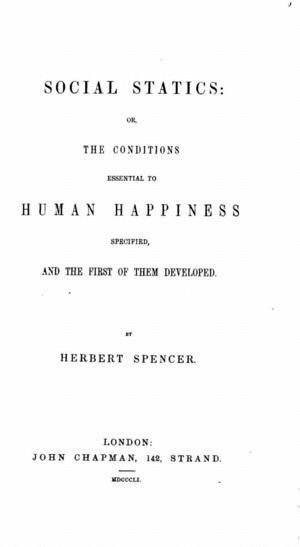
CHAPTER XXX.: general considerations. - Herbert Spencer, Social Statics [1851]Edition used:Social Statics: or, The Conditions essential to Happiness specified, and the First of them Developed, (London: John Chapman, 1851).
About Liberty Fund:Liberty Fund, Inc. is a private, educational foundation established to encourage the study of the ideal of a society of free and responsible individuals. Copyright information:The text is in the public domain. Fair use statement:This material is put online to further the educational goals of Liberty Fund, Inc. Unless otherwise stated in the Copyright Information section above, this material may be used freely for educational and academic purposes. It may not be used in any way for profit.
CHAPTER XXX.general considerations.§ 1.Social philosophy may be aptly divided (as political economy has been) into statics and dynamics; the first treating of the equilibrium of a perfect society, the second of the forces by which society is advanced towards perfection. To determine what laws we must obey for the obtainment of complete happiness is the object of the one, whilst that of the other is to analyze the influences which are making us competent to obey these laws. Hitherto we have concerned ourselves chiefly with the statics, touching upon the dynamics only occasionally for purposes of elucidation. Now, however, the dynamics claim special attention. Some of the phenomena of progress already referred to need further explanation, and many others associated with them remain to be noticed. There are also sundry general considerations not admissible into foregoing chapters, which may here be fitly included. § 2.And first let us mark, that the course of civilization could not possibly have been other than it has been. Whether a perfect social state might have been at once established; and why, if it might have been, it was not—why for unnumbered ages the world was filled with inferior creatures only—and why mankind were left to make it fit for human life by clearing it of these—are questions that need not be discussed here. But given an unsubdued earth; given the being—man, appointed to overspread and occupy it; given the laws of life what they are; and no other series of changes than that which has taken place, could have taken place. For be it remembered, that the ultimate purpose of creation—the production of the greatest amount of happiness—can be fulfilled only under certain fixed conditions (p. 68). Each member of the race fulfilling it, must not only be endowed with faculties enabling him to receive the highest enjoyment in the act of living, but must be so constituted that he may obtain full satisfaction for every desire, without diminishing the power of others to obtain like satisfaction: nay, to fulfil the purpose perfectly, must derive pleasure from seeing pleasure in others. Now, for beings thus constituted to multiply in a world already tenanted by inferior creatures—creatures that must be dispossessed to make room—is a manifest impossibility. By the definition such beings must lack all desire to exterminate the races they are to supplant. They must, indeed, have a repugnance to exterminating them, for the ability to derive pleasure from seeing pleasure, involves the liability to pain from seeing pain: the sympathy by which either of these results is effected, simply having for its function to reproduce observed emotions, irrespective of their kind. Evidently, therefore, having no wish to destroy—to destroy giving them, on the contrary, disagreeable sensations—these hypothetical beings, instead of subjugating and overspreading the earth, must themselves become the prey of pre-existing creatures, in whom destructive desires predominate. How then are the circumstances of the case to be met? Evidently the aboriginal man must have a constitution adapted to the work he has to perform, joined with a dormant capability of developing into the ultimate man when the conditions of existence permit. To the end that he may prepare the earth for its future inhabitants—his descendants, he must possess a character fitting him to clear it of races endangering his life, and races occupying the space required by mankind. Hence he must have a desire to kill, for it is the universal law of life that to every needful act must attach a gratification, the desire for which may serve as a stimulus (p. 19). He must further be devoid of sympathy, or must have but the germ of it, for he would otherwise be incapacitated for his destructive office. In other words, he must be what we call a savage, and must be left to acquire fitness for social life as fast as the conquest of the earth renders social life possible. Whoever thinks that a thoroughly-civilized community could be formed out of men qualified to wage war with the pre-existing occupants of the earth—that is, whoever thinks that men might behave sympathetically to their fellows, whilst behaving unsympathetically to inferior creatures, will discover his error on looking at the facts. He will find that human beings are cruel to one another, in proportion as their habits are predatory. The Indian, whose life is spent in the chase, delights in torturing his brother man as much as in killing game. His sons are schooled into fortitude by long days of torment, and his squaw made prematurely old by hard treatment. The treachery and vindictiveness which Bushmen or Australians show to one another and to Europeans, are accompaniments of that neverceasing enmity existing between them and the denizens of the wilderness. Amongst partially-civilized nations the two characteristics have ever borne the same relationship. Thus the spectators in the Roman amphitheatres were as much delighted by the slaying of gladiators as by the death-struggles of wild beasts. The ages during which Europe was thinly peopled, and hunting a chief occupation, were also the ages of feudal violence, universal brigandage, dungeons, tortures. Here in England a whole province depopulated to make game preserves, and a law sentencing to death the serf who killed a stag, show how great activity of the predatory instinct and utter indifference to human happiness coexisted. In later days, when bull-baiting and cock-fighting were common pastimes, the penal code was far more severe than now; prisons were full of horrors; men put in the pillory were maltreated by the populace; and the inmates of lunatic asylums, chained naked to the wall, were exhibited for money, and tormented for the amusement of visitors. Conversely, amongst ourselves a desire to diminish human misery is accompanied by a desire to ameliorate the condition of inferior creatures. Whilst the kindlier feeling of men is seen in all varieties of philanthropic effort, in charitable societies, in associations for improving the dwellings of the labouring classes, in anxiety for popular education, in attempts to abolish capital punishment, in zeal for temperance reformation, in ragged schools, in endeavours to protect climbing boys, in inquiries concerning “labour and the poor,” in emigration funds, in the milder treatment of children, and so on, it also shows itself in societies for the prevention of cruelty to animals, in acts of parliament to put down the use of dogs for purpose of draught, in the condemnation of steeplechases and battues, in the late inquiry why the pursuers of a stag should not be punished as much as the carter who maltreats his horse, and lastly, in vegetarianism. Moreover, to make the evidence complete, we have the fact that men, partially adapted to the social state, retrograde on being placed in circumstances which call forth the old propensities. The barbarizing of colonists, who live under aboriginal conditions, is universally remarked. The back settlers of America, amongst whom unavenged murders, rifle duels, and Lynch law prevail—or, better still, the trappers, who leading a savage life have descended to savage habits, to scalping, and occasionally even to cannibalism—sufficiently exemplify it. But, indeed, without collecting from so wide a field, illustrations of the truth that the behaviour of men to the lower animals and their behaviour to each other, bear a constant relationship, it becomes clear that such is the fact, on observing that the same impulses govern in either case. The blind desire to inflict suffering, distinguishes not between the creatures who exhibit that suffering, but obtains gratification indifferently from the agonies of beast and human being—delights equally in worrying a brute, and in putting a prisoner to the rack. Conversely, the sympathy which prevents its possessor from inflicting pain, that he may avoid pain himself, and which tempts him to give happiness that he may have happiness reflected back upon him, is similarly undistinguishing. As already said, its function is simply to reproduce in one being the emotions exhibited by other beings; and every one must have noticed that it extracts pleasure from the friskiness of a newly-unchained dog, or excites pity for an ill-used beast of burden, as readily as it generates fellow feeling with the joys and sorrows of men. So that only by giving us some utterly different mental constitution could the process of civilization have been altered. Assume that the creative scheme is to be wrought out by natural means, and it is necessary that the primitive man should be one whose happiness is obtained at the expense of the happiness of other beings. It is necessary that the ultimate man should be one who can obtain perfect happiness without deducting from the happiness of others. After accomplishing its appointed purpose, the first of these constitutions has to be moulded into the last. And the manifold evils which have filled the world for these thousands of years—the murders, enslavings, and robberies—the tyrannies of rulers, the oppressions of class, the persecutions of sect and party, the multiform embodiments of selfishness in unjust laws, barbarous customs, dishonest dealings, exclusive manners, and the like—are simply instances of the disastrous working of this original and once needful constitution, now that mankind have grown into conditions for which it is not fitted—are nothing but symptoms of the suffering attendant upon the adaptation of humanity to its new circumstances. § 3.But why, it may be asked, has this adaptation gone on so slowly? Judging from the rapidity with which habits are formed in the individual, and seeing how those habits, or rather the latent tendencies towards them, become hereditary, it would seem that the needful modification should have been completed long ago. How, then, are we to understand the delay? The answer is that the new conditions to which adaptation has been taking place have themselves grown up but slowly. Only when a revolution in circumstances is at once both marked and permanent, does a decisive alteration of character follow. If the demand for increase of power in some particular faculty is great and unceasing, development will go on with proportionate speed. And, conversely, there will be an appreciable dwindling in a faculty altogether deprived of exercise. But the conditions of human life have undergone no changes sudden enough to produce these immediate results. Thus, note in the first place, that the warfare between man and the creatures at enmity with him has continued up to the present time, and over a large portion of the globe is going on now. Note, further, that where the destructive propensities have almost fulfilled their purpose, and are on the eve of losing their gratification, they make to themselves an artificial sphere of exercise by game-preserving, and are so kept in activity after they would otherwise have become dormant. But note, chiefly, that the old predatory disposition is in a certain sense self-maintained. For it generates between men and men a hostile relationship, similar to that which it generates between men and inferior animals; and by doing so provides itself a lasting source of excitement. This happens inevitably. The desires of the savage acting, as we have seen, indiscriminately, necessarily lead him to perpetual trespasses against his fellows, and, consequently, to endless antagonisms—to quarrels of individuals, to fightings of tribes, to feuds of clan with clan, to wars of nations. And thus being by their constitutions made mutual foes, as well as foes to the lower races, men keep alive in each other the old propensities, after the original need for them has in great measure ceased. Hitherto, then, human character has changed but slowly, because it has been subject to two conflicting sets of conditions. On the one hand, the discipline of the social state has been developing it into the sympathetic form; whilst on the other hand, the necessity for self-defence partly of man against brute, partly of man against man, and partly of societies against each other, has been maintaining the old unsympathetic form. And only where the influence of the first set of conditions has exceeded that of the last, and then only in proportion to the excess, has modification taken place. Amongst tribes who have kept each other’s anti-social characteristics in full activity by constant conflict, no advance has been possible. But where warfare against man and beast has ceased to be continuous, or where it has become the employment of but a portion of the people, the effects of living in the associated state have become greater than the effects of barbarizing antagonisms, and progress has resulted. Regarded thus, civilization no longer appears to be a regular unfolding after a specific plan; but seems rather a development of man’s latent capabilities under the action of favourable circumstances; which favourable circumstances, mark, were certain some time or other to occur. Those complex influences underlying the higher orders of natural phenomena, but more especially those underlying the organic world, work in subordination to the law of probabilities. A plant, for instance, produces thousands of seeds. The greater part of these are destroyed by creatures that live upon them, or fall into places where they cannot germinate. Of the young plants produced by those which do germinate, many are smothered by their neighbours; others are blighted by insects, or eaten up by animals; and in the average of cases, only one of them produces a perfect specimen of its species, which, escaping all dangers, brings to maturity seeds enough to continue the race. Thus is it also with every kind of creature. Thus is it also, as M. Quetelet has shown, with the phenomena of human life. And thus was it even with the germination and growth of society. The seeds of civilization existing in the aboriginal man, and distributed over the earth by his multiplication, were certain in the lapse of time to fall here and there into circumstances fit for their development; and, in spite of all blightings and uprootings, were certain, by sufficient repetition of these occurences, ultimately to originate a civilization which should outlive all disasters and arrive at perfection. § 4.Whilst the continuance of the old predatory instinct after the fulfilment of its original purpose, has retarded civilization by giving rise to conditions at variance with those of social life, it has subserved civilization by clearing the earth of inferior races of men. The forces which are working out the great scheme of perfect happiness, taking no account of incidental suffering, exterminate such sections of mankind as stand in their way, with the same sternness that they exterminate beasts of prey and herds of useless ruminants. Be he human being, or be he brute, the hindrance must be got rid of. Just as the savage has taken the place of lower creatures, so must he, if he have remained too long a savage, give place to his superior. And, observe, it is necessarily to his superior that, in the great majority of cases, he does give place. For what are the pre-requisites to a conquering race? Numerical strength, or an improved system of warfare; both of which are indications of advancement. Numerical strength implies certain civilizing antecedents. Deficiency of game may have necessitated agricultural pursuits, and so made the existence of a larger population possible; or distance from other tribes may have rendered war less frequent, and so have prevented its perpetual decimations; or accidental superiority over neighbouring tribes, may have led to the final subjugation and enslaving of these: in any of which cases the comparatively peaceful condition resulting, must have allowed progress to commence. Evidently, therefore, from the very beginning, the conquest of one people over another has been, in the main, the conquest of the social man over the anti-social man; or, strictly speaking, of the more adapted over the less adapted. In another mode, too, the continuance of the unsympathetic character has indirectly aided civilization whilst it has directly hindered it; namely, by giving rise to slavery. It has been observed—and, as it seems, truly enough—that only by such stringent coercion as is exercised over men held in bondage, could the needful power of continuous application have been developed. Devoid of this, as from his habits of life the aboriginal man necessarily was (and as, indeed, existing specimens show), probably the severest discipline continued for many generations was required to make him submit contentedly to the necessities of his new state. And if so, the barbarous selfishness which maintained that discipline, must be considered as having worked a collateral benefit, though in itself so radically bad. Let not the reader be alarmed. Let him not fear that these admissions will excuse new invasions and new oppressions. Nor let any one who fancies himself called upon to take Nature’s part in this matter, by providing discipline for idle negroes or others, suppose that these dealings of the past will serve for precedents. Rightly understood, they will do no such thing. That phase of civilization during which forcible supplantings of the weak by the strong, and systems of savage coercion, are on the whole advantageous, is a phase which spontaneously and necessarily gives birth to these things. It is not in pursuance of any calmly-reasoned conclusions respecting nature’s intention that men conquer and enslave their fellows—it is not that they smother their kindly feelings to subserve civilization; but it is that as yet constituted they care little what suffering they inflict in the pursuit of gratification, and even think the achievement and exercise of mastery honourable. As soon, however, as there arises a perception that these subjugations and tyrannies are not right—as soon as the sentiment to which they are repugnant becomes sufficiently powerful to suppress them, it is time for them to cease. The question altogether hinges upon the amount of moral sense possessed by men; or, in other words, upon the degree of adaptation to the social state they have undergone. Unconsciousness that there is anything wrong in exterminating inferior races, or in reducing them to bondage, presupposes an almost rudimentary state of men’s sympathies and their sense of human rights. The oppressions they then inflict and submit to, are not, therefore, detrimental to their characters—do not retard in them the growth of the social sentiments, for these have not yet reached a development great enough to be offended by such doings. And hence the aids given to civilization by clearing the earth of its least advanced inhabitants, and by forcibly compelling the rest to acquire industrial habits, are given without moral adaptation receiving any corresponding check. Quite otherwise is it, however, when the flagitiousness of these gross forms of injustice begins to be recognised. Then the times give proof that the old regime is no longer fit. Further progress cannot be made until the newly-felt wrong has been done away or diminished. Were it possible under such circumstances to uphold past institutions and practices (which, happily, it is not), it would be at the expense of a continual searing of men’s consciences. The feelings whose predominance gives possibility to an advanced social state would be constantly repressed—kept down on a level with the old arrangements, to the stopping of all further progress; and before those who have grown beyond one of these probationary states could re-institute it, they must resume that inferior character to which it was natural. Before a forced servitude could be again established for the industrial discipline of eight hundred thousand Jamaica blacks, the thirty millions of English whites who established it would have to retrograde in all things—in truthfulness, fidelity, generosity, honesty, and even in material condition; for to diminish men’s moral sense is to diminish their fitness for acting together, and, therefore, to render the best producing and distributing organizations impracticable. Another illustration this of the perfect economy of Nature. Whilst the injustice of conquests and enslavings is not perceived, they are on the whole beneficial; but as soon as they are felt to be at variance with the moral law, the continuance of them retards adaptation in one direction, more than it advances it in another: a fact which our new preacher of the old doctrine, that might is right, may profitably consider a little. § 5.Contrasted as are their units, primitive communities and advanced ones must essentially differ in the principles of their structure. Like other organisms, the social organism has to pass in the course of its development through temporary forms, in which sundry of its functions are fulfilled by appliances destined to disappear as fast as the ultimate appliances become efficient. Associated humanity has larval appendages analogous to those of individual creatures. As in the common Triton of our ponds, the external lungs or branchiæ dwindle away when the internal lungs have grown to maturity; and as during the embryo stage of the higher vertebrata, temporary organs appear, serve their purpose awhile, and are subsequently re-absorbed, leaving only signs of their having been; so, in the earlier forms of the body politic do there exist institutions which after answering their ends for a time are superseded and become extinct. But deciduous institutions imply deciduous sentiments. Dependent as they are upon popular character, established political systems cannot die out until the feeling which upholds them dies out. Hence during man’s apprenticeship to the social state there must predominate in him some impulse corresponding to the arrangements requisite; which impulse diminishes as the probationary organization made possible by it, merges into the ultimate organization. The nature and operation of this impulse now demand our attention. § 6.“I had so great a respect for the memory of Henry IV.,” said the celebrated French robber and assassin, Cartouche, “that had a victim I was pursuing taken refuge under his statue on the Pont Neuf, I would have spared his life.” An apt illustration, this, of the co-existence of profound hero-worship with the extremest savageness, and of the means hero-worship affords whereby the savage may be ruled. The necessity for some such sentiment to bind men together whilst they are as yet unsympathetic, has been elsewhere shown. For the anti-social man to be transformed into the social man, he must live in the social state. But how can a society be maintained when, by the hypothesis, the aggressive desires of its members are destructive of it? Evidently its members must possess some counterbalancing tendency which shall keep them in the social state despite the incongruity—which shall make them submit to the restraint imposed—and which shall diminish as adaptation to the new circumstances renders restraint less needful. Such counterbalancing tendency we have in this same sentiment of hero-worship; a sentiment which leads men to prostrate themselves before any manifestation of power, be it in chief, feudal lord, king, or constitutional government, and makes them act in subordination to that power. Facts illustrating this alleged connection between strength of hero-worship and strength of the aggressive propensities, together with other facts illustrating the simultaneous decline of both, were given when the matter was first discussed (p. 197). Now, however, we may appropriately examine the evidence in detail. The proposition is, that in proportion as the members of a community are barbarous, that is, in proportion as they show a lack of moral sense by seeking gratification at each other’s expense, in the same proportion will they show depth of reverence for authority. What, now, are the several indications of deficient moral sense? First on the list stands disregard of human life; next, habitual violation of personal liberty; next to that, theft, and the dishonesty akin to it. Each of these, if the foregoing theory be true, we ought to find most prevalent where the awe of power is most profound. Well, is it not a fact that grovelling submission to despotic rule flourishes side by side with the practice of human sacrifices, infanticide, and assassination? We find suttees and thuggee amongst a race who have ever been abject slaves. In some of the Pacific isles, where the immolation of children to idols, and the burying of parents alive, are common, “so high is the reverence for hereditary chieftainship that it is often connected with the idea of Divine power.” Complete absolutism uniformly co-exists with cannibalism. We read of human hecatombs in connection with the extremest prostration of subjects to rulers. In Madagascar, where men are put to death on the most trifling occasions, and where the coast is decorated with skulls stuck on poles, the people are governed on the severest maxims of feudal law, by absolute chieftains under an absolute monarch. The head-hunting Dyaks of Borneo have petty tyrants over them. There is autocratic government, too, for the bloodthirsty Mongolian races. Both positive and negative proof of this association is given by Mr. Grote, where he says, “In no city of historical Greece did there prevail either human sacrifices or deliberate mutilations, such as cutting off the nose, ears, hands, feet, &c., or castration, or selling of children into slavery, or polygamy, or the feeling of unlimited obedience towards one man; all of them customs, which might be pointed out as existing amongst the contemporary Carthagimians, Egyptians, Persians, Thracians,” &c. If we consult mediæval history, there, along with loyalty strongly manifested, are the judicial combats, right of private war, constant wearing of arms, religious martyrdoms and massacres, &c., to prove that life was held in less respect than now. Glancing over modern Europe, we find the assassinations of Italy, the cruelties of the Croats and Czecks, and the Austrian butcheries, illustrating the relationship. Whilst, amongst ourselves, diminished reverence for authority has occurred simultaneously with diminished sanguinariness in our criminal code. That infringements of personal liberty are greatest where awe of power is greatest, is in some sort a truism, seeing that forced servitude, through which alone extensive violations of human liberty can be made, is impossible, unless the sentiment of power-worship is strong. Thus, the ancient Persians could never have allowed themselves to be considered the private property of their monarchs, had it not been for the overwhelming influence of this sentiment. But that such submission is associated with a defect of moral sense, is best seen in the acknowledged truth that readiness to cringe is accompanied by an equal readiness to tyrannize. Satraps lorded it over the people as their king over them. The Helots were not more coerced by their Spartan masters than these in turn by their oligarchy. Of the servile Hindoos we are told that “they indemnify themselves for their passiveness to their superiors by their tyranny, cruelty, and violence to those in their power.” During the feudal ages, whilst the people were bondsmen to the nobles, the nobles were vassals to their kings, their kings to the pope. In Russia, at the present moment, the aristocracy are dictated to by their emperor much as they themselves dictate to their serfs. And when to these facts we add the significant one elsewhere dwelt upon (pp. 161 and 178), that the treatment of women by their husbands, and children by their parents, has been tyrannical in proportion as the servility of subjects to rulers has been extreme, we have sufficient proof that hero-worship is strongest where there is least regard for human freedom. Equally abundant evidence exists that the prevalence of theft is similarly associated with a predominance of the loyalty-producing faculty. Books of travels give proof that amongst uncivilized races pilfering and the irresponsible power of chiefs co-exist. The same association of dishonesty and submissiveness is found amongst more advanced peoples. It is so with the Hindoos, with the Cinghalese, and with the inhabitants of Madagascar. The piracy of the Malays, and of the Chinese, and the long-continued predatory habits of the Arab races, both on land and sea, exist in conjunction with obedience to despotic rule. “One quality,” says Kohl, “which the Lettes show, with all enslaved tribes, is a great disposition to thieving.” The Russians, to whom worship of their emperor is a needful luxury, confess openly that they are cheats, and laugh over the confession. The Poles, whose servile salutation is, “I throw myself under your feet,” and amongst whom nobles are cringed to by the Jews and citizens, and these again by the people, are certainly not noted for probity. Turning to the superior races, we find that they, too, have passed through phases in which this same relationship of characteristics was strongly marked. Thus, the times when fealty of serfs to feudal barons was strongest, were times of universal rapine. “In Germany a very large proportion of the rural nobility lived by robbery;” their castles being built with a special view to this occupation, and that even by ecclesiasticsa Burghers were fleeced, towns were now and then sacked, and Jews were tortured for their money. Kings were as much thieves as the rest. They laid violent hands upon the goods of their vassals, like John of England and Philip Augustus of France; they cheated their creditors by debasing the coinage; they impressed men’s horses without paying for them; and they seized the goods of traders, sold them, and pocketed a large part of the proceeds. Meantime, whilst freebooters overran the land, pirates covered the sea, the Cinque Ports and St. Maloe’s being the head quarters of those infesting the English Channel. Between these days and ours, the gradual decline of loyalty—as shown in the extinction of feudal relationships, in the abandonment of divine right of kings, in the reduction of monarchical power, and in the comparative leniency with which treason is now punished—has accompanied an equally gradual increase of honesty, and of regard for people’s lives and liberties. By how much men are still deficient in respect for each other’s rights, by so much are they still penetrated with respect for authority; and we may even trace in existing parties the constant ratio preserved between these characteristics. It has been shown, for instance, that the unskilled labourers of the metropolis, who, instead of entertaining violently democratic opinions, appear to have no political opinions whatever, or, if they think at all, rather lean towards the maintenance of “things as they are,” and part of whom (the coalwhippers) are extremely proud of their having turned out to a man on the 10th of April, 1848, and become special constables for the “maintenance of law and order” on the day of the great Chartist Demonstration,—it has been shown that these same unskilled labourers constitute the most immoral class. The Criminal-Returns prove them to be nine times as dishonest, five times as drunken, and nine times as savage (shown by the assaults), as the rest of the community. Of like import is the observation respecting convicts, quoted and confirmed by Captain Maconochie, that “a good prisoner (i. e. a submissive one) is usually a bad man.”a If, again, we turn over the newspapers which circulate amongst court satellites, and chronicle the movements of the haut-ton, which ascribe national calamities to the omission of a royal title from a new coin, and which apologise for continental despots; we read in them excuses for war and standing armies, sneerings at “peace-mongers,” defences of capital punishment, condemnations of popular enfranchisement, diatribes against freedom of exchange, rejoicings over territorial robberies, and vindications of church-rate seizures: showing that, where belief in the sacredness of authority most lingers, belief in the sacredness of life, of liberty, and of property, is least displayed. § 7.The fact that, during civilization, hero-worship and moral sense vary inversely, is simply the obverse of the fact already hinted, that society is possible so long only as they continue to do this. Where there is insufficient reverence for the Divine Law, there must be supplementary reverence for human law; otherwise there will be complete lawlessness or barbarism. Evidently, if men are to live together, the absence of internal power to rule themselves rightly towards each other, necessitates the presence of external power to enforce such behaviour as may make association tolerable; and this power can become operative only by being held in awe. So that wild races deficient in the allegiance-producing sentiment cannot enter into a civilized state at all; but have to be supplanted by others that can. And it must further follow, that if in any community loyalty diminishes at a greater rate than equity increases, there will arise a tendency towards social dissolution—a tendency which the populace of Paris threaten to illustrate. How needful the continuance of a savage selfishness renders the continuance of a proportionate amount of power-worship, may be perceived daily. Listen to the chattings of men about their affairs; examine into trade practices; read over business correspondence; or get a solicitor to detail his conversations with clients:—you will find that in most cases conduct depends, not upon what is right, but upon what is legal. Provided they “keep o’ the windy side of the law,” the great majority are but little restrained by regard for strict rectitude. The question with your every-day man of the world is, not—May the claimant justly require thus much of me? but rather—“Is it so nominated in the bond?” If “an action will lie,” such an one will commonly enough take proceedings to obtain what he knows himself not equitably entitled to; and if “the law allows it and the court awards it,” will pocket all he can get without scruple. When we find doings like these regarded as matters of course, and those guilty of them passing for respectable men—when we thus find that so many will deal fairly by their fellows only on compulsion—we discover how requisite is the sentiment from which the compelling instrumentality derives its power. Without doubt this sentiment has begotten many gigantic evils, some of which it still nurtures. The various superstitions that have prevailed, and that still prevail, as to the great things legislatures can do, and the disastrous meddlings growing out of these superstitions, are due to it. The veneration which produces submission to a government, unavoidably invests that government with proportionately high attributes; for being in essence a worship of power, it can be strongly drawn out towards that only which either has great power, or is believed to have it. Hence, the old delusions that rulers can fix the value of money, the rate of wages, and the price of food. Hence, the still current fallacies about mitigating distress, easing monetary pressures, and curing over-population by law. Hence, also, the monstrous, though generally-received doctrine, that a legislature may equitably take people’s property to such extent, and for such purposes, as it thinks fit—for maintaining state-churches, feeding paupers, paying schoolmasters, founding colonies, &c. And hence, lastly, the astounding belief that an act of parliament can abrogate one of Nature’s decrees—can, for instance, render it criminal in a trader to buy goods in France, and bring them here to sell, whilst the moral law says it is criminal to prevent him! As though conduct could be made right or wrong by the votes of some men sitting in a room in Westminster! Yet, in spite of all this—in spite of the false theories and mischievous interferences, the numberless oppressions, disasters, and miseries, in one way or other traceable to it, we must admit that this power-worship has fulfilled, and does still fulfil, a very important function, and that it may advantageously last as long as it can. § 8.That it cannot last longer than needful may be readily proved. In a way equally simple and perfect it is made to decline as fast as it can be done without. The very feeling, during whose minority it exercises regency over men, becomes the destroyer of its power. Between the temporary ruler and the ultimate rightful one, there is an unceasing conflict, in which the wane of influence on the one side is necessitated by its growth on the other. For, as already shown (p. 97), the sense of rights, by whose sympathetic excitement men are led to behave justly towards each other, is the same sense of rights by which they are prompted to assert their own claims—their own liberty of action—their own freedom to exercise their faculties, and to resist every encroachment. This impulse brooks no restraint, save that imposed by fellow feeling; and disputes all assumption of extra privilege by whomsoever made. Consequently, it is in perpetual antagonism with a sentiment which delights in sub-serviency. “Reverence this authority,” suggests power-worship. “Why should I? who set it over me?” demands instinct of freedom. “Obey,” whispers the one. “Rebel,” mutters the other. “I will do what your Highness bids,” says the one with bated breath. “Pray, sir,” shouts the other, “who are you, that you should dictate to me?” “This man is Divinely appointed to rule over us, and we ought therefore to submit,” argues the one. “I tell you, no,” replies the other; “we have Divinely-endorsed claims to freedom, and it is our duty to maintain them.” And thus the controversy goes on: conduct during each phase of civilization being determined by the relative strengths of the two feelings. Whilst yet too feeble to be operative as a social restraint, moral sense, by its scarcely-heard protest, does not hinder a predominant hero-worship from giving possibility to the most stringent despotism. Gradually, as it grows strong enough to deter men from the grosser trespasses upon each other, does it also grow strong enough to struggle successfully against that excess of coercion no longer required. And when it shall finally have attained sufficient power to give men, by its reflex function, so perfect a regard for each other’s rights as to make government needless; then will it also, by its direct function, give men so wakeful a jealousy of their own rights as to make government impossible. A further example, this, of the admirable simplicity of nature. The same sentiment which fits us for freedom, itself makes us free. Of course the institutions of any given age exhibit the compromise made by these contending moral forces at the signing of their last truce. Between the state of unlimited government arising from supremacy of the one feeling, and the state of no government arising from supremacy of the other, lie intermediate forms of social organization, beginning with “despotism tempered by assassination,” and ending with that highest development of the representative system, under which the right of constituents to instruct their delegates is fully admitted—a system which, by making the nation at large a deliberative body, and reducing the legislative assembly to an executive, carries self-government to the fullest extent compatible with the existence of a ruling power. Of necessity the mixed constitutions that characterize this transition period, are in the abstract absurd. The two feelings answering to the popular and monarchical elements, being antagonistic, give utterance to antagonistic ideas. And to suppose that these can be consistently united, is to suppose that yes and no can be reconciled. The monarchical theory is, that the people are in duty bound to submit themselves with all humility to a certain individual—ought to be loyal to him—ought to give allegiance to him, that is—ought to subordinate their wills to his will. Contrariwise the democratic theory—either as specifically defined, or as embodied in our own constitution under the form of a power to withhold supplies and in the legal fiction that the citizen assents to the laws he has to obey—is, that the people ought not to be subject to the will of one, but should fulfil their own wills. Now these are flat contradictions, which no reasoning can harmonize. If a king may rightfully claim obedience, then should that obedience be entire; else there starts up the unanswerable question—why must we obey in this and not in that? But if men should mainly rule themselves, then should they rule themselves altogether. Otherwise it may be asked—why are they their own masters in such and such cases, and not in the rest? Nevertheless, though these mixed governments, combining as they do two mutually-destructive hypotheses, are utterly irrational in principle, they must of necessity exist, so long as they are in harmony with the mixed constitution of the partially-adapted man. And it seems that the radical incongruity pervading them cannot be recognized by men, whilst there exists a corresponding incongruity in their own natures: a good illustration of the law that opinion is ultimately determined by the feelings, and not by the intellect. § 9.How completely, indeed, conceptions of right and wrong in these matters depend upon the balance of impulses existing in men, may be worth considering a moment. And first, observe that no tracing out of actions to their final good or bad consequences, is, by itself, capable of generating approbation, or reprobation, of those actions. Could it do this, men’s moral codes would be high or low, according as they made these analyses well or ill, that is—according to their intellectual acuteness. Whence it would follow, that in all ages and nations, men of equal intelligence should have like ethical theories, whilst contemporaries should have unlike ones, if their reflective powers are unlike. But facts do not answer to these inferences. On the contrary, they point to the law above specified. Both history and daily experience prove to us that men’s ideas of rectitude correspond to the sentiments and instincts predominating in them (pp. 25, 159, 350). We constantly read of tyrants defending their claims to unlimited sway as being Divinely authorized. The rights of rival princes were of old asserted by their respective partisans, and are still asserted by modern legitimists, with the same warmth that the most ardent democrat asserts the rights of man. To those living in the feudal times, so unquestionable seemed the duty of serfs to obey their lords, that Luther (no doubt acting conscientiously) urged the barons to vengeance on the rebellious peasants, calling on all who could “to stab them, out them down, and dash their brains out, as if they were mad dogs.” Moreover, we shall find, that absence of the ethical sentiment completely disables the mind from realizing the abstract title of the human being to freedom. Thus, with all his high reasoning powers, Plato could conceive of nothing better for his ideal republic than a system of class despotism; and, indeed, up to his time, and long after it, there seems to have existed no man who saw anything wrong in slavery. It is narrated of Colonel D’Oyley, the first governor of Jamaica, that within a few days after having issued an order “for the distribution to the army of 1701 Bibles,” he signed another order for the “payment of the summe of twenty pounds sterling, out of the impost money, to pay for fifteen doggs, brought by John Hoy, for the hunting of the negroes.” The holding of slaves by ministers of religion in America is a parallel fact. We read that the Chinese cannot understand why European women are treated with respect; and that they attribute the circumstance to the exercise of demoniacal arts by them over the men. Here and there amongst ourselves, analogous phenomena may be detected. For example, Dr. Moberly, of Winchester College, has written a book to defend fagging, which he says, as a system of school-government, gives “more security of essential deep-seated goodness than any other which can be devised.” Again, in a recent pamphlet, signed “A Country Parson,” it is maintained, that “you must convert the Chartist spirit as you would reform the drunkard’s spirit, by showing that it is a rebellion against the laws of God.” But the strangest peculiarity exhibited by those deficient in sense of rights—or rather that which looks the strangest to us—is their inability to recognize their own claims. We are told, for instance, by Lieutenant Bernarda that in the Portuguese settlements on the African coast, the free negroes are “taunted by the slaves as having no white man to look after them, and see them righted when oppressed;” and it is said that in America the slaves themselves look down upon the free blacks, and call them rubbish. Which anomalous-looking facts are, however, easily conceivable when we remember that here in England, in this nineteenth century, most women defend that state of servitude in which they are held by men. To account, by any current hypothesis, for the numberless disagreements in men’s ideas of right and wrong here briefly exemplified, seems scarcely possible. But on the theory that opinion is a resultant of moral forces, whose equilibrium varies with every race and epoch—that is, with every phase of adaptation—the rationale is self-evident. Nor, indeed, considering the matter closely, does it appear that society could ever hold together were not opinion thus dependent upon the balance of feelings. For were it otherwise, races yet needing coercive government might reason their way to the conclusion that coercive government was bad, as readily as more advanced races. The Russians might see despotism to be wrong, and free institutions to be right, as clearly as we do. And did they see this, social dissolution would ensue; for it is not conceivable that they would any longer remain contented under that stringent rule needed to keep them in the social state. § 10.The process by which a change of political arrangements is effected, when the incongruity between them and the popular character becomes sufficient, must be itself in keeping with that character, and must be violent or peaceful accordingly. There are not a few who exclaim against all revolutions wrought out by force of arms, forgetting that the quality of a revolution, like that of an institution, is determined by the natures of those who make it. Moral suasion is very admirable; good for us; good, indeed, for all who can be induced to use it. But to suppose that, in the earlier stages of social growth, moral suasion can be employed, or, if employed, would answer, is to overlook the conditions. Stating the case mechanically, we may say that as, in proportion to their unfitness for associated life, the framework within which men are restrained must be strong, so must the efforts required to break up that framework, when it is no longer fit, be convulsive. The existence of a government which does not bend to the popular will—a despotic government—presupposes several circumstances which make any change but a violent one impossible. First, for coercive rule to have been practicable, implies in the people a predominance of that awe of power ever indicative of still lingering savageness. Moreover, with a large amount of power-worship present, disaffection can take place only when the cumulative evils of mis-government have generated great exasperation. Add to which, that as abundance of the sentiment upholding external rule, involves lack of the sentiments producing internal rule, no such check to excesses as that afforded by a due regard for the lives and claims of others, can be operative. And where there are comparatively active destructive propensities, extreme anger, and deficient self-restraint, violence is inevitable. Peaceful revolutions occur under quite different circumstances. They become possible only when society, no longer consisting of members so antagonistic, begins to cohere from its own internal organization, and needs not be kept together by unyielding external restraints; and when, by consequence, the force required to effect change is less. They become possible only when men, having acquired greater adaptation to the social state, will neither inflict on each other, nor submit to, such extreme oppressions, and when, therefore, the canses of popular indignation are diminished. They become possible only when character has grown more sympathetic, and when, as a result of this, the tendency towards angry retaliation is partially neutralized. Indeed, the very idea that reforms may and ought to be effected peacefully implies a large endowment of the moral sense. Without this, such an idea cannot even be conceived, much less carried out; with this, it may be both. Hence, we must look upon social convulsions as upon other natural phenomena, which work themselves out in a certain inevitable, unalterable way. We may lament the bloodshed—may wish it had been avoided; but it is folly to suppose that, the popular character remaining the same, things could have been managed differently. Ifsuch and such events had not occurred, say you, the result would have been otherwise; if this or that man had lived, he would have prevented the catastrophe. Do not be thus deceived. These changes are brought about by a power far above individual wills. Men who seem the prime movers, are merely the tools with which it works; and were they absent, it-would quickly find others. Incongruity between character and institutions is the disturbing force, and a revolution is the act of restoring equilibrium. Accidental circumstances modify the process, but do not perceptibly alter the effect. They precipitate; they retard; they intensify or ameliorate; but, let a few years elapse, and the same end is arrived at, no matter what the special events passed through. That these violent overturnings of early institutions fail to do what their originators hope, and that they finally result in the setting up of institutions not much better than those superseded, is very true (p.244). But it is not the less true that the modifications they effect can be effected in no other way. Non-adaptation necessitates a bad mode of making changes, as well as a bad political organization. Not only must the habitual rule it calls for be severe, but even small ameliorations of this cannot be obtained without much suffering. Conversely, the same causes which render a better social state possible, render the successive modifications of it easier. These occur under less pressure; with smaller disturbance; and more frequently: until, by a gradual diminution in the amounts and intervals of change, the process merges into one of uninterrupted growth. § 11.There is another form under which civilization can be generalized. We may consider it as a progress towards that constitution of man and society required for the complete manifestation of every one’s individuality. To be that which he naturally is—to do just what he would spontaneously do—is essential to the full happiness of each, and therefore to the greatest happiness of all. Hence, in virtue of the law of adaptation, our advance must be towards a state in which this entire satisfaction of every desire, or perfect fulfilment of individual life, becomes possible. In the beginning it is impossible. If uncontrolled, the impulses of the aboriginal man produce anarchy. Either his individuality must be curbed, or society must dissolve. With ourselves, though restraint is still needful, the private will of the citizen, not being so destructive of order, has more play. And further progress must be towards increased sacredness of personal claims, and a subordination of whatever limits them. There are plenty of facts illustrating the doctrine that under primitive governments the repression of individuality is greatest, and that it becomes less as we advance. Referring to the people of Egypt, Assyria, China, and Hindostan, as contrasted with those of Greece, Mr. Grote says, “The religious and political sanction, sometimes combined and sometimes separate, determined for every one his mode of life, his creed, his duties, and his place in society, without leaving any scope for the will or reason of the individual himself.” The ownership of people by rulers, from its pure form under Darius, through its various modifications down to the time of “L’etat c’est moi,” and as even still typifed amongst ourselves in the expression, “my subjects,” must be considered as a greater of less merging of many individualities into one. The parallel relationships of slaves or serfs to their master, and of the family to its head, have implied the same thing. In short, all despotisms, whether political or religious, whether of sex, of caste, or of custom, may be generalized as limitations of individuality, which it is in the nature of civilization to remove. Of course, in advancing from the one extreme, in which the state is everything and the individual nothing, to the other extreme, in which the individual is everything and the state nothing, society must pass through many intermediate phases. Aristocracy and democracy are not, as they have been called, separate and conflicting principles; but they and their various mixtures with each other and with monarchy mark the stages in this progress towards complete individuality. Nor is it only by amelioration of governmental forms that the growth of private claims as opposed to public ones is shown. It is shown, too, by the alteration in voluntary unions—in political parties, for instance; the manifest tendency of which is towards dissolution, by internal divisions, by diminution of power over their members, by increasing heterogeneity of opinion; that is—by the spread of a personal independence fatal to them. Still better do the changes in religious organizations illustrate this law. That multiplication of sects which has been going on in these latter times with increasing rapidity, and which is now so abundantly exemplified by the severing of the Establishment into Evangelical, High Church, and Puseyite; again, by the Free Church secession; again, by the schism of the Methodists; again, by Unitarian differences; again, by the splitting-off of numberless local congregations not to be classed; and, again, by the preaching that identity of opinion should not be the bond of union—the universal tendency to separate thus exhibited, is simply one of the ways in which a growing assertion of individuality comes out. Ultimately, by continual sub-division, what we call sects will disappear; and in place of that artificial uniformity, obtained by stamping men after an authorized pattern, there will arise one of nature’s uniformities—a general similarity, with infinitesimal differences. § 12.From the point of view now arrived at, we may discern how what is termed in our artificial classifications to truth, morality, is essentially one with physical truth—is, in fact, a species of transcendental physiology. That condition of things dictated by the law of equal freedom—that condition in which the individuality of each may be unfolded without limit, save the like individualities of each may be others—that condition towards which, as we have just seen, mankind are progressing, is a condition towards which the whole creation tends. Already it has been incidentally pointed out that only by entire fulfilment of the moral law can life become complete (p. 195); and now we shall find that all life whatever may be defined as a quality, of which aptitude to fulfil this law is the highest manifestation. A theory of life developed by Coleridge has prepared the way for this generalization. “By life,” says he, “I everywhere mean the true idea of life, or that most general form under which life manifests itself to us, which includes all other forms. This I have stated to be the tendency to individuation; and the degrees or intensities of life to consist in the progressive realizations of this tendency.” To make this definition intelligible, a few of the facts sought to be expressed by it must be specified—facts exemplifying the contrast between low and high types of structure, and low and high degrees of vitality. Restricting our illustrations to the animal kingdom, and beginning where the vital attributes are most obscure, we find, for instance, in the genus Porifera, creatures consisting of nothing but amorphous semi-fluid jelly, supported upon horny fibres(sponge). This jelly possesses no sensitiveness, has no organs, absorbs nutriment from the water which permeates its mass, and, if cut in pieces, lives on, in each part, as before. So that this “gelatinous film,” as it has been called, shows little more individuality than a formless lump of inanimate matter; for, like that, it possesses no distinction of parts, and, like that also, has no greater completeness than the pieces it is divided into. In the compound polyps which stand next, and with which Coleridge commences, the progress towards individuality is manifest; for there is now distinction of parts. To the originally uniform gelatinous mass with canals running through it, we have superadded, in the Alcyonidæ, a number of digestive sacks, with accompanying mouths and tentacles. Here is, evidently, a partial segregation into individualities—a progress towards separateness. There is still complete community of nutrition; whilst each polyp has a certain independent sensitiveness and contractility. From this stage onwards, there appear to be several routes; one through the Corallidæ, in which the polyp-bearing mass surrounds a calcareous axis, up to the Tubiporida, in which the polyps, no longer united, inhabit separate cells, seated in a common calcareous framework. But Coleridge has overlooked the remarkable mode in which these communist polyps are linked with higher individual organisms by the transitional arrangement seen in the common Hydra, or fresh-water polyps of our ponds. These creatures (which are in structure similar to the separate members of the compound animal above described), multiply by gemmation, that is, by the budding out of young ones from the body of the parent. “During the first period of the formation of these sprouts, they are evidently continuous with the general substance from which they arise; and even when considerably perfected, and possessed of an internal cavity and tentacula, their stomachs freely communicate with that of their parent…. As soon as the newly-formed hydra is capable of catching prey, it begins to contribute to the support of its parent; the food which it captures passing through the aperture at its base into the body of the original polyp. At length, when the young is fully formed, and ripe for independent existence, the point of union between the two becomes more and more slender, until a slight effort on the part of either is sufficient to detach them, and the process is completed…Sometimes six or seven gemmæ have been observed to sprout at once from the same hydra; and although the whole process is concluded in twenty-four hours, not unfrequently a third generation may be observed springing from the newly-formed polyps even before their separation from their parent; eighteen have in this manner been seen united into one group.”a Now here is a creature which cannot strictly be called either simple or compound. Nominally, it is an individual; practically, it never is so. In the alcyonide polyp many individuals are permanently united together: in this genus they are temporarilyunited, in so far as particular individuals are concerned, but otherwise permanently so; for there is always a group, though that group keeps changing its members. Indeed, may we not say that the “tendency to individuation” is here most visible; seeing that the Hydræ are, as it were, perpetually striving to become individuals, without succeeding? And may we not further say that in the gradually-decreasing recurrence of this budding, and the simultaneous appearance of a higher method of reproduction by ova (which in the Bryozoa co-exists with a comparatively languid gemmation), this “tendency to individuation” is still further manifested? After complete separateness of organisms has been arrived at, the law is still seen in successive improvements of structure. By greater individuality of parts—by greater distinctness in the nature and functions of these, are all creatures possessing high vitality distinguished from inferior ones. Those Hydra just referred to, which are mere bags, with tentacles round the orifice, may be turned inside out with impunity: the stomach becomes skin, and the skin stomach. Here, then, is evidently no speciality of character; the duties of stomach and skin are performed by one tissue, which is not yet individualized into two separate parts, adapted to separate ends. The contrast between this state and that in which such a distinction exists, will sufficiently explain what is meant by individuation of organs. How clearly this individuation of organs is traceable throughout the whole range of animal life, may be seen in the successive forms which the nervous system assumes. Thus in the Acrita, a class comprehending all the genera above-mentioned, “no nervous filaments or masses have been discovered, and the neurine or nervous matter is supposed to be diffused in a molecular condition through the body.”a In the class next above this, the Nematoneura, we find the first step towards individuation of the nervous system: “the nervous matter is distinctly aggregated into filaments.”b In the Homogangliata, it is still further concentrated into a number of small equal-sized masses—ganglia. In the Heterogangliata, some of these small masses are collected together into larger ones. Finally, in the Vertebrata, the greater part of the nervous centres are united to form a brain. And with the rest of the body there has simultaneously taken place just the same process of condensation into distinct systems—muscular, respiratory, nutritive, excreting, absorbent, circulatory, &c.—and of these again into separate parts, with special functions. The changes of vital manifestation associated with and consequent upon these changes of structure, have the same significance. To possess a greater variety of senses, of instincts, of powers, of qualities—to be more complex in character and attributes, is to be more completely distinguishable from all other created things; or to exhibit a more marked individuality. For, manifestly, as there are some properties which all entities, organic and inorganic, have in common, namely, weight, mobility, inertia, &c.; and as there are additional properties which all organic entities have in common, namely, powers of growth and multiplication; and as there are yet further properties which the higher organic entities have in common, namely, sight, hearing, &c.; then those still higher organic entities possessing characteristics not shared in by the rest, thereby differ from a larger number of entities than the rest, and differ in more points—that is, are more separate, more individual. Observe, again, that the greater power of self-preservation shown by beings of superior type may also be generalized under this same term—a “tendency to individuation”. The lower the organism, the more is it at the mercy of external circumstances. It is continually liable to be destroyed by the elements, by want of food, by enemies; and eventually is so destroyed in nearly all cases. That is, it lacks power to preserve its individuality; and loses this either by returning to the form of inorganic matter, or by absorption into some other individuality. Conversely, where there is strength, sagacity, swiftness (all of them indicative of superior structure), there is corresponding ability to maintain life—to prevent the individuality from being so easily dissolved; and therefore the individuation is more complete. In man we see the highest manifestation of this tendency. By virtue of his complexity of structure, he is furthest removed from the inorganic world in which there is least individuality. Again, his intelligence and adaptability commonly enable him to maintain life to old age—to complete the cycle of his existence; that is, to fill out the limits of this individuality to the full. Again, he is self-conscious; that is, he recognizes his own individuality. And, as lately shown, even the change observable in human affairs is still towards a greater development of individuality—may still be described as “a tendency to individuation.” But note lastly, and note chiefly, as being the fact to which the foregoing sketch is introductory, that what we call the moral law—the law of equal freedom, is the law under which individuation becomes perfect; and that ability to recognise and act up to this law, is the final endowment of humanity—an endowment now in process of evolution. The increasing assertion of personal rights, is an increasing demand that the external conditions needful to a complete unfolding of the in dividuality shall be respected. Not only is there now a consciousness of individuality, and an intelligence whereby individuality may be preserved; but there is a perception that the sphere of action requisite for due development of the individuality may be claimed; and a correlative desire to claim it. And when the change at present going on is complete—when each possesses an active instinct of freedom, together with an active sympathy—then will all the still existing limitations to individuality, be they governmental restraints, or be they the aggressions of men on one another, cease. Then, none will be hindered from duly unfolding their natures; for whilst every one maintains his own claims, he will respect the like claims of others. Then, there will no longer be legislative restrictions and legislative burdens; for by the same process these will have become both needless and impossible. Then, for the first time in the history of the world, will there exist beings whose individualities can be expanded to the full in all directions. And thus, as before said, in the ultimate man perfect morality, perfect individuation, and perfect life will be simultaneously realized. § 13.Yet must this highest individuation be joined with the greatest mutual dependence. Paradoxical though the assertion looks, the progress is at once towards complete separateness and complete union. But the separateness is of a kind consistent with the most complex combinations for fulfilling social wants; and the union is of a kind that does not hinder entire development of each personality. Civilization is evolving a state of things and a kind of character, in which two apparently conflicting requirements are reconciled. To achieve the creative purpose—the greatest sum of happiness, there must on the one hand exist an amount of population maintainable only by the best possible system of production; that is, by the most elaborate subdivision of labour; that is, by the extremest mutual dependence: whilst on the other hand, each individual must have the opportunity to do whatever his desires prompt. Clearly these two conditions can be harmonized only by that adaptation humanity is undergoing—that process during which all desires inconsistent with the most perfect social organization are dying out, and other desires corresponding to such an organization are being developed. How this will eventuate in producing at once perfect individuation and perfect mutual dependence, may not be at once obvious. But probably an illustration will sufficiently elucidate the matter. Here are certain domestic affections, which can be gratified only by the establishment of relationships with other beings. In the absence of those beings, and the consequent dormancy of the feelings with which they are regarded, life is incomplete—the individuality is shorn of its fair proportions. Now as the normal unfolding of the conjugal and parental elements of the individuality depends on having a family, so, when civilization becomes complete, will the normal unfolding of all other elements of the individuality depend upon the existence of the civilized state. Just that kind of individuality will be acquired which finds in the most highly-organized community the fittest sphere for its manifestation—which finds in each social arrangement a condition answering to some faculty in itself—which could not, in fact, expand at all, if otherwise circumstanced. The ultimate man will be one whose private requirements coincide with public ones. He will be that manner of man, who, in spontaneously fulfilling his own nature, incidentally performs the functions of a social unit; and yet is only enabled so to fulfil his own nature, by all others doing the like. § 14.How truly, indeed, human progress is towards greater mutual dependence, as well as towards greater individuation—how truly the welfare of each is daily more involved in the welfare of all—and how, truly, therefore, it is the interest of each to respect the interests of all, may, with advantage, be illustrated at length; for it is a fact of which many seem wofully ignorant. Men cannot break that vital law of the social organism—the law of equal freedom, without penalties in some way or other coming round to them. Being themselves members of the community, they are affected by whatever affects it. Upon the goodness or badness of its state depends the greater or less efficiency with which it administers to their wants; and the less or greater amount of evil it inflicts upon them. Through those vicious arrangements that hourly gall them, they feel the cumulative result of all sins against the social law; their own sins included. And they suffer for these sins, not only in extra restraints and alarms, but in the extra labour and expense required to compass their ends. That every trespass produces a reaction, partly general and partly special—a reaction which is extreme in proportion as the trespass is great, has been more or less noticed in all ages. Thus the remark is as old as the time of Thales, that tyrants rarely die natural deaths. From his day to ours, the thrones of the East have been continually stained with the blood of their successive occupants. The early histories of all European states, and the recent history of Russia, illustrate the same fact; and if we are to judge by his habits, the present Czar lives in constant fear of assassination. Nor is it true that those who bear universal sway, and seem able to do as they please, can really do so. They limit their own freedom in limiting that of others: their despotism recoils, and puts them also in bondage. We read, for instance, that the Roman emperors were the puppets of their soldiers. “In the Byzantine palace,” says Gibbon, “the emperor was the first slave of the ceremonies he imposed.” Speaking of the tedious etiquette of the time of Louis le Grand, Madame de Maintenon remarks, “Save those only who fill the highest stations, I know of none more unfortunate than those who envy them. If you could only form an idea of what it is!” The same reaction is felt by slave-owners. Some of the West India planters have acknowledged that before negro emancipation they were the greatest slaves on their estates. The Americans, too, are shackled in various ways by their own injustice. In the south, the whites are self-coerced, that they may coerce the blacks. Marriage with one of the mixed race is forbidden; there is a slave-owning qualification for senators; a man may not liberate his own slaves without leave; and only at the risk of lynching dare any one say a word in favour of abolition. It is, indeed, becoming clear to most that these gross transgressions return upon the perpetrators—that “this even-handed justice commends the ingredients of our poisoned chalice to our own lips;” but it is not yet clear to them that the like is true of those lesser transgressions they are themselves guilty of. Probably the modern maintainers of class power can see well enough that their feudal ancestors paid somewhat dearly for keeping the masses in thraldom. They can see that, what with armour and hidden mail, what with sliding panels, secret passages, dimly-lighted rooms, precautions against poison, and constant fears of surprise and treachery, these barons had but uncomfortable lives of it at the best. They can see how delusive was the notion that the greatest wealth was to be obtained by making serfs of the people. They can see that in Jacqueries and Gallician massacres, when bondsmen glut their vengeance by burning castles and slaughtering the inmates, there arrive fatal settlements of long-standing balances. But they cannot see that their own inequitable deeds. in one way or other, come home to them. Just as these feudal nobles mistook the evils they suffered under for unalterable ordinations of nature, never dreaming that they were the reflex results of tyranny, so do their descendants fail to perceive that many of their own unhappinesses are similarly generated. And yet, whilst in some cases it is scarcely possible to trace the secret channels through which our misbehaviour to others returns upon us, there are other cases in which the reaction is palpable. An audience rushing out of a theatre on fire, and in their eagerness to get before each other jamming up the doorway so that no one can get through, offers a good example of unjust selfishness defeating itself. An analogous result may be witnessed at the American ordinaries, where the attempts of greedy guests to get more than a fair share, have generated a competition in fast eating which not only frustrates these attempts, but entails on all, immediate loss of enjoyment and permanent ill-health. In such cases it is clear enough, that by trespassing upon the claims of others, men hurt themselves also. The reaction is here direct and immediate. In all other cases, however, reaction is equally sure, though it may come round by some circuitous route, or after a considerable lapse of time, or in an unrecognized form. The country squire who thinks it a piece of profound policy to clear his estate of cottages, that he may saddle some other place with the paupers, forgets that landowners in neighbouring parishes will eventually defeat him by doing the same; or that if he is so situated as to settle his labourers upon towns, the walking of extra miles to and fro must gradually lower the standard of a day’s work, raise the cost of cultivation, and, in the end, decrease rent. Nor does he see that by the overcrowded bedrooms and neglected drainage and repairs to which this policy leads, he is generating debility or disease, and raising his poor’s-rates in one way, whilst he lowers them in another. The Dorsetshire farmer who pays wages in tailings of wheat charged above market price, imagines he is economizing. It never occurs to him that he loses more than the difference by petty thefts, by the destruction of his hedges for fuel, by the consequent pounding of his cattle, and by the increase of county-rates, for the prosecution of robbers and poachers. It seems very clear to the tradesman that all extra profit made by adulterating goods, is so much pure gain; and for a while, perhaps, it may be. By-and-by, however, his competitors do as he does—are in a measure compelled to do so—and the rate of profit is then brought down to what it was before. Meanwhile the general practice of adulteration has been encouraged—has got into other departments—has deteriorated the articles our shopkeeper buys; and thus, in his capacity of consumer, he suffers from the vicious system he has helped to strengthen. When, during negro apprenticeship, the West India planters had to value slaves who wished to buy themselves off, before “the Queen’s free,” they no doubt thought it cunning to make oath to a higher worth per day than the true one. But when, awhile after, having to pay wages, they had their own estimates quoted to them, and found that the negroes would take nothing less, they probably repented of their dishonesty. It is often long before these recoils come; but they do come, nevertheless. See how the Irish landlords are at length being punished for their rack-renting, their evictions, their encouragement of middlemen, and their utter recklessness of popular welfare. Note, too, how for having abetted those who wronged the native Irish, England has to pay a penalty, in the shape of loans which are not refunded, and in the misery produced by the swarms of indigent immigrants, who tend to bring down her own people to their level. Thus, be they committed by many or by few—be they seen in efforts to despoil foreigners by restrictive duties, or in a tradesman’s trickeries—breaches of equity are uniformly self-defeating. Whilst men continue social units, they cannot transgress the life principle of society without disastrous consequences somehow or other coming back upon them. § 15.Not only does the ultimate welfare of the citizen demand that he should himself conform to the moral law; it equally concerns him that every one should conform to it. This interdependence which the social state necessitates makes all men’s business his business, in a more or less indirect way. To people whose eyes do not wander beyond their ledgers, it seems of no consequence how the affairs of mankind go. They think they know better than to trouble themselves with public matters, making enemies and damaging their trade. Yet if they are indeed so selfish as to care nothing about their fellow-creatures, whilst their own flesh-pots are well filled, let them learn that they have a pounds, shillings, and pence interest at stake. Mere pocket prudence should induce them to further human welfare, if no higher motive will. To help in putting things on a juster footing will eventually pay. The diffusion of sound principles and the improvement of public morality, end in diminishing household expenses. Can they not see that when buying meat and bread and groceries, they have to give something towards maintaining prisons and police? Can they not see that in the price of a coat they are charged a large percentage to cover the tailor’s bad debts? Every transaction of their lives is in some way hampered by the general immorality. They feel it in the rate of interest demanded for capital, which (neglecting temporary variations) is high in proportion as men are bad.a They feel it in the amount of attorneys’ bills; or in having to suffer robbery, lest the law should commit on them greater robbery. They feel it in their share of the two and a half millions a year, which our metallic currency costs. They feel it in those collapses of trade, which follow extensive gambling speculations. It seems to them an absurd waste of time to help in spreading independence amongst men; and yet, did they call to mind how those railway shares, which they bought at a premium, went down to a ruinous discount because the directors cringed to a rich bully, they would learn that the prevalence of a manly spirit may become of money-value to them. They suppose themselves unconcerned in the quarrels of neighbouring nations; and yet, on examination, they will find that a Hungarian war by the loans it calls for, or a Danish blockade by its influence upon our commerce, more or less remotely affects their profits, in whatever secluded nook of England they may live. Their belief is that they are not at all interested in the good government of India; and yet a little reflection would show them that they continually suffer from those fluctuations of trade consequent upon the irregular and insufficient supply of cotton from America—fluctuations which would probably have ceased, had not India been exhausted by its rulers extravagance. Not interested? Why even the better education of the Chinese is of moment to them, for Chinese prejudice shuts out English merchants. Not interested? Why they have a stake in the making of American railways and canals, for these ultimately affect the price of bread in England. Not interested? Why the accumulation of wealth by every people on the face of the earth concerns them; for whilst it is the law of capital to overflow from those places where it is abundant, to those where it is scarce, rich nations can never fully enjoy the fruits of their own labour until other nations are equally rich. The well ordering of human affairs in the remotest and most insignificant communities is beneficial to all men: the ill ordering of them calamitous to all men. And though the citizen may be but slightly acted upon by each particular good or evil influence, at work within his own society, and still more slightly by each of those at work within other societies—although the effect on him may be infinitesimal, yet it is on the cumulative result of myriads of these infinitesimal influences that his happiness or misery depends. § 16.Still more clearly seen is this ultimate identity of personal interests and social interests, when we discover how essentially vital is the connection between each person and the society of which he is a unit. We commonly enough compare a nation to a living organism. We speak of “the body politic,” of the functions of its several parts, of its growth, and of its diseases, as though it were a creature. But we usually employ these expressions as metaphors, little suspecting how close is the analogy, and how far it will bear carrying out. So completely, however, is a society organized upon the same system as an individual being, that we may almost say there is something more than analogy between them. Let us look at a few of the facts. Observe first, that the parallel gains immensely in reasonableness, when we learn that the human body is itself compounded of innumerable microscopic organisms, which possess a kind of independent vitality, which grow by imbibing nutriment from the circulating fluids, and which multiply, as the infusorial monads do, by spontaneous fission. The whole process of development, beginning with the first change in the ovum, and ending with the production of an adult man, is fundamentally a perpetual increase in the number of these cells by the mode of fissiparous generation. On the other hand, that gradual decay witnessed in old age, is in essence a cessation of this increase. During health, the vitality of these cells is subordinated to that of the system at large; and the presence of insubordinate cells implies disease. Thus, small-pox arises from the intrusion of a species of cell, foreign to that community of cells of which the body consists, and which, absorbing nourishment from the blood, rapidly multiplies by spontaneous division, until its progeny have diffused themselves throughout the tissues; and if the excreting energies of the constitution fail to get rid of these aliens, death ensues. In certain states of body, indigenous cells will take on new forms of life, and by continuing to reproduce their like, give origin to parasitic growths, such as cancer. Under the microscope, cancer can be identified by a specific element, known as the cancer-cell. Besides those modifications of cell-vitality, which constitute malignant diseases, there occasionally happens another in which cells, without any change in their essential nature, rebel against the general governing force of the system; and, instead of ceasing to grow, whilst yet invisible to the naked eye, expand to a considerable size, sometimes even reaching several inches in diameter. These are called Hydatids or Acephalocystsa , and have, until lately, been taken for internal parasites or entozoa. Still closer appears the relationship between tissue-cells and the lowest independent organisms, on finding that there exists a creature called the Gregarina, very similar in structure to the Hydatid, but which is admitted to be an entozoon. Consisting as it does of a cell-membrane, inclosing fluid and a solid nucleus, and multiplying as it does by the spontaneous fission of this nucleus and subsequent division of the cell-walls, the Gregarina differs from a tissue-cell merely in size, and in not forming part of the organ containing it.a . Thus there may coexist in the same organism cells of which that organism is constituted, others which should have helped to build it up, but which are insubordinate or partially separate, and others which are naturally separate, and simply reside in its cavities. Hence we are warranted in considering the body as a commonwealth of monads, each of which has independent powers of life, growth, and reproduction; each of which unites with a number of others to perform some function needful for supporting itself and all the rest; and each of which absorbs its share of nutriment from the blood. And when thus regarded, the analogy between an individual being and a human society, in which each man, whilst helping to subserve some public want, absorbs a portion of the circulating stock of commodities brought to his door, is palpable enough. A still more remarkable fulfilment of this analogy is to be found in the fact, that the different kinds of organization which society takes on, in progressing from its lowest to its highest phase of development, are essentially similar to the different kinds of animal organization. Creatures of inferior type are little more than aggregations of numerous like parts—are moulded on what Professor Owen terms the principle of vegetative repetition; and in tracing the forms assumed by successive grades above these, we find a gradual diminution in the number of like parts, and a multiplication of unlike ones. In the one extreme there are but few functions, and many similar agents to each function: in the other, there are many functions, and few similar agents to each function. Thus the visual apparatus in a fly consists of two groups of fixed lenses, numbering in some species 20,000. Every one of these lenses produces an image; but as its field of view is extremely narrow, and as there exists no power of adaptation to different distances, the vision obtained is probably very imperfect. Whilst the mammal, on the other hand, possesses but two eyes; each of these includes numerous appendages. It is compounded of several lenses, having different forms and duties. These lenses are capable of various focal adjustments. There are muscles for directing them to the right and to the left, to the ground and to the sky. There is a curtain (the iris) to regulate the quantity of light admitted. There is a gland to secrete, a tube to pour out, and a drain to carry off the lubricating fluid. There is a lid to wipe the surface, and there are lashes to give warning on the approach of foreign bodies. Now the contrast between these two kinds of visual organ is the contrast between all lower and higher types of structure. If we examine the framework employed to support the tissues, we find it consisting in the Annelida (the common worm, for instance) of an extended series of rings. In the Myriapoda, which stand next above the Annelida, these rings are less numerous and more dense. In the higher Myriapoda, they are united into a comparatively few large and strong segments, whilst in the Insecta this condensation is carried still further. Speaking of analogous changes in the crustaceans, the lowest of which is constructed much as the centipede, and the highest of which (the crab) has nearly all its segments united, Professor Jones says—“And even the steps whereby we pass from the Annelidan to the Myriapod, and from thence to the Insect, the Scorpion, and the Spider, seem to be repeated as we thus review the progressive development of the class before us.” Mark again, that these modifications of the exo-skeleton are completely paralleled by those of the endo-skeleton. The vertebra are numerous in fish, and in the ophidian reptiles. They are less numerous in the higher reptiles; less numerous still in the quadrupeds; fewest of all in man: and whilst their number is diminished, their forms and the functions of their appendages are varied, instead of being, as in the eel, nearly all alike. Thus, also, is it with locomotive organs. The spines of the echinus and the suckers of the star-fish are multitudinous. So likewise are the legs of the centipede. In the crustaceans we come down to fourteen, twelve, and ten; in the arachnidans and insects to eight and six; in the lower mammalia to four; and in man to two. The successive modifications of the digestive cavity are of analogous nature. Its lowest form is that of a sack with but one opening. Next it is a tube with two openings, having different offices. And in higher creatures, this tube, instead of being made up of absorbents from end to end—that is, instead of being an aggregation of like parts—is modified into many unlike ones, having different structures adapted to the different stages into which the assimilative function is now divided. Even the classification under which man, as forming the genus Bimana, is distinguished from the most nearly related genus Quadrumana, is based on a diminution in the number of organs that have similar forms and duties. Now just this same coalescence of like parts, and separation of unlike ones—just this same increasing subdivision of functions—takes place in the development of society. The earliest social organisms consist almost wholly of repetitions of one element. Every man is a warrior, hunter, fisherman, builder, agriculturist, toolmaker. Each portion of the community performs the same duties with every other portion; much as each portion of the polyp’s body is alike stomach, skin, and lungs. Even the chiefs, in whom a tendency towards separateness of function first appears, still retain their similarity to the rest in economic respects. The next stage is distinguished by a segregation of these social units into a few distinct classes—soldiers, priests, and labourers. A further advance is seen in the sundering of these labourers into different castes, having special occupations, as amongst the Hindoos. And, without further illustration the reader will at once perceive, that from these inferior types of society up to our own complicated and more perfect one, the progress has ever been of the same nature. Whilst he will also perceive that this coalescence of like parts, as seen in the concentration of particular manufactures in particular districts, and this separation of agents having separate functions, as seen in the more and more minute division of labour, are still going on. Significant of the alleged analogy is the further fact consequent upon the above, that the sensitiveness exhibited by societies of low and high structure differs in degree, as does the sensitiveness of similarly-contrasted creatures. That peculiar faculty possessed by inferior organisms of living on in each part after being cut in pieces, is a manifest corollary to the other peculiarity just described; namely, that they consist of many repetitions of the same elements. The ability of the several portions into which a polyp has been divided, to grow into complete polyps, obviously implies that each portion contains all the organs needful to life; and each portion can be thus constituted only when those organs recur in every part of the original body. Conversely, the reason why any member of a more highly-organized being cannot live when separated from the rest is, that it does not include all the vital elements, but is dependent for its supplies of nutriment, nervous energy, oxygen, &c., upon the members from which it has been cut off. Of course, then, the earliest and latest forms of society, being similarly distinguished in structure, will be similarly distinguished in susceptibility of injury. Hence it happens that a tribe of savages may be divided and subdivided with little or no inconvenience to the several sections. Each of these contains every element which the whole did—is just as self-sufficing, and quickly assumes the simple organization constituting an independent tribe. Hence, on the contrary, it happens, that in a community like our own no part can be cut off or injured without all parts suffering. Annihilate the agency employed in distributing commodities, and much of the rest would die before another distributing agency could be developed. Suddenly sever the manufacturing portion from the agricultural portion, and the one would expire outright, whilst the other would long linger in grievous distress. This interdependence is daily shown in commercial changes. Let the factory hands be put on short time, and immediately the colonial produce markets of London and Liverpool are depressed. The shopkeeper is busy or otherwise, according to the amount of the wheat crop. And a potato-blight may ruin dealers in consols. Thus do we find, not only that the analogy between a society and a living creature is borne out to a degree quite unsuspected by those who commonly draw it, but also, that the same definition of life applies to both. This union of many men into one community—this increasing mutual dependence of units which were originally independent—this gradual segregation of citizens into separate bodies, with reciprocally subservient functions—this formation of a whole, consisting of numerous essential parts—this growth of an organism, of which one portion cannot be injured without the rest feeling it—may all be generalized under the law of individuation. The development of society, as well as the development of man and the development of life generally, may be described as a tendency to individuate—to become a thing. And rightly interpreted, the manifold forms of progress going on around us, are uniformly significant of this tendency. Returning now to the point whence we set out, the fact that public interests and private ones are essentially in unison, cannot fail to be more vividly realized, when so vital a connection is found to subsist between society and its members. Though it would be dangerous to place implicit trust in conclusions founded upon the analogy just traced, yet harmonizing as they do with conclusions deducible from every-day experience, they unquestionably enforce these. When, after observing the reactions entailed by breaches of equity, the citizen contemplates the relation in which he stands to the body politic—when he learns that it has a species of life, and conforms to the same laws of growth, organization, and sensibility that a being does—when he finds that one vitality circulates through it and him, and that whilst social health, in a measure, depends upon the fulfilment of some function in which he takes part, his happiness depends upon the normal action of every organ in the social body—when he duly understands this, he must see that his own welfare and all men’s welfare are inseparable. He must see that whatever produces a diseased state in one part of the community, must inevitably inflict injury upon all other parts. He must see that his own life can become what it should be, only as fast as society becomes what it should be. In short, he must become impressed with the salutary truth, that no one can be perfectly free till all are free; no one can be perfectly moral till all are moral; no one can be perfectly happy till all are happy. [a]“An Archbishop of Cologne having built a fortress of this kind, the governor inquired how he was to maintain himself, no revenue having been assigned for that purpose. The prelate only desired him to remark, that the castle was situated near the junction of four cross roads.”—Hallam’s Middle Ages. [a]See pamphlets on the Mark System of Discipline. [a]“Three Years’ Crwize in the Mosambique Channel.” [a]A General Outline of the Animal Kingdom. By Professor T.R.Jones, F.G.S. [a]Jones. [b]Ibid. [a]When dishonesty and improvidence are extreme, capital cannot be bad under 30 to 40 per cent., as in the Burmese empire, or in England in the time of King John.—See Mill’s Political Economy. [a]“The primitive forms of all tissues are free cells, which grow by imbibition, and which develop their like from their nucleus of hyaline. All the animal tissues result from transformations of these cells. It is to such cells that the acephalocyst bears the closest analogies in physical, chemical, and vital properties. ∗ ∗ ∗ ∗ We may, with some truth, say that the human body is primarily composed or built up of acephalocysts; microscopical, indeed, and which, under natural and healthy conditions, are metamorphosed into cartilage, bone, nerve, muscular fibre, &c. When, instead of such change, the organic cells grow to dimensions which make them recognisable to the naked eye, such development of acephalocysts, as they are then called, is commonly connected in the human subject with an enfeeblement of the controlling plastic force, which, at some of the weaker points of the frame, seems unable to direct the metamorphosis of the primitive cells along the right road to the tissues they were destined to form, but permits them to retain, as it were, their embryo condition, and to grow by the imbibition of the surrounding fluid, and thus become the means of injuriously affecting or destroying the tissues which they should have supported and repaired. I regard the different Acephalocysts, therefore, as merely so many forms or species of morbid or dropsical cells.”—Professor Owen’s Hunterian Lectures. [a]“Schleiden has viewed these Gregarinæ as essentially single organic cells, and would refer them to the lowest group of plants. And here, indeed, we have a good instance of the essential unity of the organic division of matter. It is only the power of self-contraction of tissue, and its solubility in acetic acid, which turn the scale in favour of the animality of the Gregarinæ they have no mouth and no stomach, which have commonly been deemed the most constant organic characteristics of an animal.” |

Titles (by Subject)