Econlib

The Library

Other Sites

Front Page arrow Titles (by Subject) arrow CHAPTER XXVI.: national education. - Social Statics

Return to Title Page for Social Statics

Search this Title:

Also in the Library:

Topic: Spontaneous Order
Subject Area: Political Theory
Collection: Classics of Liberty
Topic: Natural Law and Natural Rights
Topic: Property
Topic: Freedom of speech

CHAPTER XXVI.: national education. - Herbert Spencer, Social Statics [1851]

Edition used:

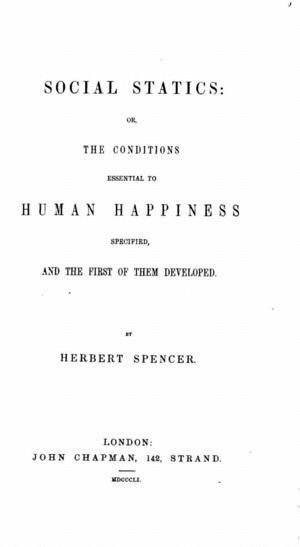
Social Statics: or, The Conditions essential to Happiness specified, and the First of them Developed, (London: John Chapman, 1851).

About Liberty Fund:

Liberty Fund, Inc. is a private, educational foundation established to encourage the study of the ideal of a society of free and responsible individuals.


CHAPTER XXVI.

national education.

§ 1.

In the same way that our definition of state-duty forbids the state to administer religion or charity, so likewise does it forbid the state to administer education. Inasmuch as the taking away, by government, of more of a man’s property than is needful for maintaining his rights, is an infringement of his rights, and therefore a reversal of the government’s function towards him; and inasmuch as the taking away of his property to educate his own or other people’s children is not needful for the maintaining of his rights; the taking away of his property for such a purpose is wrong.

Should it be said that the rights of the children are involved, and that state-interposition is required to maintain these, the reply is that no cause for such interposition can be shown until the children’s rights have been violated, and that their rights are not violated by a neglect of their education. For, as repeatedly explained, what we call rights are merely arbitrary subdivisions of the general liberty to exercise the faculties; and that only can be called an infringement of rights which actually diminishes this liberty—cuts off a previously existing power to pursue the objects of desire. Now the parent who is careless of a child’s education does not do this. The liberty to exercise the faculties is left intact. Omitting instruction in no way takes from a child’s freedom to do whatsoever it wills in the best way it can; and this freedom is all that equity demands. Every aggression, be it remembered—every infraction of rights, is necessarily active; whilst every neglect, carelessness, omission, is as necessarily passive. Consequently, however wrong the non-performance of a parental duty may be—however much it is condemned by that secondary morality—the morality of beneficence (pp. 68 and 69)—it does not amount to a breach of the law of equal freedom, and cannot therefore be taken cognizance of by the state.

§ 2.

Were there no direct disproof of the frequently alleged right to education at the hands of the state, the absurdities in which it entangles its assertors would sufficiently show its invalidity. Conceding for a moment that the government is bound to educate a man’s children, then, what kind of logic will demonstrate that it is not bound to feed and cloth them? If there should be an act-of-parliament provision for the development of their minds, why should there not be an act-of-parliament provision for the development of their bodies? If the mental wants of the rising generation ought to be satisfied by the state, why not their physical ones? The reasoning which is held to establish the right to intellectual food, will equally well establish the right to material food: nay, will do more—will prove that children should be altogether cared for by government. For if the benefit, importance, or necessity of education be assigned as a sufficient reason why government should educate, then may the benefit, importance, or necessity of food, clothing, shelter, and warmth be assigned as a sufficient reason why government should administer these also. So that the alleged right cannot be established without annulling all parental responsibility whatever.

Should further refutation be thought needful, there is the ordeal of a definition. We lately found this ordeal fatal to the assumed right to a maintenance; we shall find it equally fatal to this assumed right to education. For what is an education? Where, between the teaching of a dame-school, and the most comprehensive university curriculum, can be drawn the line separating that portion of mental culture which may be justly claimed of the state, from that which may not be so claimed? What peculiar quality is there in reading, writing, and arithmetic, which gives the embryo citizen a right to have them imparted to him, but which quality is not shared in by geography, and history, and drawing, and the natural sciences? Must calculation be taught because it is useful? why so is geometry, as the carpenter and mason will tell us; so is chemistry, as we may gather from dyers and bleachers; so is physiology, as is abundantly proved by the ill-health written in so many faces. Astronomy, mechanics, geology, and the various connate sciences—should not these be taught, too? they are all useful. Where is the unit of measure by which we may determine the respective values of different kinds of knowledge? Or, assuming them determined, how can it be shown that a child may claim from the civil power knowledge of such and such values, but not knowledge of certain less values? When those who demand a state-education can say exactly how much is due—can agree upon what the young have a right to, and what not—it will be time to listen. But until they accomplish this impossibility, their plea cannot be entertained.

§ 3.

A sad snare would these advocates of legislative teaching betray themselves into, could they substantiate their doctrine. For what is meant by saying that a government ought to educate the people? why should they be educated? what is the education for? Clearly to fit the people for social life—to make them good citizens. And who is to say what are good citizens? The government: there is no other judge. And who is to say how these good citizens may be made? The government: there is no other judge. Hence the proposition is convertible into this—a government ought to mould children into good citizens, using its own discretion in settling what a good citizen; is, and how the child may be moulded into one. It must first form for itself a definite conception of a pattern citizen; and having done this, must elaborate such system of discipline as seems best calculated to produce citizens after that pattern. This system of discipline it is bound to enforce to the uttermost. For if it does otherwise, it allows men to become different from what in its judgment they should become, and therefore fails in that duty it is charged to fulfil. Being thus justified in carrying out rigidly such plans as it thinks best, every government ought to do what the despotic governments of the Continent and of China do. That regulation under which, in France, “private schools cannot be established without a licence from the minister, and can be shut up by a simple ministerial order,” is a step in the right direction, but does not go far enough; seeing that the state cannot permit its mission to be undertaken by others, without endangering the due performance of it. The forbidding of all private schools whatever, as until recently in Prussia, is nearer the mark. Austrian legislation, too, realizes with some consistency the state-education theory. By it a tolerably stringent control over the mental culture of the nation is exercised. Much thinking being held at variance with good citizenship, the teaching of metaphysics, political economy, and the like, is discouraged. Some scientific works are prohibited. And a reward is offered for the apprehension of those who circulate bibles—the authorities in the discharge of their function preferring to entrust the interpretation of that book to their employes the Jesuits. But in China alone is the idea carried out with logical completeness. There the government publishes a list of works which may be read; and considering obedience the supreme virtue, authorizes such only as are friendly to despotism. Fearing the unsettling effects of innovation, it allows nothing to be taught but what proceeds from itself. To the end of producing pattern citizens it exerts a stringent discipline over all conduct. There are “rules for sitting, standing, walking, talking, and bowing, laid down with the greatest precision. Scholars are prohibited from chess, football, flying kites, shuttlecock, playing on wind instruments, training beasts, birds, fishes, or insects—all which amusements, it is said, dissipate the mind and debase the heart.”

Now a minute dictation like this, which extends to every action, and will brook no nay, is the legitimate realization of this state-education theory. Whether the government has got erroneous conceptions of what citizens ought to be, or whether the methods of training it adopts are injudicious, is not the question. According to the hypothesis it is commissioned to discharge a specified function. It finds no ready-prescribed way of doing this. It has no alternative, therefore, but to choose that way which seems to it most fit. And as there exists no higher authority, either to dispute or confirm its judgment, it is justified in the absolute enforcement of its plans, be they what they may. As from the proposition that government ought to teach religion, there springs the other proposition, that government must decide what is religious truth, and how it is to be taught; so, the assertion that government ought to educate, necessitates the further assertion that it must say what education is, and how it shall be conducted. And the same rigid popery, which we found to be a logical consequence in the one case (p. 307), follows in the other also.

§ 4.

There are few sayings more trite than this, that love of offspring is one of our most powerful passions. To become a parent is an almost universal wish. The intensity of affection exhibited in the glistening eye, the warm kiss, and the fondling caress—in the untiring patience, and the ever ready alarm of the mother, is a theme on which philosophers have written and poets have sung in all ages. Every one has remarked how commonly the feeling overmasters all others. Observe the self-gratulation with which maternity witnesses her first-born’s unparalleled achievements. Mark the pride with which the performances of each little brat are exhibited to every visitor as indicating a precocious genius. Consider again the deep interest which in later days a father feels in his children’s mental welfare, and the anxiety he manifests to get them on in life; the promptings of his natural affection being ofttimes sharpened by the reflection that the comfort of his old age may, perchance, be dependent upon their success.

Now “servants and interpreters of nature” have usually supposed these feelings to be of some use. Hitherto they have always thought that the gratification accruing to a mother from the forwardness of her little ones serves as a stimulus to the proper culture of their minds—that the honour which the father expects to derive from the distinction of his sons acts as an incentive to their improvement—and that the anticipation by parents of the distress which ill-trained children may one day entail constitutes an additional spur to the proper management of them. In these strong affections and mutual dependencies observers believed they saw an admirably-arranged chain of influences, calculated to secure the mental and physical development of successive generations; and in the simplicity of their faith had concluded that these divinely-appointed means were fully sufficient for this purpose. It would appear, however, according to the state-educationists, that they have been mistaken. It seems that this apparatus of feelings is wholly insufficient to work out the desideratum—that this combination of affections and interests was not provided for such a purpose, or, what is the same thing, that it has no purpose at all. And so, in default of any natural provision for supplying the exigency, legislators exhibit to us the design and specification of a state-machine, made up of masters, ushers, inspectors, and councils, to be worked by a due proportion of taxes, and to be plentifully supplied with raw material, in the shape of little boys and girls, out of which it is to grind a population of well-trained men and women, who shall be “useful members of the community”!

§ 5.

But it is argued that parents, and especially those whose children most need instructing, do not know what good instruction is. “In the matter of education,” says Mr. Mill, “the intervention of government is justifiable; because the case is one in which the interest and judgment of the consumer are not sufficient security for the goodness of the commodity.”

It is strange that so judicious a writer should feel satisfied with such a worn-out excuse. This alleged incompetency on the part of the people has been the reason assigned for all state-interferences whatever. It was on the plea that buyers were unable to tell good fabrics from bad, that those complicated regulations which encumbered the French manufacturers were established. The use of certain dyes here in England was prohibited, because of the insufficient discernment of the people. Directions for the proper making of pins were issued, under the idea that experience would not teach the purchasers which were best. Those examinations as to competency which the German handicraftsmen undergo, are held needful, as safeguards to the consumers. A stock argument for the state-teaching of religion has been that the masses cannot distinguish false religion from true. There is hardly a single department of life over which, for similar reasons, legislative supervision has not been, or may not be, established. Here is Mr. H. Hodson Rugg, M.R.C.S., publishing a pamphlet to point out the injury inflicted upon poor ignorant householders by the adulteration of milk, and proposing as a remedy that there shall be government officers to test the milk, and to confiscate it when not good—police to inspect the ventilation of cow-sheds, and to order away invalid cattle—and a government cow-infirmary, with veterinary surgeon attached. To-morrow some one else may start up to tell us that bad bread is still more injurious than bad milk, equally common, quite as difficult to distinguish, and that, consequently, bakehouses ought to be overlooked by the authorities. Next there will be wanted officials with hydrometers and chemical re-agents, to dabble in the vats of the porter-breweries. In the wake of these must, of course, follow others, commissioned to watch the doings of wine merchants. And so on, until, in the desire to have all processes of production duly inspected, we approach a condition somewhat like that of the slave states, in which, as they say, “one-half of the community is occupied in seeing that the other half does its duty.” And for each additional interference the plea may be, as it always has been, that “the interest and judgment of the consumer are not sufficient security for the goodness of the commodity.”

Should it be said that the propriety of legislative control depends upon circumstances; that respecting some articles the judgment of the consumer is sufficient, whilst respecting other articles it is not; and that the difficulty of deciding upon its quality, places education amongst these last; the reply again is, that the same has been said on behalf of all meddlings in turn. Plenty of trickeries, plenty of difficulties in the detection of fraud, plenty of instances showing the inability of purchasers to protect themselves, are quoted by the advocates of each proposed recourse to official regulation; and in each case it is urged that here, at any rate, official regulation is required. Yet does experience disprove these inferences one after another, teaching us that, in the long run, the interest of the consumer is not only an efficient guarantee for the goodness of the things consumed, but the best guarantee. Is it not unwise, then, to trust for the hundredth time in one of these plausible but deceptive conclusions? Is it not rational, rather, to infer, that however much appearances are to the contrary, the choice of the commodity—education, like the choice of all other commodities, may be safely left to the discretion of buyers?

Still more reasonable will this inference appear on observing that the people are not, after all, such incompetent judges of education as they seem. Ignorant parents are generally quick enough to discern the effects of good or bad teaching; will note them in the children of others, and act accordingly. Moreover it is easy for them to follow the example of the better instructed, and choose the same schools. Or they may get over the difficulty by asking advice; and there is generally some one both able and willing to give the uneducated parent a trustworthy answer to his inquiry about teachers. Lastly, there is the test of price. With education, as with other things, price is a tolerably safe index of value; it is one open to all classes; and it is one which the poor instinctively appeal to in the matter of schools; for it is notorious that they look coldly at very cheap or gratuitous instruction.

But even admitting that, whilst this defect of judgment is not virtually so extreme as is alleged, it is nevertheless great, the need for interference is still denied. The evil is undergoing rectification, as all analogous ones are or have been. The rising generation will better understand what good education is than their parents do, and their descendants will have clearer conceptions of it still. Whoso thinks the slowness of the process a sufficient reason for meddling, must, to be consistent, meddle in all other things; for the ignorance which in every case serves as an excuse for state-interposition is of very gradual cure. The errors both of consumers and producers often take generations to set right. Improvements in the carrying on of commerce, in manufactures, and especially in agriculture, spread almost imperceptibly. Take rotation of crops for an example. And if this tardiness is a valid argument for interference in one case, why not in others? Why not have farms superintended by government, because it may take a century for farmers generally to adopt the plans suggested by modern science?

Did we duly realize the fact that society is a growth, and not a manufacture—a thing that makes itself, and not a thing that can be artificially made—we should fall into fewer mistakes; and we should see that amongst other imperfections this incompetence of the masses to distinguish good instruction from bad, is being outgrown.

§ 6.

When in the matter of education “the interest and judgment of the consumer” are said not to be “sufficient security for the goodness of the commodity,” and when it is argued that government superintendence is therefore needful, a very questionable assumption is made: the assumption, namely, that “the interest and judgment” of a government are sufficient security. Now there is good reason to dispute this, nay, even to assert that, taking the future into account, they offer much less security.

The problem is, how best to develop minds: a problem amongst the most difficult—may we not say, the most difficult? Two things are needful for its solution. First, to know what minds should be fashioned into. Next, to know how they may be so fashioned. From the work to be done, turn we now to the proposed doers of it. Men of education (as the word goes) they no doubt are; well-meaning, many of them; thoughtful, some; philosophical, a few; men, however, for the most part, born with silver spoons in their mouths, and prone to regard human affairs as reflected in these—somewhat distortedly. Very comfortable lives are led by the majority of them, and hence “things as they are” find favour in their eyes. For their tastes—they are shown in the subordination of national business to the shooting of grouse and the chasing of foxes. For their pride—it is in wide estates or long pedigrees; and should the family coat of arms bear some such ancient motto as “Strike hard,” or, “Furth fortune, and fill the fetters,” it is a great happiness. As to their ideal of society, it is either a sentimental feudalism; or it is a state, something like the present, under which the people shall be respectful to their betters, and “content with that station of life to which it has pleased God to call them;” or it is a state arranged with the view of making each labourer the most efficient producing tool, to the end that the accumulation of wealth may be the greatest possible. Add to this, that their notions of moral discipline are shown in the maintenance of capital punishment, and in the sending of their sons to schools where dogging is practised, and where they themselves were brought up. Now could the judgment of such respecting the commodity—education be safely relied on? Certainly not.

Still less might their “interest” be trusted. Though at variance with that of the people, it would inevitably be followed in preference. The self-seeking which, consciously or unconsciously, sways rulers in other cases, would sway them in this likewise—could not fail to do so, whilst the character of men is what it is. With taxation unequally distributed, with such a glaringly unjust apportionment of representatives to population, with a nepotism that fills lucrative places with Greys and Elliots, with a staff of a hundred admirals more than are wanted, with lavish pensions to the undeserving, with a system of retrenchment which discharges common men and retains officers, and with such votes as those given by the military, the naval, the landed, and the clerically-related members of parliament, we may be quite sure that a state-education would be administered for the advantage of those in power, rather than for the advantage of the nation. To hope for anything else is to fall into the old error of looking for grapes from thorns. Nothing can be more truly Utopian than expecting that, with men and things as they are, the influences which have vitiated all other institutions would not vitiate this one.

Thus, even were it true that in the matter of education “the interest and judgment of the consumer are not sufficient security for the goodness of the commodity,” the wisdom of superseding them by the “interest and judgment” of a government is by no means obvious. It may, indeed, be said that the argument proves only the unfitness of existing governments to become national teachers, and not the unfitness of a government normally constituted: whereas the object of inquiry being to determine what a government should do, the hypothesis must be that the government is what it should be. To this the reply is, that the nature of the allegation to be met necessitates a descent to the level of present circumstances. It is on the defective “interest and judgment” of the people, as they now are, that the plea for legislative superintendence is based; and, consequently, in criticising this plea we must take government as it now is. We cannot reason as though government were what it should be; since, before it can become so, any alleged deficiency of “interest and judgment” on the part of the people must have disappeared.

§ 7.

The impolicy of setting up a national organization for cultivating the popular mind, and commissioning the government to superintend this organization, is further seen in the general truth that every such organization is in spirit conservative, and not progressive. All institutions have an instinct of selfpreservation growing out of the selfishness of those connected with them. Being dependent for their vitality upon the continuance of existing arrangements, they naturally uphold these. Their roots are in the past and the present; never in the future. Change threatens them, modifies them, eventually destroys them; hence to change they are uniformly opposed. On the other hand, education, properly so called, is closely associated with change—is its pioneer—is the never-sleeping agent of revolution—is always fitting men for higher things, and unfitting them for things as they are. Therefore, between institutions whose very existence depends upon man continuing what he is, and true education, which is one of the instruments for making him something other than he is, there must always be enmity.

From the time of the Egyptian priesthood downwards, the conduct of corporations, whether political, ecclesiastical, or educational, has given proof of this. Some 300 years B.C., unlicensed schools were forbidden by the Athenian senate. In Rome, the liberty of teaching was attacked twice before the Christian era; and again, afterwards, by the Emperor Julian. The existing continental governments show, by their analogous policy, how persistent the tendency is. In the universality of censorships we see the same fact further illustrated. The celebrated saying of the Empress Catharine to her prime minister, well exhibits the way in which rulers regard the spread of knowledge. And whenever governments have undertaken to educate, it has been with the view of forestalling that spontaneous education which threatened their own supremacy. Witness the case of China, where diligently-impressed ideas, such as, “O! how magnificent are the affairs of government!” “O! what respect is due to the officers of government!” sufficiently indicate the intention. Witness, again, the case of Austria, where, in accordance with the will of the Emperor Francis, the training of the popular mind was entrusted to the Jesuits, that they might “counteract the propagandism of liberty, by the propagandism of superstition.”a Nor have there been wanting signs of a like spirit here in England. That attempt in Cobbett’s day to put down cheap literature, by an act which prevented weekly publications from being sold for less than sixpence, unmistakably indicated it. It was again exhibited in the reluctance with which the newspaper stamp duty was reduced, when resistance had become useless. And we may still see it in the double-facedness of a legislature which professes to favour popular enlightenment, and yet continues to raise a million and a quarter sterling yearly from “taxes on knowledge.”

How unfriendly all ecclesiastical bodies have been to the spread of education every one knows. The obstinacy shown by the Brahmin in fighting against the truths of modern science—the fanaticism with which the Mahometan doctor ignores all books but the Koran—and the prejudice fostered by the religious institutions of our own country against the very name of philosophy—are kindred illustrations of the conduct which this self-conserving instinct produces. In that saying of the monks, “We must put down printing, or printing will put down us,” the universal motive was plainly expressed; as it was, again, through the mouth of that French bishop who denounced the Bell and Lancaster systems as inventions of the devil. Nor let any one conclude that the educational zeal latterly manifested by Church clergy indicates a new animus. Those who remember the bitterness with which Sunday schools were at first assailed by them; and those who mark how keenly they now compete with dissenters for the children of the poor, can see clearly enough that they are endeavouring to make the best of a necessity—that, having a more or less defined consciousness of the inevitability of educational progress, they wish to educate the people in allegiance to the Church.

Still more manifest becomes this obstructive tendency on considering that the very organizations devised for the spreading of knowledge, may themselves act as suppressors of it. Thus it is said, that Oxford was one of the last places in which the Newtonian philosophy was acknowledged. We read again, in the life of Locke, that “there was a meeting of the heads of houses at Oxford, where it was proposed to censure and discourage the reading of this essay (On the Human Understanding); and after various debates, it was concluded that without any public censure each head of a house shall endeavour to prevent its being read in his own college.” At Eton, too, in Shelley’s time, “Chemistry was a forbidden thing,” even to the banishment of chemical treatises. So uniformly has it been the habit of these endowed institutions to close the door against innovations, that they are amongst the last places to which any one looks for improvements in the art of teaching, or a better choice of subjects to be taught. The attitude of the universities towards natural science has been that of contemptuous non-recognition. College authorities have long resisted, either actively or passively, the making of physiology, chemistry, geology, &c., subjects of examination; and only of late, under pressure from without, and under the fear of being supplanted by rival institutions, have new studies been gingerly taken to.

Now, although vis inertiæ may be very useful in its place—although the resistance of office-holders has its function—although we must not quarrel with this instinct of self-preservation which gives to institutions their vitality, because it also upholds them through a lingering decrepitude—we may yet wisely refuse to increase its natural effect. It is very necessary to have in our social economy a conservative force as well as a reforming one, that there may be progress for the resultant; but it is highly impolitic to afford the one an artificial advantage over the other. To establish a state-education is to do this, however. The teaching organization itself, and the government which directs it, will inevitably lean to things as they are; and to give them control over the national mind, is to give them the means of repressing aspirations after things as they should be. Just that culture which seems compatible with their own preservation will these institutions allow, whilst just that culture which, by advancing society, threatens to sap their own foundations, or, in other words—just that culture which is most valuable, they will oppose.

The sanguine will perhaps hope that, though this has been the rule hitherto, it will not be the rule in future. Let them not deceive themselves. So long as men pursue private advantage at the expense of the common weal, that is to say—so long as government is needful at all, so long will this be true. Less marked the tendency will no doubt be in proportion as men are less unjustly selfish. But to whatever extent they lack perfect conscientiousness, to the same extent will vested interests sway them, and to the same extent will institutions resist change.

§ 8.

Did the reader ever watch a boy in the first heat of a gardening fit? The sight is an amusing, and not uninstructive one. Probably a slice of a border—some couple of square yards or so—has been made over to him for his exclusive use. No small accession of dignity, and not a little pride of proprietorship, does he exhibit. So long as the enthusiasm lasts, he never tires of contemplating his territory; and every companion, and every visitor with whom the liberty can be taken, is pretty sure to be met with the request—“Come and see my garden.” Note chiefly, however, with what anxiety the growth of a few scrubby plants is regarded. Three or four times a day will the little urchin rush out to look at them. How provokingly slow their progress seems to him. Each morning on getting up he hopes to find some marked change; and lo, everything appears just as it did the day before. When will the blossoms come out! For nearly a week has some forward bud been promising him the triumph of a first flower, and still it remains closed. Surely there must be something wrong! Perhaps the leaves have stuck fast. Ah! that is the reason, no doubt. And so ten to one you shall some day catch our young florist very busily engaged in pulling open the calyx, and, it may be, trying to unfold a few of the petals.

Somewhat like this childish impatience is the feeling exhibited by not a few state-educationists. Both they and their type show a lack of faith in natural forces—almost an ignorance that there are such forces. In both there is the same dissatisfaction with the ordained rate of progress. And by both, artificial means are used to remedy what are conceived to be nature’s failures. Within these few years men have all at once been awakened to the importance of instructing the people. That to which they were awhile since indifferent or even hostile has suddenly become an object of enthusiasm. With all the ardour of recent converts—with all a novice’s inordinate expectations—with all the eagerness of a lately-aroused desire—do they await the hoped- for result; and, with the unreasonableness ever attendant upon such a state of mind, are dissatisfied, because the progress from general ignorance to universal enlightenment has not been completed in a generation. One would have thought it sufficiently clear to everybody that the great changes taking place in this world of ours are uniformly slow. Continents are upheaved at the rate of a foot or two in a century. The deposition of a delta is the work of tens of thousands of years. The transformation of barren rock into life-supporting soil takes countless ages. If any think society advances under a different law, let them read. Has it not required the whole Christian era to abolish slavery in Europe? as far at least as it is abolished. Did not a hundered generations live and die while picture-writing grew into printing? Have not science and commerce and mechanical skill increased at a similarly tardy pace? Yet are men disappointed that a pitiful fifty years has not sufficed for thorough popular enlightment! Although within this period an advance has been made far beyond what the calm thinker would have expected—far beyond what the past rate of progress in human affairs seemed to prophesy—yet do these so impatient people summarily condemn the voluntary system as a failure! A natural process—a process spontaneously set up—a process of self-unfolding which the national mind had commenced, is pooh-poohed because it has not wrought a total transformation in the course of what constitutes but a day in the life of humanity! And then, to make up for nature’s incompetency, the unfolding must be hastened by legislative fingerings!

§ 9.

There is, indeed, one excuse for attempts to spread education by artificial means, namely, the anxiety to diminish crime, of which education is supposed to be a preventive. “We hold,” says Mr. Macaulay, “that whoever has the right to hang has the right to educate.”a And in a letter relative to the Manchester district-system, Miss Martineau writes—“Nor can I see that political economy objects to the general rating for educational purposes. As a mere police-tax this rating would be a very cheap affair. It would cost us much less than we now pay for juvenile depravity.” In both which remarks this prevalent belief is implied.

Now, with all respect to the many high authorities holding it, the truth of this belief may be disputed. We have no evidence that education, as commonly understood, is a preventive of crime. Those perpetually re-iterated newspaper paragraphs, in which the ratios of instructed to uninstructed convicts are so triumphantly stated, prove just nothing. Before any inference can be drawn, it must be shown that these instructed and uninstructed convicts, come from two equal sections of society, alike in all other respects but that of knowledge—similar in rank and occupation, having similar advantages, labouring under similar temptations. But this is not only not the truth; it is nothing like the truth. The many ignorant criminals belong to a most unfavourably circumstanced class; whilst the few educated ones are from a class comparatively favoured. As things stand it would be equally logical to infer that crime arises from going without animal food, or from living in badly-ventilated rooms, or from wearing dirty shirts; for were the inmates of a goal to be catechised, it would doubtless be found that the majority of them had been placed in these conditions. Ignorance and crime are not cause and effect; they are coincident results of the same cause. To be wholly untaught is to have moved amongst those whose incentives to wrong-doing are strongest; to be partially taught is to have been one of a class subject to less urgent temptations; to be well taught is to have lived almost beyond the reach of the usual motives for transgression. Ignorance, therefore (at least in the statistics reffered to), simply indicates the presence of crime-producing influences, and can no more be called the cause of crime than the falling of a barometer can be called the cause of rain.

So far indeed from proving that morality is increased by education, the facts prove, if anything, the reverse. Thus we are told, in a report by the Rev. Joseph Kingsmill, head chaplain of Pentonville Prison, that the proportion borne by the educated to the uneducated convicts is fully as high as that which exists between the educated and the uneducated classes in the general population; although, as just explained, we might reasonably expect, that having had fewer temptations, the educated convicts would bear a smaller ratio to their class. Again, it has been shown from government returns—“That the number of juvenile offenders in the metropolis has been steadily increasing every year since the institution of the Ragged School Union; and that whereas the number of criminals who cannot read and write has decreased from 24,856 (in 1844) to 22,968 (in 1848)—or no less than 1888 in that period—the number of those who can read and write imperfectly has increased from 33,337 to 36,229—or 2857—in the same time.”—Morning Chronicle, April 25, 1850. Another contributor to the series of articles on “Labour and the Poor,” from which the above statement is quoted, remarks that “the mining population (in the north) are exceedingly low in point of education and intelligence; and yet they contradict the theories generally entertained upon the connection of ignorance with crime, by presenting the least criminal section of the population of England.”—Morning Chronicle, Dec. 27, 1849. And, speaking of the women employed in the iron-works and collieries throughout South Wales, he says—“their ignorance is absolutely awful; yet the returns show in them a singular immunity from crime.”—Morning Chronicle, March 21, 1850.

If these testimonies are thought insufficient, they may be enforced by that of Mr. Fletcher, who has entered more elaborately into this question than perhaps any other writer of the day. Summing up the results of his investigations, he says:—

“1. In comparing the gross commitments for criminal offences with the proportion of instruction in each district, there is found to be a small balance in favour of the most instructed districts in the years of most industrial depression (1842-3-4), but a greater one against them in the years of less industrial depression (1845-6-7); while in comparing the more with the less instructed portions of each district, the final result is against the former at both periods, though fourfold at the latter what it is at the former.

“2. No correction for the ages of the population in different districts, to meet the excess of criminals at certain younger periods of life, will change the character of this superficial evidence against instruction; every legitimate allowance of the kind having already been made in arriving at these results.

“3. Down to this period, therefore, the comparison of the criminal and educational returns of this, any more than of any other country of Europe, has afforded no sound statistical evidence in favour, and as little against, the moral effects associated with instruction, as actually disseminated among the people.”a

To all which evidence may be added that of Messrs. Gurrea and Dupin, who have shown that the most highly-educated districts in France are the most criminal districts.

The fact is, that scarcely any connection exists between morality and the discipline of ordinary teaching. Mere culture of the intellect (and education as usually conducted amounts to little more) is hardly at all operative upon conduct. Creeds pasted upon the memory, good principles learnt by rote, lessons in right and wrong, will not eradicate vicious propensities, though people, in spite of their experience as parents, and as citizens, persist in hoping they will. All history, both of the race and of individuals, goes to prove that in the majority of cases precepts do not act at all. And where they seem to act, it is not by them, but by pre-existing feelings which respond to them, that the effects are really produced. Intellect is not a power, but an instrument—not a thing which itself moves and works, but a thing which is moved and worked by forces behind it. To say that men are ruled by reason, is as irrational as to say that men are ruled by their eyes. Reason is an eye—the eye through which the desires see their way to gratification. And educating it only makes it a better eye—gives it a vision more accurate and more comprehensive—does not at all alter the desires subserved by it. However far-seeing you make it, the passions will still determine the directions in which it shall be turned—the objects on which it shall dwell. Just those ends which the instincts or sentiments propose will the intellect be employed to accomplish: culture of it having done nothing but increase the ability to accomplish them. Probably some will urge that enlightening men enables them to discern the penalties which naturally attach to wrong-doing; and in a certain sense this is true. But it is only superficially true. Though they may learn that the grosser crimes commonly bring retribution in one shape or other, they will not learn that the subtler ones do. Their sins will merely be made more Machiavellian. If, as Coleridge says, “a knave is a fool with a circumbendibus,” then by instructing the knave you do but make the circumbendibus a wider one. Did much knowledge and piercing intelligence suffice to make men good, then Bacon should have been honest, and Napoleon should have been just. Where the character is defective, intellect, no matter how high, fails to regulate rightly, because predominant desires falsify its estimates. Nay, even a distinct foresight of evil consequences will not restrain when strong passions are at work. How else does it happen that men will get drunk, though they know drunkenness will entail on them suffering, and disgrace, and (as with the poor) even starvation? How else is it that medical students, who know the diseases brought on by dissolute living better than other young men, are just as reckless, and even more reckless? How else is it that the London thief, who has been at the treadmill a dozen times, will steal again as soon as he is at liberty? How else is it that people, who have all their lives long been taught Christianity, will not behave as Christians, though they believe that dire penalties are entailed by behaving otherwise?

It is, indeed, strange that with the facts of daily life before them in the street, in the counting-house, and in the family, thinking men should still expect education to cure crime. If armies of teachers, regarded with a certain superstitious reverence, have been unable to purify society in all these eighteen centuries, it is hardly likely that other armies of teachers, not so regarded, will be able to do it. If natural persuasion, backed by super-natural authority, will not induce men to do as they would be done by, it is hardly likely that natural persuasion alone will induce them. If hopes of eternal happiness and terrors of eternal damnation fail to make human beings virtuous, it is hardly likely that the commendations and reproofs of the schoolmaster will succeed.

There is, in fact, a quite sufficient reason for failure—no less a reason than the impossibility of the task. The expectation that crime may presently be cured, whether by state-education, or the silent system, or the separate system, or any other system, is one of those Utopianisms fallen into by people who pride themselves on being practical. Crime is incurable, save by that gradual process of adaptation to the social state which humanity is undergoing. Crime is the continual breaking out of the old unadapted nature—the index of a character unfitted to its conditions—and only as fast as the unfitness diminishes can crime diminish. To hope for some prompt method of putting down crime, is in reality to hope for some prompt method of putting down all evils—laws, governments, taxation, poverty, caste, and the rest; for they and crime have the same root. Reforming men’s conduct without reforming their natures is impossible; and to expect that their natures may be reformed, otherwise than by the forces which are slowly civilizing us, is visionary. Schemes of discipline or culture are of use only in proportion as they organically alter the national character, and the extent to which they do this is by no means great. It is not by humanly-devised agencies, good as these may be in their way, but it is by the never-ceasing action of circumstances upon men—by the constant pressure of their new conditions upon them—that the required change is mainly effected.

Meanwhile it may be remarked, that whatever moral benefit can be effected by education, must be effected by an education which is emotional rather than preceptive. If, in place of making a child understand that this thing is right and the other wrong, you make it feel that they are so—if you make virtue loved and vice loathed—if you arouse a noble desire, and make torpid an inferior one—if you bring into life a previously dormant sentiment—if you cause a sympathetic impulse to get the better of one that is selfish—if, in short, you produce a state of mind to which proper behaviour is natural, spontaneous, instinctive, you do some good. But no drilling in catechisms, no teaching of moral codes, can effect this. Only by repeatedly awakening the appropriate emotions can character be changed. Mere ideas received by the intellect, meeting no response from within—having no roots there—are quite inoperative upon conduct, and are quickly forgotten upon entering into life.

Perhaps it will be said that a discipline like this now described as the only efficient one, might be undertaken by the state. No doubt it might. But from all legislative attempts at emotional education may Heaven defend us!

§ 10.

Yet another objection remains. Just as we found, on close examination, that by poor-laws a government cannot really cure distress, but can only shift it from one section of the community to another (p. 327), so, astounding as the assertion looks, we shall find that a government cannot in fact educate at all, but can only educate some by uneducating others. If, before agitating the matter, men had taken the precaution to define education, they would probably have seen that the state can afford no true help in the matter. But having unfortunately neglected to do this, they have confined their attention solely to the education given at school, and have forgotten to inquire how their plans bear upon the education which commences when school-days end. It is not indeed that they do not know this discipline of daily duty to be valuable—more valuable, in fact, than the discipline of the teacher. You may often hear them remark as much. But, with the eagerness usual amongst schemers, they are so absorbed in studying the action of their proposed mechanism as to overlook its reaction.

Now of all qualities which is the one men most need? To the absence of what quality are popular distresses mainly attributable? What is the quality in which the improvident masses are so deficient? Self-restraint—the ability to sacrifice a small present gratification for a prospective great one. A labourer endowed with due self-restraint would never spend his Saturday-night’s wages at the public-house. Had he enough self-restraint, the artizan would not live up to his income during prosperous times and leave the future unprovided for. More self-restraint would prevent imprudent marriages and the growth of a pauper population. And were there no drunkenness, no extravagance, no reckless multiplication, social miseries would be trivial.

Consider next how the power of self-restraint is to be increased. By a sharp experience alone can anything be done. Those in whom this faculty needs drawing out—educating must be left to the discipline of nature, and allowed to bear the pains attendant on their defect of character. The only cure for imprudence is the suffering which imprudence entails. Nothing but bringing him face to face with stern necessity, and letting him feel how unbending, how unpitying, are her laws, can improve the man of ill-governed desires. As already shown (p. 324), all interposing between humanity and the conditions of its existence—cushioning-off consequences by poor-laws or the like—serves but to neutralize the remedy and prolong the evil. Let us never forget that the law is—adaptation to circumstances, be they what they may. And if, rather than allow men to come in contact with the real circumstances of their position, we place them in artificial—in false circumstances, they will adapt themselves to these instead; and will, in the end, have to undergo the miseries of a re-adaptation to the real ones.

Of all incentives to self-restraint, perhaps none is so strong as the sense of parental responsibility. And if so, to diminish that sense is to use the most effectual means of preventing self-restraint from being developed. We have ample proof of this in the encouragement of improvident marriages by a poor-law; and the effect which a poor-law produces by relieving men from the final responsibility of maintaining their children, must be produced in a smaller degree by taking away the responsibility of educating their children. The more the state undertakes to do for his family, the more are the expenses of the married man reduced, at the cost of the unmarried man, and the greater becomes the temptation to marry. Let not any think that the offer of apparently gratuitous instruction for his offspring would be of no weight with the working man deliberating on the propriety of taking a wife. Whoever has watched the freaks which strong passion plays in the councils of the intellect—has marked how it will bully into silence the weaker feelings that oppose it—how it will treat slightingly the most conclusive adverse evidence, whilst, in urging the goodness of its own cause, “trifles light as air are confirmations strong as proofs of Holy Writ”—whoever has marked this, can hardly doubt that, in the deliberations of such an one, the prospect of public training for children would in no small degree affect the decision. Nay, indeed, it would afford a positive reason for giving way to his desires. Just as a man at an expensive dinner will eat more than he knows is good for him, on the principle of having his money’s worth, so would the artizan find one excuse for marrying in the fact that, unless he did so, he would be paying education-rates for nothing.

Nor is it only thus that a state-education would encourage men to obey present impulses. An influence unfavourable to the increase of self-control would be exercised by it throughout the whole of parental life. That powerful restraint which the anxiety to give children schooling now imposes upon the improvident tendencies of the poor, would be removed. Many a man who, as things are, can but just keep the mastery over some vicious or extravagant propensity, and whose most efficient curb is the thought that if he gives way it must be at the sacrifice of that book-learning which he is ambitious to give his family, would fall were this curb weakened—would not only cease to improve in power of self-control as he is now doing, but would probably retrograde, and bequeath his offspring to a lower instead of a higher phase of civilization.

Hence, as was said, a government can educate in one direction only by uneducating in another—can confer knowledge only at the expense of character. It retards the development of a quality universally needed—one in the absence of which poverty, and recklessness, and crime, must ever continue; and all that it may give a smattering of information.

What a contrast is there between these futile contrivances of men and the admirable, silent-working mechanisms of nature! Nature, with a perfect economy, turns all forces to account. She makes action and re-action alike useful. This strong affection for progeny becomes in her hands the agent of a double culture, serving at once to fashion parent and child into the desired form. And beautiful is it to see how the most powerful of instincts is made the means of holding men under a discipline to which, perhaps, nothing else could make them submit. Yet this skilfully-devised arrangement statesmen propose to dislocate, confidently opining that their own patent apparatus will answer a great deal better!

§ 11.

Thus, in the present, as in other cases, we find the dictate of the abstract law enforced by secondary considerations. The alleged right to education at the hands of the state proves to be untenable; first, as logically committing its supporters to other claims too absurd for consideration; and again, as being incapable of definition. Moreover, could the claim be established, it would imply the duty of government despotically to enforce its system of discipline, and the duty of the subject to submit. That education ought not to be dealt in after the same manner as other things, because in its case “the interest and judgment of the consumer are not sufficient security for the goodness of the commodity,” is a plea with most suspicious antecedents; having been many times employed in other instances, and many times disproved. Neither is the implied assumption that the “interest and judgment” of a government would constitute a sufficient security admissible. On the contrary, experience proves that the interests of a government, and of all the institutions it may set up, are directly opposed to education of the most important kind. Again, to say that legislative teaching is needful, because other teaching has failed, presupposes a pitiably narrow view of human progress; and further, involves the strange scepticism that, though natural agencies have brought the enlightenment of mankind to its present height, and are even now increasing it at an unparalleled rate, they will no longer answer. The belief that education is a preventive of crime, having no foundation either in theory or fact, cannot be held an excuse for interference. And, to crown all, it turns out that the institution so much longed for is a mere dead machine, which can only give out in one form the power it absorbs in another, minus the friction—a thing which cannot stir towards effecting this kind of education without abstracting the force now accomplishing that—a thing, therefore, which cannot educate at all.

[a]And not without success, according to Mr. Wilde, who (writing before the late revolution) tells us, by way of panegyric upon the Austrian system of education, that the people “sigh not for a state of political liberty about which they know nothing. The government wisely preventing their minds from being inflamed by those blisters upon society that have written and preached our own countrymen into the fever of discontent and disaffection, the effects of which are now so visible in Great Britain.”(!)

[a]Quoted from a speech at Edinburgh

[a]Summary of the Moral Statistics of England and Wales. By Joseph Fletcher, Esq., Barrister-at-Law, one of Her Majesty’s Inspectors of Schools.