Econlib

The Library

Other Sites

Front Page arrow Titles (by Subject) arrow CHAPTER XXV.: poor-laws. - Social Statics

Return to Title Page for Social Statics

Search this Title:

Also in the Library:

Topic: Spontaneous Order
Subject Area: Political Theory
Collection: Classics of Liberty
Topic: Natural Law and Natural Rights
Topic: Property
Topic: Freedom of speech

CHAPTER XXV.: poor-laws. - Herbert Spencer, Social Statics [1851]

Edition used:

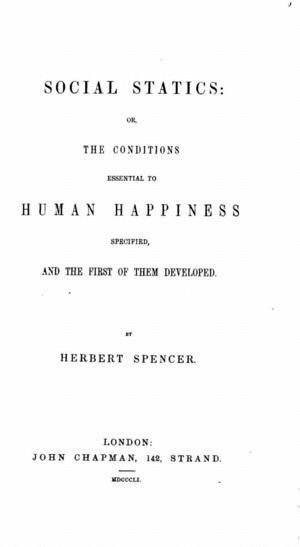
Social Statics: or, The Conditions essential to Happiness specified, and the First of them Developed, (London: John Chapman, 1851).

About Liberty Fund:

Liberty Fund, Inc. is a private, educational foundation established to encourage the study of the ideal of a society of free and responsible individuals.


CHAPTER XXV.

poor-laws.

§ 1.

In common with its other assumptions of secondary offices, the assumption by a government of the office of Reliever-general to the poor, is necessarily forbidden by the principle that a government cannot rightly do anything more than protect. In demanding from a citizen contributions for the mitigation of distress—contributions not needed for the due administration of men’s rights—the state is, as we have seen, reversing its function, and diminishing that liberty to exercise the faculties which it was instituted to maintain. Possibly, unmindful of the explanations already given, some will assert that by satisfying the wants of the pauper, a government is in reality extending his liberty to exercise his faculties, inasmuch as it is giving him something without which the exercise of them is impossible; and that hence, though it decreases the rate-payer’s sphere of action, it compensates by increasing that of the rate-receiver. But this statement of the case implies a confounding of two widely-different things. To enforce the fundamental law—to take care that every man has freedom to do all that he wills, provided he infringes not the equal freedom of any other man—this is the special purpose for which the civil power exists. Now insuring to each the right to pursue within the specified limits the objects of his desires without let or hindrance, is quite a separate thing from insuring him satisfaction. Of two individuals, one may use his liberty of action successfully—may achieve the gratifications he seeks after, or accumulate what is equivalent to many of them—property; whilst the other, having like privileges, may fail to do so. But with these results the state has no concern. All that lies within its commission is to see that each man is allowed to use such powers and opportunities as he possesses; and if it takes from him who has prospered to give to him who has not, it violates its duty towards the one to do more than its duty towards the other. Or, repeating the idea elsewhere expressed (p. 278), it breaks down the vital law of society, that it may effect what social vitality does not call for.

§ 2.

The notion popularized by Cobbett, that every one has a right to a maintenance out of the soil, leaves those who adopt it in an awkward predicament. Do but ask them to specify, and they are set fast. Assent to their principle; tell them you will assume their title to be valid; and then, as a needful preliminary to the liquidation of their claim, ask for some precise definition of it—inquire “What is a maintenance?” They are dumb. “Is it,” say you, “potatoes and salt, with rags and a mud cabin? or is it bread and bacon, in a two-roomed cottage? Will a joint on Sundays suffice? or does the demand include meat and malt liquor daily? Will tea, coffee, and tobacco be expected? and if so, how many ounces of each? Are bare walls and brick floors all that is needed? or must there be carpets and paper-hangings? Are shoes considered essential? or will the Scotch practice be approved? Shall the clothing be of fustian? if not, of what quality must the broad-cloth be? In short, just point out where, between the two extremes of starvation and luxury, this something called a maintenance lies.” Again they are dumb. You expostulate. You explain that nothing can be done until the question is satisfactorily answered. You show that the claim must be reduced to a detailed, intelligible shape before a step can be taken towards its settlement. “How else,” you ask, “shall we know whether enough has been awarded, or whether too much?” Still they are dumb. And, indeed, there is no possible reply for them. Opinions they may offer in plenty; but not a precise, unanimous answer. One thinks that a bare subsistence is all that can fairly be demanded. Here is another who hints at something beyond mere necessaries. A third maintains that a few of the enjoyments of life should be provided for. And some of the more consistent, pushing the doctrine to its legitimate result, will rest satisfied with nothing short of community of property. Who now shall decide amongst these conflicting notions? Or, rather, how shall their propounders be brought to an agreement? Can any one of them prove that his definition is tenable and the others not? Yet he must do this if he would make out a case. Before he can prosecute his claim against society, in the high court of morality, he must “file his bill of particulars.” If he accomplishes this he is entitled to a hearing. If not, he must evidently be non-suited.

The right to labour—that French translation of our poor-law doctrine—may be similarly treated. A criticism parallel to the foregoing would place its advocates in a parallel dilemma. But there is another way in which the fallacy of this theory, either in its English or its continental form, may be made manifest—a way that may here be fitly employed.

And first let us make sure of the meaning wrapped up in this expression—right to labour. Evidently if we would avoid mistakes we must render it literally—right to the labour; for the thing demanded is not the liberty of labouring: this, no one disputes; but it is the opportunity of labouring—the having remunerative employment provided, which is contended for. Now, without dwelling upon the fact that the word right as here used, bears a signification quite different from its legitimate one—that it does not here imply something inherent in man, but something depending upon external circumstances—not something possessed in virtue of his faculties, but something springing out of his relationship to others—not something true of him as a solitary individual, but something which can be true of him only as one of a community—not something antecedent to society, but something necessarily subsequent to it—not something expressive of a claim to do, but of a claim to be done unto—without dwelling upon this, let us take the expression as it stands, and see how it looks when reduced to its lowest terms. When the artizan asserts his right to have work provided for him, he presupposes the existence of some power on which devolves the duty of providing such work. What power is this? The government, he says. But the government is not an original power, it is a deputed one—is subject therefore, to the instruction of its employer—must do that only which its employer directs—and can be held responsible for nothing save the performance of its employer’s behests. Now who is its employer? Society. Strictly speaking, therefore, the assertion of our artizan is, that it is the duty of society to find work for him. But he is himself a member of society—is consequently a unit of that body who ought, as he says, to find work for every man—has hence a share in the duty of finding work for every man. Whilst, therefore, it is the duty of all other men to find work for him, it is his duty to help in finding work for all other men. And hence, if we indicate his fellows alphabetically, his theory is that A, B, C, D, and the rest of the nation, are bound to employ him; that he is bound, in company with B, C, D, and the rest, to employ A; that he is bound, in company with A, C, D, and the rest, to employ B; is bound, with A, B, D, and the rest, to employ C, with A, B C, and the rest, to employ D; and so on with each individual of the half score or score millions, of whom the society may be composed!

Thus do we see how readily imaginary rights are distinguishable from real ones. They need no disproof: they disprove themselves. The ordeal of a definition breaks the illusion at once. Bubble-like, they will bear a cursory glance; but disappear in the grasp of any one who tries to lay hold of them.

Meanwhile we must not overlook the fact that, erroneous as are these poor-law and communist theories—these assertions of a man’s right to a maintenance, and of his right to have work provided for him—they are, nevertheless, nearly related to a truth. They are unsuccessful efforts to express the fact, that whoso is born on to this planet of ours thereby obtains some interest in it—may not be summarily dismissed again—may not have his existence ignored by those in possession. In other words, they are attempts to embody that thought which finds its legitimate utterance in the law—all men have equal rights to the use of the Earth (Chap. IX.). The prevalence of these crude ideas is natural enough. A vague perception that there is something wrong about the relationship in which the great mass of mankind stand to the soil and to life, was sure eventually to grow up. After getting from under the grosser injustice of slavery, men could not help beginning in course of time to feel what a monstrous thing it was that nine people out of ten should live in the world on sufferance, not having even standing room, save by allowance of those who claimed the Earth’s surface (p. 114). Could it be right that all these human beings should not only be without claim to the necessaries of life—should not only be denied the use of those elements from which such necessaries are obtainable—but should further be unable to exchange their labour for such necessaries, except by leave of their more fortunate fellows? Could it be that the majority had thus no better title to existence than one based upon the good-will or convenience of the minority? Could it be that these landless men had “been mis-sent to this earth, where all the seats were already taken?” Surely not. And if not, how ought matters to stand? To all which questions, now forced upon men’s minds in more or less definite shapes, there come, amongst other answers, these theories of a right to a maintenance and a right of labour. Whilst, therefore, they must be rejected as untenable, we may still recognise in them the imperfect utterances of the moral sense in its efforts to express equity.

§ 3.

The wrong done to the people at large by robbing them of their birthright—their heritage in the earth—is, indeed, thought by some a sufficient excuse for a poor-law, which is regarded by such as an instrumentality for distributing compensation. There is much plausibility in this construction of the matter. But as a defence of national organizations for the support of paupers, it will not bear criticism. Even were there no better reason for demurring to the supposed compromise, it might still be objected that to counterbalance one injury by inflicting another, and to perpetuate these mutual injuries without knowing whether they are or are not equivalents, is at best a very questionable policy. Why organize a diseased state? Some time or other this morbid constitution of things, under which the greater part of the body-politic is cut off from direct access to the source of life, must be changed. Difficult, no doubt, men will find it to establish a normal condition. There is no knowing how many generations may pass away before the task is accomplished. But accomplished it will eventually be. All arrangements, however, which disguise the evils entailed by the present inequitable relationship of mankind to the soil, postpone the day of rectification. “A generous poor-law” is openly advocated as the best means of pacifying an irritated people. Workhouses are used to mitigate the more acute symptoms of social unhealthiness. Parish pay is hush-money. Whoever, then, desires the radical cure of national maladies, but especially of this atrophy of one class, and hypertrophy of another, consequent upon unjust land tenure, cannot consistently advocate any kind of compromise.

But a poor-law is not the means of distributing compensation. Neither in respect of those from whom it comes, nor in respect of those to whom it goes, does pauper-relief fulfil the assumed purpose. According to the hypothesis poors’-rates should bear wholly upon the land. But they do not. And at least that part of them which bears upon the land should come from the usurpers or their descendants. But it does not According to the hypothesis the burden should not fall upon the innocent. But it does; for poors’-rates were imposed after landed property had in many cases changed hands by purchase. According to the hypothesis the burden should not fall upon those already defrauded. But it does; for the majority of rate-payers belong to the non-landowning class. According to the hypothesis all men kept out of their inheritance should receive a share of this so-called compensation. But they do not; for only here and there one, gets any of it. In no way, therefore, is the theory carried out. The original depredators are beyond reach. The guiltless are taxed in their place. A large proportion of those already robbed are robbed afresh. And of the rest, only a few receive the proceeds.

§ 4.

The usual reason assigned for supporting a poor-law is, that it is an indispensable means of mitigating popular suffering. Given by a churchman such a reason is natural enough; but coming, as it often does, from a dissenter, it is strangely inconsistent. Most of the objections raised by the dissenter to an established religion will tell with equal force against established charity. He asserts that it is unjust to tax him for the support of a creed he does not believe. May not another as reasonably protest against being taxed for the maintenance of a system of relief he disapproves? He denies the right of any bishop or council to choose for him which doctrines he shall accept and which he shall reject. Why does he not also deny the right of any commissioner or vestry to choose for him who are worthy of his charity and who are not? If he dissents from a national church on the ground that religion will be more general and more sincere when voluntarily sustained, should he not similarly dissent from a poor-law on the ground that spontaneous beneficence will produce results both wider and better? Might not the corruption which he points out as neutralizing the effects of a state-taught creed, be paralleled by those evils of pauperism accompanying a state-provision for the poor? Should not his nonconformity in respect to faith be accompanied by non-conformity in respect to good works? Certainly his present opinions are incongruous beyond all reconciling. He resists every attempt to interfere with the choice of his religion, but submits to despotic dictation as to the exercise of that religion. Whilst he denies the right of a legislature to explain the theory, he yet argues the necessity of its direction in the practice. It is inconceivable that these positions can be harmonized. Whoso believes that spiritual destitution is to be remedied only by a national church, may with some show of reason propose to deal with physical destitution by an analogous instrumentality. But the advocate of voluntaryism is bound to stand by his principle in the one case as much as in the other.

§ 5.

Whether the sufferings of the unfortunate shall be soothed in obedience to the gentle whisperings of benevolence, or whether fear of the harsh threats of law shall be the motive for relieving them, is indeed a question of no small importance. In deciding how misery is best alleviated we have to consider, not only what is done for the afflicted, but what is the reactive effect upon those who do it. The relationship that springs up between benefactor and beneficiary is, for this present state of the world, a refining one. Having power to muzzle awhile those propensities of the savage which yet linger in us—corrective as it is of that cold, hard state of feeling in which the every-day business of life is pursued—and drawing closer as it does those links of mutual dependence which keep society together—charity is in its nature essentially civilizing. The emotion accompanying every generous act adds an atom to the fabric of the ideal man. As no cruel thing can be done without character being thrust a degree back towards barbarism, so no kind thing can be done without character being moved a degree forward towards perfection. Doubly efficacious, therefore, are all assuagings of distress instigated by sympathy; for not only do they remedy the particular evils to be met, but they help to mould humanity into a form by which such evils will one day be precluded.

Far otherwise is it with law-enforced plans of relief. These exercise just the opposite influence. “The quality of mercy (or pity) is not strained,” says the poet. But a poor-law tries to make men pitiful by force. “It droppeth as the gentle rain from heaven,” continues the poet. By a poor-law it is wrung from the unwilling. “It blesses him that gives, and him that takes,” adds the poet. A poor-law makes it curse both; the one with discontent and recklessness, the other with complainings and often-renewed bitterness.

This turning of balm into poison must have been remarked by the most careless. Watch a ratepayer when the collector’s name is announced. You shall observe no kindling of the eye at some thought of happiness to be conferred—no relaxing of the mouth as though selfish cares had for the moment been forgotten—no softening of the voice to tell of compassionate emotion: no, none of these; but rather shall you see contracted features, a clouded brow, a sudden disappearance of what habitual kindliness of expression there may be; the tax-paper is glanced over half in fear and half in vexation; there are grumblings about the short time that has elapsed since the last rate; the purse comes slowly from the pocket; every coin is grudgingly parted with; and after the collector (who is treated with bare civility) has made his exit, some little time passes before the usual equanimity is regained. Is there anything in this to remind us of the virtue which is “twice blessed?” Note again how this act-of-parliament charity perpetually supersedes men’s better sentiments. Here is a respectable citizen with enough and to spare: a man of some feeling; liberal, if there is need; generous even, if his pity is excited. A beggar knocks at his door; or he is accosted in his walk by some way-worn tramp. What does he do? Does he listen, investigate, and, if proper, assist? No; he commonly cuts short the tale with—“I have nothing for you, my good man; you must go to your parish.” And then he shuts the door, or walks on, as the case may be, with evident unconcern. Should it strike him the next moment that there was something very wo-begone in the petitioner’s look, this uncomfortable thought is met by the reflection, that so long as there is a poor-law he cannot starve, and that it will be time enough to consider his claims when he applies for relief. Thus does the consciousness that there exists a legal provision for the indigent, act as an opiate to the yearnings of sympathy. Had there been no ready-made excuse, the behaviour would probably have been different. Commiseration, pleading for at least an inquiry into the case, would most likely have prevailed; and, in place of an application to the board of guardians, ending in a pittance coldly handed across the pay-table to be thanklessly received, might have commenced a relationship good for both parties—a generosity humanizing to the one, and a succour made doubly valuable to the other by a few words of consolation and encouragement, followed, it may be, by a lift into some self-supporting position.

In truth there could hardly be found a more efficient device for estranging men from each other, and decreasing their fellow-feeling, than this system of state-almsgiving. Being kind by proxy!—could anything be more blighting to the finer instincts? Here is an institution through which, for a few shillings periodically paid, the citizen may compound for all kindness owing from him to his poorer brothers. Is he troubled with twinges of conscience? here is an anodyne for him, to be had by subscribing so much in the pound on his rental. Is he indifferent as to the welfare of others? why then in return for punctual payment of rates he shall have absolution for hardness of heart. Look: here is the advertisement. “Gentlemen’s benevolence done for them, in the most business-like manner, and on the lowest terms. Charity doled out by a patent apparatus, warranted to save all soiling of fingers and offence to the nose. Good works undertaken by contract. Infallible remedies for self-reproach always on hand. Tender feelings kept easy at per annum.”

And thus we have the gentle, softening, elevating intercourse that should be habitually taking place between rich and poor, superseded by a cold, hard, lifeless mechanism, bound together by dry parchment acts and regulations—managed by commissioners, boards, clerks, and collectors, who perform their respective functions as tasks—and kept a-going by money forcibly taken from all classes indiscriminately. In place of the music breathed by feelings attuned to kind deeds, we have the harsh creaking and jarring of a thing that cannot stir without creating discord—a thing whose every act, from the gathering of its funds to their final distribution, is prolific of grumblings, discontent, anger—a thing that breeds squabbles about authority, disputes as to claims, brow-beatings, jealousies, litigations, corruption, trickery, lying, ingratitude—a thing that supplants, and therefore makes dormant, men’s nobler feelings, whilst it stimulates their baser ones.

And now mark how we find illustrated in detail the truth elsewhere expressed in the abstract, that whenever a government oversteps its duty—the maintaining of men’s rights—it inevitably retards the process of adaptation. For what faculty is it whose work a poor-law so officiously undertakes? Sympathy. The very faculty above all others needing to be exercised. The faculty which distinguishes the social man from the savage. The faculty which originates the idea of justice—which makes men regardful of each other’s claims—which renders society possible. The faculty of whose growth civilization is a history—on whose increased strength the future ameliorations of man’s state mainly depend—and by whose ultimate supremacy, human morality, freedom, and happiness will be secured. Of this faculty poor-laws partially supply the place. By doing which they diminish the demands made upon it, limit its exercise, check its development, and therefore retard the process of adaptation.

§ 6.

Pervading all nature we may see at work a stern discipline, which is a little cruel that it may be very kind. That state of universal warfare maintained throughout the lower creation, to the great perplexity of many worthy people, is at bottom the most merciful provision which the circumstances admit of. It is much better that the ruminant animal, when deprived by age of the vigour which made its existence a pleasure, should be killed by some beast of prey, than that it should linger out a life made painful by infirmities, and eventually die of starvation. By the destruction of all such, not only is existence ended before it becomes burdensome, but room is made for a younger generation capable of the fullest enjoyment; and, moreover, out of the very act of substitution happiness is derived for a tribe of predatory creatures. Note further, that their carnivorous enemies not only remove from herbivorous herds individuals past their prime, but also weed out the sickly, the malformed, and the least fleet or powerful. By the aid of which purifying process, as well as by the fighting, so universal in the pairing season, all vitiation of the race through the multiplication of its inferior samples is prevented; and the maintenance of a constitution completely adapted to surrounding conditions, and therefore most productive of happiness, is ensured.

The development of the higher creation is a progress towards a form of being capable of a happiness undiminished by these drawbacks. It is in the human race that the consummation is to be accomplished. Civilization is the last stage of its accomplishment. And the ideal man is the man in whom all the conditions of that accomplishment are fulfilled. Meanwhile the well-being of existing humanity, and the unfolding of it into this ultimate perfection, are both secured by that same beneficent, though severe discipline, to which the animate creation at large is subject: a discipline which is pitiless in the working out of good: a felicity-pursuing law which never swerves for the avoidance of partial and temporary suffering. The poverty of the incapable, the distresses that come upon the imprudent, the starvation of the idle, and those shoulderings aside of the weak by the strong, which leave so many “in shallows and in miseries,” are the decrees of a large, far-seeing benevolence. It seems hard that an unskilfulness which with all his efforts he cannot overcome, should entail hunger upon the artizan. It seems hard that a labourer incapacitated by sickness from competing with his stronger fellows, should have to bear the resulting privations. It seems hard that widows and orphans should be left to struggle for life or death. Nevertheless, when regarded not separately, but in connection with the interests of universal humanity, these harsh fatalities are seen to be full of the highest beneficence—the same beneficence which brings to early graves the children of diseased parents, and singles out the low-spirited, the intemperate, and the debilitated as the victims of an epidemic.

There are many very amiable people—people over whom in so far as their feelings are concerned we may fitly rejoice—who have not the nerve to look this matter fairly in the face. Disabled as they are by their sympathies with present suffering, from duly regarding ultimate consequences, they pursue a course which is very injudicious, and in the end even cruel. We do not consider it true kindness in a mother to gratify her child with sweetmeats that are certain to make it ill. We should think it a very foolish sort of benevolence which led a surgeon to let his patient’s disease progress to a fatal issue, rather than inflict pain by an operation. Similarly, we must call those spurious philanthropists, who, to prevent present misery, would entail greater misery upon future generations. All defenders of a poor-law must, however, be classed amongst such. That rigorous necessity which, when allowed to act on them, becomes so sharp a spur to the lazy, and so strong a bridle to the random, these paupers’ friends would repeal, because of the wailings it here and there produces. Blind to the fact, that under the natural order of things society is constantly excreting its unhealthy, imbecile, slow, vacillating, faithless members, these unthinking, though well-meaning, men advocate an interference which not only stops the purifying process, but even increases the vitiation—absolutely encourages the multiplication of the reckless and incompetent by offering them an unfailing provision, and discourages the multiplication of the competent and provident by heightening the prospective difficulty of maintaining a family. And thus, in their eagerness to prevent the really salutary sufferings that surround us, these sigh-wise and groan-foolish people bequeath to posterity a continually increasing curse.

Returning again to the highest point of view, we find that there is a second and still more injurious mode in which lawenforced charity checks the process of adaptation. To become fit for the social state, man has not only to lose his savageness, but he has to acquire the capacities needful for civilized life. Power of application must be developed; such modification of the intellect as shall qualify it for its new tasks must take place; and, above all, there must be gained the ability to sacrifice a small immediate gratification for a future great one. The state of transition will of course be an unhappy state. Misery inevitably results from incongruity between constitution and conditions. All these evils, which afflict us, and seem to the uninitiated the obvious consequences of this or that removable cause, are unavoidable attendants on the adaptation now in progress. Humanity is being pressed against the inexorable necessities of its new position—is being moulded into harmony with them, and has to bear the resulting unhappiness as best it can. The process must be undergone, and the sufferings must be endured. No power on earth, no cunningly-devised laws of statesmen, no world-rectifying schemes of the humane, no communist panaceas, no reforms that men ever did broach or ever will broach, can diminish them one jot. Intensified they may be, and are; and in preventing their intensification, the philanthropic will find ample scope for exertion. But there is bound up with the change a normal amount of suffering, which cannot be lessened without altering the very laws of life. Every attempt at mitigation of this eventuates in exacerbation of it. All that a poor-law, or any kindred institution can do, is to partially suspend the transition—to take off for awhile, from certain members of society, the painful pressure which is effecting their transformation. At best this is merely to postpone what must ultimately be borne. But it is more than this: it is to undo what has already been done. For the circumstances to which adaptation is taking place cannot be superseded without causing a retrogression—a partial loss of the adaptation previously effected; and as the whole process must some time or other be passed through, the lost ground must be gone over again, and the attendant pain borne afresh. Thus, besides retarding adaptation, a poor-law adds to the distresses inevitably attending it.

At first sight these considerations seem conclusive against all relief to the poor—voluntary as well as compulsory; and it is no doubt true that they imply a condemnation of whatever private charity enables the recipients to elude the necessities of our social existence. With this condemnation, however, no rational man will quarrel. That careless squandering of pence which has fostered into perfection a system of organized begging—which has made skilful mendicancy more profitable than ordinary manual labour—which induces the simulation of palsy, epilepsy, cholera, and no end of diseases and deformities—which has called into existence warehouses for the sale and hire of impostor’s dresses—which has given to pity-inspiring babes a market value of 9d. per day—the unthinking benevolence which has generated all this, cannot but be disapproved by every one. Now it is only against this injudicious charity that the foregoing argument tells. To that charity which may be described as helping men to help themselves, it makes no objection—countenances it rather. And in helping men to help themselves, there remains abundant scope for the exercise of a people’s sympathies. Accidents will still supply victims on whom generosity may be legitimately expended. Men thrown upon their backs by unforeseen events, men who have failed for want of knowledge inaccessible to them, men ruined by the dishonesty of others, and men in whom hope long delayed has made the heart sick, may, with advantage to all parties, be assisted. Even the prodigal, after severe hardship has branded his memory with the unbending conditions of social life to which he must submit, may properly have another trial afforded him. And, although by these ameliorations the process of adaptation must be remotely interfered with, yet in the majority of cases, it will not be so much retarded in one direction as it will be advanced in another.

§ 7.

Objectionable as we find a poor-law to be, even under the supposition that it does what it is intended to do—diminish present suffering—how shall we regard it on finding that in reality it does no such thing—cannot do any such thing? Yet, paradoxical as the assertion looks, this is absolutely the fact. Let but the observer cease to contemplate so fixedly one side of the phenomenon—pauperism and its relief, and begin to examine the other side—rates and the ultimate contributors of them, and he will discover that to suppose the sum-total of distress diminishable by act-of-parliament bounty is a delusion. A statement of the case in terms of labour and produce will quickly make this clear.

Here, at any specified period, is a given quantity of food and things exchangable for food, in the hands or at the command of the middle and upper classes. A certain portion of this food is needed by these classes themselves, and is consumed by them at the same rate, or very near it, be there scarcity or abundance. Whatever variation occurs in the sum-total of food and its equivalents must therefore affect the remaining portion, not used by these classes for personal sustenance. This remaining portion is given by them to the people in return for their labour, which is partly expended in the production of a further supply of necessaries, and partly in the production of luxuries. Hence, by how much this portion is deficient, by so much must the people come short. Manifestly a re-distribution by legislative or other agency cannot make that sufficient for them which was previously insufficient. It can do nothing but change the parties by whom the insufficiency is felt. If it gives enough to some who else would not have enough, it must inevitably reduce certain others to the condition of not having enough. And thus, to the extent that a poor-law mitigates distress in one place, it unavoidably produces distress in another.

Should there be any to whom this abstract reasoning is unsatisfactory, a concrete statement of the case will, perhaps, remove their doubts. A poors’-rate collector takes from the citizen a sum of money equivalent to bread and clothing for one or more paupers. Had not this sum been so taken, it would either have been used to purchase superfluities, which the citizen now does without, or it would have been paid by him into a bank, and lent by the banker to a manufacturer, merchant, or tradesman; that is, it would ultimately have been given in wages either to the producer of the superfluities or to an operative, paid out of the banker’s loan. But this sum having been carried off as poors’-rate, whoever would have received it as wages must now to that extent go without wages. The food which it represented having been taken to sustain a pauper, the artizan to whom that food would have been given in return for work done, must now lack food. And thus, as at first said, the transaction is simply a change of the parties by whom the insufficiency of food is felt.

Nay, the case is even worse. Already it has been pointed out, that by suspending the process of adaptation, a poor-law increases the distress to be borne at some future day; and here we shall find that it also increases the distress to be borne now. For be it remembered, that of the sum taken in any year to support paupers, a large portion would otherwise have gone to support labourers employed in new reproductive works—land-drainage, machine-building, &c. An additional stock of commodities would by-and-by have been produced, and the number of those who go short would consequently have been diminished. Thus the astonishment expressed by some that so much misery should exist, notwithstanding the distribution of fifteen millions a year by endowed charities, benevolent societies, and poor-law unions, is quite uncalled for; seeing that the larger the sum gratuitously administered, the more intense will shortly become the suffering. Manifestly, out of a given population, the greater the number living on the bounty of others, the smaller must be the number living by labour; and the smaller the number living by labour, the smaller must be the production of food and other necessaries; and the smaller the production of necessaries, the greater must be the distress.

§ 8.

We find, then, that the verdict given by the law of state-duty against a public provision for the indigent is enforced by sundry independent considerations. A critical analysis of the alleged rights, for upholding which a poor-law is defended, shows them to be fictitious. Nor does the plea that a poor-law is a means of distributing compensation for wrongs done to the disinherited people turn out to be valid. The assumption that only by law-administered relief can physical destitution be met, proves to be quite analogous to the assumption that spiritual destitution necessitates a law-administered religion; and consistency requires those who assert the sufficiency of voluntary effort in the one case to assert it in the other also. The substitution of a mechanical charity for charity prompted by the heart is manifestly unfavourable to the growth of men’s sympathies, and therefore adverse to the process of adaptation. Legal bounty further retards adaptation by interposing between the people and the conditions to which they must become adapted, so as partially to suspend those conditions. And, to crown all, we find, not only that a poor-law must necessarily fail to diminish popular suffering, but that it must inevitably increase that suffering, both directly by checking the production of commodities, and indirectly by causing a retrogression of character, which painful discipline must at some future day make good.