Econlib

The Library

Other Sites

Front Page arrow Titles (by Subject) arrow CHAPTER XXI.: the duty of the state. - Social Statics

Return to Title Page for Social Statics

Search this Title:

Also in the Library:

Topic: Spontaneous Order
Subject Area: Political Theory
Collection: Classics of Liberty
Topic: Natural Law and Natural Rights
Topic: Property
Topic: Freedom of speech

CHAPTER XXI.: the duty of the state. - Herbert Spencer, Social Statics [1851]

Edition used:

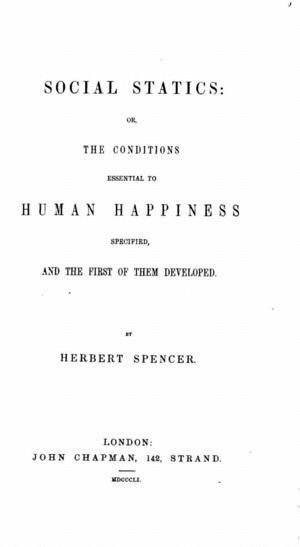
Social Statics: or, The Conditions essential to Happiness specified, and the First of them Developed, (London: John Chapman, 1851).

About Liberty Fund:

Liberty Fund, Inc. is a private, educational foundation established to encourage the study of the ideal of a society of free and responsible individuals.


CHAPTER XXI.

the duty of the state.

§ 1.

As already said (pp. 207 and 208), morality stands towards government only in the nature of a limitation—behaves negatively with regard to it, not positively—replies to all inquiries by silently indicating the conditions of existence, constitution, and conduct, under which alone it may be ethically tolerated. And thus, ignoring government altogether, the moral law can give us no direct information as to what a government ought to do—can merely say what it ought not to do. That we are left with no precise knowledge beyond this, may indeed be inferred from a preceding chapter. For if, as was shown, every man has a right to secede from the state, and if, as a consequence, the state must be regarded as a body of men voluntarily associated, there remains nothing to distinguish it in the abstract from any other incorporated society—nothing to determine its specific function; and we may conceive its members assigning to it any function that does not involve a breach of the moral law.

Immediate guidance in this matter being thus impossible, we must follow such indirect ways of arriving at the truth as are open to us. The question is no longer one of pure ethics, and is therefore incapable of solution by any exact methods: approximative ones only are available. Fortunately there are several of these; and converging as they do to the same conclusion, that conclusion assumes something like the character of certainty. Let us now successively employ them.

§ 2.

Good, and perfect, and complete, are words applicable to whatever is thoroughly fitted to its purpose; and by the word moral we signify the same property in a man. A thing which entirely answers its end cannot be improved; and a man whose nature leads him to a spontaneous fulfilment of the Divine will cannot be conceived better. To be quite self-sufficing—to have powers exactly commensurate with what ought to be done, is to be organically moral. Given the ordained object—happiness; given the conditions under which this happiness is to be compassed; and perfection consists in the possession of faculties exactly adapted to these conditions: whilst the moral law is simply a statement of that line of conduct by which the conditions are satisfied. Hence to the rightly-constituted man all external help is needless—detrimental even. Just as the healthy body wants no crutch, tonic, or stimulus, but has within itself the means of doing everything required of it, so the normally-developed character asks no artificial aids; and indeed repudiates them as pre-occupying the sphere for the exercise of faculties which the hypothesis supposes it to have. When, on the other hand, man’s constitution and the conditions of his existence are not in harmony there arise external agencies to supply the place of deficient internal faculties. And these temporary substitutes being supplementary to the faculties, and assisting the imperfect man as they do to fulfil the law of his being—the moral law, as we call it—obtain a certain reflex authority from that law, varying with the degree in which they subserve its requirements. Whatever may be its special function, it is clear that government is one of these artificial aids; and the most important of them.

Or the case may perhaps be more clearly stated thus:—If government has any duty at all, that duty must be to perform a service of some kind—to confer a benefit. But every possible benefit or service which can be rendered to a man is comprehended under the general expression of assisting him to fulfil the law of his being. Whether you feed the hungry, or cure the diseased, or defend the weak, or curb the vicious, you do but enable or constrain them to conform to the conditions of complete happiness more nearly than they would otherwise do. And causing conformity to the conditions of complete happiness is causing conformity to the moral law. If, therefore, all benefits that can be conferred on men are aids to the fulfilment of the moral law, the benefits to be conferred by government must be of this nature.

So much being conceded, let us next inquire how the moral law may be most essentially subserved. Practicability manifestly underlies performance. That which makes an act feasible must take precedence of the act itself. Before the injunction—Do this, there necessarily comes the postulate—It can be done. Before establishing a code for the right exercise of faculties, there must be established the condition which makes the exercise of faculties possible. Now, this condition which makes the exercise of faculties possible is—power to pursue the objects on which they are to be exercised—the objects of desire; and this is what we otherwise call liberty of action—freedom. But that which makes the exercise of faculties possible, is that which makes the fulfilment of the moral law possible. And freedom being thus the grand pre-requisite to the fulfilment of the moral law, it follows that if a man is to be helped in fulfilling the moral law, the first thing to be done is to secure to him this all-essential freedom. This aid must come before any other aid—is, in fact, that which renders any other aid practicable; for no faculty to which liberty of action is denied can be assisted in the performance of its function until liberty of action has been restored. Of all institutions, therefore, which the imperfect man sets up as supplementary to his nature, the chief one must have for its office to guarantee his freedom. But the freedom that can be guaranteed to each is bounded by the like freedom to be guaranteed to all others. This is necessitated both by the moral law and by the simultaneous claims made upon the institution itself by its clients. Hence we must infer that it is the function of this chief institution which we call a government, to uphold the law of equal freedom.

To determine the duty of the state by reverting to a supposed understanding entered into by the founders of society—a social contract—we have already seen to be impracticable (p. 200). Men did not deliberately establish political arrangements, but grew into them unconsciously—probably had no conception of an associated condition until they found themselves in it. Moreover, were the hypothesis of an original agreement reasonable, it could not help us; for it would be folly to assume that the duties imposed by a horde of savages on their chief, or council of chiefs, must necessarily be the duties of governments throughout all time. Nevertheless, if, instead of speculating as to what might have happened during the infancy of civilization, we consider what must have happened, something may be learnt. On turning to page 203, the reader will find it argued at length that for men to have remained in the associated state implies that on the whole they found it preferable to the isolated one; which means that they obtained a greater sum total of gratification under it; which means that it afforded them fuller exercise for their faculties; which means that it offered a safer guarantee for such exercise—more security for their claims to life and property; that is, for their rights. But if men could have continued in the associated state only because on the average it insured their rights better than the previous one, then the insurance of their rights becomes the special duty which society in its corporate capacity has to perform towards individuals. That function by which a thing begins to exist we may safely consider its all-essential function. Now, whilst those many aids to gratification which civilization has brought us were yet undeveloped, society must have existed only because it protected its members in the pursuit of those things which afford satisfaction to the faculties. But to protect men in the pursuit of those things which afford satisfaction to the faculties is to maintain their rights. And if it was by maintaining the rights of its members that society began to be, then to maintain their rights must ever be regarded as its primary duty.

Further confirmation may be drawn from the universal practice of mankind in this matter. Widely as people have differed respecting the proper bounds of legislative superintendence, all have held them to include the defence of the subject against aggression. Whilst, in various countries and times, a hundred different functions have been assigned to the state—whilst there have probably been no two governments that have entirely agreed in the number and nature of their functions—whilst the things specially attended to by some have been wholly neglected by others, and thereby proved non-essential, there is one office—that of protector—which has been common to them all. Did this fact stand alone it might by a stretch of incredulity be construed into an accident. But coinciding as it does with the foregoing inferences drawn from the nature of man’s constitution and the necessary origin of society, we may safely take it as a further evidence that the duty of the state is—to protect—to enforce the law of equal freedom; to maintain men’s rights, or, as we commonly express it—to administer justice.

§ 3.

The question—What is the thing to be done by a government? being answered, there arises the other—Which is the most efficient mode of doing it? To the proposition—the administration of justice is the special duty of the state, there hangs the corollary—the state ought to employ the best methods of fulfilling that duty; and this brings us to the inquiry—What are they?

By our hypothesis the connection of each individual with the community as politically organized, must be voluntary. In virtue of its very office an institution which proposes to guarantee a man’s freedom to exercise his faculties, can only tender its services to him; cannot coerce him into the acceptance of them. If it does it becomes self-contradicting—vio. lates that very freedom which it proposes to maintain. Citizenship then being willingly assumed, we must inquire what agreement is thereby tacitly entered into between the state and its members. Two things are conceivable. There may either be an understanding that whoever applies to the judicial power for assistance shall defray the costs thereupon incurred by it on his behalf, or it may be provided that the payment of a constant contribution towards the expenses of this judicial power shall entitle the contributor to its services whenever he needs them. The first of these arrangements does not seem altogether practicable; the other is one to which existing systems partially assimilate. In either case, however, it is taken for granted that the parties will duly fulfil their promises; that equivalents of protection and taxation shall be exchanged; that, on the one side, if the individual chooses to avail himself of state guardianship, he shall not refuse his fair share of state burdens; and on the other, that when the state has imposed the burdens it shall not withhold the guardianship.

Self-evident as is this interpretation of the agreement, which citizenship presupposes, judicial practice is but little guided by it. Our system of jurisprudence takes a very one-sided view of the matter. It is indeed stringent enough in enforcing the claim of the state against the subject; but as to the reciprocal claim of the subject against the state it is comparatively careless. That it recognises the title of the tax-payer to protection is true; but it is also true that it does this but partially. From certain infringements of rights, arbitrarily classed as criminal, it is ready to defend every complainant; but against others, not so classed, it leaves every one to defend himself. The most trifling injury, if inflicted in a specified manner, is cognizable by the magistrate, and redress may be obtained free of charge; but if otherwise inflicted, the injury, no matter how serious, must be passively borne, unless the sufferer has plenty of money and a sufficiency of daring. Let a man have his hat knocked over his eyes, and the law will zealously espouse his cause—will mulct his assailant in a fine and costs, and will do this without charge. But if, instead of having been bonneted, he has been wrongfully imprisoned, he is politely referred to a solicitor, with the information that the offence committed against him is actionable: which means, that if rich he may play double or quits with Fate; and that if poor he must go without even this chance of compensation. Against picking of pockets, as ordinarily practised, the ruling power grants its lieges gratuitous protection; but pockets may be picked in various indirect ways, and it will idly look on unless costly means are taken to interest it. It will rush to the defence of one who has been deprived of a few turnips by a half-starved tramp; but as to the estate on which these turnips grew, that may be stolen without risk, so long as the despoiled owner is left friendless and pennylessa . Some complaints need only to be whispered, and it forthwith plays the parts of constable, lawyer, judge, and gaoler; whilst to others it turns a deaf ear unless they are made through its bribed hangers-on. Now it is the injured man’s champion; and now it throws down its weapons to sit as umpire, whilst oppressor and oppressed run a tilt at each other. Over such and such portions of a citizen’s rights it mounts guard and cries—“Who goes there?” to every intruder; but upon the rest any one may trample without fear of being challenged by it.

To a man with perceptions unblunted by custom, this mode of carrying out the agreement subsisting between himself and the state, would seem strange enough. It is not impossible that he might call the transaction a swindle; might argue that his property had been taken from him under false pretences. “To what purpose,” he might ask, “did I submit myself to your laws, if I am now to be denied the advantages promised in return? Have I not complied with all the stipulations? You demanded allegiance, and I gave it. You said money was needful, and I paid the uttermost farthing of your exactions, heavy as they were. You required me to fulfil certain civil functions, and I fulfilled them cheerfully. Yet now when I ask you to give me that for which I made these sacrifices, you shuffle. I supposed you were to act the part of an Arguseyed and Briareus-armed guardian, ever watching over my interests, ever ready to step in and defend them; so that whether sleeping or waking, absorbed in business or immersed in pleasure, I might have the gratifying consciousness of being carefully shielded from injury. Now, however, I find, not only that my rights may be trespassed upon in many ways without attracting your notice, but that even when I tell you I have been wronged, and demand your interposition, you shut the door in my face, and will not listen until I have exorbitantly feed some of the servants who have access to your private ear. What am I to understand by this? Is it that your revenue is insufficient to defray the cost of dispensing justice in all cases? If so, why not say as much, and let us increase it? Is it that you cannot accomplish what you profess? If so, declare candidly what you are able to do, and what not. But at any rate let us have some intelligible understanding, and not this jumble of contradictions—this conflict of promise and performance—this taking of the pay without doing the duty.”

§ 4.

That men should sit down so apathetically as they do under the present corrupt administration of justice, is not a little remarkable. That we, with all our jealousy of abuses; with all our opportunities of canvassing, blaming, and amending the acts of the legislature; with all our readiness to organize and agitate; with the Anti-Corn-Law, Slavery-Abolition, and Catholic-Emancipation victories fresh in remembrance; that we, the independent, determined, self-ruling English, should daily behold the giant abominations of our judicial system, and yet do nothing to rectify them, is really quite incomprehensible. It is not as though the facts were disputed; all men are agreed upon them. The dangers of law are proverbial. The names of its officers are used as synonymes for trickery and greediness. The decisions of its courts are typical of chance. In all companies you hear but one opinion, and each person confirms it by a fresh illustration. Now you are informed of £300 having been expended in the recovery of forty shillings’ worth of property; and again of a cause that was lost because an affirmation could not be received in place of an oath. A right-hand neighbour can tell you of a judge who allowed an indictment to be objected to, on the plea that the words, “in the year of our Lord,” were not inserted before the date; and another to your left narrates how a thief lately tried for stealing a guinea-pig was acquitted, because a guinea-pig was shown to be a kind of rat, and a rat could not be property. At one moment the story is of a poor man whose rich enemy has deliberately ruined him by tempting him into litigation; and at the next it is of a child who has been kept in prison for six weeks, in default of sureties for her appearance as witness against one who had assaulted hera . This gentleman has been cheated out of half his property, but dared not attempt to recover it for fear of losing more; whilst his less prudent companion can parallel the experience of him who said that he had only twice been on the verge of ruin; once when he had lost a law-suit, and once when he had gained one. On all sides you are told of trickery and oppression, and revenge, committed in the name of justice; of wrongs endured for want of money wherewith to purchase redress; of rights unclaimed because contention with the powerful usurper was useless; of chancery-suits that outlasted the lives of the suitors; of fortunes swallowed up in settling a title; of estates lost by an informality. And then comes a catalogue of victims—of those who have trusted and been deceived; gray-headed men whose hardly-earned savings went to fatten the attorney; threadbare and hollow-cheeked insolvents who lost all in the attempt to get their due; some who had been reduced to subsist on the charity of friends; others who had died the death of a pauper; with not a few whose anxieties had produced insanity, or who in their desperation had committed suicide. Yet, whilst all parties echo each others’ exclamations of disgust, these iniquities continue unchecked!

§ 5.

There are not wanting, however, men who defend this state of things—who actually argue that government should perform but imperfectly what they allow to be its special function. Whilst, on the one hand, they admit that administration of justice is the vital necessity of civilized life, they maintain, on the other, that justice may be administered too well! “For,” say they, “were law cheap, all men would avail themselves of it. Did there exist no difficulty in obtaining justice, justice would be demanded in every case of violated rights. Ten times as many appeals would be made to the authorities as now. Men would rush into legal proceedings on the slightest provocation; and litigation would be so enormously increased as to make the remedy worse than the disease.”

Such is the argument; an argument involving either a gross absurdity or an unwarrantable assumption. For observe: when this great multiplication of law proceedings under a gratuitous administration of justice is urged as a reason why things should remain as they are, it is implied that the evils attendant upon the rectification of all wrongs, would be greater than are the evils attendant upon submission to those wrongs. Either the great majority of civil aggressions must be borne in silence as now, or must be adjudicated upon as then; and the allegation is that the first alternative is preferable. But if ten thousand litigations are worse than ten thousand injustices, then one litigation is worse than one injustice. Which means that, as a general principle, an appeal to the law for protection is a greater evil than the trespass complained of. Which means that it would be better to have no administration of justice at all! If for the sake of escaping this absurdity it be assumed that, as things now are, all great wrongs are rectified,—that the costliness of law prevents insignificant ones only from being brought into court, and that consequently the above inference cannot be drawn,—then, either denial is given to the obvious fact that, by the poverty they inflict, many of the greatest wrongs incapacitate their victims from obtaining redress, and to the obvious fact that the civil injuries suffered by the masses, though absolutely small, are relatively great; or else it is taken for granted that on nine-tenths of the population, who are too poor to institute legal proceedings, no civil injuries of moment are ever inflicted!

Nor is this all. It is not necessarily true that making the law easy of access would increase litigation. An opposite effect might be produced. The prophecy is vitiated by that very common mistake of calculating the result of some new arrangement on the assumption that all other things would remain as they are. It is taken for granted that under the hypothetical regime just as many transgressions would occur as at present. Whereas any candid observer can see that most of the civil offences now committed, are committed in consequence of the inefficiency of our judicial system;

“For sparing justice feeds iniquity.”

It is the difficulty that he knows there will be in convicting him which tempts the knave to behave knavishly. Were not the law so expensive and so uncertain, dishonest traders would never risk the many violations of it they now do. The trespasses of the wealthy against the poor would be rare, were it not that the aggrieved have practically no remedy. Mark how, to the man who contemplates wronging his fellow, our legal system holds out promises of impunity. Should his proposed victim be one of small means, there is the likelihood that he will not be able to carry on a law-suit: here is encouragement. Should he possess enough money, why, even then, having, like most people, a great dread of litigation, he will probably bear his loss unresistingly: here is further encouragement. Lastly, our plotter remembers that, should his victim venture an action, judicial decisions are very much matters of accident, and that the guilty are often rescued by clever counsel: here is still more encouragement. And so, all things considered, he determines to chance it. Now, he would never decide thus were legal protection efficient. Were the administration of law prompt, gratuitous, and certain, those probabilities and possibilities which now beckon him on to fraudulent acts would vanish. Civil injuries wittingly committed would almost cease. Only in cases where both parties sincerely believed themselves right, would judicial arbitration be called for; and the number of such cases is comparatively small. Litigation, therefore, so far from increasing on justice being made easy of obtainment, would probably decrease.

§ 6.

But, after all, it is not the setting up of this or that system of jurisprudence which causes the intercourse of men with each other to be equitable or otherwise. The matter lies deeper. As with forms of government, so with forms of law; it is the national character that decides. The power of an apparatus primarily depends, not on the ingenuity of its design, but on the strength of its materials. Be his plan never so well devised—his arrangement of struts, and ties, and bolts, never so good—his balance of forces never so perfect—yet if our engineer has not considered whether the respective parts of his structure will bear the strain to be put upon them, we must call him a bungler. Similarly with the institution-maker. If the people with whom he has to deal are not of the requisite quality, no cleverness in his contrivance will avail anything. Let us never forget that institutions are made of men; that men are the struts, ties, and bolts, out of which they are framed; and that, dovetail and brace them together as we may, it is their nature which must finally determine whether the institutions can stand. Always there will be some line of least resistance, along which, if the humanity they are wrought out of be not strong enough, they will give way; and having given way, will sink down into a less trying attitude. Thus it is, amongst other things, with judicial mechanisms. No matter how admirably devised, their results will be good only in proportion as the nation is good. The instrumentalities by which they are to act—judges, juries, constables, witnesses, gaolers, and the rest—must be units of the people—will, on the average, be marked by the same imperfections as the people; and though the system they are set to work out be perfect, yet will the badness of their characters degrade its acts down to a level with the general conduct of society.

That justice can be well administered only in proportion as men become just, is a fact too generally overlooked. “If they had but trial by jury!” says some one, moralizing on the Russians. But they can’t have it. It could not exist amongst them. Even if established it would not work. They lack that substratum of honesty and truthfulness on which alone it can stand. To be of use, this, like any other institution, must be born of the popular character. It is not trial by jury that produces justice, but it is the sentiment of justice that produces trial by jury, as the organ through which it is to act; and the organ will be inert unless the sentiment is there. These social forms which we regard as so potential, are things of quite secondary importance. What mattered it that the Roman plebeians were endowed with certain privileges, when the patricians prevented them from exercising those privileges by ill-treatment carried even to the death? What mattered it that our statute-book contained equitable provisions, and that officers were appointed to enforce them, when there needed a Magna Charta to demand that justice should neither be sold, denied, nor delayed? What matters it even now, that all men are declared equal before the law, when magistrates are swayed by class sympathies, and treat a gentleman more leniently than an artizan? If we think that we can rectify the relationships of men at will, we deceive ourselves. What Sir James Mackintosh says of constitutions—that they are not made, but grow, applies to all social arrangements. It is not true that once upon a time men said—“Let there be law”; and there was law. Administration of justice was originally impracticable, Utopian; and has become more and more practicable only as men have become less savage. The old system of settling disputes by personal contest, and the new system of settling them by state arbitration, have coexisted throughout all ages; the one little by little usurping the place of the other, outgrowing it. It was only after some advance had been made that the civil power could get recognised at all as a maintainer of rights. The feudal baron with castle and retainers maintained his own rights, and would have considered himself disgraced by asking legal aid. Even after he had agreed to regard his suzerain as umpire, it was still in the lists, and by the strength of his arm and his lance, that he made good his cause. And when we remember that equally amongst lords and labourers this practice lingers even now—that we have still duels, which it is thought dishonourable for a gentleman to avoid by applying to a magistrate—that we have still pugilistic fights, which the people try to hide from the police—we are taught that it is impossible for a judicial system to become efficient faster than men become good. It is only after public morality has gained a certain ascendancy, that the civil power gets strong enough to perform its simplest functions. Before this it cannot even put down banditti; border forays continue in spite of it; and it is bearded in its very strongholds, as, amongst ourselves, by the thieves of Whitefriars but two centuries ago. Under early governments the officers of law are less friends than enemies. Legal forms are habitually used for purposes of oppression. Causes are decided by favouritism, bribery, and back-stairs intrigue. The judicial apparatus breaks down under the work it has to do, and shows us in a Jonathan Wild, a Judge Jeffries, and even a Lord Chancellor Bacon, how inevitably its several parts are rendered inoperative by a generally-diffused wickedness.

Of course the efficiency of present and future systems of jurisprudence must be determined by the same influences. Of our own legal arrangements we may say, what Emerson has well said of institutions generally—that they are about as good as the characters of men permit them to be. When we read of Orange magistrates who become aggressors rather than protectors; of policemen who conspire with each other to obtain convictions that they may be promoted; and of the late Palace Court, whose officers habitually favoured the plaintiff with the view of inducing men to enter suits there, we find that now, as of old, judicial protection is vitiated by the depravity of the age. Nevertheless it is probable that we are ripe for something better than we have. The universal disgust with which law is regarded, may be taken as evidence of this—as evidence, moreover, that a change is at hand. But it is not likely that the mode of administering justice lately pointed out as the proper one is immediately feasible; seeing that men, by not having yet even recognised it as theoretically right, show themselves considerably below the state to which it is natural. This, however, is no reason for not advocating its adoption. For, what was said in the last chapter respecting an equitable form of government, may be here said respecting an equitable system of law; that the power quietly to establish it is the measure of its practicability.

§ 7.

By dispersing that haze of political superstition through which the state and its appendages loom so large, the foregoing considerations suggest a somewhat startling question. For if when men’s savageness and dishonesty render the administration of justice most necessary, it is impossible; if it becomes possible only in proportion as men themselves become just; and if that same universal uprightness, which permits the administration of justice to become perfect, also makes it needless, as it evidently must, then we may naturally ask—Can the state really administer justice at all? Does it, looking at society as a whole, secure to the people any fuller enjoyment of their rights than they would have without it? May we not conclude that it takes away from men’s liberties in one direction, as much as it gives in another? Is it not a mere dead mechanism worked by a nation’s moral sense; neither adding to, nor deducting from, the force of that moral sense; and consequently unable to alter the sum-total of its effects?

A strange idea, this, some will think; and so at first sight it seems. We have such a habit of regarding government in its protective character, and forgetting its aggressive one, that to ask whether the rights it secures are not about balanced by the rights it violates, seems almost laughable. Nevertheless we shall find that on drawing up a debtor and creditor account, the absurdity of the doubt disappears. Passing over those ruling powers of the East, which, in return for the small amount of security they guarantee, are in the habit of confiscating, under one pretence or other, any property not efficiently concealed by the unfortunate owners, and which, in some cases, push their exactions so far as to have to give back for seed in the spring a part of that crop they had taken from the husband-man at the previous harvest—passing over, too, those middle-age systems of government under which protection, such as it was, had to be purchased by the resignation of personal freedom, let us institute as favourable a comparison as possible. Let us take the relatively good governments we now know, and setting down on the one side the benefits conferred, and on the other the evils inflicted, let us strike a balance between them. Under the head of obligations may be entered the efficient curb which our police system puts upon offences against person and property; our courts of law, too, with all their defects, afford a partial defence against civil injuries which needs setting down in the estimate; and to these must be added what far outweigh them both—that sense of habitual security, and that consequent ability to fearlessly carry on the business of life, which are produced by the mere presence of an active civil power. Even after deducting from these a heavy discount on the score of shortcomings, there unquestionably remains a large surplus of benefit for which the state may claim credit. Turn we now to the per contra statement. As the first item on the list there stands that gigantic injustice inflicted upon nineteen-twentieths of the community by the usurpation of the soil—by the breach of their rights to the use of the earth (Chap. IX.). For this the civil power is responsible—has itself been a party to the aggression—has made it legal, and still defends it as right. Next comes the trespass committed against the many by subordinating them to the few, and forcing them to obey laws to which their consent was never asked. Note again the tyrannies accompanying national defence—the impressments and militiadrawings, the continuous abnegation of liberty in the persons of soldiers and sailors, ending not unfrequently in the sacrifice of their lives. Remember also how our rights are trenched upon by commercial restrictions; and how men are not only prevented from buying and selling where they please, but are debarred from following certain occupations until they have bought government permits. Nor let us forget the penalties that until lately so seriously transgressed religious freedom—penalties which, as the Anti-State-Church Association can show, have by no means disappeared. And all these, together with the many minor restrictions hedging us about, are accompanied by those never-ceasing incursions made upon our property by the tax-gatherer and the officers of customs and excise, by poorrate collectors and churchwardens. Measuring wrongs, as we must, by the degree in which they limit the exercise of faculties, let us now add up the two accounts and contrast their sum-totals. On the one side government partially saves us (only partially, mind) from those assaults, robberies, murders, cheatings, and kindred injuries, to which, were there no such institution, the existing immorality of men would expose us. These we must imagine to be distributed over the community at large, and over the life of each citizen, and then conceive to what average restriction on the free exercise of faculties they would be equivalent. On the other side government itself transgresses men’s liberties by the monopoly of land, by the usurpation of power, by restrictions on trade, by the slavery and death of thousands of soldiers, by the ruin of hundreds it ought to protect, by favouritism to creeds and classes, by the civil functions it makes imperative, by petty restraints too numerous to name, but above all by a remorseless taxation, which, affecting seven-eighths of the nation as it does by abstracting a large percentage from earnings already insufficient for necessaries, virtually obliterates, in great measure, the spheres needed for the development of their natures. We have now to suppose these manifold limitations to the free exercise of faculties averaged like the others, and then to ask ourselves whether the two averages are, or are not, equal. Is the question after all so very irrational? Is not the answer doubtful?

Nay, indeed; consider it rightly and the answer is not at all doubtful. It is very certain that government can not alter the total amount of injustice committed. The absurdity is in supposing that it can—in supposing that by some ingenious artifice we may avoid the consequences of our own natures. The civil power no more does what to the careless eye it seems to do, than the juggler really performs his apparent miracles. It is impossible for man to create force. He can only alter the mode of its manifestation, its direction, its distribution. The power that propels his steamboats and locomotives is not of his making; it was all lying latent in the coal. He telegraphs by an agent set free during the oxidation of zinc; but of which no more is obtained than is due to the number of atoms that have combined. The very energy he expends in moving his arm is generated by the chemical affinities of the food he eats. In no case can he do anything but avail himself of dormant forces. This is as true in ethics as in physics. Moral feeling is a force—a force by which men’s actions are restrained within certain prescribed bounds; and no legislative mechanism can increase its results one iota. By how much this force is deficient, by so much must its work remain undone. In whatever degree we lack the qualities needful for our state, in the same degree must we suffer. Nature will not be cheated. Whoso should think to escape the influence of gravitation by throwing his limbs into some peculiar attitude, would not be more deceived than are those who hope to avoid the weight of their depravity by arranging themselves into this or that form of political organization. Every jot of the evil must in one way or other be borne—consciously or unconsciously; either in a shape that is recognised, or else under some disguise. No philosopher’s stone of a constitution can produce golden conduct from leaden instincts. No apparatus of senators, judges, and police, can compensate for the want of an internal governing sentiment. No legislative manipulation can eke out an insufficient morality into a sufficient one. No administrative sleight of hand can save us from ourselves.

But must not this imply that government is of no use whatever? Not at all. Although unable to alter the sum-total of injustice to be supported, it can still alter its distribution. And this is what it really does. By its aid, men to a considerable extent equalize the evil they have to bear—spread it out more uniformly over the whole community, and over the life of each citizen. Entire freedom to exercise the faculties, interrupted by entire deprivations of it, and marred by the perpetual danger of these deprivations, is exchanged for a freedom on which the restrictions are constant but partial. Instead of those losses of life, of limb, or of the means of subsistence, which, under a state of anarchy, all are liable to, and many suffer, a political organization commits universal aggressions of a comparatively mild type. Wrongs that were before occasional, but crushing, are now unceasing, but bearable. The system is one of mutual assurance against moral disasters. Just as men, whilst they cannot prevent fires and shipwrecks, can yet guarantee each other against ruin from these, by bearing them in common, and distributing the injuries entailed over long periods of time; so, although by uniting together for judicial purposes men cannot diminish the amount of injustice to be borne, they can, and do, insure themselves against its otherwise fatal results.

§ 8.

When we agreed that it was the essential function of the state to protect—to administer the law of equal freedom—to maintain men’s rights—we virtually assigned to it the duty, not only of shielding each citizen from the trespasses of his neighbours, but of defending him, in common with the community at large, against foreign aggressions. An invading force may violate people’s rights as much as, or far more than, an equal body of felons; and our definition requires that government shall resist transgression in the one case as much as in the other. Protection,—this is what men seek by political combination; and whether it be against internal or external enemies matters not. Unquestionably war is immoral. But so likewise is the violence used in the execution of justice; so is all coercion. Ethical law is as certainly broken by the deeds of judicial authorities as by those of a defensive army. There is, in principle, no difference whatever between the blow of a policeman’s baton and the thrust of a soldier’s bayonet. Both are infractions of the law of equal freedom in the persons of those injured. In either case we have force sufficient to produce submission; and it matters not whether that force be employed by a man in red or by one in blue. Policemen are soldiers who act alone: soldiers are policemen who act in unison. Government employs the first to attack in detail ten thousand criminals who separately make war upon society; and it calls in the last when threatened by a like number of criminals in the shape of drilled troops. Resistance to foreign foes and resistance to native ones having consequently the same object—the maintenance of men’s rights, and being effected by the same means—force, are in their nature identical, and no greater condemnation can be passed upon the one than upon the other. The doings of the battle-field merely exhibit in a concentrated form that immorality which is inherent in government, and attaches to all its functions. What is so manifest in its military acts is true of its civil acts, that it uses wrong to put down wrong.

Defensive warfare (and of course it is solely to this that the foregoing argument applies) must therefore be tolerated as the least of two evils. There are indeed some who unconditionally condemn it, and would meet invasion by non-resistance. To such there are several replies.

First, consistency requires them to behave in like fashion to their fellow-citizens. They must not only allow themselves to be cheated, assaulted, robbed, wounded, without offering active opposition, but must refuse help from the civil power; seeing that they who employ force by proxy, are as much responsible for that force as though they employed it themselves.

Again, such a theory makes pacific relationships between men and nations look needlessly Utopian. If all agree not to aggress, they must as certainly be at peace with each other as though they had all agreed not to resist. So that, whilst it sets up so difficult a standard of behaviour, the rule of non-resistance is not one whit more efficient as a preventive of war, than the rule of non-aggression.

Moreover this principle of non-resistance is not deducible from the moral law. The moral law says—Do not aggress. It cannot say—Do not resist; for to say this would be to presuppose its own precepts broken. As explained at the outset (Chap. I.), Morality describes the conduct of perfect men; and cannot include in its premises circumstances that arise from imperfection. That rule which attains to universal sway when all men are what they ought to be, must be the right rule, must it not? And that rule which then becomes impossible of fulfilment must be the wrong one? Well; in an ideal state the law of non-aggression is obeyed by all—is the vital principle of every one’s conduct—is fully carried out, reigns, lives; whereas in such a state the law of non-resistance necessarily becomes a dead letter.

Lastly, it can be shown that non-resistance is absolutely wrong. We may not carelessly abandon our rights. We may not give away our birthright for the sake of peace. If it be a duty to respect other men’s claims, so also is it a duty to maintain our own. That which is sacred in their persons is sacred in ours also. Have we not a faculty which makes us feel and assert our title to freedom of action, at the same time that, by a reflex process, it enables us to appreciate the like title in our fellows? Did we not find that this faculty can act strongly on behalf of others, only when it acts strongly on our own behalf (p. 98)? And must we assume that, whilst its sympathetic promptings are to be diligently listened to, its direct ones are to be disregarded? To suppose this, is to suppose an incurable defect in our moral constitution—is to suppose that the very sentiment intended to lead us will itself mislead us. No: we may not be passive under aggression. In the due maintenance of our claims is involved the practicability of all our duties. Without liberty of action, without rights, we cannot fully exercise our faculties; and if we cannot fully exercise our faculties we cannot fulfil the Divine will; and if we allow ourselves to be deprived of that without which we cannot fulfil the Divine will, we virtually neglect that will.

But how, if all coercion is immoral? Will it not follow that it is immoral to use violence in opposing a trespasser? Certainly. Then either alternative is wrong? Just so: the law of right conduct has been broken, and this dilemma is the consequence. Action and reaction are equal. The blow dealt at morality in the person of the injured cannot end with itself: there must be a corresponding recoil. The first evil gives rise to an equivalent second, whether it is met by resistance or not. The assertion looks strange—will perhaps be incredible to many; nevertheless it must be made. And all we can say of this seeming paradox is, that it shows how actions lapse into a moral chaos when once the equilibrium of men’s relationships is destroyed.

Thus we find that the principle of non-resistance is not ethically true, but only that of non-aggression—that hence a government is justified in taking up a defensive attitude towards foreign enemies—and that the abstract criminality undoubtedly attaching to such a proceeding is the same criminality which pervades the administration of justice, is the same criminality of which government is itself a consequence.

§ 9.

Of international arbitration we must say, as of a free constitution, or a good system of jurisprudence, that its possibility is a question of time. The same causes which once rendered all government impossible have hitherto forbidden this widest extension of it. A federation of peoples—a universal society, can exist only when man’s adaptation to the social state has become tolerably complete. We have already seen (p. 197), that in the earliest stage of civilization, when the repulsive force is strong, and the aggregative force weak, only small communities are possible; a modification of character causes these tribes, and satrapies, and gentes, and feudal lordships, and clans, gradually to coalesce into nations; and a still further modification will allow of a still further union. That the time for this is now drawing nigh, seems probable. We may gather as much from the favour with which such an arrangement is regarded. The recognition of its desirableness foreshadows its realization. In peace societies, in proposals for simultaneous disarmment, in international visits and addresses, and in the frequency with which friendly interventions now occur, we may see that humanity is fast growing towards such a consummation. Though hitherto impracticable, and perhaps impracticable at the present moment, a brotherhood of nations is being made practicable by the very efforts used to bring it about. These philanthropic enthusiasms, which the worldly-wise think so ridiculous, are essential parts of the process by which the desideratum is being wrought out. Perhaps no fact is more significant of the change going on than the spread of that non-resistance theory lately noticed. That we should find sprinkled amongst us, men, who from the desire to receive this ultra-humane doctrine do violence to their perceptions of what is due to themselves, cannot but afford matter for congratulation. Unsound as the idea may be, its origin is good. It is a redundant utterance of that sympathy which transforms the savage man into the social man, the brutal into the benevolent, the unjust into the just; and, taken in conjunction with other signs of the times, prophesies that a better relationship between nations is approaching. Meanwhile, in looking forward to some all-embracing federal arrangement, we must keep in mind that the stability of so complicated a political organization depends, not upon the fitness of one nation but upon the fitness of many.

[a]It is true that a plaintiff who can swear that he is not worth £5 may sue in formâ pauperis. But this privilege is almost a dead letter. Actions so instituted are usually found to fail, because those who conduct them, having to plead gratuitously, plead carelessly.

[a]The case occurred at Winchester in July, 1849.