EconlibThe LibraryOther Sites |
Front Page Titles (by Subject) PART III. - Social Statics
Return to Title Page for Social StaticsThe Online Library of LibertyA project of Liberty Fund, Inc.Search this Title:Also in the Library:
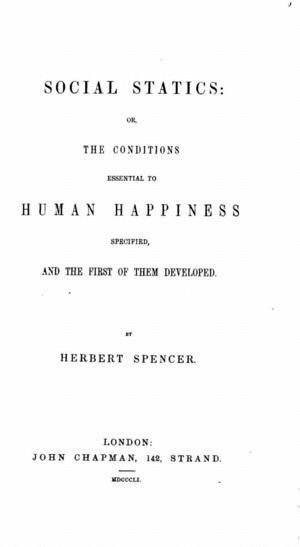
PART III. - Herbert Spencer, Social Statics [1851]Edition used:Social Statics: or, The Conditions essential to Happiness specified, and the First of them Developed, (London: John Chapman, 1851).
About Liberty Fund:Liberty Fund, Inc. is a private, educational foundation established to encourage the study of the ideal of a society of free and responsible individuals. Copyright information:The text is in the public domain. Fair use statement:This material is put online to further the educational goals of Liberty Fund, Inc. Unless otherwise stated in the Copyright Information section above, this material may be used freely for educational and academic purposes. It may not be used in any way for profit.
PART III.CHAPTER XVIII.political rights.§ 1.Our principle is the primordial one. It is the first pre-requisite to the realization of the Divine will. Every mode of interpreting that will points to this as the all-essential condition of its fulfilment. If we start with an à priori view of creative design, we are immediately led to the law of equal freedom (Chap. III). Do we appeal to the general character of the human constitution? the law of equal freedom is its corollary (Chap. IV). And when, pursuing the examination further, we observe the detailed arrangements of that constitution, we discover a faculty by which the law of equal freedom is recognised and responded to (Chap. V.). Otherwise viewed, this law is seen to be a direct deduction from the necessities of existence: as thus. Life depends upon the performance of certain actions. Abrogate entirely the liberty to exercise the faculties, and we have death: abrogate it partially, and we have pain or partial death. This remains true of man whether he be savage or civilized—isolated or social. And as there must be life before there can be society, this first principle of life must take precedence of the first principle of society—must fix or govern it. Or, speaking definitely, as liberty to exercise the faculties is the first condition of individual life, the liberty of each, limited only by the like liberty of all, must be the first condition of social life. Derived, therefore, as it is, directly from the Divine will, and underlying as it does the right organization of society, the law of equal freedom is of higher authority than all other laws. The creative purpose demands that everything shall be subordinated to it. Institutions and social forms must just marshal themselves as it commands. It dates from the creation; they are of yesterday. It is constant; they are changeable. It appertains to the perfect; they to the imperfect. It is co-enduring with humanity; they may die to-morrow. As surely then as the incidental must bow before the necessary, so surely must all conventional arrangements be subject to the absolute moral law. § 2.Allusion has from time to time been made to a school of politicians, especially claiming for themselves the title of philosophical, who demur to this. They do not recognise any such supreme authority to which all human regulations must bend. Practically, if not professedly, they hold, with Archelaus, that nothing is intrinsically right or wrong; but that it becomes either by the dictum of the state. If we are to credit them government determines what shall be morality; and not morality what shall be government. They believe in no oracular principle by whose yea or nay we may be guided: their Delphi is the House of Commons. By their account man lives and moves and has his being by legislative permit. His freedom to do this or that is not natural, but conferred. The question—Has the citizen any claim to the work of his hands? can only be decided by a parliamentary division. If—the ayes have it,—he has; if—the noes,—he has not. The reader who has arrived thus far, needs not to have the fallacy of this doctrine pointed out. The expediency-system, of which it forms an essential part, has been repeatedly proved untenable, and with it must fall its dependent propositions. And having, moreover, been collaterally refuted in foregoing chapters, the notion that man has no rights save those of government manufacture, might safely be left where it lies. There are, however, additional evidences of its untruth, which it may be as well to state. And first let us inquire how it has originated. § 3.Considering society as a corporate body, we may say that man, when he first enters into it, has the repulsive force in excess, whilst in the cohesive force he is deficient. His passions are strong; his sympathies weak. Those propensities which fitted him for savage life necessarily tend to breed war between himself and his neighbours. His condition has been that of perpetual antagonism; and his antagonistic habits must of course accompany him into the social state. Aggression, dispute, anger, hatred, revenge—these are the several stages of the process by which the members of a primitive community are continually being sundered. Hence the smallness of the first communities. Populations burst as fast as they increase. Races split into tribes; tribes into factions. Only as civilization advances do larger unions become possible. And even these have to pass through some such stage as that of feudalism, with its small chieftainships and right of private war, showing that the tendency to repel is still active. Now, in proportion to the repulsive force subsisting between atoms of matter, must be the restraint required to keep them from exploding. And in proportion to the repulsive force subsisting between the units of a society must be the strength of the bonds requisite to prevent that society from flying to pieces. Some powerful concentrative influence there must be to produce even these smallest unions: and this influence must be strong in proportion to the savageness of the people; otherwise the unions cannot be maintained. Such an influence we have in the sentiment of veneration, reverence for power, loyalty, or, as Carlyle terms it—hero-worship. By this feeling it is, that society begins to be organized; and where the barbarism is greatest, there is this feeling strongest. Hence the fact that all traditions abound in superhuman beings, in giants and demigods. The mythical accounts of Bacchus and Hercules, of Thor and Odin, and of the various divine and half-divine personages who figure in the early histories of all races, merely prove the intensity of the awe with which superiority was once regarded. In that belief of some of the Polynesian Islanders that only their chiefs have souls, we find a still extant example of the almost incredible influence which this sentiment of reverence has over savage men. Through it only does all authority, whether that of ruler, teacher, or priest, become possible. It was alike the parent of beliefs in the miraculous conception of Gengis Khan, in the prophetic characters of Zoroaster, Confucius, and Mahomet, and in the infallibility of the Pope. Where it no longer deifies power, it associates it with divine attributes. Thus it was death for the Assyrian to enter unbidden into the presence of his monarch. The still stationary Orientals ascribe to their emperors celestial relationships. Schamyl, the prophet-chief of the Circassians, is believed to have entire union with the Divine essence. And the Russian soldiers pray for their Czar as—our God upon earth.—The fealty of vassal to feudal lord—the devotion of Highland Celt to chief—were exhibitions of the same feeling. Loyalty it made the brightest virtue, and treason the blackest crime. With the advance of civilization this awe of power diminishes. Instead of looking up to the monarch as a God, it begins to view him as a man reigning by divine authority—as—the Lord’s anointed.—Submission becomes less abject. Subjects no longer prostrate themselves before their rulers, nor do serfs kiss their master’s feet. Obedience ceases to be unlimited: men will choose their own faiths. Gradually, as there grow up those sentiments which lead each to maintain his own rights, and sympathetically to respect the rights of others—gradually as each, thus, by the acquirement of self-restraining power, becomes fitted to live in harmony with his fellow—so gradually do men cease to need external restraint, and so gradually does this feeling which makes them submit to that external restraint decrease. The law of adaptation necessitates this. The feeling must lose power just as fast as it ceases to be needful. As the new regulator grows, the old one must dwindle. The first amelioration of a pure despotism is a partial supplanting of the one by the other. Mixed constitutions exhibit the two acting conjointly. And whilst the one advances to supremacy, the other sinks into decrepitude: divine right of kings is exploded, and monarchical power becomes but a name. Although the adaptation of man to the social state has already made considerable progress—although the need for external restraint is less—and although consequently that reverence for authority which makes restraint possible, has greatly diminished—diminished to such an extent that the holders of power are daily caricatured, and men begin to listen to the National Anthem with their hats on—still the change is far from complete. The attributes of the aboriginal man have not yet died out. We still trench upon each other’s claims—still pursue happiness at each other’s expense. Our savage selfishness is seen in commerce, in legislation, in social arrangements, in amusements. The shopkeeper imposes on his lady customer; his lady customer beats down the shopkeeper Classes quarrel about their respective—interests;—and corruption is defended by those who profit from it. The spirit of caste morally tortures its victims with as much coolness as the Indian tortures his enemy. Gamblers pocket their gains with unconcern: and your share-speculator cares not who loses, so that he gets his premium. No matter what their rank, no matter in what they are engaged—whether in enacting a Corn Law, or in struggling with each other at the doors of a theatre—men show themselves as yet, little else than barbarians in broadcloth. Hence we still require shackles; rulers to impose them; and power-worship to make those rulers obeyed. Just as much as the love of God’s law is deficient, must the fear of man’s law be called in to supply its place. And to the extent that man’s law is needful there must be reverence for it to ensure the necessary allegiance. Hence, as men are still under the influence of this sentiment, we must expect their customs, creeds, and philosophies to testify of its presence. Here, then, we have a rationale of the expediency-idea of government. It is the latest and most refined form assumed by this disposition to exalt the state at the expense of the individual. There have been books written to prove that the monarch’s will should be the subject’s absolute law; and if instead of monarch we read legislature, we have the expediency-theory. It merely modifies—divine right of kings—into divine right of governments. It is despotism democratized. Between that old eastern regime under which the citizen was the private property of his ruler, having no rights at all, and that final state under which his rights will be entire and inviolable, there comes this intermediate state in which he is allowed to possess rights, but only by sufferance of parliament. Thus the expediency-philosophy falls naturally into its place as a phenomenon attending our progress from past slavery to future freedom. It is one of a series of creeds through which mankind have to pass. Like each of its predecessors, it is natural to a certain phase of human development. And it is fated to lose its hold as fast as our adaptation to the social state increases. § 4.It is only by bearing in mind that a theory of some kind being needful for men they will espouse any absurdity in default of something better, that we can understand how Rousseau’s doctrine of Social Contract ever came to be so widely received. This fact remembered, however, the belief in such a doctrine becomes comprehensible. Here were men combined together under government and law. It seemed clear that the arrangement was on the whole a beneficial one. Hence the very natural, though erroneous, conclusion that state-authority was a moral institute. And state-authority being taken for a moral institute, it became needful to account for it, to defend it, to reconcile it with justice and truth. Under which stimulus there suggested itself this theory of a covenant originally entered into between individuals on the one hand, and the community, or agents acting for it, on the other, by which allegiance was agreed to be exchanged for protection; and in virtue of which supposed covenant governments continue to exercise power and demand obedience. That such an explanation should have satisfied the unthinking, is not to be wondered at; but it is passing strange that it should have gained credence amongst educated men. Observe the battery of fatal objections which may be opened upon it. In the first place, the assumption is a purely gratuitous one. Before submitting to legislative control on the strength of an agreement alleged to have been made by our forefathers, we ought surely to have some proof that such agreement was made. But no proof is given. On the contrary, the facts, so far as we can ascertain them, rather imply that under the earliest social forms, whether savage, patriarchal, or feudal, obedience to authority was given unconditionally; and that when the ruler afforded protection it was because he resented the attempt to exercise over one of his subjects a power similar to his own—a conclusion quite in harmony with what we know of oaths of allegiance taken in later times. Again; even supposing the contract to have been made, we are no forwarder, for it has been repeatedly invalidated by the violation of its terms. There is no people but what has from time to time rebelled; and there is no government but what has, in an infinity of cases, failed to give the promised protection. How, then, can this hypothetical contract be considered binding, when, if ever made, it has been broken by both parties? But, granting the agreement, and granting that nothing positive has occurred to vitiate it, we have still to be shown on what principle that agreement, made, no one knows when, by no one knows whom, can be held to tie people now living. Dynasties have changed, and different forms of government have supplanted each other, since the alleged transaction could have taken place; whilst, between the people who are supposed to have been parties to it, and their existing descendants, unnumbered generations have lived and died. So we must assume that this covenant has over and over again survived the deaths of all parties concerned! Truly a strange power this which our forefathers wielded—to be able to fix the behaviour of their descendants for all futurity! What would any one think of being required to kiss the Pope’s toe, because his great- great-great-grandfather promised that he should do so? However, there never was such a contract. If there had been, constant breaches must have destroyed it. And even if undestroyed it could not bind us, but only those who made it. § 5.The self-importance of a Malvolio is sufficiently ludicrous; but we must go far beyond it to parallel the presumption of legislatures. Some steward who, deluded by an intense craving after dominion, and an impudence equal to his craving, should construe his stewardship into proprietorship, would more fitly illustrate it. Were such an one to argue that the estate he was appointed to manage had been virtually resigned into his possession—that to secure the advantages of his administration its owner had given up all title to it—that he now lived on it only by his (the steward’s) sufferance—and that he was in future to receive no emoluments from it, except at his (the steward’s) good pleasure—then should we have an appropriate travesty upon the behaviour of governments to nations; then should we have a doctrine perfectly analogous to this fashionable one, which teaches how men on becoming members of a community, give up, for the sake of certain social advantages, their natural rights. Adherents of this fashionable doctrine will doubtless protest against such an interpretation of it. They have no reasonable cause for doing so, however, as will appear on submitting them to a cross-examination. Suppose we begin it thus:— “Your hypothesis that men, when they entered into the social state, surrendered their original freedom, implies that they entered into such state voluntarily, does it not?” “It does.” “Then they must have considered the social state preferable to that under which they had previously lived?” “Necessarily.” “Why did it appear preferable?” “Because it offered greater security.” “Greater security for what?” “Greater security for life, for property, for the things that minister to happiness.” “Exactly. To get more happiness: that must have been the object. If they had expected to get more unhappiness, they would not have willingly made the change, would they?” “No.” “Does not happiness consist in the due satisfaction of all the desires? in the due exercise of all the faculties?” “Yes.” “And this exercise of the faculties is impossible without freedom of action. The desires cannot be satisfied without liberty to pursue and use the objects of them.” “True.” “Now it is this freedom to exercise the faculties within specific limits, which we signify by the term ‘rights,’ is it not?”(Page 77.) “It is.” “Well, then, summing up your answers, it seems that, by your hypothesis, man entered the social state voluntarily; which means that he entered it for the sake of obtaining greater happiness; which means that he entered it to obtain fuller exercise of his faculties; which means that he entered it to obtain security for such exercise; which means that he entered it for the guaranteeing of his ‘rights.’” “Put your proposition in a more tangible form.” “Very good. If this is too abstract a statement for you, let us attempt a simpler one. You say that a state of political combination was preferred mainly because it afforded greater security for life and property than the isolated state, do you not?” “Certainly.” “Are not a man’s claims to his life and his property amongst what we term his rights; and moreover, the most important of them?” “They are.” “Then to say that men formed themselves into communities to prevent the constant violation of their claims to life and property, is to say that they did it for the preservation of their rights?” “It is.” “Wherefore, either way we find that the preservation of rights was the object sought.” “So it would seem.” “But your hypothesis is that men give up their rights on entering the social state?” “Yes.” “See now how you contradict yourself. You assert that on becoming members of a society, men give up, what by your own showing they joined it the better to obtain!” “Well, perhaps I ought not to have said that they ‘give up’ their rights, but that they place them in trust.” “In whose trust?” “In that of a government.” “A government, then, is a kind of agent employed by the members of a community, to take care of, and administer for their benefit, something given into its charge?” “Exactly.” “And of course, like all other agents, exercises authority only at the will of those who appoint it—performs all that it is commissioned to do subject to their approval?” “Just so.” “And the things committed to its charge still belong to the original owners. The title of the people to the rights they have placed in trust continues valid: the people may demand from this agent the full benefit accruing from these rights; and may, if they please, resume possession of them?” “Not so.” “Not so! What, can they not reclaim their own?” “No. Having once consigned their rights into the keeping of a legislature, they must be content with such use of them as that legislature permits.” And thus we arrive at the curious doctrine above referred to, that the members of a community having entrusted an estate (their rights) to the care of a steward (their government), thereby lose all proprietorship in such estate, and can have no benefit from it, except what their steward pleases to vouchsafe! § 6.But it is needless to assault this theory of government-omnipotence from without, for it is betrayed from within. It is self-destructive. It is disproved by its own innermost principle. The very witness called to testify of its truth lets out its falsity. For to what end is this attempted denial of rights? It is to the end of establishing the law of the greatest happiness to the greatest number—a law to carry out which government is said to exist—a law by whose dictates alone government ought to be guided—a law, therefore, of higher authority than government; antecedent to it—a law to which government must be subservient, subordinate. But what, when scrutinized, does this law of the greatest happiness to the greatest number resolve itself into? Why, into the ultrademocratic dogma—all men have equal rights to happiness (page 22). Wherefore it is to carry out the law—all men have equal rights to happiness, that government exists. And thus, even according to the opposition hypothesis, rights are the be-all and end-all of government; and rank above it, as the end above the means. CHAPTER XIX.the right to ignore the state.§ 1.As a corollary to the proposition that all institutions must be subordinated to the law of equal freedom, we cannot choose but admit the right of the citizen to adopt a condition of voluntary outlawry. If every man has freedom to do all that he wills, provided he infringes not the equal freedom of any other man, then he is free to drop connection with the state—to relinquish its protection, and to refuse paying towards its support. It is self-evident that in so behaving he in no way trenches upon the liberty of others; for his position is a passive one; and whilst passive he cannot become an aggressor. It is equally selfevident that he cannot be compelled to continue one of a political corporation, without a breach of the moral law, seeing that citizenship involves payment of taxes; and the taking away of a man’s property against his will, is an infringement of his rights (p. 134). Government being simply an agent employed in common by a number of individuals to secure to them certain advantages, the very nature of the connection implies that it is for each to say whether he will employ such an agent or not. If any one of them determines to ignore this mutual-safety confederation, nothing can be said except that he loses all claim to its good offices, and exposes himself to the danger of maltreatment—a thing he is quite at liberty to do if he likes. He cannot be coerced into political combination without a breach of the law of equal freedom; he can withdraw from it without committing any such breach; and he has therefore a right so to withdraw. § 2.“No human laws are of any validity if contrary to the law of nature; and such of them as are valid derive all their force and all their authority mediately or immediately from this original.” Thus writes Blackstone, to whom let all honour be given for having so far outseen the ideas of his time; and, indeed, we may say of our time. A good antidote, this, for those political superstitions which so widely prevail. A good check upon that sentiment of power-worship which still misleads us by magnifying the prerogatives of constitutional governments as it once did those of monarchs. Let men learn that a legislature is not “our God upon earth,” though, by the authority they ascribe to it, and the things they expect from it, they would seem to think it is. Let them learn rather that it is an institution serving a purely temporary purpose, whose power, when not stolen, is at the best borrowed. Nay, indeed, have we not seen (p. 13) that government is essentially immoral? Is it not the offspring of evil, bearing about it all the marks of its parentage? Does it not exist because crime exists? Is it not strong, or, as we say, despotic, when crime is great? Is there not more liberty, that is, less government, as crime diminishes? And must not government cease when crime ceases, for very lack of objects on which to perform its function? Not only does magisterial power exist because of evil, but it exists by evil. Violence is employed to maintain it; and all violence involves criminality. Soldiers, policemen, and gaolers; swords, batons, and fetters, are instruments for inflicting pain; and all infliction of pain is in the abstract wrong. The state employs evil weapons to subjugate evil, and is alike contaminated by the objects with which it deals, and the means by which it works. Morality cannot recognise it; for morality, being simply a statement of the perfect law, can give no countenance to anything growing out of, and living by, breaches of that law (Chap. I.). Wherefore, legislative authority can never be ethical—must always be conventional merely. Hence, there is a certain inconsistency in the attempt to determine the right position, structure, and conduct of a government by appeal to the first principles of rectitude. For, as just pointed out, the acts of an institution which is in both nature and origin imperfect, cannot be made to square with the perfect law. All that we can do is to ascertain, firstly, in what attitude a legislature must stand to the community to avoid being by its mere existence an embodied wrong;—secondly, in what manner it must be constituted so as to exhibit the least incongruity with the moral law;—and thirdly, to what sphere its actions must be limited to prevent it from multiplying those breaches of equity it is set up to prevent. The first condition to be conformed to before a legislature can be established without violating the law of equal freedom, is the acknowledgment of the right now under discussion—the right to ignore the statea . § 3.Upholders of pure despotism may fitly believe state-control to be unlimited and unconditional. They who assert that men are made for governments and not governments for men, may consistently hold that no one can remove himself beyond the pale of political organization. But they who maintain that the people are the only legitimate source of power—that legislative authority is not original, but deputed—cannot deny the right to ignore the state without entangling themselves in an absurdity. For, if legislative authority is deputed, it follows that those from whom it proceeds are the masters of those on whom it is conferred: it follows further, that as masters they confer the said authority voluntarily: and this implies that they may give or withhold it as they please. To call that deputed which is wrenched from men whether they will or not, is nonsense. But what is here true of all collectively is equally true of each separately. As a government can rightly act for the people, only when empowered by them, so also can it rightly act for the individual, only when empowered by him. If A,B, and C, debate whether they shall employ an agent to perform for them a certain service, and if whilst A and B agree to do so, C dissents, C cannot equitably be made a party to the agreement in spite of himself. And this must be equally true of thirty as of three: and if of thirty, why not of three hundred, or three thousand, or three millions? § 4.Of the political superstitions lately alluded to, none is so universally diffused as the notion that majorities are omnipotent. Under the impression that the preservation of order will ever require power to be wielded by some party, the moral sense of our time feels that such power cannot rightly be conferred on any but the largest moiety of society. It interprets literally the saying that “the voice of the people is the voice of God,” and transferring to the one the sacredness attached to the other, it concludes that from the will of the people, that is, of the majority, there can be no appeal. Yet is this belief entirely erroneous. Suppose, for the sake of argument, that, struck by some Malthusian panic, a legislature duly representing public opinion were to enact that all children born during the next ten years should be drowned. Does any one think such an enactment would be warrantable? If not, there is evidently a limit to the power of a majority. Suppose, again, that of two races living together—Celts and Saxons, for example—the most numerous determined to make the others their slaves. Would the authority of the greatest number be in such case valid? If not there is something to which its authority must be subordinate. Suppose, once more, that all men having incomes under £50 a year were to resolve upon reducing every income above that amount to their own standard, and appropriating the excess for public purposes. Could their resolution be justified? If not it must be a third time confessed that there is a law to which the popular voice must defer. What, then, is that law, if not the law of pure equity—the law of equal freedom? These restraints, which all would put to the will of the majority, are exactly the restraints set up by that law. We deny the right of a majority to murder, to enslave, or to rob, simply because murder, enslaving, and robbery are violations of that law—violations too gross to be overlooked. But if great violations of it are wrong, so also are smaller ones. If the will of the many cannot supersede the first principle of morality in these cases, neither can it in any. So that, however insignificant the minority, and however trifling the proposed trespass against their rights, no such trespass is permissible. When we have made our constitution purely democratic, thinks to himself the earnest reformer, we shall have brought government into harmony with absolute justice. Such a faith, though perhaps needful for the age, is a very erroneous one. By no process can coercion be made equitable. The freest form of government is only the least objectionable form. The rule of the many by the few we call tyranny: the rule of the few by the many is tyranny also; only of a less intense kind. “You shall do as we will, and not as you will,” is in either case the declaration; and if the hundred make it to the ninety-nine, instead of the ninety-nine to the hundred, it is only a fraction less immoral. Of two such parties, whichever fulfils this declaration necessarily breaks the law of equal freedom: the only difference being that by the one it is broken in the persons of ninety-nine, whilst by the other it is broken in the persons of a hundred. And the merit of the democratic form of government consists solely in this, that it trespasses against the smallest number. The very existence of majorities and minorities is indicative of an immoral state. The man whose character harmonizes with the moral law, we found to be one who can obtain complete happiness without diminishing the happiness of his fellows (Chap. III.). But the enactment of public arrangements by vote implies a society consisting of men otherwise constituted—implies that the desires of some cannot be satisfied without sacrificing the desires of others—implies that in the pursuit of their happiness the majority inflict a certain amount of unhappiness on the minority—implies, therefore, organic immorality. Thus, from another point of view, we again perceive that even in its most equitable form it is impossible for government to dissociate itself from evil; and further, that unless the right to ignore the state is recognised, its acts must be essentially criminal. § 5.That a man is free to abandon the benefits and throw off the burdens of citizenship, may indeed be inferred from the admissions of existing authorities and of current opinion. Unprepared as they probably are for so extreme a doctrine as the one here maintained, the radicals of our day yet unwittingly profess their belief in a maxim which obviously embodies this doctrine. Do we not continually hear them quote Blackstone’s assertion that “no subject of England can be constrained to pay any aids or taxes even for the defence of the realm or the support of government, but such as are imposed by his own consent, or that of his representative in parliament?” And what does this mean? It means, say they, that every man should have a vote. True: but it means much more. If there is any sense in words it is a distinct enunciation of the very right now contended for. In affirming that a man may not be taxed unless he has directly or indirectly given his consent, it affirms that he may refuse to be so taxed; and to refuse to be taxed, is to cut all connection with the state. Perhaps it will be said that this consent is not a specific, but a general one, and that the citizen is understood to have assented to everything his representative may do, when he voted for him. But suppose he did not vote for him; and on the contrary did all in his power to get elected some one holding opposite views—what then? The reply will probably be that, by taking part in such an election, he tacitly agreed to abide by the decision of the majority. And how if he did not vote at all? Why then he cannot justly complain of any tax, seeing that he made no protest against its imposition. So, curiously enough, it seems that he gave his consent in whatever way he acted—whether he said yes, whether he said no, or whether he remained neuter! A rather awkward doctrine this. Here stands an unfortunate citizen who is asked if he will pay money for a certain proffered advantage; and whether he employs the only means of expressing his refusal or does not employ it, we are told that he practically agrees; if only the number of others who agree is greater than the number of those who dissent. And thus we are introduced to the novel principle that A’s consent to a thing is not determined by what A says, but by what B may happen to say! It is for those who quote Blackstone to choose between this absurdity and the doctrine above set forth. Either his maxim implies the right to ignore the state, or it is sheer nonsense. § 6.There is a strange heterogeneity in our political faiths. Systems that have had their day, and are beginning here and there to let the daylight through, are patched with modern notions utterly unlike in quality and colour; and men gravely display these systems, wear them, and walk about in them, quite unconscious of their grotesqueness. This transition state of ours, partaking as it does equally of the past and the future, breeds hybrid theories exhibiting the oddest union of bygone despotism and coming freedom. Here are types of the old organization curiously disguised by germs of the new—peculiarities showing adaptation to a preceding state modified by rudiments that prophecy of something to come—making altogether so chaotic a mixture of relationships that there is no saying to what class these births of the age should be referred. As ideas must of necessity bear the stamp of the time, it is useless to lament the contentment with which these incongruous beliefs are held. Otherwise it would seem unfortunate that men do not pursue to the end the trains of reasoning which have led to these partial modifications. In the present case, for example, consistency would force them to admit that, on other points besides the one just noticed, they hold opinions and use arguments in which the right to ignore the state is involved. For what is the meaning of Dissent? The time was when a man’s faith and his mode of worship were as much determinable by law as his secular acts; and, according to provisions extant in our statute-book, are so still. Thanks to the growth of a Protestant spirit, however, we have ignored the state in this matter—wholly in theory, and partly in practice. But how have we done so? By assuming an attitude which, if consistently maintained, implies a right to ignore the state entirely. Observe the positions of the two parties. “This is your creed,” says the legislator; “you must believe and openly profess what is here set down for you.” “I shall not do anything of the kind,” answers the nonconformist; “I will go to prison rather.” “Your religious ordinances,” pursues the legislator, “shall be such as we have prescribed. You shall attend the churches we have endowed, and adopt the ceremonies used in them.” “Nothing shall induce me to do so,” is the reply; “I altogether deny your power to dictate to me in such matters, and mean to resist to the uttermost.” “Lastly,” adds the legislator, “we shall require you to pay such sums of money towards the support of these religious institutions, as we may see fit to ask.” “Not a farthing will you have from me,” exclaims our sturdy Independent: “even did I believe in the doctrines of your church (which I do not), I should still rebel against your interference; and if you take my property, it shall be by force and under protest.” What now does this proceeding amount to when regarded in the abstract? It amounts to an assertion by the individual of the right to exercise one of his faculties—the religious sentiment—without let or hindrance, and with no limit save that set up by the equal claims of others. And what is meant by ignoring the state? Simply an assertion of the right similarly to exercise all the faculties. The one is just an expansion of the other—rests on the same footing with the other—must stand or fall with the other. Men do indeed speak of civil and religious liberty as different things: but the distinction is quite arbitrary. They are parts of the same whole and cannot philosophically be separated. “Yes they can,” interposes an objector; “assertion of the one is imperative as being a religious duty. The liberty to worship God in the way that seems to him right, is a liberty without which a man cannot fulfil what he believes to be Divine commands, and therefore conscience requires him to maintain it.” True enough; but how if the same can be asserted of all other liberty? How if maintenance of this also turns out to be a matter of conscience? Have we not seen that human happiness is the Divine will—that only by exercising our faculties is this happiness obtainable—and that it is impossible to exercise them without freedom? (Chap. IV.) And if this freedom for the exercise of faculties is a condition without which the Divine will cannot be fulfilled, the preservation of it is, by our objector’s own showing, a duty. Or, in other words, it appears not only that the maintenance of liberty of action may be a point of conscience, but that it ought to be one. And thus we are clearly shown that the claims to ignore the state in religious and in secular matters are in essence identical. The other reason commonly assigned for nonconformity, admits of similar treatment. Besides resisting state dictation in the abstract, the dissenter resists it from disapprobation of the doctrines taught. No legislative injunction will make him adopt what he considers an erroneous belief; and, bearing in mind his duty towards his fellow-men, he refuses to help through the medium of his purse in disseminating this erroneous belief. The position is perfectly intelligible. But it is one which either commits its adherents to civil nonconformity also, or leaves them in a dilemma. For why do they refuse to be instrumental in spreading error? Because error is adverse to human happiness. And on what ground is any piece of secular legislation disapproved? For the same reason—because thought adverse to human happiness. How then can it be shown that the state ought to be resisted in the one case and not in the other? Will any one deliberately assert that if a government demands money from us to aid in teaching what we think will produce evil, we ought to refuse it; but that if the money is for the purpose of doing what we think will produce evil, we ought not to refuse it? Yet, such is the hopeful proposition which those have to maintain who recognise the right to ignore the state in religious matters, but deny it in civil matters. § 7.The substance of this chapter once more reminds us of the incongruity between a perfect law and an imperfect state. The practicability of the principle here laid down varies directly as social morality. In a thoroughly vicious community its admission would be productive of anarchy. In a completely virtuous one its admission will be both innoeuous and inevitable. Progress towards a condition of social health—a condition, that is, in which the remedial measures of legislation will no longer be needed, is progress towards a condition in which those remedial measures will be cast aside, and the authority prescribing them disregarded. The two changes are of necessity co-ordinate. That moral sense whose supremacy will make society harmonious and government unnecessary, is the same moral sense which will then make each man assert his freedom even to the extent of ignoring the state—is the same moral sense which, by deterring the majority from coercing the minority, will eventually render government impossible. And as what are merely different manifestations of the same sentiment must bear a constant ratio to each other, the tendency to repudiate governments will increase only at the same rate that governments become needless. Let not any be alarmed, therefore, at the promulgation of the foregoing doctrine. There are many changes yet to be passed through before it can begin to exercise much influence. Probably a long time will elapse before the right to ignore the state will be generally admitted, even in theory. It will be still longer before it receives legislative recognition. And even then there will be plenty of checks upon the premature exercise of it. A sharp experience will sufficiently instruct those who may too soon abandon legal protection. Whilst, in the majority of men, there is such a love of tried arrangements, and so great a dread of experiments, that they will probably not act upon this right until long after it is safe to do so. CHAPTER XX.the constitution of the statea .§ 1.Of the several conclusions deducible from the law of equal freedom there are few more manifest or more generally agreed to than this, that all members of a community have like claims to political power. If every man has freedom to do all that he wills, provided he infringes not the equal freedom of any other man, then each is free to exercise the same authority in legislation as his fellows; and no individual or class can exercise greater authority than the rest without violating the law. Evidently, therefore, a purely democratic government is the only one which is morally admissible — is the only one that is not intrinsically criminal. As lately shown, no government can have any ethical authority. The highest form it can assume is that in which the moral law remains passive with regard to it—tolerates it—no longer protests against it. The first condition of that form is that citizenship shall be voluntary; the second—that it shall confer equal privileges. § 2.It is a tolerably well-ascertained fact that men are still selfish. And that beings answering to this epithet will employ the power placed in their hands for their own advantage is self-evident. Directly or indirectly, either by hook or by crook, if not openly, then in secret, their private ends will be served. Granting the proposition that men are selfish, we cannot avoid the corollary, that those who possess authority will, if permitted, use it for selfish purposes. Should any one need facts in proof of this, he may find them at every page in the nearest volume of history. Under the head—Monarchy, he will read of insatiable cravings after more territory; of confiscations of the subjects’ property; of justice sold to the highest bidder; of continued debasements of coinage; and of a greediness which could even descend to share the gains of prostitutes. He will find Feudalism exemplifying the same spirit by the cruelties inflicted upon serfs; by the right of private war; by the predatory incursions of borderers; by robberies practised on Jews; and by the extortionate tribute wrung from burghers—all of them illustrations of that motto, so characteristic of the system, “Thou shalt want ere I want.” Does he seek like evidence in the conduct of later aristocracies? He may discover it in every state in Europe: in Spain, where the lands of nobles and clergy were long exempted from direct taxation; in Hungary, where, until lately, men of rank were free of all turnpikes, and only the mercantile and working classes paid; in France, before the first revolution, where the tiers-etat had to bear all the state burdens; in Scotland, where less than two centuries ago it was the custom of lairds to kidnap the common people, and export them as slaves; in Ireland, where at the rebellion a band of usurping landowners hunted and shot the Catholics as they would game, for daring to claim their own. If more proofs are wanted that power will be made to serve the purposes of its possessors, English legislation can furnish many such. Take, for example, the significantly named “Black Act” (9th of George I.), which declares that any one disguised and in possession of an offensive weapon “appearing in any warren, or place where hares or conies have been, or shall be usually kept, and being thereof duly convicted, shall be adjudged guilty of felony, and shall suffer death, as in cases of felony, without benefit of clergy.” Instance again the Inclosure Laws, by which commons were divided amongst the neighbouring landowners, in the ratios of their holdings, regardless of the claims of the poor cottagers. Notice also the manœuvre by which the land tax has been kept stationary, or has even decreased, whilst other taxes have so enormously increased. Add to these the private monopolies (obtained from the King for “a consideration”), the perversion of the funds of public schools, the manufacture of places, and pensions. Nor is the disposition to use power for private ends less manifest in our own day. It shows itself in the assertion that an electoral system should give a preponderance to the landed interest. We see it in the legislation which relieves farmers from sundry assessed taxes, that they may be enabled to pay more rent. It is palpably indicated in the Game Laws. The conduct of the squire, who gets his mansion rated at one-third of its value, bears witness to it. It appears in the law enabling a landlord to anticipate other creditors, and to obtain his rent by immediate seizure of his tenant’s property. We are reminded of it by the often-mentioned legacy and probate duties. It is implied by the fact that whilst no one dreams of compensating the discharged workman, gentlemen sinecurists must have their “vested interests” bought up if their offices are abolished. In the tracts of the Anti-Corn Law League it received abundant illustration. It is seen in the votes of the hundred and fifty military and naval members of Parliament. And lastly, we find this self-seeking of those in authority creeps out, even in the doings of the “Right Reverend Fathers in God” forming the Ecclesiastical Commission, who have appropriated, for the embellishment of their own palaces, funds entrusted to them for the benefit of the Church. But it is needless to accumulate illustrations. Though every historian the world has seen should be subpœned as a witness, the fact could not be rendered one whit more certain than it is already. Why ask whether those in power have sought their own advantage in preference to that of others? With human nature as we know it, they must have done so. It is this same tendency in men to pursue gratification at the expense of their neighbours that renders government needful. Were we not selfish, legislative restraint would be unnecessary. Evidently, then, the very existence of a state-authority proves that irresponsible rulers will sacrifice the public good to their personal benefit; all solemn promises, specious professions, and carefully-arranged checks and safeguards, notwithstanding. If, therefore, class-legislation is the inevitable consequence of class-power, there is no escape from the conclusion that the interest of the whole society can be secured, only by giving power into the hands of the whole people. § 3.Against the position that to ensure justice to the nation at large all its members must be endowed with like powers, it is indeed urged that, as the working classes constitute the majority, to endow all with like powers, is practically to make the working classes supreme. And it will probably be added that by virtue of this same self-seeking tendency just insisted upon, legislation in their hands would inevitably be twisted to serve the ends of labour regardless of the claims of property. Of course those who raise this objection do not wish to insinuate that the people would use their power after the fashion of brigands. Although in the old Norman day, when the sacking and burning of towns by neighbouring nobles was not unfrequent, a change to popular rule involved retaliatory attacks upon the strongholds of these feudal buccaneers, yet we may fairly conclude that the increased social morality which deters modern aristocracies from direct robbery of the people, would also prevent the people from inflicting any direct injury upon them. The danger this objection points to—the only danger to be rationally feared—is that the same insensible bias by which our present rulers are swayed, would lead the working classes to sacrifice the rights of the rich on the altar of their own desires—would give rise to a code of laws favouring poverty at the expense of wealth. Even were there no answer to this, the evidence would still preponderate in favour of popular enfranchisement. For what at the utmost does the argument amount to? Just this:—that the few must continue to trespass against the many, lest the many should trespass against the few. The well fed, the luxuriously housed and clothed, the placemen and pensioners, may perhaps think it better that the masses should suffer for their benefit (as they do) than that they should suffer for the benefit of the masses (as they might). But would a just arbitrator say this? Would he not say, on the contrary, that even if their respective members were blessed with equal advantages, the minority ought to be sacrificed rather than the majority; but that as the most numerous are at the same time the least favoured, their claim becomes still more imperative. Surely, if one of the two parties must submit to injustice, it ought to be the rich hundreds, and not the poor thousands. The foregoing objection, however, is not so sound as it looks. It is one thing for a comparatively small class to unite in the pursuit of a common advantage, and it is another thing for a dispersed multitude to do so. Some thousands of individuals having identical interests, moving together in the same circle, brought up with like prejudices, educated in one creed, bound together by family ties, and meeting annually in the same city, may easily enough combine for the obtainment of a desired object. But for half a dozen millions of working men, distributed over a vast area, engaged in various occupations, belonging to different religious sects, and divided into two totally distinct bodies, the one imbued with the feelings and theories of town life, the other retaining all those prejudices of the past which yet linger in the country—for these to act with unanimity is scarcely possible. Their mass is too great, too incongruous, too scattered, for effective combination. We have current proof of this. The Chartist agitation shows us men, who, during the last twenty years, have gradually imbibed ideas of political freedom—men who have been irritated by a sense of injustice—men who have been slighted by their fellow-citizens—men who have been suffering daily privations—men, therefore, who have had an accumulated stimulus to unite in obtaining what they feel themselves entitled to, and what they see reason to believe would greatly benefit them. And how have they prospered in the attempt to carry their point? Disputes, divisions, apathy, adverse influences of every kind, have joined to produce repeated failures. Now if, with the aid of that enthusiasm which a righteous cause always inspires, the masses have not attained to that unity of action needful for the accomplishment of their object, much less would they be able successfully to unite were that object a dishonest one. § 4.Whoever demurs to the enfranchisement of the working men on the ground that they are immoral, is bound to point out a constituency which is not immoral. When it is alleged that the venality of the people renders them unfit for the possession of votes, it is assumed that some class not chargeable with venality may be found. But no such class exists. Bring them all to trial and not a single section of the community would obtain a verdict of “not guilty.” Were the shopkeepers put upon their examination, how would they excuse their trade practices? Is it moral to put potatoes and alum in bread; to add salt, tobacco, and colchicum to beer; to mix lard with butter; to manufacture milk in various known and unknown ways; to adulterate oils, chemicals, colours, wines—in short, everything capable of adulteration? Does the existence of inspectors of weights and measures indicate morality? Or is it honest to sell over the counter, goods whose quality is inferior to that of the samples ticketed in the window? Did the manufacturers make any pretension to purity, they might have to encounter some awkward hints as to the practice of tearing up old rags into shoddy to be worked into cloth along with new wool. Disagreeable questions might be asked concerning the proportion of cotton woven into some fabrics, pretended to be wholly of silk. The piracy of patterns, too, would be a delicate subject. And the practice of using gypsum to increase the weight and substance of paper, could hardly be defended on the principles of the Decalogue. Not less discreditable would be the sentence deserved by the agriculturists. In spite of the refining effects which poets ascribe to intercourse with nature, it is nevertheless an undoubted fact that the farmers—in Dorsetshire, at least—have been convicted of paying their labourers in damaged wheat, charged at the full price—a habit not altogether conscientious. It is matter of history, too, that before the enactment of the New Poor Law, it was in many districts the custom to give farm servants but half wages; the remainder being made up to them out of the poor-rates, over which their masters exercised the chief control. And to these samples of morality the transactions of the cattle-market and the horse-fair would probably furnish fit companions. Neither in such a scrutiny would the professions escape unscathed. Who can hear the word “venality” without straight-way thinking of the law? Attorneys already stand in too bad repute to need their sins hinting at; and even the gentlemen of the bar are not without reproach. The attempt to make a known felon appear innocent denotes rather confused ideas of right and wrong. Then their habit of taking fees to plead in a cause, which other engagements will not permit them to attend, and keeping the pay, although they do not perform the work, scarcely implies that honesty deemed so requisite for the proper use of political power. Our members of Parliament, too, were the gauntlet taken up on their behalf, would come off but indifferently. That arrangement which places them beyond the reach of their creditors, is hardly consistent with the moral law; nor does it imply the nicest sense of honour. And then that disease of the representative system—bribery; ought the rich to escape all the odium attaching to it—should all the disgrace fall upon the poor electors? Nor can those who move in titled circles boast of superior integrity. In the trickeries of the turf, and in the midnight scenes at gaming-houses, the denizens of Mayfair and Belgravia play a sufficiently conspicuous part. The Huntingtower bankruptcy was not to the credit of the caste, any more than are those acts of outlawry to which, from time to time, members of it are subjected. And did the aristocracy possess strict notions of equity it is probable that a little more respect would be shown by them to the claims of their tradesmen, than is indicated by their proverbially bad character as paymasters. Nay, even our highest officers of state participate in the general contamination. Did not the Mazzini affair show some laxity of principle? Was it nothing, as the Westminster Review put it, to teach that theft is permissible when officials wish to steal information from a letter—that lying is permissible if they desire to conceal the theft by re-sealing that letter—that forgery is permissible for the purpose of counterfeiting seals? And then our present ministers—are they any better than their predecessors? If so, how shall we explain away the garbling of some of the West Indian despatches, and the suppression of others? No, no; let not any one oppose the enfranchisement of the people on the score of their immorality, lest he be put to the blush by the exposure of his own offences, or the offences of his class. Let him that is guiltless cast the first stone. Vice, dishonesty, venality, pervade all ranks; and if political power must be denied to working men because they are corrupt, it must be denied to all classes whatever for the same reason. § 5.Some indeed allege that the masses are more vicious than the rest of the community. But those who express this opinion arrive at it very illogically. They glance at assize proceedings, read through the names and occupations in the calendar of prisoners, skim over statistics of crime, and because they meet with an immense preponderance of vagrants, farm-servants, bricklayers, drovers, bargemen, porters, factory hands, and the like, they forthwith set down the peasant and artizan class as greatly inferior in moral character to every other class. They take no account of the fact, that in number, the labouring population is at least six times all the rest put together. They do not inquire whether, if the cases that appear in the police sheets of swindling advertisers, of false-ticketing tradesmen, of embezzling clerks, of young gentlemen concerned in drunken sprees, attacks on the police, insults to women, and so on, were multiplied by six, they would not approach in number the other cases daily reported. Were this done, however—were the crimes committed by each class reduced to a percentage upon the size of that class, there would be found much less inequality than is commonly thought to exist. Moreover, it should be remembered that the immorality of the middle and upper ranks assumes a different guise from that worn by the vices of the poor. Men comparatively well off are not likely to be guilty of those grosser offences seen amongst the lower orders, for their circumstances remove them almost beyond temptation to these. But the bad propensities may and do exist in full force notwithstanding; and enough of their workings may any day be seen in courts of law. Fraudulent bankruptcies, actions for debt, suits for the restitution of usurped rights, quarrels about wills—all these show the activity of passions which, under other conditions, might have produced acts technically called crimes. Men who, by legal chicanery, cheat others out of their property, or who refuse to discharge the claims justly made upon them until forced by law, are men who, in a lower walk of life, would have picked pockets or robbed hen-roosts. We must measure morality by motives, not by deeds. And if we thus estimate the characters of the trading and richer grades, taking into account also the consideration above adverted to—number—we shall find that the data on the strength of which we attribute especial immorality to the labouring classes are by no means sufficient. § 6.It is a pity that those who speak disparagingly of the masses have not wisdom enough, or candour enough, to make due allowance for the unfavourable circumstances in which the masses are placed. Suppose that after carefully weighing the evidence it should turn out that the working men do exhibit greater vices than those more comfortably off; does it therefore follow that they are morally worse? Are the additional temptations under which they labour to be left out of the estimate? Shall as much be expected at their hands as from those born into a more fortunate position? Ought the same demands to be made upon the possessors of five talents as upon the possessors of ten? Surely the lot of the hard-handed labourer is pitiable enough without having harsh judgments passed upon him. To be wholly sacrificed to other men’s happiness; to be made a mere human tool; to have every faculty subordinated to the sole function of work—this, one would say, is alone a misfortune, needing all sympathy for its mitigation. Consider well these endowments of his—these capacities, affections, tastes, and the vague yearnings to which they give birth. Think of him now with his caged-up desires doomed to a daily, weekly, yearly round of painful toil, with scarcely any remission but for food and sleep. Observe how he is tantalized by the pleasures he sees his richer brethren partaking of, but from which he must be for ever debarred. Note the humiliation he suffers from being looked down upon as of no account amongst men. And then remember that he has nothing to look forward to but a monotonous continuance of this till death. Is this a salutary state of things to live under? It is very easy for you, O respectable citizen, seated in your easy chair, with your feet on the fender, to hold forth on the misconduct of the people;—very easy for you to censure their extravagant and vicious habits;—very easy for you to be a pattern of frugality, of rectitude, of sobriety. What else should you be? Here are you surrounded by comforts, possessing multiplied sources of lawful happiness, with a reputation to maintain, an ambition to fulfil, and the prospect of a competency for your old age. A shame indeed would it be if with these advantages you were not well regulated in your behaviour. You have a cheerful home, are warmly and cleanly clad, and fare, if not sumptuously every day, at any rate abundantly. For your hours of relaxation there are amusements. A newspaper arrives regularly to satisfy your curiosity; if your tastes are literary, books may be had in plenty: and there is a piano if you like music. You can afford to entertain your friends, and are entertained in return. There are lectures, and concerts, and exhibitions, accessible if you incline to them. You may have a holiday when you choose to take one, and can spare money for an annual trip to the sea-side. And enjoying all these privileges you take credit to yourself for being a well-conducted man! Small praise to you for it! If you do not contract dissipated habits where is the merit? you have few incentives to do so. It is no honour to you that you do not spend your savings in sensual gratification; you have pleasures enough without. But what would you do if placed in the position of the labourer? How would these virtues of yours stand the wear and tear of poverty? Where would your prudence and self-denial be if you were deprived of all the hopes that now stimulate you; if you had no better prospect than that of the Dorsetshire farm-servant with his 7s. a week, or that of the perpetually-straitened stocking-weaver, or that of the mill-hand with his periodical suspensions of work? Let us see you tied to an irksome employment from dawn till dusk; fed on meagre food, and scarcely enough of that; married to a factory girl ignorant of domestic management; deprived of the enjoyments which education opens up; with no place of recreation but the pot-house, and then let us see whether you would be as steady as you are. Suppose your savings had to be made, not, as now, out of surplus income, but out of wages already insufficient for necessaries; and then consider whether to be provident would be as easy as you at present find it. Conceive yourself one of a despised class contemptuously termed “the great unwashed;” stigmatized as brutish, stolid, vicious; suspected of harbouring wicked designs; excluded from the dignity of citizenship; and then say whether the desire to be respectable would be as practically operative on you as now. Lastly, imagine that seeing your capacities were but ordinary, your education next to nothing, and your competitors innumerable, you despaired of ever attaining to a higher station; and then think whether the incentives to perseverance and forethought would be as strong as your existing ones. Realize these circumstances, O comfortable citizen, and then answer whether the reckless, disorderly habits of the people are so inexcusable. How offensive is it to hear some pert, self-approving personage, who thanks God that he is not as other men are, passing harsh sentence on his poor hard-worked heavily-burdened fellow-countrymen; including them all in one sweeping condemnation, because in their struggles for existence they do not maintain the same prim respectability as himself. Of all stupidities there are few greater, and yet few in which we more doggedly persist, than this of estimating other men’s conduct by the standard of our own feelings. There is no more mischievous absurdity than this judging of actions from the outside as they look to us, instead of from the inside as they look to the actors; nothing more irrational than to criticize deeds as though the doers of them had the same desires, hopes, fears, and restraints with ourselves. We cannot understand another’s character except by abandoning our own identity, and realizing to ourselves his frame of mind, his want of knowledge, his hardships, temptations, and discouragements. And if the wealthier classes would do this before forming their opinions of the working man, their verdicts would savour somewhat more of that charity which covereth a multitude of sins. § 7.After all it is a pitiful controversy, this about the relative vices of rich and poor. Two school-boys taunting each other, with faults of which they were equally guilty, would best parody it. Whilst indignant Radicalism denounces “the vile aristocrats,” these in their turn enlarge with horror on the brutality of the mob. Neither party sees its own sins. Neither party recognises in the other, itself in a different dress. Neither party can believe that it would do all the other does if placed in like circumstances. Yet a cool bystander finds nothing to choose between them; knows that these class recriminations are but the inflammatory symptoms of a uniformly-diffused immorality. Label men how you please with titles of “upper,” and “middle,” and “lower,” you cannot prevent them being units of the same society, acted upon by the same spirit of the age, moulded after the same type of character. The mechanical law, that action and reaction are equal, has its moral analogue. The deed of one man to another tends ultimately to produce a like effect upon both, be the deed good or bad. Do but put them in relationship, and no division into castes, no differences of wealth, can prevent men from assimilating. Whoso is placed amongst the savage will in process of time get savage too; let his companions be treacherous, and he will become treacherous in self-defence; surround him with the kind-hearted and he will soften; amidst the refined he will acquire polish; and the same influences which thus rapidly adapt the individual to his society, ensure, though by a slower process, the general uniformity of a national character. This is no unsupported theory. Look when or where we please, thickly-strewn proofs may be gathered. The cruelties of the old Roman rulers were fully paralleled by those over which the populace gloated in their arenas. During the servile wars of the middle ages, barons tortured rebels, and rebels tortured barons, with equally diabolical ferocity. Those massacres which took place a few years since in Gallicia covered with infamy both the people who committed them and the government who paid for them at per head. The Assam chiefs, to whom the East India Company have allowed compensation for abandoning their established right of plunder, are neither better nor worse than the mass of the people, amongst whom joint-stock robbing companies are common. A similar sameness is exhibited in Russia, where all are alike swindlers, from the Prince Marshal who cheats the troops out of their rations, the officers who rob the Emperor of his stores, the magistrates who require bribing before they will act, the police who have secret treaties with the thieves, the shopkeepers who boast of their successful trickeries, down to the postmasters and dhrosky-drivers with their endless impositions. In Ireland, during the last century, whilst the people had their faction fights and secret revenge societies, duelling formed the amusement of the gentry, and was carried to such a pitch that the barrister was bound to give satisfaction to the witness he had bullied, or to the client who was dissatisfied with hima . And let us not forget how completely this unity of character is exhibited by the Irish of to-day, amongst whom Orangemen and Catholics display the same truculent bigotry; amongst whom magistrates and people join in party riots; and amongst whom the improvidence of the peasantry is only to be paralleled by that of the landlords. Our own history furnishes like illustrations in plenty. The time when England swarmed with highwaymen and outlaws, and when the populace had that sneaking kindness for a bold robber still shown in some parts of the Continent, was the time when kings also played the bandit; when they cheated their creditors by debasing the coinage; when they impressed labourers to build their palaces (Windsor Castle, for instance), obliging them under pain of imprisonment to take the wages offered; and when they seized and sold men’s goods, paying the owners less than a third of what the goods realized. During the age of religious persecution, Papists martyred Protestants, and Protestants martyred Papists, with equal cruelty; and Cavaliers and Roundheads treated each other with the same rancour. In the present day dishonesty shows itself not less in the falsification of dockyard accounts, or the “cooking” of railway-reports, than in burglary or sheep-stealing; whilst those who see heartlessness in the dealings of slop-tailors and their sweaters, may also find it in the conduct of rich landlords, who get double rent from poor allotment holdersa , and in that of respectable ladies who underpay half-starved seamstressesb Changes in tastes and amusements are similarly common to all. The contrast between the Squire Westerns and their descendants has its analogy amongst the people. As in Spain a bull fight is still the favourite pastime of both the Queen and her subjects, so in England fifty years ago, the cock-pit and the prize-ring were patronized alike by peer and pauper; and a reference to the sporting papers will show that the lingering instincts of the savage are at this moment exhibited by about an equal percentage of all classes. Thus the alleged homogeneity of national character is abundantly exemplified. And so long as the assimilating influences productive of it continue at work, it is folly to suppose any one grade of a community can be morally different from the rest. In whichever rank you see corruption, be assured it equally pervades all ranks—be assured it is the symptom of a bad social diathesis. Whilst the virus of depravity exists in one part of the body politic, no other part can remain healthy. § 8.When it is urged that the working classes ought not to be admitted within the pale of the constitution because they are ignorant, it is tacitly assumed that the existing electors are enlightened. And, quietly making this assumption, the opponents of popular enfranchisement argue, at their ease, that it would be extremely impolitic to swamp intelligent ten-pound house-holders, freeholders, and tenants at will, by letting in upon them the masses lying in outer darkness. Painful as it may be, the pleasing illusion that our present constituency is thus honourably distinguished, must be dispelled. If by ignorance is meant want of information on matters which, for the due performance of his function, the citizen should understand (and no other definition is to the point), then it is a great error to suppose that ignorance is peculiar to the unenfranchised. Were there no other illustrations, sufficient proof that this ignorance is shared by those on the register, might be gathered from their conduct at elections. Much might be inferred from the tuft-hunting spirit exhibited in the choice of aristocratic representatives. It might be asked whether those are intelligent voters whose ears are tickled by the euphony of a title, whose eyes are attracted by heraldic emblazonry, or whose votes are determined by the acreage of a candidate’s estates. Some doubts might be cast on the penetration of men who, whilst they complain of the pressure of taxation, send to parliament hordes of military and naval officers, who have an interest in making that taxation still greater. Or the pretensions of the present monopolists of political power might be tested by quotations from the debates of a farmer’s market-ordinary, and from those of the assembly into which electoral wisdom is distilled. But without dilating upon these general considerations, let us examine a few of the opinions entertained by the mercantile classes upon state questions, and see how far these opinions entitle them to a reputation for enlightenment. “Money is wealth,” was the dogma universally held by legislators and economists before the days of Adam Smith, as a self-evident truth; and in conformity with it acts of parliament were, by general consent, framed to attract and retain in the country as much coin as possible. Mr. Mill, in the introduction to his recent elaborate work, assumes that this belief is now extinct. It may be so amongst philosophers, but it is still prevalent in the trading world. We continue to hear acts praised as tending to “circulate money;” and on analyzing the alarm periodically raised that “the money is going out of the country,” we find such an occurrence regarded as a disaster in itself, and not simply as indicating that the country is poor in some essential commodity. Is there not occasion for a little “enlightenment” here? Again; no small number of respectable people seeing that increased consumption always accompanies prosperity, infer that consumption is in itself beneficial—is the cause of prosperity, instead of its collateral effect; and hence, on witnessing a fire, or the mad extravagance of some spendthrift, they console themselves with the reflection that such things are “good for trade.” Dangerous voters these, if sound political knowledge is a needful qualification. Similarly diffused amongst the middle ranks, is a notion that the withdrawal of a large part of the funds of the community by the non-producing classes is no real detriment to the rest; for that as the money thus abstracted is subsequently spent amongst the rest, it eventually comes to the same thing as though it had not been abstracted at all. Even a professed political economist—Doctor Chalmers—maintains that the revenues of landowners form no deduction from the means of society, seeing that the expenditure of such revenues consists “in a transference to the industrious of sustenance and support for their services:” which proposition amounts to this—that it matters not in the end whether A and his servants B, C, and D, live on the produce of their own industry, or on the produce of other men’s industrya ! Another mistake current alike amongst rich and poor is, that the speculations of corn-dealers are injurious to the public. So indignant are many well-meaning men at what they conceive to be a practice of intolerable cruelty, that it is scarcely possible to make them see how perfect freedom of trade is nationally advantageous in this, as in all other cases. Their anger blinds them to the fact that were not the price raised immediately after a deficient harvest by the purchases of these large factors, there would be nothing to prevent the people from consuming food at their ordinary rate; which would end in the inadequate supply being eaten up long before the ripening of the next crop. They do not perceive that this mercantile operation is analogous in its effect to putting the crew of a vessel on diminished rations when the stock of provisions is found insufficient to last out the voyage. A somewhat serious error this, for electors to labour under; especially as many of them would prevent the buying up of corn by legal penalties! What crude theories prevail also respecting the power of a legislature to encourage different branches of industry—“agricultural interests” and other “interests.” It is not farmers only who labour under the mistake that their occupation can be made permanently more prosperous than the rest by act of parliament: educated towns people, too, participate in the delusion; quite forgetting that the greater profitableness artificially given to any particular trade, inevitably draws into that trade such an increased number of competitors as quickly to reduce its proffered advantages to the general level, and even for a time below that level. Is not the educator wanted behind the counter and on the farm, as well as in the workshop? Note again the wild ideas entertained on currency questions. We smile at the simplicity which in times past led a famine-pinched populace to ascribe the high price of bread to the covetousness of bakers and millers; yet there is no little analogy between such a theory and that which attributes national distress to bad monetary arrangements. Just as the poor man, when made to feel the scarcity of food by having to pay double the usual sum for a loaf, straightway taxed the seller of the loaf with the evil; so do many traders to whom commercial depression comes in the shape of a difficulty in getting advances from their bankers, or cash for their bills of exchange, conclude that the “circulating medium” is in fault; being ignorant, like their hungry prototypes, that the primary cause of the mischief is a deficiency in the national stock of food or other commodities. To suppose that a state of general privation can be cured by the issue of bank notes, is to err with the projector of perpetual motion, who hopes to make power out of nothing. Thus the tu quoque argument, which we found so completely to neutralize the inference drawn from the alleged immorality of the labouring classes, is a not much less cogent answer to the objection urged against the extension of the suffrage on the ground of popular ignorance. If, because they are deficient in information, the people should continue unenfranchised, then for a like reason should the existing electoral body be disfranchised. If the two classes are to have their relative degrees of competence to wield political power determined by comparing the amounts of their knowledge—their political knowledge, mind—then the advantage on the side of the present holders of such power is quite insufficient to give them an exclusive claim to it. As we have just seen, a great proportion of them are in error on the most important public questions—on the nature of wealth, on what things are “good for trade,” on the relationship of producers and non-producers, on dealings in the people’s food, on the “encouragement” of trade, on the influences of currency, and so forth. Where, then, is their great superiority over the non-electors? Have many artizans mistaken excessive competition for the cause of an evil, instead of taking it for what it is—the symptom of one? why they are countenanced in this error by not a few of the educated. Do working men hold wrong opinions concerning machinery? so likewise do nearly all the farmers and no small number of tradesmen. Is the false impression that manufacturers can raise or lower wages at will, prevalent amongst the masses? it is widely entertained, too, by their richer neighbours. How, then, can the ignorance of the people be urged as a reason for refusing them votes? § 9.Those who cut short the arguments in favour of democracy by saying that it has been tried and found wanting, would do well to consider whether the governments they refer to really were democratic ones—whether a true democracy has ever been known—whether such a thing can be found even now. Of arrangements simulating it, the world has seen not a few. But that democracy itself has ever existed—existed, that is, for a sufficient length of time to admit of its fruits being judged—or that it was possible for it so to have existed during the past condition of humanity, is denied. A return to definitions settles the matter at once. A democracy, properly so called, is a political organization modelled in accordance with the law of equal freedom. And if so, those cannot be called democracies under which, as under the Greek and Roman governments, from four-fifths to eleven-twelfths of the people were slaves. Neither can those be called democracies, which, like the constitutions of mediæval Italy, conferred power on the burghers and nobles only. Nor can those even be called democracies, which, like the Swiss states, have always treated a certain unincorporated class as political outlaws. Enlarged aristocracies these should be termed; not democracies. No matter whether they be a minority or a majority to whom power is denied; the exclusion of them is in spirit the same, and the definition of a democracy is equally broken. The man who steals a penny we call dishonest, as well as the man who steals a pound; and we do so because his act equally testifies to a certain defect of character. Similarly we must consider a government aristocratic, be the class it excludes large or small. They, however, make the strangest mistake who, referring as they commonly do to the United States, urge the existence of slavery as itself an argument against democracy. Put in a definite form, this would aptly serve the logician as a specimen absurdity. A pseudo-democracy is found not democratic enough, and it is therefore inferred that democracy is a bad thing! Whilst some Autolycus is eulogizing honesty and quoting himself as a sample of it, he is detected in the act of picking his neighbour’s pocket; whereupon it is argued that honesty ought forthwith to be repudiated! With his mouth full of “noble sentiments,” and leading a seemingly moral life, a Joseph Surface deceives his friends; and, on its being discovered that he is a villain, there arises the exclamation—“What a shocking thing is this morality!” But, passing over what might further be said concerning the alleged failure of democracies, let it be granted that they have failed; let it be granted that there have from time to time been forms of government approaching to the democratic—nay, that in the course of revolutions the thing itself has had a transient existence; let all this be granted, it still proves nothing. For which is it amongst the endeavours of man that does not at first fail? Is not perseverance through a series of defeats the natural history of success? Does not the process we pass through in learning to walk afford us a type of all human experiences? Though we see a child make hundreds of bootless attempts to maintain its balance, we do not conclude that it is doomed to remain for ever upon all-fours. Nor do we, in the conduct of its education, cease telling it to “try again,” because it has many times fallen short of a desired achievement. Doubtless it would be unwise to base an argument upon the assumed analogy between the growth of the individual and of the state (though, both being governed by the same laws of human development, there is probably a genuine analogy between them); but the simile may fairly be employed to hint that the failure of past efforts made by society to preserve the erect attitude of democracy, by no means shows that such attitude is not the proper one. And, in fact, our theory anticipates such failures. We have already seen that a high form of government is rendered practicable only by a high type of character—that freedom can increase only as fast as control becomes needless—that the perfect man alone can realize the perfect state. A democracy, therefore, being the highest form that a government can assume—indicative, if not of the ultimate phase of civilization, still of the penultimate one—must of necessity fail in the hands of barbarous and semi-barbarous men. Whilst, then, it is maintained that nearly all these alleged failures of democracy are not failures of democracy at all, but of something else, it is argued that the fact of those comparatively genuine democracies set up during revolutions, lapsing rapidly back into pre-existing arrangements, is in nowise at variance with our position. § 10.Whether in any given case a democracy is practicable, is a question that will always find its own solution. The physiologist shows us that in an animal organism, the soft parts determine the forms of the hard ones; and it is equally true that in the social organism, the seemingly fixed framework of laws and institutions is moulded by the seemingly forceless thing—character. Social arrangements are the bones to that body, of which the national morality is the life; and they will grow into free, healthy shapes, or into sickly and cramped ones, according as that morality, that life, is vigorous or otherwise. The vital principle of society we have seen to be the law of equal freedom: and we have further seen that in the compound faculty originating a moral sense, there exists an agent enabling men to appreciate, to love, and to act up to this law (Chaps. IV. and V.). We have seen that to realize the Divine idea—greatest happiness—the human constitution must be such as that each man confining himself within his own sphere of activity, shall leave intact the similar spheres of activity of others (Chap. III.); and we have further seen that an instinct of our own freedom, and a sympathy which makes us respect the like freedom of our fellows, compose a mechanism capable of establishing this state of things. If these feelings are undeveloped, a people’s beliefs, laws, customs, and manners, will be aggressive in their character: let them act with due force, and the organization of the community, equally with the conduct of its members, will be in harmony with the social law. Political forms indicate the degree of efficiency with which this mental mechanism works; are in a manner supplementary to such mechanism; are bad and coercive if it is defective; become ameliorated in proportion as it acts well. And thus democracy, as one of the higher social forms, is of necessity identified, both in origin and practicability, with a dominant moral sense. This fact has been already more than once hinted; but it will be desirable now to examine more attentively than heretofore the grounds on which it is alleged. Observe first, then, that in the earlier stages of civilization, before the process of adaptation has yet produced much effect, the desire for political equality does not exist. There were no agitations for representative government amongst the Egyptians, or the Persians, or the Assyrians; with them all disputes were as to who should be tyrant. By the Hindoos a similar state of things is exhibited to the present hour. The Russians, too, are still under this phase; and, in their utter carelessness of civil liberty, shun any one who preaches justice and condemns tyranny, as a perverse malcontent. The like mental condition was shown during the earlier stages of our own progress. In the middle ages fealty to a feudal lord was accounted a duty, and the assertion of personal freedom a crime. Rights of man were not then dreamed of. Revolutions were nothing but dynastic quarrels; not what they have been in later times—attempts to make government more popular. And if, after glancing at the changes that have taken place between the far past and the present, we reflect upon the character of modern ideas and agitations, on declarations of rights, liberty of the press, slave emancipation, removal of religious disabilities, Reform Bills, Chartism, &c., and consider how through all of them there runs a kindred spirit, and how this spirit is manifesting itself with constantly-increasing intensity and universality, we shall see that these facts imply some moral change; and explicable as they are by the growth of this compound faculty responding to the law of equal freedom, it is reasonable to consider them as showing the mode in which such faculty seeks to place social arrangements in harmony with that law; or, in other words, as illustrating the efforts of the moral sense to realize the democratic state. If a democracy is produced by this agency, so also is it rendered practicable by it. The popular form of government as contrasted with the monarchical, is professedly one which places less restraint upon the individual. In speaking of it we use such terms as free institutions, civil liberty, self-government, all implying this. But the diminution of external restraint can take place only at the same rate as the increase of internal restraint. Conduct has to be ruled either from without or from within. If the rule from within is not efficient, there must exist a supplementary rule from without. If, on the other hand, all men are properly ruled from within, government becomes needless, and all men are perfectly free. Now the chief faculty of self-rule being the moral sense (Chap. V.), the degree of freedom in their institutions which any given people can bear, will be proportionate to the diffusion of this moral sense amongst them. And only when its influence greatly predominates can so large an instalment of freedom as a democracy become possible. Lastly, the supremacy of this same faculty affords the only guarantee for the stability of a democracy. On the part of the people it gives rise to what we call a jealousy of their liberties—a watchful determination to resist anything like encroachment upon their rights: whilst it generates amongst those in power such a respect for these rights as checks any desire they may have to agress. Conversely, let the ruled be deficient in the instinct of freedom, and they will be indifferent to the gradual usurpation of their privileges so long as it entails no immediate inconvenience upon them; and the rulers in such case, being deficient in sympathetic regard for these privileges, will be, to a like extent, unscrupulous in usurping. Let us observe, in detail, the different modes in which men thus contradistinguished comport themselves under a representative form of government. Amongst a people not yet fitted for such a form, citizens, lacking the impulse to claim equal power with each other, become careless in the exercise of their franchise, doubt whether it is of any use to them, and even pride themselves on not interfering in public affairsa . Provided their liberties are but indirectly affected, they will watch the passing of the most insidious measures with vacant unconcern. It is only barefaced aggressions that they can perceive to be aggressions at all. Placing as they do but little value upon their privileges, they are readily bribed. When threatened, instead of assuming that altitude of dogged resistance which the instinct of freedom dictates, they truckle. If tricked out of a right of citizenship, they are quite indifferent about getting it again; and indeed when the exercise of it conflicts with any immediate interest are glad to give it up,—will even petition, as in times past did many of the corporate towns, both in England and Spain, that they may be excused from electing representatives. Meanwhile, in accordance with that law of social homogeneity lately dwelt upon, those in authority are in a like ratio ready to encroach. They intimidate, they bribe, they plot, and by degrees establish a comparatively coercive government. On the other hand, amongst a people sufficiently endowed with the faculty responding to the law of equal freedom, no such retrograde process is possible. The man of genuinely democratic feeling loves liberty as a miser loves gold, for its own sake and quite irrespective of its advantages (p. 95). What he thus highly values he sleeplessly watches; he quickly detects any attempt at diminution of it; and he opposes aggression the moment it commences. Should any assume undue prerogatives, he straightway steps up to them, and demands their authority for so doing. Transactions that seem in the remotest degree underhand awaken his suspicions, which are not be laid so long as anything remains unexplained. He scents out an abuse with instinctive sagacity, and having found one, never rests until it is abolished. If in any proposed arrangement there be a latent danger to the liberties of himself and others—any germ of irresponsible power, he instantly discovers it and refuses his consent. He is alarmed by such a proposal as the disfranchisement of a constituency by the legislature; for it at once occurs to him that the measure thus levelled against one may be levelled against many. To call that responsible government under which a cabinet minister can entangle the nation in a quarrel about some paltry territory before they know anything of it, he sees to be absurd. It needs no chain of reasoning to show him that the assumption, by a delegated assembly, of the power to lengthen its own existence from three years to seven, is an infraction of the representative principle; he feels that it is so; and no plausible professions of patriotism, no boasting of honourable intentions, can check his opposition to the setting up of so dangerous a precedent. Still more excited is he when applied to for grants of public money, with the understanding that on a future occasion he shall be told how they have been spent. Flimsy excuses about “exigencies of the state,” and the like, cannot entrap him into so glaring an act of self-stultification. He listens to them frowningly, and maintaining as he does that the protection of men’s rights is the chief, or rather the sole, “exigency of the state,” sternly negatives the request. Thus is he ever on the watch to extirpate incipient oppression; to nip abuses in the bud; or, if such an expression is allowable, to stop encroachment before it begins. And when a community consists of men animated by the spirit thus exemplified, the continuance of liberal institutions is certain. Political freedom, therefore, is, as we say, an external result of an internal sentiment—is alike, in origin, practicability, and permanence, dependent on the moral sense; and it is only when this is supreme in its influence that so high a form of social organization as a democracy can be maintained. § 11.And thus we arrive at the true answer to that question at present so widely agitated—Is a purely popular form of government practicable now? For, as the sentiment by which a state of perfect political liberty is generated, is also the one by which it is upheld, there immediately suggests itself the corollary that, when the sentiment is strong enough to generate it, it is strong enough to uphold it. Whenever, therefore, a people calmly arrives at the conclusion that democratic institutions are right; whenever they dispassionately determine that they shall be adopted; or, in other words, whenever the circumstances show that the setting up of such institutions is not an accident, but results from the ascendancy of the aforesaid sentiment; then, and then alone, are such institutions permanently possible. In the opinion, now happily so prevalent, that the pacific mode of working out political changes is the only efficient one, we have a collateral expression of this truth. Men see that freedom achieved by the sword is uniformly lost again; but that it is lasting when gained by peaceful agitation. Hence they very properly infer the propriety of carrying reforms solely by means which the moral law recognises—means which do not involve violations of it. Right as this conclusion may be, however, it is not philosophically understood. Men do not see why the thing is so. There is no truth in the usual supposition that the loss of liberties obtained by violence is a kind of retribution. It is not that bloodshed vitiates the free institutions it may help to set up; nor is it that when peacefully established such institutions are preserved by virtue of their being so established; but it is that the manner in which the change is wrought indicates the national character, and proves it to be respectively unfit or fit for the new social form. A brief examination of the moral conditions implied by these different kinds of revolution will show this. When an old regime is overthrown by force, no guarantee is given that the new one put in its place will satisfy the wants of the age. The occurrence is simply a demonstration that the miseries inflicted under this old regime were no longer bearable. To repeat the saying of Sully, quoted by Burke, and which is perfectly true when applied to convulsions of this nature—“It is never from the desire to attack that the people rise, but from impatience under suffering.” Now anger against an agent inflicting pain is a passion, exhibited by brutes as well as by men; and a social revolution wrought out by such a motive power is not likely to leave behind it a state of things specially adapted to the people’s circumstances. That sudden display of ill-temper with which a man dashes on the ground something that has given him much provocation, and yet the loss of which he will subsequently regret, serves in some measure to illustrate the conduct of a people thus excited. They are irritated, and justly so; the hold which authority has had over them is weakened; that sentiment of power-worship—that loyalty, as we term it—which was but the index of a certain adaptation between their characters and the rule they had lived under, is for the time being in abeyance—is silenced, drowned in the rising tide of their wrath; and when, after they have destroyed the old framework of things, another becomes needful, it is very improbable that the one set up during this temporary state of excitement will be one really in harmony with their natural characters. Nay, indeed, it is sure to be out of harmony with their natural characters; for consider, the institutions they set up will bear the impress of the feeling then prevalent—a feeling widely different from that previously exhibited, and also from that which will come uppermost again by-and-by. Stimulated by transpiring events, the germs of those sentiments destined some day to establish genuine political freedom, assume a precocious activity—seem much stronger and more general than they really are; whilst, on the contrary, those sentiments which upheld the preceding state of things are almost wholly dormant. The improvised form of government exactly answers to this exceptional condition of mind, and might work could that condition be maintained; but as fast as the popular feeling ebbs back into its ordinary channels, so fast does the incongruity between the new arrangements and the old character make itself felt; and so fast is the retrogression. On viewing the facts, through the foregoing theory of moral-sense agency, it becomes still more manifest that free institutions obtained by violence are of necessity premature. For what are the requisite antecedents to one of these social convulsions? They are the torments of a wide-spread and deep-seated injustice. And of what character is this injustice the exponent? Evidently a character deficient in those sentiments which deter men from aggression—a character in which the faculties of the social man are as yet imperfectly developed—a character, that is, by which the law of equal freedom is not duly responded to. Hence the unscrupulous trespasses on the one part, and the culpable submission on the other, which, by their accumulated results, have induced so terrible a crisis. Well: though by a revolution the people may re-make their government, they cannot re-make themselves. Slightly changed, perhaps, they may be in the passing through a period of such fiery excitement; but, in the main, they are still the men they were. The old process will consequently repeat itself. The storm of passion having died away, there will again begin these encroachments and this indifference; and they will continue until, by a gradual imposition of fresh bonds, the nation has been reduced, not, indeed, to a condition as bad as before, but to a condition not greatly in advance of it. Of political ameliorations pacifically wrought out, exactly the opposite is predicable. These appertain to a higher |

Titles (by Subject)