EconlibThe LibraryOther Sites |
Front Page Titles (by Subject) CHAPTER VII.: application of this first principle. - Social Statics
Return to Title Page for Social StaticsThe Online Library of LibertyA project of Liberty Fund, Inc.Search this Title:Also in the Library:
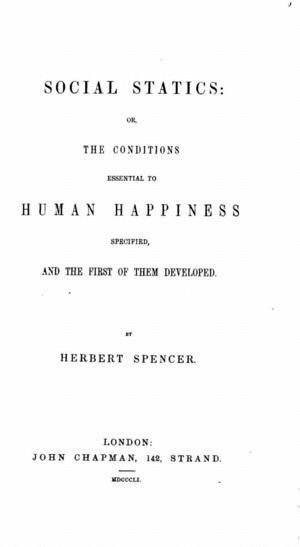
CHAPTER VII.: application of this first principle. - Herbert Spencer, Social Statics [1851]Edition used:Social Statics: or, The Conditions essential to Happiness specified, and the First of them Developed, (London: John Chapman, 1851).
About Liberty Fund:Liberty Fund, Inc. is a private, educational foundation established to encourage the study of the ideal of a society of free and responsible individuals. Copyright information:The text is in the public domain. Fair use statement:This material is put online to further the educational goals of Liberty Fund, Inc. Unless otherwise stated in the Copyright Information section above, this material may be used freely for educational and academic purposes. It may not be used in any way for profit.
CHAPTER VII.application of this first principle.§ 1.The process by which we may develop this first principle into a system of equity, is sufficiently obvious. We have just to distinguish the actions that are included under its permit, from those which are excluded by it—to find what lies inside the sphere appointed for each individual, and what outside. Our aim must be to discover how far the territory of may extends, and where it borders upon that of may not. We shall have to consider of every deed, whether, in committing it, a man does, or does not, trespass upon the ordained freedom of his neighbour—whether, when placed side by side, the shares of liberty the two parties respectively assume are equal. And by thus separating that which can be done by each without trenching on the privileges of others, from that which cannot be so done, we may classify actions into lawful and unlawful. § 2.Difficulties may now and then occur in the performance of this process. We shall, perhaps, occasionally find ourselves unable to decide whether a given action does or does not trespass against the law of equal freedom. But such an admission by no means implies any defect in that law. It merely implies human incapacity—an incapacity which puts a limit to our discovery of physical as well as of moral truth. It is for instance, quite beyond the power of any mathematician to state in degrees and minutes, the angle at which a man may lean without falling. Not being able to find accurately the centre of gravity of a man’s body, he cannot say with certainty whether, at a given inclination, the line of direction will or will not fall outside the base. But we do not, therefore, take exception to the first principles of mechanics. We know that, in spite of our inability to follow out those first principles to all their consequences, the stability or instability of a man’s attitude might still be accurately determined by them, were our perceptions competent to take in all the conditions of such a problem. Similarly, it is argued that, although there may possibly arise out of the more complex social relationships, questions that are apparently not soluble by comparing the respective amounts of freedom the concerned parties assume, it must nevertheless be granted that, whether we see it or not, their claims are either equal or unequal, and the dependent actions right or wrong accordingly. § 3.For those who have faith in the abstract, and who dare to follow wherever an acknowledged doctrine may lead, it will be sufficient to point out the several conclusions which may be drawn from this first principle, and to leave those conclusions to stand or fall by the logicalness of their deduction. It is to be feared, however, that results arrived at by so purely philosophical a process, will weigh but little with the majority. People who “cannot understand a principle until its light falls upon a fact,” are not to be swayed by inferences so deduced. Wedded as they are to the guidance of a superficial experience, they are deaf to the enunciation of those laws, of which the complex phenomena they draw their experience from are the workings out. We have, nevertheless, to deal with such as best we may; and, to meet their case, evidence of a so-called “practical” nature must be adduced. Whenever, therefore, we arrive at inferences conflicting with the general opinion, it is intended to follow up the argument by showing that “experience,” rightly interpreted, enforces these inferences. |

Titles (by Subject)