EconlibThe LibraryOther Sites |
Front Page Titles (by Subject) CHAPTER IV.: derivation of a first principle. - Social Statics
Return to Title Page for Social StaticsThe Online Library of LibertyA project of Liberty Fund, Inc.Search this Title:Also in the Library:
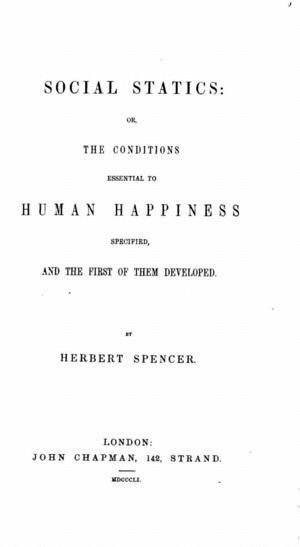
CHAPTER IV.: derivation of a first principle. - Herbert Spencer, Social Statics [1851]Edition used:Social Statics: or, The Conditions essential to Happiness specified, and the First of them Developed, (London: John Chapman, 1851).
About Liberty Fund:Liberty Fund, Inc. is a private, educational foundation established to encourage the study of the ideal of a society of free and responsible individuals. Copyright information:The text is in the public domain. Fair use statement:This material is put online to further the educational goals of Liberty Fund, Inc. Unless otherwise stated in the Copyright Information section above, this material may be used freely for educational and academic purposes. It may not be used in any way for profit.
CHAPTER IV.derivation of a first principle.§ 1.There will possibly be some for whom the à priori considerations set forth in the foregoing chapter, are too abstract for distinct comprehension. It is easy, however, to reason our way to that first principle of ethical science which we are about to follow out to its consequences, without any appeal to these. And it will be desirable now to do this. Starting afresh then, from the admitted truth, that human happiness is the Divine will, let us look at the means appointed for the obtainment of that happiness, and observe what conditions they presuppose. Happiness is a certain state of consciousness. That state must be produced by the action upon consciousness of certain modifying influences—by certain affections of it. All affections of consciousness we term sensations. And amongst the rest, those affections of it which constitute happiness must be sensations. But how do we receive sensations? Through what are called faculties. It is certain that a man cannot see without eyes. Equally certain is it that he can experience no impression of any kind, unless he is endowed with some power fitted to take in that impression; that is, a faculty. All the mental states which he calls feelings and ideas, are affections of his consciousness received through the faculties—sensations given to it by them. There next comes the question—under what circumstances do the faculties yield those sensations of which happiness consists? The reply is—when they are exercised. It is from the activity of one or more of them that all gratification arises. To the healthful performance of each function of mind or body attaches a pleasurable feeling. And this pleasurable feeling is obtainable only by the performance of the function; that is, by the exercise of the correlative faculty. Every faculty in turn affords its special emotion; and the sum of these constitutes happiness. Or the matter may be briefly put thus. A desire is the need for some species of sensation. A sensation is producible only by the exercise of a faculty. Hence no desire can be satisfied except through the exercise of a faculty. But happiness consists in the due satisfaction of all the desires; that is, happiness consists in the due exercise of all the faculties. § 2.Now if God wills man’s happiness, and man’s happiness can be obtained only by the exercise of his faculties, then God wills that man should exercise his faculties; that is, it is man’s duty to exercise his faculties; for duty means fulfilment of the Divine will. That it is man’s duty to exercise his faculties is further proved by the fact, that what we call punishment attaches to the neglect of that exercise. Not only is the normal activity of each faculty productive of pleasure, but the continued suspension of that activity is productive of pain. As the stomach hungers to digest food, so does every bodily and mental agent hunger to perform its appointed action. And as the refusal to satisfy the cravings of the digestive faculty is productive of suffering, so is the refusal to satisfy the cravings of any other faculty also productive of suffering, to an extent proportionate to the importance of that faculty. But as God wills man’s happiness, that line of conduct which produces unhappiness is contrary to his will. Therefore the non-exercise of the faculties is contrary to his will. Either way then, we find that the exercise of the faculties is God’s will and man’s duty. But the fulfilment of this duty necessarily presupposes freedom of action. Man cannot exercise his faculties without certain scope. He must have liberty to go and to come, to see, to feel, to speak, to work; to get food, raiment, shelter, and to provide for each and all of the needs of his nature. He must be free to do everything which is directly or indirectly requisite for the due satisfaction of every mental and bodily want. Without this he cannot fulfil his duty or God’s will. But if he cannot fulfil God’s will without it, then God commands him to take it. He has Divine authority, therefore, for claiming this freedom of action. God intended him to have it; that is, he has a right to it. From this conclusion there seems no possibility of escape. Let us repeat the steps by which we arrive at it. God wills man’s happiness. Man’s happiness can only be produced by the exercise of his faculties. Then God wills that he should exercise his faculties. But to exercise his faculties he must have liberty to do all that his faculties naturally impel him to do. Then God intends he should have that liberty. Therefore he has a right to that liberty. § 3.This, however, is not the right of one but of all. All are endowed with faculties. All are bound to fulfil the Divine will by exercising them. All therefore must be free to do those things in which the exercise of them consists. That is, all must have rights to liberty of action. And hence there necessarily arises a limitation. For if men have like claims to that freedom which is needful for the exercise of their faculties, then must the freedom of each be bounded by the similar freedom of all. When, in the pursuit of their respective ends, two individuals clash, the movements of the one remain free only in so far as they do not interfere with the like movements of the other. This sphere of existence into which we are thrown not affording room for the unrestrained activity of all, and yet all possessing in virtue of their constitutions similar claims to such unrestrained activity, there is no course but to apportion out the unavoidable restraint equally. Wherefore we arrive at the general proposition, that every man may claim the fullest liberty to exercise his faculties compatible with the possession of like liberty by every other man. § 4.Upon a partial consideration this statement of the law will perhaps seem open to criticism. It may be thought better to limit the right of each to exercise his faculties, by the proviso that he shall not hurt any one else—shall not inflict pain on any one else. But although at first sight satisfactory, this expression of the law allows of erroneous deductions. It is true that men, answering to those conditions of greatest happiness set forth in the foregoing chapter, cannot exercise their faculties to the aggrieving of one another. It is not, however, that each avoids giving pain by refraining from the full exercise of his faculties; but it is that the faculties of each are such that the full exercise of them offends no one. And herein lies the difference. The giving of pain may have two causes. Either the abnormally-constituted man may do something displeasing to the normal feelings of his neighbours, in which case he acts wrongly; or the behaviour of the normally-constituted man may irritate the abnormal feelings of his neighbours; in which case it is not his behaviour that is wrong, but their characters that are so. Under such circumstances the due exercise of his faculties is right, although it gives pain; and the remedy for the evil lies in the modification of those abnormal feelings to which pain is given. To elucidate this distinction let us take a few illustrations. An honest man discovers some friend, of whom he had previously thought well, to be a rogue. He has certain high instincts to which roguery is repugnant; and allowing free play to these, he drops the acquaintanceship of this unworthy one. Now, though in doing so he gives pain, it does not follow that he transgresses the law. The evil must be ascribed, not to an undue exercise of faculties by him, but to the immorality of the man who suffers. Again, a Protestant in a Roman Catholic country, refuses to uncover his head on the passing of the host. In so obeying the promptings of certain sentiments, he annoys the spectators; and were the above modified expression of the law correct, would be blameable. The fault, however, is not with him, but with those who are offended. It is not that he is culpable in thus testifying to his belief, but it is that they ought not to have so tyrannical an intolerance of other opinions than their own. Or again, a son, to the great displeasure of his father and family, marries one who, though in all respects admirable, is dowerless. In thus obeying the dictates of his nature he may entail considerable distress of mind upon his relatives; but it does not follow that his conduct is bad; it follows rather that the feelings which his conduct has wounded are bad. Hence we see that in hourly-occurring cases like these, to limit the exercise of faculties by the necessity of not giving pain to others, would be to stop the proper exercise of faculties in some persons, for the purpose of allowing the improper exercise of faculties in the rest. Moreover, the observance of such a rule does not, as at first sight appears, prevent pain. For though he who is restrained by it avoids inflicting suffering on his fellows, he does so at the expense of suffering to himself. The evil must be borne by some one, and the question is by whom. Shall the Protestant, by showing reverence for what he does not revere, tell a virtual lie, and thus do violence to his conscientious feeling that he may avoid vexing the intolerant spirit of his Catholic neighbours? or shall he give the rein to his own healthy sinoerity and independence, and offend their unhealthy bigotry? Shall the honest man repress those sentiments that make him honest, lest the exhibition of them should give pain to a rogue? or shall he respect his own nobler feelings, and hurt the other’s baser ones? Between these alternatives no one can well pause. And here indeed we get down to the root of the matter. For be it remembered the universal law of life is, that the exercise or gratification of faculties strengthens them; whilst, on the contrary, the curbing or inflicting pain upon them, entails a diminution of their power. And hence it follows that when the action of a normal faculty is checked, to prevent pain being given to the abnormal faculties of others, those abnormal faculties remain as active as they were, and the normal one becomes weaker or abnormal. Whereas under converse circumstances the normal one remains strong, and the abnormal ones are weakened, or made more normal. In the one case the pain is detrimental, because it retards the approximation to that form of human nature under which the faculties of each may be fully exercised without displeasure to the like faculties of all. In the other case the pain is beneficial, because it aids the approximation to that form. Thus, that first expression of the law which arises immediately from the conditions of social existence, turns out to be the true one: any such modification of it as the above, necessitating conduct that is in many cases absolutely mischievous. And yet, on the other hand, when we seek to express the law by saying that every man has full liberty to exercise his faculties, provided always he does not trench upon the similar liberty of any other, we commit ourselves to an imperfection of an opposite character; and we find that there are many cases in which the above modified expression answers better. Various ways exist in which the faculties may be exercised to the aggrieving of other persons, without the law of equal freedom being overstepped. A man may behave unamiably, may use harsh language, or annoy by disgusting habits; and whoso thus offends the normal feelings of his fellows, manifestly diminishes happiness. If we say that every one is free to exercise his faculties so long only as he does not inflict pain upon any one else, we forbid all such conduct. Whereas if we simply limit the liberty of each by the like liberty of all, we do not forbid it; seeing that he who exercises his faculties in this way, does not hinder others from exercising theirs in the same way, and to the same extent. How then are we to escape from this difficulty? Neither statement of the law quite fulfils our requirement, and yet we must choose one of them. Which must it be, and why? It must be the original one, and for a very good reason. Limiting the liberty of each by the like liberty of all, excludes a wide range of improper actions, but does not exclude certain other improper ones. Limiting the liberty of each by the necessity of not giving pain to the rest, excludes the whole of these improper actions, but excludes along with them many others that are proper. The one does not cut off enough; the other cuts off too much. The one is negatively erroneous; the other is positively so. Evidently, then, we must adopt the negatively erroneous one, seeing that its shortcomings may be made good by a supplementary law. And here we find the need for that distinction lately drawn between justice and negative beneficence—a distinction which we habitually make in the affairs of life. Justice imposes upon the exercise of faculties a primary series of limitations, which is strictly true as far as it goes. Negative beneficence imposes a secondary series. It is no defect in the first of these that it does not include the last. The two are, in the main, distinct; and, as we have just seen, the attempt to unite them under one expression leads us into fatal errors. § 5.Yet another objection will probably be started. By full liberty to exercise the faculties, is meant full liberty to do all that the faculties prompt, or, in other words, to do all that the individual wills; and it may be said, that if the individual is free to do all that he wills, provided he does not trespass upon certain specified claims of others, then he is free to do things that are injurious to himself—is free to get drunk, or to commit suicide. To this it must be in the first place replied, as above, that whilst the law now laid down forbids a certain class of actions as immoral, it does not recognise all kinds of immorality—that the restriction it puts on the free exercise of faculties, though the chief, is not the sole restriction, and must be received without prejudice to further ones. Of the need for such further ones, the difficulty here raised furnishes a second instance. Mark now, however, that these supplementary restrictions are of quite inferior authority to the original law. Instead of being, like it, capable of strictly scientific development, they (under existing circumstances) can be unfolded only into superior forms of expediency. The limit put to each man’s freedom, by the like freedom of every other man, is a limit almost always possible of exact ascertainment; for let the condition of things be what it may, the respective amounts of freedom men assume can be compared, and the equality or inequality of those amounts recognised. But when we set about drawing practical deductions from the propositions that a man is not at liberty to do things injurious to himself, and that he is not at liberty (except in cases like those lately cited) to do what may give unhappiness to his neighbours, we find ourselves involved in complicated estimates of pleasures and pains, to the obvious peril of our conclusions. It is very true, that to trace out the consequences a given act will entail upon oneself or another, is incomparably less difficult than to determine the ultimate effects of some public measure upon a whole nation; and hence the being guided by expediency in private life is proportionably less dangerous. Yet it is also true, that even here, trustworthy inferences are attainable in but a minority of cases. In the first place we frequently cannot say whether the bad results will exceed the good ones; and in the second place we frequently cannot say whether the faculties on which suffering will be inflicted, are in normal or abnormal states. For example, though it is very manifest that drunkenness is an injurious exercise of faculties, as being clearly productive of more pain than pleasure, it is by no means manifest how much work is proper for us, and when work becomes detrimental; it is by no means manifest where lies the line between due and undue intellectual activity; it is by no means manifest what amount of advantage will justify a man in submitting to unsuitable climate and mode of life; and yet in each of these cases happiness is at stake, and the wrong course is wrong for the same reason that drunkenness is so. Even were it possible to say of each private action whether the resulting gratification did or did not preponderate over the resulting suffering, there would still present itself this second difficulty, that we cannot with certainty distinguish suffering that is detrimental, from suffering that is beneficial. Whilst we are as yet imperfectly adapted to our conditions, pain must inevitably arise from the repression of faculties that are too active, and from the overtasking of those that are not equal to their duties; and, as being needful to the development of the ultimate man, such pain cannot be held damnatory of the actions causing it. Thus, referring again to the instances just cited, it is self-evident that the ability to work is needful for the production of the greatest happiness; yet is the acquirement of this ability by the uncivilized man so distressing, that only the severest discipline will force him to it. That degree of intelligence which our existing mode of life necessitates, cannot be arrived at without ages of wearisome application; and perhaps cannot get organized in the race without a partial and temporary sacrifice of bodily health. The realization of the Divine Idea implies the peopling of every habitable region; and this implies the adaptation of mankind to a variety of climates—an adaptation which cannot be undergone without great suffering. Here, then, are cases in which men’s liberty must not be limited by the necessity of not injuring themselves; seeing that it cannot be so limited without a suspension of our approach to greatest happiness. Similarly we saw awhile since (p. 79), that there are cases in which for the same reason men’s liberty must not be limited by the necessity of not inflicting pain upon others. And the fact now to be noticed is, that we possess no certain way of distinguishing the two groups of cases thus exemplified from those cases in which the doing what diminishes happiness, either in ourselves or others, is both immediately and ultimately detrimental, and therefore wrong. Not being able to define specifically the constitution of the ideal man, but being able to define it generically only—not being able to determine the ratios of the several faculties composing that constitution, but being able simply to lay down certain laws which their action must conform to—we are quite incompetent to say of every particular deed whether it is or is not accordant with that constitution. Or, putting the difficulty in its simplest form, we may say, that as both of these supplementary limitations involve the term happiness, and as happiness is for the present capable only of a generic and not of a specific definition (p. 5), they do not admit of scientific development. Though abstractedly correct limitations, and limitations which the ideal man will strictly observe, they cannot be reduced to concrete forms until the ideal man exists. § 6.And now we have arrived at the threshold of an important truth touching this matter; the truth namely, that only by a universal exercise of this alleged liberty of each, limited alone by the like liberty of all, can there ever arise a separation of those acts which, though incidentally and temporarily injurious to ourselves or others, are indirectly beneficial, from those acts which are necessarily and eternally injurious. For manifestly, that non-adaptation of faculties to their functions, from which springs every species of evil, must consist either in excess or defect. And manifestly, in the wide range of cases we are now treating of, there exists no mode but a tentative one of distinguishing that exercise of faculties which produces suffering because it oversteps the conditions of normal existence, from that other exercise of faculties which produces suffering because it falls short of those conditions. And manifestly, the due employment of this tentative mode requires that each man shall have the greatest freedom compatible with the like freedom of all others. Or, turning the proposition the other side up, we may say, that whilst these secondary conditions of greatest happiness are really fixed, yet the practical interpretation of them requiring a detailed knowledge of the ultimate human constitution, bodily and mental, and such detailed knowledge being unattainable, our course is to regard the law of equal freedom as setting up the only recognisable limit to the exercise of faculties, knowing that the other limits will inevitably make themselves felt, and that in virtue of the law of adaptation, there must eventually arise a complete conformity to them. That, on this course being pursued, there will happen a gradual cessation of the detrimentally painful actions, whilst the beneficially painful ones will be continued until they have ceased to be painful, may be made clear by a few illustrations. Thus, the change from the impulsive nature of the savage to that nature which enables the civilised man to sacrifice a present gratification for a future greater one, involves much suffering; but the necessities of social life demanding such a change, and continually visiting the lack of a self-restraining power with severe punishment, ensure a constant though irk-some endeavour on the part of all to acquire this power—an endeavour that must surely though slowly succeed. Conversely, the prevalence amongst men of a somewhat undue desire for food, entailing as it perpetually does much bodily, and some mental, affliction, is sure to be therefore accompanied by such attempts at abstemiousness, as must, by constantly curbing it, finally reduce this desire to a normal intensitya . And what so manifestly happens in these simple cases, will with equal certainty happen in those complex ones above exemplified, where the good and bad results are more nearly balanced: for although it may be impossible in such cases for the intellect to estimate the respective amounts of pleasure and pain consequent upon each alternative, yet will experience enable the constitution itself to do this; and will further cause it instinctively to shun that course which produces on the whole most suffering, or, in other words—most sins against the necessities of existence, and to choose that which least sins against them. Turning to those actions which put us in direct relationship to other men, it must in the same manner happen that such of them as give no necessary displeasure to any one, will be persevered in, and the faculties answering to them developed; whilst, on the contrary, actions necessarily displeasing to our neighbours, must, by virtue of the disagreeable reaction which they commonly entail upon ourselves, be, in the average of cases, subject to a certain degree of repression—a repression that must ultimately tell upon the desires they spring from. And now observe what it is the special purpose of the present argument to show, namely, that in the course of this process there must be continually produced a different effect upon conduct which is necessarily painful to others, from that produced upon conduct that is incidentally painful only. Conduct which hurts necessary feelings in others, will, as just explained, inevitably undergo restraint and consequent diminution: conduct which hurts only their incidental feelings, as those of caste, or prejudice, will not inevitably do so; but, if it springs from necessary feelings, will, on the contrary, be continued at the expense of these incidental feelings, and to the final suppression of them. When men mutually behave in a way that offends some essential element in the nature of each, and all in turn have to bear the consequent suffering, there will arise a tendency to curb the desire that makes them so behave. When, instead of this, they keep hurting in each other those non-essential elements of character peculiar to a passing phase of things, and are impelled to do this by impulses that are permanently requisite, then will these non-essential elements be extirpated. Thus, the existing confusion of necessary and conventional feelings, necessary and conventional circumstances, and feelings and circumstances that are partly necessary and partly conventional, will eventually work itself clear. Conventional feelings will give way before necessary circumstances, and conventional circumstances before necessary feelings. And when, as a result of this process, complete adaptation between constitution and conditions has been arrived at, a complete classification of actions into essentially injurious and essentially beneficial, will have been arrived at also. If, then, we find that the one thing needful to produce ultimate subordination to these secondary limits of right conduct is, that we should have the opportunity of freely coming in contact with them—should be allowed freely to expand our natures in all directions until the available space has been filled, and the true bounds have made themselves felt—if a development of these secondary limits into practical codes of duty can only thus be accomplished, then does the supreme authority of our first law—the liberty of each limited alone by the like liberty of all—become still more manifest, seeing that that right to exercise the faculties which it asserts, must precede the unfolding of this supplementary morality. Indeed, regarding it from this point of view, we may almost say that the first law is the sole law; for we find that of the several conditions to greatest happiness it is the only one at present capable of a systematic development; and we further find that conformity to it, ensures ultimate conformity to the others. § 7.Nevertheless, it must still be admitted, that in cases where these secondary limitations to the exercise of faculties are undoubtedly transgressed, the full assertion of this law of equal freedom betrays us into an apparent dilemma. By drunkenness, or by brutality of manner, our own happiness, or the happiness of others, is diminished; and that not in an incidental but in a necessary way. And if by affirming a man’s liberty to do all that he wills so long as he respects the like liberty of every other, we imply that he is at liberty to get drunk or to behave brutally, then we fall into the inconsistency of affirming that he is at liberty to do something essentially destructive of happiness. Of this difficulty nothing can be said, save that it seems in part due to the impossibility of making the perfect law recognise an imperfect state, and in part to that defect in our powers of expression elsewhere exemplified (p. 39). As matters stand, however, we must deal with it as best we may. There is clearly no alternative but to declare man’s freedom to exercise his faculties; for without this freedom fulfilment of the Divine will is impossible. There is clearly no alternative but to declare the several limitations of that freedom needful for the achievement of greatest happiness. And there is clearly no alternative but to develop the first and chief of these limitations separately; seeing as we have done that a development of the others is at present impossible. Against the consequence of neglecting these secondary limitations, we must therefore guard ourselves as well as we can; supplying the place of scientific deductions from them, by such inferences as observation and experience enable us to make. § 8.Finally, however, there is satisfaction in the thought, that no such imperfection as this, can in the least vitiate any of the conclusions we are now about to draw. Liberty of action being the first essential to exercise of faculties, and therefore the first essential to happiness; and the liberty of each limited by the like liberty of all, being the form which this first essential assumes when applied to many instead of one (§ 3), it follows that this liberty of each, limited by the like liberty of all, is the rule in conformity with which society must be organised. Freedom being the pre-requisite to normal life in the individual, equal freedom becomes the pre-requisite to normal life in society. And if this law of equal freedom is the primary law of right relationship between man and man, then no desire to get fulfilled a secondary law can warrant us in breaking it. Now we shall find that in the unfolding of this primary limitation to the exercise of faculties into a series of practical regulations, it is impossible to recognise any secondary limitations without committing a breach of the primary one. For, in what must recognition of any secondary limitations consist? It must consist in the establishment in our social organization of certain further restrictions on the exercise of faculties besides those imposed by the law of equal freedom. And how are these further restrictions to be enforced? Manifestly, by men. Now the men who enforce them must necessarily assume in so doing a greater amount of freedom than those on whom they are enforced;—that is to say, they must transgress the primary law to prevent others transgressing secondary ones. Hence, in drawing from it deductions respecting the equitable constitution of society, we may safely assert in full this liberty of each limited alone by the like liberty of all—must so assert it. The neglect of other limitations will in no way affect the accuracy of our conclusions, so long as we confine ourselves to deducing from this fundamental law the just relationships of men to each other; whereas we cannot include these other limitations in our premises without vitiating those conclusions. We have no alternative therefore but, for the time being, to ignore such other limitations; leaving that partial interpretation of them which is at present possible to us, for subsequent statement. [a]Why the appetite for food should now be greater than is proper, seems at first difficult to understand. On calling to mind, however, the conditions of the aboriginal man, we shall find an explanation of this apparent anomaly in the fact, that the irregularity in his supplies of food necessitated an ability to eat largely when food was attainable, and necessitated, therefore, a corresponding desire. Now that the supplies of food have become regular, and no contingent periods of long fasting have to be provided against, the desire is in excess and has to be abated. |

Titles (by Subject)