EconlibThe LibraryOther Sites |
Front Page Titles (by Subject) INTRODUCTION.: the doctrine of expediency. - Social Statics
Return to Title Page for Social StaticsThe Online Library of LibertyA project of Liberty Fund, Inc.Search this Title:Also in the Library:
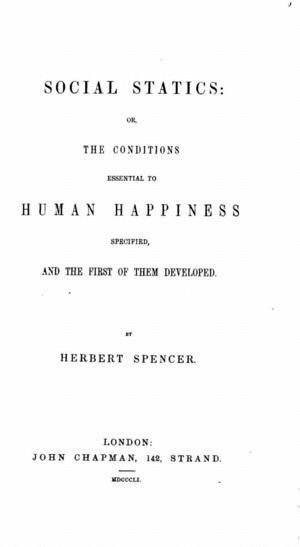
INTRODUCTION.: the doctrine of expediency. - Herbert Spencer, Social Statics [1851]Edition used:Social Statics: or, The Conditions essential to Happiness specified, and the First of them Developed, (London: John Chapman, 1851).
About Liberty Fund:Liberty Fund, Inc. is a private, educational foundation established to encourage the study of the ideal of a society of free and responsible individuals. Copyright information:The text is in the public domain. Fair use statement:This material is put online to further the educational goals of Liberty Fund, Inc. Unless otherwise stated in the Copyright Information section above, this material may be used freely for educational and academic purposes. It may not be used in any way for profit.
INTRODUCTION.the doctrine of expediency.§ 1.“Give us a guide,” cry men to the philosopher. “We would escape from these miseries in which we are entangled. A better state is ever present to our imaginations, and we yearn after it; but all our efforts to realize it are fruitless. We are weary of perpetual failures; tell us by what rule we may attain our desire.” “Whatever is expedient is right;” is one of the last of the many replies to this appeal. “True,” rejoin some of the applicants. “With the Deity right and expedient are doubtless convertible terms. For us, however, there remains the question—which is the antecedent, and which is the consequent? Granting your assumption that right is the unknown quantity and expediency the known one, your formula may be serviceable. But we deny your premises; a painful experience has proved the two to be equally indeterminate. Nay, we begin to suspect that the right is the more easily ascertained of the two; and that your maxim would be better if transposed into—whatever is right is expedient.” “Let your rule be, the greatest happiness to the greatest number,” interposes another authority. “That, like the other, is no rule at all,” it is replied; “but rather an enunciation of the problem to be solved. It is your ‘greatest happiness’ of which we have been so long and so fruitlessly in search; albeit we never gave it a name. You tell us nothing new; you merely give words to our want. What you call an answer, is simply our own question turned the right side up. If this is your philosophy it is surely empty, for it merely echoes the interrogation.” “Have a little patience,” returns the moralist, “and I will give you my opinion as to the mode of securing this greatest happiness to the greatest number.” “There again,” exclaim the objectors, “you mistake our requirement. We want something else than opinions. We have had enough of them. Every futile scheme for the general good has been based on opinion; and we have no guarantee that your plan will not add one to the list of failures. Have you discovered a means of forming an infallible judgment? If not, you are, for aught we can perceive, as much in the dark as ourselves. True, you have obtained a clearer view of the end to be arrived at; but concerning the route leading to it, your offer of an opinion proves that you know nothing more certain than we do. We demur to your maxim because it is not what we wanted—a guide; because it dictates no sure mode of securing the desideratum; because it puts no veto upon a mistaken policy; because it permits all actions—bad, as readily as good—provided only the actors believe them conducive to the prescribed end. Your doctrines of ‘expediency’ or ‘utility’ or ‘general good’ or ‘greatest happiness to the greatest number’ afford not a solitary command of a practical character. Let but rulers think, or profess to think, that their measures will benefit the community, and your philosophy stands mute in the presence of the most egregious folly, or the blackest misconduct. This will not do for us. We seek a system that can return a definite answer when we ask—‘Is this act good?’ and not like yours, reply—‘Yes, if it will benefit you.’ If you can show us such an one—if you can give us an axiom from which we may develope successive propositions until we have with mathematical certainty solved all our difficulties—we will thank you. If not, we must go elsewhere.” In his defence, our philosopher submits that such expectations are unreasonable. He doubts the possibility of a strictly scientific morality. Moreover he maintains that his system is sufficient for all practical purposes. He has definitely pointed out the goal to be attained. He has surveyed the tract lying between us and it. He believes he has discovered the best route. And finally he has volunteered as pioneer. Having done this, he claims to have performed all that can be expected of him, and deprecates the opposition of these critics as factious, and their objections as frivolous. Let us examine this position somewhat more closely. § 2.Assuming it to be in other respects satisfactory, a rule, principle, or axiom, is valuable only in so far as the words in which it is expressed have a definite meaning. The terms used must be universally accepted in the same sense, otherwise the proposition will be liable to such various constructions, as to lose all claim to the title—a rule. We must therefore take it for granted that when he announced “the greatest happiness to the greatest number” as the canon of social morality, its originator supposed mankind to be unanimous in their definition of “greatest happiness.” This was a most unfortunate assumption, for no fact is more palpable than that the standard of happiness is infinitely variable. In all ages—amongst every people—by each class—do we find different notions of it entertained. To the wandering gipsy a home is tiresome; whilst a Swiss is miserable without one. Progress is necessary to the well-being of the Anglo-Saxons; on the other hand the Esquimaux are content in their squalid poverty, have no latent wants, and are still what they were in the days of Tacitus. An Irishman delights in a row; a Chinese in pageantry and ceremonies; and the usually apathetic Javan gets vociferously enthusiastic over a cock-fight. The heaven of the Hebrew is “a city of gold and precious stones, with a supernatural abundance of corn and wine;” that of the Turk—a harem peopled by houris; that of the American Indian—a “happy hunting ground;” in the Norse paradise there were to be daily battles with magical healing of wounds; whilst the Australian hopes that after death he shall “jump up a white fellow, and have plenty of sixpences.” Descending to individual instances, we find Louis XVI. interpreting “greatest happiness” to mean—making locks; instead of which his successor read—making empires. It was seemingly the opinion of Lycurgus that perfect physical development was the chief essential to human felicity; Plotinus, on the contrary, was so purely ideal in his aspirations as to be ashamed of his body. Indeed the many contradictory answers given by Grecian thinkers to the question—What constitutes happiness? have given occasion to comparisons that have now become trite. Nor has greater unanimity been shown amongst ourselves. To a miserly Elwes the hoarding of money was the only enjoyment of life; but Day, the philanthropic author of “Sandford and Merton,” could find no pleasurable employment save in its distribution. Rural quietude, books, and a friend, are the wants of the poet; a tuft-hunter longs rather for a large circle of titled acquaintance, a box at the Opera, and the freedom of Almack’s. The ambitions of the tradesman and the artist are anything but alike; and could we compare the air castles of the ploughman and the philosopher, we should find them of widely-different orders of architecture. Generalizing such facts, we see that the standard of “greatest happiness” possesses as little fixity as the other exponents of human nature. Between nations the differences of opinion are conspicuous enough. On contrasting the Hebrew patriarchs with their existing descendants, we observe that even in the same race the beau ideal of existence changes. The members of each community disagree upon the question. Neither, if we compare the wishes of the gluttonous school-boy with those of the earth-scorning transcendentalist into whom he may afterwards grow, do we find any constancy in the individual. So we may say, not only that every epoch and every people has its peculiar conceptions of happiness, but that no two men have like conceptions; and further, that in each man the conception is not the same at any two periods of life. The rationale of this is simple enough. Happiness signifies a gratified state of all the faculties. The gratification of a faculty is produced by its exercise. To be agreeable that exercise must be proportionate to the power of the faculty; if it is insufficient discontent arises, and its excess produces weariness. Hence, to have complete felicity is to have all the faculties exerted in the ratio of their several developments; and an ideal arrangement of circumstances calculated to secure this constitutes the standard of “greatest happiness;” but the minds of no two individuals contain the same combination of elements. Duplicate men are not to be found. There is in each a different balance of desires. Therefore the conditions adapted for the highest enjoyment of one, would not perfectly compass the same end for any other. And consequently the notion of happiness must vary with the disposition and character; that is, must vary indefinitely. Whereby we are also led to the inevitable conclusion that a true conception of what human life should be, is possible only to the ideal man. We may make approximate estimates, but he only in whom the component feelings exist in their normal proportions is capable of a perfect aspiration. And as the world yet contains none such, it follows that a specific idea of “greatest happiness” is for the present unattainable. It is not then to be wondered at, if Paleys and Benthams make vain attempts at a definition. The question involves one of those mysteries which men are ever trying to penetrate and ever failing. It is the insoluble riddle which Care, Sphinx-like, puts to each new comer, and in default of answer devours him. And as yet there is no Œdipus, nor any sign of one. The allegation that these are hypercritical objections, and that for all practical purposes we agree sufficiently well as to what “greatest happiness” means, will possibly be made by some. It were easy to disprove this, but it is unnecessary, for there are plenty of questions practical enough to satisfy such cavillers, and about which men exhibit none of this pretended unanimity. For example: — What is the ratio between the mental and bodily enjoyments constituting this “greatest happiness”? There is a point up to which increase of mental activity produces increase of happiness; but beyond which, it produces in the end more pain than pleasure. Where is that point? Some appear to think that intellectual culture and the gratifications deriveable from it can hardly be carried too far. Others again maintain that already amongst the educated classes mental excitements are taken in excess; and that were more time given to a proper fulfilment of the animal functions, a larger amount of enjoyment would be obtained. If “greatest happiness” is to be the rule, it becomes needful to decide which of these opinions is correct; and further to determine the exact boundary between the use and abuse of every faculty. — Which is most truly an element in the desired felicity, content or aspiration? The generality assume, as a matter of course, that content is. They think it the chief essential to well-being. There are others, however, who hold that but for discontent we should have been still savages. It is in their eyes the greatest incentive to progress. Nay, they maintain that were content the order of the day, society would even now begin to decay. It is required to reconcile these contradictory theories. — And this synonyme for “greatest happiness”—this “utility”—what shall be comprised under it? The million would confine it to the things which directly or indirectly minister to the bodily wants, and in the words of the adage “help to get something to put in the pot.” Others there are who think mental improvement useful in itself, irrespective of so-called practical results, and would therefore teach astronomy, comparative anatomy, ethnology, and the like, together with logic and metaphysics. Unlike some of the Roman writers who held the practice of the fine arts to be absolutely vicious, there are now many who suppose utility to comprehend poetry, painting, sculpture, the decorative arts, and whatever aids the refinement of the taste. Whilst an extreme party maintains that music, dancing, the drama, and what are commonly called amusements, are equally worthy to be included. In place of all which discordance we ought to have agreement. — Whether shall we adopt the theory of some that felicity means the greatest possible enjoyment of this life’s pleasures, or that of others, that it consists in anticipating the pleasures of a life to come? And if we compromise the matter, and say it should combine both, how much of each shall go to its composition? — Or what must we think of this wealth-seeking age of ours? Shall we consider the total absorption of time and energy in business—the servitude of the mind to the needs of the body—the spending of life in the accumulation of the means to live, as constituting “greatest happiness,” and act accordingly? Or shall we legislate upon the assumption that this is to be regarded as the voracity of a larva assimilating material for the development of the future psyche? Similar unsettled questions might be indefinitely multiplied. Not only therefore is an agreement as to the meaning of “greatest happiness” theoretically impossible, but it is also manifest, that men are at issue upon all topics, which for their determination require defined notions of it. So that in directing us to this “greatest happiness to the greatest number,” as the object towards which we should steer, our pilot “keeps the word of promise to our ear and breaks it to our hope.” What he shows us through his telescope is a fata morgana, and not the promised land. The real haven of our hopes dips far down below the horizon and has yet been seen by none. It is beyond the ken of seer be he never so farsighted. Faith not sight must be our guide. We cannot do without a compass. § 3.Even were the fundamental proposition of the expediency system not thus vitiated by the indefiniteness of its terms, it would still be vulnerable. Granting for the sake of argument, that the desideratum, “greatest happiness,” is duly comprehended, its identity and nature agreed upon by all, and the direction in which it lies satisfactorily settled, there yet remains the unwarranted assumption that it is possible for the self-guided human judgment to determine, with something like precision, by what methods it may be achieved. Experience daily proves that just the same uncertainty which exists respecting the specific ends to be obtained, exists likewise respecting the right mode of attaining them when supposed to be known. In their attempts to compass one after another the several items which go to make up the grand total, “greatest happiness,” men have been anything but successful; their most promising measures having commonly turned out the greatest failures. Let us look at a few cases. When it was enacted in Bavaria that no marriage should be allowed between parties without capital, unless certain authorities could “see a reasonable prospect of the parties being able to provide for their children,” it was doubtless intended to advance the public weal by checking improvident unions, and redundant population; a purpose most politicians will consider praiseworthy, and a provision which many will think well adapted to secure it. Nevertheless this apparently sagacious measure has by no means answered its end; the fact being that in Munich, the capital of the kingdom, half the births are illegitimate! Those too were admirable motives, and very cogent reasons, which led our government to establish an armed force on the coast of Africa for the suppression of the slave trade. What could be more essential to the “greatest happiness” than the annihilation of the abominable traffic? And how could forty ships of war, supported by an expenditure of £700,000 a year, fail to wholly or partially accomplish this? The results have, however, been anything but satisfactory. When the abolitionists of England advocated it, they little thought that such a measure instead of preventing would only “aggravate the horrors, without sensibly mitigating the extent of the traffic;” that it would generate fast-sailing slavers with decks one foot six inches apart, suffocation from close packing, miserable diseases, and a mortality of thirty-five per cent. They dreamed not that when hard pressed a slaver might throw a whole cargo of 500 negroes into the sea; nor that on a blockaded coast the disappointed chiefs would, as at Gallinas, put to death 200 men and women, and stick their heads on poles, along shore, in sight of the squadrona . In short, they never anticipated having to plead as they now do for the abandonment of coercion. Again, how great and how self-evident to the artisan mind, were the promised advantages of that trades-union project, whereby master manufacturers were to be dispensed with! If a body of workmen formed themselves into a joint-stock manufacturing company, with elective directors, secretary, treasurer, superintendents, foremen, &c., for managing the concern, and an organization adapted to ensure an equitable division of profits amongst the members, it was clear that the enormous sums previously pocketed by the employers, would be shared amongst the employed to the great increase of their prosperity. Yet all past attempts to act out this very plausible theory have, somehow or other, ended in miserable failures. Another illustration is afforded by the fate which befel that kindred plan recommended by Mr. Babbage in his “Economy of Manufactures,” as likely to be to the benefit of the workmen and to the interest of the master; that namely, in which factory hands were to “unite together, and have an agent to purchase by wholesale those articles which are most in demand; as tea, sugar, bacon, &c., and to retail them at prices which will just repay the wholesale cost, together with the expenses of the agent who conducts their sale.” After fourteen years’ trial a concern, established in pursuance of this idea, was “abandoned with the joint consent of all parties;” Mr. Babbage confessing that the opinion he had expressed “on the advantage of such societies was very much modified,” and illustrating by a series of curves “the quick rise and gradual decline” of the experimental association. The Spitalfields weavers afford us another case in point. No doubt the temptation which led them to obtain the Act of 1773, fixing a minimum of wages, was a strong one; and the anticipations of greater comfort to be secured by its enforcement must have seemed reasonable enough to all. Unfortunately, however, the weavers did not consider the consequences of being interdicted from working at reduced rates; and little expected that before 1793, some 4000 looms would be brought to a stand in consequence of the trade going elsewhere. To mitigate distress appearing needful for the production of the “greatest happiness,” the English people have sanctioned upwards of one hundred acts in Parliament having this end in view, each of them arising out of the failure or incompleteness of previous legislation. Men are nevertheless still discontented with the Poor Laws, and we are seemingly as far as ever from their satisfactory settlement. But why cite individual cases? Does not the experience of all nations testify to the futility of these empirical attempts at the acquisition of happiness? What is the statute-book but a record of such unhappy guesses? or history but a narrative of their unsuccessful issues? And what forwarder are we now? Is not our government as busy still as though the work of law-making commenced but yesterday? Has it made any apparent progress toward a final settlement of social arrangements? Does it not rather each year entangle itself still further in the web of legislation, confounding the already heterogeneous mass of enactments into still greater confusion? Nearly every parliamentary proceeding is a tacit confession of incompetency. There is scarcely a bill introduced but is entitled “An Act to amend an Act.” The “Whereas” of almost every preamble heralds an account of the miscarriage of previous legislation. Alteration, explanation, and repeal, form the staple employment of every session. All our great agitations are for the abolition of institutions purporting to be for the public good. Witness those for the removal of the Test and Corporation Acts, for Catholic Emancipation, for the repeal of the Corn Laws; to which may now be added, that for the separation of Church and State. The history of one scheme is the history of all. First comes enactment, then probation, then failure; next an amendment and another failure; and, after many alternate tinkerings and abortive trials, arrives at length repeal, followed by the substitution of some fresh plan, doomed to run the same course, and share a like fate. The expediency-philosophy, however, ignores this world full of facts. Though men have so constantly been balked in their attempts to secure, by legislation, any desired constituent of that complex whole, “greatest happiness,” it nevertheless continues to place confidence in the unaided judgment of the statesman. It asks no guide; it possesses no eclectic principle; it seeks no clue whereby the tangled web of social existence may be unravelled and its laws discovered. But, holding up to view the great desideratum, it assumes that after an inspection of the aggregate phenomena of national life, governments are qualified to concoct such measures as shall be “expedient.” It considers the philosophy of humanity so easy, the constitution of the social organism so simple, the causes of a people’s conduct so obvious, that a general examination can give to “collective wisdom,” the insight requisite for law-making. It thinks that man’s intellect is competent, first, to observe accurately the facts exhibited by associated human nature; to form just estimates of general and individual character, of the effects of religions, customs, superstitions, prejudices, of the mental tendencies of the age, of the probabilities of future events, &c., &c.; and then, grasping at once the multiplied phenomena of this ever-agitated, ever-changing sea of life, to derive from them that knowledge of their governing principles which shall enable him to say whether such and such measures will conduce to “the greatest happiness of the greatest number.” If without any previous investigation of the properties of terrestrial matter, Newton had proceeded at once to study the dynamics of the universe, and after years spent with the telescope in ascertaining the distances, sizes, times of revolution, inclinations of axes, forms of orbits, perturbations, &c., of the celestial bodies, had set himself to tabulate this accumulated mass of observations, and to educe from them the fundamental laws of planetary and stellar equilibrium, he might have cogitated to all eternity without arriving at a result. But absurd as such a method of research would have been, it would have been far less absurd, than is the attempt to find out the principles of public polity, by a direct examination of that wonderfully intricate combination—society. It needs excite no surprise when legislation, based upon the theories thus elaborated, fails. Rather would its success afford matter for extreme astonishment. Considering that men as yet so imperfectly understand man—the instrument by which, and the material on which, laws are to act—and that a complete knowledge of the unit—man, is but a first step to the comprehension of the mass—society, it seems obvious enough that to educe from the infinitely-ramified complications of universal humanity, a true philosophy of national life, and to found thereon a code of rules for the obtainment of “greatest happiness” is a task far beyond the ability of any finite mind. § 4.Yet another fatal objection to the expediency-philosophy, is to be found in the fact, that it implies the eternity of government. It is a mistake to assume that government must necessarily last for ever. The institution marks a certain stage of civilization—is natural to a particular phase of human development. It is not essential but incidental. As amongst the Bushmen we find a state antecedent to government; so may there be one in which it shall have become extinct. Already has it lost something of its importance. The time was when the history of a people was but the history of its government. It is otherwise now. The once universal despotism was but a manifestation of the extreme necessity of restraint. Feudalism, serfdom, slavery—all tyrannical institutions, are merely the most vigorous kinds of rule, springing out of, and necessary to, a bad state of man. The progress from these is in all cases the same—less government. Constitutional forms mean this. Political freedom means this. Democracy means this. In societies, associations, joint-stock companies, we have new agencies occupying fields filled in less advanced times and countries by the State. With us the legislature is dwarfed by newer and greater powers—is no longer master but slave. “Pressure from without” has come to be acknowledged as ultimate ruler. The triumph of the Anti-Corn-Law League is simply the most marked instance yet, of the new style of government—that of opinion, overcoming the old style—that of force. It bids fair to become a trite remark that the lawmaker is but the servant of the thinker. Daily is statecraft held in less repute. Even the Times can see that “the social changes thickening around us establish a truth sufficiently humiliating to legislative bodies,” and that “the great stages of our progress are determined rather by the spontaneous workings of society, connected as they are with the progress of art and science, the operations of nature, and other such unpolitical causes, than by the proposition of a bill, the passing of an act, or any other event of politics or of state.”a Thus, as civilization advances, does government decay. To the bad it is essential; to the good, not. It is the check which national wickedness makes to itself and exists only to the same degree. Its continuance is proof of still-existing barbarism. What a cage is to the wild beast, law is to the selfish man. Restraint is for the savage, the rapacious, the violent; not for the just, the gentle, the benevolent. All necessity for external force implies a morbid state. Dungeons for the felon; a strait-jacket for the maniac; crutches for the lame; stays for the weak-backed; for the infirm of purpose a master; for the foolish a guide; but for the sound mind, in a sound body, none of these. Were there no thieves and murderers, prisons would be unnecessary. It is only because tyranny is yet rife in the world that we have armies. Barristers, judges, juries—all the instruments of law—exist, simply because knavery exists. Magisterial force is the sequence of social vice; and the policeman is but the complement of the criminal. Therefore it is that we call government “a necessary evil.” What then must be thought of a morality which chooses this probationary institution for its basis, builds a vast fabric of conclusions upon its assumed permanence, selects acts of parliament for its materials, and employs the statesman for its architect? The expediency-philosophy does this. It takes government into partnership—assigns to it entire control of its affairs—enjoins all to defer to its judgment—makes it in short the vital principle, the very soul of its system. When Paley teaches that “the interest of the whole society is binding upon every part of it,” he implies the existence of some supreme power by which that “interest of the whole society” is to be determined. And elsewhere he more explicitly tells us, that for the attainment of a national advantage the private will of the subject is to give way; and that “the proof of this advantage lies with the legislature.” Still more decisive is Bentham, when he says that “the happiness of the individuals of whom a community is composed, that is, their pleasures and their security, is the sole end which the legislator ought to have in view; the sole standard in conformity with which each individual ought, as far as depends upon the legislature, to be made to fashion his behaviour.” These positions, be it remembered, are not voluntarily assumed; they are necessitated by the premises. If, as its propounder tells us, “expediency” means the benefit of the mass, not of the individual—of the future as much as of the present, it presupposes some one to judge of what will most conduce to that benefit. Upon the “utility” of this or that measure, the views are so various as to render an umpire essential. Whether protective duties, or established religions, or capital punishments, or poor laws, do or do not minister to the “general good,” are questions concerning which there is such difference of opinion, that were nothing to be done till all agreed upon them, we might stand still to the end of time. If each man carried out, independently of a state power, his own notions of what would best secure “the greatest happiness of the greatest number,” society would quickly lapse into confusion. Clearly, therefore, a morality established upon a maxim of which the practical interpretation is questionable, involves the existence of some authority whose decision respecting it shall be final—that is, a legislature. And without that authority, such a morality must ever remain inoperative. See here then the predicament. A system of moral philosophy professes to be a code of correct rules for the control of human beings—fitted for the regulation of the best, as well as the worst members of the race—applicable, if true, to the guidance of humanity in its highest conceivable perfection. Government, however, is an institution originating in man’s imperfection; an institution confessedly begotten by necessity out of evil; one which might be dispensed with were the world peopled with the unselfish, the conscientious, the philanthropic; one, in short, inconsistent with this same “highest conceivable perfection.” How, then, can that be a true system of morality which adopts government as one of its premises? § 5.Of the expediency-philosophy it must therefore be said, in the first place, that it can make no claim to a scientific character, seeing that its fundamental proposition is not an axiom, but simply an enunciation of the problem to be solved. Further, that even supposing its fundamental proposition were an axiom, it would still be inadmissible, because expressed in terms possessing no fixed acceptation. Moreover, were the expediency theory otherwise satisfactory, it would be still useless; since it requires nothing less than omniscience to carry it into practice. And, waiving all other objections, we are yet compelled to reject a system, which, at the same time that it tacitly lays claim to perfection, takes imperfection for its basis. The Doctrine of the Moral Sense.§ 1.There is no way of coming at a true theory of society, but by inquiring into the nature of its component individuals. To understand humanity in its combinations, it is necessary to analyze that humanity in its elementary form—for the explanation of the compound, to refer back to the simple. We quickly find that every phenomenon exhibited by an aggregation of men, originates in some quality of man himself. A little consideration shows us, for instance, that the very existence of society, implies some natural affinity in its members for such a union. It is pretty clear too, that without a certain fitness in mankind for ruling, and being ruled, government would be an impossibility. The infinitely complex organizations of commerce, have grown up under the stimulus of certain desires existing in each of us. And it is from our possession of a sentiment to which they appeal, that religious institutions have been called into existence. In fact, on looking closely into the matter, we find that no other arrangement is conceivable. The characteristics exhibited by beings in an associated state cannot arise from the accident of combination, but must be the consequences of certain inherent properties of the beings themselves. True, the gathering together may call out these characteristics; it may make manifest what was before dormant; it may afford the opportunity for undeveloped peculiarities to appear; but it evidently does not create them. No phenomenon can be presented by a corporate body, but what there is a pre-existing capacity in its individual members for producing. This fact, that the properties of a mass are dependent upon the attributes of its component parts, we see throughout nature. In the chemical combination of one element with another, Dalton has shown us that the affinity is between atom and atom. What we call the weight of a body, is the sum of the gravitative tendencies of its separate particles. The strength of a bar of metal, is the total effect of an indefinite number of molecular adhesions. And the power of the magnet, is a cumulative result of the polarity of its independent corpuscles. After the same manner, every social phenomenon must have its origin in some property of the individual. And just as the attractions and affinities which are latent in separate atoms, become visible when those atoms are approximated; so the forces that are dormant in the isolated man, are rendered active by juxtaposition with his fellows. This consideration, though perhaps needlessly elaborated, has an important bearing on our subject. It points out the path we must pursue in our search after a true social philosophy. It suggests the idea that the moral law of society, like its other laws, originates in some attribute of the human being. It warns us against adopting any fundamental doctrine which, like that of “the greatest happiness to the greatest number,” cannot be expressed without presupposing a state of aggregation. On the other hand it hints that the first principle of a code for the right ruling of humanity in its state of multitude, is to be found in humanity in its state of unitude—that the moral forces upon which social equilibrium depends, are resident in the social atom—man; and that if we would understand the nature of those forces, and the laws of that equilibrium, we must look for them in the human constitution. § 2.Had we no other inducement to eat than that arising from the prospect of certain advantages to be thereby obtained, it is scarcely probable that our bodies would be so well cared for as now. One can quite imagine, that were we deprived of that punctual monitor—appetite, and left to the guidance of some reasoned code of rules, such rules, were they never so philosophical, and the benefits of obeying them never so obvious, would form but a very inefficient substitute. Or, instead of that powerful affection by which men are led to nourish and protect their offspring, did there exist merely an abstract opinion that it was proper or necessary to maintain the population of the globe, it is questionable whether the annoyance, anxiety, and expense, of providing for a posterity, would not so far exceed the anticipated good, as to involve a rapid extinction of the species. And if, in addition to these needs of the body, and of the race, all other requirements of our nature were similarly consigned to the sole care of the intellect—were knowledge, property, freedom, reputation, friends, sought only at its dictation—then would our investigations be so perpetual, our estimates so complex, our decisions so difficult, that life would be wholly occupied in the collection of evidence, and the balancing of probabilities. Under such an arrangement the utilitarian philosophy would indeed have strong argument in nature; for it would be simply applying to society, that system of governance by appeal to calculated final results, which already ruled the individual. Quite different, however, is the method of nature. Answering to each of the actions which it is requisite for us to perform, we find in ourselves some prompter called a desire; and the more essential the action, the more powerful is the impulse to its performance, and the more intense the gratification derived therefrom. Thus, the longings for food, for sleep, for warmth, are irresistible; and quite independent of foreseen advantages. The continuance of the race is secured by others equally strong, whose dictates are followed, not in obedience to reason, but often in defiance of it. That men are not impelled to accumulate the means of subsistence solely by a view to consequences, is proved by the existence of misers, in whom the love of acquirement is gratified to the neglect of the ends meant to be subserved. We find employed a like system of regulating our conduct to our fellows. That we may behave in the public sight in the most agreeable manner, we possess a love of praise. It is desirable that there should be a segregation of those best fitted for each other’s society—hence the sentiment of friendship. And in the reverence felt by men for superiority, we see a provision intended to secure the supremacy of the best. May we not then reasonably expect to find a like instrumentality employed in impelling us to that line of conduct, in the due observance of which consists what we call morality? All must admit that we are guided to our bodily welfare by instincts; that from instincts also, spring those domestic relationships by which other important objects are compassed—and that similar agencies are in many cases used to secure our indirect benefit, by regulating social behaviour. Seeing, therefore, that whenever we can readily trace our actions to their origin, we find them produced after this manner, it is, to say the least of it, highly probable that the same mental mechanism is employed in all cases—that as the all-important requirements of our being are fulfilled at the solicitations of desire, so also are the less essential ones—that upright conduct in each being necessary to the happiness of all, there exists in us an impulse towards such conduct; or, in other words, that we possess a “Moral Sense,” the duty of which is to dictate rectitude in our transactions with each other; which receives gratification from honest and fair dealing; and which gives birth to the sentiment of justice. In bar of this conclusion it is indeed urged, that did there exist such an agency for controlling the behaviour of man to man, we should see universal evidence of its influence. Men would exhibit a more manifest obedience to its supposed dictates than they do. There would be a greater uniformity of opinion as to the rightness or wrongness of actions. And we should not, as now, find one man, or nation, considering as a virtue, what another regards as a vice—Malays glorying in the piracy abhorred by civilized races—a Thug regarding as a religious act, that assassination at which a European shudders—a Russian piquing himself on his successful trickery—a red Indian in his undying revenge—things which with us would hardly be boasted of. Overwhelming as this objection appears, its fallacy becomes conspicuous enough, if we observe the predicament into which the general application of such a test betrays us. As thus:—None deny the universal existence of that instinct already adverted to, which urges us to take the food needful to support life; and none deny that such instinct is highly beneficial, and in all likelihood essential to being. Nevertheless there are not wanting infinite evils and incongruities, arising out of its rule. All know that appetite does not invariably guide men aright in the choice of food, either as to quality or quantity. Neither can any maintain that its dictates are uniform, when reminded of those unnumbered differences in the opinions called “tastes” which it originates in each. The mere mention of “gluttony,” “drunkenness,” reminds us that the promptings of appetite are not always good. Carbuncled noses, cadaverous faces, fœtid breaths, and plethoric bodies, meet us at every turn; and our condolences are perpetually asked for headaches, flatulence, nightmare, heartburn, and endless other dyspeptic symptoms. Again:—equally great irregularities may be found in the workings of that generally recognised feeling—parental affection. Amongst ourselves, its beneficial sway seems tolerably uniform. In the East, however, infanticide is practised now as it ever has been. During the so-called classic times, it was common to expose babes to the tender mercies of wild beasts. And it was the Spartan practice to cast all the newly-born who were not approved by a committee of old men, into a public pit provided for the purpose. If, then, it be argued that the want of uniformity in men’s moral codes, together with the weakness and partiality of their influence, prove the non-existence of a feeling designed for the right regulation of our dealings with each other, it must be inferred from analogous irregularities in men’s conduct as to food and offspring, that there are no such feelings as appetite and parental affection. As, however, we do not draw this inference in the one case, we cannot do so in the other. Hence, notwithstanding all the incongruities, we must admit the existence of a Moral Sense to be both possible and probable. § 3.But that we possess such a sense, may be best proved by evidence drawn from the lips of those who assert that we have it not. Oddly enough Bentham unwittingly derives his initial proposition from an oracle whose existence he denies, and at which he sneers when it is appealed to by others. “One man,” he remarks, speaking of Shaftesbury, “says he has a thing made on purpose to tell him what is right and what is wrong; and that it is called a moral sense: and then he goes to work at his ease, and says such and such a thing is right, and such and such a thing is wrong. Why? ‘because my moral sense tells me it is.’” Now that Bentham should have no other authority for his own maxim than this same moral sense, is somewhat unfortunate for him. Yet, on putting that maxim into critical hands, we shall soon discover such to be the fact. Let us do this. “And so you think,” says the patrician, “that the object of our rule should be ‘the greatest happiness to the greatest number.’” “Such is our opinion,” answers the petitioning plebeian. “Well now, let us see what your principle involves. Suppose men to be, as they very commonly are, at variance in their desires on some given point; and suppose that those forming the larger party will receive a certain amount of happiness each, from the adoption of one course, whilst those forming the smaller party will receive the same amount of happiness each, from the adoption of the opposite course: then if ‘greatest happiness’ is to be our guide, it must follow, must it not, that the larger party ought to have their way?” “Certainly.” “That is to say, if you—the people, are a hundred, whilst we are ninety-nine, your happiness must be preferred, should our wishes clash, and should the individual amounts of gratification at stake on the two sides be equal.” “Exactly; our axiom involves that.” “So then it seems, that as, in such a case, you decide between the two parties by numerical majority, you assume that the happiness of a member of the one party, is equally important with that of a member of the other.” “Of course.” “Wherefore, if reduced to its simplest form, your doctrine turns out to be the assertion, that all men have equal claims to happiness; or, applying it personally—that you have as good a right to happiness as I have.” “No doubt I have.” “And pray, sir, who told you that you have as good a right to happiness as I have?” “Who told me?—I am sure of it; I know it; I feel it; I—” “Nay, nay, that will not do. Give me your authority. Tell me who told you this—how you got at it—whence you derived it.” Whereupon, after some shuffling, our petitioner is forced to confess, that he has no other authority but his own feeling—that he has simply an innate perception of the fact; or, in other words, that “his moral sense tells him so.” Whether it rightly tells him so, need not now be considered. All that demands present notice is the fact, that when cross-examined, even the disciples of Bentham have no alternative but to fall back upon an intuition of this much derided moral sense, for the foundation of their own system. § 4.In truth, none but those committed to a preconceived theory, can fail to recognise, on every hand, the workings of such a faculty. From early times downward there have been constant signs of its presence—signs which happily thicken as our own day is approached. The articles of Magna Charta embody its protests against oppression, and its demands for a better administration of justice. Serfdom was abolished partly at its suggestion. It encouraged Wickliffe, Huss, Luther, and Knox, in their contests with Popery; and by it were Huguenots, Covenanters, Moravians, stimulated to maintain freedom of judgment in the teeth of armed Ecclesiasticism. It dictated Milton’s “Essay on the Liberty of Unlicensed Printing.” It piloted the pilgrim fathers to the new world. It supported the followers of George Fox under fines and imprisonment. And it whispered resistance to the Presbyterian clergy of 1662. In latter days it emitted that tide of feeling which undermined and swept away Catholic disabilities. Through the mouths of anti-slavery orators, it poured out its fire, to the scorching of the selfish, to the melting of the good, to our national purification. It was its heat, too, which warmed our sympathy for the Poles, and made boil our indignation against their oppressor. Pent-up accumulations of it, let loose upon a long-standing injustice, generated the effervescence of a reform agitation. Out of its growing flame came those sparks by which Protectionist theories were exploded, and that light which discovered to us the truths of Free-trade. By the passage of its subtle current is that social electrolysis effected, which classes men into parties—which separates the nation into its positive and negative—its radical and conservative elements. At present it puts on the garb of Anti-State-Church Associations, and shows its presence in manifold societies for the extension of popular power. It builds monuments to political martyrs, agitates for the admission of Jews into Parliament, publishes books on the rights of women, petitions against class-legislation; threatens to rebel against militia conscriptions, refuses to pay church-rates, repeals oppressive debtor acts, laments over the distresses of Italy, and thrills with sympathy for the Hungarians. From it, as from a root, spring our aspirations after social rectitude: it blossoms in such expressions as—“Do as you would be done by,” “Honesty is the best policy,” “Justice before Generosity;” and its fruits are Equity, Freedom, Safety. § 5.But how, it may be asked, can a sentiment have a perception? how can a desire give rise to a moral sense? Is there not here a confounding of the intellectual with the emotional? It is the office of a sense to perceive, not to induce a certain kind of action; whilst it is the office of an instinct to induce a certain kind of action, and not to perceive. But in the foregoing arguments, motor and percipient functions are attributed to the same agent. The objection seems a serious one; and were the term sense to be understood in its strictest acceptation, would be fatal. But the word is in this case, as in many others, used to express that feeling with which an instinct comes to regard the deeds and objects it is related to; or rather that judgment which, by a kind of reflex action, it causes the intellect to form of them. To elucidate this we must take an example; and perhaps the love of accumulation will afford us as good a one as any. We find, then, that conjoined with the impulse to acquire property, there is what we call a sense of the value of property; and we find the vividness of this sense to vary with the strength of the impulse. Contrast the miser and the spendthrift. Accompanying his constant desire to heap up, the miser has a quite peculiar belief in the worth of money. The most stringent economy he thinks virtuous; and anything like the most ordinary liberality vicious; whilst of extravagance he has an absolute horror. Whatever adds to his store seems to him good: whatever takes from it, bad. And should a passing gleam of generosity lead him on some special occasion to open his purse, he is pretty sure afterwards to reproach himself with having done wrong. On the other hand, whilst the spendthrift is deficient in the instinct of acquisition, he also fails to realize the intrinsic worth of property; it does not come home to him; he has little sense of it. Hence under the influence of other feelings, he regards saving habits as mean; and holds that there is something noble in profuseness. Now it is clear that these opposite perceptions of the propriety or impropriety of certain lines of conduct, do not originate with the intellect, but with the emotional faculties. The intellect, uninfluenced by desire, would show both miser and spendthrift that their habits were unwise; whereas the intellect, influenced by desire, makes each think the other a fool, but does not enable him to see his own foolishness. Now this law is at work universally. Every feeling is accompanied by a sense of the rightness of those actions which give it gratification—tends to generate convictions that things are good or bad, according as they bring to it pleasure or pain; and would always generate such convictions, were it unopposed. As however there is a perpetual conflict amongst the feelings—some of them being in antagonism throughout life—there results a proportionate incongruity in the beliefs—a similar conflict amongst these also—a parallel antagonism. So that it is only where a desire is very predominant, or where no adverse desire exists, that this connection between the instincts and the opinions they dictate, becomes distinctly visible. Applied to the elucidation of the case in hand, these facts explain how from an impulse to behave in the way we call equitable, there will arise a perception that such behaviour is proper—a conviction that it is good. This instinct or sentiment, being gratified by a just action, and distressed by an unjust action, produces in us an approbation of the one, and a disgust towards the other; and these readily beget beliefs that the one is virtuous, and the other vicious. Or, referring again to the illustration, we may say that as the desire to accumulate property is accompanied by a sense of the value of property, so is the desire to act fairly, accompanied by a sense of what is fair. And thus, limiting the word sense to the expression of this fact, there is nothing wrong in attributing motor and percipient functions to the same agent. It will perhaps be needful here to meet the objection, that whereas according to the foregoing statement each feeling tends to generate notions of the rightness or wrongness of the actions towards which it is related; and whereas morality should determine what is correct in all departments of conduct, it is improper to confine the term “moral sense” to that which can afford directions in only one department. This is quite true. Nevertheless, seeing that our behaviour towards each other is the most important part of our behaviour, and that in which we are most prone to err; seeing also that this same faculty is so purely and immediately moral in its purpose; and seeing further, as we shall shortly do, that its dictates are the only ones capable of reduction to an exact form, we may with some show of reason continue to employ that term, with this restricted meaning. § 6.Assuming the existence in man of such a faculty as this for prompting him to right dealings with his fellows, and assuming that it generates certain intuitionsa respecting those dealings, it seems reasonable enough to seek in such intuitions the elements of a moral code. Attempts to construct a code so founded have from time to time been made. They have resulted in systems based by Shaftesbury and Hutchinson on “Moral Sense,” by Reid and Beattie on “Common Sense,” by Price on “Understanding,” by Clarke on “Fitness of Things,” by Granville Sharpe on “Natural Equity,” by others on “Rule of Right,” “Natural Justice,” “Law of Nature,” “Law of Reason,” “Right Reason,” &c. Unsuccessful as these writers have been in the endeavour to develope a philosophical morality, all of them, if the foregoing reasoning be correct, have consulted a true oracle. Though they have failed to systematize its utterances, they have acted wisely in trying to do this. An analysis of right and wrong so made, is not indeed the profoundest and ultimate one; but, as we shall by-and-by see, it is perfectly in harmony with that in its initial principle, and coincident with it in its results. Against codes thus derived, it is indeed alleged, that they are necessarily worthless because unstable in their premises. “If,” say the objectors, “this ‘moral sense,’ to which all these writers directly or indirectly appeal, possesses no fixity, gives no uniform response, says one thing in Europe, and another in Asia—originates different notions of duty in each age, each race, each individual, how can it afford a safe foundation for a systematic morality? What can be more absurd than to seek a definite rule of right, in the answers of so uncertain an authority?” Even granting that there is no escape from this difficulty—even supposing no method to exist, by which from this source, a moral philosophy can be drawn free from so fatal an imperfection, there still results merely that same dilemma, in which every other proposed scheme is involved. If such a guide is unfit, because its dictates are variable, then must Expediency also be rejected for the same reason. If Bentham is right in condemning Moral Sense, as an “anarchical and capricious principle, founded solely upon internal and peculiar feelings,” then is his own maxim doubly fallacious. Is not the idea, “greatest happiness,” a capricious one? Is not that also “founded solely upon internal and peculiar feelings?” (See page 3.) And even were the idea “greatest happiness” alike in all, would not his principle be still “anarchical,” in virtue of the infinite disagreement as to the means of realizing this “greatest happiness?” All utilitarian philosophies are in fact liable to this charge of indefiniteness, for there ever recurs the same unsettled question—what is utility?—a question which, as every newspaper shows us, gives rise to endless disputes, both as to the goodness of each desired end, and the efficiency of every proposed means. At the worst therefore, in so far as want of scientific precision is concerned, a philosophy founded on Moral Sense, simply stands in the same category with all other known systems. § 7.But happily there is an alternative. The force of the objection above set forth may be fully admitted, without in any degree invalidating the theory. Notwithstanding appearances to the contrary, it is still possible to construct upon this basis, a purely synthetic morality proof against all such criticism. The error pointed out is not one of doctrine, but of application. Those who committed it did not start from a wrong principle, but rather missed the right way from that principle to the sought-for conclusions. It was not in the oracle to which they appealed, but in their method of interpretation, that the writers of the Shaftesbury school erred. Confounding the functions of feeling and reason, they required a sentiment to do that, which should have been left to the intellect. They were right in believing that there exists some governing instinct generating in us an approval of certain actions we call good, and a repugnance to certain others we call bad. But they were not right in assuming such instinct to be capable of intuitively solving every ethical problem submitted to it. To suppose this, was to suppose that moral sense could supply the place of logic. For the better explanation of this point, let us take an analogy from mathematics, or rather some branch of it, as geometry. The human mind possesses a faculty that takes cognizance of measurable quantity, which faculty, to carry out the analogy, let us term a geometric sense. By the help of this we estimate the linear dimensions, surfaces, and bulks of surrounding objects, and form ideas of their relationship to each other. But in the endeavour to reduce the knowledge thus obtained to a scientific form, we find that no reliance can be placed on the unaided decisions of this geometric sense, in consequence of the conflicting judgments it makes in different persons. On comparing notes, however, we discover that there are certain simple propositions upon which we all think alike, such as “Things which are equal to the same thing are equal to one another;” “The whole is greater than its part;” and agreeing upon these axioms as we call them—these fundamental truths recognised by our geometric sense, we find it becomes possible by successive deductions to settle all disputed points, and to solve with certainty, problems of the most complicated naturea . Now if, instead of adopting this method, geometricians had persisted in determining all questions concerning lines, angles, squares, circles, and the like, by the geometric sense—if they had tried to discover whether the three angles of a triangle were, or were not, equal to two right angles, and whether the areas of similar polygons were, or were not, in the duplicate ratio of their homologous sides, by an effort of simple perception, they would have made just the same mistake that moralists make, who try to solve all the problems of morality by the moral sense. The reader will at once perceive the conclusion towards which this analogy points; namely, that the perception of the primary laws of quantity bears the same relationship to mathematics, that this instinct of right bears to a moral system; and that as it is the office of the geometric sense to originate a geometric axiom, from which reason may deduce a scientific geometry, so it is the office of the moral sense to originate a moral axiom, from which reason may develope a systematic morality. And, varying the illustration, it may be further remarked that just as erroneous notions in mechanics,—for instance, that large bodies fall faster than small onesa ; that water rises in a pump by suction; that perpetual motion is possible, together with the many other mistaken opinions, formed by unaided mechanical sense,—are set aside by the conclusions synthetically deduced from those primary laws of matter which the mechanical sense recognises; so may we expect the multitudes of conflicting beliefs about human duty dictated by unaided moral sense, to disappear before the deductions scientifically drawn from some primary law of man which the moral sense recognises. § 8.On reviewing the claims of the Moral Sense doctrine, it appears that there is à priori reason for expecting the first principle of social morality to originate in some feeling, power, or faculty of the individual. Quite in harmony with this belief, is the inference that as desire is found to be the incentive to action where motives are readily analyzable, it is probably the universal incentive; and that the conduct we call moral is determined by it as well as other conduct. Moreover we find that even the great maxim of the expediency-philosophy presupposes some tendency in man towards right relationship with his fellow, and some correlative perception of what that right relationship consists in. There are sundry phenomena of social life, both past and present, that well illustrate the influence of this supposed moral sense, and which are not readily explicable upon any other hypothesis. Assuming the existence of such a faculty, there appears reason to think that its monitions afford a proper basis for a systematic morality; and to the demurrer that their variability unfits them for this purpose, it is replied that, to say the least, the foundations of all other systems are equally open to the same objection. Finally, however, we discover that this difficulty is apparent only, and not real: for that whilst the decisions of this moral sense upon the complex cases referred to it are inaccurate and often contradictory, it may still be capable of generating a true fundamental intuition, which can be logically unfolded into a scientific morality. LEMMA I.§ 1.It seems at first sight a very rational way of testing any proposed rule of conduct to ask—How will it work? Taking men as we know them, and institutions as they are, what will result from carrying such a theory into practice? This very common-sense style of inquiry is that by which most opinions on morals and politics are formed. People consider of any system, whether it seems feasible, whether it will square with this or the other social arrangement, whether it fits what they see of human nature. They have got certain notions of what man is, and what society must be; and their verdict on any ethical doctrine depends upon its accordance or discordance with these. Such a mode of settling moral questions, is clearly open to all the criticisms so fatal to the expediency-philosophy. Incapacity for guiding ourselves in detail by making estimates of consequences, implies incapacity for judging of first principles by that method. But passing over this, there is yet another reason for rejecting an inquiry so pursued as worthless; namely, that it assumes the character of mankind to be constant. If moral systems are adopted or condemned, because of their consistency or inconsistency, with what we know of men and things, then it is taken for granted that men and things will ever be as they are. It would be absurd to measure with a variable standard. If existing humanity is the gauge by which truth must be determined, then must that gauge—existing humanity—be fixed. Now that it is not fixed, might have been thought sufficiently obvious without any proving—so obvious indeed as to make proof look ridiculous. But, unfortunately, those whose prejudices make them think otherwise are too numerous to be passed by. Their scepticism needs to be met by facts; and, wearisome though it may be to the philosophic reader, there is no alternative but to go into these. § 2.And first, let us pause a moment to consider the antecedent improbability of this alleged constancy in human nature. It is a trite enough remark that change is the law of all things: true equally of a single object, and of the universe. Nature in its infinite complexity is ever growing to a new development. Each successive result becomes the parent of an additional influence, destined in some degree to modify all future results. No fresh thread enters into the texture of that endless web, woven in “the roaring loom of Time” but what more or less alters the pattern. It has been so from the beginning. As we turn over the leaves of the earth’s primeval history—as we interpret the hieroglyphics in which are recorded the events of the unknown past, we find this same ever-beginning, neverceasing change. We see it alike in the organic and the inorganic—in the decompositions and recombinations of matter, and in the constantly-varying forms of animal and vegetable life. Old formations are worn down; new ones are deposited. Forests and bogs become coal basins; and the now igneous rock was once sedimentary. With an altering atmosphere, and a decreasing temperature, land and sea perpetually bring forth fresh races of insects, plants, and animals. All things are metamorphosed; infusorial shells into chalk and flint, sand into stone, stone into gravel. Strata get contorted; seas fill up; lands are alternately upheaved and sunk. Where once rolled a fathomless ocean, now tower the snow-covered peaks of a wide-spread, richly-clothed country, teeming with existence; and where a vast continent once stretched, there remain but a few lonely coral islets to mark the graves of its submerged mountains. Thus also is it with systems, as well as with worlds. Orbits vary in their forms, axes in their inclinations, suns in their brightness. Fixed only in name, the stars are incessantly changing their relationships to each other. New ones from time to time suddenly appear, increase and wane; whilst the members of each nebula—suns, planets, and their satellites, sweep for ever onwards into unexplored infinity. Strange indeed would it be, if, in the midst of this universal mutation, man alone were constant, unchangeable. But it is not so. He also obeys the law of indefinite variation. His circumstances are ever altering; and he is ever adapting himself to them. Between the naked houseless savage, and the Shakspeares and Newtons of a civilized state, lie unnumbered degrees of difference. The contrasts of races in form, colour, and feature, are not greater than the contrasts in their moral and intellectual qualities. That superiority of sight which enables a Bushman to see further with the naked eye than a European with a telescope, is fully paralleled by the European’s more perfect intellectual vision. The Calmuck in delicacy of smell, and the red Indian in acuteness of hearing, do not excel the white man more than the white man excels them in moral susceptibility. Every age, every nation, every climate, exhibits a modified form of humanity; and in all times, and amongst all peoples, a greater or less amount of change is going on. There cannot indeed be a more astounding instance of the tenacity with which men will cling to an opinion in spite of an overwhelming mass of adverse evidence, than is shown in this prevalent belief that human nature is uniform. One would have thought it impossible to use eyes or ears without learning that mankind vary indefinitely, in instincts, in morals, in opinions, in tastes, in rationality, in everything. Even a stroll through the nearest museum would show that some law of modification was at work. Mark the grotesque frescos of the Egyptians, or the shadowless drawings of the Chinese. Does the contrast between these and the works of European artists indicate no difference in the perceptive powers of the races? Compare the sculptures of Athens with those of Hindostan or Mexico. Is not a greater sense of beauty implied by the one than the others? But, passing to the more significant facts supplied by historians and travellers, what are we to think on reading that the Greeks and Romans had a deity to sanction and patronise every conceivable iniquity? or when we hear of Polynesian tribes who believe that their gods feed upon the souls of the departed? Surely the characters indicated by such conceptions of Divinity differ somewhat from ours! Surely too we may claim some essential superiority over those Tartars who leave infirm parents to die of hunger in the desert; and over those Feejee islanders, amongst whom members of the same family have to keep watch against each other’s treachery. It is not the custom of an Englishman to dine, like a Carrib, upon a roasted captive; or even as the Abyssinian, on a quivering slice from the haunch of a live ox. Neither does he, like a red Indian, delight in the writhing of a victim at the stake; nor, like a Hindoo, burn his wife that her spirit may haunt his enemy. What one respect is there in which it can be asserted that human nature is always the same? Is it in rationality? Why, Anaxagoras had to fly his country for having blasphemously asserted that the sun was not the chariot of the deity Helios: whilst amongst ourselves a child often puzzles its seniors by the question—Who made God? Is it in justice? No: badly as the moderns have treated slaves, they have never, like the Spartans, encouraged their young warriors to waylay and assassinate helots for practice. Is it in honesty? If so, how come we to read that “piracy was the exercise, the trade, the glory, and the virtue of the Scandinavian youth;” whilst amongst ourselves privateering, even in time of war, is disapproved? Is it in want of mercy? Not so: for much as Austrian butcheries have lately disgraced Europe, they have not paralleled the doings of Gengis Khan, who signalized his first victory by casting seventy prisoners into cauldrons of boiling water; or of Timour, who massacred 100,000 Indian prisoners, and erected a pyramid of 90,000 human heads on the smoking ruins of Bagdad; or of Attila, who totally extirpated and erased seventy cities. Is it in vindictiveness? Why no: for whilst we are told of the Begum Sumroo, that having ordered one of her dancing girls to be bricked up in a vault, she had her bed placed over it, that she might listen to her victim’s dying moans; we find our own Queen requesting, much to her credit, that the man who fired at her should not be flogged. Where now is the sameness? It is not in actions as we see. Is it then in manners and opinions? Certainly not. Society in our day would hardly receive a lady or gentleman known to have poisoned an enemy: in Italy, however, there was a time when disgrace did not attach to such. No family would now follow the example of the Visconti, and choose the viper for an armorial bearing. Nor could we in the nineteenth century, find a match to that German captain of mercenaries, who in silver letters labelled himself—“Duke Werner, Lord of the great Company; the enemy of mercy, of pity, and of God.” But why go abroad for illustrations of human variability? have we not plenty at home? In those early days when it was thought “quite sufficient for noblemen to winde their horn, and carry their hawke fair, and leave study and learning to the children of mean people”—in those days when men secured themselves inside thick walls and behind deep moats, and when women wore daggers, character was not just what we now find it. Whilst all nominally held the creed professed by ourselves, the Borderer was most zealous at his prayers when going on a foray; saints’ names were battle cries; bishops led on their retainers to fight; and the highest piety was in the slaying of Saracens. Must not our natures have changed somewhat, when we translate this same religion into peace, into philanthropic effort of all kinds, into missionary enterprise, into advocacy of temperance, into inquiries about “labour and the poor”? Does the agitation for the abolition of death punishment indicate no revolution in men’s feelings since the days when Cromwell’s body was exhumed, and his head stuck on Temple Bar—the days when criminals were drawn and quartered as well as hung—the days when there were murmurs “because Stafford was suffered to die without seeing his bowels burned before his face”—the days when creaking gibbets were scattered over the country—the days when church-doors were covered with the skins of men who had committed sacrilege? And when we read that Sir John Hawkins, in honour of his having been the first to commence the slave-trade, received the addition to his coat of arms of “a demi-moor proper bound with a cord,” does it not seem that the national character has improved between his times and ours, when, out of sympathy for the negroes, 300,000 persons pledged themselves to abstain from all West-India produce? But really it is absurd to argue the matter. The very assertors of this fixedness of human nature tacitly disown their belief in it. They constantly stultify themselves by remarks on differences of national character, on peculiarities in their friends’ dispositions, and on their own special tastes and feelings. Admissions thus accidentally made quite invalidate their dogma. Nay, not even these are needed. No comparison between the habits of separate races—between man as he is and as he was—between the tempers and talents of individuals—are necessary for this. To the man of any insight, the mere fact that he himself changes with circumstances, from day to day, and from year to year, in sentiments, capacities, and desires, is sufficient to show that humanity is indefinitely variable. § 3.And if humanity is indefinitely variable, it cannot be used as a gauge for testing moral truth. When we see that institutions impracticable in one age have flourished in a subsequent one; and that what were once salutary laws and customs have become repugnant; we may shrewdly suspect that the like changes will take place in future. That incongruity with the state of men and things which at present gives to certain proposed principles an appearance of impracticability, may, in a coming age, no longer exist; and those principles that now seem so well adapted to our social condition, may then no longer harmonise with it. Unless, therefore, we assume that human nature, although hitherto variable, will henceforth remain fixed—a somewhat unwarrantable assumption—we must not allow the disagreement between any system of ethics and the present state of mankind, to be taken as evidence against that system. Nay more: not only ought we to regard such disagreement, when it appears, without prejudice; but we ought to expect it; and to consider it, if anything, rather an indication of truth than of error. It is preposterous to look for consistency between absolute moral truth, and the defective characters and usages of our existing state! As already said, Morality professes to be a code of rules proper for “the guidance of humanity in its highest conceivable perfection.” A universal obedience to its precepts implies an ideal society. How then can it be expected to harmonise with the ideas, and actions, and institutions of man as he now is? When we say that mankind are sinful, weak, frail, we simply mean that they do not habitually fulfil the appointed law. Imperfection is merely another word for disobedience. So that congruity between a true theory of duty, and an untrue state of humanity, is an impossibility, a contradiction in the nature of things. Whoever, by way of recommending his scheme of ethics, sets forth its immediate and entire practicability, thereby inevitably proves its falsehood. Right principles of action become practicable, only as man becomes perfect; or rather, to put the expressions in proper sequence—man becomes perfect, just in so far as he is able to obey them. A total disagreement may therefore be looked for between the doctrines promulgated in the following pages, and the institutions amidst which we live. And the reader will be prepared to view such disagreement not only as consistent with their truth, but as adding to its probability. LEMMA II.And yet, unable as the imperfect man may be to fulfil the perfect law, there is no other law for him. One right course only is open; and he must either follow that or take the consequences. The conditions of existence will not bend before his perversity; nor relax in consideration of his weakness. Neither, when they are broken, may any exception from penalties be hoped for. “Obey or suffer” are the ever-repeated alternatives. Disobedience is sure to be convicted. And there are no reprieves. It is indeed the favourite maxim of a certain popular philosophy, that “there is no rule without an exception,”—a maxim about as respectable as the proverbs along with which it commonly passes current. Applied to conventional usages—to the tenets of state policy—to social regulations—to the precepts of pocket prudence—to the laws of grammar, of art, of etiquette—or to those common aphorisms which roughly classify the experiences of every-day life, it may be true enough; but if affirmed of the essential principles of things, of society, of man, it is utterly false. Nature’s rules, on the contrary, have no exceptions. The apparent ones are only apparent; not real. They are indications either that we have not found the true law, or that we have got an imperfect expression of it. Thus, if terrestrial gravitation be defined as “a tendency possessed by all free bodies to descend towards the centre of the earth,” you may triumphantly add—“all free bodies except the balloon.” But your balloon is no exception. Its ascent is just as much a result of gravitation as the falling of a stone. You have merely proved that the definition does not adequately express the law. Again, to the assertion that exercise increases strength—you may answer, that although generally true, it is not true of invalids, to whom exercise is often detrimental; and that it is only true of the healthy within certain limits. Just so. But such qualifications would have been needless, if the law had been completely stated. Had it been said that—so long as the power of assimilation is sufficient to make good the waste consequent upon exercise, exercise increases strength—no limitations could have been discovered. The so-called exceptions are in ourselves, not in nature. They show either that the law eludes our perception, or baffles our power of expression. Rightly understood, the progress from deepest ignorance to highest enlightenment, is a progress from entire unconsciousness of law, to the conviction that law is universal and inevitable. Accumulating knowledge and continual induction are ever restricting the old ideas of special causation within narrower limits. Each new discovery in science—every anomaly solved—strengthens men in the belief that phenomena result from general uniform forces. And at length, by dint of constantly-repeated evidence, they begin to perceive that there are no suspensions of these forces even for the avoidance of the most terrific catastrophes. They see that although fleets be sent to the bottom by the resulting storm, yet must atmospheric equilibrium be restored. They see that the earth does not cease its attraction, even to save a village from the impending avalanche. They see that, regardless of the consequent destruction of a church, or blowing up of a vessel, the electric fluid will still follow “the line of least resistance.” They see that chemical affinity must act, notwithstanding it ends in the burning of a city to ashes—in the submergence of half a country by volcanic disturbance—or in the loss of a hundred thousand lives by an epidemic. Every increment of knowledge goes to show that constancy is an essential attribute of the Divine rule: an unvaryingness which renders the eclipse of a hundred years hence predicable to a moment! And for the end of these unbending ordinances of nature—we find it to be the universal good. To render the world habitable; that is the great object. The minor evils due to this persistency of action are as nothing compared with the infinite benefits secured. Whether those evils might or might not have been avoided, we need not now consider. It is enough for us to know that constancy is the law, and we have no alternative but to assume that law to be the best possible one. § 2.As with the physical, so with the ethical. A belief, as yet fitful and partial, is beginning to spread amongst men, that here also there is an indissoluble bond between cause and consequence, an inexorable destiny, a “law which altereth not.” Confounded by the multiplied and ever-new aspects of human affairs, it is not perhaps surprising that men should fail duly to recognise the systematic character of the Divine rule. Yet in the moral as in the material world, accumulated evidence is gradually generating the conviction, that events are not at bottom fortuitous; but that they are wrought out in a certain inevitable way by unchanging forces. In all ages there has been some glimmering perception of this truth; and experience is ever giving to that perception increased distinctness. Indeed even now all men do, in one mode or other, testify of such a faith. Every known creed is an assertion of it. What are the moral codes of the Mahometan, the Brahmin, the Buddhist, but so many acknowledgments of the inseparable connection between conduct and its results? Do they not all say you shall not do this, and this, because they will produce evil; and you shall do that and that, because they will produce good? No matter that their founders erred in the attempt to refer each effect to its special cause, and so botched their systems of morality; notwithstanding this, they evinced the belief that there is an inevitable law of causation in human affairs, which it is for man to learn and conform to. And is not this the doctrine of the highest known religion? Does not Christianity also teach that such and such deeds shall surely end in such and such issues—evil-doing in punishment, well-doing in reward—and that these things are necessarily and indissolubly connected? We imply such a faith, too, in our every-day conversations; in our maxims and precepts, in our education of children, in our advice to friends. In judging men and things we instinctively refer them to some standard of ascertained principles. We predict good or evil of this or the other scheme, because of its accordance or discordance with certain perceived laws of life. Nay, even the pettifogging red-tapist, with his hand-to-mouth expediency, and professed contempt for “abstract principles,” has really a secret consciousness of some such invariable sequence of events—does really believe in the sway of that “beneficent necessity” which to a given act attaches a fixed result. For what is the true meaning of his “measures”—his “projects of law”? He does not think it a toss-up whether this, or that, effect will be produced by them. If he did, he would be as ready to adopt one plan as another. Evidently he sees that there are constant influences at work, which, from each circumstance, or set of circumstances, educe an unavoidable consequence; and that under like conditions like events will again follow. Surely, then, if all believe in the persistency of these secondary laws, much more should they believe in the persistency of those primary ones, which underlie human existence, and out of which our every-day truths grow. We cannot deny the root, if we recognise the branches. And if such is the constitution of things, we are compelled to admit this same “beneficent necessity.” There is no alternative. Either society has laws, or it has not. If it has not, there can be no order, no certainty, no system in its phenomena. If it has, then are they like the other laws of the universe—sure, inflexible, ever active, and having no exceptions. § 3.How infinitely important is it, that we should ascertain what these laws are; and having ascertained, implicitly obey them! If they really exist, then only by submission to them can anything permanently succeed. Just in so far as it complies with the principles of moral equilibrium can it stand. Our social edifice may be constructed with all possible labour and ingenuity, and be strongly cramped together with cunningly-devised enactments, but if there be no rectitude in its component parts—if it is not built on upright principles, it will assuredly tumble to pieces. As well might we seek to light a fire with ice, feed cattle on stones, hang our hats on cobwebs, or otherwise disregard the physical laws of the world, as go contrary to its equally imperative ethical laws. Yes, but there are exceptions, say you. We cannot always be strictly guided by abstract principles. Prudential considerations must have some weight. It is necessary to use a little policy. Very specious, no doubt, are your reasons for advocating this or the other exception. But if there be any truth in the foregoing argument, no infraction of the law can be made with impunity. Those cherished schemes by which you propose to attain some desired good by a little politic disobedience, are all delusive. Were any one to tell you that he had invented a mechanical combination, which doubled power without diminishing velocity, or that he had discovered the quadrature of the circle, or that he knew the receipt for the philosopher’s stone, or that he could sell you a child’s caul which would save you from drowning, you would reply, that whilst there were laws of matter, such things could not be—that they were proved impossibilities. Exactly so. But rest satisfied that they are not more complete impossibilities than are your proposed achievements, which similarly conflict with the essential laws of life. It may indeed be difficult for those who have but little faith in the invisible, to follow out a principle unflinchingly, in spite of every threatening evil—to give up their own power of judging what seems best, from the belief that that only is best which is abstractedly right—to say, “although appearances are against it, yet will I obey the law.” Nevertheless, this is the true attitude to assume: the conduct which it has been the object of all moral teaching to inculcate; the only conduct which can eventually answera . § 4.Even supposing for a moment, that a solitary act of disobedience may pass without evil results—nay, may bring beneficial ones: even supposing this, the wisdom of the act is not thereby proved. For consider the probable effects of a wrong precedent. As Paley truly says, “the bad consequences of actions are twofold, particular and general.“ And admitting even that a particular good has been secured, a far greater general evil has been entailed by opening the way to future disobedience. There is no security in this lax creed. One breach of the law leaves a gap for numberless subsequent trespasses. If the first false step has been taken with seeming impunity, it will inevitably be followed by others. School-boy promises of—“only this once” are not to be believed. Make a hole through a principle to admit a solitary exception, and, on one pretence or other, so many other exceptions will by and by be thrust through after it, as to render the principle utterly good-for-nothing. In fact, if its consequences are closely traced, this same plea for licence in special cases turns out to be the source of nearly all the evils that afflict us. Almost every wrong doing is excused by the doer on this ground. He confesses his act is at variance with the moral law, which he admits to be, and in some sort believes to be, the best guide. He thinks, however, that his interest requires him now and then to make exceptions. All men do this;—and see the result. § 5.But can we ever be sure that an exceptional disobedience will bring the anticipated benefits? Whose would forsake for a time a confessedly-legitimate guide, should remember that he is falling back upon that expediency-hypothesis of which we have already seen the falsity. He is laying claim to a perfect knowledge of man, of society, of institutions, of events, of all the complex, ever-varying phenomena of human existence; and to a grasp of mind that can infer from these how things will go in future. In short, he is assuming that same omniscience, which, as we saw, is requisite for the successful carrying out of such a system. Does he shrink from arrogating as much? Then observe his dilemma. He deserts what he admits to be on the whole a safe rule of conduct, to follow one which is difficult to understand; unsettled in its directions; doubtful in its consequences. If the foolishness of such conduct needs illustrating by facts, there are plenty at hand. The constant failure of schemes devised without consulting ethical principles has been already exemplified (see page 8). Let us now, however, take a few cases specially applying to the present point—cases in which benefit has been sought by going in palpable opposition to those principles—cases in which men, dissatisfied with the road whose finger-post declares that “Honesty is the best policy,” have diverged into the by-ways of injustice, in the hope of more readily attaining their ends. The enslavement of the negroes serves for a good example. Nothing could have seemed more conclusive than the reasoning of unscrupulous colonists on this matter. Here were rich soils, a splendid climate, and a large market for the sale of produce. Now, could but a sufficiency of labourers be imported and reduced to servitude, what profit they would bring to their possessors! Maintained at a cheap rate; made to work hard, and to keep long at it, what a surplus would they not create! Here was a mine of wealth! Well: the planters acted out their thought—did that which, although it might not be just, was apparently “the best policy,” so far as they were concerned. Their golden visions have been far from realized however. Slave countries are comparatively poverty-stricken all over the world. Though Jamaica at one time sent us a few overgrown nabobs, yet West-Indian history has been a history of distress and complainings, in spite of continual assistance and artificial advantages. The southern states of America are far behind their northern neighbours in prosperity—are in process of abandoning slavery one after another, in consequence of its ruinous results. Somehow the scheme has not answered as was expected. Though worked in some cases sixteen hours out of the twenty-four; though supported on “a pint of flour and one salt herring per day;” though kept to his work by whips, yet did not the slave bring to his owner the large profit calculated upon. Indeed it has turned out that, under like circumstances, free labour is much cheaper. And then, besides the disappointment, there came results that were never looked for. Slavery brought in its train the multiplied curses of a diseased social state; a reign of mutual hatred and terror; of universal demoralization; of sin-begotten recklessness; of extravagant expenditure; of bad cultivation, exhausted soils, mortgaged estates, bankruptcy, beggary. After all, the moral law would have been the safest guide. When Philip of Valois swore the officers of his mint to conceal the debasement of the coinage, and to endeavour to make the merchants believe that the gold and silver pieces were of full value, he thought that although perhaps unprincipled, such a measure would be vastly profitable. And so no doubt believed the other kings, who, in the “good old times,” almost universally did the like. They overreached themselves, however, as all such schemers do. It is true that their debts were diminished “in proportion to the reduction in the value of the currency; but their revenues were at the same time reduced in the like ratio. Moreover, the loss of their reputation for honesty made them afterwards unable to borrow money, except at proportionately high rates of interest, to cover the risk ran by the lender.” So that they not only lost on the creditor side of their accounts what they gained on the debtor side, but put themselves at a great disadvantage for the future. After centuries of dearly-bought experience, the practice was reluctantly abandoned, and is now universally exploded as essentially suicidal—just as suicidal in fact as all other infringements of the rule of right. Let us remember also, the failure of those attempts to profit at the expense of our American colonies; and the disastrous results to which they led. Our governors thought it would be highly beneficial to the mother country, if the colonies were constrained to become her customers; and in pursuance of this conclusion, not only prohibited the settlers from purchasing certain goods from any other country than England, but actually denied them the right to make those goods for themselves! As usual the manœuvre proved worse than abortive. The outlay required to keep open this national truck-shop was greater than the receipts. Nay, indeed, that outlay was wholly thrown away, and worse than thrown away; for it turns out that artificial trades so obtained entail loss upon both parties. Then too came the punishment, the resistance of the settlers, the war of independence, and the hundred and odd millions added to our national burdens! What an astounding illustration of the defeat of dishonesty by the eternal laws of things we have in the history of the East India Company! Selfish, unscrupulous, worldly-wise in policy, and with unlimited force to back it, this oligarchy, year by year, perseveringly carried out its schemes of aggrandisement. It subjugated province upon province; it laid one prince after another under tribute; it made exorbitant demands upon adjacent rulers, and construed refusal into a pretext for aggression; it became sole proprietor of the land, claiming nearly one-half the produce as rent; and it entirely monopolized commerce: thus uniting in itself the character of conqueror, ruler, landowner, and merchant. With all these resources, what could it be but prosperous? From the spoils of victorious war, the rent of millions of acres, the tribute of dependent monarchs, the profits of an exclusive trade, what untold wealth must have poured in upon it! what revenues! what a bursting exchequer! Alas! the Company is some 50,000,000l. in debt. Protected trades, too, have afforded many proofs of the impolicy of injustice. The history of the wool business some centuries ago might be quoted as one; but let us take the more recent case of silk. Under the now happily exploded plea of protection to native industry, the silk manufacturers were freed from all foreign competition. Their prices were thus artificially raised, and all the nation was compelled to buy of them. And so, having a large market and high profits, they thought their prosperity ensured. They were doomed to disappointment, however. Instead of a brisk and extensive trade, they obtained a languishing and confined one; and that branch of manufacture, which was to have been a pattern of commercial greatness, became a by-word for whining poverty. How utterly absurd, under such a lamentable state of things, must have appeared the proposal to return towards equitable dealing by lowering the duties! What “impracticables” must those men have been thought, who, because monopoly was unjust, wished to expose the almost ruined manufacturers to the additional difficulty of foreign competition! Could anything be more contrary to common sense? Here surely was a case in which “abstract principles” must give way to “policy.” No: even here, too, obedience to the moral law proved to be the best. Rebellion against it had been punished by accumulated distresses: a partial submission was rewarded by an increase of prosperity. Within fourteen years from the date at which the duties were lowered, the trade had more than doubled itself—had increased more within that period than during the preceding century. And those who, but a short time before, were unable to meet their French compeers in the home-markets, not only began to compete with them in the marts of other nations, but to send large quantities of goods to France itself. These are but a few samples from a universal experience. If diligently traced, the results of abandoning the right to pursue the politic will uniformly be found to end thus. Men who are insane enough to think that they may safely violate the fundamental laws of right conduct, may read in such defeats and disasters their own fate. Let them but inquire, and they will find that each petty evil, each great catastrophe, is in some way or other a sequence of injustice. Monetary panics, South-Sea bubbles, Railway manias, Irish rebellions, French revolutions,—these, and the miseries flowing from them, are but the cumulative effects of dishonesty. A bitter experiences teaches all men when it is too late, that, alike in national and individual affairs, entire submission is the wisest course. Even Napoleon, after his seeming success, his triumphs, his profound statesmanship, his far-seeing “policy,” ended in the belief that “There is no power without justice.” Yet this commentary on the moral code—this History as we call it—men for ever read in vain! Poring with microscopic eye over the symbols in which it is written, they are heedless of the great facts expressed by them. Instead of collecting evidence bearing upon the all-important question—What are the laws that determine national success or failure, stability or revolution?—they gossip about state intrigues, sieges and battles, court scandal, the crimes of nobles, the quarrels of parties, the births, deaths, and marriages of kings, and other like trifles. Minutiæ, pettifogging details, the vanity and frippery of bygone times, the mere decorations of the web of existence, they examine, analyze, and learnedly descant upon; yet are blind to those stern realities which each age shrouds in its superficial tissue of events—those terrible truths which glare out upon us from the gloom of the past. From the successive strata of our historical deposits, they diligently gather all the highly-coloured fragments, pounce upon everything that is curious and sparkling, and chuckle like children over their glittering acquisitions; meanwhile the rich veins of wisdom that ramify amidst this worthless debris, lie utterly neglected. Cumbrous volumes of rubbish are greedily accumulated, whilst those masses of rich ore, that should have been dug out, and from which golden truths might have been smelted, are left unthought of and unsought. § 6.But why all this laboured examination into the propriety, or impropriety, of making exceptions to an ascertained ethical law? The very question is absurd. For what does a man really mean by saying of a thing that it is “theoretically just,” or “true in principle,” or “abstractedly right”? Simply that it accords with what he, in some way or other, perceives to be the established arrangements of Divine rule. When he admits that an act is “theoretically just,” he admits it to be that which, in strict duty, should be done. By “true in principle,” he means in harmony with the conduct decreed for us. The course which he calls “abstractedly right,” he believes to be the appointed way to human happiness. There is no escape. The expressions mean this, or they mean nothing. Practically, therefore, when he proposes to disobey, he does so in the hope of improving on this guidance! Though told that such and such are the true roads to happiness, he opines that he knows shorter ones! To the Creator’s silent command—“Do this;” he replies that, all things considered, he thinks he can do better! This is the real Infidelity; the true Atheism: to doubt the foresight and efficiency of the Divine arrangements, and with infinite presumption to suppose a human judgment less fallible! When will man “cease his frantic pretension of scanning this great God’s World in his small fraction of a brain; and know that it has verily, though deep beyond his soundings, a Just Law; that the soul of it is good;—that his part in it is to conform to the Law of the Whole, and in devout silence follow that, not questioning it, obeying it as unquestionable.”a § 7.Briefly reviewing the argument, we mark first, that physical laws are characterized by constancy and universality, and that there is every reason to believe the like true of ethical once. It is inferred, that if so, there is no safety but in entire obedience, even in spite of threatening appearances. This inference is enforced by the consideration, that any departure from principle to escape some anticipated evil, is a return to the proved errors of expediency. It is again enforced by the fact, that the innumerable attempts of a stiff-necked worldly wisdom to benefit by disobedience have failed. And it is yet further enforced by the reflection, that to think we can better ourselves by deserting the road marked out for us, is an impious assumption of more than divine omniscience. The reasons for thus specially insisting on implicit obedience will become apparent as the reader proceeds. Amongst the conclusions inevitably following from an admitted principle, he will most likely find several for which he is hardly prepared. Some of these will seem strange; others impracticable; and, it may be—one or two wholly at variance with his ideas of duty. Nevertheless should he find them logically derived from a fundamental truth, he will have no alternative but to adopt them as rules of conduct, which ought to be followed without exception. If there be any weight in the considerations above set forth, then, no matter how seemingly inexpedient, dangerous, injurious even, may be the course which morality points out as “abstractedly right,” the highest wisdom is in perfect and fearless submission. [a]See Anti-Slavery Society’s Report for 1847; and Evidence before Parliamentary Committee, 1848. [a]See Times of October 12, 1846. [a]As here used, this word is of course to be understood in a popular, and not in a metaphysical sense. [a]Whether we adopt the views of Locke or of Kant as to the ultimate nature of what is here, for analogy’s sak |

Titles (by Subject)