EconlibThe LibraryOther Sites |
Front Page Titles (by Subject) 24.: OLD AND NEW INSTITUTIONS MORNING CHRONICLE, 17 OCT., 1823, P. 2 - The Collected Works of John Stuart Mill, Volume XXII - Newspaper Writings December 1822 - July 1831 Part I
Return to Title Page for The Collected Works of John Stuart Mill, Volume XXII - Newspaper Writings December 1822 - July 1831 Part IThe Online Library of LibertyA project of Liberty Fund, Inc.Search this Title:Also in the Library:
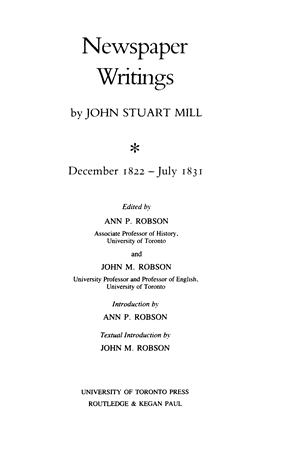
24.: OLD AND NEW INSTITUTIONS MORNING CHRONICLE, 17 OCT., 1823, P. 2 - John Stuart Mill, The Collected Works of John Stuart Mill, Volume XXII - Newspaper Writings December 1822 - July 1831 Part I [1822]Edition used:The Collected Works of John Stuart Mill, Volume XXII - Newspaper Writings December 1822 - July 1831 Part I, ed. Ann P. Robson and John M. Robson, Introduction by Ann P. Robson and John M. Robson (Toronto: University of Toronto Press, London: Routledge and Kegan Paul, 1986).
Part of: Collected Works of John Stuart Mill, in 33 vols.About Liberty Fund:Liberty Fund, Inc. is a private, educational foundation established to encourage the study of the ideal of a society of free and responsible individuals. Copyright information:The online edition of the Collected Works is published under licence from the copyright holder, The University of Toronto Press. ©2006 The University of Toronto Press. All rights reserved. No part of this material may be reproduced in any form or medium without the permission of The University of Toronto Press. Fair use statement:This material is put online to further the educational goals of Liberty Fund, Inc. Unless otherwise stated in the Copyright Information section above, this material may be used freely for educational and academic purposes. It may not be used in any way for profit.
24.OLD AND NEW INSTITUTIONS
This letter is in response to the speech on 9 Oct. to the Chester Whig Club by Colonel William Lewis Hughes (1767-1852), M.P. for Wallingford (1806-31), reported in the Morning Chronicle, 13 Oct., 1823, p. 2, in which Hughes was at pains to put distance between the terms “Whig” and “Radical, and Rebel.” In the passage referred to by Mill, Hughes said, “We seek no new institutions—we claim only for the people their inalienable rights,” a remark galling to the Philosophic Radicals. Headed as title, subheaded “To the Editor of the Morning Chronicle,” the item is described in Mill’s bibliography as “A letter on Old and New Institutions signed ‘No Worshipper of Antiquity,’ which appeared in the Chronicle of 17th October 1823” (MacMinn, p. 4). sir,—In Colonel Hughes’s late speech at the Chester Whig Meeting, most of the principles of which meet with my warmest approbation, I however find one passage to which I cannot agree. The Colonel disclaims a wish to introduce new institutions, and only wishes to restore the Constitution to its pristine purity. I am well aware that this is the ordinary language of those with whom Reform is only the watchword of a party—of those who wish for the removal only of trifling abuses, leaving untouched those great ones in which all the others originate. But that such a man as Colonel Hughes should give in to this cant is what, certainly, I did not expect. I am one of those, Sir, who are friends, and not enemies to innovation; for I wish to see the human race well governed—which would certainly be the greatest of innovations. All history proves, that in every nation of the earth, the powers of Government have uniformly been monopolized in the hands of a privileged few, who, accordingly, never failed to abuse those powers for the benefit of themselves and of their connections, with only one difference, that of old, when the public were far more ignorant and prejudiced than they now are, misgovernment was proportionally more flagrant. We are told of the wisdom of our ancestors. Let us look back to what by an abuse of terms is called venerable antiquity, and which in fact was the nonage of the world; let us consider for a moment who and of what use were these ancestors, whom it is incumbent on us in the nineteenth century to reverence and worship. Those sages who firmly believed, that St. Dunstan tweaked the evil spirit by the nose,1 that Aves and Credos, holy water, and the relics of saints were infallible safeguards in the hour of danger, and that a comet or an eclipse portended the ruin of an Empire—those worthies, whose brutality and licentiousness mastered every good feeling, and yielded only to slavish reverence for ascetic and bigotted Priests. Such “ancestors” as these are indeed worthy of being held up as patterns for us their degenerate “sons.” Why are we not also required, in imitation of them, to put thousands to death by the most excruciating torments, for heresy, magic, witchcraft and sorcery? Let us consider for one moment what would have been the consequence, if reverence for our ancestors had prevented us from adopting improvements in the physical, as it has in the moral sciences. We should never then have been initiated into the wonders of chemistry and of natural philosophy. We should never have seen the air pump, the spinning jenny, or the steam engine. No canals, no bridges, should we have had; and our roads would have remained inferior to the worst lanes of the present day. The press, and all the wonders which it has produced, would never have had existence. It were indeed strange, if at that period of our history, when all the other arts and sciences were in their infancy—when the earth was believed to be a flat surface in the centre of the universe, and the sea to flow round its outer circumference—when the philosopher’s stone and the universal medicine were the only objects of chemistry, and to foretel events by the stars, the sole purpose of astronomy; when wool, the only material of clothing, was carded and spun by hand, and when navigators rarely trusted themselves out of sight of the shore. It were strange, I say, if a people among whom these things were, should, amid all their ignorance, superstition, and barbarism, have taken enlarged views of human nature and of human society—should have foreseen all possible modes of oppression, and have provided efficient securities against all—should, in a word, have established a Constitution which could secure in perpetuity the blessings of good government to mankind. Happily we are much wiser than our ancestors; it were a shame if we were not, seeing that we have all their experience, and much more in addition to it. We look back with contempt upon all which they did in the field of physical and mechanical knowledge. It is only in moral and political science that we are not ashamed to bow submission to their authority. This will not appear strange, if it be considered what influence the ruling few must necessarily exercise over the opinions and feelings of the subject many. The few profit by the existing Government; if a better were substituted, they would cease to receive more than their due share of the benefit. Sir James Mackintosh, in his Vindiciae Gallicae ([2nd ed.,] p. 120n), makes the following observations: Mechanics, because no passion or interest is concerned in the perpetuity of abuse, always yield to scientific improvement. Politics, for the contrary reason, always resist it. It was the remark of Hobbes, that if any interest or passion were concerned in disputing the theorems of geometry, different opinions would be maintained regarding them. It has actually happened (as if to justify the remark of that great man), that under the administration of Turgot, a financial reform, grounded on a mathematical demonstration, was derided as visionary nonsense. So much for the sage preference of practice to theory.2 One word more on innovation. They who do not fall into the egregious absurdity of throwing indiscriminate censure upon innovation, as if it were a necessary inference—because a thing is new, therefore it is bad; but who, nevertheless, wish to keep some measures with those who raise the cry against improvement; these half-and-half-men frequently repel the charge of loving innovation, by giving us to understand that they do not love it for its own sake. A most extraordinary merit, in truth! I will venture to affirm, that I have never yet either seen or heard of any one who loved innovation for its own sake. I have seen men who desired to effect pernicious innovations; but it was always from a view of some real or imaginary good, either to society, or to themselves individually. To conclude, whenever I hear the cry against innovation, I always presume that the cause, in defence of which it is raised, is a bad one. For I am sure, that if it were a good one, its advocates could find some more substantial reason in its defence than merely the antiquity of the opinions which favour it, and the novelty of contrary opinions. And I cannot but consider, that he who, like Colonel Hughes, has a good cause to defend, calculates very ill if he avails himself of an argument which will serve a bad cause with as much success as a good one, when so many cogent arguments may be drawn from the real merits of the case. No Worshipper of Antiquity[1 ]Mill probably got the story about St. Dunstan (ca. 924-88), Archbishop of Canterbury, from The History of England (1754-62), 8 vols. (London: Cadell, Rivington, et al., 1823), Vol. I, p. 112, by David Hume (1711-76), whose source was Osbern, “Vita Sancti Dunstani,” in Anglia sacra, ed. Henry Wharton, 2 vols. (London: Chiswell, 1691), Vol. II, p. 97. [2 ]Mackintosh’s references are to Hobbes, Leviathan, in English Works, Vol. III, p. 91 (Pt. I, Chap. xi); and Anne Robert Jacques Turgot, baron de l’Aulne (1727-81), French statesman and economist, Controller General (1774-76) under Louis XVI. For the derision of Turgot’s proposals for taxation based on mathematics, see Vie de M. Turgot (London: n.p., 1786), pp. 112-14, by Marie Jean Antoine Nicolas Caritat, marquis de Condorcet (1743-94). |

Titles (by Subject)