EconlibThe LibraryOther Sites |
Front Page Titles (by Subject) 20.: SECURITIES FOR GOOD GOVERNMENT MORNING CHRONICLE, 25 SEPT., 1823, P. 2 - The Collected Works of John Stuart Mill, Volume XXII - Newspaper Writings December 1822 - July 1831 Part I
Return to Title Page for The Collected Works of John Stuart Mill, Volume XXII - Newspaper Writings December 1822 - July 1831 Part IThe Online Library of LibertyA project of Liberty Fund, Inc.Search this Title:Also in the Library:
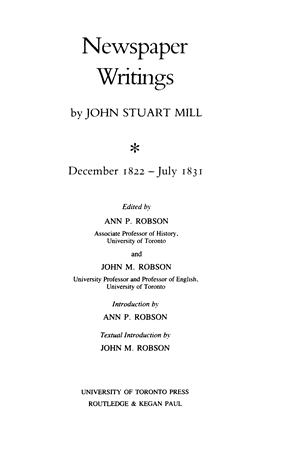
20.: SECURITIES FOR GOOD GOVERNMENT MORNING CHRONICLE, 25 SEPT., 1823, P. 2 - John Stuart Mill, The Collected Works of John Stuart Mill, Volume XXII - Newspaper Writings December 1822 - July 1831 Part I [1822]Edition used:The Collected Works of John Stuart Mill, Volume XXII - Newspaper Writings December 1822 - July 1831 Part I, ed. Ann P. Robson and John M. Robson, Introduction by Ann P. Robson and John M. Robson (Toronto: University of Toronto Press, London: Routledge and Kegan Paul, 1986).
Part of: Collected Works of John Stuart Mill, in 33 vols.About Liberty Fund:Liberty Fund, Inc. is a private, educational foundation established to encourage the study of the ideal of a society of free and responsible individuals. Copyright information:The online edition of the Collected Works is published under licence from the copyright holder, The University of Toronto Press. ©2006 The University of Toronto Press. All rights reserved. No part of this material may be reproduced in any form or medium without the permission of The University of Toronto Press. Fair use statement:This material is put online to further the educational goals of Liberty Fund, Inc. Unless otherwise stated in the Copyright Information section above, this material may be used freely for educational and academic purposes. It may not be used in any way for profit.
20.SECURITIES FOR GOOD GOVERNMENT
This letter, like No. 19, employs a particular instance in support of an idea of Bentham’s, in this case the popular removal of judges (see his Draught of a New Plan for the Organization of the Judicial Establishment in France [1790], in Works, Vol. IV, p. 359). The case was that of Richard Battlebar, a tradesman, and Jane Ashwood, “a perfectly respectable woman” (Examiner, 14 Sept., 1823, p. 605), who were sentenced on 12 Sept. to one month’s imprisonment at the treadmill, on suspicion of indecent exposure, by Maurice Swabey (1785-1864), magistrate at Union Hall, Southwark. Mill picks up the argument of a letter to the Editor, “Revision of the Magistracy,” Morning Chronicle, 22 Sept., 1823, p. 4, signed “A True Friend of Morality and Social Order” (not “to Morality,” as Mill says). The case had occasioned much earlier comment in the Morning Chronicle: see 13 Sept., p. 4, 15 Sept., p. 3, and 16 Sept., p. 3 (a letter and a satirical poem, “Love and Justice”). Headed as title, subheaded “To the Editor of the Morning Chronicle,” the item is described in Mill’s bibliography as “A letter on the advantages of a judicial establishment consisting of judges removeable by the people, in the Chronicle of 24th [sic] September [1823.] Signed a Friend to Responsible Governments.” (MacMinn, p. 3.) sir,—I perused with great satisfaction the Letter inserted in your Paper of Monday, the 22d, on Police Abuses, signed “A True Friend to Morality and Social Order.” One passage, however, in that very able Letter, appears to me objectionable. The writer recommends as a remedy for police abuses, that several of the individuals at present in the Magistracy should be removed. Now, Sir, I am one of those who look at measures rather than men,1 and who reprobate the former when I conceive them to merit reprobation, without feeling any peculiar animosity against the latter. My appetite for change would be satisfied, if the welfare of the community were exclusively consulted, no matter whether by one man or another. I know that although some men will yield to a small temptation, while others cannot be moved but by a great one, yet upon the whole there are few exceptions, or rather none at all, to the principle that all men who have power will infallibly abuse it; a principle the truth of which every one admits with regard to other men, although each considers himself to be an exception. My object, therefore, is, to obtain securities for the good conduct of Legislators, Judges, and Ministers; not to substitute one set of men for another set, leaving to those whom you nominate the same facilities for abuse of power which were enjoyed by those whom you remove. Unless the abuses of the judicial power are such as indicate a radically unsound and depraved intellect, there is no reason for removing the individual, although there is great reason for subjecting him to such responsibility as will effectually prevent the recurrence either of the same or of other abuses. And if there is no particular reason for removing him, there is always this reason against it, that the experience which he has acquired in the exercise of his office, gives him (ceteris paribus) an advantage over any unpractised candidate. Now in the recent instances of police abuses, no greater weakness of intellect appears, than that which is evinced by sacrificing the public good to the desire of gratifying the whole, or some particular section of the Aristocracy. When Mr. White dismissed the complaint of Lady Caroline Lamb’s waiting-woman, on the word of her Ladyship’s husband, and expelled the Reporters from the Police Office because they had reported the woman’s story,2 it is easy to see that the feeling uppermost in the mind of the Worthy Magistrate was a desire of gratifying such Honourables and Right Honourables as may hereafter be pleased to quarrel with their servants. In like manner when Mr. Swabey consigned two low vulgar people to a month’s torture at the tread mill for indulging in gratifications which their superiors are suffered to enjoy without restraint, a discerning eye might detect in this specimen of Magisterial delicacy, a disposition to curry favour with a certain Society,3 and with the numerous and powerful portion of the Aristocracy by which that Society is patronized. And I am persuaded that this puerile ambition is at the bottom of almost every instance of injustice which is perpetrated in this country by what are called Courts of Justice as well as of Law, but which should only be termed Courts of Law. Far be it from me to object the desire of pleasing great people to these Magistrates as a crime. It is the unavoidable result of their situation. In a country where there is an aristocracy interested in injustice, and where the judges are dependent upon the aristocracy, the judges will be unjust. Alter the circumstances, and they will be unjust no longer. Place the judicial office on such a footing that it shall not be necessary for them to conciliate the favour of the aristocracy, and that it shall be necessary for them to obtain that of the people; and then it will be no longer the interest of the aristocracy, but that of the people, which will be consulted. For the attainment of this object, I see no other expedient, than that of giving to the people, either immediately or through their representatives, the power of removing judges of all descriptions from their offices. Let the power be given, and the necessity for the exercise of it will rarely occur. If it be not given, then even if the popular voice made itself heard so strongly as to effect the removal of one or a few obnoxious magistrates, there would be no permanent good, for there would be no securities for good judicature, and as soon as the violent excitement of the public mind subsided, misgovernment would return with undiminished vigour. A Friend to Responsible Governments[1 ]The catch-phrase, “not men but measures,” seems to have originated in “Stentor Telltruth,” The Herald; or, Patriot-Proclaimer, 2 vols. (London: Wilkie, 1758), Vol. II, p. 247, but was much used in the later eighteenth century, for instance by Edmund Burke (1729-97), the political philosopher, who refers to it as cant in his Thoughts on the Cause of the Present Discontents (1770), in Works, 8 vols. (London: Dodsley, Rivington, 1792-1827), Vol. I, p. 499. [2 ]For details, see No. 15. [3 ]The Society for the Suppression of Vice was founded in 1802 as an auxiliary of Samuel Wilberforce’s Proclamation Society (which it soon superseded). Originally much concerned with blasphemy and obscene publications, it later, using vigilante methods, pressed for greater control over prostitution. It had support from aristocrats and, it was said, from the government. |

Titles (by Subject)