EconlibThe LibraryOther Sites |
Front Page Titles (by Subject) 11.: JUDICIAL OATHS MORNING CHRONICLE, 25 JULY, 1823, P. 3 - The Collected Works of John Stuart Mill, Volume XXII - Newspaper Writings December 1822 - July 1831 Part I
Return to Title Page for The Collected Works of John Stuart Mill, Volume XXII - Newspaper Writings December 1822 - July 1831 Part IThe Online Library of LibertyA project of Liberty Fund, Inc.Search this Title:Also in the Library:
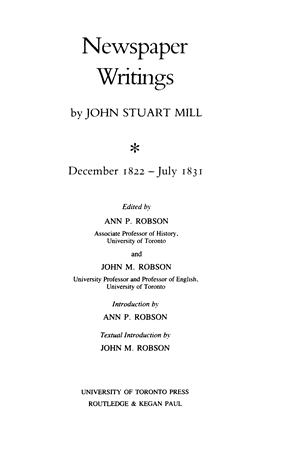
11.: JUDICIAL OATHS MORNING CHRONICLE, 25 JULY, 1823, P. 3 - John Stuart Mill, The Collected Works of John Stuart Mill, Volume XXII - Newspaper Writings December 1822 - July 1831 Part I [1822]Edition used:The Collected Works of John Stuart Mill, Volume XXII - Newspaper Writings December 1822 - July 1831 Part I, ed. Ann P. Robson and John M. Robson, Introduction by Ann P. Robson and John M. Robson (Toronto: University of Toronto Press, London: Routledge and Kegan Paul, 1986).
Part of: Collected Works of John Stuart Mill, in 33 vols.About Liberty Fund:Liberty Fund, Inc. is a private, educational foundation established to encourage the study of the ideal of a society of free and responsible individuals. Copyright information:The online edition of the Collected Works is published under licence from the copyright holder, The University of Toronto Press. ©2006 The University of Toronto Press. All rights reserved. No part of this material may be reproduced in any form or medium without the permission of The University of Toronto Press. Fair use statement:This material is put online to further the educational goals of Liberty Fund, Inc. Unless otherwise stated in the Copyright Information section above, this material may be used freely for educational and academic purposes. It may not be used in any way for profit.
11.JUDICIAL OATHS
This letter was occasioned by the assize report in the Morning Chronicle, 22 July, p. 4, under the heading “Worcester, July 18th (Last Day.) / Before Mr. Justice Park. / Forgery,” of the trial of Thomas Pidgeon, a cattle dealer, for forgery, before James Alan Park (1763-1838). Headed as title and subheaded “To the Editor of the Morning Chronicle,” the letter is described in Mill’s bibliography as “A letter on Judicial Oaths, signed No Lawyer, which appeared in the Chronicle of 23d [sic] July 1823” (MacMinn, p. 2). sir,—In your paper of Tuesday, 22d July, I see a new instance of the mode in which the ends of justice are frustrated by the useless and demoralising, not to say unchristian, ceremony of an oath. An individual who was capitally indicted for presenting a forged check to a Quaker clerk in the banking-house of Whitehead and Co. at Shipston-upon-Stour, was acquitted from the insufficiency of evidence; the Judge, however, appearing convinced that if the scruples of the Quakers had permitted them to give evidence upon oath, the prisoner would in all probability have been convicted. The express prohibition of oaths, which we find in the Gospel, couched in the emphatic words “Swear not at all,”1 has been disregarded, on the ground of expediency, under the supposition that our Saviour could never have intended to prohibit oaths, in any case where they could be proved to be expedient. To the general principle of this assumption I cannot object, as it would be impiety to ascribe to our Saviour any injunction, the observance of which is not consistent with that greatest of blessings, a good administration of justice. I have noticed the assumption merely to shew, that if oaths can be justified, it must be on the ground of expediency, and if they cannot be supported on this ground, they ought to be abolished altogether. Now it has long been recognised by all men of understanding, that an honest man’s word is as good as his oath. And the same may be said of a rogue. But it has been supposed that between these extremes there is a middle point; that some who are sunk low enough in guilt to have lost all compunction at simple mendacity, still retain a degree of reverence for the ceremony of an oath. It is well known that public opinion sets more strongly against the violation of an oath, than against that of a simple affirmation; and what if this circumstance should be adequate to account for the difference in the binding force of the two engagements? When several motives co-operate in producing a given line of action, and when it is desired to ascertain which of the given causes contributes most to their joint effect, there is, I apprehend, only one course to be pursued. The several motives are to be observed when acting separately, and the effects are to be compared which each of them produces, when divested of the co-operating inducements. When I apply this analytic process to the two sanctions, that of an oath, and that of public opinion, I find the latter continually producing effects of the most tremendous magnitude—I find men readily marching up to the cannon’s mouth in the pursuit of public esteem and applause; but if I consider the ceremony of an oath when disjoined from the co-operating force of public opinion, I find it utterly disregarded, without the hesitation of a moment. Of this, one of the most remarkable examples is that of Custom-house oaths. It is well known that the individuals who are sent with goods to the Custom-house, swear readily to their nature and amount, without having ever opened the chests in which they are contained. In Scotland, a country where the religious spirit certainly is not deficient, a law once existed, which imposed higher duties upon French than upon Spanish wine. The inconveniences of this law were soon felt; public opinion ceased to enforce its observation, and we are told by Lord Kaimes that it was constantly evaded by all who were interested in doing so, through the simple expedient of swearing the French wine to be Spanish.2 The statutes of the University of Oxford, which were drawn up by Archbishop Laud, contain a variety of regulations of a frivolous and harassing nature.3 These statutes, all the students swear to observe; but from their absurdity, they are not supported by public opinion; accordingly they are openly violated, not on some occasions merely, but whenever their observance involves the most trifling sacrifice either of ease or of pleasure. Who, then, will venture to assert that the binding force of oaths can be ascribed to the religious obligation? The religious part of the ceremony is not more binding in a judicial, than in a Custom-house oath. But in the former case the obligation is enforced by public opinion; in the latter it is not: accordingly, in the one case it is openly violated; in the other it is observed. Since then the ceremony does not contribute in any degree to secure the veracity of witnesses, it may be, and ought to be, abolished. Nor is this profanation of the name of God frivolous only and nugatory, it is productive of many very serious mischiefs. Of these I shall instance only one, but that one is of unspeakable importance; whenever an oath is part of the formalities of a judicial affirmation, people soon learn to consider it as the binding part. When Judges charge the jury, or address the prisoner in cases of perjury, they take no notice of the misery which he has in all probability occasioned, the ruin possibly of many individuals—they do not remind him that he has done all which depended upon him to poison the fountain of security and happiness to the people, by frustrating the ends of judicature, by causing the acquittal of a guilty, or the punishment of an innocent individual. It is not from these circumstances that they draw the aggravation, or even the original criminality of the offence. No; it is because he has forsworn himself before the Deity—it is because he has disregarded the awful name of God, that he is guilty and deserving of punishment; a reason equally applicable to the blasphemous exclamations of dustmen and coalheavers in the streets, and tending to place these trivial indiscretions on a level with the most pernicious, without exception, of all crimes—judicial perjury. Such being the style in which the obligation of judicial veracity is spoken of by the Judges themselves—the people soon learn to consider the profanation of the religious ceremony as the principal part of the crime. This cannot increase their detestation of mendacity, when aggravated by perjury: but it greatly diminishes their abhorrence of the same offence, whenever the ceremony of an oath has been omitted. Examine the cases in which judicial evidence is taken, without the aid of an oath; and if you find mendacity, in those instances, more frequent, you cannot ascribe it to the absence of the religious ceremony, which the Custom-house and University oaths prove to be wholly void of influence; but you must necessarily attribute this lamentable effect to the demoralizing influence of judicial oaths, which, by diverting the minds of men from the real to the nominal guilt, greatly diminish the horror with which false evidence, as such, would otherwise be regarded. Mr. Justice Park, with his accustomed liberality, took occasion from the trial in question to inveigh against the prejudices of the Quakers. I myself, Sir, am no Quaker; but I think that a man to whom justice is thus denied, because he will not violate what he considers to be his duty, deserves more tender treatment, at the hands at least of Mr. Justice Park, and might fairly retort the accusation of prejudice upon his Lordship, who is willing thus openly to frustrate the ends of justice, for the preservation of a frivolous, nugatory, and demoralizing ceremony. The absurdity of the exclusion is recognised by the law itself, since Quakers are admitted, in civil cases, to give evidence by simple affirmation.4 The law does not presume that on a civil action, a Quaker will give false evidence, because he will not profane the name of God; why should it set up a contrary presumption in criminal cases, where the accused party having more at stake, a conscientious man (and the Quakers are generally speaking the most conscientious of all religious sects) would be, if possible, more cautious than ever in giving his evidence? It is absurd to suppose that criminal cases are either of more importance, or more exposed to the danger of perjury, than civil ones. A cause where the whole earthly resources, perhaps, of innumerable families concerned may well compete in importance with a prosecution for stealing a cow or a sheep. And where the interests at stake are equal, the motives to perjury are the same. In the instance of Quakers, and in all similar instances, it has been well remarked by Mr. Ricardo, in his able speech in favour of free discussion, that the presumption of veracity is not weaker, but stronger, from the very circumstance of their not consenting to violate what they conceive to be a sacred duty of the highest order.5 I am, Sir, yours, with the greatest respect,
|

Titles (by Subject)