Econlib

The Library

Other Sites

Front Page arrow Titles (by Subject) arrow 5.: FREE DISCUSSION, LETTER I MORNING CHRONICLE, 28 JAN., 1823, P. 3 - The Collected Works of John Stuart Mill, Volume XXII - Newspaper Writings December 1822 - July 1831 Part I

Return to Title Page for The Collected Works of John Stuart Mill, Volume XXII - Newspaper Writings December 1822 - July 1831 Part I

Search this Title:

Also in the Library:

Subject Area: Political Theory
Collection: The Collected Works of John Stuart Mill

5.: FREE DISCUSSION, LETTER I MORNING CHRONICLE, 28 JAN., 1823, P. 3 - John Stuart Mill, The Collected Works of John Stuart Mill, Volume XXII - Newspaper Writings December 1822 - July 1831 Part I [1822]

Edition used:

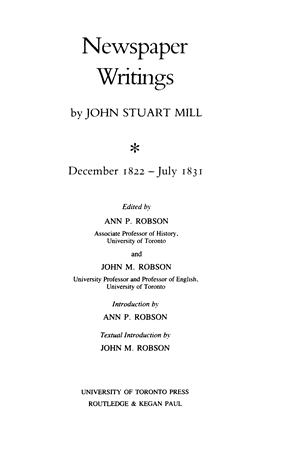
The Collected Works of John Stuart Mill, Volume XXII - Newspaper Writings December 1822 - July 1831 Part I, ed. Ann P. Robson and John M. Robson, Introduction by Ann P. Robson and John M. Robson (Toronto: University of Toronto Press, London: Routledge and Kegan Paul, 1986).

Part of: Collected Works of John Stuart Mill, in 33 vols.

About Liberty Fund:

Liberty Fund, Inc. is a private, educational foundation established to encourage the study of the ideal of a society of free and responsible individuals.


5.

FREE DISCUSSION, LETTER I

MORNING CHRONICLE, 28 JAN., 1823, P. 3

The series made up of this and the next two letters is referred to in Mill’s Autobiography after his mention of his first publications, Nos. 1 and 2: “I soon after attempted something considerably more ambitious. The prosecutions of Richard Carlile and his wife and sister for publications hostile to Christianity, were then exciting much attention, and nowhere more than among the people I frequented. Freedom of discussion, even in politics, much more in religion, was at that time far from being, even in theory, the conceded point which it at least seems to be now; and the holders of noxious opinions had to be always ready to argue and reargue for the liberty of expressing them. I wrote a series of five letters, under the signature of Wickliffe [sic], going over the whole length and breadth of the question of free publication of all opinions on religion, and offered them to the Morning Chronicle. Three of them were published in January and February 1823; the other two containing things too outspoken for that journal, never appeared at all.” (CW, Vol. I, pp. 89-91.) The two final letters seem not to have survived. All headed as title and subheaded “To the Editor of the Morning Chronicle,” the letters are described in Mill’s bibliography as “Three letters, signed Wickliff, on the same subject [as that of No. 3, i.e., freedom of religious discussion], inserted in the Morning Chronicle of 28th January [, 8th February and 12th February,] 1823”

(MacMinn, p. 1).

sir,

At a time when the question of free discussion on religious subjects is agitated with unusual perseverance, and is therefore peculiarly interesting, I think it highly useful to call the public attention to the nothingness of the arguments which have been brought against unlimited toleration; arguments which, though they have been refuted many times already, are daily repeated, and by a very common artifice represented as never having been answered.

I shall first observe, that as it is generally allowed that free discussion contributes to the propagation of truth, and as this assertion is never controverted on the great majority of subjects, it is incumbent on those who declare against toleration to point out some reason which prevents the general rule from being applicable to this particular case; to shew that free discussion, which on almost every other subject is confessedly advantageous to truth, in this particular case unfortunately contributes to the progress of error. If they cannot produce any satisfactory reason, the general rule ought unquestionably to be observed; and that, even if it were not necessary to employ fine and imprisonment in support of the exception; much more when so great a mass of evil is produced by it.

The puerility of the reasons which have hitherto been brought against religious toleration, is perfectly surprising, and proves most satisfactorily that the cause in support of which they are brought is a bad one. The most common of all is the worn-out fallacy, that there is greater danger of mistake on these subjects than on others.

This assertion, it is to be observed, is wholly destitute of proof. In a subsequent letter I will endeavour to prove, not only that the danger of mistake is not greater, but that it is much less in the case of religion than in any other.1 Admitting, however, for the present, that there is greater danger of mistake, I shall proceed to shew, that if free discussion be excluded, the danger is greatly increased.

For if you determine before-hand that opinions shall be promulgated only on one side of the question, in whom will you rest the power of determining which side shall be chosen? The answer is, in those who are most enlightened and best qualified to judge. But there are no determinable and universal marks by which wisdom is to be known. To whom will you give the power of determining what men are the most enlightened?

What is meant, though it is not openly avowed, by the assertion that the wisest men shall chuse opinions for the people, is that the Government shall chuse them. But if the Government is allowed to chuse opinions for the people, the Government is despotic. To say that there is no danger in permitting the Government to chuse religious opinions for the people, is to assert what is notoriously untrue: since there is no conceivable opinion, true or false, which may not, at some time or other, be made a religious doctrine. There is scarcely a single improvement, either in physical or in political science, which has not at one time or another been opposed by religion. The Ptolemaean astronomy was at one time a part of religion.2 A professor was imprisoned within these last two years at Rome for maintaining the truth of the Newtonian system, which is still condemned by the Papal Court.3 The doctrine of passive obedience and non-resistance was generally a religious doctrine, and is still that of the prevailing party of the Church of England.4

But if you exclude discussion on any one doctrine of religion, you must, by parity of reason, exclude it on all. It is in vain to say that Atheistical opinions shall alone be excluded. What reason is there why this more than any other subject should be prevented from undergoing a thorough examination? There is, if not a reason, at least a cause, why Atheism now undergoes that persecution to which other less obnoxious doctrines were formerly subjected. But this cause is merely that the persuasion of its falsehood is more general than in the case of any other obnoxious opinion. To bring this as a reason for preventing discussion, is to say that the people are better qualified to judge before discussion than after it: which is absurd, since before discussion, if their opinions are true it is only by accident, whereas after it they hold them with a complete conviction, and perfect knowledge of the proofs on which they are grounded.

That the evils incurred by permitting any person or persons to chuse opinions for the people are evils of the greatest magnitude, is evident from the arguments which I have adduced. This subject is developed in the most satisfactory manner in Mr. Mill’s invaluable Essay on the Liberty of the Press, forming an article in Napier’s Supplement to the Encyclopaedia Britannica.5

The only other argument of any plausibility which the anti-tolerationists adduce in favour of the present persecutions, is the incalculable mischievousness of the doctrines persecuted, which they conceive to outweigh the evil we have proved to arise from allowing the Government to chuse opinions for the people.

I, therefore, propose to examine whether the mischievous effects of these doctrines are so great as to justify persecution; secondly, whether there are not many other doctrines attended with mischiefs infinitely greater, and which, nevertheless, it would be reckoned, and with justice, highly improper to persecute; thirdly, to prove that there is scarcely any kind of mischievous opinion, be it what it may, which the ignorant are not more likely to adopt, if it be tolerated, than atheism and deism; and lastly, to refute some of the minor fallacies which have been brought in defence of persecution.

These four objects I shall endeavour to attain in as many letters, if they should be thought worthy of insertion in your admirable paper, which, in addition to the other benefits it is continually rendering to mankind, has uniformly stood forward in a most manly and most Christian manner in defence of free discussion.

Wickliff

[1 ]See No. 7.

[2 ]The geocentric astronomy of Claudius Ptolemaeus, 2nd-century Alexandrian mathematician, had been incorporated into traditional Christian cosmology.

[3 ]The reference is presumably to Giuseppe Settele (d. 1841), teacher and astronomer at the University of Rome. In 1820 the Holy Office withheld the imprimatur from his Elementi di Ottica e di Astronomia, 2 vols. (Rome, 1818-19), though he was neither permanently condemned nor imprisoned. For the original ruling, see Giovanni Battista Riccioli, Almagestum novum, 2 vols. (Bologna: Haeredis Victorii Benatii, 1651), Vol. II, p. 497.

[4 ]The High Church party in the Church of England saw itself as the heir of the “non-jurors,” those clergy who refused after the Revolution of 1688 to swear allegiance to William and Mary on the grounds that their oath to James II, whose title was of divine right, was still in effect. Their opposition, however, was passive, according to their reading of Scripture, esp. I Samuel, 15:23, Romans, 13:1-2, and I Peter, 2:13-14.

[5 ]“F.F.” (James Mill), “Liberty of the Press,” in Supplement to the Fourth, Fifth and Sixth Editions of the Encyclopaedia Britannica, ed. Macvey Napier, 6 vols. (Edinburgh: Constable, 1824), Vol. V, pp. 258-72. The Supplement was first issued in fascicles, this article appearing in that published in July 1821.