Econlib

The Library

Other Sites

Front Page arrow Titles (by Subject) arrow NEWSPAPER WRITINGS BY JOHN STUART MILL December 1822 to July 1831 - The Collected Works of John Stuart Mill, Volume XXII - Newspaper Writings December 1822 - July 1831 Part I

Return to Title Page for The Collected Works of John Stuart Mill, Volume XXII - Newspaper Writings December 1822 - July 1831 Part I

Search this Title:

Also in the Library:

Subject Area: Political Theory
Collection: The Collected Works of John Stuart Mill

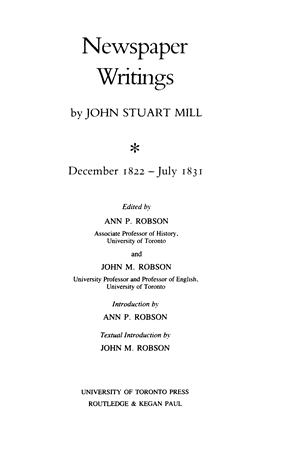
NEWSPAPER WRITINGS BY JOHN STUART MILL December 1822 to July 1831 - John Stuart Mill, The Collected Works of John Stuart Mill, Volume XXII - Newspaper Writings December 1822 - July 1831 Part I [1822]

Edition used:

The Collected Works of John Stuart Mill, Volume XXII - Newspaper Writings December 1822 - July 1831 Part I, ed. Ann P. Robson and John M. Robson, Introduction by Ann P. Robson and John M. Robson (Toronto: University of Toronto Press, London: Routledge and Kegan Paul, 1986).

Part of: Collected Works of John Stuart Mill, in 33 vols.

About Liberty Fund:

Liberty Fund, Inc. is a private, educational foundation established to encourage the study of the ideal of a society of free and responsible individuals.


NEWSPAPER WRITINGS BY JOHN STUART MILL

December 1822 to July 1831

December 1822 to December 1824

1.

EXCHANGEABLE VALUE [1]

TRAVELLER, 6 DEC., 1822, P. 3

This and the next letter, Mill’s first published writings, were occasioned by “Political Economy Club,” Traveller, 2 Dec., p. 3, by Robert Torrens (1780-1864), co-proprietor of the newspaper and a founding member of the Political Economy Club; the subject of Torrens’s article was the meeting of that Club to be held later that day. Mill’s reply brought forth a retort from Torrens in “Exchangeable Value,” Traveller, 7 Dec., p. 3, and the series terminated with a note by Torrens appended to Mill’s second letter. The exchange centred on the theory of value advanced in Elements of Political Economy (London: Baldwin, et al., 1821) by James Mill (1773-1836), J.S. Mill’s father; in his Autobiography Mill says his reply to Torrens was at his father’s “instigation” (CW, Vol. I, p. 89). Headed as title, with the subhead “To the Editor of the Traveller,” the items are described in Mill’s bibliography as “Two letters in the Traveller of [6th Dec.] and [13th Dec.] 1822 containing a controversy with Col. Torrens on the question whether value depends on quantity of labour. Signed S.”

(MacMinn, p. 1.)

sir,

In your notice of the late Meeting of the Political Economy Club, you have inserted a disquisition, which professes to be a refutation of Mr. Mill’s theory of value. I take the liberty of submitting to you several remarks which occurred to me on reading your article.

In the first place, if I rightly understand Mr. Mill’s chapter on Exchangeable Value,1 he cannot be said with propriety to have any theory of value—at least, in that sense in which the word theory is applied to Mr. Ricardo’s doctrines on this subject. Mr. R. renders the word value, as synonymous with productive cost2 —thus introducing a new, and as it appears to me, a needless ambiguity of language. Mr. Mill, on the other hand, never uses the word value in any other than its vulgar acceptation. I am not aware that there is any passage in the Elements of Political Economy, in which the words power of purchasing may not be substituted for the word value, without in any degree affecting the truth of Mr. Mill’s positions.

But though the word value is never employed by Mr. Mill, in any other sense than purchasing power, it is nevertheless true that he endeavours to ascertain what are the circumstances which regulate the purchasing power of commodities.3 He agrees with the distinguished political economist whom we have cited, in considering the regulating circumstance to be cost of production. This cost he considers as resolvable into quantity of labour, and it is to this part of his doctrine that your strictures refer. As your arguments on this subject do not appear to me to be conclusive, I beg leave to offer my objections to their validity.

You say, “Let the rate of profit be 20 per cent.; let a manufacturer in silver and a manufacturer in iron each advance a capital of a thousand pounds, and let the advance of the former consist of ninety days’ hoarded labour, in the form of material, and ten days’ hoarded labour in the form of subsistence, while the advance of the latter consists of ten days’ hoarded labour in the form of material, and ninety in the form of subsistence.” [P. 3.]

You observe that the manufacturer in silver, with ten days’ labour of subsistence, must employ twelve days of immediate labour, in order to realize a profit of 20 per cent.; and that the manufacturer in iron, with his 90 days’ labour of subsistence, will employ 108 days of immediate labour: that therefore the silver goods, when completed, will be the produce of twelve days of immediate labour, and 90 of hoarded labour, in the form of material; while the iron goods will be the produce of 108 days of immediate labour, and 120 of hoarded labour, also in the form of material; forming the two different sums total of 102 and 118 days’ labour.

This being the case, you assert that the silver and the iron goods will exchange for one another. To this I cannot assent. You appear to have forgotten, that if profits are taken into the account at all, we must suppose the two manufacturers to make a profit, not merely on that portion of their capital which they expend in maintaining labour, but also on that portion which they expend in furnishing the raw material. By supposition, the capital of each producer consisted of one hundred days’ labour. You assert that when the production is completed, the silver manufacturer has only the produce of 102 days’ labour, while the iron manufacturer has the produce of 118 days’ labour, in remuneration for their capital. The former then has only a profit of 2 per cent. on his whole capital, the latter has a profit of 18 per cent. on the whole. It is evident that, under these circumstances, the two commodities will not exchange for one another: their values will be in the proportion of 102 to 118—that is, of the quantities of labour by which they were produced. This, at least, will be the case, if profits are to be considered as forming one ingredient in cost of production, the position on which your whole argument is founded.

If profits are equal in the two cases, as the principle of competition will render them, it is unnecessary to take them into the calculation of exchangeable value, which is, by the force of the term, not something absolute, but something relative. If the whole produce of the one capital exchanges for the whole produce of the other, those parts of them which remain when profits are deducted, will also exchange for one another. But if we exclude profits, your objection falls to the ground. Mr. Mill’s argument must, therefore, be considered as resting on the same foundation as before.

You have also started an objection against another of Mr. Mill’s arguments. The value of commodities (says Mr. M.) cannot depend upon capital, since capital is commodities, and if the value of commodities depends on the value of capital, it depends on the value of commodities—that is, on itself.4 You observe, that this argument cuts both ways. If the value of commodities depends upon labour, as the value of labour can only be estimated in commodities, this (say you) is to assert that the value of labour depends on the value of labour. This would be true if Mr. M. had asserted that the value of commodities depends on the value of labour. But he says, that it depends, not on the value but on the quantity of labour:5 there is here no inconsistency. The value of commodities depends upon the quantity of labour employed in producing them. The value of labour, which is not itself produced by labour, cannot be subject to the same laws. Mr. M. in his Chapter on Wages, has expounded the laws which regulate the value of labour.6

S.

2.

EXCHANGEABLE VALUE [2]

TRAVELLER, 13 DEC., 1822, P. 2

For the context, heading, and bibliographical information, see No. 1.

sir,

In your Paper of Saturday you inserted an article professing to be a refutation of that which you did me the honour of inserting on Friday. Permit me, however, to say, that if I was before convinced of the truth of Mr. Mill’s conclusions, my conviction is strengthened by the weakness of the arguments which are brought against them by the ablest of their opponents.

You accuse me of having misunderstood your arguments. I am at a loss to conceive what interpretation can be put upon them, different from that which I have given. In the argument of your first article I can see only two things: first, an elaborate attempt to prove what no one ever thought of disputing—namely, that labour produces more than is necessary for the maintenance of the labourers: and secondly, an inference drawn from this—namely, that labour does not regulate exchangeable value. Your reasoning amounts to this—labour is productive, therefore labour does not regulate value. I hope you will excuse me if I confess that I do not see the connection between these two propositions. One man by one day’s labour may possibly produce food which will maintain him for ten days; but it does not follow from this, that one day’s labour of food will not exchange for one day’s labour of any other commodity.

In your last article, you put a different case. You suppose A to have wine, the produce of 100 days’ labour, and B to have food, the produce of equal labour. A keeps his wine in his cellar to improve by age; B employs his capital in maintaining 120 days of labour in the production of a commodity. These commodities, you say, will exchange for one another; and you conceive that here labour does not regulate value. It seems to me, however, that this is not an exception to Mr. Mill’s doctrine. You virtually admit that the value of B’s commodity is regulated by the quantity of labour expended in its production. But if the wine produced by equal capital, and deposited in the cellar of the merchant, did not command the same price, no wine would ever be kept. The value, therefore, of A’s wine is regulated by that of B’s commodity. But the value of B’s commodity depends on quantity of labour. Is it not, therefore, evident that the value of A’s wine also depends on quantity of labour?

S.

3.

RELIGIOUS PERSECUTION

MORNING CHRONICLE, 1 JAN., 1823, P. 1

This letter was occasioned by a series of prosecutions for blasphemous libel that received considerable attention in the press (see, e.g., in the last part of 1822, Examiner, 27 Oct., pp. 685-6, 3 Nov., pp. 709-10, 17 Nov., pp. 721-4, 726, 734, 24 Nov., pp. 748-9, 764-5, 15 Dec., pp. 788ff.). Headed as title, with the subhead “To the Editor of the Morning Chronicle,” the letter was the first of Mill’s many contributions to the Morning Chronicle. The item is described in Mill’s bibliography as “A letter in the Morning Chronicle of 1st January 1823 on Free Discussion, signed, An Enemy to Religious Persecution”

(MacMinn, p. 1).

sir,

I beg leave to submit to you some observations, which may, perhaps, appear too obvious to be deserving of insertion. The importance, however, of the subject, and the state of vagueness in which every thing connected with it has been hitherto suffered to remain, must plead my apology for intruding upon your notice.

The late persecutions for matters of opinion have frequently been defended, on the ground that “Christianity is part and parcel of the law of England.”1 This sentence, put together by a Judge, passed from Judge to Judge with solemn and appalling gravity, will be found, on examination, to be, like the many other high-sounding maxims with which our law abounds, utterly unmeaning and absurd. This is so evident, that nothing but the extreme vagueness of the language in which this doctrine is conveyed could have protected it from detection and exposure.

A law is a precept, to the non-observance of which, pains and penalties are attached by the Government. Against this definition, I apprehend, no objection can be brought. And the law of England, collectively considered, is a collection of the precepts, thus sanctioned by legal authority.

Having thus settled the meaning of one of the words employed, let us pass to the other. Christianity then consists of two parts—a collection of precepts and a collection of opinions. When we speak of the spirit of christianity, of its morality, &c., we allude more particularly to the precepts. When we speak of the doctrines, the dogmas, the truths of christianity, this is with reference to the opinions which it inculcates. This division appears to me to be complete. No one can mention any thing connected with christianity, which is not either matter of precept, or matter of opinion.

Now when it is asserted by Judges that christianity is part and parcel of the law, is this meant of the precepts of christianity?—No, certainly: for if so, it would mean that every moral duty is enforced by the law of England; of the impossibility of this, it is scarcely necessary to produce any illustration. Not to notice the frequent admonitions which we find in the Gospel for preserving purity of heart,2 it will not be denied that sobriety and chastity are among the first of moral duties. But what would be the consequence of erecting them into a law? It is enough to say that it would be necessary to place a spy in every house.

But if not the precepts, perhaps the opinions which christianity inculcates, may be said with propriety to be “part and parcel of the law.” And how? The law is a collection of precepts. In what sense can an opinion be part of a collection of precepts?—Surely this maxim, which has been made the foundation of proceedings such as we have lately witnessed, is either palpably false, or wholly without a meaning. Unfortunately the protection, as it is sacrilegiously termed, of the christian doctrines, by the persecution of those who hold contrary opinions, is part and parcel of the law. But this, the only intelligible sense in which the maxim can be taken, ought not thus to be made a foundation for itself.—The Judge argues as follows:—I punish infidelity, because christianity is part and parcel of the law. This is as much as to say, I punish infidelity, because such punishment is part of the law.—This may be a very good defence for the particular Judge who pronounces the sentence, but is it not absurd to give it as a justification of the persecuting law?

An Enemy to Religious Persecution

4.

THE WORD “NATURE”

REPUBLICAN, 3 JAN., 1823, PP. 25-6

This letter, which reflects Mill’s contemporaneous study of law with John Austin, is addressed to Richard Carlile (1790-1843), the free-thinker, who was editing the Republican from Dorchester Gaol, where he had been imprisoned for publishing the works of Thomas Paine and other writings held to be seditious. Mill seems to have been mistaken in attributing to Carlile the view expressed in his opening paragraph; Carlile appended to the letter a signed note: “My Atheistical friend is, I think, wrong in supposing that I wrote such an assertion as that, there must be a cause to be attributed. I may have said the phenomena of the material world: or that the constant charges [sic] which we behold in materials argue the existence of a cause or active power that pervades them. But I have again and again renounced the notion of that power being intelligent or designing.” The letter, Mill’s only one to the Republican, is headed “To Mr. R. Carlile, Dorchester Gaol,” and is described in Mill’s bibliography as “A letter in the Republican of [3 Jan., 1823,] on the word Nature”

(MacMinn, p. 1).

sir,

Admiring as I do the firmness with which you maintain, and the astonishing candour with which you defend your principles, sympathising in your opinions and feelings both on the subject of politics and on that of religion; I deeply regret, in common with your correspondent Gallus,1 that you should ever have given currency to doctrines in direct opposition to your other opinions. From among many such doctrines, I select one, which appears to me to be the stumbling block of a great number of Infidels. This is to be gathered from the use which you frequently make of the word Nature as denoting some positive, active, if not intelligent being. In a former No. of The Republican, in allusion to the application which has been made to you of the word Atheist, you observe that although you do not reject this appellation, you consider it as a very absurd one, as you conceive that every man must acknowledge, under the name either of God, or of nature some cause to which the material world is to be attributed. Your exact words I do not remember, but I am certain that this was the import of what you said.

Now as I do not myself acknowledge any such cause, I would if it were necessary, endeavour to convince you that there is no foundation for any such belief. But I rejoice to see that this labour is spared me by the admirable letter of Gallus. I will therefore confine myself to a brief examination of the import and application of the word Nature.

All human knowledge consists in facts, or phenomena, observed by the senses and recorded by means of language. The study of these phenomena is what is called the study of Nature: the aggregate of the phenomena, or human knowledge as it stands, is called Nature in the abstract. If this be true, you must at once see the absurdity of supposing any thing to be caused by Nature. Nature is that for which the cause is to be sought; or rather, it is that for which it is needless to seek any cause, as if it has any, this must remain for ever unknown.

The phenomena which we observe are found to follow one another in a certain order; the same event is invariably observed to be preceded by the same event. When a sufficient number of these sequences has been observed, it becomes possible to express them by a certain number of general propositions, which have been metaphorically termed Laws of Nature, but which have in reality no resemblance to laws. A law is a general command laid down by a superior, most commonly by the governors of a nation. The analogy is very distant between this and a verbal expression for a series of phenomena; which is absurdly called a law of Nature.

When once this phraseology was introduced, the poets and mythologists soon took hold of it, and made it subservient to their purposes. Nature was personified: the phrase law of Nature, which originally meant no more than a law for the regulation of Nature, or of the natural world, became a law laid down by the goddess Nature to be obeyed by her creatures. From the poets, this fictitious personage speedily penetrated into the closets of the philosopher, and hence arose the error of attributing a creative power to nature. To make any use of this word, in the explanation of the material phenomena, is only substituting for rational scepticism, a mystical and poetical kind of Theism. Of course, the arguments which serve to explode the belief in an ante-material and intelligent Being, will also suffice to destroy the unmeaning word Nature.

Yours, with the greatest respect,
An Atheist

5.

FREE DISCUSSION, LETTER I

MORNING CHRONICLE, 28 JAN., 1823, P. 3

The series made up of this and the next two letters is referred to in Mill’s Autobiography after his mention of his first publications, Nos. 1 and 2: “I soon after attempted something considerably more ambitious. The prosecutions of Richard Carlile and his wife and sister for publications hostile to Christianity, were then exciting much attention, and nowhere more than among the people I frequented. Freedom of discussion, even in politics, much more in religion, was at that time far from being, even in theory, the conceded point which it at least seems to be now; and the holders of noxious opinions had to be always ready to argue and reargue for the liberty of expressing them. I wrote a series of five letters, under the signature of Wickliffe [sic], going over the whole length and breadth of the question of free publication of all opinions on religion, and offered them to the Morning Chronicle. Three of them were published in January and February 1823; the other two containing things too outspoken for that journal, never appeared at all.” (CW, Vol. I, pp. 89-91.) The two final letters seem not to have survived. All headed as title and subheaded “To the Editor of the Morning Chronicle,” the letters are described in Mill’s bibliography as “Three letters, signed Wickliff, on the same subject [as that of No. 3, i.e., freedom of religious discussion], inserted in the Morning Chronicle of 28th January [, 8th February and 12th February,] 1823”

(MacMinn, p. 1).

sir,

At a time when the question of free discussion on religious subjects is agitated with unusual perseverance, and is therefore peculiarly interesting, I think it highly useful to call the public attention to the nothingness of the arguments which have been brought against unlimited toleration; arguments which, though they have been refuted many times already, are daily repeated, and by a very common artifice represented as never having been answered.

I shall first observe, that as it is generally allowed that free discussion contributes to the propagation of truth, and as this assertion is never controverted on the great majority of subjects, it is incumbent on those who declare against toleration to point out some reason which prevents the general rule from being applicable to this particular case; to shew that free discussion, which on almost every other subject is confessedly advantageous to truth, in this particular case unfortunately contributes to the progress of error. If they cannot produce any satisfactory reason, the general rule ought unquestionably to be observed; and that, even if it were not necessary to employ fine and imprisonment in support of the exception; much more when so great a mass of evil is produced by it.

The puerility of the reasons which have hitherto been brought against religious toleration, is perfectly surprising, and proves most satisfactorily that the cause in support of which they are brought is a bad one. The most common of all is the worn-out fallacy, that there is greater danger of mistake on these subjects than on others.

This assertion, it is to be observed, is wholly destitute of proof. In a subsequent letter I will endeavour to prove, not only that the danger of mistake is not greater, but that it is much less in the case of religion than in any other.1 Admitting, however, for the present, that there is greater danger of mistake, I shall proceed to shew, that if free discussion be excluded, the danger is greatly increased.

For if you determine before-hand that opinions shall be promulgated only on one side of the question, in whom will you rest the power of determining which side shall be chosen? The answer is, in those who are most enlightened and best qualified to judge. But there are no determinable and universal marks by which wisdom is to be known. To whom will you give the power of determining what men are the most enlightened?

What is meant, though it is not openly avowed, by the assertion that the wisest men shall chuse opinions for the people, is that the Government shall chuse them. But if the Government is allowed to chuse opinions for the people, the Government is despotic. To say that there is no danger in permitting the Government to chuse religious opinions for the people, is to assert what is notoriously untrue: since there is no conceivable opinion, true or false, which may not, at some time or other, be made a religious doctrine. There is scarcely a single improvement, either in physical or in political science, which has not at one time or another been opposed by religion. The Ptolemaean astronomy was at one time a part of religion.2 A professor was imprisoned within these last two years at Rome for maintaining the truth of the Newtonian system, which is still condemned by the Papal Court.3 The doctrine of passive obedience and non-resistance was generally a religious doctrine, and is still that of the prevailing party of the Church of England.4

But if you exclude discussion on any one doctrine of religion, you must, by parity of reason, exclude it on all. It is in vain to say that Atheistical opinions shall alone be excluded. What reason is there why this more than any other subject should be prevented from undergoing a thorough examination? There is, if not a reason, at least a cause, why Atheism now undergoes that persecution to which other less obnoxious doctrines were formerly subjected. But this cause is merely that the persuasion of its falsehood is more general than in the case of any other obnoxious opinion. To bring this as a reason for preventing discussion, is to say that the people are better qualified to judge before discussion than after it: which is absurd, since before discussion, if their opinions are true it is only by accident, whereas after it they hold them with a complete conviction, and perfect knowledge of the proofs on which they are grounded.

That the evils incurred by permitting any person or persons to chuse opinions for the people are evils of the greatest magnitude, is evident from the arguments which I have adduced. This subject is developed in the most satisfactory manner in Mr. Mill’s invaluable Essay on the Liberty of the Press, forming an article in Napier’s Supplement to the Encyclopaedia Britannica.5

The only other argument of any plausibility which the anti-tolerationists adduce in favour of the present persecutions, is the incalculable mischievousness of the doctrines persecuted, which they conceive to outweigh the evil we have proved to arise from allowing the Government to chuse opinions for the people.

I, therefore, propose to examine whether the mischievous effects of these doctrines are so great as to justify persecution; secondly, whether there are not many other doctrines attended with mischiefs infinitely greater, and which, nevertheless, it would be reckoned, and with justice, highly improper to persecute; thirdly, to prove that there is scarcely any kind of mischievous opinion, be it what it may, which the ignorant are not more likely to adopt, if it be tolerated, than atheism and deism; and lastly, to refute some of the minor fallacies which have been brought in defence of persecution.

These four objects I shall endeavour to attain in as many letters, if they should be thought worthy of insertion in your admirable paper, which, in addition to the other benefits it is continually rendering to mankind, has uniformly stood forward in a most manly and most Christian manner in defence of free discussion.

Wickliff

6.

FREE DISCUSSION, LETTER II

MORNING CHRONICLE, 8 FEB., 1823, P. 3

This letter, centring on the utility of oaths, draws heavily on “Swear not at all”: Containing an Exposure of the Inutility and Mischievousness, as Well as Anti-Christianity, of the Ceremony of an Oath (London: Hunter, 1817), by Jeremy Bentham (1748-1832); in his Works, ed. John Bowring, 11 vols. (Edinburgh: Tait, 1843), Vol. V, pp. 187-229. (This work was printed in 1813, and a copy given to the Head of an Oxford College in that year, almost certainly during the tour on which Bentham took Mill and his father; see CW, Vol. I, pp. 55-7.) In the tract Bentham refers to all the issues cited by Mill: jurymen’s oaths, pp. 204-5, custom-house oaths, p. 195, university oaths, pp. 195-7, 209-12, 213-19, and 224-9 (all dealing with Oxford, Bentham’s university, except pp. 213-19, on Cambridge), and Quakers’ affirmations, p. 201. For the context, heading, and entry in Mill’s bibliography, see No. 5.

sir,

In my first letter I endeavoured to give a general conception of the plan which I intend to pursue in advocating the cause of free discussion. This plan I will now endeavour to carry into execution.

Persecutors do not usually attempt to justify their intolerance under pretence of avenging the cause of God. The absurdity of this pretension would be too obvious, since it would imply that God is unable to avenge his own cause; and since it is also evident, that Christianity rejects this method of defence. If there was any reason which could justify persecution in the eyes of a man of sense, that reason must be its utility to man; and it is upon this circumstance accordingly, that the greatest stress has been laid. By permitting the propagation of infidel doctrines, you destroy, it is said, the principal security for good judicature, and for the practice of private morality.

How far this assertion is true it shall be our business to inquire; and first as to judicature—among those requisites without which good judicature cannot exist, the principal is true and complete evidence. A great part of the evidence delivered in a Court of Justice consists in the testimony of witnesses. To secure veracity on the part of witnesses is therefore one of the most important ends to which the Legislator can direct his endeavours.

For insuring the veracity of witnesses, among other securities the ceremony of an oath has been resorted to. That the desired effect is attained in a very considerable degree is certain—that this beneficial result is to be attributed to the ceremony of swearing, is by no means a legitimate conclusion. There are several motives which tend to produce veracity on the part of witnesses. Even those who attribute the effect principally to the ceremony of swearing will admit, that the fear of punishment and the fear of shame in this instance co-operate with the religious inducement.—Since, then, it is allowed on all hands, that the veracity of witnesses is the joint result of several causes, it is for them to shew why it is to be attributed to one of these more than to another.

When a number of different causes co-operate in the production of a given effect, it is often a matter of some difficulty to determine which of the causes is principally instrumental in bringing it about. This difficulty, however, is removed, if an opportunity presents itself of examining the effects produced by each of the causes, taken separately. If we find that one of the causes, when unsupported by the others, is not followed by any degree of the effect in question, we shall be intitled to conclude, that in all those cases in which the effect really takes place, it is to the other causes, and not to this one, that it ought to be attributed.

This opportunity fortunately presents itself in the case we are considering. There are several instances in which, although the ceremony of an oath is employed, neither the laws nor the popular voice enforce observance of it. If it should appear that in all these cases truth is uniformly and openly violated, then we ought to conclude, that whenever judicial mendacity is prevented, we owe this benefit to the laws and to popular opinion, not to the ceremony of swearing.

I. It is notorious, that from motives of humanity, but in defiance of the strongest evidence, Juries frequently condemn a criminal to a milder punishment than the laws have appropriated to his offence, by finding him guilty of stealing under the value of 40s. Here the oath of the Jurymen is flagrantly violated. They have sworn to judge according to the evidence; but humanity, which dictates the perjury, also prevents public opinion from censuring the perjured Jurymen. This instance, therefore, makes it apparent, how slender is the security which an oath affords, when unsupported by, or at variance with, public opinion.

II. Another most striking instance of the inefficacy of oaths is, the abuse which is made of them at the Custom House. So notoriously does every merchant, who imports or exports goods, swear falsely to their quality and amount, that Custom House oaths have almost passed into a proverb.1 This perjury, indeed, has for its object to evade certain laws, which are so admirably contrived for the purpose of fettering commerce, that if they were rigidly enforced, certain commodities could not possibly be exported or imported. From the acknowledged absurdity of the laws, this perjurious evasion of them is not reprobated by public opinion.

III. Every young man, at his admission into the University of Oxford, swears to obey certain statutes, drawn up by Archbishop Laud for the government of the University.2 Now it is well known that no one of these students ever bestows a single thought upon the observance of these statutes. The cause of this non-observance is, that from the uselessness and absurdity of the statutes, public opinion does not enforce obedience to them. If, however, the ceremony of an oath was of any efficacy in preventing mendacity, this efficacy would shew itself even in a case where the obligation is not sanctioned by public opinion. The violation of the University oath, in every case where its observance interferes in the slightest degree with the convenience of the swearer, is a complete proof that the ceremony of swearing affords no security whatever for veracity in any other case, and that whenever witnesses speak the truth, it is not because they have sworn, but because they fear punishment and shame.

The inefficiency of an oath is practically recognized by English Legislators, and by English Judges, when they admit persons of all religious denominations to give evidence, after taking an oath according to the form prescribed by their own religion. For there are some religions which are acknowledged to have little or no efficacy in preventing mendacity. Yet we do not find that, ceteris paribus, less reliance is to be placed on the oaths of one set of religionists, than of another.

But the law is not even applicable to all Christians, which amounts to an admission of the inefficacy of oaths to secure good evidence. The respectable sect of Quakers is freed from the necessity of swearing,3 and yet it is always understood that there is proportionably less false evidence on the part of the members of that body, than on the part of the members of any of the swearing sects.

Having thus made it appear that it is not to the influence of religious motives that good evidence is to be attributed, we might conclude from analogy that the security we have for useful actions is chiefly referrable to other sources. This conclusion is farther supported by the frequency with which duelling and fornication are practised, notwithstanding the positive manner in which they are forbidden by Christianity. They are practised merely because public opinion does not, in these instances, support the dictates of religion. The drinking of wine in Mahometan countries is another equally striking instance.

From the considerations which we have adduced, all of them notorious results of experience, it is evident how ill-founded is the argument of those who defend persecution on the ground which we have combated.

In my next I will endeavour to shew that persecution is not necessary for the support of Christianity.

Wickliff

7.

FREE DISCUSSION, LETTER III

MORNING CHRONICLE, 12 FEB., 1823, P. 3

For the context, heading, and entry in Mill’s bibliography, see No. 5.

sir,

I shall now endeavour to prove that persecution is not necessary for the preservation of Christianity.

The Christian Religion may be contemplated in two points of view. We may direct our attention to those peculiar characteristics which distinguish it from all other doctrines, true or false; or we may consider it with reference to those properties which it has in common with all true doctrines, as contradistinguished from false ones.

Not one, but many, arguments might be adduced to prove that Christianity, considered merely as a true doctrine, could not, under the influence of free discussion, fail of prevailing over falsehood. This ground, however, has already been gone over by far abler pens than mine; and a truth which has been maintained (not to speak of other writers) by Divines so eminent as Tillotson, Taylor, Chillingworth, Campbell, Lardner, Lowth, Warburton, Paley, Watson, and more recently by Hall, cannot stand in need of such feeble support as I can afford.1

In the present Letter I shall therefore confine myself to the consideration of those qualities peculiar to Christianity, which render persecution even less necessary for its support than for that of any other true doctrine.

And first, let me observe, that the only supposition on which persecution can be defended—by such of its advocates, I mean, as are Christians—is that of the utter incapacity and incorrigible imbecility of the people. That infidels should think persecution essential to the being of Christianity, can be matter of no surprise; but one who believes in the truth of the doctrine he supports, can not for a moment entertain any such opinion, unless he believes what no man, whose judgment is not biassed by interest, can believe, that the people are incapable of distinguishing truth from falsehood.

The fact, that the utility of persecution rests on such a basis, would alone induce every reasonable man to scout the idea of it; but, even though we were to allow the incapacity of the people, to admit the truth of all which their worst calumniators have ever imputed to them; it would not be less true that Christianity can support itself without persecution, nor, consequently, would the arguments in favour of toleration be a whit less conclusive.

If a true proposition, and the false one which is opposed to it, are presented at the same time to the mind of a man who is utterly incapable of distinguishing truth from error, which of the two is he most likely to embrace? This question will be found to admit of an easy answer. If he was before prepossessed in favour of either opinion, that one he will still continue to hold. If both were equally new to him, he will choose that which is most flattering to his prevailing passion.

All the prepossessions of those whom it is wished to protect by persecution from the danger of becoming infidels are uniformly and confessedly favourable to religion. No where is education, even partially, in the hands of infidels. There is no place where religion does not form one of the most essential parts of education. It is not, therefore, upon this ground, that persecution can be justified.

To counteract the effect of early impressions, it will, no doubt, be affirmed that infidelity is peculiarly flattering to the passions, and that those who wish to throw off the shackles of morality will be glad, in the first instance, to emancipate themselves from the salutary restraint which religion imposes.

It was partly with the intention of obviating this objection that my last letter was penned. There is no use in representing the evils of infidelity as greater than they really are: nor does a disposition to do so evince, on the part of him who shews it, any very great anxiety to vindicate either himself or his religion from the imputation of want of candour. That infidelity excludes us from the blessings of a future life, would surely be a sufficient reason to induce every reasonable man to reject it. I have endeavoured to shew that even if (which God forbid) all sense of religion were to die away among men, there would still remain abundant motives to ensure good conduct in this life. The passions, therefore, are not interested in throwing off religious belief, or all our ethical writers have been employing their labour to very little purpose.

Nor is this all. Infidel doctrines are peculiarly ill fitted for making converts among that portion of mankind who are most in danger of mistaking falsehood for truth. They bear a greater analogy to general abstract propositions in metaphysics than to any thing which can immediately affect the sensitive faculties. Besides, they superinduce what, to all men not convinced of the necessity of it by the habit of scientific disquisitions, is the most painful of all states of mind, a state of doubt. On the other hand, one of the strongest feelings in every uneducated mind is the appetite for wonder, the love of the marvellous. Witness the rapid progress of so many religious, which we now think so unutterably absurd that we wonder how any human being can ever have given credit to them. This passion is gratified in the most eminent degree by the Christian religion; for what is there in Christianity which is not in the highest degree sublime and mysterious?

Against so general and so powerful a feeling, what has scepticism to oppose? It is not peculiarly fitted to take hold of the imagination; on the contrary, it is eminently and almost universally repelled by it. If, then, it had not been evident before, I trust that the considerations I have adduced will suffice to make it so, that of all the doctrines which the invention of man ever devised, none is so little likely to prevail over the contrary doctrine as religious infidelity.

Doctrines which, if left to themselves, have no chance of prevailing, may be saved from oblivion by persecution. The advocates of infidelity are active and fearless: no persecution can daunt, no ignominy can restrain them. By persecution they are raised to an importance which they could never otherwise have attained: by ignominy they are only advertised that it is impossible for them to retreat. To prevent them from diffusing infidelity through the whole kingdom, what has been done by our well-paid divines? I am not aware that they have yet employed any other weapon than vague and declamatory abuse. Books indeed there are; but, alas! what avails a mass of ponderous volumes, written in a style as little suited to the capacity, as the price at which they are sold is to the purses, of those for whose use they are principally required? It is true abuse is far easier, and requires less time and application than argument. But unless my knowledge of the duties of Christian Clergymen is very imperfect, they do not receive one-tenth of the produce of the soil in order that they may attack infidels by coarse and disgusting abuse, but that they may bring them back by gentle persuasion within the pale of the Church.

Wickliff

8.

TOOKE’S THOUGHTS ON HIGH AND LOW PRICES [1]

GLOBE AND TRAVELLER, 4 MAR., 1823, P. 1

Thomas Tooke (1774-1858), another founding member of the Political Economy Club, became best known for his History of Prices, 6 vols. (1838-57). His Thoughts and Details on the High and Low Prices of the Last Thirty Years was published in London by Murray in 1823, with the Parts separately issued and paginated. This, Mill’s first published review, appeared in two parts, both headed “Thoughts and Details on the High and Low Prices of the Last Thirty Years,” with subheadings for the first, “Part 1.—On the Alterations in the Currency. By Thomas Tooke, F.R.S.,” and for the second (No. 12), “In Four Parts. Parts II, III, and IV. By Thomas Tooke, F.R.S.” The first part was his first contribution to the newly amalgamated Globe and Traveller. The two-part unsigned review is described in Mill’s bibliography as “A Notice of Part I of Mr. Tooke’s work on High and Low Prices, which appeared in the Traveller of 4th March 1823” and “A notice of Part II of Mr. Tooke’s work on High and Low Prices, which appeared in the Chronicle of 9th August 1823”

(MacMinn, p. 2).

mr. tooke’s new work on the High and Low Prices of the last Thirty Years, promises to be of so great utility in furnishing answers to many of the usual fallacies, on what is called “the Agricultural Question,” that we cannot devote our columns to a better purpose than that of giving a short outline of its contents. The questions, it is true, which regarded the operation of the Bank Restriction, and subsequently of Mr. Peel’s Bill,1 were settled long ago by general reasoning to the satisfaction of every thinking man. As, however, several well-intentioned, but mistaken individuals, have brought forward in opposition to conclusions borne out by the most convincing arguments, certain facts which they assert to be inconsistent with them, we think that Mr. Tooke has rendered a great service to the British public, in proving that of these facts, a great proportion are incorrect, and the remainder perfectly reconcileable to the results of general reasoning.

On the fluctuations of prices during the last thirty years, there are, says Mr. Tooke, two prevailing opinions. The one attributes the high prices wholly to the excess of paper, and the present low ones to the resumption of cash payments. The other ascribes the high prices wholly to the war, and the low ones to the transition from war to peace. The advocates of both opinions agree in attributing very little to the varieties of the seasons.

These opinions Mr. T. considers as erroneous. He enumerates three principal causes of the variations in prices:—

1. Alterations in the currency; 2. War, and the return to peace; 3. Varieties of the seasons. [Pt. I, p. 4.] In the present volume, however, he confines himself to the first of these causes.

It is allowed on all hands that the Bank Restriction, by producing over-issues of paper, raised prices to the extent at least of the difference between the market and Mint prices of gold—that is, to the degree in which more paper was required to buy an ounce of gold than was equal to it in nominal amount. This difference, during the whole period from 1797 to 1814, never exceeded 20 per cent. on the average of three years, and during the first twelve years after the suspension of cash payments, averaged no more than about 4 per cent.

But it is a common opinion that the Bank Restriction was the cause, not only of a rise of prices to this extent, but of a much greater rise. There is no doubt that many commodities rose in price, not twenty per cent. merely, but as much as cent. per cent. To prove that this rise was owing to the Bank Restriction, and consequently the present low prices to the resumption of cash payments, three arguments are employed:—

1. That the value of the precious metals, in the commercial world, was lowered by the exportation of gold from England, in consequence of the Bank Restriction, and raised again by the re-importation produced by a return to a metallic currency. The value, therefore, of the currency varied more than is indicated by its fall relatively to gold, since gold itself had fallen in value.

2. That the compulsory paper system lowered the value of money by introducing expedients to economise the use of it, which was equivalent to an increase of its quantity.

3. That a progressive rise of prices accompanied a progressive increase of paper, which affords a strong presumption that the latter was the cause of the former.2

Mr. Tooke proceeds to examine these arguments.

The first he answers by showing that the quantity of gold set at liberty by the Bank Restriction was not sufficient to lower the value of gold above one per cent.; that this was compensated by the great demand for gold, for the use of the Continental armies, &c. That in like manner the drain of gold on the Continent, for re-importation into England, was compensated by the cessation of the extraordinary demand. These conclusions he further confirms by an adduction of facts relative to the value of precious metals in France. [Pt. I, pp. 21-42, and 212-15.]

As to the second alleged effect, that of heightening the expedients for economising the circulating medium, Mr. T. admits that it took place; but he proves by conclusive arguments that it did not arise from the Bank Restriction; that, moreover, at the time when it occurred, and for some years after, the amount of currency was not increased, but diminished, while, from the increased money transactions of the country, the demand for currency was increased—two circumstances which fully compensated for the virtual increase of the circulating medium. The expedients for economising the currency are still in operation as before. If they had raised prices, they ought to have prevented them from falling. [Pt. I, pp. 43-50.]

The Bank Restriction is supposed to have further contributed to lower the value of money by increasing the issue of country paper, and thus substituting credit for currency. Mr. T. however, proves, that except to the degree indicated by the price of gold, the increase and diminution of country paper, which took place at various periods during the Restriction, were not simultaneous with the increase and diminution of Bank of England paper, and depended upon causes entirely different. [Pt. I, pp. 50-62.]

Mr. T. next considers the alleged connection between the Bank Restriction and a progressive rise of prices. In order to meet this assertion, he passes in review all the variations of prices which have taken place during the last 30 years: he shows that during the first seven years after the Bank Restriction, instead of a progressive rise, there was a decided fall in the price of corn: that the subsequent fluctuations were in no way dependent on the Bank Restriction, except to the degree indicated by the price of gold; but were referable to other causes. These are, the variations of the seasons, and the variations in the amount of private paper and credit, arising from speculation and over-trading; which Mr. Tooke also analyses, and refers to their real sources. [Pt. I, pp. 63-168.]

He then anticipates an objection, viz. that were it not for the Bank Restriction, these variations of private paper and credit would either not have taken place, or not to so great a degree.—Mr. T. however, proves, from the examples of Hamburg, the United States of America, and this country before the Bank Restriction, that great variations in private credit are by no means peculiar to a system of unconvertible paper money. [Pt. I, pp. 169-76.]

Finally, he inquires into the immediate cause of the present low prices, and shows that they are by no means lower than the excess of supply over demand, which is well ascertained to exist, will account for. [Pt. I, pp. 184-98.]

We must now take our leave of Mr. Tooke for the present; we shall take an early opportunity to resume the consideration of this important subject.3 In the mean time, we earnestly recommend to such of our readers as desire to understand thoroughly the Agricultural and Currency questions, to peruse with attention this well-timed and highly-useful production.

9.

THE DEBATE ON THE PETITION OF MARY ANN CARLILE

MORNING CHRONICLE, 9 MAY, 1823, P. 3

Mill’s article is associated by him in the Autobiography with his letters on Free Discussion (Nos. 5-7): “a paper which I wrote soon after [them] on the same subject, à propos of a debate in the House of Commons, was inserted as a leading article” (CW, Vol. I, p. 91). The occasion was the debate, initiated by Joseph Hume (1777-1855), Radical M.P. and lifelong friend of James Mill, in speeches of 26 Mar., presenting the Petition of Mary Ann Carlile for Release from Imprisonment (PD, n.s., Vol. 8, cols. 709-16), and of 8 May, presenting the Petition of Richard Carlile Complaining of the Seizure of His Property (ibid., Vol. 9, cols. 114-15). Richard Carlile complained that, as a result of the seizure of his goods, he was unable to pay his fine and was subject to perpetual imprisonment. Mary Ann Carlile (b. 1794), his sister, on the instigation of the Society for the Suppression of Vice, had been sentenced to one year’s imprisonment and a fine of £500 for selling, in her brother’s shop, a pamphlet, An Appendix to the Theological Works of Thomas Paine. Mill’s first leading article, unheaded and anonymous as they are in all such journals, is described in his bibliography as “Observations on the debate concerning the petition of Mary Ann Carlile, which appeared as a leading article in the Chronicle of [9th May] 1823”

(MacMinn, p. 2).

we are not of the number of those who have no praise but for the times that are past. We think, on the contrary, the present time, on the whole, better than any former time. There are, for instance, unquestionably a much greater number of intelligent and enlightened men in this country now than it has ever contained at any former period. But while we willingly admit the general superiority of the age, we are not blind to its defects. There is, in particular, one feature belonging to it which we cannot contemplate with satisfaction. We allude to the mental cowardice which prevents men from giving expression to their conviction, and the insincerity which leads them to express what they do not think. A certain assembly has fully its share of this want of singleness of heart and pusillanimity. No man who knows any thing of the world can listen for any length of time to the language used in the assembly in question, without perceiving that the fear of offending in this quarter, and the desire to please in that, rather than conscientious conviction, too often actuates the speakers. There are certainly some distinguished exceptions, who scorn to sacrifice on the altar of timidity or machiavelism, and of these we think Mr. Hume unquestionably one. The unshrinking firmness with which he grapples with the subjects that come before him, without turning to the right hand or the left, has indeed not been lost, either on the country or on the House. We doubt, for instance, whether another Member of any standing in the House could have been found to present and enforce the Petition from Mary Ann Carlile which he brought forward some weeks ago, though the grounds on which he supported that Petition were such as to make a strong impression on the House, and a still stronger on the country. But taking counsel only from his own conscience, being actuated by a sincere desire to rescue that religion of which we deem him a sincere believer and friend, from the odium which false or less judicious friends were throwing on it, and listening to the counsel of the most eminent advocates of Christianity, the most illustrious ornaments of the Church of England, when its higher places were not deemed the almost exclusive portion of the Nobility, he hesitated not to raise his voice in favour of equal law and free discussion, which were wounded in the case of this individual. The result proved, that it was a mere phantom, at which others had taken fright, and the advocates of persecution and of partiality were found unequal to a contest which only exposed them to ridicule.

Last night he presented a Petition from Richard Carlile, an individual whom an injudicious activity has of late brought so much into notice. Alluding to the prejudices against this man, he stated as the result of his inquiries respecting him, that “he was one of the best moral characters in England,” that “his religious opinion might differ from that of some other persons, but that that did not affect his moral character; and he would dare any one to contradict him, when he said that as a husband, as a father, as head of a family, and as a neighbour, Mr. Carlile might challenge calumny itself.”1 This was cheered by the Ministerial Benches, not probably because they who cheered knew whether Carlile was a moral or immoral man, but because they thought Mr. Hume had got on ticklish ground, by allowing the probability of a notorious infidel being moral. But we are not to hold religion in less esteem, when we find that faith does not uniformly produce good works, any more than we are to deem it unnecessary to the support of morality, because we find occasionally moral individuals without a due sense of religion. “An unbeliever [says Bishop Sanderson], awed sometimes by the law of natural conscience, may manifest much simplicity and integrity of heart; and the true child of God, swayed sometimes with the law of sinful concupiscence, may bewray much foul hypocrisie and infidelity.”2 It is only injuring the cause of religion to attribute more either to it, or to the absence of it, than is consistent with the truth; and the most respectable Christian writers, though they justly observe that religion and honesty are most frequently found together, are ready at the same time to allow that they are sometimes found separate. We never for instance heard it questioned that Mr. Owen of New Lanark is a very moral man.3 On the other hand, we have doubts whether M. de Chateaubriand was a much more honest man when he brought water from the River Jordan for the baptism of the King of Rome, or is so even now, than when “shocked at the abuse of some of the Institutions of Christianity and at the vices of some of its professors, he suffered himself to be misled by sophistry and gave way to declamation.”4

It is curious to see what very different notions have prevailed on this subject within a comparatively short period. Addison thought Catholicism worse than infidelity, because the former was incompatible with morality, while the latter was not.5 Bishop Sanderson seemed to think the Atheists, whom he supposed to be more numerous than either Papists or Sectaries, principally dangerous from the possibility of their joining the Catholics.

Neither, [says he,] will the supposed (and I fear truly supposed) greater number of Atheists, than either Papists or Sectaries, be any hinderance to the Papists for finally prevailing. Because it is not for the interest of the Atheist and his religion (pardon the boldness of the catachresis) to engage either for or against any side farther than a jeer, but to let them fight it out, keep himself quiet till they have done, and then clap in with him that getteth the day. He that is of no religion can make a shift to be of any rather than suffer. And the Atheist, though he be in truth and in heart neither Protestant nor Papist, nor any thing else; yet can he be in face and outward comportment either Protestant or Papist, or any thing else (Jew or Turk, if need be) as will best serve his present turn.6

If Catholicism were incompatible with morality, we should be rather in an awkward plight in the present day, for notwithstanding the aid which infidelity has received of late by the publicity given to it at the expence of the Constitutional Association,7 we suspect (so much has Atheism gone down since the worthy Bishop’s time), that the Atheists are now less numerous than even the Priests of the Catholics, leaving out of the account the flocks. We say nothing of the number of the other sectaries, as this is a much sorer point than that of the number of Atheists, from which we believe no Church Establishment will ever be in much danger.

The question of last night, however, was not so much free discussion itself, as the injustice which had been committed under a sentence levelled against it. On the subject of the severity which had been displayed, Mr. Lennard forcibly observed “that the supporters of the Six Acts, having failed in their efforts to procure the punishment of perpetual banishment, as was contemplated, had still continued through the agency of the Judges to supply that deficiency by sentences which amounted to perpetual imprisonment.”8 Mr. Denman, indeed, offered an apology for the Judges that “had they been aware of the inability of Mr. Carlile to pay the fine at the time judgment was passed, he was sure they never would have passed it.”9 But this apology does not, at all events, apply to the case of Mary Ann Carlile, with respect to whose means to pay the fine imposed on her there never could be the smallest doubt.

Religion disclaims those who would advance her cause by the mean expedients to which Mr. Hume alluded last night. Let good ends be promoted by fair and upright means. The equal administration of law is due to the Infidel as well as to the Christian. Give not to the Infidel any advantage from your disgracing a good cause by disreputable means. In the words of Bishop Warburton, “Can any but an enthusiast believe that he may use guile to promote the glory of God—the wisdom from above is without partiality and without hypocrisy. Partiality consists in dispensing an unequal measure in our transactions with others: hypocrisy in attempting to cover that unequal measure by prevarication and false pretences.10 And in the words of a man less learned, perhaps, but not less upright than Bishop Warburton, we mean the worthy John Wesley, “no man living is authorised to break or dispensed with in breaking any law of morality.”11

The discussions have done, and will do, good, and we trust Mr. Hume will return to the subject. The Courts of Law must profit by them. “Shame, albeit the daughter of sinne, becomes sometimes the mother of conversion; and when all good motions else seem mere strangers, this one is admitted as a profitable, though unwelcome guest.”12

10.

THE DEBATE ON EAST AND WEST INDIA SUGARS

GLOBE AND TRAVELLER, 7 JUNE, 1823, P. 3

This article was preceded by an editorial comment: “The following article on this question, from our Correspondent, has long been omitted for want of room. Though our Correspondent treats the interests of the West Indians rather cavalierly, the power of his arguments entitle [sic] him to attention.” The delay was not very long, for the debate in the House of Commons took place on 22 May (PD, n.s., Vol. 9, cols. 444-67), just two days after Mill’s seventeenth birthday, on which day he joined his father in the Examiner’s Office of the East India Company (which was interested in East India sugar). The leading article, headed “East and West India Sugars,” is described in Mill’s bibliography as “Strictures on the Debate concerning East and West India sugars, which appeared in the Globe and Traveller of [7th June] 1823”

(MacMinn, p. 2).

the debate in the house of commons, on Thursday the 22d ult., upon Mr. Whitmore’s proposal for equalizing the duties on East and West India Sugar, is remarkable, not only for the able and argumentative speeches of Mr. Ricardo and Mr. Whitmore, but for the unprecedented exposure which their opponents made of the weakness of their cause.1

There are two arguments against the monopoly, either of which would be conclusive, but when combined, they are irresistible. One of these applies to this in common with all other monopolies, that they enhance the price to the consumer. The other argument applies peculiarly to the West India monopoly, that it perpetuates Negro Slavery.

To these arguments, no answer was or could be made. A cry, however, could be raised against them; and this has been done. The great objection of the West India Gentlemen to the abrogation of the monopoly is this: “It would ruin us.” Supposing this to be true, it accounts perfectly for their disapprobation of the measure; but it may not, perhaps, be so all-important a consideration in the eyes of the philosopher as it is in theirs. When a Government has made laws for the protection of a particular class—that is, laws to enable them to pillage the rest of the community for their own benefit, it can never happen that no expectations will be founded on those laws, no calculations bottomed upon their stability. This may be a reason for making the abrogation a gradual one; but it can never be a reason for allowing the nuisance to be perpetual, inasmuch as the interest of the many is preferable to that of the few. No great reform can ever be effected without producing distress somewhere; and the greater the benefit the greater will be the distress. If the public has been robbed of a great advantage, to retard the ruin of the West India Planters, this advantage cannot be restored to the public without deeply affecting the interest of those Gentlemen. But if this were a reason for allowing the abuse which perpetuates Slavery to exist, there are few abuses for which as good an argument might not be found.

In point of fact, however, it is not by the rejection of Mr. Whitmore’s motion, that the ruin can be averted which has so long been impending over our Sugar Colonies. It is not many years since the whole continent of Europe was supplied with Sugar from the West Indies. Our Colonies not only possessed a monopoly of the English market, but furnished a large supply for re-exportation. These were the days of West Indian prosperity. But for some time past, the Continent of Europe has derived by far the greater part of its supply from other sources; and the price of Sugar on the Continent has fallen below the lowest rate at which the West Indies could supply it. Excluded thus from the Continental market, colonial Sugar experienced an unexampled depression of price, which was further enhanced by the influx from Demerara and the other newly-acquired Colonies.

This depression must be permanent, or can be remedied only by the removal of a large capital from the production of Sugar to other employments: for at present our Colonies produce and send annually to market a far greater quantity than the consumption of England requires. Hence it is that Mr. Marryatt had to present a petition from a body of Planters in Trinidad, “who did not derive one shilling of profit from four hundred thousand pounds of capital which they had invested, but, on the contrary, sustained considerable losses from the depression in the price of Colonial produce.”2 At present, therefore, as Mr. Ricardo has justly observed, the admission of East India produce would not enhance the distress, for the price is already as low as it would be if the competition were open.3 But it would do what is of equal importance; it would prevent Sugar from ever rising again to a monopoly price. To reject a measure from its tendency to lower the price of Sugar, when Sugar is at a losing price, and cannot for many years be expected to rise again, might only tend to delude the West India Planters by false hopes, and aggravate their distress by disappointment.

The minor objections of the West India Gentlemen are to the last degree futile. It is scarcely necessary to give more than a bare statement of them.

As for instance—Mr. Ellis says that by acquiring new colonies we pledged ourselves to support the colonial system.4 This is to say, that if we ever were ignorant enough to think Colonies an advantage, and to act upon that persuasion, we thereby pledge ourselves never to correct our errors.

For another specimen of this Gentleman’s mode of arguing, he tells us that it is unjust to deprive the Colonies of their peculiar advantages, unless, at the same time, we take off the peculiar restrictions under which they labour.5 This is not a reason for leaving both evils, but for taking them both away. The monopoly is an evil; the restrictions are another, and a very great evil. There is nothing which we more ardently desire than to get rid of both. But, according to Mr. Ellis, we are to retain the one evil on its own account, and the other because it would be unjust to take it away and leave the former alone.

Another argument of a similar stamp was used by Mr. Marryatt—namely, that the East India Company is a monopoly: “Gentlemen who deprecated monopoly, with the profits of monopoly in their pockets, would be much better employed in declaiming against it in Leadenhall-street than in that House.”6 And why not in both? Should the existence of one evil secure another from attack? Nay, more—if we can obtain the co-operation in destroying one evil, even of those who profit by the other, why should we not gratefully accept of it? Evils would seldom be removed if those who attack them were to refuse all aid but from persons who agree in all their opinions.

It is worthy of remark, that while Mr. Ellis opposes the admission of East India Sugar, because too much would come, Mr. Robertson opposes it because no Sugar would come at all. If we may believe him, the East Indies are not only incapable of exporting Sugar—they are even under the necessity of importing it.7 Be it so. Mr. Ellis’s alarm, then, is ill-founded; and there is no danger of ruining the Colonies by granting a permission of which no use can be made. We desire no more than a fair trial. But Mr. Robertson, in his wisdom, has discovered, that “the consumers of this country would be materially injured.”8 How injured? By purchasing their Sugar too cheap? But they desire no better than to be injured in this way. By being forced to pay too high a price for it? But how can this be, when, at the worst, they can obtain it from the West Indies at the same price as before!

It would appear that the West India Gentlemen differ in every thing else, and agree only in condemning the proposed measure. While Mr. Robertson contends that do what we will we can never get an ounce of Sugar from the East Indies, Mr. Marryatt thinks that the admission of East India Sugars would “lead to so general a growth of Sugars, as must prove highly injurious, by glutting the markets both here and on the Continent.”9 It is the ruined West India Planters, we suppose, who are thus all on a sudden to extend their cultivation. Or if the glut is to come from the East Indies, this proves that—in the opinion, at least, of Mr. Marryatt—Sugar can be grown cheaper in the East Indies than in the West.—We would recommend to this Gentleman the propriety of imposing restrictions upon the trade of making shoes, with a view to prevent a glut of that article. To whom is this glut, as it is called, injurious? To the consumer? No; to him it is a benefit. To the producer? But it is quite evident that the East India cultivator can never permanently sell his Sugar below the price which will repay the cost of production with the ordinary profit. And the consumer would be greatly injured if he could sell it higher. If, indeed, a merchant has a stock of Sugar on sale, the proposed measure may be injurious to him. But why? Simply because it lowers the price, and benefits the consumer. Mr. Marryatt’s reasoning would go to prevent all improvements in agriculture or manufactures. There is none of these which does not cause a “glut”—that is, lower the price to the consumer.

Mr. K. Douglas treats the subject as if it were a question of charity. The Sugar Trade can be “no object” either to the Hindoos or the British residents. Mr. Whitmore has proved conclusively, that, far from being no object, it is among the greatest of objects to the East Indies.10 Suppose, however, that it really were “no object” to the natives or British residents, unfortunately for the argument of Mr. Douglas, there is a third class of persons—namely, the consumers. What should we think if we were compelled to buy hats or shoes, not where we could get them best or cheapest, but where it is the greatest “object” to the seller?

We are informed by Mr. Ellis and Mr. Marryatt, that the “mercantile marine of the West Indies, contributed to support the naval power of Great Britain.”11 We had thought that the day for this sort of cant was gone by; that even in the House of Commons, at this time of day, the mention of the Navigation Laws12 would excite a laugh. Surely no one can now be deceived by it. Can any one seriously think it possible, that a country rich and commercial like Great Britain, can labour under so great a deficiency of ships and seamen, that it should be necessary for her to continue a branch of commerce where there is not only no gain, but an actual loss, merely for the purpose of having a nursery for seamen! Who can doubt that even if the West India commerce were to cease altogether, the ships and seamen now employed by it would speedily find employment in bringing from the East Indies what they formerly brought from the West! For the longer voyage, indeed, more ships and seamen would be required; and if they be Lascars, what then?—Are not Lascars as good as any other seamen?

Mr. Ellis, moreover, tells us that the proposed measure would deprive the negroes of employment.13 Can any thing more effectually deprive them of employment, than the present unexampled, but permanent, depression of price? Waiving, however, this consideration, the calamity with which we are menaced by Mr. Ellis is no calamity, but one of the greatest of blessings. We desire nothing more than that the negroes should be without employment. It is the prelude to their final emancipation. What was impracticable when the labour of negroes produced an abundant profit, will be easy when they are a dead weight about the necks of their employers. This alone would be far more than a counterpoise to the most terrific evil which could befal a few West India Planters. They could scarcely be put in a worse condition than their own slaves.

That Mr. Ellis, or any of his supporters, should talk rather unwisely, can be matter of surprise to no one; but we confess we did not expect to hear such a sentence as the following from the mouth of Mr. Huskisson: “If it was true that the production of slavery was more costly than that of free labour, that would be an additional reason for not depriving him [the slave holder] of the advantage of his protecting duty.”14 That is, the greater the mischief the greater the reward. What! is it not enough that we should be compelled to fee the planter for employing slaves? Must the fee be even greater because that kind of labour is not only cruel but unproductive? Is he to be rewarded not only for doing evil, but for going out of his way to do it?

To crown all, Mr. Douglas thinks, that “a great deal of mischief is likely to result from the frequent agitation of this question.”15 What a speech for a legislator! We remember that when a cry was first raised against the abominations of the Slave Trade—when benevolent Philanthropists, both in and out of Parliament, lifted up their voices, for a long time unsuccessfully, in earnest reprobation of that atrocious traffic—then too we were warned of the “mischief which was likely to result from the frequent agitation of this question.”16 The slave-owners, indeed, felt, very deservedly, the mischief which resulted to them from it. But we have learned to be suspicious of those questions from the agitation of which mischief ensues.

To conclude—this debate is a striking exemplification of the evils arising from the present constitution of the House of Commons. On one side are liberal principles—the interest of the consumer, and above all, the interest of the slave, for which so many Members express unbounded zeal, and which all affect t