EconlibThe LibraryOther Sites |
Front Page Titles (by Subject) Introduction - The Collected Works of John Stuart Mill, Volume XXII - Newspaper Writings December 1822 - July 1831 Part I
Return to Title Page for The Collected Works of John Stuart Mill, Volume XXII - Newspaper Writings December 1822 - July 1831 Part IThe Online Library of LibertyA project of Liberty Fund, Inc.Search this Title:Also in the Library:
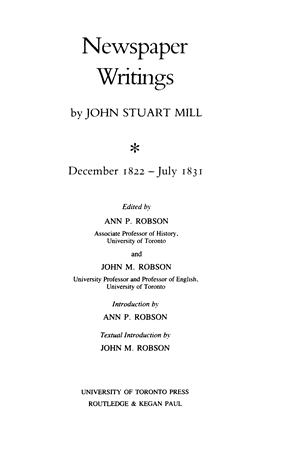
Introduction - John Stuart Mill, The Collected Works of John Stuart Mill, Volume XXII - Newspaper Writings December 1822 - July 1831 Part I [1822]Edition used:The Collected Works of John Stuart Mill, Volume XXII - Newspaper Writings December 1822 - July 1831 Part I, ed. Ann P. Robson and John M. Robson, Introduction by Ann P. Robson and John M. Robson (Toronto: University of Toronto Press, London: Routledge and Kegan Paul, 1986).
Part of: Collected Works of John Stuart Mill, in 33 vols.About Liberty Fund:Liberty Fund, Inc. is a private, educational foundation established to encourage the study of the ideal of a society of free and responsible individuals. Copyright information:The online edition of the Collected Works is published under licence from the copyright holder, The University of Toronto Press. ©2006 The University of Toronto Press. All rights reserved. No part of this material may be reproduced in any form or medium without the permission of The University of Toronto Press. Fair use statement:This material is put online to further the educational goals of Liberty Fund, Inc. Unless otherwise stated in the Copyright Information section above, this material may be used freely for educational and academic purposes. It may not be used in any way for profit.
The Collected Edition of the Works of John Stuart Mill has been planned and is being directed by an editorial committee appointed from the Faculty of Arts and Science of the University of Toronto, and from the University of Toronto Press. The primary aim of the edition is to present fully collated texts of those works which exist in a number of versions, both printed and manuscript, and to provide accurate texts of works previously unpublished or which have become relatively inaccessible. Editorial Committee j. m. robson,General Editor harald bohne, j. c. cairns, j. b. conacher, d. p. dryer, marion filipiuk, francess halpenny, samuel hollander, r. f. mcrae, ian montagnes, margaret parker, f. e. l. priestley, ann p. robson, f. e. sparshott TO FRANCIS E. MINEKA HUMANIST, GUIDE, AND FRIEND Introductionthis introduction does not attempt to analyze the thought of John Stuart Mill; it attempts to provide the context of his contribution to newspapers. The limited task is quite sufficient. Mill wrote in the papers for more than fifty of his sixty-seven years, twice on a sustained basis, in the 1830s on France and in 1846 on Ireland. From the chaotic early years of the nineteenth century to the more organized life of Victoria’s heyday, he contributed practical and theoretical advice, sometimes hopefully, sometimes irately, frequently despairingly, to his stolid countrymen. Newspapers were not his major medium—periodicals and books were the media he chose for his important writings—but he knew their impact and their value. Their impact was immediate and widespread. The Morning Chronicle under John Black in his prime was read over more cups of coffee than The Times. Albany Fonblanque’s Examiner informed radical opinion. There was no other forum but the press influencing the minds of the politically important men and women with an immediacy made all the more potent because in Mill’s youth the numbers who proposed and disposed were so small. As the years went by and as numbers grew, individual influence lessened, Mill’s not so much as others, but the influence of the press, still unchallenged, increased with its readership. Influence upon policy was not the most that Mill obtained by his journalism. Of more value to him was the necessity, forced upon him by the political involvement his journalism entailed, of bringing his hypotheses to the bar of actual events. Perhaps opportunity would be the better word because Mill was aware of, and took advantage of, the laboratory provided by “common experience respecting human nature.”1 It is the testing of his theories concerning human behaviour and the progress of human civilization which gives his newspaper writings weight in the development of his thought and interest to its students. The London into which John Stuart Mill was born had a population of under one million; by the time he was twenty-five, it had doubled; when he died there were over three million. The changes taking place in England had produced by the beginning of the nineteenth century a turbulence in society rarely experienced before and a radical political press unique in English history. James Mill may have protected his son from the rough and tumble of boys his own age but he brought him up in the centre of the riots, assassinations, treasonous plots, and mass meetings that were the political manifestation of the social upheaval of early industrial England. The world around the young boy—and he lived his boyhood in London in its very vortex, precocious, his father’s intellectual shadow, listening to radical arguments and plans—was violent, brutal, anarchic, insecure, filthy, and noisy. His youthful mind was shaped in this environment—he always stressed the influence of circumstances—as was also his vision as a mature Radical. Mill was born on 20 May, 1806, in a small house in Pentonville. His father was establishing himself amongst the Radicals of London. The times were desperate for radicalism and yet equally desperate for the condition of England; there was little time for reform but never greater need. Insecurity and violence, and the repression and hatred they bred, were everywhere. The rapidly changing basis of wealth brought increased insecurity for rich and poor. It would be fifty years before the technological and administrative knowledge would be developed to make town life secure, and the same was true for the new financial world. Insecurity haunted all levels of society. Consequently, while Mill was growing up, riots were a way of life, in peace or in war. There were nearly always riots of more or less seriousness at elections; there were food riots; there were riots amongst the prisoners in Dartmoor and Porchester Castle in 1810; there were riots among the theatre-goers, not only the Old Price riots at Drury Lane in 1809, but at Plymouth in 1810 and Peterborough and Liverpool in 1811; that year the East India College students rioted in Hertford and the next year rioters wrecked the newsroom at the Manchester Exchange; there were riots against high food prices, in favour of a minimum wage, against press gangs; handloom weavers, Tyneside keelmen, Suffolk labourers, Bilston colliers, London shipwrights, all rioted in 1814. From 1811 to 1816 the Luddites broke machinery throughout Yorkshire and the Midlands; in Nottinghamshire in 1812 to make their feelings perfectly clear they rioted in celebration of the assassination of Lord Perceval. The Prime Minister was shot, the King was insane, a profligate Prince was regent, and the country was at war. There was reason for violent dissatisfaction and fear, and both continued to increase. The outbreaks fed into the post-war violence. In 1815 James Mill moved his family to 1 Queen Square Place, to live beside Bentham. A stone’s throw from the Houses of Parliament, this was the very heart of political London, so the young Mill was right in the thick of things, not only for the splendid celebrations as the Prince Regent fêted European royalty at the marriage of Princess Charlotte, but also for the activity leading up to the Spa Fields meeting when the Spenceans, led by the two Watsons and joined by some sailors, broke into several gunsmiths’ shops, killing one gunsmith, and attempted to seize the Tower and the Bank of England. Unrest is the word most frequently used to describe the outbreaks from 1815 to 1820, but the word does not indicate the tension or explain Government response. In the atmosphere of the times, any outbreak seemed a possible revolutionary spark to both participants and observers. The year 1817 saw the Manchester Blanketeers, the activities of Oliver the Spy, and the Derbyshire insurrection, for which three were executed and many transported. The popularity of the monarchy reached new depths as public sorrow over the death of Princess Charlotte in childbirth turned to anger over the spectacle of the unprepossessing children of George III without a legitimate heir among them. No one was surprised when a missile was hurled at the Prince’s carriage along with the boos and jeers. Rumours of an assassination attempt were readily believed. The years 1819 and 1820—the years of John Stuart’s thirteenth and fourteenth birthdays—saw Peterloo, the Six Acts, the death of the beloved old mad king, the Cato Street conspiracy, and Queen Caroline’s trial. These events may be played down with hindsight, but at the time rumour fed violence and no one was sure when the revolution might ignite. The year 1789, seen through the glare of 1792, was in everyone’s mind. How far could repression and prosecution go? Might the suspension of habeas corpus lead a mob to storm the Tower? No child living in the heart of Westminster in a house that was the centre of a passionately radical group could be unaware of the violence out of doors. So much has been made of the seclusion and concentration of Mill’s upbringing and education that it is necessary to give some emphasis to the other side. The image of the child prodigy screened from friends of his own age is dear to a society which holds the untrained mind to be proof of a happy childhood and which delights in the crisis of the trained mind. But Mill’s childhood was not unhappy—he is to be believed on this point, his Autobiography being painfully honest and happiness being estimable only by the possessor—nor did his crisis necessarily come from the concentration of the education. Indeed a more likely cause is the gap between his father’s solutions and the coarse world he grew up in. James Mill’s house was not a place of total seclusion except from children not of his own making; and of those who were, it should be remembered, there were nine. The young boy also had the society of his father’s friends. During this first period of my life [up to the age of fourteen], the habitual frequenters of my father’s house were limited to a very few persons, most of them little known to the world, but whom personal worth, and more or less of congeniality with at least his political opinions (not so frequently to be met with then as since) inclined him to cultivate; and his conversations with them I listened to with interest and instruction. He also mentions being “disputatious” “from having been encouraged in an unusual degree to talk on matters beyond [his] age, and with grown persons.”2 Mill mentions only David Ricardo, Joseph Hume, and Jeremy Bentham (A, 55), but there were others. And if the number who came to the house was small, the much larger world of violent political activity entered with them. The turmoil of England, its causes and its remedies, was the urgent question during John Stuart Mill’s formative years and it was the paramount, if not the only topic of conversation amongst his father’s friends. They were an extraordinary group of men. They argued the facts and the principles passionately. It was not the talk of abstract philosophers but of men committed to the society, a society on the brink of revolution or dissolution, of which they felt themselves the proper leaders.3 The young Mill’s world was exciting; all about him was radicalism verging on revolution, not necessarily violent but violent if necessary. He dreamt of being a Girondist.4 The impression Mill gives in the Autobiography that life in Queen Square Place was regulated and commonplace is frequently accepted without question because the work is so obviously intellectually honest. But what was commonplace to the young Mill would have been commonplace to few others. (It is doubtful if Mill ever had much idea how uncommonplace he was.) All around him were unconforming, if not eccentric. The central figure was Jeremy Bentham who, however much his eccentricity stemmed from his rationality, was also a passionate, at times incoherent, denouncer of abuses. History has often made him quaint, concentrating on his foibles and universal constitutions and prisons, giving others the credit for realizing his law reforms in particular and his social reforms in general. History has made Francis Place respectable, but he had at one time been a co-worker of Colonel Despard, hanged for treason in 1803. And it was he who, through his writings on birth control, was, if indirectly, responsible for the young Mill’s being arrested for distributing “anti-social” pamphlets. Frequently on Sundays, John Black, a man who as editor of the Morning Chronicle was to be long an associate of John Mill’s, visited James Mill. They talked politics, but some of the flavour of Black’s unconventional personality must have been noticed by the listening and disputatious son. Black’s quarrelsome nature had led to twelve challenges to duels before he was thirty. Having failed to win a divorce suit, he was now living with his housekeeper and being blackmailed by his wife. Brougham, Ricardo, Romilly, and Hume, each of marked character and ability, also provided contrast and interest. And of equal interest but possibly more charm, after 1819 there were the neighbours Sarah and John Austin with, two years later, their lovely baby daughter Lucie. Despite the long hours of study, life could not have been dull for the young boy and, even without the rough-and-tumble of his peers (siblings are never peers), he was better fitted than most to go at age fourteen to stay for a week with J.B. Say in Paris, meeting many of the French liberal circle, on his way for an extended visit in the south of France with the eccentric Samuel Benthams, where, however, the turmoil and chaos were domestic. It may have been somewhat of a relief to leave London in the spring of 1820. Within a week of the death of the Duke of Kent, the old King had died. Arthur Thistlewood, a long-time friend of the Watsons of Spa Fields, advanced his plans and was surprised in Cato Street on the night of 23 February. The opening scenes of the drama of Queen Caroline, an emotional extravaganza orchestrated by Brougham, were drawing large London audiences.5 But France was in truth not much calmer, although less noisy and, for the moment, seemingly less volatile. The Duke of Berry had been assassinated the week before the Cato Street conspiracy (the Cato Street conspirators now seem farcically inept; but so would Louvel had he missed), and the royalist reaction was benefiting. Under the Ministry of Villèle, Louis XVIII was following his autocratic inclinations fully supported by the old aristocracy. The law of the double vote passed, increasing the influence of the small rich minority which had already seemed impregnable. The talk at the home of J.B. Say would have been of the kind the boy was used to, only in French. Say’s household was radical; he was a political economist—in 1822 he became an honorary member of the Political Economy Club in London—a long-time friend of Lafayette’s and a befriender of the Carbonari. Mill met many of the leaders of the French left, “among whom [he had] pleasure in the recollection of having once seen Saint-Simon, not yet the founder either of a philosophy or a religion, and considered only as a clever original” (A, 63). He also recorded that he benefited little; this is hardly surprising since he was only fourteen and spoke only English. But although he may have benefited little immediately, the friendship with that family and the acquaintance of the political group to which it belonged were of immense importance to both his thinking and his actions a decade later. And Mill would have benefited more than any other lad his age. His radical training also stood him in good stead as he started off on his own to the Garonne to join the Samuel Benthams. As a true Radical and a disputatious youngster he knew his rights, and asserted them against a female claimant to an inside seat that was his by seniority in the coach if not in the world.6 He arrived without mishap and spent an exceedingly happy year in a household that was normal only by Benthamite standards. The success of this year was of immense importance in Mill’s intellectual growth; he developed an enduring affection for France and an unwavering belief that she was in the van of European civilization and that all, including England, must follow the path she took. These thoughts were not matured in 1821, but the ground had been prepared and sown. The influence on his political thought was to be crucial. He later said: “the greatest, perhaps, of the many advantages which I owed to this episode in my education, was that of having breathed for a whole year the free and genial atmosphere of Continental life.” In England it is taken for granted “that conduct is of course always directed towards low and petty objects” (James Mill’s teaching can be heard here); amongst the French elevated sentiments are “the current coin of human intercourse” (A, 59-61). That Mill could feel these sentiments unchanged after the French events of 1851 and 1870 shows how powerful were his early impressions. One may also see here feelings which would contribute to the promptings of the “irrepressible self-consciousness” to answer “No!” and trigger his depression in 1826 (A, 139). Certainly one can see here the seeds of his later emphasis on the possibility of the improvement of mankind through the cultivation of their higher natures. The method of his thinking was to be altered in another direction also—one which was to be crucial to his youthful journalism. Mill concluded the account of his sojourn in France: The chief fruit which I carried away from the society I saw, was a strong and permanent interest in Continental Liberalism, of which I ever afterwards kept myself au courant, as much as of English politics: a thing not at all usual in those days with Englishmen, and which had a very salutary influence on my development, keeping me free from the error always prevalent in England, and from which even my father with all his superiority to prejudice was not exempt, of judging universal questions by a merely English standard (A, 63). The England to which the fifteen-year-old Mill returned in June 1821 was a little calmer than the one he had left. Queen Caroline’s trial was over and the illuminations extinguished. The royal Dukes’ hasty marriages had produced more than one promising successor to the throne. It was hoped that, God and the Duke of Clarence willing, a regency could be avoided; George IV was unlikely to last long enough—certainly everybody hoped that too. England had largely separated herself from the repressive ideas of the great Continental powers and was associating herself with the liberal aspirations asserting themselves in Europe. There were many insurrections, the precise aims of which were not always clear, but it was clear that Europe was far from calm. Greece, Spain, the Spanish colonies, the Two Sicilies, Northern Italy, Portugal, all were providing alternating hope and despair for the Radicals. At home the mood was easier. The pitch of excitement reached by the summer of 1820 could not be maintained, partly because Burdett, Cochrane, and Cobbett had all in their several ways pulled back from the monster demonstrations in London. A brief period of prosperity in both town and country had lowered tempers and reduced the mob. John Stuart Mill spent two busy years after his return from France, enjoying a wider acquaintance, including many much nearer his own age with whom to match wits. His father’s plans for him at that time included as a distinct possibility a career at the bar. Consequently Mill read law to his great benefit with John Austin, a man whose incisive understanding of the subject was best communicated by tutoring, not lecturing. Mill gained more than legal knowledge from the Austin connection. He went to stay with Sarah Austin’s family, the Taylors of Norwich. There he met John Austin’s brother Charles, a brilliant Cambridge undergraduate, who, Mill says, “attached me among others to his car. Through him I became acquainted with Macaulay, Hyde and Charles Villiers, Strutt (now Lord Belper), Romilly (now Lord Romilly and Master of the Rolls), and various others. . . . It was through him that I first felt myself, not a pupil under teachers, but a man among men.” (A, 79.) It is small wonder that Mill’s writing shows an unusual blend of modesty, certainty, and arrogance when one looks at the contemporaries against whom he measured himself. And they all assumed it their right and their duty to point England the way. Mill received another benefit from his father’s arranging for him to read under Austin. As part of his preparation for law, Mill was given Bentham’s principal speculations, as interpreted to the Continent, and indeed to all the world, by Pierre Etienne Louis Dumont, in the Traités de législation (1802). The reading of this book was an epoch in my life; one of the turning points in my mental history. . . . The feeling rushed upon me, that all previous moralists were superseded, and that here indeed was the commencement of a new era in thought. . . . As I proceeded farther, there seemed to be added to this intellectual clearness, the most inspiring prospects of practical improvement in human affairs. . . . Bentham’s subject was Legislation . . . and at every page he seemed to open a clearer and broader conception of what human opinions and institutions ought to be, how they might be made what they ought to be, and how far removed from it they now are. When I laid down the last volume of the Traité I had become a different being. . . . I now had opinions; a creed, a doctrine, a philosophy; in one among the best senses of the word, a religion; the inculcation and diffusion of which could be made the principal outward purpose of a life. And I had a grand conception laid before me of changes to be effected in the condition of mankind through that doctrine. The Traité de Legislation wound up with what was to me a most impressive picture of human life as it would be made by such opinions and such laws as were recommended in the treatise. . . . And the vista of improvement which he did open was sufficiently large and brilliant to light up my life, as well as to give a definite shape to my aspirations. (A, 67-71.) The euphoria of the moment of grace shines through the calculated wording of thirty years later. Not the least of the emotions was relief at now at last understanding what his father had been teaching him. But the paramount effect was the vision; for the young lad of fifteen the feelings he had experienced in his Girondist dreams were now his in reality. For the rest of his life Mill was to be a visionary, at times a very depressed visionary when the future became blurred or the present seemingly regressing, but always beneath the calm, measured analytical philosopher or economist or political scientist, the saint of rationalism would be following the yellow brick road. The immediate effects of the vision were to inspire Mill to write his first “argumentative essay” (A, 73) and to form debating clubs and discussion societies in order to prove and spread the gospel. He was also ready to take his message to the wider public; he was finally confident of what he had been taught and, truly comprehending it for the first time, was not only able “to converse, on general subjects, with the instructed men with whom [he] came in contact” (A, 75) but also desirous of instructing the uninstructed. In December of 1822 appeared the first of his newspaper writings.7 Journalism was never intended by James Mill to be his son’s career. Some time during the winter of 1822-23, he decided that the India House was a more utilitarian career for his son than the bar. Certainly in retrospect John Mill expressed few regrets about the bar and an acute awareness of the drawbacks of journalism, especially when contrasted with the advantages of following in his father’s footsteps. I do not know any one of the occupations by which a subsistence can now be gained, more suitable than such as this to any one who, not being in independent circumstances, desires to devote a part of the twenty-four hours to private intellectual pursuits. Writing for the press, cannot be recommended as a permanent resource to any one qualified to accomplish anything in the higher departments of literature or thought. . . . Those who have to support themselves by their pen must depend on literary drudgery . . . and can employ in the pursuits of their own choice . . . less than the leisure allowed by office occupations, while the effect on the mind is far more enervating and fatiguing. (A, 85.) So John Mill started work, the day after his seventeenth birthday, 21 May, 1823, in the Examiner’s Office of the East India Company, and the newspaper was to become for him throughout his life a means of putting his solutions for immediate problems before the public and of educating that public on the broader philosophical and political issues that lay behind the great events of the day.8 Journalism also educated Mill; it played an important part in his development by keeping his feet firmly on the ground. He himself was not unaware of the importance of active involvement to prove philosophical speculation. “But the man to lead his age is he who has been familiar with thought directed to the accomplishment of immediate objects, and who has been accustomed to see his theories brought early and promptly to the test of experiment . . . and to make an estimate of means and of obstacles habitually a part of all his theories that have for their object practice, either at the present or at a more distant period.”9 In his newspaper writings, Mill can be watched applying the principles he had acquired to the practical problems of everyday administration and politics: “My practice (learnt from Hobbes and my father) [was] to study abstract principles by means of the best concrete instances I could find . . .” (A, 167). The political scientist needed, like every other scientist, to see if the laws or the hypotheses were verified by the facts.10 Especially in his earlier years the world was Mill’s laboratory and the newspapers his daily notebook. There are interesting times in his journalism, in the early 1820s, the early 1830s, the late 1840s, and the early 1850s, when Mill is quite evidently applying a strongly held belief, quite recently worked out, to contemporary events: in the ’20s, Bentham’s laws; in the ’30s, the laws of historical development and social progress; in the ’40s, the consequences of systems of land tenure; and in the ’50s, the social consequences of sexual inequality. It is his observation of the actual instances around him (and here his work in the India Office greatly added to his journalist’s experience) that lies behind his conviction, so often expressed, that all reforms must be chosen for their present practicality, as well as their furthering of the eventual goal. It was not only his early mental training that led him, in spite of his great sympathy, to reject Saint-Simonism in his time. The radical world of journalism that he now entered was a small world, peopled by figures long familiar to the sixteen-year-old Mill.11 Radical politics were led by a select, dedicated few, all of whom turned their hands to whatever task needed doing. The persecution of the press had strengthened the bonds of brotherhood, and freedom of the press became a sine qua non, if not the sine qua non, of the intellectual radical movement. Between 1808 and 1821, there had been 101 prosecutions for seditious libel, many of them unsuccessful thanks to Charles James Fox’s amendment of the law in 1792, which gave juries the power to decide if the words in question were libellous. That amendment itself may have spared England revolution. As it was, the trials provided soapboxes, and if sometimes imprisonment followed, Lord Ellenborough found himself thwarted as often as not. But the continuing struggle against repression, the shared prison experiences, the rallying point provided by people like the Carliles, all created an exciting world, not less so for its danger, which the young boy was now to share. His father and his father’s allies welcomed the new torch bearer, but journalism was more a rite of passage than a new land. Small though the world of journalism was, it had a power quite out of proportion to its size. A great deal of influence was wielded by those whose reasoned argument or memorable invective was read over breakfast or coffee. Westminster with its eleven thousand voters could be swayed by a Black or a Barnes, and most constituencies had less than a tenth that number. But even more important, if also more intangible, was the amount of pressure that could be exerted on the Government by the political temperature in London. Certainly a succession of ministries thought it worth the risk of increasing their unpopularity by attempting to silence, or keep within bounds, a Leigh Hunt or a Cobbett. It was said that “an epigram in the Examiner went off like a great gun, echoing all over the country.”12 In 1835, when the Chronicle, which had fallen behind The Times, suddenly acquired many readers lost by its rival through a change in policy, Black exclaimed, “Now our readers will follow me anywhere I like to lead them!”13 A government that ruled in the final analysis by the tolerance of the people could be forced to alter its course by the strong expression of feeling out of doors. Lord Brougham’s triumph in the withdrawal of the Bill relating to Queen Caroline was a triumph of the press and the people, certainly not of justice. John Mill was fully aware of the power of the press. When he pours scorn on the state of the press in England (No. 57) it is just because he was aware of how much good journalists could do and how much evil in his eyes many of them—The Times was often in his mind—were doing. Mill’s diatribes against the press must be seen in the context of his frustration with England and Englishmen for their “low moral tone” and “absence of high feelings” (A, 61). Certainly only a handful of men in England, including himself, employed daily or weekly journalism with the honesty, respect, knowledge, and integrity that would make it an instrument for the advancement of mankind. To Mill’s mind one of that handful was John Black, his father’s old friend and, to a certain extent, disciple; when considering Mill’s own journalism his estimate of Black should be set beside his condemnations of the press. I have always considered Black as the first journalist who carried criticism & the spirit of reform into the details of English institutions. . . . [He] introduced Bentham’s opinions on legal & judicial reform into newspaper discussion. And by doing this he broke the spell. Very early in his editorship he fought a great battle for the freedom of reporting the preliminary investigations in the Police Courts in which Fonblanque . . . occasionally helped him, but he had little other help. . . . Another subject on which his writings were of the greatest service was the freedom of the press in matters of religion. His first years as editor of the Chronicle coincided with the prosecutions of Carlile & his shopmen & Black kept up the fight against those prosecutions with great spirit & power. All these subjects were Black’s own. Parl. Reform, Catholic emancipation, free trade, &c, were the liberal topics of the day & on all of these he wrote frequently, as you will see by any file of the Chronicle.14 The Mills’ only worry was that Black might not maintain his influence over the regular purchasers of his paper:15 “in their weekly talks with their editor, both the Mills insisted as a condescension necessary to the temper of the time” on a lightness of touch. It was feared “that Black and his contributors were habitually writing above the heads of the public.”16 The readers, it must be kept in mind, were in the dining room or the coffee house at the beginning or end of a busy day. They had the normal physical disadvantages to contend with: dull weather, smoke, poor window glass, flickering candlelight, more-or-less helpful spectacles, and small bad print on fawn paper. To modern eyes it appears (somewhat dimly) strange that so little effort was made to ease the task of the reader. In the first half of the century the leading dailies usually had only four pages of small print in six columns, the first and fourth pages being devoted to advertisements. (Advertisements were integral to a newspaper then as now, bringing in the crucial portion of their revenue; indeed most, like the Morning Chronicle, were originally established as advertising media for a trade.) The second page would contain extracts from foreign papers in two columns, with the other four columns containing theatre and current happenings, chiefly domestic politics. A leading article, if there was one, would usually be on page two. Foreign news, society news, sporting news, and the ever-popular detailed description of the seamy side of life from the law courts filled page three. The Examiner was a weekly, with more pages but smaller format than the dailies, and appeared every Sunday; it had sixteen pages with only two columns but of equally miserable type-face. The reader the Mills had in mind, though interested in politics, had other activities to occupy the greater part of his day. He would have intellectual pretensions but not necessarily a profession; most probably he would be to a large extent self-educated after the age of fourteen. He would like to consider himself an independent thinker, keeping abreast of what went on at home and abroad, especially the former and especially politically, standing on his own intellectual feet, and voicing opinions which he could support on intelligible principles. He would consider himself anti-Tory and, although certainly not of the labouring classes himself, was frequently sympathetic to their plight. But he was not a deep thinker and he was a busy man; his attention must be caught and held and his opinion influenced by blunt arguments. For the most part, John Mill keeps the temporary nature of his reader’s attention in mind; the largest exception would be the series of articles on the “Spirit of the Age,” their length being unusual even for the Examiner—but on Sunday perhaps the reader could be expected to sit somewhat longer over his coffee. (I say “his” coffee, because it is my impression—and I have no hard facts—that newspapers then for the most part addressed themselves consciously or unconsciously to a male audience.)17 There are advantages to the student of Mill’s thought in the demands that this audience made on him. In a newspaper, the ideas cannot be hedged around with qualifications and elaborations. What a journalist feels, he must say in a limited number of words, in a straightforward manner immediately intelligible to a man of intelligence but lacking learning and sophistication. For the most part, Mill was very successful (although he thought he lacked the light touch [A, 181]) in adapting his writing to this level. In addition, journalism most frequently demands hasty execution and topicality. The hasty execution was not a problem for Mill; from the beginning of his career, he wrote enviably well under pressure. The topicality can occasionally be a barrier for the reader many generations later, because the ambience of an incident is very difficult, if not impossible, to recapture; one cannot live in the past. But this difficulty is more than compensated for by the opportunity to watch Mill’s ideas, unequivocally expressed, shape and reshape themselves as they are proved against the facts and the events. DECEMBER 1822 TO DECEMBER 1824john stuart mill began to write for the press in December of 1822. It was not a propitious time, or not seemingly so. The European powers generally were looking for a return to the status quo ante; the experience of the French Revolution and the Napoleonic Wars with their economic and political turbulence was much too recent to admit of broad proposals for change. But the time had rays of hope. Although France had invaded Spain to re-establish the autocratic rule of Ferdinand VII, the Spanish constitutionalists were showing considerable strength. The Greeks had risen against Turkey and liberal fervour was wholly on their side. At home, Lord Liverpool was still stolidly sitting in the saddle, but the worst of the post-war economic disruption was over. Prosperity was returning and tension was lessening. The Cabinet now contained considerable liberal talent: Castlereagh’s suicide and Liverpool’s resistance to the King had brought Canning back to the Foreign Office; Peel, who had endorsed in 1819 a return to cash payments, had replaced Sidmouth at the Home Office; Huskisson was supporting freer trade at the Board of Trade; and Lord John Russell had been successful in disenfranchising the quite rotten borough of Grampound, thus setting the precedent of eliminating a parliamentary borough. But at the end of 1822 these were little more than straws in the wind; Peterloo and the Six Acts, Cato Street, and Queen Caroline were only yesterday and still fresh in the mind. The unpopularity of George IV, which was if possible increasing with his girth, assured popular dislike of his Ministry. Peel might contemplate reforms in the Home Office but they would have to be accompanied by a watchful eye and a firm hand, especially on the radical press. The stamp duty had been extended after Peterloo and there were continual prosecutions as the war of the unstamped press raged. For most Radicals a cheap press and a free one continued to be the rallying ground in the defence of Englishmen’s liberties, for it was still a radicalism largely in the eighteenth-century tradition of John Wilkes. Radicals stood against encroachment by the King and his Ministers upon the constitutional rights of free men; and generally speaking the reforms they proposed were within the system rather than of the system. Mill was sixteen and a half, a brilliant, gauche, likely lad, the product of one of the best-known educations of any nineteenth-century figure. He was ready to write, having found a message, and his father was nothing loath, perhaps wanting his son to have experience before Bentham’s projected radical periodical was started.18 During the next fifteen months, until the plans for the Westminster Review were realized, the young boy wrote thirty-two newspaper pieces, some quite short, but some more than a full column in length. His taking up his post in the East India Office caused only a slight and momentary lessening of his output; the pattern of life that was to prevail until his retirement in 1858 was set in the first months. The pattern of thought was not. These early attempts are what might be expected, even from a prodigy, of a youth in his seventeenth and eighteenth years. They are clever but not profound or original, giving ample proof of his own assessment: The first intellectual operation in which I arrived at any proficiency, was dissecting a bad argument, and finding in what part the fallacy lay. . . . It is also a study peculiarly adapted to an early stage in the education of philosophical students, since it does not presuppose the slow process of acquiring, by experience and reflection, valuable thoughts of their own. (A, 23.) Mill’s youthful journalism shows as much the thought of the Queen Square Place circle as of the youngest member of it. In these years the young Mill accepted his mentors’ view of a mechanistic world whose parts could not be redesigned, but could be realigned by the adjusting of a legal problem here and the promoting of a political economy reform there. The first principle on which their reforms were based was that men, because they put their own interests before the public’s, abuse a public trust if left unchecked. Mill’s articles all assume a dog-eat-dog world wherein every top dog must be prevented from dining off those lower in the hierarchy. The nature of the beast could not be much improved, but the beast’s behaviour could be bettered through the judicious provision of punishments and rewards. A second principle was that there are laws of political economy, the correct understanding of which would vastly improve the lot of the greatest number. It was appropriate that Mill, whose name has become inseparable from his Principles of Political Economy, should have written publicly first in that field. The first writings of mine which got into print were two letters published towards the end of 1822, in the Traveller evening newspaper. The Traveller (which afterwards grew into the Globe and Traveller by the purchase and incorporation of the Globe) was then the property of the well known political economist Colonel Torrens. Under the editorship of an able man, Mr. Walter Coulson (who after being an amanuensis of Mr. Bentham, became a reporter, then an editor . . . ), it had become one of the most important newspaper organs of liberal politics. Col. Torrens wrote much of the political economy of his paper; and had at this time made an attack upon some opinion of Ricardo and my father, to which at my father’s instigation I attempted an answer, and Coulson out of consideration for my father and good will to me, inserted it. There was a reply by Torrens, to which I again rejoined. (A, 89.) Thus his career started off on ground he knew well; he had been educated on and by Ricardo, and was well aware of the controversy over the theory of value which had frequently exercised them all. It is twentieth-century opinion expressed by Lord Robbins that in these first two essays in public controversy, the newcomer received a “thorough trouncing from Torrens, evoked by . . . [the] effort to sustain his father’s preposterous view that differences in the period of investment might all be reduced to labour.”19 The controversy over the causes of price fluctuations—related to that over value—was equally undecided. This controversy had been stimulated rather than settled by the passing of the Corn Law of 1815 and Peel’s Currency Act of 1819. Mill’s favourable reviews of Thomas Tooke’s Thoughts on High and Low Prices (Nos. 8 and 12) consist largely of expository, approving synopses of Tooke’s influential book. (He was to use Tooke’s arguments again in the following year in his Westminster Review article, “War Expenditure.”)20 Young Mill next took on the Rev. Thomas Malthus in a review (No. 18) of The Measure of Value, which demonstrated the adolescent neophyte’s proficiency at dissecting bad logic. Having dismissed one of the established economist’s arguments “as a specimen of the obscure and disjointed mode of reasoning which Mr. Malthus has adopted,” and referring to “two or three other paragraphs of too little importance to require a refutation,” the youngster concludes with a triumphant reassertion of the orthodox position on the currency question.21 Another economic piece, written in June 1823, “The Debate on East and West Indian Sugars” (No. 10), has additional interest as an example of the way Mill’s daily articles not infrequently originated. James Mill was Zachary Macaulay’s ally in the anti-slavery movement (Macaulay had supported James Mill for the position in the Examiner’s Office of the East India Company); in December of 1821 he had been applied to as the natural authority by Macaulay, who was seeking help in the preparation for a debate, scheduled for May 1822, on the West Indian Monopoly.22 Macaulay then contributed to the pamphlet war,23 showing a detailed knowledge of India, its manufactures, and its trade. At this distance we cannot know whether John worked to gather information for his father and Macaulay, but certainly James Mill and his radical allies with their constant discussion and planning provided the motivation and put the needed knowledge at John Mill’s fingertips for an article on the parliamentary debate in 1823. Another example is Mill’s article on Spanish affairs (No. 13). His easy familiarity with the recent very complicated events came quite naturally. Radical eyes had been watching the revolutionary events in Spain since 1820. Jeremy Bentham had written a pamphlet to impress upon the Cortes the importance of a free press.24 In April 1823 the French invasion of Spain had outraged radical opinion; Major Cartwright “entreats” (in Alexander Bain’s words) James Mill’s “intervention,” and a meeting was held on 13 June at the London Tavern “for aiding the Spaniards to maintain their independence against France.”25 Consequently, when on 4 August the news came of the capitulation of the constitutionalist general, Ballasteros, heralding the restoration of Ferdinand, the young boy could write a remarkably sure and percipient article without delay. The young Mill’s main interest in 1823, however, was not political economy or foreign affairs but the issues that Bentham’s Traités had inspired him to fight for. In Mill’s account of the thought of the radical writers—he included himself—associated with the Westminster Review founded in 1824 he says, “Their mode of thinking was not characterized by Benthamism in any sense which has relation to Bentham as a chief or guide . . .” (A, 107), but his own journalism of 1823 would lead to a qualification of this estimate. Recollecting thirty years later his “considerably more ambitious” articles in the Morning Chronicle on freedom of the press, prompted by the prosecution of the Carliles, Mill dismisses his other contributions: “during the whole of this year, 1823, a considerable number of my contributions were printed in the Chronicle and Traveller: sometimes notices of books, but oftener letters, commenting on some nonsense talked in Parliament, or some defect of the law, or misdoings of the magistracy or the courts of justice” (A, 91); however, it is these writings, especially those on “some defect or misdoings” that show the strength of Bentham’s influence, be it from his writings or his lips. A far greater number than Mill implies of his early articles appeared in the Morning Chronicle exposing the “defects of the law, and of the administration of justice.” “I do not go beyond the mark in saying,” Mill comments, “that after Bentham, who supplied the principal materials, the greatest share of the merit of breaking down this wretched superstition belongs to Black, as editor of the Morning Chronicle” (A, 91).26 In 1823 seventeen of his twenty-five contributions, at a conservative estimate, are applications of principles enunciated by Bentham, and by James Mill in his articles in Napier’s Supplement to the Encyclopaedia Britannica. In his castigation of religious persecution in January of 1823 (No. 3), Mill applied the fundamental lesson learnt from the Traités: “What thus impressed me was the chapter in which Bentham passed judgment on the common modes of reasoning in morals and legislation, deduced from phrases like ‘law of nature,’ ‘right reason,’ ‘the moral sense,’ ‘natural rectitude,’ and the like, and characterized them as dogmatism in disguise . . .” (A, 67). The exposure of such fallacious language had become the trademark of a true practising Benthamite.27 Such a maxim as “Christianity is part and parcel of the law of England,” declares Mill to the editor of the Morning Chronicle, is “utterly unmeaning and absurd,” and no grounds for religious persecution.28 As he pursued the argument in the “Letters on Free Discussion” (Nos. 5, 6, and 7) the young disciple laid about him with his master’s sword. Bentham’s arguments on efficacious causes and truthfulness in witnesses,29 Quaker honesty,30 atheists’ reliability,31 and foresworn jurymen when the punishment is too large for the crime,32 all appear quite recognizably in these letters to the editor. The argument that Christianity is not needed for the basis of a good judicature, since non-Christians keep their word and many Christians ignore their oaths, bolstered by examples of custom-house oaths and university students’ oaths, can be found repeatedly in Bentham.33 Perhaps even in his reusing of examples, Bentham’s influence can be seen. When the evidence of a Quaker is refused in July 1823, custom-house oaths and university regulations are called into service again (No. 11). Mill in August applies Bentham’s expostulations on the perniciousness of oath-taking as weakening the sin of lying in “The Mischievousness of an Oath” (No. 14). And the following week in yet another letter on oath-taking (No. 16), custom houses and universities bear witness one more time.34 The move from oaths to judges (No. 15) gives the young Benthamite many texts to choose from, all vituperative and all based on the axiom so movingly put by George Grote in his letter to Fanny Lewin on her discovery of the true faith, “I truly rejoice that you have satisfied yourself as to the fact of amour de soi being the universal mover, variously modified, of the human race. There is no possibility of correctly appreciating men or motives until this has become a faultless truth.”35 Mill argues, “A Judge must always have much to gain by injustice: and if due securities are not provided, he will do injustice” (No. 15). Bentham said the same thing at greater length in the Rationale of Judicial Evidence, especially in Vol. IV, Book viii, culminating in Chapter xxix, “Apology for the Above Exposure,” which for sheer spluttering indignant abuse cannot be outdone. Mill’s solution is Bentham’s—publicity.36 Mill goes so far as to propose “giving to the people, either immediately or through their representatives, the power of removing judges of all descriptions from their offices” (No. 20)—a position he later qualifies. When Mill objects to the use of the treadmill (No. 26) and reviews a book by Hippisley deploring its use (No. 22), it is Bentham’s views of punishment, found also in James Mill’s “Prison and Prison Discipline,” that he puts forward. The son includes a puff for his father’s work, and well he might, since his piece is little more than a rewording of his father’s argument that “People of industry, people who love labour, seldom become the criminal inmates of a prison,”37 and, therefore, to use labour of any kind, even the treadmill, as an instrument of punishment is exceptionable. But he might equally well have acknowledged his erstwhile guardian in whose Rationale of Punishment the distinction between reformation and punishment was argued: reformation would be achieved by bringing the slothful to an appreciation of labour.38 In September of 1823 (No. 19) Mill took as his text Bentham’s expostulation that it is hardly conceivable that a people could be found so stupid as to be persuaded that to serve justice “Nothing more was in any case necessary, than to pronounce one or other of three or four words, such as null, void, bad, quash, irregularity”;39 the legal student holds up two cases, one dismissed for the misspelling of a magistrate’s name and the other for using “after-forenoon” for “afternoon.” In January of 1824 two more articles (Nos. 29 and 30) echo Bentham. In his review of Francis Place’s pamphlet on special juries, which was itself largely based on Bentham,40 Mill paraphrases Bentham’s defence of his personal criticism of judges, that he meant no slur on any individual. Bentham wrote: “The fault lies not in the individual, not in any particular taint of improbity seated in the bosom of the individual, but in the system itself”;41 Mill writes: “We cannot sufficiently reprobate the principle itself, of endeavouring to deter men from exposing a bad system, lest their strictures should be construed into imputations upon the character of individuals” (No. 29). Mill pointed out “the absurdity of a system of law which forces the Grand Jury to say one thing when they mean another; and not only to say it, but to swear it. This is innocent perjury, but it is perjury, and though the Jurors do not deserve blame, the law evidently does,” and signed himself, “An Enemy to Legal Fictions” (No. 30): in doing so, he must have had Bentham’s voice in his ear, the voice that had filled vitriolic pages on “Legal Mendacity” in the Rationale of Judicial Evidence.42 The echoes of James Mill’s voice in these articles, though not as resonant as those of Bentham’s, are better known, so a few examples will make the point. There is no embarrassment, indeed there is pride, at being the son of his father when Mill writes that this “subject is developed in the most satisfactory manner in Mr. Mill’s invaluable Essay on the Liberty of the Press, forming an article in Napier’s Supplement to the Encyclopaedia Britannica” (No. 5). No thought then of renouncing “sectarian follies” (A, 117). The father’s essays and the son’s articles show a remarkable similarity in word and idea. James Mill: “As the surface of history affords, therefore, no certain principle of decision, we must go beyond the surface, and penetrate to the springs within.”43 John Mill: “Against theories founded upon universal experience, the enemies of improvement hold out—what? Theories founded upon history; that is, upon partial and incomplete experience.” (No. 13.) James Mill: “Government is founded upon this, as a law of human nature, that a man, if able, will take from others any thing which they have and he desires. . . .”44 John Mill: “unless securities are provided, men will neglect the public interest, whenever it interferes with their own” (No. 13). These were the commonplaces of the Philosophic Radicals at the time, be they seventeen-year-old boys or nineteen-year-old girls or fifty-year-old mentors. Mill’s article on parliamentary reform (No. 21) relies heavily on his father’s essay on “Government” but with an interesting twist, one of the early examples of the rhetoric that John Mill was frequently to use against wrong thinkers. James Mill dismissed the argument that a king or aristocracy is ever satiated as “an opinion founded upon a partial and incomplete view of the laws of human nature.”45 The son, more subtle than the father, did not use his father’s hatred of the aristocracy. He preferred to defeat his opponents by allowing their original premise: that a people would infallibly make so bad a choice “as to render the attainment of good government in this mode utterly hopeless” (No. 21), and to prove that the logical alternative is not an aristocratic government but an absolute monarchy. Mill’s consciousness of his potential opponents, undoubtedly heightened by his debating experience, typifies his lifelong rhetorical style. But the clever scoring of points, though undoubtedly a rewarding game, with a serious purpose for the recently unleashed reformer, was still a game, still “dissecting a bad argument, and finding in what part the fallacy lay,” rather than examining the principles of good government and “acquiring, by experience and reflection, valuable thoughts” of one’s own. In a short while, this game was to prove unsatisfactory, and the young man would be seeking the principles upon which to base the refutation of his opponents’ argument. There may even be an early warning sign of this dissatisfaction in “Old and New Institutions” (No. 24). Mill attacks an innocent Colonel Hughes who, although advocating reform, does so on the grounds of restoring the old, not introducing the new. Mill’s views are quite orthodox, but there is rather an abundance of fervour in his Benthamite deluging of “the wisdom of our ancestors” with scorn. “Happily we are much wiser than our ancestors; it were a shame if we were not, seeing that we have all their experience, and much more in addition to it” (No. 24). The words of a cocky young whippersnapper. Does half a century between birth dates make one an ancestor and another an heir? Bentham and his father were essentially improving the springs of the stagecoach rather than designing the steam engine. Another element in the philosophical radical synthesis, Hartleian metaphysics, lies behind the curious piece that Mill wrote for the newly founded Lancet; the uncompromising nature of his assertion is quite startling: as it is generally admitted that circumstances often overcome the effect of natural predisposition, while no proof has ever been given that natural disposition can overcome external circumstances: we are at liberty to conclude, that in ascribing to any person a natural and original disposition to vice, men are following the very common practice of representing as natural that which is only habitual, merely because they do not recollect its beginning, and will not take the trouble to inquire into its cause (No. 26). Although both Bentham and James Mill were Hartleians, John Mill’s analysis in this article on the making of a murderer is more than a derivative attempt to argue a problem. This question of human nature bothered him all his life (in the Subjection of Women he skirted around it),46 though he was to find a position he could live with: “I saw that though our character is formed by circumstances, our own desires can do much to shape those circumstances . . .” (A, 177). Interwoven with his argument was the depressing prospect of reforming a world for people who are of clay, not only their feet but their souls, clay that must be shaped in Benthamite moulds for every generation. No wonder the promptings of the small voice that wanted to believe in the improvement of mankind, not just circumstances, were gathering force. The teen-age Mill’s regular writing for the newspapers ended with the unfurling of the Malthusian banner in combat against the Black Dwarf (Nos. 27, 28, 31, and 32). It is still clever debating: Wooler has only to be forced to concede one point—“such matters will always regulate themselves”—and Mill exults in triumph: “This, Sir, is all that I want” (No. 31). But the central issue of the article is powerfully felt and continues to be felt throughout his life; diminution of family size would bring about other and permanent improvement. Many of the principles learnt from Bentham and James Mill are mustered for this debate, and it is fitting that their influence on him should be so clearly illustrated as the first phase of Mill’s journalism draws to a close. What makes a government bad is the amount of discomfort it produces. “Until they [the people] are well fed, they cannot be well instructed: and until they are well instructed, they cannot emancipate themselves from the double yoke of priestcraft and of reverence for superiors” (No. 27). Overpopulation, he argues, is in the interest of landowner and manufacturer who will, therefore, oppose any remedy. To the argument that the plan was against the law of nature, Mill rejoined, “To check population is not more unnatural than to make use of an umbrella” (No. 27), an analogy perhaps prompted by Joseph Hanway’s being the introducer into London of both brollies and foundling hospitals. And there is a happy echo of Bentham’s style in the concluding sentence of his next article, where he protests the application of the word “heartless” to the promoters of limitation, “unless, indeed, the word heartless, be one of the engines of a sentimental cant, invented to discourage all steady pursuit of the general happiness of mankind” (No. 28). His technique of argument has developed over the last twelve months; he has become cleverer in ticking off one by one the possible objections of probable opponents; he turns their arguments upon them. Neat turns of invective come from his pen (“you have made a much more free use, in this paper, of that easy figure of speech called assertion, than of that more intractable one called proof” [No. 31]—a use at this age he was well qualified to recognize); but some techniques seem to have been instilled with his training. For example, he sets the onus of an argument upon his opponents (“it is incumbent upon those who declare against toleration to point out some reason which prevents the general rule from being applicable to this particular case” [No. 5])—he uses nearly the same words forty years later when writing The Subjection of Women.47 But the great value of these early writings is their unique witness to the mind created by James Mill’s education. It is almost uncomfortably apposite that this period of his apprenticeship should conclude with two letters to the editor, one (No. 33) defending his father’s views, and one which reads: The accompanying paragraphs are destined for insertion in your Dwarf. They are extracted from the article “Colonies,” in the supplement to the Encyclopaedia Britannica; a discourse composed by an eminent friend of the people. They contain, I think, a most conclusive answer to your last article on population; and if you insert them, you will be very well able to dispense with the reply which you would otherwise have received from Sir, your most obedient Servant. (No. 32.) SEPTEMBER 1825 TO OCTOBER 1828parliamentary events were the centre of interest in England in the latter half of the decade. The rioting common after the Napoleonic Wars was less so now, though not unknown. There were strikes in 1824 and after the repeal of the Combination Acts that year, engineered by Place and executed by Hume, there were even more strikes in 1825. The middle classes, too, had their griefs. That year saw wild speculation in “bubble” companies, and county banks joined the Bank of England in over-issuing paper money to fuel the dreams. In December the end came; Pole and Company failed and between sixty and seventy banks were sucked under with it. The Bank Act of 1826 authorizing joint-stock banks and providing controls for currency issue was Peel’s response. There followed coincidentally a period of prosperity, quickly terminated by a poor harvest. Corn Law agitation revived amongst the manufacturing classes, and the labouring classes again vented their despair by attacks on mills, especially those with power looms. To the economic uncertainty and discontent at all levels was suddenly added political uncertainty and discontent. On 18 February, 1827, Lord Liverpool had a stroke; the hand that had for fifteen years provided a semblance of stability was gone. The Whigs raised their hopes. After six weeks, Canning formed a Government including some Whigs and thus embittered both Tories and the Whigs who were not included. In August he died. For five months the ship of state was guided by Viscount Goderich, “as firm as a bullrush.” He was succeeded in January of 1828 by the Duke of Wellington, with the support, until May, of William Huskisson and other Canningites, to whom Canning’s widow referred publicly as her husband’s murderers. It was in this spirit of public animosity that Parliament and the country debated the Corn Law, Repeal of the Test and Corporation Acts, Catholic Emancipation, and electoral reform. During all the uproar, Mill contributed only a few pieces to the daily press. His newspaper career was in virtual abeyance between 1824 and 1828; during those five years he wrote mostly for the Westminster Review, thirteen articles in all, with another four in the Parliamentary Review. He also edited the Rationale of Judicial Evidence, a formidable task despite his demonstrated familiarity with Bentham’s ideas, and contributed to McCulloch’s edition of the Wealth of Nations an appendix on Adam Smith’s views on rent, territory also familiar to him. There is little new in the topics of Mill’s articles in the Westminster on free trade and the laws of libel,48 but, significantly, there were three on France, its great revolution, and its historians.49 And Mill felt that those written in the Parliamentary History and Review50 were also markedly different: “These writings were no longer mere reproductions and applications of the doctrines I had been taught; they were original thinking, as far as that name can be applied to old ideas in new forms and connexions” (A, 121-3). Although this impressive output, especially in the light of his other activities, would easily explain the paucity of his newspaper contributions, inclination undoubtedly played a role. He was depressed during 1826; duty occasionally led him to contribute though he was not inspirited—except in his political satire on Wellington’s Ministry—but by 1828 the gloom was lifting. After his hasty closing of the debate with Thomas Wooler over population, he wrote nothing more until the end of 1824, when he wrote one piece (No. 33) correcting Black’s misinterpretation in the Morning Chronicle of what James Mill had said in the Westminster Review. He wrote another piece in September 1825; two others in June and December 1827; and six in 1828. In themselves they are of only minor significance. His defence of McCulloch’s views (No. 34) was off the top of a well-stocked head; he had been writing in the Westminster on both economics and Ireland, and showed once again that warmed-up leftovers make a palatable enough snack. Ireland was also the topic of “The Brunswick Clubs” (No. 42). He contributed to the New Times (No. 35), probably because he could score off The Times and help Eugenius Roche, an editor known to his father from the earlier days of persecution of the press, who had just become its editor (again). Both the inhabitants of Queenborough (No. 36) and the shopkeepers on the approaches to London Bridge (No. 41) were small people being hurt by sinister interests, but there seems to be no special motivation for the articles. These are desultory pieces. More interesting are the satirical political squibs in 1828 prompted by the resignation of the Canningite faction from Wellington’s cabinet (Nos. 37, 38, 39, and 40); perhaps he was cheering up, for they exhibit publicly the clever wit for which John Mill was enjoyed by his intimates but which, one must regret, appeared in his writings usually only as a very neat, sharp turn of phrase. Gaiety had been certainly missing from the adolescent mind. There have been many analyses of the mental crisis since 1873; the light thrown on it by his early journalism (and vice versa) is all that need be seen here. John Stuart Mill, the teen-age romantic dreaming of the French Revolution (A, 65-7), himself playing the lead as the noblest of the Girondists, had spent his days writing letters and leaders. In them he applied the sectarian doctrines of the Utilitarians to a creaking eighteenth-century mechanical model in an attempt to make it run smoothly in the nineteenth. The world of Jeremy Bentham and James Mill was by definition made up of eternally self-seeking, pre-programmed abusers of power, all carefully set to watch over each other so that their selfish desires were controlled and directed towards the greatest happiness of the greatest number, who “will always prefer themselves to their neighbours . . . will indulge their indolence and satiate their rapacity whenever they can do it without fear of detection” (No. 15). Bentham said, “Amend the system, you amend the man.” The idealistic teenager wanted more than to prevent a man from abusing his power; he wanted to reform the man and the system would take care of itself. It is no wonder that the small voice of his self-consciousness whispered “No” clearly, distinctly, and brooking no argument. It is no wonder that the brilliance of “the vista of improvement” that Bentham’s Traités opened, originally sufficient “to light up my life, as well as to give a definite shape to my aspirations” (A, 71), began to dim after several years of applying principles to actual cases and evaluating the effects. From the end of 1828 until the middle of 1830 he wrote very little (both John and James Mill withdrew from the Westminster Review) and nothing in the papers, “and great were the advantages which I derived from the intermission. It was of no common importance to me, at this period, to be able to digest and mature my thoughts. . . .” (A, 137.) The ideas which he needed to digest had come from a bewildering number of sources, all tending to loosen the moorings of the basically stationary world his father had explained to him. In England, many other influences came upon him: the ideas of people as different as Robert Owen, Samuel Taylor Coleridge, Thomas Carlyle, Thomas Macaulay, John Sterling, William Thompson. Most important were the young men with whom he associated. Change was in the atmosphere for the young—and for some not so young. For there was not one of Mill’s thoughtful cotemporaries (as he would say) who did not acknowledge that some change must come. There was vast disagreement about the route to be taken and how far should be travelled, but there was no disagreement that travel one must. There is an enormous sense of the temporary in the first half of the century, especially after about 1820. Mill may have taken up from the French the phrase “age of transition” in his “Spirit of the Age,” but it labelled what many in England felt. Everybody was passing through. Be they currency reformers or Corn Law repealers, Cambridge apostles or utilitarians, ten-hours men or socialists, Chartists or trade unionists, muscular Christians or Popish ones, Poor Law bashaws or angels of charity, conservatives or radicals, they were all working for a better tomorrow. One person’s tomorrow might look like another person’s yesterday, but they would both agree that today could not be the pattern for the future. The young men who had developed this sense of change into a philosophy were French youths who breathed “the free and genial atmosphere of Continental life” (A, 59) so much admired by Mill. He read Auguste Comte’s early Système de politique positive (1824) and learnt the stages of historical development, the characteristics of an age of transition, and, most importantly, the significance in historical progress of the French Revolution (A, 173); he started his lifelong friendship with Gustave d’Eichthal. The Saint-Simonians had a fundamental influence on him. Through their eyes, Mill had seen the promised land, and that vision, indeed obsession (but perhaps all visions are obsessions), he never lost.51 The writings of the mature man were sustained by the passionate vision vouchsafed to the young man in his late teens. Not the less passionate by its expression being moderate,52 this vision was dramatically given immediate reality by the French Revolution of 1830. Experience was to make the expected realization of the vision fade into the future, but the vision itself did not fade. The cards of history revealed movement. Mankind would improve; infinite improvement was possible. JULY 1830 TO JULY 1831if life in london had been less violent for the last decade than in the 1810s, violence was about to threaten once again. In the summer of 1830 the elections in England on the death of George IV were fought on reform and under the excitement of the July Revolution in France. It was thought the Tories had lost, and in November, when Parliament resumed, the issues became absolutely clear. Earl Grey raised the question of reform; the Duke of Wellington replied that England was perfect. London was so roused that King William’s safety was feared for were he to attend the Lord Mayor’s dinner accompanied by the Duke. The Duke resigned. Earl Grey formed a government and everybody went home for Christmas and the foxhunting. When Parliament resumed, Lord John Russell introduced the Reform Bill on 1 March, 1831. On 23 March, it passed its second reading by one vote, with the support of the Irish members. In April the Tories defeated the Government. A general election returned a majority for Grey and reform, and in June a second version of the Reform Bill was introduced into the Commons. Throughout the spring and summer of 1831, tension in England mounted. Crowds gathered in the streets; guns were being bought; political unions were formed and their members attended military drills. All watched as the Reform Bill, carried along by the parliamentary process, moved slowly and inexorably towards the House of Lords. The tension was heightened by events in France.53 The Polignac Ministry, with Charles X’s full encouragement, had attempted to tamper with the elections in July of 1830. When, nevertheless, it became clear that the tiny electorate had defied their King and returned a majority opposed to the present Government, including the 221 recalcitrant Deputies who had signed a protest to the King against Polignac, Charles X issued the fatal ordinances, annulling the elections, constricting the electorate even more, and gagging the press. Paris rose, and for three glorious days, 27, 28, and 29 July, manned the barricades. During an exhilarating, frenetic week, those who had opposed Charles gathered and argued under a Provisional Government. Charles X abdicated, and Lafayette, the republican idol of France, embraced the Duke of Orleans before an immense crowd saying, “Voilà ce que nous avons pu faire de plus républicain.”54 The Duke, son of Philippe Egalité, became Louis Philippe I on 9 August; Lafayette’s embrace had established “un trône populaire entouré d’institutions tout à fait républicaines.”55 From that day began the struggle between, as Mill saw it, the party of movement, led in the National Assembly by the old revolutionists and outside it by the young republicans especially the journalists, and the stationary party, led in the Assembly by Guizot and the Doctrinaires—broadly speaking the 221 Deputies who had been the phalanx of the opposition to Charles X—and outside it by Louis Philippe, his Ministry, and the thousands of government place-men throughout the bureaucracy of France. By the summer of 1831, Louis Philippe and the Ministry under Casimir Périer, through relentless persecution of the republican press and brutal repression of insurrections, had established the bourgeois monarchy modelled, to Mill’s infinite disgust, on the Whig example in England. In the spring of 1830 Mill was well on the way to recovery of his equilibrium, although periods of depression would return. The frame of mind in which the French Revolution of July found him (A, 163ff.) still showed many of the effects of his depression, but three things elated him: his introduction to Harriet Taylor, whose effect on him, whatever one may think of her, cannot be overestimated; the prorogation of the French Parliament; and the death of George IV, which effectually prorogued the English Parliament. All three events portended for the young man a much brighter future. The mouvement of history that he had learnt from his French acquaintances to hold as a faith was clearly about to advance noticeably. Mill was quite confident that the death of George IV would mean reform in England. He himself took little part directly in advancing the movement of history in England, not even with his pen. But indirectly he did. His articles on France, contributed to the Examiner regularly after August 1830, are written with an acute awareness of the happenings and the attitudes around him. Here Mill’s new ideas can be seen being put to the test. “The only actual revolution which has ever taken place in my modes of thinking, was already complete. My new tendencies had to be confirmed in some respects, moderated in others: but the only substantial changes of opinion that were yet to come, related to politics. . . .” (A, 199.) Mill’s return to journalism (No. 43) was fired by his desire to ensure that the English public were correctly informed about the issues involved in the French elections; misunderstanding of France must not lead to a weakening of resolve at home. Ignorance could mean destruction and bloodshed in England.56 It is noteworthy that Mill wrote his articles on France for Fonblanque’s Examiner.57 The Examiner was a weekly and therefore occasionally allowed longer articles while demanding a summary of the week’s news rather than daily reports. Fonblanque’s ardour was more suitable in spirit than Black’s heavier touch for the new (born again?) Mill, and his father’s shadow over his shoulder was less sensed. When the French elections turned into confrontation which developed into revolution, “it roused [his] utmost enthusiasm, and gave [him], as it were, a new existence” (A, 179). Mill ecstatically travelled to Paris for two weeks, to the very heart of the intellectual excitement he so much admired. H |

Titles (by Subject)