EconlibThe LibraryOther Sites |
Front Page Titles (by Subject) Appendix B: Harriet Taylor Mill, PAPERS ON WOMEN'S RIGHTS (1847-1850?) - The Collected Works of John Stuart Mill, Volume XXI - Essays on Equality, Law, and Education
Return to Title Page for The Collected Works of John Stuart Mill, Volume XXI - Essays on Equality, Law, and EducationThe Online Library of LibertyA project of Liberty Fund, Inc.Search this Title:Also in the Library:
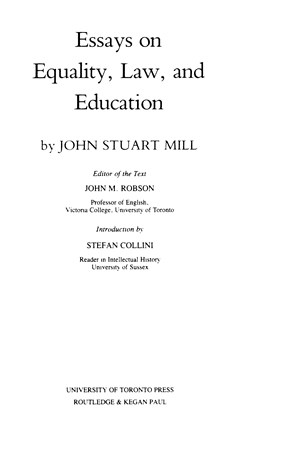
Appendix B: Harriet Taylor Mill, PAPERS ON WOMEN’S RIGHTS (1847-1850?) - John Stuart Mill, The Collected Works of John Stuart Mill, Volume XXI - Essays on Equality, Law, and Education [1825]Edition used:The Collected Works of John Stuart Mill, Volume XXI - Essays on Equality, Law, and Education, ed. John M. Robson, Introduction by Stefan Collini (Toronto: University of Toronto Press, London: Routledge and Kegan Paul, 1984).
Part of: Collected Works of John Stuart Mill, in 33 vols.About Liberty Fund:Liberty Fund, Inc. is a private, educational foundation established to encourage the study of the ideal of a society of free and responsible individuals. Copyright information:The online edition of the Collected Works is published under licence from the copyright holder, The University of Toronto Press. ©2006 The University of Toronto Press. All rights reserved. No part of this material may be reproduced in any form or medium without the permission of The University of Toronto Press. Fair use statement:This material is put online to further the educational goals of Liberty Fund, Inc. Unless otherwise stated in the Copyright Information section above, this material may be used freely for educational and academic purposes. It may not be used in any way for profit.
Appendix BPAPERS ON WOMEN’S RIGHTS (1847–50?)Holograph MSS, Mill-Taylor Collection, British Library of Political and Economic Science, London School of Economics. The title of the first fragment is in Harriet Taylor’s hand at the end; those of the second, third, and fourth fragments are in Mill’s hand, that of the fifth has been supplied. The MSS are in Mill’s hand (except for a few corrections in pencil by Taylor in the first and fourth, indicated in variant notes, and in repeated parts of the second); however, her title for the first, our knowledge of their working habits, and the apparent status of these fragments as preparatory for her “Enfranchisement of Women” suggest that they should be attributed jointly, if not solely to her. For descriptions of the MSS, and comment on them, see lxxii-lxxiv above. 1.Rights of Women—and Especially with Regard to the Elective Franchise—By a Woman—Dedicated to Queen Victoriaa great number of progressive changes are constantly going forward in human affairs and ideas, which escape the notice of unreflecting people, because of their slowness. As each successive, step requires a whole generation or several generations to effect it, and is then only one step, things in reality very changeable remain a sufficient length of time without perceptible progress, to be, by the majority of cotemporaries, mistaken for things permanent and immovable—and it is only by looking at a long series of generations that they are seen to be, in reality, always moving, and always in the same direction. This is remarkably the case with respect to Privileges and Exclusions. In every generation, the bulk of mankind imagine that all privileges and all exclusions, then existing by law or usage, are natural, fit and proper, even necessary: aexcepta such as happen to be, just at that time, in the very crisis of the struggle which puts an end to them—which rarely happens to more than one set or class of them at a time. But when we take all history into view we find that its whole course is a getting rid of privileges and exclusions. Anciently all was privilege and exclusion. There was not a person or class of persons who had not a line marked round them which they were in no case permitted to overstep. There was not a function or operation in society, sufficiently desirable to be thought worth guarding, which was not rigidly confined to a circumscribed class or body of persons. Some functions were confined to particular families—some to particular guilds, corporations, or societies. Whoever has any knowledge of ancient times knows that privilege and exclusion was not only the general rule in point of fact, but bthat nothing else was inb accordance with the ideas of mankind. Whenever any action or occupation, private or public, was thought of, it seemed natural to everybody that there should be some persons who were allowed to do the action or follow the occupation, and others who were not. People never thought of inquiring why it should be so, or what there was in the nature of the particular case to require it. People seldom ask reasons for what is in accordance with the whole spirit of what they see round them, but only for what jars with that spirit. Even bodily freedom, the right to use one’s own labour for one’s own benefit, was once a privilege, and the great majority of mankind were excluded from it. This seems to the people of our day something monstrously unnatural, to people of former days it seemed the most natural of all things. It was very gradually that this was got rid of, through many intermediate stages, of serfage, villenage &c. Where this did not exist, the system of castes did: and that appears profoundly unnatural to us, but so profoundly natural to Hindoos that they have not yet given it up. Among the early Romans fathers had the power of putting their sons to death, or selling them into slavery: this seemed perfectly natural to them, most unnatural to us. To hold land, in property, was throughout feudal Europe the privilege of a noble. This was only gradually relaxed and in Germany there is still much land which can only be so held. Up to the Reformation to teach religion was the exclusive privilege of a male separate class, even to read the Bible was a privilege: Those who lived at the time of the Reformation and who adopted it, ceased to recognize this case of privilege and exclusion, but did not therefore call in question any others. Throughout the Continent political office and military rank were exclusive privileges of a hereditary noblesse, till the French revolution destroyed these privileges. Trades and occupations have almost everywhere ceased to be privileges. Thus exclusion after exclusion has disappeared, until privilege has ceased to be the general rule, and tends more and more to become the exception: it now no longer seems a matter of course that there should be an exclusion, but it is conceded that freedom and admissibility ought to prevail, wherever there is not some special reason for limiting them. Whoever considers how immense a change this is from primitive opinions and feelings, will think it nothing less than the very most important advance which has hitherto been made in human society. It is nothing less than the beginning of the reign of justice, or the first dawn of it at least. It is the introduction of the principle that distinctions, and inequalities of rights, are not good things in themselves, and that none ought to exist for which there is not a special justification, grounded on the greatest good of the whole community, privileged and excluded taken together. Considering how slowly this change has taken place and how very recent is its date, it would be surprising if many exclusions did not still exist, by no means fitted to stand the test which until lately no one ever thought of applying to them. The fact that any particular exclusion exists, and has existed hitherto, is in such a case no presumption whatever that it ought to exist. We may rather surmise that it is probably a remaining relic of that past state of things, in which privilege and exclusion were the general rule. That the opinions of mankind have not yet put an end to it is not even a presumption that they ought not, or that they will not hereafter do so. We propose to examine how far this may be the case with one of the principal remaining cases of privilege, the privilege of sex: and to consider whether the civil and political disabilities of women have any better foundation in justice or the interest of society than any of the other exclusions which have successively disappeared.[*] In the first place it must be observed that the disabilities of women are exactly of the class which modern times most pride themselves on getting rid of—disabilities by birth. It is the boast of England that if some persons are privileged by birth, at least none are disqualified by it—that anybody may rise to be a peer, or a member of parliament, or a minister—that the path to distinction is not closed to the humblest. But it is closed irrevocably to women. A woman is born disqualified, and cannot by any exertion get rid of her disabilities. This makes her case an entirely peculiar one in modern Europe. It is like that of the negro in America, and worse than that of the roturier formerly in Europe, for he might receive or perhaps buy a patent of nobility. Women’s disqualifications are the only indelible ones. It is also a peculiarity in the case, that the persons disqualified are of the same race, the same blood, the same parents, as the privileged, and have even been brought up and educated along with them. There are none of the excuses grounded on their belonging to a different class in society. The excluded, have the same advantages of breeding and social culture, as the admitted, and have or might have the same educational advantages of all sorts. It is necessary to protest first of all against a mode of thought on the subject of political exclusions which though less common than it once was is still very common, viz. that a prohibition, an exclusion, a disability, is not an evil or a grievance in itself. This is the opinion of many grave, dignified people, who think that by uttering it they are shewing themselves to be sound, sage, and rational, superior to nonsense and sentimentality. Where is the grievance, they say, of not being allowed to be an elector? What good would it do you to be an elector? Why should you wish to be one? They always require you to point out some distinct loss or suffering, some positive inconvenience which befals you from anything you complain of. This class of persons are enemies of all sorts of liberty. They say to those who complain. Have you not liberty enough? What do you want to do more than you do at present? And what is strange is, that they think this is shewing peculiar good sense and sobriety. It is a doctrine however which they are not fond of applying to their own liberties. Suppose that a law were made forbidding them ever to go beyond the British isles, and that when they complained they were answered thus: Is not Great Britain large enough for you? Are not England, Scotland and Ireland fine countries? Is there not variety enough in them for any reasonable taste? Why do you want to go to foreign countries? Your proper place is at home. Your duties are there. You have no duties to perform abroad, you are not a sailor, or a merchant, or an ambassador. Stay at home.—Would they not say—“My good friend, it is possible that I may never wish to go abroad at all; or that if I do wish, it may not be convenient: but that does not give you any right to say I shall not go abroad. It is an injustice and a hardship to be told that even if I do wish to go I shall not be permitted. I shall probably live all my life in this house, but that is a very different thing from being imprisoned in it.”—What these people (who deem their notions wise because they are limited) think there is no harm in cutting off from the life of anybody, except themselves, is precisely what makes the chief value of life. They think you lose nothing as long as you are not prevented from having what you have and doing what you do: now the value of life does not consist in what you have or do, but in what you may have and may do. Freedom, power, and hope, are the charms of existence. If you are outwardly comfortable they think it nothing to cut off hope, to close the region of possibilities, to say that you shall have no carrière, no excitement, that neither chance nor your own exertions shall ever make you anything more or other than you now are. This is essentially the doctrine of people legislating for others. Nobody legislates in this way for himself. When it comes home to them personally all feel that it is precisely the inconnu, the indefinite, to be cut off from which would be unbearable. They know that it is not the thing they please to do, but the power of doing as they please, that makes to them the difference between contentment and dissatisfaction. Everybody, for himself, values his position just in proportion to the freedom of it: yet the same people think that freedom is the very thing which you may subtract from in the case of others, without doing them any wrong. The grievance they think is merely ideal: but they find in their own case that these ideal grievances are among the most real of any.[*] “The proper sphere of women is domestic life.” Putting aside the word “proper” which begs the question, what does this assertion mean? That no woman is qualified for any other social functions than those of domestic life? This will hardly be asserted, in opposition to the fact not only of the numerous women who have distinguished themselves as writers, but of the great number of eminent sovereigns who have been women—not only in Europe but in the East where they are shut up in zenanas. The assertion therefore can only be supposed to mean that a large proportion of mankind must devote themselves mainly to domestic management, the bringing up of children &c. and that this kind of employment is one particularly suitable for women. Now, taking this for what it is worth, is it in other cases thought necessary to dedicate a multitude of people from their birth to one exclusive employment lest there should not be people enough, or people qualified enough, to fill it? It is necessary that there should be coalheavers, paviours, ploughmen, sailors, shoemakers, clerks and so forth, but is it therefore necessary that people should be born all these things, and not permitted to quit those particular occupations? Still more, is it necessary that because people are clerks or shoemakers they should have no thoughts or opinions beyond clerking or shoemaking? for that is the implication involved in denying them votes. The occupations of men, however engrossing they may be considered, are not supposed to make them either less interested in the good management of public affairs, or less entitled to exercise their share of influence in those affairs by their votes. It is not supposed that nobody ought to have a vote except idle people. A shoemaker, a carpenter, a farmer have votes. Those who say that a scavenger or a coalheaver should not have a vote, do not say so on account of his occupation but on account of his poverty or want of education. Let this ground of exclusion be admitted for one sex just as far as for the other. Whatever class of men are allowed the franchise, let the same class of women have it. If a woman’s habitual employment, whether chosen for or by her, is the management of a family, she will be no more withdrawn from that occupation by voting in an election than her neighbour will be withdrawn by it from his shop or his office.[†] The feeling, however, which expresses itself in such phrases as “The proper sphere of women is private life,” “Women have nothing to do with politics” and the like, is, I believe, not so much any feeling regarding women as women, as a feeling against any new and unexpected claimants of political rights. In England especially there is always a grudging feeling towards all persons who unexpectedly profess an opinion in politics, or indeed in any matter not concerning their own speciality. There is always a disposition to say, What business is that of yours? When people hear that their tradespeople, or their workpeople, concern themselves about politics, there is almost always a feeling of dislike accompanying the remark. It seems as if people were vexed at finding more persons than they expected in a condition to give them trouble on that subject. Men have the same feeling about their sons unless the sons are mere echoes of their own opinions: and if their wives and daughters claimed the same privilege, their feeling would be that of having an additional disagreeable from a quarter they did not expect. The truth is, everybody feels that whether in classes or individuals, having an opinion of their own makes them more troublesome and difficult to manage: and everybody is aware, in all cases but his own, that the intrinsic value of the opinion is very seldom much of an equivalent. But this is no more than the ministers of despotic monarchs feel with regard to popular opinion altogether. It is an exact picture of the state of mind of Metternich. It is much more consistent in him. He says, or would say, Leave politics to those whose business it is. But these other people say, No; some whose business it is not peculiarly may and ought to have opinions on it, but others, workpeople for instance, and women, ought not. Constitutionalists and Liberals are right against Metternich only on grounds which prove them to be wrong against those whom they would exclude. Metternich is wrong because if none but those who make politics their business, had opinions and could give votes, all the rest would be delivered blindfold into the hands of those professional politicians. This argument is good against excluding anybody, especially any class or kind of persons. It is a very great evil that any portion of the community should be left politically defenceless. To justify it in any case it must be shewn that still greater evils would arise from arming the class with opinions and votes. It may possibly admit of being maintained that this would be the result of giving votes to very ignorant or even in some cases to very poor people. But it is impossible to shew that any evils would arise from admitting women of the same social rank as the men who have votes. Objection, “You would have perpetual domestic discussion.” If people cannot differ in opinion on any important matter and remain capable of living together without quarrelling, there cannot be a more complete condemnation of marriage: for if so, two people cannot live together at all unless one of them is a mere cipher, abdicating all will and opinion into the hands of the other, and marriage can only be fit for tyrants and nobodies. But the proposition is false. Do not married people live together in perfect harmony although they differ in opinions and even feelings on things which come much nearer home than politics do to most people? Does it not often happen for instance that they hold different opinions in religion? And have they not continually different opinions or wishes on innumerable private matters without quarrelling? People with whose comfort it is incompatible that the person they live with should think differently from them in politics or religion will if they marry at all generally marry a person who has either no opinions or the same sort of opinions with themselves. Besides, by discouraging political opinions in women, you only prevent independent disinterested opinions. In a woman, to have no political opinions, practically means to have the political opinions which conduce to the pecuniary interest or social vanity of the family. If honest opinions on both sides would make dissension between married people, will there not be dissension between a man who has an opinion and a conscience in politics and a woman who sees what she thinks the interests of the family sacrificed to what seems to her a matter of indifference? except indeed that the man’s public spirit is seldom strong enough to hold out long against the woman’s opposition, especially if he really cares for her. Now when women and men really live together, and are each other’s most intimate associates, (which in the ancient republics they were not) men never can or will be patriotic or public spirited unless women are so too. People cannot long maintain a higher tone of feeling than that of their favourite society. The wife is the incarnate spirit of family selfishness unless she has accustomed herself to cultivate feelings of a larger and more generous kind: while, when she has, her (in general) greater susceptibility of emotion and more delicate conscience makes her the great inspirer of those nobler feelings in the men with whom she habitually associates. A part of the feeling which makes many men dislike the idea of political women, is, I think, the idea that politics altogether are a necessary evil, a source of quarrelsome and unamiable feelings, and that their sphere of action should be restricted as much as possible, and especially that home, and social intercourse, should be kept free from them, and be retained as much as possible under influences counteractive of those of politics. One would imagine from this manner of looking at the subject, that the danger in modern times was that of too much political earnestness: that people generally felt so strongly about politics as to require a strong curb to prevent them from quarrelling about it when they meet. The fact however we know to be that people in general are quite lukewarm about politics, except where their personal interests or the social position of their class are at stake, and when that is the case women have already as strong political feelings as men have. And this wish to keep the greater interests of mankind from being thought of and dwelt on when people are brought together in private, does not really prevent ill feeling and ill blood in society, but only causes it to exist about things not worth it. Where is the benefit of hindering people from disliking each other on matters involving the liberty or the progress of mankind, only to make them hate each other from petty personal jealousies and piques? Active minds and susceptible feelings will and must interest themselves about something, and if you deny them all subjects of interest except personal ones, you reduce the personal interests to a petty scale, and make personal or social vanities the primum mobile of life: now personal rivalities are a much more fruitful source of hatred and malice than differences of political opinion. How vain the idea that the way to make mankind amiable is to make them care for nothing except themselves and the individuals immediately surrounding them. Does not all experience shew that when people care only for themselves and their families, then unless they are held down by despotism, every one’s hand is against every one, and that only so far as they care about the public or about some abstract principle is there a basis for real social feeling of any sort? One reason why there is scarcely any social feeling in England, but every man, entrenched within his family, feels a kind of dislike and repugnance to every other, is because there is hardly any concern in England for great ideas and the larger interests of humanity. The moment you kindle any such concern, if it be only about negroes or prisoners in gaols, you not only elevate but soften individual character; because each begins to move in an element of sympathy, having a common ground, even if a narrow one, to sympathize on. And yet you would prevent the sympathetic influence of women from exercising itself on the great interests. Observe, by the way, that almost all the popular movements towards any object of social improvement which have been successful in this country, have been those in which women have taken an active part, and have fraternized thoroughly with the men who were engaged about them: Slavery abolition, establishment of schools, improvement of prisons. In the last we know that a woman[*] was one of the principal leaders, and in all three the victory was chiefly due to the Quakers among whom women are in all points of public exertion as active as men. Probably none of these things would have been effected if women had not taken so strong an interest in them—if the men engaged had not found a constant stimulus in the feelings of the women connected with them, and a necessity for excusing themselves in the eyes of the women in every case of failure or shortcoming. And will any one say that the harmony of domestic life or of social intercourse was rendered less because women took interest in these subjects? It will be said, they were questions peculiarly concerning the sympathies and therefore suitable to women. But they were also subjects which concerned people’s self interest and were therefore sources of antipathy as well as sympathy: and there have been few subjects on which there has been more party spirit and more vehement opposition of political feeling, than on West India slavery and on the Bell and Lancaster schools.[†] “What is the use of giving women votes?” Before answering this question it may be well to put another: What is the use of votes at all? Whatever use there is in any case, there is in the case of women. Are votes given to protect the particular interests of the voters? Then women need votes, for the state of the law as to their property, their rights with regard to children, their right to their own person, together with the extreme maladministration of the courts of justice in cases of even the most atrocious violence when practised by men to their wives, contributes a mass of grievances greater than exists in the case of any other class or body of persons. Are votes given as a means of fostering the intelligence of the voters, and enlarging their feelings by directing them to a wider class of interests? This would be as beneficial to women as to men. Are votes given as a means of exalting the voters in social position and estimation? and to avoid making an offensive distinction to their disadvantage? This reason is strong in the case of women. And this reason would suffice in the absence of any other. Women should have votes because otherwise they are not the equals but the inferiors of men. So clear is this, that any one who maintains that it is right in itself to exclude women from votes, can only do it for the express purpose of stamping on them the character of inferiors. * * * * * 2.Women—(Rights of)the rights of women are no other than the rights of human beings. The phrase has come into use, and become necessary, only because law and opinion, having been made chiefly by men, have refused to recognize in women the universal claims of humanity. When opinion on this subject shall be further advanced towards rectification, neither “rights of women” nor even “equality of women” will be terms in use, because neither of them fully expresses the real object to be aimed at, viz. the negation of all distinctions among persons, grounded on the accidental circumstance of sex. The present legal and moral subjection of women is the principal, and likely to be the latest remaining relic of the primitive condition of society, the tyranny of physical force. Society sets out from the state of lawlessness in which every one’s hand is against every one, and each robs and slays a weaker than himself when he has any object to gain by it: the next stage is that in which the races and tribes which are vanquished in war are made slaves, the absolute property of their conquerors, this by degrees changes into serfdom, or some other limited form of dependence, and in the course of ages mankind pass through various decreasing stages of subjection on one side and privilege on the other, up to complete democracy which the advanced guard of the human species are now just reaching: so that the only arbitrary distinction among human beings, which the one or two most advanced nations do not now, at least in principle, repudiate, is that between women and men. And even this distinction, although still essentially founded on despotism, has assumed a more mitigated form with each step in the general improvement of mankind, whether we compare age with age, people with people or class with class: which was also the case with all the other social tyrannies, in their progress towards extinction. It deserves particular remark, that at every period in this gradual progress, the prevailing morality of the time (with or without the exception of a few individuals superior to their age) invariably consecrated all existing facts. It assumed every existing unjust power or privilege as right and proper, contenting itself with inculcating a mild and forbearing exercise of them: by which inculcation no doubt it did considerable good, but which it never failed to balance by enjoining on the sufferers an unresisting and uncomplaining submission to the power itself. Morality recommended kind treatment of slaves by their masters, and just rule by despots over their subjects, but it never justified or tolerated either slaves or subjects in throwing off the yoke, and wherever they have done so it has been by a plain violation of the then established morality. It is needless to point out how exactly the parallel holds in the case of women and men. In the position of women as society has now made it, there are two distinct peculiarities. The first is, the domestic subjection of the larger portion of them. From this, unmarried women who are either in independent or in self-dependent pecuniary circumstances are exempt; so that by the admission of society itself, there is no inherent necessity for it, and the time cannot be far off when to hold any human being, who has past the age which requires to be taken care of and educated by others, in a state of compulsory obedience to any other human being (except as the mere organ and minister of the law) will be acknowledged to be as monstrous an infraction of the rights and dignity of humanity, as slavery is at last, though tardily, among a small, comparatively advanced part of the human race, felt to be. Practically the evil varies, in the case of women, (as it did in the case of slaves) from being slowly murdered by continued bodily torture, to being only subdued in spirit and thwarted of all those higher and finer developements of individual character of which personal liberty has in all ages been felt to be the indispensable condition. The other point of the question relates to the numberless disabilities imposed on women by law or by custom equivalent to law; their exclusion from most public and from a great number of private occupations, and the direction of all the forces of society towards educating them for, and confining them to, a small number of functions, on the plea that these are the most conformable to their nature and powers. It is impossible here to enter, with any detail, into this part of the subject. Three propositions however may be laid down as certain. First; that the alleged superior adaptation of women to certain occupations, and of men to certain others, does not, even now, exist, to anything like the extent that is pretended. Secondly, that so far as it does exist, a rational analysis of human character and circumstances tends more and more to shew, that the difference is principally if not wholly the effect of differences in education and in social circumstances, or of physical characteristics by no means peculiar to one or the other sex. Lastly; even if the alleged differences of aptitude did exist, it would be a reason why women and men would generally occupy themselves differently but no reason why they should be forced to do so. It is one of the aberrations of early and rude legislation to attempt to convert every supposed natural fitness into an imperative obligation. There was an apparent natural reason why the children should follow the occupation of their parents; they were often familiar with it from childhood, and had always peculiar facilities for being instructed in it: but this natural fitness, converted into a law, became the oppressive and enslaving system of Castes. Good laws, laws which pay any due regard to human liberty, will not class human beings according to mere general presumptions, nor require them to do one thing and to abstain from another on account of any supposed suitableness to their natural or acquired gifts, but will leave them to class themselves under the natural influence of those and of all the other peculiarities of their situation, which if left free they will not fail to do quite as well, not to say much better, than any inflexible laws made for them by pedantic legislators or conceited soi-disant philosophers are ever likely to do. * * * * * 3.The Rights of Women to the Elective Franchise and Its Advantagesstatement of the principle—perfect equality. Although this requires no proof, necessary to consider the subject as usually treated and reply categorically to objections either to it as a principle or as a matter of practice. Prevailing opinion is that some change is needed but not fundamental, only of degree—above all that the change shall not alter the principle of inequality, foundation of present condition. Present state of opinion divided into the following: Largest class, both men and women, composed of those who take things for granted because they are so and have always been so—have a natural fear of making any alteration in the relations on which they are accustomed to think the best things in life depend. We would prove to them that tho’ the best things in life did depend on those relations as they are, the relation under its present conditions is worn out and no longer affords to either party a life either well or sufficiently filled for the spirit of the present time which requires more developement of the spiritual and less of the physical instead of the contrary. True, education is the great want of the time, but people have scarce begun to perceive in what sense of education—that which modern developement requires should be the desire, power and habit of using the person’s own mind, instead of (as almost all educationists seem to think) filling the mind with an undigested mass from the minds of others, in consequence of which process the most educated people now are among the most ignorant—witness not only the (absurdly) called educated classes but preeminently the collegiate, legal, clerical, professional men. Placeman, clergyman, barrister, doctor, has each something to say on one subject—in the majority of cases this something is what he has heard from others and therefore comes from him deadborn—if an active minded person, he is found to talk interestingly on his one subject, but let conversation be anything worthy the name of general, and the profound ignorance and inactivity of intellect presented by the educated classes in England is the only thing capable of exciting the mind in intercourse with them. After all the objections that are made both by men and women have been considered, one may perhaps put it down as a fact that they are all based on the supposition that conceding equal political rights to women would be contrary to the interests of men. Some think it would be contrary to their real interests, some to their selfish interests. We think they would be not only in accordance with, but greatly advantageous to, the interests of men with perhaps the exception of interests if such they can be called, as no man in the present day would venture to &c. It would probably put a stop to the sort of license of indulgence which everybody is now agreed in discountenancing:— A great part of the feeling which resists the political equality of women is a feeling of the contrast it would make with their domestic servitude. The evils of women’s present condition all lie in the necessity of dependence, the just cause of complaint lies here and not elsewhere.
Historical parallel between men and women sovereigns. The expression “Rights of Women,” it is the fashion among women and among a certain vulgar class of men to affect to receive with a sneer and to endeavour to drown with ridicule. In neither case does this appear to be because they really regard it as meaningless, for if the same people are asked why they receive it so, they invariably grow angry and this mode of reception perpetuates itself because the intense constitutional shyness of Englishmen makes them of all things fear ridicule and this phrase as well as the idea it includes has always hitherto been put down by ridicule. Commonplace women’s aversion to it has more meaning—it contains the everlasting dread of the givers of the loaves and fishes[*] —their lively imagination exaggerates the disagreeables of having to work instead of being worked for, which their education having precluded all notions of public spirit or personal dignity, far from being revolted at the idea of dependence, elevates submission into a virtue per se. They enormously exaggerate both the talent and the labour required for the external details of life, unaware that they give as much labour and fritter away as much talent in executing badly those domestic details which they enlarge upon as arguments against women’s emancipation, as would be sufficient to conduct both the public and private affairs of either an individual or a family. Is it not true that half the time of half the women in existence is passed in worthless and trashy work, of no benefit to any human being? Objection. Well bred people never exercise the power which the law gives them. But all their conduct takes the bent which has been given to the two characters by the relation which the law establishes. The woman’s whole talent goes into the inducing, persuading, coaxing, caressing, in reality the seducing, capacity. In whatever class in life, the woman gains her object by seducing the man. This makes her character quite unconsciously to herself, petty and paltry. * * * * * 4.Why Women Are Entitled to the Suffrage1st. Because it is just. 2nd. Because women have many serious practical grievances from the state of the law as it regards them. 3rd. Because the general condition of women, being one of dependence, is in itself a grievance, which their exclusion from the suffrage stamps and perpetuates. 4th. Reply to objections. The exclusion of women from the suffrage becomes a greater offence and degradation in proportion as the suffrage is opened widely to all men. When the only privileged class is the aristocracy of sex the slavery of the excluded sex is more marked and complete. Notion that giving the suffrage does no good; a shallow fallacy. The greatest good that can be done for women and the preparation of all others is to recognize them as citizens—as substantive members of the community instead of mere things belonging to members of the community. One of the narrownesses of modern times, in England, is that the indirect effects produced by the spirit of institutions are not recognized and therefore the immense influence on the whole life of a person produced by the fact of citizenship is not at all felt. Even according to the most moderate reformers the suffrage should include clerks and other educated persons who are dependent on employers. These are not turned out of their employments for voting against their employers, only because there is a point of honour on the subject. There ought to be the same between married people.— To suppose that one person’s freedom of opinion must merge in that of the other and that they could not vote differently at an election without quarrelling is a satire on marriage and a reductio ad absurdum of it. All persons, men and women, in the present age, are entitled to mental independence and marriage like other institutions must reconcile itself to this necessity. The queen professes to live and act perfectly conscientiously, does she ask her husband’s opinion and submit to it in all her acts as queen? is not this a case of married persons exercising their separate freedom of opinion and conduct? The principle that all who are taxed should be represented, would give votes not only to single women but to married women whose property is settled. Women should either not be allowed to have property or should have all which follows from the possession of property. The man acquires the points of character that belong to one who is always having homage paid to the power vested in him, self-important, domineering, with more or less politeness of form according to his breeding, and more or less suavity according to his temper—the difference in the case of a well bred man being mainly this, that as he does not need to assert what never is disputed, so he does not do so, but contents himself with accepting the position which the law assigns and which the woman yields to him, it being a main point in the ways of well bred people that all occasions of bringing wills into active collision, are avoided, sometimes by a tacit compromise in which however the chief part always remains with the strongest, sometimes because that which knows itself to be the weakest makes a graceful retreat in time. In this as in other relations, good breeding does not so much affect the substance of conduct as the manner aof ita . When the man is ill bred the manner is coarse, tyrannical, brutal, either in a greater or in a less degree; there is superfluous self assertion, and of an offensive kind, well bred people’s self assertion is only tacit, until their claims are in some way resisted, but they are not therefore less tenacious of all that bthe lawb gives them, and are often not less really inflated by self-worship caused by the cworshipc they receive from dependents of every description. * * * * * 5.[Reform: Ends and Means]PoliticalNo hereditary privileges whatever. No exclusion from the suffrage, but an educational qualification (qu. what?) Complete freedom of speech, printing, public meetings and associations, locomotion, and industry in all its branches. No church establishment or paid clergy; but national schools and colleges without religion. SocialAll occupations to be alike open to men and women; and all kinds and departments of instruction. Marriage to be like any other partnership, dissoluble at pleasure, and not merging any of the individual rights of either of the parties to the contract. All the interests arising out of marriage to be provided for by special agreement. The property of intestates to belong to the state, which then undertakes the education, and setting out in life, of all descendants not otherwise provided for. No one to acquire by gift or bequest more than a limited amount. [a-a]unless indeed [first cancelled by HTM] [b-b][first read] was in entire [altered by JSM to] was alone in [which was cancelled first by HTM and replaced, first by HTM, by interlined final version] [[*] ]The last paragraph, especially the last line, which concludes f. 2v, is crowded in (the final word is interlined below), as though to conclude, or else to avoid disturbing what was already written on 3r. [[*] ]The text here stops about nine lines above the bottom of f. 4v. [[†] ]The text here stops about two lines above the bottom of f. 5v. [[*] ]Elizabeth Fry. [[†] ]Similar, but competing, systems, founded by Andrew Bell and Joseph Lancaster. The text here stops about seven lines above the bottom of f. 9v. [[*] ]See Luke, 9:11-15. [a-a][marked for deletion in pencil by HTM] [b-b][altered in pencil by HTM to] law or custom [c-c][altered in pencil by HTM to] deference |

Titles (by Subject)