EconlibThe LibraryOther Sites |
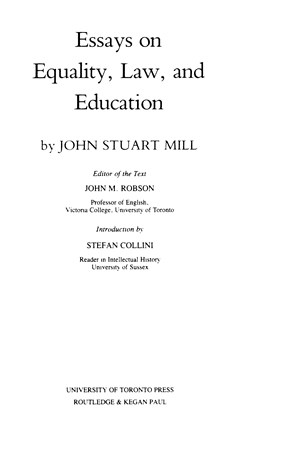
Front Page Titles (by Subject) LAW OF LIBEL AND LIBERTY OF THE PRESS 1825 - The Collected Works of John Stuart Mill, Volume XXI - Essays on Equality, Law, and Education
Return to Title Page for The Collected Works of John Stuart Mill, Volume XXI - Essays on Equality, Law, and EducationThe Online Library of LibertyA project of Liberty Fund, Inc.Search this Title:Also in the Library:
LAW OF LIBEL AND LIBERTY OF THE PRESS 1825 - John Stuart Mill, The Collected Works of John Stuart Mill, Volume XXI - Essays on Equality, Law, and Education [1825]Edition used:The Collected Works of John Stuart Mill, Volume XXI - Essays on Equality, Law, and Education, ed. John M. Robson, Introduction by Stefan Collini (Toronto: University of Toronto Press, London: Routledge and Kegan Paul, 1984).
Part of: Collected Works of John Stuart Mill, in 33 vols.About Liberty Fund:Liberty Fund, Inc. is a private, educational foundation established to encourage the study of the ideal of a society of free and responsible individuals. Copyright information:The online edition of the Collected Works is published under licence from the copyright holder, The University of Toronto Press. ©2006 The University of Toronto Press. All rights reserved. No part of this material may be reproduced in any form or medium without the permission of The University of Toronto Press. Fair use statement:This material is put online to further the educational goals of Liberty Fund, Inc. Unless otherwise stated in the Copyright Information section above, this material may be used freely for educational and academic purposes. It may not be used in any way for profit.
LAW OF LIBEL AND LIBERTY OF THE PRESS
EDITOR’S NOTEWestminster Review, III (Apr., 1825), 285-321. Headed “Art I On the Law of Libel, with Strictures on the self-styled Constitutional Association. [By Francis Place.] 8vo. pp. 73. London: John Hunt, 1823. The Law of Libel. By Richard Mence, Esq. of the Middle Temple, Barrister. 8vo. 2 Vols. in one, pp. 595. London [“Pople], 1824.” Running titles “Law of Libel and Liberty of the Press.” Unsigned; not republished. Identified in Mill’s bibliography as “An article on the Liberty of the Press, in the sixth number of the Westminster Review” (MacMinn, 6). Vol. III of the Westminster in the Somerville College Library has no corrections or alterations. For comment on the review, see xl-xli and lviii above. Law of Libel and Liberty of the Pressthe two publications which we have chosen to head this article, possess considerable merit, and we do not hesitate to recommend them to our readers, as worthy of an attentive perusal. The first, though no name appears in the title-page, is the acknowledged production of a known and tried friend of the people.[*] It consists of a series of essays, all of which, except the last, appeared nearly two years since in a weekly newspaper. It comprises a summary exposure of many of the abominations contained in what is called the Law of Libel, as well as in the administration of that Law; and a brief review of the acts of a body of men, now sunk into obscurity, who were at one time notorious under the name of the Constitutional Association. We will not say that the author has completely exhausted the subject, but we consider no small praise to be his due, for having said so much, and so much to the purpose, in the narrow compass within which, by the original design, he was unavoidably confined. Mr. Mence’s work attracted our attention, from being advertised as dedicated to the Constitutional Association. What might be expected from a work, appearing under such auspices, our readers have no occasion to be informed. We, however, had not proceeded far in the perusal, before we found Mr. Mence to be, not a humble aspirant after ministerial patronage, content to lend himself to the purposes of those who would keep the human mind in perpetual bondage; but one who does not shrink from exposing, even at the risk of his professional success, the vices of existing institutions; one who dares give utterance to great and important truths, however little acceptable, to the rich and powerful, and who would be, for that reason alone, deserving of high praise, had he executed his task with far less ability than he has displayed. Without entering into a critical examination of the merits and defects of these two works, we embrace this opportunity of delivering our sentiments upon the highly important subject to which they refer: availing ourselves of the language of either or both of them, as often as it appears peculiarly adapted to our purpose. We shall divide our remarks into two parts; in one of which we shall discuss the general question, to what extent restraints upon the freedom of the press can be considered as warranted by sound principles of political philosophy; and in the other, we shall take a brief review of the English Law, and of the doctrines of English Lawyers, on this subject; and we pledge ourselves to prove, that the Law of England is as unfavourable to the liberty of the press, as that of the most despotic government which ever existed; and, consequently, that whatever degree of that liberty is enjoyed in this country, exists, not in consequence of the law, but in spite of it. The general question has usually been disposed of in a very summary way. It has, in fact, been regularly assumed, first, that to employ the press in any other than a certain manner, is inconceivably wicked; and secondly, that, for this reason, it is the duty of the magistrate to prevent it, by fine and imprisonment, if not by means still more certainly and more promptly effectual. The author of the article “Liberty of the Press,” in the Supplement to the Encyclopaedia Britannica, has, however, set the example of rather a different sort of reasoning; and (what was never completely or consistently done before) he has pointed out the considerations on which this question really turns. We have no higher ambition than that of treading in his steps; and, taking his principles as our guide, we shall endeavour to unravel the sophistry, and expose the mischievous designs of the enemies to free discussion. That the press may be so employed as to require punishment, we are very far from denying: it may be made the instrument of almost every imaginable crime, There is scarcely a right,* for the violation of which, scarcely an operation of government, for the disturbance of which, the press may not be employed as an instrument. The offences capable of being committed by the press are indeed nearly coextensive with the whole field of delinquency. It is not, however, necessary to give a separate definition of every such violation or disturbance, when committed by the press, for that would be to write the penal code a second time; first describing each offence as it appears in ordinary cases, and then describing it anew for the case in which the press is the particular instrument. If, for the prevention of the violation of rights, it were necessary to give a separate definition, on account of every instrument which might be employed as a means of producing the several violations, the penal code would be endless. In general the instrument or means is an immaterial circumstance. The violation itself, and the degree of alarm which may attend it, are the principal objects of consideration. If a man is put in fear of his life, and robbed of his purse, it is of no consequence whether he is threatened with a pistol, or with a sword. In the deposition of a theft, of a fraud, or a murder, it is not necessary to include an account of all the sorts of means by which these injuries may be perpetrated. It is sufficient if the injury itself is accurately described. The object is, to prevent the injury, not merely when produced by one sort of means or another sort of means, but by any means. As far as persons and property are concerned, the general definition of the acts by which rights are liable to be violated, has always been held sufficient, and has been regarded as including not less the cases in which the instrumentality of the press has been employed, than those in which any other means have been employed to the same end. Nobody ever thought of a particular law for restraining the press on account of the cases in which it may have been rendered subservient to the perpetration of a murder or theft. It is enough that a law is made to punish him who has been guilty of the murder or theft, whether he has employed the press or any thing else as the means for accomplishing his end.* There are some species of acts, however, of which the press if not the sole, may, at any rate, be regarded as the most potent instrument: these are, the publication of facts, and the expression of opinions; and to one or other of these heads belong those uses of the press, against which the Law of Libel is principally directed. It is not pretended that, in the language of English Law, the word Libel is strictly confined to one meaning. It includes, on the contrary, a number of acts, of a very heterogeneous nature, resembling one another scarcely at all, except in having penalties attached to them by the authorized interpreters of the law. A threatening letter, demanding money, is a libel. An indecent picture is a libel. For the present, however, we may confine our remarks to the question regarding the publication of facts and the expression of opinions. To begin with the latter. If the magistrate is to be intrusted with power to suppress all opinions which he, in his wisdom, may pronounce to be mischievous—to what control can this power be subjected? What security is it possible to take against its abuse? For without some security all power, and of course this power, is sure to be abused, just as often as its abuse can serve any purpose of the holder. It is the boast of English lawyers that the offence of treason is defined; so strictly defined, that nothing is ambiguous, nothing arbitrary, nothing left to the discretion of the judge. This, they tell us, is one of the chief bulwarks of our liberty, implying, that if it were left to the judge to say what should, and what should not be treason, every thing would be treason which the government did not like. Yet why should definition be required in the case of treason, not required in the case of libel? Is the government less interested in misdecision? Is the judge less dependent on the government? Is a packed special jury less subservient? Or are the judge and jury angels when they judge of libel, men only when they judge of treason? It would be hardy to assert, that to give the right of pronouncing upon libels to the judge, is any thing more than another name for giving it to the government. But there are many subjects, and these the most important of all, on which it is the interest of the government, not that the people should think right, but, on the contrary, that they should think wrong: on these subjects, therefore, the government is quite sure, if it has the power, to suppress, not the false and mischievous opinions, but the great and important truths. It is the interest of rulers that the people should hold slavish opinions in politics: it is equally so, that they should hold slavish opinions in religion: all opinions, therefore, whether in politics or religion, which are not slavish, the government, if it dares, will be sure to suppress. It is the interest of rulers that the people should believe all their proceedings to be the best possible, every thing, therefore, which has a tendency to make them think otherwise, and among the rest, all strictures, however well deserved, government will use its most strenuous exertions to prevent. If these endeavours could succeed, if it could suppress all censure, its dominion, to whatever degree it might pillage and oppress the people, would be for ever secured. This is so palpable, that a man must be either insincere or imbecile to deny it: and no one, we suppose, will openly affirm that rulers should have the power to suppress all opinions which they may call mischievous—all opinions which they may dislike. Where, then, is the line to be drawn? At what point is the magistrate’s discretionary power of suppressing opinions to end? Can it be limited in such a manner as to leave him the power of suppressing really mischievous opinions, without giving him that of silencing every opinion hostile to the indefinite extension of his power? It is manifest, even at first sight, that no such limit can be set. If the publication of opinions is to be restrained, merely because they are mischievous, there must be somebody to judge, what opinions are mischievous, and what the reverse. It is obvious, that there is no certain and universal rule for determining whether an opinion is useful or pernicious; and that if any person be authorized to decide, unfettered by such a rule, that person is a despot. To decide what opinions shall be permitted, and what prohibited, is to choose opinions for the people, since they cannot adopt opinions which are not suffered to be presented to their minds. Whoever chooses opinions for the people, possesses absolute control over their actions, and may wield them for his own purposes with perfect security. It thus appears, by the closest ratiocination, that there is no medium between perfect freedom of expressing opinions, and absolute despotism. Whenever you invest the rulers of the country with any power to suppress opinions, you invest them with all power; and absolute power of suppressing opinions would amount, if it could be exercised, to a despotism far more perfect than any which has yet existed, because there is no country in which the power of suppressing opinions has ever, in practice, been altogether unrestrained. How, then, it may be asked, if to have any power of silencing opinions is to have all power—since the government of Great Britain certainly has that power in a degree—how do we account for the practical freedom of discussion, which to a considerable extent undoubtedly prevails in this country? The government having the power to destroy it, why is it suffered to exist? Why? For the same reason for which we have a habeas corpus act,[*] with a government possessing the power to suspend or repeal it: for the same reason for which a jury is sometimes allowed to acquit a prisoner, whom the aristocracy wish to destroy, for the same reason for which we are not taxed up to the highest amount which could be extorted from us, without impairing our power of being useful slaves. The aristocracy do not submit to these restraints because they like them, but because they do not venture to throw them off. This is conformable to the theory of the British constitution itself. Even a Turkish Sultan is restrained by the fear of exciting insurrection. The power of shackling the press may, like all other power, be controlled in its exercise by public opinion, and to a very great, though far from a sufficient, extent, it has been and is so controlled in Great Britain. By law, however—notwithstanding the assertions of lawyers, which assertions, when it suits them, they never scruple to contradict—liberty of discussion, on any topic by which the interests of the aristocracy can be affected, does not exist at all in this country, as we have already shewn, upon general principles, and shall prove in the sequel from the actual words of the highest legal authorities. The preliminary inquiry, however, would not be complete, unless, having discussed the consequences of restraining the press, we were also to inquire what would be the consequences of leaving it free. It is evident, at first sight, that, whatever might be the evils of freedom, they could not be worse than the evils of restraint. The worst that could happen, if the people chose opinions for themselves, would be, that they would choose wrong opinions. But this evil, as we have seen, is not contingent, but unavoidable, if they allow any other person to choose opinions for them. Nor would it be possible that the opinions, however extravagant, which might become prevalent in a state of freedom, could exceed in mischievousness those which it would be the interest, and therefore the will, of rulers, to dictate, since there cannot be more mischievous opinions, than those which tend to perpetuate arbitrary power. There would, however, be one great difference. Under a free system, if error would be promulgated, so would truth: and truth never fails, in the long run, to prevail over error. Under a system of restraint, the errors which would be promulgated from authority would be the most mischievous possible, and would not be suffered to be refuted. That truth, if it has fair play, always in the end triumphs over error, and becomes the opinion of the world, is a proposition which rests upon the broadest principles of human nature, and to which it would be easy to accumulate testimonials from almost every author, whatever may be his political leanings, who has distinguished himself in any branch of politics, morals, or theology. It is a proposition which the restrictors themselves do not venture to dispute. They continually protest, that their opinions have nothing to fear from discussion; the sole effect of which, according to them, is, to exhibit their irrefragable certainty in a still stronger light than before. And yet they do not scruple to punish men for doing that which, if their own assertions be correct, merits not punishment, but reward. Although, however, the worst enemies of discussion, do not deny, as a general proposition, its tendency to unveil the truth, there is a certain number of subjects on which, if they are to be believed, discussion tends, not to enlighten, but to mislead. Among these are all the subjects on which it is the interest of rulers that the people should be misled; the political religion of the country, its political institutions, and the conduct and character of its rulers. On the first of these topics, we have delivered our opinions so fully in our third number,[*] that we shall in the present confine ourselves principally to the three latter: all of which substantially resolve themselves into one. That there is no subject of greater importance, no one needs to be told: and to say this, is to say that there is no subject on which it is of greater importance that the people should be rightly informed. As the stability of a good government wholly depends upon its being acknowledged by the people to be good, so, on the other hand, the reform of a bad one wholly depends upon its being believed by the people to be bad. In the correctness of the estimate which the people form of the goodness of their government, their whole happiness is involved; since misgovernment includes every misery which is capable of afflicting mankind: and misgovernment is alike the consequence, whether the people believe a good government to be a bad one, or a bad government to be a good one. We have been thus particular in laying down first principles, because the language held on this subject by rulers implies, that it is indeed the greatest of calamities, for the people to believe a good government to be bad, but that their considering a bad government to be good, is no evil at all, or at most a very trifling one. The evil, however, as we have already observed, is in both cases the same; or rather, the one is an evil, chiefly because it leads to the other: that the people should think ill of a good government is principally to be lamented, because it may occasion their acquiescence in a worse. If, therefore, there be any subject on which the people cannot, without the greatest danger, trust the power of choosing opinions for them out of their own hands, it is this. And if such power cannot safely be given to any one, least of all can it be given to the rulers of the country. If the people were compelled to take their opinions implicitly from some one who might have an interest in persuading them that their government is worse than it is, the greatest evils, it is admitted, would be the consequence. To think ill of a good government, and well of a bad one, are evils of equal magnitude. If, therefore, the privilege of dictating opinions to the people, on the subject of their government, be intrusted to persons interested in persuading them that their government is better than it is, the mischief cannot consistently be affirmed to be less. That rulers are so interested, will not be denied. What inference, then, are we to draw? or rather, how can the inference be evaded, that, if rulers are suffered to choose what opinions the people shall hold concerning their government, all the evils of misrule are rendered perpetual? Such a choice, however, is made by rulers, as often as they inflict punishment upon any person for criticizing institutions, or censuring the conduct of government: unless they are willing to prohibit, under equal penalties, the expression of praise. To forbid the expression of one opinion, and give encouragement to that of another, is surely to make a choice. To punish censure of rulers, while praise is permitted, is to say, ’tis fit that the people should think well of their government, whether good or bad; and to take the most effectual mode of compelling them to do so. Against this reasoning it is impossible that any rational objection can be urged. Cavils, indeed, may be brought against it: but there are few conclusions of equal importance, the proof of which affords so little hold even for cavil. When it is asserted, that to restrain discussion is to choose opinions for the people, and that rulers, if permitted to dictate opinions to their subjects, having an interest in choosing the most mischievous of all opinions, will act as that interest directs; there is only one objection which can by possibility be raised. It cannot be said, that to fetter discussion is not to choose opinions, nor that rulers are not interested in making a bad choice. But, it may be said, that our rulers are men in whom the confidence of the people may be reposed; and that, although it be confessedly their interest to make a bad choice, they will disregard that interest, and make a good one. To such a pinnacle of absurdity men may always be driven, when they attempt to argue in defence of mischievous power. They begin by boldly denying the possibility of abuse: when this can no longer be maintained, they fly for refuge to the characters of the individuals, and insist with equal pertinacity, that in their hands power may be trusted without fear of being abused. This is a compliment of which the rulers for the time being, be they who they may, always receive as much as they can pay for: dead rulers are not so fortunate. That all rulers in time past abused their power when they could, is allowed: but an exception is made in favor of the present. This is a species of reasoning, however, which will pass current with nobody in the present day: we cannot be forced back to the times when rulers were thought not to be made like human beings, but to be free from all the passions and appetites by which other men are misled. If uncontrolled power can exist, and not be abused, then away with the British, and all other constitutions, and let us return to the despotism of our wise and venerable ancestors. But if men will abuse all other powers, when unrestrained, so they will that of controlling the press: if rulers will avail themselves of all other means to render themselves despotic, they will not pass over an expedient so simple and effectual as that of suppressing, in as far as they dare, all opinions hostile to the extension of their authority. And perfect freedom of discussion is, as we have already proved, the only alternative. The objections which have been urged against the principle of free discussion, though infinitely diversified in shape, are at bottom only one assertion: the incapacity of the people to form correct opinions. This assumption is indeed the stronghold of all the disguised or undisguised partisans of despotism. It has been the unremitting, and hitherto, unhappily, the successful endeavour of rulers, to make it be believed that the most dreadful calamities would be the effect of any attempt to obtain securities that their power should be employed for the benefit, not of themselves, but of the community. With this view, it has been their uniform practice to vilify those whom they are striving to enslave. If the people were permitted to choose opinions for themselves, they would be sure, it is alleged, to choose the most mischievous and dangerous opinions. Being utterly incapable either of thinking or of acting for themselves, they are quite sure, unless kept in awe by priests and aristocracies, to become blind instruments in the hands of factious demagogues, who would employ them to subvert all establishments, and to throw every thing into the wildest anarchy and confusion. This language, by the way, is a practical illustration of the impartiality of the Law of Libel. It restrains all declaration, even of unfavourable truth with regard to the aristocracy: it gives full indulgence, and there is plenty of encouragement, to the propagation of all manner of unfavourable lies against the people. The conspiracy have thus all that is necessary for their purpose. Give a dog a bad name, and hang him, so they try with the people. Whether the object be to coerce them by standing armies, or to muzzle them by libel law, the motive always is pure loving-kindness, to save the unoffending, that is, the aristocratic part of mankind, from the jaws of those ravenous wolves and tigers, the people. Such a language is calculated to act upon men by their fears, not by their reason, otherwise a little reflection would show, that the incapacity of the people, were it admitted, proves nothing, or, at least, nothing to the purpose. The practical conclusion would be the same, even if the people were so destitute of reasoning power, as to be utterly incapable of distinguishing truth from falsehood: since there is no alternative, but to let them choose their own opinions, or to give the choice to persons interested in misleading them. An ignorant man, even if he decide at hap-hazard, has at least a chance of being sometimes in the right. But he who adopts every opinion which rulers choose to dictate, is always in the wrong, when it is their interest that he should be so, that is, on the most momentous of all topics. Another question, which it does not suit those who make the ignorance of the people a plea for enslaving them to put, is, why are they ignorant? because to this question there can be only one answer, namely, that if they are ignorant, it is precisely because that discussion, which alone can remove ignorance, has been withheld from them. And although their masters may find it convenient to speak of their ignorance as incurable, we take the liberty of demurring to this conclusion, until the proper remedy shall have been tried. This remedy is, instruction, and of instruction, discussion is the most potent instrument. Discussion, therefore, has a necessary tendency to remedy its own evils. For the evils which spring from an undue veneration for authority, there is no such cure and the longer the disease continues, without the remedying influence of discussion, the more inveterate it becomes. But, the assertion itself, by which so many terrors have been conjured up—the incapacity of the people to choose correct opinions—upon what evidence does it rest? Upon history? No for history proves, that just in proportion as the people have been permitted to choose opinions for themselves, in that proportion have they been moral, intelligent, and happy: and it is precisely in those countries in which the greatest pains has been taken to shut out discussion, that the people, when once roused from their habitual apathy, have proved themselves to be most ignorant and ferocious. No people which had ever enjoyed a free press, could have been guilty of the excesses of the French Revolution. By what artifices, then, have governments contrived to spread a vague apprehension of danger from discussion so widely among the unthinking part of mankind? By availing themselves of that universal law of human nature, by which men are prone to dread whatever they do not understand, and they who foresee the least, uniformly fear the most. The evils which they endure, habit has rendered tolerable but change, because they cannot foresee its consequences, is the object of their terror and aversion. And though history does not prove that discussion produces evil, but the contrary, there is abundant proof from history, that it produces change: change, not indeed in any thing good, but in every thing that is bad, bad laws, bad judicature, and bad government. That it leads to such changes is the very reason for which it is most to be desired, but it is also the reason why short-sighted persons hold it in terror. Nor is there any difficulty in convincing the understanding of any one who will coolly apply his attention to the subject. The real difficulty is, to quiet fears. We cannot confide in persons whose fears appear to us to fall always in the wrong place. Nothing is more to be feared than a habit of fearing, whenever any thing is proposed for the good of mankind. The man who is always fearing evil to the many from the many, never from the few, appears to us an object of very rational fear. The ignorance of the people is a mere pretext for a line of conduct which would have been equally pursued without any such pretext. This appears from the little regard paid to it in the practice of rulers themselves. The proper course in regard to ignorant persons, they say truly, is to guard them against deception: now, as rulers dare not openly lay claim to impeccability, they cannot deny that there may be deception on both sides: on the side of praise, as well as on the side of blame. To praise, however, both of rulers and of institutions, the most unlimited latitude has been given: censure alone has been restricted. Every one is free to represent the government and its functionaries as better than they are; and that to any extent: but woe to him who presumes, with whatever truth, to cast any blame upon either! Does this look as if it were believed that the people are ignorant? No! it looks as if it were feared that they would be too clear-sighted. It seems not very consistent, in those whose case rests wholly upon the people’s incapacity of judging, to propose as a remedy for that incapacity, that nothing but an ex-parte statement should be presented to them. Is incapacity to judge cured by hearing only one side? Is ignorance remedied by placing it in a situation where the most perfect wisdom could scarcely escape being misled? To make the ignorance of the people a pretext for refusing them the means of judging, when it is precisely on account of their ignorance that they stand most in need of those means, would excite laughter, if it did not excite indignation. In other countries, it is maintained that the people ought not to judge of public affairs. To prevent them from hearing evidence, therefore, is, at any rate, consistent. In this country it is admitted that the people should judge; and it is, nevertheless, asserted, that they should hear only one side! To support this monstrous absurdity, there is, in addition to the grand assumption of the incapacity of the people, another question which it has been customary to beg. This is, that the people hate their rulers, and are strongly disposed to judge unfavorably, both of them and of their actions. So utterly false is this assumption, that, on the contrary, there is no fact to which the testimony of experience is more unvarying, than to the strong disposition of the people, to think much better of their rulers and of their institutions than they deserve. The love of ease, perhaps the strongest principle of human nature, and beyond all comparison stronger, in the majority of mankind, than the hope of any remote and contingent advantage, is constantly urging them to avoid innovation, and rest satisfied with things as they are;[*] with what success, every one has it in his power to observe. Who is there that has not seen a hundred instances of evil needlessly endured, for one of good wantonly abandoned and evil adopted? Is there, then, no inconsistency in supposing that in public matters the case is directly reversed? Nor is the love of ease the only principle which is constantly in operation, to warp the judgments of the people in favour of their rulers. He must have looked at mankind with a resolution not to see the truth, who can be blind to the excessive veneration of the poor for title, rank, and riches, a veneration arising from the habitual propensity of mankind to over-estimate advantages which they do not possess, and which was enumerated by Adam Smith among the most fertile sources of false judgments in morality which could be named.[*] With these two principles strongly on one side, and nothing but reason on the other, knowledge must be far advanced among the people before they learn to venerate rulers only as far as they deserve veneration. Accordingly, all history bears testimony to the constancy with which the most dreadful mis-government has been suffered to prevail in almost every country of the globe: but the advocates of restriction may safely be challenged to produce one instance from history, in which the people have risen against a good government and overthrown it. So strong, and so durable, is the veneration of the people for their rulers: nor has it ever yet been eradicated by anything short of the most grinding oppression. What epithet, then, can be too severe for the conduct of those who would prevent this feeling from giving way, like all other mischievous feelings, with the progress of civilization; who would deny a hearing to opinions and arguments which tend to weaken the inordinate reverence of the people for every ruler, good or bad, and give free scope to those which tend to render that blind reverence, and all its consequent miseries, everlasting! Although our sentiments on the subject of free discussion in religion have already been fully stated, we will quote one passage from an essay to which we have before referred, merely to show that the same arguments apply to religion, which we have already stated with a more immediate reference to politics. Religion, in some of its shapes, has in most countries been placed on the footing of an institution of the state. Ought the freedom of the press to be as complete with regard to this, as we have seen that it ought to be in regard to all other institutions of the state? If any one says that it ought not, it is incumbent upon him to shew, wherein the principles which are applicable to the other institutions, fail in their application to this. We have seen, that, in regard to all other institutions, it is unsafe for the people to permit any but themselves to choose opinions for them. Nothing can be more certain, than that it is unsafe for them to permit any but themselves to choose for them in religion. If they part with the power of choosing their own religious opinions, they part with every power. It is well known with what ease religious opinions can be made to embrace every thing upon which the unlimited power of rulers and the utmost degradation of the people depend. The doctrine of passive obedience and non-resistance was a religious doctrine. Permit any man, or any set of men, to say what shall and what shall not be religious opinions, you make them despotic immediately. This is so obvious, that it requires neither illustration nor proof. But if the people here, too, must choose opinions for themselves, discussion must have its course; the same propositions which we have proved to be true in regard to other institutions, are true in regard to this; and no opinion ought to be impeded more than another, by any thing but the adduction of evidence on the opposite side.* The argument drawn from the unsafeness of permitting governments to choose a religion for their subjects, cogent as it is, ranks only as one among a host of arguments, for leaving the people to follow their own reason, in matters of religion, as in every thing else. In an age when the slightest difference of opinion on such a subject was deemed a perfectly sufficient reason for bringing the unhappy minority to the stake, it was not wonderful that Infidelity also should be considered a crime. But now, when a Churchman no more thinks of persecuting a Calvinist, or a Calvinist of persecuting a Churchman, than we think of punishing a man because he happens to be taller, or shorter, than ourselves; it is truly strange that there should be any one who can so blind himself as not to see, that the same reasons which make him a friend to toleration in other cases, bind him also to tolerate Infidelity. The expression of opinions having been disposed of, it remains to be considered, whether in any case there is sufficient reason for placing restrictions upon the statement of facts. It must be admitted that the case of facts, and that of opinions, are not precisely similar. False opinions must be tolerated for the sake of the true: since it is impossible to draw any line by which true and false opinions can be separated from one another. There is no corresponding reason for permitting the publication of false statements of fact. The truth or falsehood of an alleged fact, is matter, not of opinion, but of evidence; and may be safely left to be decided by those, on whom the business of deciding upon evidence in other cases devolves. It is maintained, however, by lawyers, that there ought to be other restrictions upon the statement of facts, besides the punishment of falsehood: there being some facts, as they allege, which, even if true, ought not to be made public. On this it is to be observed, that the same reasoning which proves that there should be perfect freedom of expressing opinions, proves also that there should be perfect freedom of expressing true facts. It is obviously upon facts, that all true opinions must be founded; if rulers, therefore, have, on any subject, on their own conduct, for example, the power of keeping from the knowledge of the people all facts which it does not suit them to disclose, they do, in fact, choose opinions for the people on that subject, just as completely as if they assumed the power of doing so, by a positive enactment. There is one case, and only one, in which there might appear to be some doubt of the propriety of permitting the truth to be told without reserve. This is, when the truth, without being of any advantage to the public, is calculated to give annoyance to private individuals. That there are such cases must be allowed; and also that it would be desirable, in such cases, that the truth should be suppressed, if it could be done by any other means than law, or arbitrary power. It must, however, be borne in mind, that, if there are cases in which a truth unpleasant to individuals is of no advantage to the public, there are others in which it is of the greatest; and that the truths which it most imports to the public to know, are precisely those which give most annoyance to individuals, whose vices and follies they expose. Tory lawyers, indeed, for whom no doctrine is too extravagant which tends to uphold their power, or that of their employers, have asserted that one man has no right whatever to censure another: that to do so is an act of judicial authority which no individual is entitled to exercise: and that to expose vices and follies, instead of being one of the most important of all services to mankind, is a gross and unwarrantable usurpation of superiority.* We hope that none but Tory lawyers are hardy enough to profess concurrence in doctrines like these. Since, then, there is no one who can be trusted to decide which are useful, which the unimportant truths; and the consequences of suppressing both would, beyond comparison, exceed in mischievousness the consequences of allowing both to be heard; the practical conclusion needs not to be stated. We have yet to notice a shift, to which recourse has frequently been had, since the spread of liberal opinions has rendered it scarcely safe to acknowledge the same degree of enmity to discussion, which was formerly avowed. We allude to the doctrine, that calm and fair discussion should be permitted, but that ridicule and invective ought to be chastised. This is so much the doctrine which has been fashionable of late, that most of our readers probably believe it to be the law: and so, according to the dicta of judges, it is; but according to other dicta of the same judges, it is also the law, that any discussion, unless it be all on one side, and even a bare statement of acknowledged facts, is a libel. The doctrine, however, being as we have said, a fashionable one, it is necessary to say something on it; and we observe, in the first place, that if argument may be permitted with safety, there can be little hazard in tolerating ridicule and invective; since, on all questions of importance, it is, in the long run, the balance of argument which always determines the decision of the majority. First, from the very nature of the weapons themselves: the operation of invective and ridicule being in a great measure limited to those whose minds are already made up. They may stimulate partizans, but they are not calculated to make converts. If a man does not renounce his opinion from conviction, it is scarcely by hearing himself laughed at, or reviled for holding it, that he will be prevailed upon to give it up. Such means usually have no effect but to make him adhere to his opinion still more pertinaciously than before. And secondly, because ridicule and invective, if they may be used on one side, may be used also on the other; and against falsehood, for obvious reasons, with greater effect than against truth. In the next place, if exclusion is to be put upon ridicule and invective, why is it not impartial? If any advantage can be derived from the employment of such weapons, why is it permitted to one set of opinions, withheld from another? Or is it that ridicule and invective then only tend to mislead, when they are employed on the side adverse to rulers? To deny any advantage to censure, which is extended to praise, is the same thing, though in a less aggravated degree, with the total prohibition of censure. Its effect, in as far as it has any, is to give an undue preponderance to praise: its tendency is, to make the people think better of their rulers than they deserve; and, to that extent rulers are enabled to oppress with impunity. Suppose, for instance, that a writer is permitted to say, in as many words, that ministers or parliament have acted improperly, have engaged, for instance, in an unjust war; but, if he says this, and moreover expresses indignation that it should be so, he is punished. By expressing indignation, he gives it to be understood, that the evil, in his opinion, is great, and its authors deserving of punishment. If he refrains from expressing indignation, he virtually says, that the evil is not great, and its authors not deserving of punishment. Is it of no consequence, then, that the public should be informed, whether an evil is great or small? whether its authors are criminal, or the reverse? We fully subscribe to the manly and liberal sentiments of Mr. Mence on this subject. “It is not only no crime, but a positive duty, never to state crimes drily and coldly, and without the language of just and honest indignation. And our law, or supposed law of libel, by repressing the exercise of this duty, ministers to and encourages every kind of vice; and corrupts and undermines the manners and morals of the people.” (Vol. I, p. 162.) Great as are these evils, they are not the greatest which the prohibition of ridicule and invective carries along with it: nor is it for the mere purpose of securing exclusively to themselves any advantage which such weapons can bestow, that rulers cling so closely to the privilege of putting them down. It is because they know well that, if they are permitted to suppress ridicule and invective, they have it in their power to suppress all unfavourable representation. Who is to judge, what is invective, and what is fair and temperate discussion? None but rulers themselves: for no line can be drawn. All censure is invective. To censure is to ascribe misconduct. Even error is misconduct, in those to whose management the great affairs of a community are intrusted. When to err is to put to hazard the welfare of a nation, it is a crime for those who cannot avoid error to remain at the helm. To impute even error, therefore, is equivalent to invective, and might be construed as employing it. The mere statement of a great crime is itself invective. It implies, and is meant to imply, moral guilt: if it fails of doing so, the statement is so far imperfect. It is impossible, therefore, to prohibit invective, without prohibiting all discussion, or leaving it to rulers to decide what sort of discussion shall be punished, and what left free. The question is, whether indecent discussion should be prohibited? To answer this question, we must, of course, inquire what is meant by indecent In English libel law, where this term holds so distinguished a place, is it not defined? English legislators have not hitherto been good at defining, and English lawyers have always vehemently condemned, and grossly abused it. The word “indecent,” therefore, has always been a term under which it was not difficult, on each occasion, for the judge to include whatever he did not like. “Decent” and “what the judge likes,” have been pretty nearly synonymous.* And while indecent discussion is prohibited by law, they always will be synonymous. The doctrine which we have now exposed, is merely one of the shifts to which English rulers, from their peculiar situation, have been compelled to have recourse. In other countries, where the system to be upheld is one of undisguised despotism, the utter incapacity of the people to judge rightly, and the unspeakable wickedness of their presuming to judge at all, on the subject of government, are the avowed doctrines of rulers. The people, it is there contended, have no business to form any opinion on the acts of government. They have nothing to do with their rulers except to obey them.[*] The magistrate, as he ought to have absolute control over the actions of all under his dominion, ought likewise to have power equally unlimited over their opinions. And this doctrine, if it has no other merit, has at least the recommendation of consistency. The language of English rulers, down to the Revolution in 1688, was precisely similar. At that period, however, a new government was established, and this government, having come in upon the popular ground of resistance to kings, could not avoid admitting, that the people ought to be permitted to judge both of rulers and of institutions; since to deny this, would have been to give up the principle upon which its own dominion was founded. At the same time, having the same interests as any other government, it was desirous of suppressing, as far as possible, all censure upon its proceedings. Accordingly, the course which, since that time, it has pursued, has been one of perpetual compromise. It has admitted, in the fullest and most unequivocal terms, that discussion on all subjects of government and legislation ought to be free. It has even maintained, that the privilege of canvassing the acts of their government, is the birthright of Englishmen: that we owe to it all that we hold dear, that, without it, there can be no security for good government. At the same time, in the teeth of these large professions, it has maintained, that censure of established governments ought not to be permitted; and it has assumed to itself, in practice, the privilege of visiting such censure, as often as it has thought fit, with some of the severest penalties of the law. In this see-saw, English rulers have been followed by English lawyers. We shall select our first instances from Mr. Holt’s celebrated treatise on the Law of Libel: a work which, having been declared by the late Lord Ellenborough from the bench to contain an accurate expression of his own sentiments, and being now generally received among lawyers as one of their standard works, may be considered unexceptionable authority, both for the law itself, and for the sentiments of rulers upon it. Observe what he says of the unspeakable importance of free discussion: Our constitution, in fact, as it at present exists, in a church reformed from the errors of superstition, and in a system of liberty equally remote from feudal anarchy, and monarchical despotism, is almost entirely, under Providence, the fruit of a free press. It was this which awakened the minds of men from that apathy in which ignorance of their rights, and of the duties of their rulers, left them. It was by these means that moral and religious knowledge, the foundations of all liberty, was refracted, multiplied, and circulated, and instead of existing in masses, and in the single points of schools and universities, was rendered the common atmosphere in which we all live and breathe. It was from the press that originated, what is, in fact, the main distinction of the ancient and modern world, public opinion. A single question will be sufficient to put the importance of this subject in the strongest point of view. In the present state of knowledge and manners, is it possible that a Nero or Tiberius would be suffered to live or reign? (1st ed., pp. 39, 40.) Judging from this passage, who would not conceive it to be the doctrine of English lawyers, that mankind are indebted for all that is of greatest value, to censure of existing institutions: such censure as tends to produce the most radical changes, both in church and state, and even the dethronement and destruction of a bad sovereign? Now mark the language of the same writer, only a few pages afterwards. “In every society, therefore, the liberty of the press may justly be restricted within those limits which are necessary to maintain the establishment, and are necessary to maintain its exercise.” (Pp. 45-6.) “Every society” admits of no exception. It includes the worst governed, as well as the best. According to Mr. Holt, therefore, in this passage, all governments, no matter how bad, should be maintained. They are establishments, and that alone is a sufficient recommendation. It is to a free press, indeed, that we owe “a church reformed from the errors of superstition, and a system of liberty equally remote from feudal anarchy and monarchical despotism;” but as these were obtained by overthrowing a former system, and as “the limits necessary to maintain the establishment” are by no means to be passed, the writings which led to the Revolution ought to have been suppressed, and that great event, with all its glorious consequences, ought never to have been suffered to take place. The difference, therefore, between the doctrine of rulers in England, and that of rulers elsewhere, exists only in name; and is not indicative of any difference in their real sentiments, but only in their power of giving expression to them without danger. If there be any truth in the great principles of human nature, or any validity in the reasoning, upon which the British constitution is founded, there is no ruler who would not, if he could, suppress all censure of himself, of his measures, or of any of the arrangements which contribute to this authority. The British constitution supposes, that rulers always wish to abuse their power, and, of course, wish to remove every check which has a tendency to prevent them from abusing their power. But the great check to abuses of all sorts, is a free press. It is of the utmost importance, therefore, to observe, that all rulers have the strongest possible interest in destroying the freedom of the press: that they are under an absolute necessity of hating it; and that although they may not, at any one moment, have a fixed and regular plan for effecting its destruction, they are obstinately averse to any, even the most trifling, extension of it; and are eager to seize every opportunity for restraining it within the narrowest practicable limits. The necessity for veiling this disposition by the tricks of language, has taught our rulers to devise a number of artful phrases, by the help of which they contrive, in the same breath, to give and take away the right of free discussion, and which, as often as they have occasion for the punishment of an obnoxious writer, serve them to beg the question in favour of their object. A trick of this kind, which has done them much good service, is the well-known profession, that they are friends to the liberty of the press, but enemies to its licentiousness. Let us examine what this means. The liberty of the press, we are told, is good, that is, as we suppose, discussion, if not in all cases, at any rate in some cases, ought to be free. But the licentiousness of the press, it seems, is an evil; which we must presume to mean, that there are certain other cases in which discussion ought not to be free: but what cases? Of this we are not informed, for the word licentiousness, far from marking the distinction, is merely a vague epithet of blame. Their meaning, therefore, must be, that they are to judge what is the liberty of the press, and what is licentiousness. But this is to have the whole power of choosing opinions for the people. Allow them to decide what is, or is not licentiousness, and every thing will be licentiousness which implies censure of themselves, which involves any doctrine hostile to the indefinite increase and perpetual duration of their power. With them, indeed, to use the language of Mr. Mence, “the liberty of the press is a liberty of flattering, fawning, trifling, prosing, but not of writing freely, or fairly, or usefully, or in a way to engage attention, or have a chance of exciting interest, upon men or manners, or upon political, or legal, or religious, or moral subjects.” (Vol. I, p. 206.) It now remains to exhibit the actual state of the law of this country, with respect to the liberty of the press. It is proper here to take notice of a very elaborate attempt made by Mr. Mence, to prove that the law really is not so unfavourable to free discussion as is commonly supposed. The whole of the law by which the offence of libel is created, exists only in the state of common or unwritten law, of precedent, or custom. But this circumstance is so far from being peculiar to libel, that more than one half of the law of England exists in no other shape. Mr. Mence alleges, and endeavours to prove—perhaps (for we shall not enter into so unimportant an inquiry) he has succeeded in proving, that the precedents on which the law of libel is founded, are not older than the star-chamber (printing itself, indeed, was not older); and from this he infers, that they are not, to use a legal phrase, good law; that there is, therefore, no law of libel, and that the punishments which have been inflicted upon alleged libellers are illegal.[*] Mr. Mence, however, is not the interpreter of the law. It belongs to the judges, and to them alone, to say what is, and what is not law. It is true, that the instances of omission are far more numerous than the instances of execution, and in the eye of reason, are equally entitled to be considered as precedents. It is true, that the judge hears a case, or refuses to hear it, as he pleases, and, therefore, makes the law, toties quoties, under the guise of declaring it. Nothing, indeed, can be more shocking, more grossly inconsistent with all ideas of good law, or good judicature, than this; but it is an evil inseparable from a system of common law, and if the law of libel be not, technically speaking, good law, we can scarcely be said to have any law at all, since even statutes are for the most part built upon the common law, and taking the offence for granted, confine themselves to regulating the punishment. It is of little importance in itself, what the law is, if the practice be bad: but it is of the greatest importance that the public should not be made to believe that the law, if it were executed, would afford a security, when in reality it would afford no security at all; and it is because Mr. Mence has taken, as we conceive, so erroneous a view of this question, that we think it necessary to caution our readers against being misled by an author, from whom, in other respects, they may derive so much information. Our own view of the state of the law will be collected, partly from Mr. Holt’s work, which is a digest of the cases, and which, as we have already observed, carries with it all the weight of Lord Ellenborough’s authority,[†] partly from the dicta of judges themselves. The object being to asertain, what meaning the English law attaches to the term libel, it is natural to begin by asking, what definition of libel it affords? To which we answer, none: nothing which deserves the name of a definition ever having been adduced. Mr. Holt says, “A libel is a malicious defamation, expressed either in printing or writing, or by signs, pictures, &c., tending either to blacken the memory of one who is dead, with an intent to provoke the living, or the reputation of one who is alive, and thereby exposing him to public hatred, contempt and ridicule.” (P. 50.) What can be more absurd than to put forth such a definition as this, with great parade too of exactness, and fortified by references to no less than six legal authorities;[*] and in the very next sentence, enumerating the species of libel, to talk of libels against religion, against morality, against the constitution.[†] Mr. Holt’s definition, by whomsoever devised, was obviously intended only for private libel; and if applied to any thing else, is unintelligible. It necessarily supposes a person libelled. Religion, morality, &c. are not persons, either dead or alive, but abstract terms. Considered only as a definition of private libel, it is abundantly mischievous, since it informs us, that to give publicity to vice, in other words, to take the only effectual security against its overspreading the earth, is, according to English law, a crime. And this doctrine, Mr. Holt, in another place, does not scruple openly to avow.[‡] This is, at any rate, an attempt to define. In most law books, if we look for a definition of libel, we find nothing but a fiction, Libel is punishable, we are there told, because it tends to provoke a breach of the peace. The person libelled, may, out of resentment, commit the crime of assault against his accuser: it is fit, therefore, that the law should extend its protecting shield over the libeller, and save him from the chance of a broken head, by inflicting upon him a year’s imprisonment. A tweak by the nose, according to this doctrine, should be more criminal than any libel, for it is certainly far more likely to provoke the species of retaliation alluded to, Miserable as this fiction is, it has served as a foundation to lawyers for building up the excellent law maxim, “the greater the truth, the greater the libel.” A bad man, it is alleged, is more easily provoked than a good man! and a true accusation being usually more cutting than a false one, exposes the accuser to a greater hazard of being knocked down! One might almost as reasonably contend, [says Mr. Mence,] that it ought to be criminal in point of law for any person to carry money about him, lest it should tempt some scoundrel to pick his pocket or knock his brains out. The punishment in such a case, as the law now stands, would fall upon the thief, instead of the tempter. And the peace would be at least as well secured, and the interests of morality much better consulted, in cases of alleged libel, by punishing not the man who exposes vice and holds it up to deserved infamy, but the man whose vicious conduct is exposed, and who to his crimes has added the farther crime of braving the disgrace, and committing violence upon the person who may justly and meritoriously have exposed him. (Vol. I, p. 136.) The reader may be curious to learn for what purpose this ludicrous fiction was invented. The purpose was, to render libel a penal offence, instead of being merely a civil injury. Had it been classed among private offences, under the head of injuries to reputation, it would have been necessary to prove, in the first place, that an injury had really been sustained; and then the damages awarded would not have exceeded a fair compensation for the actual injury which had been proved. To make it a public offence, it was erected into a sort of virtual breach of the peace, which, again, by another equally contemptible fiction, is the king’s peace; and thus, a libel against an individual became an offence against the king. Englishmen, who have been accustomed to hear, and to believe, that the law is the perfection of human reason,[*] will be astonished to learn, that there is scarcely one, even of its good principles, which has any thing better than such fictions as the above for its basis. In fictione juris semper aequitas, say the lawyers. It is an assertion which they would not venture to put forth, were not the apathy of the public a sufficient security for its being believed without inquiry. Yet here is, at any rate, one instance, (and every one who has examined the law without a resolution to find every thing as it should be,[†] can supply many more), in which such fictions have been devised for the most mischievous of all purposes. This technical definition answered to admiration, so long as there were no libels but against individuals, all the rest being heresy or treason; but when times altered, and it was no longer practicable to hang, draw, and quarter men for libel, judges were put to their shifts for a definition which should give them power really unlimited, without the appearance. The late Lord Ellenborough, who, from his greater boldness of character, was in the habit of giving utterance to the pernicious doctrine with less of restraint and disguise than is usual, once said from the bench, that a libel was any thing which hurts the feelings of any body.[‡] This was acknowledging more than was quite safe. It was admitting, that, according to English law, as administered by English judges, it is a crime to impute either error or criminality to public functionaries or to individuals; since to impute even error to any one, if it does not in all cases actually hurt his feelings, has, at least, always a tendency to do so. The words of an indictment for public libel, which, in the absence of a definition, are, it must be presumed, intended to give some indication of the meaning and import of the charge, are “tending to bring our Lord the King and his administration,” or “the constitution and government of these realms,” or “the two Houses of Parliament,” or “the administration of justice, the trial by jury,” &c. “into great and public hatred and contempt.”[*] Lord Ellenborough’s dictum itself is not better adapted to bear out the judge in the most mischievous exertion of power, than this. It is criminal to bring rulers into “hatred and contempt.” But hatred is the legitimate consequence of guilt, contempt the legitimate consequence of folly. To impute either guilt or folly, either intentional or unintentional error, to rulers, is, therefore, by English law, a crime. The attempts at definition, bad as they are, have only been exceptions the general rule has been, to maintain, that libel, though it ought to be punished, cannot, and ought not to be defined. The conspiracy, in truth, have a good reason for leaving the offence of libel undefined: for they would not dare to include in a definition all that the support of the conspiracy requires to be included. They would not dare to assume, by a specific law, all the power which they hope to enjoy by usurpation. Were they to make a definition which included all that they wish to be included, common feeling would be shocked, neither they nor other men would bear to look at it. Nothing, however, can be more gross than the inconsistency into which this necessarily drives them. They insist that libel cannot be defined, yet they say that twelve unlettered men are to judge what is libel and what is not. How can any man know what is included in a general rule, if he knows not what that rule is? On the subject of libels against the constitution, the following is the language of Mr. Holt. If the law protects the subject in his rights, and punishes every invasion of them, much more does it protect that system from which all these rights proceed, and by which alone they can be maintained. The government and constitution being the common inheritance, every attack made upon them, which affects their permanence and security, is in a degree an attack upon every individual in the state, and concerns the rights of all. If it be the highest crime known to our laws, to subvert by force that constitution and polity which the wisdom and valour of our ancestors have erected and confirmed, it is certainly a crime, though of inferior magnitude, yet of great enormity, to endeavour to despoil it of its best support, the veneration, esteem, and affection of the people. It is, therefore, a maxim of the law of England, flowing by natural consequence and easy deduction from the great principle of self-defence, to consider as libels and misdemeanours every species of attack by speaking or writing, the object of which is wantonly to defame, or indecorously to calumniate, that economy, order, and constitution of things, which make up the general system of the law and government of the country. (P. 74.) Considering the parade of logic, which characterizes Mr. Holt’s book, it is not a little remarkable that, on the most important point of all, he should be detected in using language so utterly destitute of any definite or precise meaning. Such vagueness can have but one object; namely, to hide the absolute power which the words that he uses are intended to confer upon the judge. In the first place, he is pleased to represent the constitution as a person, and talks of defaming the constitution, calumniating the constitution, as if an abstract term could be defamed or calumniated. Then it is wantonly to defame, and indecorously to calumniate. Whether any thing be added to, or taken from the sense by these epithets, we profess ourselves unable to understand. What is the constitution? merely the aggregate of the securities for good government, which are provided by the existing law, whatever those securities may be, more or less complete.[*] This must be the meaning of the word, constitution, if it has any; and if by a sort of metaphor we speak of the constitution as being calumniated, we can only mean, that these securities are represented as insufficient for the prevention of mis-government; that the constitution is represented as not attaining its end. Consider what is implied, when it is said, that the securities for good government which, being taken collectively, we call the constitution, are inadequate to their end. It is implied, that, to a certain extent at least, if not altogether, we are as if we had no constitution; and that rulers have the power to tyrannize over us with impunity. If this be true, it will not be openly asserted that, to make it known would not be highly meritorious. The supposition, therefore, must be, that it is not true. This cannot be proved, without suffering those who deny it to be heard. It is, therefore, taken for granted without proof. It being, therefore, according to this doctrine, allowable for English rulers to take for granted, without proof, that their own form of government is the best possible, it must be equally allowable for all other rulers to make the same assumption in favour of theirs. It will not, however, be contended, that all forms of government are the best. The doctrine, therefore, of the law of England, as expounded by Mr. Holt, is, that any rulers, in any country, may justly assume that the most detestable of all governments is the best, and upon that assumption may with perfect propriety inflict punishment to any extent upon all who presume to call in question its excellence. Higher authorities than Mr. Holt have propounded the same doctrine. Lord Camden says, “All governments must set their faces against libels, and whenever they come before a court and a jury, they will set their faces against them. And if juries do not prevent them, they may prove fatal to liberty, destroy government, and introduce anarchy; but tyranny is better than anarchy, and the worst government better than none at all.”* It is here pretty distinctly intimated, that the worst government is justified in punishing all who hold it up to that detestation which it deserves; and the premises are equally edifying with the conclusion: if a tyrannical government be subverted, it is possible that anarchy may ensue; and anarchy, in the opinion of Lord Camden and of Mr. Holt, is a greater evil than the worst possible government. Adam Smith, indeed, thought differently; in the opinion of that great philosopher and practical judge of human nature, despotism is “more destructive of leisure and security, than anarchy itself.”* His lordship is welcome, however, as far as we are concerned, to whatever advantage he can derive from this assumption. But we submit that, if the worst possible government may be succeeded by anarchy, it may also be succeeded by a good government; and how must his mind be constituted who, if it were necessary, would fear to risk a few years, even of anarchy, for such a possibility! In this investigation we have purposely avoided making the supposition, that the British constitution really is not the best possible. It is obvious, however, how much, if it be not, the strength of the argument is increased. If we were as firmly convinced that the British constitution is, as we are convinced that it is not, the best possible government, we should be willing to expose even such a government to a very considerable degree of risk, rather than support it by means, which if they may be used for the preservation of the best government, may be equally used to perpetuate all the atrocities of the worst. But if the constitution be really imperfect—and who shall say that it is otherwise, if gainsayers are not suffered to be heard? then how greatly is the atrocity aggravated! and what are we to think of those who wickedly endeavour to prop up a bad cause, by means which even the best ought to reject with horror! Mr. Holt seems to have been in some degree aware, that the mischievous purpose of the law would shew itself even through the vague and evasive language in which he has clothed it. After telling us that the judges have the power to punish every thing which they may pronounce intended to “despoil the constitution of its best support, the veneration, esteem, and affection of the people,” he has thought it expedient to say something with a view to make it appear that they have not this power. The constitution of this country, which is nothing but perfect reason, acknowledges in every man a right to set forth a general or individual hardship, and to suggest error, even in the highest branch of the magistracy. The constitution, indeed, is too wise not to acknowledge that the best interest of the state, as of human society at large, is truth. It opens, therefore, a ready ear to honest and useful truth of all kinds, and as it receives this truth from human beings, and therefore can only expect it as mingled up and adulterated with human passions, it will often pardon and overlook a natural warmth, for the sake of the truth which it produces. This is the character of the constitution with respect to public libels in good times. But every right has its limits. The right is given by the constitution, in so far as it is necessary and salutary, for the purposes of reminding kings of their duty, and parliaments of their trusts; the right stops at that point where its exercise would endanger the permanence and due weight of government: that is, where it serves no other purpose than to revive the original anarchy and to spread disaffection and tumult through the state. (P. 76.) It is not easy to enumerate all the gratuitous assumptions, all the shifts and evasions, which this one passage contains. In the first place, it is assumed, that to “endanger the permanence of government” (such are the words of Mr. Holt) can have no object but to “revive the original anarchy:” which is precisely the assumption by which all bad rulers, from time immemorial, have begged the question in favour of themselves. In the next place, we are informed that the right of unfavourable representation is allowed, so far as is necessary to “remind kings of their duty, and parliaments of their trusts;” but not to such a degree as to “spread disaffection through the state.” So said the Mogul emperor: his subjects might state their grievances for his information, and if he thought fit, he would redress them; with this reservation, however, that if he should happen to take offence at their representations, he might cut off their heads upon the spot.[*] But, thirdly, it seems, even this limited right of unfavourable representation is allowed only in good times; the question, what are and are not good times, being of course left to be decided by the government itself. It is not difficult to see what, by such a judge, would be pronounced to be good times. So long as the people were perfectly quiet, and any breath of censure which might be heard boded no danger to profitable abuses, that censure might be tolerated, simply because there would be no motive for its suppression. But as soon as a feeling began to be excited, that there was something wrong, something calling for reformation; as soon as there began to be a chance, that unfavourable representations, if they continued, might at length have the effect of forcing upon rulers some degree of amendment; then would be the time for declaring that the “permanence and due weight of government” were endangered: then would be the time for suspending the habeas corpus act, and extending, like Mr. Pitt, the strong arm of power, to crush every writer who presumed to insinuate, that all was not for the best.[†] One admission, however (we shall see how far it is sincere), is made in the above passage; that the constitution does permit censure, if not at all times, and on all subjects, yet at some times, and on some subjects. Now mark the language of Mr. Holt, a few pages afterwards: “If” a writer, “forgetting the wholesome respect which is due to authority and to the maintenance of every system, proposes to reform the evils of the state by lessening the reverence of the laws; the law, under such circumstances, considers him as abusing to the purposes of anarchy, what it has given him for the purposes of defence.” (P. 103.) It is not to the doctrine, that not only a good system, but every system ought to be maintained, that we would at present direct the attention of our readers. It is to the declaration, that nothing must be done tending to lessen the reverence for the laws: that to whatever degree a law may be bad, its badness shall not be suffered to be exposed, nor any representation to be made which shall convince the people of the necessity for its repeal. What, then, is to be said of the assertions that “the constitution acknowledges the best interest of the state to be truth”; that it “opens a ready ear to honest and useful truth of all kinds?” What, but that they are cant, disgusting from its hypocrisy, as mischievous as false, and put forth solely to deceive the people into a belief that the constitution and the law are much better than they really are? From libels on the constitution, Mr. Holt passes to libels on the king and his government, and to this subject we shall follow him, promising to the reader, that, after all that we have already said, we shall not detain him long. From Mr. Holt’s general view of the law on this subject, one passage has been already extracted. We now give it entire. Every Englishman has a clear right to discuss public affairs freely, inasmuch as, from the renewable nature of the popular part of our constitution, and the privilege of choosing his representatives, he has a particular, as well as a general interest in them. He has a right to point out error and abuse in the conduct of the affairs of state, and freely and temperately to canvass every question connected with the public policy of the country. But, if instead of the sober and honest discussion of a man prudent and attentive to his own interests, his purpose is, to misrepresent, and find a handle for faction; if, instead of the respectful language of complaint and decorous remonstrance, he assumes a tone and a deportment which can belong to no individual in civil society, if, forgetting the wholesome respect which is due to authority, and to the maintenance of every system, he proposes to reform the evils of the state by lessening the reverence of the laws; if he indiscriminately assigns bad motives to imagined errors and abuses; if, in short, he uses the liberty of the press to cloak a malicious intention, to the end of injuring private feeling, and disturbing the peace, economy, and order of the state, the law, under such circumstances, considers him as abusing to the purposes of anarchy what it has given him for the purposes of defence. (Pp. 102-3.) For the exposure of this doctrine, a few words are sufficient. In the first place, the distinction between the censure which is permitted, and the censure which is prohibited, turns out to be, not any thing in the censure itself, but something in the intention. By what evidence is the intention to be ascertained? By the greater severity of the censure? No: for it surely does not follow, that a man must necessarily intend to misrepresent because he censures severely; unless it is contended that governments can never act in such a manner as to merit severe censure. To obtain reform, you must point out defects. By pointing out defects, you bring discredit on the government. By pointing out defects and seeking remedies, you shew your malice. Yes; the same sort of malice which a man shews towards himself by going to a physician to know the defects of his constitution, and how to remedy them. Some parts of Mr. Holt’s language, however, seem to insinuate, what he himself in other places denies, that censure may be freely applied, provided it be without assigning bad motives. “The law,” says he, “in this respect, follows in the line of our duty. Invective, and the assignment of bad motives, can evidently answer no good purpose. No man assuredly can justify such contumely, even towards a private individual, and society at least should have dignity enough to communicate something of its sacredness to its officers.” (P. 103.) What is meant by the dignity of society, and communicating sacredness to its officers, we do not pretend to understand. What Mr. Holt, or the judges, would consider as bad motives, we do not know. Perhaps, by bad motives he means criminality, as distinguished from innocent error; and, in that case, we utterly deny the assertion, that no good purpose is to be answered by exposing it. Is it of no importance that the public should know the character of those in whose hands the disposal of their whole happiness is placed? Apply this doctrine to the crimes of individuals: would Mr. Holt assert that it can answer no good purpose to distinguish between wilful murder and accidental homicide? This part of the law of libel, as expounded by the judges, and by Mr. Holt, is, like all other parts of it, purposely left in such a state of vagueness, as to place every public writer absolutely at the mercy of the judge. “Every thing,” says Mr. Holt, “is a libel, the purpose of which is, to misrepresent and find a handle for faction.” But what is faction? Every man opposing ministers. What is misrepresentation? Falsehood. Who is to judge what is falsehood? The government: and the government, therefore, is to judge in its own cause; the government is to decide upon the truth or falsehood of a charge of error or crime against itself, and if it pronounces the charge to be false, it is to have the power of inflicting punishment, to any extent, upon the accuser! It may be thought, perhaps, that Mr. Holt has distorted the law. To prove that he has not, we shall next quote some of the dicta of judges; than which nothing can be more explicit, as to the illegality of all censure upon the government. lord holt. They say that nothing is a libel but what reflects on some particular person. But this is a very strange doctrine, to say that it is not a libel reflecting on the government, endeavouring to possess the people that the government is mal-administered by corrupt persons that are employed in such stations, either in the navy or army. To say that corrupt officers are appointed to administer affairs is certainly a reflection on the government. If men should not be called to account for possessing the people with an ill opinion of the government, no government can subsist.* According to this judge, nothing is to be permitted which tends to possess the people with an ill opinion of the government; that all censure has this for its object, it is unnecessary to remark. All censure, therefore, is prohibited. lord chief justice raymond. Even a private man’s character is not to be scandalized, either directly or indirectly; because there are remedies appointed by law, in case he has injured any person, without maliciously scandalizing him in his character. And much less is a magistrate, minister of state, or other public person’s character to be stained, either directly or indirectly. And the law reckons it a greater offence when the libel is pointed at persons in a public capacity, as it is a reproach to the government to have corrupt magistrates, &c. substituted by his majesty, and tends to sow sedition, and disturb the peace of the kingdom.† From this we learn two things; first, that nothing is permitted to be said which can be construed as either directly or by implication a reproach upon the government. And secondly, that all persons whatever, public or private, are guaranteed by the law against all exposure of any misconduct, however glaring, and however hurtful to the community. sir philip yorke (afterwards Lord Chancellor Hardwicke). He (the printer) is not to publish any thing reflecting on the character, and reputation, and administration of his majesty, or his ministers.‡ This doctrine, which is honoured with the peculiar approbation of Mr. Holt (p. 111), is in substance the same with that which we last quoted, with this addition, that it contains a prohibition of strictures, even upon particular measures. The “administration of his majesty, or his ministers,” is not to be reflected upon. On the trial of Woolston for a deistical work,[*] the Court said, “that the Christian religion is established in this kingdom, and therefore they would not allow any books to be written which should tend to alter that establishment.”§ Christianity is to be made an instrument of persecution because it is an establishment; no books are to be written which tend to alter establishments. What sort of a doctrine is this? lord ellenborough. It is no new doctrine, that if a publication be calculated to alienate the affections of the people, by bringing the government into disesteem, whether the expedient be by ridicule or obloquy, the person so conducting himself is exposed to the inflictions of the law. It is a crime, it has ever been considered as a crime, whether wrapt in one form or another.* Having commented at so much length upon similar doctrines, we are under no inducement to spend time upon this. The two trials of Mr. Wooler, in the year 1817, for seditious libels, teem with similar dicta, both of the attorney-general who prosecuted, and the judge who presided. We quote a report which was printed verbatim from the manuscript of an eminent short-hand writer. On that occasion, the then attorney-general, the present Master of the Rolls, and, if report say true, the future Lord Chancellor, delivered himself in the following terms: To impute to the ministers under any form of government, whether monarchy or any other established form of government, wicked and corrupt motives of a pecuniary nature, or of another and a worse sort, viz. that corruption arising from a desire to destroy the liberties and the constitution of their country, and to take away from the subjects of the state all the happiness intended to be given by the laws and constitution, is, I take leave boldly to state, without hazard of contradiction from any lawyer in the country, a libel against the administration of the government: against the ministers employed in that administration.† It would appear at first sight, to an incautious reader, that the improved spirit of the times had produced some effect, even upon his majesty’s attorney-general. The doctrine, that all censure of ministers is a libel, was no longer dared to be openly avowed. What was avowed, however, is, that when ministers aim at subverting the constitution, at subverting that, which, according to the attorney-general, is our only security against every horror which mankind have, at any period of history, endured from bad rulers; that when ministers aim at taking away this security, and plunging us into these evils, no one shall be allowed to say so. That this is an unfair interpretation we deny. Is it, or is it not, possible, that ministers should wish to be absolute? If it be answered, that such a design is possible, but that in this instance it was unjustly ascribed to them, we answer, that if despotism has been the aim of some ministers, it may be the aim of the present, and we are not to believe that to be impossible which all experience proves to be certain, merely because the attorney-general thinks proper to deny it. This modest claim, however, he did not scruple to prefer. “They (the ministers) would not make their will the general law, but it is not that they dare not, but, I take leave to state, because they cannot and will not.”* Here we are asked to believe that ministers are not men of ordinary virtue, nor even men of extraordinary virtue, but something infinitely superior to all men who ever did, or can exist. Not so says the law of England. That law always presumes that men act according to their interest. So far is this principle carried, that, if a man has a single shilling to gain by perjury, the law presumes that he will perjure himself for that shilling, and refuses to hear his evidence. And here we are called upon to take it for granted, not only that the strongest conceivable temptations are weaker than the virtue of ministers, but that a man ought to be severely punished for insinuating the contrary. And why? Because such is the ipse dixit of his majesty’s attorney-general. The present Chief Justice Abbott, on the same occasion, was pleased to deliver, as has been recently the usual practice, two contrary doctrines; both of which, of course, by his pronouncing them, became equally the law of the land. It is open to every subject of the country to discuss the measures of government, provided he do it reasonably, fairly, and impartially; but if, instead of reasoning and discussing upon measures general or particular, a person chooses to issue forth to the world slander and calumny against the government, or against the authors of those measures, he then becomes amenable to the law; if I may so say, where reasoning ends and slander and calumny begin, there is the line by which a judgment is to be formed.† This is one doctrine. Shortly afterwards he, in a passage too long to quote, propounds, and praises Lord Holt for propounding, the other.[*] This is, that it is libellous in any way to reflect upon, that is, to censure, the government, and to bring into discredit, that is again to censure, the two Houses of Parliament. We will take the least bad doctrine of the two; that which asserts that reasoning is permitted, but slander and calumny prohibited. What is the use of reasoning? To draw conclusions, we suppose. All reasoning is, we apprehend, for the sake of the conclusion. Reasoning, it seems, is fit and proper: is it proper to draw conclusions? If they are favourable, yes, if unfavourable, no; because in that case, they are slander and calumny. We might quote many cases posterior to this, but we shall stop here, partly because we have already exhibited enough, partly because the more recent trials have not been published in an equally authoritative form. It is not because there is nothing to say on the trial of Mr. Harvey for a libel on a living king, or on that of Mr. John Hunt, for a libel on a dead one,[†] that we refrain from particularly alluding to what was said by lawyers and judges on those memorable occasions. It is because it was not in our power to quote any better authority than newspaper reports; and it is not enough for us that our assertions are true; we would have them exempt even from the possibility of suspicion. We notice the head “Libels against the two Houses of Parliament,”[*] only to say that, according to Mr. Holt, the one thing to which all the influence of public opinion over those assemblies is owing, the publication of their proceedings—is illegal. Under the head, “Libels against Courts of Justice,”[†] Mr. Holt says. It is, undoubtedly, within the natural compass of the liberty of the press, to discuss, in a peaceable and temperate manner, the decisions and judgments of a court of justice: to suggest even error, and, provided it be done in the language, and with the views, of fair criticism, to censure what is apparently wrong, but with this limitation, that no false or dishonest motives be assigned to any party.* “Any public reflection,” he continues, “on the ministration of justice, is unquestionably libellous.”[‡] Here are two assertions, the one, that the law permits censure, the other that it does not. We shall now see which of them is borne out by the dicta of judges. And we shall content ourselves with quoting the first case, related under this branch of his subject, by Mr. Holt himself. justice buller. Nothing can be of greater importance to the welfare of the public, than to put a stop to the animadversions and censures which are so frequently made upon courts of justice in this country. They can be of no service, and may be attended with the most mischievous consequences. Cases may happen, in which the judge and jury may be mistaken; when they are, the law has afforded a remedy, and the party injured is entitled to pursue every method which the law allows to correct the mistake. But, when a person has recourse either by writing like the present, by publications in print, or by any other means, to calumniate the proceedings of a court of justice, the obvious tendency of it is, to weaken the administration of justice, and, in consequence, to sap the very foundation of the constitution itself.† The law has afforded a remedy! Yes; the injured party, if he can afford it, may move the very judge by whom he was condemned, for a new trial, and if by miracle he should obtain it, he may go again to be tried before the same, or a brother judge, subject to the same sinister interest,[§] and a jury under the same influence. We may be permitted to doubt, however, whether his chance of obtaining redress in this way be so considerable, as to render all other means superfluous; or whether he would have any chance whatever of obtaining it, if he had not the means of influencing public opinion in his favour. The doctrine inculcated in the above dictum, that it is criminal to censure the proceedings of a court of judicature, and that whoever presumes to do so, is an enemy to the administration of justice, became unhapply, by the artifices of judges and the influence of rulers, deeply rooted in the minds of Englishmen. It was long the prevailing cry, that the administration of justice must be preserved free from suspicion, that no reflections must be permitted on the administration of justice: as if any mischief could be done to good judges, and good judicature, by the exposure of bad; as if it were not the greatest possible injury to a good judge, to render it impossible for the public to distinguish him from a bad one. So far is the conduct of judges from requiring no surveillance, that there is scarcely any set of public functionaries, whose conduct requires it so much. Receiving their appointments from government, having, of necessity, from the course they must have adopted to obtain those appointments, all their leanings on the side of power; having, most of them, sons and nephews at the bar, for whom they are in the habit of looking to advancement and patronage at the hands of government; vested with power, which, if thrown into the scale of government, goes so far to render it despotic, that no sacrifice, on the part of rulers, can be too great, by which their co-operation can be obtained, it is not easy for any set of persons to be exposed to stronger temptations: and that those temptations have invariably proved too strong for the virtue even of the best judges, we have only to look at the records of libel cases, to be convinced. We are perpetually boasting, [says the writer of the pamphlet which stands together with Mr. Mence’s work, at the head of this article.] We are perpetually boasting of the integrity of the judges. The judges on the bench are always, for the time being, the best of judges, the wisest and most upright of men, men who will neither do nor suffer injustice, men who will drive from their presence all who seek to pervert the law, or who take advantage of its defects to do injury to any one. Woe to him who shall dare to impeach the conduct of a living judge! Yet how few are the dead judges whose conduct has not been impeached, and that, too, on good grounds. Were the judges really and truly independent of the executive power, and were the people at liberty, as they ought to be, but as, with the consent of the judges, they never will be, were they at liberty to canvass the conduct of a living judge to the necessary extent, so that no judge could commit acts of folly or of injustice with impunity, very few such acts would be committed. Had this security been taken, and this freedom been enjoyed in time past, the evils which have been accumulating for ages would have had no existence, the law would have been precise, clear, and sufficient, and its administration very different indeed from that which we are compelled to witness.* We regard it, then, as one of the most favourable signs of the times, that this indiscriminating reverence for all the instruments of judicature is giving way; that the proceedings of judges begin to obtain their due share of examination, and their misconduct of reprobation. And we take this opportunity of declaring our conviction, that this great and salutary change has been in a great degree owing to the indefatigable exertions of the Morning Chronicle; a journal, in which we have now been long accustomed to look for excellence of all sorts, but which has displayed, more particularly, in its strictures on the language and conduct of judicial functionaries, a degree of true courage, of ability, and of morality in its highest and least common shape, which it has been but too rarely our lot to witness in the periodical press of this country. The two following conclusions may now, we think, be regarded as fully established: That the law of England, as delivered by its authorized interpreters, the judges, however earnestly the same judges may occasionally disavow this doctrine, prohibits all unfavourable representation with respect to institutions, and with respect to the government and its acts. And, consequently, that if any freedom of discussion is permitted to exist, it is only because it cannot be repressed; the reason why it cannot be repressed, being, the dread of public opinion. And now, having established these two propositions, we have only further to recommend them to the most serious consideration of our readers. The importance of free discussion, though frequently dwelt upon by public writers, is seldom fully appreciated by those who, not being themselves exp |

Titles (by Subject)