EconlibThe LibraryOther Sites |
Front Page Titles (by Subject) Textual Introduction - The Collected Works of John Stuart Mill, Volume XXI - Essays on Equality, Law, and Education
Return to Title Page for The Collected Works of John Stuart Mill, Volume XXI - Essays on Equality, Law, and EducationThe Online Library of LibertyA project of Liberty Fund, Inc.Search this Title:Also in the Library:
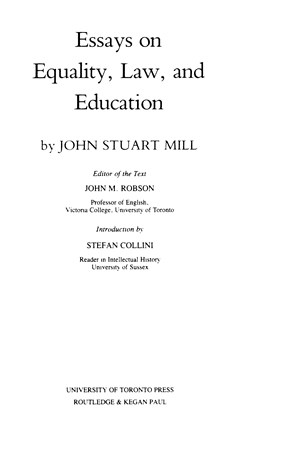
Textual Introduction - John Stuart Mill, The Collected Works of John Stuart Mill, Volume XXI - Essays on Equality, Law, and Education [1825]Edition used:The Collected Works of John Stuart Mill, Volume XXI - Essays on Equality, Law, and Education, ed. John M. Robson, Introduction by Stefan Collini (Toronto: University of Toronto Press, London: Routledge and Kegan Paul, 1984).
Part of: Collected Works of John Stuart Mill, in 33 vols.About Liberty Fund:Liberty Fund, Inc. is a private, educational foundation established to encourage the study of the ideal of a society of free and responsible individuals. Copyright information:The online edition of the Collected Works is published under licence from the copyright holder, The University of Toronto Press. ©2006 The University of Toronto Press. All rights reserved. No part of this material may be reproduced in any form or medium without the permission of The University of Toronto Press. Fair use statement:This material is put online to further the educational goals of Liberty Fund, Inc. Unless otherwise stated in the Copyright Information section above, this material may be used freely for educational and academic purposes. It may not be used in any way for profit.
Textual Introductionequality, as Stefan Collini asserts in the Introduction above, is the dominant theme in this volume. Perhaps because the word does not appear in the title of any of Mill’s great essays, its importance in his thought and life is not often emphasized. The materials now gathered, which demonstrate its significance in his thought on education and law as well as on sexual, racial, and domestic issues, derive from each of the decades of his writing career, that is, from the 1820s to the 1870s.1 They also cover a wide range in provenance.2 The majority, eleven of the eighteen in the text proper, originated as reviews or essays in periodicals, three in each of the Westminster Review and Fraser’s Magazine, two in the Monthly Repository, and one in each of Tait’s Edinburgh Magazine, the Edinburgh Review, and the Fortnightly Review. Of these eleven, three were reprinted during Mill’s lifetime in the British edition of Dissertations and Discussions, one (“Treaty Obligations”) was republished in the posthumous fourth volume, and one (“The Slave Power”) in the U.S. editions of that collection. Two of the items, the Inaugural Address at St. Andrews (originally a speech) and The Subjection of Women, appeared as books; and one, Remarks on Mr. Fitzroy’s Bill, as a pamphlet. Parliamentary evidence, in written form and as a transcription of oral answers (republished in pamphlet form), supplies two further items. And two more not published by Mill are presented from manuscript. The appendices given to ancillary textual matter include essays and fragments by Harriet Taylor Mill, only one of which was published in her lifetime (in the Westminster), a manuscript fragment of the Inaugural Address, and three publications of the Jamaica Committee under Mill’s chairmanship. These disparities make it convenient to discuss textual matters not according to dominant focus3 or provenance, but chronologically, beginning with “Law of Libel and Liberty of the Press” (April, 1825). Nothing specific is known of Mill’s relevant activities at this time, though he was in 1825 immersed in the massive task of editing Jeremy Bentham’s Rationale of Judicial Evidence (published in 1827). The essay, remarkable as the work of a youth still in his eighteenth year, reveals some Benthamic echoes (for example, the reference to judge-made law on 20), as well as much material from Francis Place, whose pamphlet on libel Mill is reviewing along with Richard Mence’s The Law of Libel. It will be noted that Place’s pamphlet was published in 1823 (in fact its separate essays first appeared at the end of 1822); and Mill had already reviewed it favourably in the Morning Chronicle on 1 January, 1824, 2, more than a year before the article here reprinted. Quite apparent is Mill’s heavy dependence on his father, James Mill, whose arguments in “Liberty of the Press” and whose habits of thought and phrasing reverberate throughout the essay. “We have no higher ambition,” anonymously and collectively says the young Mill, “than that of treading in [James Mill’s] steps [in “Liberty of the Press”], and, taking his principles as our guide, we shall endeavour to unravel the sophistry, and expose the mischievous designs of the enemies to free discussion.”4 This article, Mill’s fifth for the Westminster since its founding at the beginning of 1824, was the first of his to be given pride of place in the Radical review. The wide gap in approach and style between that essay and the manuscript we have entitled. “On Marriage” is explained by Mill’s internal declaration of independence after his “mental crisis” and his meeting Harriet Hardy Taylor who, twenty years later, was to marry him. This essay, with her companion piece (printed here as Appendix A), examines in a highly personal tone questions that had the greatest practical import for their relations.5 It is therefore very annoying not to be able precisely to date the manuscripts. The evidence is slight: the watermarks, some of Mill’s letters, although none mentions the essays, and the reference in Mill’s essay to Robert Owen’s definitions of chastity and prostitution. The watermarks, 1831 and 1832,6 led Professor Hayek to postulate a date of 1832, which presents no obvious difficulty when placed in the context of our general knowledge of their developing relations. Helen, the last of the Taylors’ three children, was born in July, 1831; Harriet Taylor’s attitudes towards marriage were consistently—and sensibly—coloured by her sense of responsibility to her children, and the views expressed in her and in Mill’s essays suggest a prior and protracted discussion of the effect of frequent births on a young and inexperienced mother. By 1832 they clearly had reached emotional intimacy, if the earliest of Mill’s surviving letters to her is correctly dated to August of that year.7 Another likely occasional cause for the essays appears in the marital disruption in the household of W.J. Fox, their friend, whose wife began to live separately from him though in the same house, her place being taken by his ward, Eliza Flower, Harriet Taylor’s closest and most admired companion. Again, the essays may well have preceded the six-month trial separation between Harriet and John Taylor beginning in September, 1833, when she went to Paris, to be joined there by Mill in October.8 The citation of Robert Owen’s definitions of chastity and prostitution proves less helpful in dating the essay than one would hope. The Owenite attitude to marriage had been known in the 1820s, particularly in the United States, where an account of one of Owen’s speeches in 1827 concludes with mention of his promptly complying with a request for his opinions on marriage which, having “before been promulgated in various ways, it is not thought necessary here to recapitulate.”9 But where and when would Mill have heard or read the definitions? He had, of course, debated with Owen’s adherents in 1825, and his father had known Owen for many years, but it is not known whether or not marriage was a moot issue in the debates and conversations. The closest wording to that appearing in Mill’s footnote is in the published account of an unbelievably long debate between Owen and Alexander Campbell in Cincinnati from 13 to 21 April, 1829, in which Owen is reported as saying: “For real chastity consists, in connexion with affection, and prostitution, in connexion without affection.”10 It is hard to believe that Mill (or anyone) read the two thick volumes of that account, which cannot have had much of a sale in Britain. The first of Owen’s statements in Britain that approximates Mill’s wording was not made until 1 May, 1833, in London:11 Mill is likely to have heard of it—and could even have heard it—and if this was his first acquaintance with Owen’s precise views, the manuscript must be dated as late at least as May, 1833, not by any means an impossible date, but one that would slightly revise the received view of the rate at which his intimacy with Harriet Taylor had developed. The exchange of statements between them at that time would, in fact, help explain the crisis in their affairs that led to the flight to Paris in September, 1833. It could even be argued that Mill’s reference (39) to Thomas Carlyle simply by his last name implies a closeness of acquaintance on his part not reached until 1833. But this evidence is very tenuous, and it seems wise, unless and until further evidence emerges, to assign only a tentative “1832-33?” to the essays. About the date of the next item, “Austin’s Lectures on Jurisprudence,” there is no such mystery: Mill had finished and sent off the review by 13 September, 1832,12 and it appeared in Tait’s Edinburgh Magazine for December of that year. A devoted friend of John and Sarah Austin at this time, Mill had read law while staying with them at Norwich a decade earlier, attended in 1829 the lectures he is here reviewing, advised John Austin (through Sarah) about the lectures in 1830, was now addressing Mrs. Austin as “My Dear Mütterlein,” and toured part of Cornwall with them in the interval between the writing and publishing of the review. It is not, however, mere puffery or “doctrinal matter”,13 nor was it composed because Mill was unoccupied. Indeed in five or six weeks he also wrote two other important—and very different—essays, “Corporation and Church Property” and “On Genius.”14 The same personal connection lies behind Mill’s “Reform in Education,” a review of Sarah Austin’s translation of Victor Cousin’s Report on the State of Public Instruction in Prussia. The personal note is muted, sounding only innocently in the recommendation that her preface to the translation “well deserves to be separately printed and widely circulated,” because it shows “force and conclusiveness,” and a “happy union . . . of an earnest spirit and a conciliatory and engaging tone” (64). Probably Mill got from Sarah Austin other information used in the review; in any case the first generation of Philosophic Radicals had engaged both theoretically and practically in the controversies over Lancasterian and National Schools that occupy much space in Mill’s review, especially in the long quotations from Biber. Mill also quotes from his own “Corporation and Church Property,” modifying the wording slightly as indicated in the variant notes:15 one merits mention here. Everywhere and always, Mill says in the original essay, and in its reprint in Dissertations and Discussions, “enlightened individuals and enlightened governments should . . . bestir themselves to provide (though by no means forcibly to impose) that good and wholesome food for the wants of the mind” that “the mere trading market” does not supply (65-6). As quoted in his review of Sarah Austin, the passage lacks the parenthesis, and it may be that at this particular time (though only a year had passed since the first version in “Corporation and Church Property”) Mill had entered one of his fiercer moods, and was less reluctant to restrain benevolent leaders. The next two items, short reviews separated in time by seven years, reflect Mill’s continued interest in legal questions, especially those having to do with reform. “On Punishment” (1834) gives some hints of attitudes seen in newspaper articles of the 1850s by Harriet and John Mill, in Remarks on Mr. Fitzroy’s Bill, and in his later comments on justifications for corporal and capital punishment. It is the earliest of the pieces in this volume to have textual corrections based on Mill’s emendations in his own copy in the Somerville College Library, all such corrections are described in the headnotes. The second of these short reviews, “Smith on Law Reform” (1841), was written when Mill, though busy finishing his System of Logic for the press, felt obliged to help work off a debt to William Hickson, who had taken over the Westminster Review from him in the preceding year. It presents no textual problems. While there is another gap of nine years between that review and the next essay. “The Negro Question” (1850), one should not infer that Mill lacked interest in issues of equality, law, or education during the 1840s, which was one of his greatest decades as an author.16 Indeed, “The Negro Question,” occasioned by Carlyle’s “Occasional Discourse on the Negro Question,”17 was Mill’s second public disagreement on questions of justice and equality with his earlier intimate, for he had responded, in “England and Ireland” (Examiner, 13 May, 1848), to an article by Carlyle advocating forceful subjugation of the Irish anarchy. From this time, justice between blacks and whites became a leading theme in Mill’s writings, as the later essays in this volume clearly indicate. The attack on Carlyle was reprinted in the Daily News, with three substantive and several accidental variants; the substantive changes are given here in notes although there is no reason to think the reprinted text was supervised by Mill.18 The next item is Mill’s formal moral renunciation of the legal powers that would result from his impending marriage to Harriet Taylor, written on 6 March, prior to their wedding on 21 April, 1851.19 The text is taken from the facsimile reproduced in Hugh S.R. Elliot’s edition of Mill’s letters;20 the present location of the manuscript is unknown. It is not surprising that chronologically the preceding items in the present volume are Harriet Taylor’s fragments (here printed in Appendix B), and the succeeding ones are her “Enfranchisement of Women” (Appendix C) and the pamphlet Remarks on Mr. Fitzroy’s Bill, in all of which the abuse of power in sexual and familial relations is central. The last of these, the pamphlet, prompted by the introduction in Parliament on 10 March, 1853, of a bill to improve the protection of women and children from assaults, was jointly written by the two Mills.21 At this time Mill was publishing little, though he was beginning, with his wife, to draft what was finally published as his Autobiography, and to sketch out other important essays, including On Liberty and Utilitarianism.22 In the year after his wife’s death in 1858 came a great burst of books and articles, many of the latter on political issues, such as “A Few Words on Non-Intervention” (Fraser’s Magazine, December, 1859), the first of the items in this volume to have been reprinted in full by Mill himself. It is also the first to be explicitly mentioned in the Autobiography, where Mill explains his being prompted to write it by a desire to defend England against imputations of habitual selfishness in foreign affairs, and to account for the colour given to such imputations by the “low tone” of governmental pronouncements and behaviour (especially Palmerston’s).23 This retrospective account is borne out by a letter of 14 November, 1859, to Alexander Bain, in which he also says he has just sent the article from Avignon to J.W. Parker for December publication in Fraser’s.24 He had the article offprinted (without revision), hoping it would have quick public effect, and was pleased with the response.25 The reprint in Dissertations and Discussions reveals very few changes;26 in this respect it is typical of Mill’s essays revised between 1859 and 1867 for Volume III of Dissertations and Discussions (which then first appeared, along with the 2nd edition of Volumes I and II). “The Contest in America” (Fraser’s, February, 1862) was also reprinted in Volume III of Dissertations and Discussions. That reprinting suggests the importance Mill attached to this (and of course the preceding) essay, though a glance at the contents of Volume III shows that one criterion he had established in his Preface to the first two volumes in 1859 was somewhat loosely interpreted; he had excluded papers dominated by comments “on passing events.”27 Because his more enduring attitudes are also expressed, no question would be raised were it not that the companion essay (also 1862), “The Slave Power,” which moreover was a review of a work by his great friend John Elliot Cairnes, was not reprinted in the British version of Dissertations and Discussions. In any case, Mill thought “The Contest in America” had been timely and influential. He had withheld public comment on the American war because of the Trent incident, feelings over it having abated, he wrote the essay quickly in mid-January while in Avignon.28 Writing to William T. Thornton before the essay appeared in the February number of Fraser’s, Mill said his views, if noticed at all, would probably be much attacked, as opposed to the “tone of the press & of English opinion, a tone which,” he remarks, “has caused me more disgust than anything has done for a long time.”29 Reports of the article’s reception cheered him,30 and his retrospective view in the Autobiography is self-congratulatory or—more accurately—congratulatory of Helen Taylor: I shall always feel grateful to my daughter that her urgency prevailed on me to write it when I did: for we were then on the point of setting out for a journey of some months in Greece and Turkey, and but for her, I should have deferred writing till our return. Written and published when it was, the paper helped to encourage those Liberals who had felt overborne by the tide of illiberal opinion, and to form in favour of the good cause a nucleus of opinion which increased gradually, and after the success of the North began to seem probable, rapidly. When we returned from our journey I wrote a second article, a review of Professor Cairnes’ book published in the Westminster Review. England is paying the penalty, in many uncomfortable ways, of the durable resentment which her ruling classes stirred up in the United States by their ostentatious wishes for the ruin of America as a nation; they have reason to be thankful that a few, if only a few known writers and speakers, standing firmly by the Americans in the time of their greatest difficulty, effected a partial diversion of these bitter feelings, and made Great Britain not altogether odious to the Americans.31 The essay was offprinted in a textually unchanged version,32 and published as a pamphlet in Boston (Little, Brown, 1862) that went through two printings within a year. Of the changes between the versions in Fraser’s and in Dissertations and Discussions only one is important, the addition of a long footnote at 133, consisting mostly of quotation from a letter from Wendell Phillips correcting Mill’s statements about the Abolitionists. Of the minor alterations, perhaps the most interesting (as typical of Mill’s search for the accurate word) is his describing Henry Carey as a “high authority” in 1862 and an “unimpeachable” one in 1867 (132e-e). The review of Cairnes’ The Slave Power, as suggested above, is closely related to “The Contest in America” in time as well as theme; it appeared, however, in the Westminster rather than Fraser’s, was not offprinted by Mill, and was excluded from the British Dissertations and Discussions. Like “The Contest in America” it was published as a pamphlet in the United States, and was included in American editions of Dissertations and Discussions. There is no indication that these versions were supervised by Mill, so our copy-text is the original and only British version; but substantive variants in the American versions, all minor, are given in notes.33 The epistolary record will make twentieth-century authors again sorrowful that technological progress has made haste rather less than slowly. While travelling with his stepdaughter after completing “The Contest in America,” Mill offered to review Cairnes for the Westminster. John Chapman, its editor, having accepted, Mill—now back in Avignon—promised on 31 August, 1862, to have it to Chapman by 20 September at the latest, as it was important to call attention to Cairnes’ book as soon as possible.34 He actually sent the review from Avignon on 11 September, asking for proof or, if there was not time, to have “some careful person . . . collate the proof with the manuscript.” But there was time, and thirteen days later, after two postal journeys between Avignon and London, setting, and proof-correction, the last page of proof was returned to Chapman.35 The intimacy that obtained between Mill and the Austins in the 1820s and ’30s did not survive political and personal differences in the late ’40s; indeed, when John Austin died late in 1859, Mill acknowledged his debt to him in a note to their granddaughter, Janet Duff-Gordon, without even mentioning Sarah.36 He brought himself, however, shortly thereafter, to recommend to her that all of her husband’s lectures be published, revised only to remove the repetitions; when the 2nd edition of the Province appeared in 1861, Mill actually defended those repetitions as necessary in lectures to students, against the criticism of James Fitzjames Stephen in the Edinburgh.37 In assembling her husband’s manuscripts, Sarah Austin found some gaps in the lectures; Mill, hearing of the problem, wrote to Henry Reeve, her nephew, offering his notes taken thirty years earlier, “to supply, in however imperfect a manner, the hiatus.”38 This typical meticulousness led to the restoration of important parts of the text, particularly much of Lecture 39 and all of Lecture 40, when, six years later, Robert Campbell prepared a so-called 3rd edition of the Lectures on Jurisprudence.39 To avoid confusion about the status of the edition Mill reviewed in October, 1863, a few words about the publishing history of Austin’s lectures are needed. The edition he reviewed is known as the 2nd, and Campbell’s is known as the 3rd, but those identifications are not exactly right: the 2nd edition of the Province, published in 1861, was also designated as Volume I of the three-volume edition of the Lectures in 1863 (the version Mill reviewed, though the original heading of his article refers to them as separate works, and in his notes he cites Volumes II and III as Volumes I and II). That is, Volumes II and III of the Lectures on Jurisprudence first appeared, and that title was first used, in 1863, so the edition of 1869 was really the 2nd, not the 3rd, edition of the Lectures, though (counting the 1861 and 1863 issues as one edition) it was the 3rd of the Province (though that title was not separately used in 1869). The matter is even further complicated by the issuance in 1863 as a separate publication of On the Uses of Jurisprudence “from the Third Volume of ‘Lectures on Jurisprudence”’, in the heading of Mill’s article it is so identified, although, as mentioned above, the Lectures are said in that heading to consist of only two volumes. Mill’s interest having been both stimulated and revealed to Austin and Reeve, it is not surprising that he reviewed the volumes, thus giving himself, as he says in the Autobiography, “an opportunity of paying a deserved tribute” to Austin’s memory, and also of “expressing some thoughts on a subject on which, in my old days of Benthamism, I had bestowed much study.”40 Correspondence concerning the review itself has not survived, except in a letter to Henry Samuel Chapman of 5 October, 1863, which mentions that it is about to appear in the Edinburgh.41 By that time Mill was occupied with the first draft of his Examination of Sir William Hamilton’s Philosophy (completed by November), and was thinking of the form his judgments of Auguste Comte should take, and so, given the detail and length of the article, it is likely that he worked on it early in the year.42 The close attention to the subject matter did not preclude the kind of personal touch that heightens the sense of mastery, as in the indications that he heard the lectures (179, 204), and had knowledge of the manuscripts (192). There is also an echo (though the terms of the metaphor have altered) of his earlier assessments of Bentham, who is here portrayed as employing a “battering ram” rather than a “builder’s trowel” (168). And there is another reflection that Mill himself may not have been conscious of, and that his contemporaries certainly could not have seen, in saying that Austin “has been in nothing more useful than in forming the minds by which he is, and will hereafter be, judged” (167). Mill comes very close to the views expressed by his wife and himself about their role as guides for the future.43 Like other articles of this period, the review of Austin was little revised for republication. It was offprinted without alterations, and only five minor changes (including two reflecting the difference in provenance and two corrections of misprints) were made for Dissertations and Discussions. There are rather more accidental changes than usual, probably because the Edinburgh’s preferred spellings (“s” rather than “z” in participles and hyphens inserted in some compound words) and punctuation (especially lighter use of commas) differed more from Longman’s (and Mill’s) style than did that of the other journals printing his essays at the time. The next few years brought Mill to the height of his public acclaim as new books and editions poured forth and his election as M. P. for Westminster highlighted his ideas and public character. One inevitable result was a great increase in requests for opinions and appearances, his occasional compliance with which is witnessed in the next two items in this volume, his evidence to the Taunton Schools Inquiry Commission and his Inaugural Address at St. Andrews Anticipating a request for his opinion on educational endowments, he wrote on 21 May, 1866, to his lifelong friend Edwin Chadwick for information and advice; Chadwick, ever willing, complied, and some time in the next two months, busy as Mill was with political affairs (the great Hyde Park Reform agitation occurred in July, when he also assumed the Chair of the Jamaica Committee), he sent a draft of his paper to Chadwick for comment. He requested its return on 5 August, and, having made “various alterations and insertions” to comply with those comments, sent his answers to the Commission on 9 August, at the same time conveying his thanks to Chadwick.44 The text, taken from Parliamentary Papers, has been altered slightly to conform to that used in this edition for all of Mill’s interrogations and evidence for parliamentary committees and royal commissions: the most significant typographical feature is the placing of the questions in italic type to contrast with the roman of Mill’s answers. The other item directly related to Mill’s public stature is his Inaugural Address delivered to the University of St. Andrews on 1 February, 1867, and quickly published in an edition of 1000 copies, a 2nd edition of 500 being called for in the same month, and a cheap People’s Edition of 2000 copies in March, with another issue of 1000 in June. The students, in electing Mill Rector, were obviously partaking in a widespread expectation of sagacity from him, and seeking to honour him, rather than to have him serve them in very material ways.45 The general rather than local aims—though the praise of Scottish universities and the concluding references to theological studies show his attention to pathos and ethos46 —are clear in the few sentences he gives to the Address in his Autobiography: In this Discourse I gave expression to many thoughts and opinions which had been accumulating in me through life respecting the various studies which belong to a liberal education, their uses and influences, and the mode in which they should be pursued to render those influences most beneficial. The position I took up, vindicating the high educational value alike of the old classic and the new scientific studies, on even stronger grounds than are urged by most of their advocates and insisting that it is only the stupid inefficiency of the usual teaching which makes those studies be regarded as competitors instead of allies, was, I think, calculated, not only to aid and stimulate the improvement which has happily commenced in the national institutions for higher education, but to diffuse juster ideas than we often find even in highly educated men on the conditions of the highest mental cultivation.47 This account suggests both the time and the care he spent in preparing the Address (probably in Avignon, where he spent much of the inter-parliamentary recess), however, he gave little time to St. Andrews, arriving only on 31 January, and leaving again on 2 February for two speaking engagements in Manchester before returning to London on the 5th. (This flurry of activity outside London was quite untypical; Mill delivered public speeches rarely, even during his parliamentary career, and almost always in London.) He undoubtedly had a printed version in mind from the beginning, though perhaps he thought a three-hour speech was fitting to the occasion. The full transcription of his speech in those capacious repositories, the contemporary newspapers, as well as the quick publication in book form, gave publicity to his ideas, and the response to them was generally favourable, though, as Stefan Collini points out (liii-liv above), there was criticism of his support for classical studies. The Address was widely read in the United States (it appeared in Littell’s Living Age, in book form, and in the U.S. editions of Dissertations and Discussions); it was, like almost all his works, quickly translated into German, and, unusually, into Hungarian. The printed text is uncomplicated, with but one variant, probably from the compositor’s misreading of “lines” for “times.” A portion of what would appear to be a first draft exists, which differs in a multitude of details from the printed version; the differences are so numerous that attention to them might divert the reader from the main argument, and so they are given in Appendix D, as variant notes to the fragment in its draft version. The Inaugural Address provides a broad and relatively objective survey of many of Mill’s concerns, public and private, the second book in this volume, The Subjection of Women, gives his fullest argument for the most passionately felt of these, sexual equality. The book’s antecedents may be inferred in part from other items here included: the companion essays on marriage, the fragments printed in Appendix B, and Harriet Mill’s “Enfranchisement of Women” (Appendix C). Mill so determinedly and correctly asserted that his attitude to sexual equality preceded her teaching of him that his main statement deserves quotation in full: The steps in my mental growth for which I was indebted to her were far from being those which a person wholly uninformed on the subject would probably suspect. It might be supposed, for instance, that my strong convictions on the complete equality in all legal, political, social and domestic relations, which ought to exist between men and women, may have been adopted or learnt from her. This was so far from being the fact, that those convictions were among the earliest results of the application of my mind to political subjects, and the strength with which I held them was, as I believe, more than anything else, the originating cause of the interest she felt in me. What is true is, that until I knew her, the opinion was, in my mind, little more than an abstract principle. I saw no more reason why women should be held in legal subjection to other people, than why men should. I was certain that their interests required fully as much protection as those of men, and were quite as little likely to obtain it without an equal voice in making the laws by which they are to be bound. But that perception of the vast practical bearings of women’s disabilities which found expression in the book on The Subjection of Women, was acquired mainly through her teaching. But for her rare knowledge of human nature and comprehension of moral and social influences, though I should doubtless have held my present opinions I should have had a very insufficient perception of the mode in which the consequences of the inferior position of women intertwine themselves with all the evils of existing society and with all the difficulties of human improvement. I am indeed painfully conscious how much of her best thoughts on the subject I have failed to reproduce, and how greatly that little treatise falls short of what would have been given to the world if she had put on paper her entire mind on this question, or had lived to revise and improve, as she certainly would have done, my imperfect statement of the case.48 It seems likely, though not provable, that the priority of publication of her “Enfranchisement of Women” in 1851 inhibited the preparation of a fuller work by them together or by him alone. When, three years later, they were planning their life’s work, their list of subjects only hints at aspects of the question.49 “Differences of character,” including those arising from sex, “Love,” “Education of tastes,” “Family & Conventional,” all bear some relation to the themes of The Subjection of Women, but none is specially close except the first (which clearly suggests the “Ethology” that Mill never wrote) and the last two (which, especially the final one, are touched on in Harriet Taylor’s manuscript fragments). A month later, in March, 1854, however, when they agreed not to accept John Chapman’s request to reprint the “Enfranchisement,” a work more specifically like The Subjection of Women is implied. “I think that to refuse was best, on the whole,” Mill writes to his wife, “for I should not like any more than you that that paper should be supposed to be the best we could do, or the real expression of our mind on the subject. . . . I only wish the better thing we have promised to write were already written instead of being in prospect.”50 It remained in prospect, however, until 1860, when Mill felt ready to put down his own thoughts at length. Writing to Henry Fawcett on 24 December, he remarked that he had finished two works (Considerations on Representative Government and Utilitarianism), and had “made good progress with a third,” that is, The Subjection of Women.51 It was, like most of his other works, including the other two just mentioned, not occasional, and his explanation in the Autobiography of its genesis and delayed publication is plausible if not fully conclusive: It was written at my daughter’s suggestion that there might, in any event, be in existence a written exposition of my opinions on that great question, as full and conclusive as I could make it. The intention was to keep this among other unpublished papers, improving it from time to time if I was able, and to publish it at the time when it should seem likely to be most useful. As ultimately published it was enriched with some important ideas of my daughter’s, and passages of her writing. But in what was of my own composition, all that is most striking and profound belongs to my wife; coming from the fund of thought which had been made common to us both, by our innumerable conversations and discussions on a topic which filled so large a place in our minds.52 At any rate, when he decided to publish the book in 1869, after his help in founding and promoting the Women’s Suffrage Society and his advocacy of the cause in the House of Commons, he seems to have chosen his time well. Three British editions, each of 1500 copies, appeared in May, June, and October, 1869, and two in the United States in that year; and it was translated almost immediately into French, Danish, German, Italian, Polish, and Russian.53 Even a casual glance through Mill’s correspondence for 1869 and 1870 will show just how much interest and admiration The Subjection of Women earned; indeed, on the surviving evidence, no other of his works drew so much immediate correspondence. (The comparison is of course skewed because both his public position and his circle of acquaintance were greater in 1869 than when his earlier works appeared.) As well as enthusiastic supporters, and such vituperative opponents as J.F. Stephen, there were some allies who thought Mill’s message was untimely if not excessive; Bain was one, and Mill’s reply to him strongly asserts the ripeness of the time. Mill’s impassioned plea, too long for full quotation here, deserves to be read, but Bain’s subdued summary gives the sense: Without entering into an argument with him on his equality view, I expressed my doubts as to the expediency of putting this more strongly than people generally would be willing to accept, inasmuch as the equality of rights did not presuppose absolute equality of faculties. He replied with much warmth, contending that the day of a temporizing policy was past, that it was necessary to show, not simply that the removal of restrictions would leave things as they are, but that many women are really capable of taking advantage of the higher openings. And further, he urged, it was necessary to stimulate the aspirations of women themselves, so as to obtain proofs from experience as to what they could do.54 The rapid exhaustion of the first two editions meant that Mill had little time to reconsider, and so it is not surprising that the only textual change is the correction in the 2nd edition of a misprint (“progressive” for “progressive” at 276.16), or that one evident error remained in all editions (“she” at 324.20, corrected in this edition to “he”). Like On Liberty and Utilitarianism, The Subjection of Women has few even implicit references; unlike them, and in this respect unique among Mill’s books, for no evident reason it lacks chapter titles. The campaign for women’s rights occupied much of Mill’s time and energy for the remainder of his life, sharing primacy with the movement for reform of land tenure, but he, deeply concerned like many others over the European situation, did not ignore international relations. “Treaty Obligations,” published over his name in the Fortnightly Review in December, 1870, shows his concern, as do the associated letters he wrote to The Times. They were, indeed, written at the same time, for the letters appeared on 19 and 24 November, and Mill returned the proofs of “Treaty Obligations” on the 28th.55 In her continuation of Mill’s Autobiography, Helen Taylor refers to the publication of the article, and says. he also wrote two letters to the Times in the month of November 1870 on the same topic. They were called forth by a cry, that arose at that time in a portion of the English press, for plunging England into a war with Russia. They were the first protest that appeared in any well known name against such a war, they called forth others and helped to calm down the warlike excitement that was being aroused.56 Again the text provides no problems, the article was not republished in Mill’s lifetime, and the posthumous version in Volume IV of Dissertations and Discussions (1875), edited by Helen Taylor, shows a corrected typographical error (a comma was removed), one minor substantive (“which” changed to “that”, a change purists wish had been more often made in Mill’s works), and one altered spelling (“s” to “z” in “demoralizing”). The final item in the main text is Mill’s evidence, given on 13 May, 1871, before the Royal Commission on the Contagious Diseases Acts of 1866 and 1869. Busy as ever, he was engaged—aided, abetted, and led by Helen Taylor—in controversy over leadership of the women’s suffrage movement,57 and active in the Land Tenure Reform Association, having written its Explanatory Statement in March, and making a speech for it on 15 May. He also published “Maine on Village Communities” in that month, and was understandably fussed over getting rid of his Blackheath house, where he had lived since his marriage, preparatory to moving to his last London home in apartments in Victoria Street. He must have had little time to consider the details of the administration and operation of the Contagious Diseases Acts, of which he certainly had no personal knowledge, and so his answers, firm and persistent, draw, as Stefan Collini argues, on principle and reason, not facts and induction. The text presents problems that are disguised in other cases where Mill’s oral evidence is included in this edition, because here there are two versions, one in Parliamentary Papers and one in a pamphlet issued by the National Association for the Repeal of the Contagious Diseases Acts that says on its title page, quite wrongly, “Reprinted Verbatim from the Blue Book.” Under normal circumstances, which there is no reason to believe did not obtain, the evidence in the Blue Books gives what the recorder took down, amended—not by the witness—merely to ensure sense. Nothing is known that would indicate Mill’s control over the pamphlet text, and neither version is in Mill’s library, and so one is left with two differing versions with competing authority. It appears, however, that the pamphlet was printed, if not verbatim, at least on the basis of the Blue Book, and not from some version amended by Mill or another.58 The later version has some evident corrections (“fail” for “fall” at 365.40, and “care” for “cure” at 366.47), and in general the pamphlet reflects some attention to clarity. We therefore have adopted it as copy-text, but have given the variant readings from Parliamentary Papers in notes,59 and accepted, where sense and consistency demanded, some accidentals from the earlier version. (The resisted urge to do more emendation was very strong, as will be realized by anyone who has seen supposedly verbatim reports of her or his lectures or conversation.) The format, as with all such verbal evidence, has been slightly modified to ease reading: questions are italicized, the “Q.” and “A.” that precede questions and answers in the pamphlet version are omitted, as are the numbers of the questions in the Blue Book version; and the full names of the commission members are given before the first question each asks. APPENDICESthe appended materials are of four kinds: (a) essays and fragments by Harriet Taylor, before and after her marriage to Mill, that are cognate to his writings on sexual equality, and in the writing of which he had an indirect or even a direct hand, (b) a draft fragment in his hand, (c) material that is not certainly of Mill’s own composition, though issued over his name with his authority, and (d) editorial materials. In the first group fall Appendices A, B, and C. The first of these is Harriet Taylor’s early essay,60 which we have entitled, like Mill’s companion piece, “On Marriage” (see above, lviii-lx).61 The evidence for dating, as indicated above, is slight. One related fragment is on paper watermarked 1831; the other, closer to our text, is like it on paper watermarked 1832.62 So we have contented ourselves with the rather hollow certainty that her essay is of the same unascertained but probable date as his, i.e., 1832-33. The essay is of interest biographically, and also as tending to support, if not confirm, his assertion about her role in giving him ideas that he developed. The most obvious one here is in the concluding sentence. “It is for you . . . to teach, such as may be taught, that the higher the kind of enjoyment, the greater the degree . . .”; this hint, coupled as it is with the notion of the lofty “poetic nature,” adumbrates a central issue in Mill’s ethics. Appendix B is made up of five items that we attribute jointly to Harriet Taylor and J.S. Mill. They are all in Mill’s hand, except the title of the first and some corrections on the first and fourth, which are in hers, but that title, “Rights of Women—and Especially with Regard to the Elective Franchise—By a Woman—Dedicated to Queen Victoria,” the character, tone, and syntax of the pieces, and our slight knowledge of their working habits, all suggest that Mill wrote them at her dictation and/or copied them from now lost drafts in her hand. They all, in subject and in argument, can be interpreted as preliminary to her “Enfranchisement of Women” (discussed below), especially as the paper that is watermarked is of 1847, but there is no reference to them in extant correspondence or memoirs. The first and most extensive is on paper of 1847.63 The editorial notes indicate where Taylor’s changes can be made out (she made alterations in pencil that Mill traced over in ink), and where the length of text on a side suggests piece-meal composition. The text of the second manuscript, entitled in Mill’s hand “Women—(Rights of),” is reconstructed from two now separate items in the Mill-Taylor Collection.64 No explanation has been found for the curious condition of this manuscript the first two sheets having been cut in half. Taylor pencilled a circled “A” at the end of the text on f. 1r and a circled “B” at the end of f. 2r of No. 2; she then, in the blank space at the bottom of 3v, wrote (all in faded pencil, except for the first twenty words of “B,” where the pencil has been inked over), following a circled “A” and “B,” the same words that Mill wrote in ink on 1r and 2r of No. 6—i.e., the parts of 1r and 2r of No. 2 that were cut off. Also, after the first word on No. 6, f. 1v (“extinction,”), which ends a paragraph, she has pencilled “Rights of women.” Whatever the explanation, there can be no doubt that the sequence of scraps is (as here published) No. 2, f. 1r; No. 6, f. 1r; No. 2, f. 1v; No. 6, f. 1v; No. 2, f. 2r; No. 6, f. 2v (because the slip is bound in backwards); No. 2, f. 2v; No. 6, f. 2r; No. 2, f. 3r; No. 2, f. 3v (top half). The third manuscript, headed rather ungrammatically in Mill’s hand “The Rights of Women to the Elective Franchise and Its Advantages,” is clearly an outline rather than a finished document or even a draft.65 The fourth manuscript, headed in Mill’s hand “Why Women Are Entitled to the Suffrage,”66 and the fifth unheaded manuscript67 are even more patently outlines. Although only preliminary workings, these are all informative, not least in their expressing radical feminist principles rather more openly than do “The Enfranchisement of Women” and The Subjection of Women. It may be noted incidentally that the title of the latter is adumbrated at the opening of the second paragraph of “Women—(Rights of).” Certainly the manuscripts indicate singly and collectively the extent to which questions of sexual equality were in the minds of Taylor and Mill in the late 1840s when, it seems fair to say, their effective authorial collaboration was really beginning, as Mill’s account in the Autobiography of her part in Principles of Political Economy and his dedication of that work to her assert so strongly.68 Appendix C, “The Enfranchisement of Women,” was the only published expression of their views on sexual equality during Harriet Taylor Mill’s lifetime. That the items included in Appendix B are related to its composition is suggested by Mill’s letter to her of 21 February, 1849, wherein he says that the best contribution to improved relations between women and men would be for her to finish her “pamphlet—or little book rather, for it should be that.” He adds: “I do hope you are going on with it—gone on with & finished & published it must be, & next season too.”69 That urgency was not complied with, but just over a year later, on 19 March, 1850, when writing to Hickson about the possibility of articles for the Westminster, Mill says that he may be moved to write on the whole question of the effect of laws and customs on the status of women.70 The occasion for completing the essay came in October, when the New York Tribune reported on the Women’s Rights Convention in Worcester, Massachusetts; here obviously was a chance to show advanced British opinion that the United States was leading the way. But the essay was not finished before 3 March, 1851, when Mill offered to send it to Hickson within a week for the April number of the Westminster.71 Indeed, it was not quite ready even then, for, learning that the April number was full, Mill delayed a little further, but finally sent it for the July number (expressing relief that it escaped association with the “despicable trash” printed in the April number).72 Hickson was at this time trying vainly to get Mill to reassume editorship of the review, but Mill, who had—after over twenty years of love—finally married Harriet Taylor on 21 April, seems not to have been seriously tempted.73 In an undated letter, probably of late May, Mill wrote again to Hickson, to say that he wished to keep the proof, which had just arrived, as long as was convenient, it being “necessary on such a subject to be as far as possible invulnerable.” “I have not,” he continues, “quite fixed on a heading. The best I have thought of is ‘Enfranchisement of Women.’ The one you propose with the word ‘sex’ in it would never do. That word is enough to vulgarize a whole review. It is almost as bad as ‘female.’ ”74 The touchiness here evident is much more pronounced in the next letter to Hickson on 9 June. I am surprised to see by the revise of my article that you have made two verbal alterations. I gave you the article on an understood consideration, the only one on which I ever write, that no alterations should be made by anyone but myself, & from this condition I cannot depart. I have returned the corrected revise to the printer. I should be obliged by your letting me have (if possible before the review is out) twenty-five separate copies, at my expense. I wish for no title page, but in place of it a page with only the words “Reprinted from the Westminster Review for July 1851.” I should like to see a proof of the reprint.75 It will have been noted that in the correspondence with Hickson Mill consistently refers to the article as his own, because Hickson was familiar with Mill’s handwriting, one may infer that the manuscript was in his hand (as are those in Appendix B). There is, therefore, on this evidence some uncertainty about authorship, and the essay has been attributed to Mill by some. As will be seen, however, most of the evidence lies in the other scale. Mill, it will be recalled, had urged Harriet Taylor to finish her “pamphlet” or “little book.” After its publication (and their marriage), he wrote to Anna Blackwell, on 16 August, 1851, noting that the article was anonymous, and declining her attribution of it to him.76 This is a quiet hint, but the next is more vehement, in a letter to his wife on 6 March, 1854, when reporting a letter from John Chapman proposing to reprint the article, which Chapman “vulgarly calls . . . the article on Woman,” Mill says, “How very vulgar all his notes are. I am glad however that it is your permission he asks.” He goes on to ask her what to do.77 She, as always, complied, and he reported to her on 20 March: I sent to Chapman the letter you drafted, exactly as it was, only choosing the phrases I preferred where you gave the choice of two. I think that to refuse was best, on the whole, for I should not like any more than you that that paper should be supposed to be the best we could do, or the real expression of our mind on the subject. This is not supposed of a mere review article written on a special occasion as that was, but would perhaps be so if the same thing were put out, years after, under our own auspices as a pamphlet. I only wish the better thing we have promised to write were already written instead of being in prospect. In any case the article will of course be in any collection or rather selection of articles which we may either publish in our life, or leave for publication afterwards, & whichever we do it shall be preceded by a preface which will shew that much of all my later articles, & all the best of that one, were, as they were, my Darling’s.78 On any assumption about authorship it is difficult to interpret the remark, “I should not like any more than you that that paper should be supposed to be the best we could do,” and the comment that “the best” of the “Enfranchisement” was hers leaves open the interpretation that the rest, the “worst,” was his. In the preface to the article when republished, he says more clearly that the essay is different from the “joint productions,” in that his share in it was “little more than that of an editor and amanuensis” (393). He also elaborates the excuse for the essay’s failure to do her mind justice, and says, in my view conclusively, that her authorship was known at the time. Indeed, in an angry letter to George Jacob Holyoake of 21 September, 1856, he is explicit on the subject: On returning a few days ago from the Continent I found your note inclosing the reprint of my wife’s article in the W.R. on the enfranchisement of women. I think you are not justified in reprinting it without asking the permission of the author which you could easily have done through me, still less with many errors in the reprint. I have marked the principal of them in the margin of the copy you sent. One particularly offensive is the excessive vulgarity of substituting “woman” for “Women”; this occurs in several places and in the first paragraph. One of the purposes of writing the article was to warn the American women to disunite their cause from the feeble sentimentality which exposes it to contempt & of which the stuff continually talked & written about “woman” may be taken as a symbol & test,—& it is therefore very disagreeable to the writer to see this piece of vulgarity prominent on the face of the article itself.79 And later, in 1865, in agreeing to the publication of his articles by his election committee, he says that if the “Enfranchisement” is reprinted, “it must be as my wife’s, not as mine”; and in thanking Moncure Conway for his report of the article’s value in the U.S.A., he comments on how much pleasure its author would have taken from the movement’s progress, “had she lived to see it.”80 Finally, in preparing for the reprinting of the essay as a pamphlet, with “by Mrs. Stuart Mill” on the cover, he describes it to Herbert Spencer as “Mrs Mill’s paper,” and after the publication refers to it in correspondence as hers.81 It is not fanciful, further, to see the delay in completing the article and the spiteful annoyance over details as not being characteristic of Mill in reference to writings unmistakably his own. One may safely conclude that the article is, on the common understanding of authorship, Harriet Taylor Mill’s; on her and her husband’s understanding, it is a “joint production”; but to accept that description here is surely to weaken the claim that she played a major role in those joint productions that appeared under his name. Attributing it to her, of course, again strengthens the case for her influence on Mill’s thought (see the Introduction, xxxii above, for resemblances). The transmission of text among the different versions seems clear the original article (or its textually identical offprint) served as base text for the 1st edition of Dissertations and Discussions, in which nine substantive changes were introduced. The 2nd edition of Dissertations and Discussions was based on the first, four substantive changes being made. None of these appears in the pamphlet of 1868, and only one of the nine introduced in 1859 is seen there, while the pamphlet differs from all other versions in twenty-two substantives. The inference that the version of 1868 was based on that of 1851 is borne out by a study of the accidental variants, where in punctuation those two agree as against Dissertations and Discussions in sixteen cases compared with one agreement between 1868 and Dissertations and Discussions as against 1851.82 No elaborate conclusions seem necessary or justified: it appears probable that Mill, having made the changes for the 1st edition of Dissertations and Discussions himself, thought little about the (typically) minor changes for the 2nd edition, but called on Helen Taylor’s collaboration in preparing the pamphlet, for which they used the most convenient base text, a copy of the offprint. The second kind of material in the appendices is found in Appendix D, the draft of part of the Inaugural Address, which has a quite different, and much slighter, interest, as giving one of the rare glimpses of Mill, late in life, revising a work thoroughly as to wording, but not finding it necessary to make structural or argumentative changes. Both economy and precision were well served in what must have been a rapid rewriting. This fragment was probably preserved merely by accident when many of the Mill-Taylor papers were destroyed in Avignon after Helen Taylor’s return to England in 1905; it found a place in a miscellaneous collection bought from the Avignon bookseller J. Roumanille by George Herbert Palmer, and eventually was deposited in the Houghton Library, Harvard University. Appendix E is of the third kind; it consists of three documents issued by the Jamaica Committee under Mill’s chairmanship, one dating from 1866, and two from 1868. Mill’s name appears first among the signatories of each, and he must have approved, even if he did not draft, the contents of each. His passionate involvement in the attempt of the Committee to bring Governor Eyre to trial, discussed in the Introduction (xxvi-xxviii), is fully illustrated in his parliamentary career, both in his speeches and actions and in attacks on and defences of him in Parliament and the press. The texts for the documents are based on different sources. The first, the extensive “Statement of the Jamaica Committee,” 27 July, 1866, is taken from Volume III of the series of Jamaica Papers issued from time to time by the Committee. It also appeared in the press. No official copy has been found of the second document, an address to friends of the Committee, dated October, 1866. Our text is taken from the Examiner of 13 October, where the format appears less altered by newspaper practice than that in the Daily News of 12 October. The third, the concluding statement by the Committee, dated 15 July, 1868, and indicating the winding up of its business, comes from a printed letter, two copies of which are in the Mill-Taylor Collection; no full version has been found in the press, which by then reflected the general public indifference or hostility to the Committee’s cause, though a summary of the statement is in the Daily Telegraph of 24 July. The final two appendices contain editorial materials. Appendix F lists the textual emendations, most of which are corrections of typographical errors. Appendix G, the Bibliographic Appendix, provides a guide to Mill’s references and quotations, with notes concerning the separate entries, and a list of substantive variants between his quotations and their sources. The items in this volume contain references to more than 150 publications (excluding Statutes and Parliamentary Papers and unidentified anonymous quotations, but including classical tags and references that occur in quotations from others). Mill quotes from over seventy of these, including the eight works he reviews. The most extensive quotation is, as one would expect, from the reviewed works; a large number of the shorter quotations (some of which are indirect) are undoubtedly taken from memory, with no explicit references being given, and the identification of some of these is inescapably inferential. Because Appendix G serves as an index to persons, writings, and statutes, references to them do not appear in the Index proper, which has been prepared by Dr. Jean O’Grady. TEXTUAL PRINCIPLES AND METHODSas throughout this edition, the copy-text for each item is that of the final version supervised by Mill.83 Details concerning revisions are given in the headnotes to each item and in the discussion above. Method of indicating variants. All the substantive variants are governed by the principles enunciated below; “substantive” here means all changes of text except spelling, hyphenation, punctuation, demonstrable typographical errors, and such printing-house concerns as type size, etc. The substantive variants are of three kinds: addition of a word or words, substitution of a word or words, deletion of a word or words. The following illustrative examples are drawn, except as indicated, from “The Contest in America.” Addition of a word or words: see 128a-a. In the text, the last word of the passage “A nation which has made the professions that England has made” appears as “amadea”, the variant note reads “a-a+67”. The plus sign indicates an addition in the edition signalled by the following numbers. The editions are always indicated by the last two numbers of the year of publication, here 67 indicates 1867 (the 2nd edition of Volumes I and II of Dissertations and Discussions). Information explaining the use of these abbreviations is given in each headnote, as required. Any added editorial comment is enclosed in square brackets and italicized. Placing this example in context, the interpretation is that when first published (1862) the reading was “A nation which has made the professions that England has”; this reading was retained in the offprint (also 1862); but in 1867 the reading of the concluding clause became “that England has made”. Substitution of a word or words: see 129d-d. In the text the passage “Now that the mind of England” appears as “Now dthatd the mind of England”, the variant note reads “d-d621,2 , when”. Here the word following the edition indicator is that for which “that” was substituted; applying the same rules and putting the variant in context, the interpretation is that when first published in 1862 (indicated by 621) the reading was “Now, when the mind of England”, this reading was retained in the offprint (indicated by 622): in 1867 it was altered to “Now that the mind of England”. Deletion of a word or words, see 141j and 65c-c. The first of these is typical, representing the most convenient way of indicating deletions in a later edition. In the text on 141 a single superscript j appears centred between “repudiation,” and “Unless”; the variant note reads “j621,2 Mississippi was the first state which repudiated, Mr. Jefferson Davis was Governor of Mississippi, and the Legislature of Mississippi had passed a Bill recognizing and providing for the debt, which Bill Mr. Jefferson Davis repudiated.” Here the sentence following the edition indicator was deleted. Applying the same rules and putting the variant in context, the interpretation is that when first published (1862) and offprinted (also 1862) the sentence appeared between “repudiation,” and “Unless”, in 1867 it was deleted. The second example (65c-c), illustrates the method used to cover more conveniently deletions when portions of the copy-text were later reprinted, as in the case of “Reform in Education,” in which Mill quotes from his own “Corporation and Church Property,” which was republished in Dissertations and Discussions, Volume I. (That is, there is here, exceptionally, a later version of part of the copy-text, whereas normally the copy-text is the latest version.) In the text the words “a particle worse than” appear as “ca particlec worse than”; the variant note reads “c-c-59.67”. The minus sign indicates that in the editions signified the words enclosed were deleted. Putting the example in context, the interpretation is that when first published (1834) the reading was (as is clear in the text) “a particle worse than”; this reading was altered in 1859 (the 1st edition of Dissertation and Discussions) to “worse than”; and the altered reading was retained in 1867. Dates of footnotes: see 133n. In this edition the practice is to place immediately after the footnote indicator, in square brackets, the figures indicating the edition in which Mill’s footnote first appeared. In the example cited, “[67]” signifies that the note was added in 1867. In the only other instance in this volume (at 420n) “[-67]” signifies that the footnote in the draft manuscript was removed for the printed version. Elsewhere, where no such indication appears, the note is in all versions. Punctuation and spelling. In general, changes between versions in punctuation and spelling are ignored. Those changes that occur as part of a substantive variant are included in that variant, and the superscript letters in the text are placed exactly with reference to punctuation. Changes between italic and roman type are treated as substantive variants except in titles of works, abbreviations, and in one case (“prima facie” at 275.33) a foreign phrase. One unusual old form (“began” rather than “begun” at 315.15) has been retained, as it persists through three editions. Other textual liberties. Some of the titles have been modified or supplied, but most are those found in the copy-texts “Law of Libel and Liberty of the Press” and “Austin’s Lectures on Jurisprudence” are taken from the running titles. The manuscripts, if not entitled, are given titles reflecting their contents, as are the short review “Smith on Law Reform” and the two extracts from Parliamentary Papers. The headnotes give information about original headings and titles (the running titles, when cited, are standardized in capitalization and font). The dates added to the titles are those of first publication or, for manuscripts, composition. When footnotes to the original titles of articles gave bibliographic information, these have been deleted, and the information given in the headnotes. The original headnote to “The Negro Question,” which was supplied by the editor of Fraser’s Magazine, is given as a footnote. Typographical errors have been silently corrected in the text, they are listed in Appendix F. Some of these, as well as some variants, are indicated by Mill in copies now in Somerville College, Oxford (signified by “SC” in our notes). In the headnotes, errors in the quotations from Mill’s bibliography, the manuscript of which is a scribal copy, are also silently corrected; the note below lists them.84 While the punctuation and spelling of each item are retained, the style has been made uniform: for example, periods are deleted after references to monarchs (for example, “Charles I.”), dashes are deleted when combined with other punctuation before a quotation or reference, and italic punctuation after italic passages has been made roman. For consistency, in a few places titles are given an initial capital, and at 270.10 an initial capital has been placed on “parliament”. In monarchs’ titles the sequential designations have been regularized to roman numerals (for example, “Francis the First” is given as “Francis I”). Indications of ellipsis have been normalized to three dots plus, when necessary, terminal punctuation. The positioning of footnote indicators has been normalized so that they always appear after adjacent punctuation marks; in some cases references have been moved from the beginning to the end of quotations for consistency. Where the copy-text is manuscript, the ampersand is given as “and”, in those in Appendix B contractions such as “wd” are expanded and superscripts lowered. Also, in accordance with modern practice, all long quotations have been reduced in type size and the quotation marks removed. In consequence, it has occasionally been necessary to add square brackets around Mill’s words in quotations; there is little opportunity for confusion, as there are no editorial insertions except page references. Double quotation marks replace single, and titles of works originally published separately are given in italics. At 198.3 and 245.26-7 quotation marks have been placed around “Vision” (i.e., Addison’s “Vision of Mirzah”) and “Hymn to Intellectual Beauty” by Shelley. Mill’s references to sources, and additional editorial references (in square brackets), have been normalized. When necessary his references have been corrected, a list of the corrections and alterations is given in the note below.85 As indicated above, the format of “The Contagious Diseases Acts” has been made compatible with that used elsewhere in this edition for Mill’s parliamentary evidence: the numbers of the questions have been deleted; the questioners’ names are given in full; and the questions are given in italic (this practice is also followed in “Educational Endowments,” where Mill’s evidence was given in writing rather than viva voce). [1 ]Of course, full appreciation of his thought on these matters requires reference to other volumes of the Collected Works, to cite only the most obvious cases, the parallels between The Subjection of Women and On Liberty will lead readers of this volume to Essays on Politics and Society, Vols. XVIII and XIX of the Collected Works, and the educational writings will suggest consultation of the Autobiography in Vol. I. [2 ]Bibliographic details are given in the Editor’s Note to each item. These include information about provenance (“not republished” means not republished by Mill), evidence for attribution and dating, listing of copies in Mill’s library. Somerville College, Oxford, and the entry in Mill’s bibliography of his published writings, which has been edited by Ney MacMinn. J.M. McCrimmon, and J.R. Hainds, Bibliography of the Published Writings of J.S. Mill (Evanston: Northwestern University Press, 1945), this edition being identified as “MacMinn.” [3 ]Eight of the items are directly related to equality of various kinds, seven to legal issues, and three to education; they of course differ greatly in length, so that, as is argued in the Introduction above, more than one-half of the volume concerns equality, with the remainder divided almost equally between law and education. [4 ]See 4. Other familiar phrases include. “It thus appears, by the closest ratiocination” (6), “a proposition which rests upon the broadest principles of human nature” (8), “that universal law of human nature” (11), “all history bears testimony” (13), “security for good government” and “see-saw” (18). [5 ]Friedrich A. Hayek, whose researches during the 1940s did much to bring Mill back into scholarly and public repute, published these essays in his valuable and readable John Stuart Mill and Harriet Taylor. Their Friendship and Subsequent Marriage (London: Routledge and Kegan Paul, 1951), from which their frequent reprinting and quotation unfortunately perpetuated the errors in transcription. [6 ]Mill’s essay (British Library of Political and Economic Science, Mill-Taylor Collection, Vol. XLI, No. 1) is on seven sheets of paper watermarked “E. Wise 1831” (probably East India Co. paper), folded once to make fourteen folios, c. 34.0 cm. × 21.1 cm., written recto and verso on the right-hand side of each folio, leaving the left side free for notes and revisions (as Mill commonly did in these years, for example in his “Notes on Some of the More Popular Dialogues of Plato,” reprinted in Essays on Philosophy and the Classics, CW, XI). Harriet Taylor’s companion essay (Mill-Taylor Collection, Box III, No. 79) is on two sheets of paper watermarked “J. Morbey & Co. 1832”, tolded once to make four folios, c. 19.8 cm. × 25.0 cm., written recto and verso on all sides. [7 ]EL, CW, XII, 114 Hayek’s inferred date of July, 1832, which is followed by Michael St. J. Packe in his Life of John Stuart Mill (London: Secker and Warburg, 1954), is rejected by Professor Mineka because of the reference to flowers gathered in the New Forest, where Mill had been on a walking tour from 19 July to 6 Aug. [8 ]See Mill to W.J. Fox, EL, CW, XII, 185-9 (5 or 6 Nov., 1833). [9 ]Address Delivered by Robert Owen, at a Public Meeting, Held at the Franklin Institute in the City of Philadelphia, on Monday Morning June 25, 1827 (Philadelphia: Gould, and Mortimer, 1827), 39. [10 ]Debate on the Evidences of Christianity, 2 vols. (Bethany, Va. Campbell, 1829), I, 120 (15 Apr., forenoon). [11 ]See “The Address of Robert Owen, at the Great Public Meeting, . . . on the 1st of May, 1833, Denouncing the Old System of the World, and Announcing the Commencement of the New,” The Crisis, II (11 May, 1833), 141. The passage is quoted in App. G. 472-3 below. [12 ]See Mill’s letters to Sarah Austin and to Thomas Carlyle, EL, CW, XII, 116 (13 Sept., 1832) and 117 (17 Sept., 1832). [13 ]Ibid., 117. [14 ]Printed respectively in CW, IV, 193-222, and CW, I, 327-39. [15 ]Most of the variants record changes made when “Corporation and Church Property” was revised for Dissertations and Discussions. [16 ]Of special relevance are his “Claims of Labour” (1845), his extended series of newspaper leading articles on Ireland (1846-47), and the 1st (1848) and 2nd (1849) eds. of his Principles of Political Economy. [17 ]Carlyle, totally contemptuous of Mill’s response, lengthened his diatribe and republished it with the title altered to “The Nigger Question.” [18 ]The change at 92b-b shows someone correcting a first-person singular non-emphatic “will” to “shall,” a solecism that my mentor A.S.P. Woodhouse, with quite unnecessary exaggeration, said no Englishman was ignorant enough to commit, and no Scot learned enough to avoid (he was implicating me, like Mill a second-generation Scot). [19 ]That Mill did not view the marriage with insouciance is shown even more in the letter he wrote to his wife fifteen months after their union in the Registry Office at Melcombe Regis, suggesting that because his signature in the register was irregular, they should be married again—in a church (LL, XIV, 96-7). [20 ]The Letters of John Stuart Mill, 2 vols. (London: Longmans, Green, 1910), the printed text in Elliot (I, 158-9), has in the concluding sentence one manifest error, “pretence” for “pretension”. [21 ]This echo of the title of Gertrude Himmelfarb’s book on Mill is somewhat ironical, but unavoidable Mill, in his bibliography of his published writings, says of this pamphlet. “In this I acted chiefly as amanuensis to my wife.” As we cannot apportion responsibility for parts of this work, we have included it, like other “joint productions” (to use Mill’s usual term)—which include the Principles and On Liberty—in the text proper rather than in an appendix. [22 ]He also made, with her help, very extensive revisions of the 3rd eds. of both A System of Logic, Ratiocinative and Inductive (1851) and the Principles (1852). For comment on the former, see John M. Robson, “‘Joint Authorship’ Again The Evidence in the Third Edition of Mill’s Logic,” Mill News Letter, VI (Spring, 1971), 15-20. [23 ]Autobiography, CW, I, 263-4. [24 ]LL, CW, XV, 646. Mill, still in Avignon, received the number through the post on 8 Dec. (ibid., 652). [25 ]Ibid., to Edwin Chadwick, 655 (20 Dec., 1859). [26 ]Normally spelling changes are not recorded in our variant notes, but here the change from “rivality” to “rivalry” is given, as calling attention to a different form, also used in a manuscript by Mill (114). [27 ]The Preface is reprinted as App. A, Essays on Ethics, Religion and Society, CW, X, see 493. [28 ]See letters to George Grote and Cairnes, LL, CW, XV, 764 (10 Jan., 1862) and 767 (20 Jan., 1862). [29 ]Ibid., 774 (28 Jan., 1862). Cf. the discussion in the Introduction, xxiii above. [30 ]In letters to Henry Fawcett, Cairnes, and Theodor Gomperz, ibid., 776 (6 Mar., 1862), 783 (15 June, 1862), and 809 (14 Dec., 1862). In the second of these he qualifies his apparently favourable judgment on Seward’s despatch “as a whole” in response to Cairnes’ dissatisfaction. [31 ]CW, I, 268. [32 ]One typographical error was introduced, another was not corrected, and the page numbers were changed. [33 ]One change in the pamphlet, from “round” to “around”, is not so recorded. The accidentals show undoubted intervention on the western side of the ocean for example, where Mill uses a quotation of Cairnes from Clay, both have “neighbours” for Clay’s “neighbors”—but the American versions delete the non-U.S. “u.” [34 ]LL, CW, XV, 788, 789. [35 ]Ibid., 792, 798. [36 ]Ibid., 658. [37 ]Ibid., 674 (10 Feb., 1860), and 757-8 (20 Dec., 1861). [38 ]Ibid., 822 (15 Jan., 1863), see also 823 (17 Jan., 1863), XVI, 1142-3 (30 Jan., 1866), and XVII, 1625 (26 July, 1869). [39 ]London Murray, 1869. There, in the “Advertisement to this Edition,” I, v-vi, and again in a note at II, 705, Campbell explains the part Mill’s notes played in his reconstruction of the text (Apart from Lectures 39 and 40, Lectures 3, 4, 5, 22, 28, and 29 were improved and or expanded). [40 ]Autobiography, CW, I, 268. [41 ]LL, CW, XV, 889. [42 ]He spent the first part of the year in London, going to Avignon for April and May, returning to London in June, and then again to Avignon from September until January, 1864. From April to June he was troubled by Theodore Gomperz’s unrequited infatuation with Helen Taylor. [43 ]See, for one of the less attractive statements, his letter to her of 29 Jan., 1854 (LL, CW, XIV, 141-2). [44 ]Ibid., XVI, 1168, 1172, 1187-8, 1190. [45 ]For details of his election and his performance of Rectorial duties, see Anna J. Mill: ‘The First Ornamental Rector at St. Andrews University,’ Scottish Historical Review, XLIII (1964), 131-44. [46 ]Cf. Bain, John Stuart Mill, 128. [47 ]CW, I, 287. Of the specific notions in the Address, several permit of fuller elucidation than they have received, in one place, for instance, he makes the point later fully elucidated by R. H. Tawney, saying that British character has been shaped since the Stuarts by two influences “commercial money-getting business, and religious Puritanism” (253). [48 ]Autobiography, CW, I, 253n. [49 ]The full list reads (in “confused order,” as Mill said). “Differences of character (nation, race, age, sex, temperament). Love Education of tastes Religion de l’Avenir Plato Slander Foundation of morals Utility of religion Socialism Liberty Doctrine that causation is will To these,” already agreed on, he continues, “I have now added from your letter Family, & Conventional” (LL, CW, XIV, 152 [7 Feb., 1854]). For comment on most of these see CW, X, cxxii-cxxiv. [50 ]LL, CW, XIV, 189-90 (20 Mar., 1854). [51 ]Ibid., XV, 716. [52 ]CW, I, 265, he habitually referred to his stepdaughter, Helen Taylor, as his daughter. Later in the Autobiography, in his one-paragraph concluding summary of his post-parliamentary career, he says. “I . . . have published The Subjection of Women, written some years before, with some additions by my daughter and myself. . . .” (ibid., 290). It cannot be superfluous, in the light of these disclaimers to point to some isolated passages that show his personal touch for example, the echo of Bentham’s tone and terminology in the reference to “the power of the scold, or the shrewish sanction” (289), the claim to personal knowledge of Indian government (303n), the comment, going back to discussions with his father, that “sensibility to the present, is the main quality on which the capacity for practice, as distinguished from theory, depends” (305), the typical notion that echoes the passage here being footnoted, that men verify and work out women’s original thoughts (316), and, perhaps strongest of all, the account of feelings on emerging from boyhood (337). [53 ]It is surprising that The Subjection of Women is not listed in Mill’s bibliography of his published writings, but perhaps the amanuensis simply failed to copy the entry. [54 ]Bain, John Stuart Mill, 131, for Mill’s statement see LL, CW, XVII, 1623-4 (letter to Bain, 14 July, 1869). [55 ]With the proofs went his offer (cf. xi above) to act as editor of the Fortnightly while Morley regained his strength. [56 ]CW, I, 626. < |

Titles (by Subject)