EconlibThe LibraryOther Sites |
Front Page Titles (by Subject) APPENDICES - The Collected Works of John Stuart Mill, Volume X - Essays on Ethics, Religion, and Society
Return to Title Page for The Collected Works of John Stuart Mill, Volume X - Essays on Ethics, Religion, and SocietyThe Online Library of LibertyA project of Liberty Fund, Inc.Search this Title:Also in the Library:
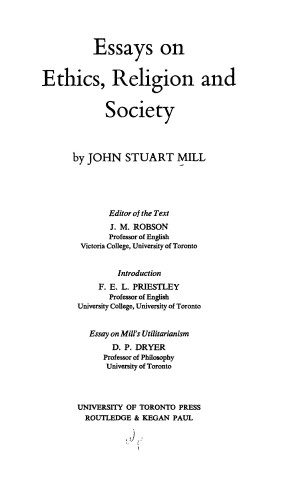
APPENDICES - John Stuart Mill, The Collected Works of John Stuart Mill, Volume X - Essays on Ethics, Religion, and Society [1833]Edition used:The Collected Works of John Stuart Mill, Volume X - Essays on Ethics, Religion, and Society, ed. John M. Robson, Introduction by F.E.L. Priestley (Toronto: University of Toronto Press, London: Routledge and Kegan Paul, 1985).
Part of: Collected Works of John Stuart Mill, in 33 vols.About Liberty Fund:Liberty Fund, Inc. is a private, educational foundation established to encourage the study of the ideal of a society of free and responsible individuals. Copyright information:The online edition of the Collected Works is published under licence from the copyright holder, The University of Toronto Press. ©2006 The University of Toronto Press. All rights reserved. No part of this material may be reproduced in any form or medium without the permission of The University of Toronto Press. Fair use statement:This material is put online to further the educational goals of Liberty Fund, Inc. Unless otherwise stated in the Copyright Information section above, this material may be used freely for educational and academic purposes. It may not be used in any way for profit.
APPENDICESAppendix APreface to Dissertations and Discussions (1859)Dissertations and Discussions, I, iii-vi. For a discussion of this Preface (unaltered in the 2nd ed. of D&D) see the Textual Introduction, cxviff. above. JSM’s views on republication of his essays is discussed in the Textual Introduction to Essays on Economics and Society, in Collected Works, IV, xliv-xlv. the republication in a more durable form, of papers originally contributed to periodicals, has grown into so common a practice as scarcely to need an apology; and I follow this practice the more willingly, as I hold it to be decidedly a beneficial one. It would be well if all frequent writers in periodicals looked forward, as far as the case admitted, to this reappearance of their productions. The prospect might be some guarantee against the crudity in the formation of opinions, and carelessness in their expression, which are the besetting sins of writings put forth under the screen of anonymousness, to be read only during the next few weeks or months, if so long, and the defects of which it is seldom probable that any one will think it worth while to expose. The following papers, selected from a much greater number, include all of the writer’s miscellaneous productions which he considers it in any way desirable to preserve. The remainder were either of too little value at any time, or what value they might have was too exclusively temporary, or the thoughts they contained were inextricably mixed up with comments, now totally uninteresting, on passing events, or on some book not generally known; or lastly, any utility they may have possessed has since been superseded by other and more mature writings of the author. Every one whose mind is progressive, or even whose opinions keep up with the changing facts that surround him, must necessarily, in looking back to his own writings during a series of years, find many things which, if they were to be written again, he would write differently, and some, even, which he has altogether ceased to think true. From these last I have endeavoured to clear the present pages. Beyond this, I have not attempted to render papers written at so many different, and some of them at such distant, times, a faithful representation of my present state of opinion and feeling. I leave them in all their imperfection, as memorials of the states of mind in which they were written, in the hope that they may possibly be useful to such readers as are in a corresponding stage of their own mental progress. Where what I had written appears a fair statement of part of the truth, but defective inasmuch as there exists another part respecting which nothing, or too little, is said, I leave the deficiency to be supplied by the reader’s own thoughts; the rather, as he will, in many cases, find the balance restored in some other part of this collection. Thus, the review of Mr. Sedgwick’s Discourse,[*] taken by itself, might give an impression of more complete adhesion to the philosophy of Locke, Bentham, and the eighteenth century, than is really the case, and of an inadequate sense of its deficiencies; but that notion will be rectified by the subsequent essays on Bentham and on Coleridge.[†] These, again, if they stood alone, would give just as much too strong an impression of the writer’s sympathy with the reaction of the nineteenth century against the eighteenth: but this exaggeration will be corrected by the more recent defence of the “greatest happiness” ethics against Dr. Whewell.[‡] Only a small number of these papers are controversial, and in but two am I aware of anything like asperity of tone. In both these cases some degree of it was justifiable, as I was defending maligned doctrines or individuals, against unmerited onslaughts by persons who, on the evidence afforded by themselves, were in no respect entitled to sit in judgment on them: and the same misrepresentations have been and still are so incessantly reiterated by a crowd of writers, that emphatic protests against them are as needful now as when the papers in question were first written. My adversaries, too, were men not themselves remarkable for mild treatment of opponents, and quite capable of holding their own in any form of reviewing or pamphleteering polemics. I believe that I have in no case fought with other than fair weapons, and any strong expressions which I have used were extorted from me by my subject, not prompted by the smallest feeling of personal ill-will towards my antagonists. In the revision, I have endeavoured to retain only as much of this strength of expression, as could not be foregone without weakening the force of the protest. Appendix BObituary of Bentham (1832)Examiner, 10 June, 1832, 370-2. This, JSM’s first published commentary on Bentham, is described in his bibliography as “An obituary notice of Jeremy Bentham in the Examiner of 10th June 1832” (MacMinn, 21). The passage reprinted here is the central part of the obituary; the full text will be found in the volume of this edition given to newspaper writings. While the tone is more eulogistic, many of the remarks are paralleled in the more critical account in the Appendix to Bulwer (3-18 above) and in the passage from Bulwer’s text given below in Appendix C. See also my “John Stuart Mill and Jeremy Bentham,” 259. Let it be remembered what was the state of jurisprudence and legislation, and of the philosophy of jurisprudence and legislation, when he [Bentham] began his career. A labyrinth without a clue—a jungle, through which no path had ever been cut. All systems of law then established, but most of all that in which he himself was nurtured, were masses of deformity, in the construction of which reason in any shape whatever had had little to do, a comprehensive consideration of ends and means nothing at all: their foundation the rude contrivances of a barbarous age, even more deeply barbarous in this than in aught else; the superstructure an infinite series of patches, some larger, some smaller, stuck on in succession wherever a hole appeared, and plastered one over another until the monstrous mass exceeded all measurable bulk, and went beyond the reach of the strongest understanding and the finest memory. Such was the practice of law: was its theory in any better state? And how could it be so? for of what did that theory consist, but either of purely technical principles, got at by abstraction from these established systems, (or rather, constructed, generally in utter defiance of logic, with the sole view of giving something like coherence and consistency in appearance to provisions which in reality were utterly heterogeneous); or of vague cloudy generalities arbitrarily assumed à priori, and called laws of nature, or principles of natural law. Such was existing jurisprudence; and that it should be such, was less surprising than the superstition by which, being such, it was protected. The English people had contrived to persuade themselves, and had to a great degree persuaded the rest of the world, that the English law, as it was when Mr. Bentham found it, was the perfection of reason. That it was otherwise, was the only political heresy, which no one had been found hardy enough to avow; even the English constitution you might (if you did it very gently) speak ill of,—but not the English law: Whig, Tory, and Democrat joined in one chorus of clamorous admiration, whenever the law or the courts of justice were the subject of discourse: and to doubt the merits of either appeared a greater stretch of absurdity than to question the doctrine of gravitation. This superstition was at its height, when Mr. Bentham betook himself to the study of English law, with no other object than the ordinary one of gaining his living by practising a liberal profession. But he soon found that it would not do for him, and that he could have no dealing or concern with it in an honest way, except to destroy it. And there is a deep interest now, at the close of his life, in looking back to his very first publication, the Fragment on Government, which appeared considerably more than half a century ago, and which exhibits, at that remote period, a no less strong and steady conviction than appears in his very latest production, that the worship of the English law was a degrading idolatry—that instead of being the perfection of reason, it was a disgrace to the human understanding—and that a task worthy of him, or any other wise and brave man, to devote a life to, was that of utterly eradicating it and sweeping it away. This accordingly became the task of his own existence: glory to him! for he has successfully accomplished it. The monster has received from him its death wound. After losing many a limb, it still drags on, and will drag on for a few years more, a feeble and exanimate existence; but it never will recover. It is going down rapidly to the grave. Mr. Bentham has fought this battle for now almost sixty years; the greater part of that time without assistance from any human being, except latterly what M. Dumont gave him in putting his ideas into French; and for a long time almost without making one human being a convert to his opinions. He exhausted every mode of attack; he assailed the enemy with every weapon, and at all points; now he fell upon the generalities, now upon the details; now he combatted evil by stripping it naked, and showing that it was evil; and now by contrasting it with good. At length his energy and perseverance triumphed. Some of the most potent leaders of the public became convinced; and they, in their turn, convinced or persuaded others: until at last the English law, as a systematic whole, is given up by every body, and the question, with all thinking minds even among lawyers, is no longer about keeping it as it is, but only whether, in rebuilding, there be a possibility of using any of the old materials.* Mr. Bentham was the original mover in this mighty change. His hand gave the impulse which set all the others at work. To him the debt is due, as much as any other great work has ever been owing to the man who first guided other men to the accomplishment of it. The man who has achieved this, can afford to die. He has done enough to render his name for ever illustrious. But Mr. Bentham has been much more than merely a destroyer. Like all who discredit erroneous systems by arguments drawn from principles, and not from mere results, he could not fail, even while destroying the old edifice, to lay a solid foundation for the new. Indeed he considered it a positive duty never to assail what is established, without having a clear view of what ought to be substituted. It is to the intrinsic value of his speculations on the philosophy of law in general, that he owes the greater part of his existing reputation; for by these alone is he known to his continental readers, who are far the most numerous, and by whom, in general, he is far more justly appreciated than in England. There are some most important branches of the science of law, which were in a more wretched state than almost any of the others when he took them in hand, and which he has so exhausted, that he seems to have left nothing to be sought by future enquirers; we mean the departments of Procedure, Evidence, and the Judicial Establishment. He has done almost all that remained to perfect the theory of punishment. It is with regard to (what is the foundation of all) the civil code, that he has done least, and left most to be done. Yet even here his services have been invaluable, by making far clearer and more familiar than they were before, both the ultimate and the immediate ends of civil law; the essential characteristics of a good law; the expediency of codification, that is, of law written and systematic; by exposing the viciousness of the existing language of jurisprudence, guarding the student against the fallacies which lurk in it, and accustoming him to demand a more precise and logically-constructed nomenclature. Mr. Bentham’s exertions have not been limited to the field of jurisprudence, or even to that of general politics, in which he ranks as the first name among the philosophic radicals. He has extended his speculations to morals, though never (at least in his published works) in any great detail; and on this, as on every other subject which he touched, he cannot be read without great benefit. Some of his admirers have claimed for him the title of founder of the science of morals, as well as of the science of legislation; on the score of his having been the first person who established the principle of general utility, as the philosophic foundation of morality and law. But Mr. Bentham’s originality does not stand in need of any such exaggerations. The doctrine of utility, as the foundation of virtue, he himself professes to have derived from Hume: he applied it more consistently and in greater detail, than his predecessors; but the idea itself is as old as the earliest Greek philosophers, and has divided the philosophic world, in every age of philosophy, since their time. Mr. Bentham’s real merit, in respect to the foundation of morals, consists in his having cleared it more thoroughly than any of his predecessors, from the rubbish of pretended natural law, natural justice, and the like, by which men were wont to consecrate as a rule of morality, whatever they felt inclined to approve of without knowing why. The most prominent moral qualities which appear in Mr. Bentham’s writings, are love of justice, and hatred of imposture: his most remarkable intellectual endowments, a penetrating deep-sighted acuteness, precision in the use of scientific language, and sagacity and inventiveness in matters of detail. There have been few minds so perfectly original. He has often, we think, been surpassed in powers of metaphysical analysis, as well as in comprehensiveness and many-sidedness of mind. He frequently contemplates a subject only from one or a few of its aspects; though he very often sees further into it, from the one side on which he looks at it, than was seen before even by those who had gone all round it. There is something very striking, occasionally, in the minute elaborateness with which he works out, into its smallest details, one half-view of a question, contrasted with his entire neglect of the remaining half-view, though equally indispensable to a correct judgment of the whole. To this occasional one-sidedness, he failed to apply the natural cure; for, from the time when he embarked in original speculation, he occupied himself very little in studying the ideas of others. This, in almost any other than himself, would have been a fault; in him, we shall only say, that, but for it, he would have been a greater man. Mr. Bentham’s style has been much criticised; and undoubtedly, in his latter writings, the complicated structure of his sentences renders it impossible, without some familiarity, to read them with rapidity and ease. But his earlier, among which are some of his most valuable productions, are not only free from this defect, but may even, in point of ease and elegance, be ranked among the best English compositions. Felicity of expression abounds even in those of his works which are generally unreadable; and volumes might be filled with passages selected from his later as well as his earlier publications, which, for wit and eloquence, have seldom been surpassed. Appendix CComment on Bentham in Bulwer’s England and the English (1833)edward lytton bulwer (later Bulwer-Lytton, later 1st Baron Lytton), England and the English (London: Bentley, 1833), II, 163-70. JSM comments in his Autobiography (139) that, in addition to the Appendix on Bentham (the first essay printed above), Bulwer also “incorporated” in his text “a small part” of JSM’s critique of Bentham. (See Textual Introduction, cxvi-cxvii above). It cannot be determined which part of the following passage is JSM’s, but the images of Bentham as destroyer and reconstructor, the description of Bentham as the great questioner (cf. 78), the reference to an age of transition, and the suggestion of Bentham’s seminality, are all typical of his attitude at the time; and both in wording and idea the fourth paragraph closely approximates comments on Bentham known to be his. [In] legislative and moral philosophy, Bentham must assuredly be considered the most celebrated and influential teacher of the age—a master, indeed, whom few have acknowledged, but from whom thousands have, mediately and unconsciously, imbibed their opinions. The same causes which gave so great a fertility to the school of the Economists, had their effect upon the philosophy of Bentham; they drew his genius mainly towards examinations of men rather than of man—of the defects of Law, and of the hypocrisies and fallacies of our Social System; they contributed to the material form and genus of his code, and to those notions of Utility which he considered his own invention, but which had been incorporated with half the systems that had risen in Europe since the sensualism of Condillac had been grafted upon the reflection of Locke. But causes far more latent, and perhaps more powerful, contributed also to form the mind and philosophy of Bentham. He had preceded the great French Revolution—the materials of his thoughts had been compounded from the same foundations of opinion as those on which the more enlightened advocates of the Revolution would have built up that edifice which was to defy a second deluge, and which is but a record of the confusion of the workmen. With the philosophy of the eighteenth century, which first adopted what the French reasoners term the Principle of Humanity—(that is, the principle of philanthropy—a paramount regard for multitudes rather than for sectarian interests,)—with this philosophy, I say, the whole mind of Bentham was imbued and saturate. He had no mercy, no toleration for the knots and companies of men whom he considered interrupters or monopolists of the power of the many—to his mind they were invariably actuated by base and designing motives, and such motives, according to his philosophy, they were even compelled to entertain. His intellect was as the aqueduct which bore aloft, and over the wastes and wrecks below, the stream of the philosophy of one century to the generations of the other. His code of morals, original in its results, is in many parts (unconsciously to himself) an eclecticism of nearly all the best parts of the various theories of a century. “The system of Condillac required its ‘moral’ code, and Helvetius supplied it.” The moral code of Helvetius required its legislative, and in Bentham it obtained it. I consider, then, that two series of causes conspired to produce Bentham—the one national, the other belonging to all Europe; the same causes on the one hand which produced with us the Economists—the same causes on the other hand which produced in France, Helvetius and Diderot, Volney, Condorcet, and Voltaire. He combined what had not been yet done, the spirit of the Philanthropic with that of the Practical. He did not declaim about abuses; he went at once to their root: he did not idly penetrate the sophistries of Corruption; he smote Corruption herself. He was the very Theseus of legislative reform,—he not only pierced the labyrinth—he destroyed the monster. As he drew his vigour from the stream of Change, all his writings tended to their original source. He collected from the Past the scattered remnants of a defeated innovation, and led them on against the Future. Every age may be called an age of transition—the passing on, as it were, from one state to another never ceases; but in our age the transition is visible, and Bentham’s philosophy is the philosophy of a visible transition. Much has already happened, much is already happening every instant, in his country—throughout Europe—throughout the world, which might not have occurred if Bentham had not been; yet of all his works, none have been read by great numbers; and most of them, from their difficulties of style and subject, have little chance of ever being generally popular. He acted upon the destinies of his race by influencing the thoughts of a minute fraction of the few who think—from them the broad principles travelled onward—became known—(their source unknown)—became familiar and successful. I have said that we live in an age of visible transition—an age of disquietude and doubt—of the removal of time-worn landmarks, and the breaking up of the hereditary elements of society—old opinions, feelings—ancestral customs and institutions are crumbling away, and both the spiritual and temporal worlds are darkened by the shadow of change. The commencement of one of these epochs—periodical in the history of mankind—is hailed by the sanguine as the coming of a new Millennium—a great inconoclastic reformation, by which all false gods shall be overthrown. To me such epochs appear but as the dark passages in the appointed progress of mankind—the times of greatest unhappiness to our species—passages into which we have no reason to rejoice at our entrance, save from the hope of being sooner landed on the opposite side. Uncertainty is the greatest of all our evils. And I know of no happiness where there is not a firm unwavering belief in its duration. The age then is one of destruction! disguise it as we will, it must be so characterized; miserable would be our lot were it not also an age of preparation for reconstructing. What has been the influence of Bentham upon his age?—it has been twofold—he has helped to destroy and also to rebuild. No one has done so much to forward, at least in this country, the work of destruction, as Mr. Bentham. The spirit of examination and questioning has become through him, more than through any one person besides, the prevailing spirit of the age. For he questioned all things. The tendencies of a mind at once sceptical and systematic, (and both in the utmost possible degree,) made him endeavour to trace all speculative phenomena back to their primitive elements, and to reconsider not only the received conclusions, but the received premises. He treated all subjects as if they were virgin subjects, never before embraced or approached by man. He never set up an established doctrine as a thesis to be disputed about, but put it aside altogether, commenced from first principles, and deliberately tasked himself systematically to discover the truth, or to re-discover it if it were already known. By this process, if he ever annihilated a received opinion, he was sure of having something either good or bad to offer as a substitute for it; and in this he was most favourably distinguished from those French philosophers who preceded and even surpassed him, as destroyers of established institutions on the continent of Europe. And we shall owe largely to one who reconstructed while he destroyed, if our country is destined to pass more smoothly through this crisis of transition than the nations of the continent, and to lose less of the good it already enjoys in working itself free from the evil;—his be the merit, if while the wreck of the old vessel is still navigable, the masts of the new one, which brings relief, are dimly showing themselves above the horizon! For it is certain, and will be seen every day more clearly, that the initiation of all the changes which are now making in opinions and in institutions, may be claimed chiefly by men who have been indebted to his writings, and to the spirit of his philosophy, for the most important part of their intellectual cultivation. I had originally proposed in this part of my work to give a slight sketch of the principal tenets of Bentham, with an exposition of what I conceive to be his errors; pointing out at once the benefits he has conferred, and also the mischief he has effected. But slight as would be that sketch, it must necessarily be somewhat abstract; and I have therefore, for the sake of the general reader, added it to the volume in the form of an appendix.* I have there, regarding him as a legislator and a moralist, ventured to estimate him much more highly in the former capacity than the latter; endeavouring to combat the infallibility of his application of the principle of Utility, and to show the dangerous and debasing theories, which may be, and are, deduced from it. Even, however, in legislation, his greatest happiness principle is not so clear and undeniable as it is usually conceded to be. “The greatest happiness of the greatest number” is to be our invariable guide! Is it so?—the greatest happiness of the greatest number of men living, I suppose, not of men to come; for if of all posterity, what legislator can be our guide? who can prejudge the future? Of men living, then?—well—how often would their greatest happiness consist in concession to their greatest errors. In the dark ages, (said once to me very happily the wittiest writer of the day, and one who has perhaps done more to familiarize Bentham’s general doctrines to the public than any other individual,) in the dark ages, it would have been for the greatest happiness of the greatest number of burn the witches; it must have made the greatest number, (all credulous of wizardry,) very uncomfortable to refuse their request for so reasonable a conflagration; they would have been given up to fear and disquietude—they would have imagined their safety disregarded and their cattle despised—if witches were to live with impunity, riding on broomsticks, and sailing in oyster-shells;—their happiness demanded a bonfire of old women. To grant such a bonfire would have been really to consult the greatest happiness of the greatest number, yet ought it to have been the principle of wise, nay, of perfect, (for so the dogma states,) of unimpugnable legislation? In fact, the greatest happiness principle, is an excellent general rule, but it is not an undeniable axiom. Appendix DQuotation from “Coleridge” in Mill’s System of Logic (8th ed., 1872), 519-23 (VI, x, 5)As indicated in the Textual Introduction, there is little evidence concerning the dating of the revisions of the essays in Dissertations and Discussions between their first periodical publication and their republication in 1859. However, Mill’s inclusion in his Logic of the long passage from “Coleridge” printed below supplies some interesting internal evidence. The variant notes give all the substantive changes in the three versions of “Coleridge” and the nine versions of the Logic. The “Coleridge” versions are indicated by italic numerals: 40 = the periodical version, 1840; 59 = Dissertations and Discussions, 1st ed., 1859; 67 = Dissertations and Discussions, 2nd ed., 1867. The Logic versions are indicated by numerals in roman type: MS = manuscript (1840, with revisions through 1842); 43 = 1st ed., 1843; 46 = 2nd ed., 1846; 51 = 3rd ed., 1851; 56 = 4th ed., 1856; 62 = 5th ed., 1862; 65 = 6th ed., 1865; 68 = 7th ed., 1868; 72 = 8th ed., 1872 (the last in Mill’s lifetime). An examination of the variants, substantive and accidental (the latter not here recorded), shows that there are two main groups: in the first and larger group, 59 and 67 (the 1st and 2nd eds. of D&D) agree with 51 and subsequent eds. of the Logic, but not with 40 (the periodical version) or MS, 43, 46 (the manuscript and first two eds. of the Logic); in the second, 59 and 67 agree with 40 and MS, 43, 46, but not with 51 and subsequent eds. of the Logic. Changes in the Logic that appear only prior to or subsequent to 1851 did not affect the text of 59 and 67; similarly, changes in 59 and 67 that do not appear in 51 do not appear in subsequent eds. of the Logic. In the absence of external evidence, of marked proof, and of all copy-texts except the manuscript of the Logic, the most likely explanation of these phenomena is that Mill, after having copied the passage into the Logic MS, revised the “Coleridge” with a view to republication (which did not occur until 1859); these revisions he transferred to the Logic when making the most extensive rewriting of that work, that is, for the 3rd ed. (1851). The revised “Coleridge,” with no further changes except a few accidentals, became the copy-text for 59. Further, it appears that when the time came for printing the 3rd ed. of the Logic, Mill made a few further changes, probably in proof, changes that are retained in subsequent eds. of the Logic, but do not appear in the reprinted “Coleridge” of 59 and 67. The terminus ab quo for the revision of “Coleridge” is, therefore, some time after the writing of the MS of Book VI of the Logic (1840-42); the terminus ad quem is between the beginning of the revision of the 3rd ed. of the Logic and its printing (1851). This conclusion is not very startling, as it narrows the possible time, that is, the time between printings (1840 and 1859), by less than half; still, it places the revision before Mill’s marriage, and bears out the contention in the Textual Introduction. Some slight evidence suggests a date near the beginning of the possible period. The final variant in the passage, the earlier form of which appears only in 40 and MS, would by itself seem to upset the argument above and, even in the context of the other changes, is inconclusive as to the transmission of text; one can tentatively infer, however, that if the change was made first in the proof of the Logic, the “Coleridge” was revised not later than 1843, whereas if it was first made in the revision of the “Coleridge,” that revision was not later than 1842. Also, when John Parker agreed, in the spring of 1842, to publish the Logic, he turned down the suggestion that he publish the collection that later appeared as Dissertations and Discussions; Mill then proposed to publish the collection himself (see Earlier Letters, XIII, 514, 520-1). Again, therefore, it would appear likely that the revisions were made in 1842-43. Mill prefaces the passage in the Logic with the comment that it is “extracted, with some alterations, from a criticism on the negative philosophy of the eighteenth century” (in MS, 43, 46 the reading is “forming part of a criticism on the negative philosophy of the eighteenth century”); actually the major alterations, as already indicated, were probably made in that criticism (i.e., in “Coleridge”), and not for the Logic. Only one change, the deletion in the Logic of a long footnote (508o), was made in the interests of the new context. The passage is introduced in the Logic as an example of results that, although they “amount in themselves only to empirical laws . . . are found to follow with so much probability from general laws of human nature, that the consilience of the two processes raises the evidence to proof [MS,43,46 to complete proof], and the generalizations to the rank of scientific truths.” In a typical phrase, he apologizes for the quotation, saying: “. . . I quote, though (as in some former instances) from myself, because I have no better way of illustrating the conception I have formed of the kind of theorems of which sociological statics would consist.” a The very first element of the social union, obedience to a government of some sort, has not been found so easy a thing to establish in the world. Among a timid and spiritless race like the inhabitants of the vast plains of tropical countries, passive obedience may be of natural growth; though even there we doubt whether it has ever been found among any people with whom fatalism, or in other words, submission to the pressure of circumstances as ba divine decreeb , did not prevail as a religious doctrine. But the difficulty of inducing a brave and warlike race to submit their individual arbitrium to any common umpire, has always been felt to be so great, that nothing short of supernatural power has been deemed adequate to overcome it; and such tribes have always assigned to the first institution of civil society a divine origin. So differently did those judge who knew savage cmenc by actual experience, from those who had no acquaintance with dthemd except in the civilized state. In modern Europe itself, after the fall of the Roman empire, to subdue the feudal anarchy and bring the whole people of any European nation into subjection to government (though Christianity in ethee most concentrated form fof its influencef was co-operatingg in the work) required thrice as many centuries as have elapsed since that time. Now if these philosophers had known human nature under any other type than that of their own age, and of the particular classes of society among whom they hlivedh , it would have occurred to them, that wherever this habitual submission to law and government has been firmly and durably established, and yet the vigour and manliness of character which resisted its establishment have been in any degree preserved, certain requisites have existed, certain conditions have been fulfilled, of which the following may be regarded as the principal. First: there has existed, for all who were accounted citizens,—for all who were not slaves, kept down by brute force,—a system of education, beginning with infancy and continued through life, of which whatever else it might include, one main and incessant ingredient was restraining discipline. To train the human being in the habit, and thence the power, of subordinating his personal impulses and aims, to what were considered the ends of society; of adhering, against all temptation, to the course of conduct which those ends prescribed; of controlling in himself alli feelings which were liable to militate against those ends, and encouraging all such as tended towards them; this was the purpose, to which every outward motive that the authority directing the system could command, and every inward power or principle which its knowledge of human nature enabled it to evoke, were endeavoured to be rendered instrumental. jThe entire civil and military policy of the ancient commonwealths was such a system of training; in modern nations its place has been attempted to be supplied, principally, by religious teaching.j And whenever and in proportion as the strictness of kthe restrainingk discipline was relaxed, the natural tendency of mankind to anarchy re-asserted itself; the state became disorganized from within; mutual conflict for selfish ends, neutralized the energies which were required to keep up the contest against natural causes of evil; and the nation, after a longer or briefer interval of progressive decline, became either the slave of a despotism, or the prey of a foreign invader. The second condition of permanent political society has been found to be, the existence, in some form or other, of the feeling of allegiance or loyalty. This feeling may vary in its objects, and is not confined to any particular form of government; but whether in a democracy or in a monarchy, its essence is always the same; viz. that there be in the constitution of the state something which is settled, something permanent, and not to be called in question; something which, by general agreement, has a right to be where it is, and to be secure against disturbance, whatever else may change. This feeling may attach itself, as among the Jews (andl in most of the commonwealths of antiquity), to a common God or gods, the protectors and guardians of their state. Or it may attach itself to certain persons, who are deemed to be, whether by divine appointment, by long prescription, or by the general recognition of their superior capacity and worthiness, the rightful guides and guardians of the rest. Or it may mconnect itself with laws; with ancient liberties or ordinances. Or, finally, (and this is the only shape in which the feeling is likely to exist hereafter), it may attach itself to the principles of individual freedom and political and social equality, as realized in institutions which as yet exist nowhere, or exist only in a rudimentary state.m But in all political societies which have had a durable existence, there has been some fixed point: something which npeoplenoagreedo in holding sacred; whichp, wherever freedom of discussion was a recognised principle, it was of coursep lawful to contest in theory, but which no one could either fear or hope to see shaken in practice; which, in short (except perhaps during some temporary crisis) was in the common estimation placed qbeyondq discussion. And the necessity of this may easily be made evident. A state never is, nor until mankind are vastly improved, can hope to be, for any long time exempt from internal dissension; for there neither is nor has ever been any state of society in which collisions did not occur between the immediate interests and passions of powerful sections of the people. What, then, enables rnationsr to weather these storms, and pass through turbulent times without any permanent weakening of the ssecurities for peaceable existences ? Precisely this—that however important the interests about which men tfellt out, the conflict udidu not affect the fundamental vprinciplev of the system of social union which whappenedw to exist; nor threaten large portions of the community with the subversion of that on which they xhadx built their calculations, and with which their hopes and aims yhady become identified. But when the questioning of these fundamental principles is (not zthez occasional disease, aor salutary medicine,a but) the habitual condition of the body politic, and when all the violent animosities are called forth, which spring naturally from such a situation, the state is virtually in a position of civil war; and can never long remain free from it in act and fact. The third essential condition bof stability in political societyb , is a strong and active principle of ccohesion among the members of the same community or statec . We need scarcely say that we do not mean dnationality, in the vulgar sense of the term;d a senseless antipathy to foreigners;efindifference to the general welfare of the human race, or an unjust preference of the supposed interests of our own country;fg a cherishing of hbadh peculiarities because they are national, or a refusal to adopt what has been found good by other countries.i We mean a principle of sympathy, not of hostility; of union, not of separation. We mean a feeling of common interest among those who live under the same government, and are contained within the same natural or historical boundaries. We mean, that one part of the community jdoj not consider themselves as foreigners with regard to another part; that they kset a value on their connexion—k feel that they are one people, that their lot is cast together, that evil to any of their fellow-countrymen is evil to themselves, and ldo not desire selfishly tol free themselves from their share of any common inconvenience by severing the connexion. How strong this feeling was in mthosem ancient commonwealths nwhich attained any durable greatness,n every one knows. How happily Rome, in spite of all her tyranny, succeeded in establishing the feeling of a common country among the provinces of her vast and divided empire, will appear when any one who has given due attention to the subject shall take the trouble to point it out.o In modern times the countries which have had that feeling in the strongest degree have been the most powerful countries; England, France, and, in proportion to their territory and resources, Holland and Switzerland; while England in her connexion with Ireland, is one of the most signal examples of the consequences of its absence. Every Italian knows why Italy is under a foreign yoke; every German knows what maintains despotism in the Austrian empire;* the pevilsp of Spain flow as much from the absence of nationality among the Spaniards themselves, as from the presence of it in their relations with foreigners: while the completest illustration of all is afforded by the republics of South America, where the parts of one and the same state adhere so slightly together, that no sooner does any province think itself aggrieved by the general government than it proclaims itself a separate nation. Appendix EBibliographic Index of Persons and Works Cited in the Essays, with Variants and NotesMill, like most nineteenth-century authors, is cavalier in his approach to sources, seldom identifying them with sufficient care, and frequently quoting them inaccurately. This Appendix is intended to help correct these deficiencies, and to serve as an index of names and titles (which are consequently omitted in the Index proper). Included also, at the end of the Appendix, are references to British statute law, which are entered in order of date under the heading “Statutes.” The material otherwise is arranged in alphabetical order, with an entry for each author and work quoted or referred to in the text proper and in Appendices A-D. In cases of simple reference only surnames are given. As the references in Appendix B will be found again in the volume of newspaper writings, and as those in Appendix C may be Bulwer’s rather than Mill’s they are identified as occurring in those appendices. The entries take the following form: 1. Identification: author, title, etc., in the usual bibliographic form. 2. Notes (if required) giving information about JSM’s use of the source, indication if the work is in his library, and any other relevant information. 3. A list of the places where the author or work is quoted, and a separate list of the places where there is reference only. Those works that are reviewed are specially noted; individual works by Bentham, Coleridge, and Comte (except for the Cours) are not noted as “reviewed” because the articles on these authors are general and not specific reviews. 4. A list of substantive variants between JSM’s text and his source, in this form: Page and line reference to the present text. Reading in the present text] Reading in the source (page reference in the source). The list of substantive variants also attempts to place quoted passages in their contexts by giving the beginnings and endings of sentences. Omissions of two sentences or less are given in full; only the length of other omissions is given. In a few cases, following the page reference to the source, cross-references are given to footnoted variants in the present text. Translated material is given in the original language. When the style has been altered by setting down quotations, the original form is retained in the entries. Acts. See Statutes. Addison, Joseph. Referred to: 114 — Cato. A Tragedy. London: Tonson, 1713. quoted: 12 12.39-40 “the woman who deliberates,”] When Love once plead’s Admission to our Hearts / (In spite of all the Virtue we can boast) / The Woman that Deliberates is lost. (P. 46; IV, i, 29-31) Aeschylus. Referred to: 42, 324 Agrippa. Referred to: 136 note: the reference is in a quotation from Coleridge. Alfred the Great (of England). Referred to: 151 note: the reference is in a quotation from Coleridge. Ampère. Referred to: 354 Anaxagoras. Referred to: 276, 278 Antoninus, Marcus Aurelius. Referred to: 422 — Meditations. Referred to: 416 note: as the reference is general, no edition is cited. A Greek and Latin edition (Glasgow: Foulis, 1744) is in JSM’s library, Somerville College. Apollonius. Referred to: 362 Archimedes. Referred to: 362 Aristotle. Referred to: 66, 125, 276, 292, 301, 309, 362 note: the reference at 301 is to G. H. Lewes’s Aristotle. — De Anima. Quoted: 268 note: there are many editions of Aristotle in JSM’s library, Somerville College. The quoted words derive from 415a, 23. Augustus. See Caesar Augustus. Aurelius. See Antoninus. Bacon, Francis. Referred to: 9, 10, 83, 88, 119, 171, 174, 266 — Novum Organum Scientiarum. 2nd ed. Amsterdam: Ravensteiny, 1660. note: in JSM’s library, Somerville College. For convenience, reference is also given to Works (14 vols. Ed. James Spedding, Robert Leslie Ellis, and Douglas Denon Heath. London: Longman, et al., 1857-74), which is also in JSM’s library. In this standard edition, the Novum Organum is in Vol. I; the English translation is in Vol. IV. The quotations at 29 and 111 are identical (the passage is marked with a marginal pencil line in JSM’s copy of the edition of 1660; that at 379 is indirect; the reference at 88 is to 113 (Works I, 205; Bk. I, Aph. cv; cf. Vol. IV, 97-8; see also Vol. III, 504, 601). quoted: 29, 111, 379 referred to: 88 29.29 vera illa et media axiomata] At media sunt Axiomata illa vera, & solida, & viva, in quibus humanae res, & fortunae, sitae sunt; & supra haec quoque, tandem ipsa illa generalissima; talia scilicet, quae non abstracta sint, sed per hae media vere limitantur. (112, Works, I, 205; Bk. I, Aph. civ) [Cf. Works, IV, 97.] 111.1-2 [see previous entry] 379.33-4 we can obey nature in such a way as to command it] Human knowledge and human power meet in one; for where the cause is not known the effect cannot be produced. Nature to be commanded must be obeyed; and that which in contemplation is as the cause is in operation as the rule. (47; Bk. I, Aph. iii) [Cf. 114; Bk. I, Aph. cxxix. For the Latin version, see 28; Works, I, 157, 222.] Bain, Alexander. Referred to: 298. — The Emotions and the Will. London: Parker, 1859. note: the “first treatise” referred to at 246n is Bain’s The Senses and the Intellect (London: Parker, 1855). referred to: 246n “Balwhidder, Micah.” See Galt. Bancroft. Referred to: 155. Beattie. Referred to: 85, 86. note: the reference at 85 derives from Bentham’s identification of the moralist intended in his second category (see 514:85.12 below). “Beauchamp, Philip.” See Grote, Analysis. Becket. Referred to: 142. Bentham, Jeremiah. Referred to: 81. Bentham, Jeremy. Referred to: 5-18 passim, 21, 26, 54, 77-115 passim, 119-21, 127, 128, 146, 150, 169-70, 172-4, 176, 179, 181, 183-5, 190, 191, 193n, 194, 195-6, 198-9, 201, 207, 209, 220n, 258n, 267, 290, 300, 307, 325, 394, 406, 413-14, 494, 495-8 (App. B), 499-502 (App. C). note: the references at 172, 181, 183, 198 are in quotations from Whewell. The references at 406, 413-14 are to Bentham’s authorship of the Analysis of the Influence of Natural Religion; see under Grote. — The Works of Jeremy Bentham. Ed. John Bowring. Parts I to IV (1838). Vols. I and IV of complete edition in 11 vols. Edinburgh: Tait, 1843. note: for ease of reference, most citations of Bentham’s writings are taken from this edition, which is in JSM’s library, Somerville College. The edition appeared in twenty-two separate parts between 1838 and 1843, and then was issued in eleven volumes in 1843. JSM’s review (“Bentham”) is of the first four parts, all published in 1838, which form Vols. I (Parts I and II) and IV (Parts III and IV) of the complete edition. The corresponding volume and part numbers, with dates of the parts, are as follows: Vols. I (Parts I and II, 1838; J. H. Burton’s “Introduction to the Study of Jeremy Bentham’s Works,” which appeared at the end of Part XXII in 1843, is also in Vol. I), II (VII and VIII, 1839), III (IX and X, 1839), IV (III and IV, 1838), V (V and VI, 1838), VI (XI and XII, 1839), VII (XIII and XIV, 1840), VIII (XV and XVI, 1841), IX (XVII and XVIII, 1841 and 1842), X (XIX and XX, 1842), XI (XXI and XXII, 1842 and 1843; for Burton’s “Introduction,” see Vol. I above). Parts I to IV contain the following works (most of which are not referred to in JSM’s review): Part I. An Introduction to the Principles of Morals and Legislation; On the Promulgation of Laws, with Specimen of a Penal Code; On the Influence of Time and Place in Matters of Legislation; A Table of the Springs of Action; A Fragment on Government. Part II. Principles of the Civil Code; Principles of Penal Law. Part III. View of the Hard-Labour Bill; Panopticon; Postscript to Panopticon; Panopticon v. New South Wales; A Plea for the Constitution; Draught of a Code for a Judicial Establishment in France. Part IV. Bentham’s Draught for the Organization of Judicial Establishments; Emancipate Your Colonies; On Houses of Peers and Senates; Papers relative to Codification and Public Instruction; Codification Proposal. reviewed: 77-115 — Analysis of the Influence of Natural Religion. See Grote, Analysis. — The Book of Fallacies; from the unfinished papers of Jeremy Bentham. Ed. Peregrine Bingham. London: Hunt, 1824. note: for ease of reference, the quotations are also located in Works, II, 375-487. quoted: 14-15, 90 referred to: 81-2 14.30-1 “In every human breast (rare . . . extraordinarily . . . excitement, excepted) ] 3. [i.e., the 3rd of the premises on which the following argument is based] In every human breast, rare . . . extraordinary . . . incitement, excepted, (392-3; Works, II, 482) 14.34 “Taking] [paragraph] Taking (363; Works, II, 482) 14.35 nor . . . exist] [not in italics] (363; Works, II, 482) 14.38-9 (which . . . virtuous) of], which . . . virtuous of (363; Works, II, 482) 90.17 “vague generalities.”] [title of Part IV, Chap. iii] (230ff.; Works, II, 440ff.) — Constitutional Code; for the use of all nations and all governments professing liberal opinions. Vol. I. London: Heward, 1830. note: no more published until the complete work appeared in Works, IX, which was not published at the time of JSM’s review. referred to: 106 — Defence of Usury; shewing the impolicy of the present legal restraints on the terms of pecuniary bargains. In a series of letters to a friend. To which is added, a letter to Adam Smith, on the discouragements opposed by the above restraints to the progress of inventive industry. London: Payne, 1787. note: in Works, III. referred to: 81-2 — Deontology. See Bowring, Deontology. — Essay on the Influence of Time and Place in Matters of Legislation. In Works, I, 169-94. referred to: 105, 195 — “Essay on the Promulgation of Laws, and the Reasons thereof, with Specimen of a Penal Code,” in Works, I, 155-68. quoted: 84 84.1 “there are] [paragraph] There are (I, 161) 84.3 them. It] them. It is necessary to demonstrate certain palpable truths, in order that others, which may depend upon them, may be adopted. It (I, 161) — A Fragment on Government; being an examination of what is delivered, on the subject of government in general in the introduction to Sir William Blackstone’s Commentaries; with a preface, in which is given a critique on the work at large. London: Payne, 1776. note: in JSM’s library, Somerville College. In Works, I, 240-359. referred to: 82, 496 (App. B) — An Introduction to the Principles of Morals and Legislation, in Works, I, 1-154. note: for ease of reference, the passages are collated with the version in Works (which is in JSM’s library), although he probably was using the edition in 2 vols. (London: Wilson, 1823), also in his library. (The Bowring edition was of course not published at the time of the early references.) Because of the importance of this work to JSM, the page reference to the Bowring edition is followed by references to the 1st ed. (London: Payne, 1789 [printed 1780—JSM gives this as the date of publication at 186]) and to the edition of 1823. In his copy of the latter, a faint pencil line (31n) marks the end of the paragraph describing the nine kinds of mistaken moralists in his favourite quotation from Bentham. The quotation at 186 is taken by JSM from Whewell’s version. Bowring’s bracketed identifications of the moralists in the passage quoted at 85-6 and elsewhere derive from Bentham’s inked marginalia in his copy (British Museum) of the 1st ed.; the mistaken spellings are Bentham’s. In the reference at 97 to Bentham’s sanctions, JSM omits the first of Bentham’s four sanctions, the “physical” (see Introduction to the Principles, Chap. iii, especially the note to the chapter title). quoted: 5, 85-6, 110, 177-8, 271 referred to 8, 94, 97, 175-6 5.15-16 principle . . . principle,”] [paragraph] To this denomination [“principle of utility”] has of late [written 1822] been added or substituted, the greatest happiness or greatest felicity principle: this for shortness, instead of saying at length that principle which states the greatest happiness of all those whose interest is in question, as being the right and proper, and only right and proper and universally desirable, end of human action: of human action in every situation, and in particular in that of a functionary or set of functionaries exercising the powers of Government. (I, 1n; not in 1789 ed.; 1823 ed., I, 1n-2n) 5.21-2 “law . . . sense.”] [see 85-6 above, and entries below for that passage] (I, 8n-9n; 1789 ed., xiin-xvn; 1823 ed., I, 28n-31n) 5.26 accept the] accept of the (I, 8; 1789 ed., xiii; 1823 ed., I, 28) 5.27 reason for] reason, and that a sufficient one, for (ibid.; in both 1789 and 1823 the reading is as JSM gives it) 84.32-4 “contrivance . . . itself.”] contrivances . . . itself. (I, 8; cf. entry for 5.27 above) 85.8 man says] man [Lord Shaftesbury, Hutchinson, Hume, &c.] says (8n; 1789 ed., xiiin; 1823 ed., I, 29n: the latter two do not have these or the other identifications; the square brackets are Bowring’s) 85.9 that is] that it is (ibid.) 85.9 a ‘moral sense:’] a moral sense: (ibid.; correctly quoted at 177.35) 85.12 man comes] man [Dr. Beattie] comes (ibid.) 85.13 tells] teaches (ibid.,; correctly quoted at 177.39) 85.16 out as] out of the account as (ibid.; correctly quoted at 177.43) 85.24 man comes] man [Dr. Price] comes (ibid.; 1789 ed., xivn) 85.28 part] point (ibid.; 1823 ed., I, 30n) 85.30 there] here (ibid.; “there” in 1789 and 1823, printer’s error in Bowring) 85.34 man,] man [Dr. Clark], (ibid.) 86.4 philosopher,] philosopher [Woolaston], (I, 9n; 1789 ed., xivn; 1823 ed., I, 31n) 86.9 not be] not to be (ibid.; 1789 ed., xvn) [cf. cxxxvin] 86.12 and let] that let (ibid.) [cf. cxxxvin] 86.14 but to come] but come (ibid.; 1789 and 1823 agree with JSM) 86.25 “exhaustive method of classification,”] [the passage in which Bentham “ascribes everything original” in the Introduction to his method is at I, 101n (1789 ed., ccxn; 1823 ed., II, 73n); see also ibid., 17, 96n-97n, 137-9 (cf. 237-8, and III, 172), and for a more extended discussion of his method, VIII, 101ff.] 110.18-19 “principle . . . principle.”] [see entry for 5.15-16 above] 177.7 It] XII. It (I, 8; 1789 ed., xii; 1823 ed., I, 27) 177.13 these] those (ibid.) [printer’s error?] 177.14 In] XIII. In (ibid., 1789 ed., xiii) 177.20 proportion] proportion (ibid.) 177.24 The] XIV. The (ibid.) 177.29 reason for] reason, and that a sufficient one, for (ibid.) [cf. entry for 5.27 above] 177.29 phrase is different] phrases different (ibid.) 177.29 same] same.* (ibid.) [the rest of the quotation is all in this footnote; cf. 85-6 above, and entries for that passage. The entries below indicate only differences between the version here quoted and that quoted at 85-6; errors in both passages are therefore indicated for the former only] 177.34 One] 1. One (I, 8n; 1789 ed., xiiin; 1823 ed., I, 29n) 177.38 Another] 2. Another (ibid.) 177.40 much] surely (ibid.) 178.7 Another] 4. Another (ibid.; 1823 ed., I, 30n) 178.11 Another] 5. Another (ibid.) 178.15 A] 6. A (I, 9n; ibid.) 178.18-19 nature. [paragraph] We] [JSM omits Bentham’s 7th category here, and his 9th after the next paragraph; cf. 117] (ibid.) 178.19 We] 8. We (ibid.; 1823 ed., I, 31n) 185.34 religion] religions, (I, 142n-143n; 1789 ed., cccviiin; 1823 ed., II, 235n) [this and the following variants indicate JSM’s agreement with Whewell’s misquotations from Bentham, except as indicated] 185.35 kingdom] creation (ibid.) 185.39 ought] ought (ibid.) [given correctly in “Whewell”] 185.40 given. The] [9-sentence omission, indicated in “Whewell” by ellipsis] (ibid.; 1789 ed., cccviiin-cccixn) 185.40 may] may (ibid.) [given correctly in “Whewell”] 185.42 tyranny. It] tyranny. The French have already discovered that the blackness of the skin is no reason why a human being should be abandoned without redress to the caprice of a tormentor.* [footnote:] *See Lewis XIVth Code Noir. [text:] It (ibid.; 1823 ed., II, 235n-236n) [ellipsis indicated in “Whewell”] 185.43-186.1 reasons insufficient] reasons equally insufficient (ibid.) [see previous entry] 186.1 caprice of a tormentor.] same fate? (ibid.) [see two previous entries] 186.5 day, a] day, or a (ibid.) 186.6 The] the (ibid.) 186.6-7 can they reason? nor, can they speak? but, can they suffer?] Can they reason? nor, Can they talk? but, Can they suffer? (ibid.) [italics given in “Whewell”] 271.34 fictitious entities] [a very common phrase in Bentham; see, e.g., I, 53n (1789 ed., cxin; 1823 ed., I, 191n); cf. 57n, and for a fuller treatment, VIII, 197ff.] — Plan of Parliamentary Reform, in the Form of a Catechism, with Reasons for Each Article: with an Introduction, showing the necessity of radical, and the inadequacy of moderate, reform. London: Hunter, 1817. note: in Works, III, 433-557; the comparative passage below is taken from this version. quoted: 257 257.35-6 “everybody to count for one, nobody for more than one,”] [exact wording not located, but see:] [paragraph:] 3. The happiness and unhappiness of any one member of the community—high or low, rich or poor—what greater or less part is it of the universal happiness and unhappiness, than that of any other? (III, 459) [Cf.: “And, on what ground, in the eyes of a common guardian, can any one man’s happiness be shown to have any stronger or less strong claim to regard than any others?” (Codification Proposal, in Works, IV, 540) See also I, 302, 321; II, 252, 271-2; III, 211.] — “Principles of the Civil Code,” in Works, I, 297-364. note: at 104n and 154, JSM refers to this work as “Principles of Civil Law”; Part I is entitled “Objects of the Civil Law” and the phrase is used by Dumont in his Introduction (I, 299) to characterize the subject. quoted: 197 referred to: 104n, 154 197.24-5 “takes . . . themselves,”] The government which interdicts them [divorces], takes . . . themselves. (I, 355) — Rationale of Judicial Evidence, specially applied to English Practice. Ed. J. S. Mill. 5 vols. London: Hunt and Clarke, 1827. note: in Works, VI-VII. The reference at 470 is to one of JSM’s editorial notes to the Rationale, I, 137 (where the criticism is of Price, not of Campbell). In JSM’s library, Somerville College. quoted: 95n referred to: 470 95.n2 “love of justice”] 2. Another reason [why one of the “mendacity-restraining sanctions” may operate] is to be found in that love of justice, which, at least in a civilized state of society, may be considered as having more or less hold on every human breast.* [footnote by the Editor, i.e., JSM:] *This love of justice, commonplace moralists, and even a certain class of philosophers, would be likely to call an original principle of human nature. Experience proves the contrary: by any attentive observer of the progress of the human mind in early youth, the gradual growth of it may be traced. [paragraph] Among the almost innumerable associations by which this love of justice is nourished and fostered, that one to which it probably owes the greatest part of its strength, arises from a conviction which cannot fail to impress itself upon the mind of every human being possessed of an ordinary share of intellect,—the conviction, that if other persons in general were habitually and universally to disregard the rules of justice in their conduct towards him, his destruction would be the speedy consequence: and that by every single instance of disregard to those rules on the part of any one, (himself included), the probability of future violations of the same nature is more or less increased. (V, 638-639n; Works, VII, 570-570n) [Another passage using “love of justice” is to be found at I, 83 (Works, VI, 227).] — The Rationale of Reward. London: Hunt, 1825. note: in Works, II, 189-266; the comparative passages below are taken from this version. quoted: 113 113.35-6 “quantity of pleasure being equal, push-pin is as good as poetry:”] Prejudice apart, the game of push-pin is of equal value with the arts and sciences of music and poetry. (II, 253) 114.1 “All poetry is misrepresentation.”] [exact wording not located, but see:] Indeed, between poetry and truth there is a natural opposition: false morals, fictitious nature. The poet always stands in need of something false. . . . Truth, exactitude of every kind, is fatal to poetry. (II, 253-4) — A Table of the Springs of Action. London: Hunter, 1817 [printed 1815]. note: in Works, I, 195-219. quoted: 95, 109 referred to: 12, 95, 96 95:19-21 “Conscience . . . reputation;”] [“Conscience” and “Principle” appear under the “Eulogistic” motives in Table VII, which is concerned with “Pleasures and Pains of the Moral or Popular Sanction; viz. Pleasures of Reputation, or Good-Repute,” with a reference directing attention to Tables IX and X, concerned with pleasures and pains of the “Religious Sanction” and of “Sympathy.” “Moral Rectitude” and “Moral Duty” appear in Table VIII under the “Neutral” motives.] (Works, I, 201) 109.28 “interest-begotten prejudice”] [see title of §6] (I, 217; cf. title of Book of Fallacies, Part V, Chap. iv, in Works, II, 477] — Traités de législation civile et pénale. Ed. Etienne Dumont. 3 vols. Paris: Bossange, Mason, and Besson, 1802. note: the “Vue générale d’un corps complet de législation” (“de lois” in Table of Contents of Vol. I) is in Vol. I (moved to Vol. III of 2nd ed. 3 vols. Paris: Bossange, Rey, and Gravier, 1820). As the reading of these volumes marked “an epoch” in JSM’s life (Autobiography [New York: Columbia University Press, 1924], 45), the contents are of special interest: Vol. I. Discours préliminaire (by Dumont); Principes généraux de législation; Vue générale d’un corps complet de législation. Vol. II. Principes du code civil; Principes du code pénal. Vol. III. Principes du code pénal (cont.); Mémoire sur le Panoptique; Promulgation des lois; De l’influence de tems et des lieux en matière de législation. referred to: 11, 496 (App. B) — “Vue générale d’un corps complet de législation.” See Traités de législation civile et pénale. Berkeley. Referred to: 46 Berthelot, Marcelin-Pierre-Eugène. “La science idéale et la science positive,” Revue des Deux Mondes, 2e sér., 48 (Nov., 1863), 442-59. referred to: 264 Beverley, Robert Mackenzie. Referred to: 36n note: for Beverley’s writings, see Sedgwick, Four Letters. Bible. Referred to: 27-8, 144-5, 159, 160-2, 300, 322, 382, 416 — New Testament. Referred to: 65, 161, 218, 416-17, 423, 424-5, 469, 487 — Old Testament. Referred to: 161, 224, 396, 416n — Acts. Referred to: 480n note: the reference is to 9: 1-19; Paul’s conversion is also described in Acts, 22:3-16, 26:4-18; Galatians, 1:11ff. — I Corinthians. quoted: 420 420.14 “Let us] If after the manner of men I have fought with beasts at Ephesus, what advantageth it me, if the dead rise not? let us (15:32; cf. Isaiah, 22:13) — Exodus. quoted: 410 410.29-30 “follow . . . evil;”] Thou shalt not follow . . . evil; neither shalt thou speak in a cause to decline after many to wrest judgment: / Neither shalt thou countenance a poor man in his cause. (23:2-3) — Genesis. Referred to: 27, 162, 435 note: the reference at 27 is in a quotation from Blakey. — Isaiah. note: the quotation is indirect. quoted: 423 423.40-1 its ways are not our ways] For my thoughts are not your thoughts, neither are your ways my ways, saith the Lord. (55:8) — John. quoted: 28, 416 referred to: 487 28.39 “He spake as never man spake.”] The officers answered, Never man spake like this man. (7:46) 416.36 “new commandment to love one another;”] A new commandment I give unto you, That ye love one another; as I have loved you, that ye also love one another. (13:34) 417.3-4 “he that is without sin let him throw the first stone;”] So when they continued asking him, he lifted up himself, and said unto them, He that is without sin among you, let him first cast a stone at her. (8:7) — Judges. Referred to: 320 — Leviticus. note: the quotation is indirect. quoted: 416n 416.n2-3 to love . . . thyself,] Thou shalt not avenge, nor bear any grudge against the children of thy people, but thou shalt love . . . thyself: I am the Lord. (19:18) — Luke. Referred to: 417 note: the reference is to 10:30-7. — Mark. Referred to: 29, 424 note: the reference at 29 is general; see 3:5. — Matthew. note: the reference at 417 is to 7:12; that at 423 is to 5:1ff. quoted: 388 referred to: 417, 423 388.7-8 “to him that . . . given, but . . . taken even] For unto every one that . . . given, and he shall have abundance: but . . . taken away even (25:29) — Revelations. Referred to: 27, 412 note: the reference at 27 is in a quotation from Blakey; that at 412 is to Chap. 18. — Romans. quoted: 424 424.28 “the . . . God”] Let every soul be subject unto the higher powers. For there is no power but of God: the . . . God. (13:1) Bichat. Referred to: 289 Blackstone. Referred to: 82, 103, 151 Blainville. Referred to: 323 Blakey, Robert.History of Moral Science. 2 vols. London: Duncan, 1833. reviewed: 21-9 quoted: 23-7 24.39 remembrance] remembrance (II, 117) 25.15 assert] assent [printer’s error in Blakey?] (II, 117) 25.41 The] [no paragraph] In considering the nature of man, they have looked upon him as a mere insulated being, without any reference to the relations in which he stands to the Great Author of his existence; and hence it is, in the majority of cases, that the (II, 300) 25.42 mind] mind such (II, 300) 25.42 is profusely] is so profusely (II, 300) 26.3 all things should be seen in God;] The metaphysical theory of Father Malenbranche [sic] is contained in this single principle, that all things should be seen in God. (II, 308) 26.10 All] [no paragraph] All (II, 317) 26.16 vibrations,*] [JSM’s footnote] (II, 317) 26.18-20 “there are . . . truth,” and that “we cannot . . . principle,”] [paragraph] There are . . . truth; but the great imperfection which runs through them all is, that they attempt to generalise too much. We cannot . . . principle. (II, 319) 26.22 “that . . . God,”] The abstract arguments, for and against this theory [of Archbishop King] have been detailed at a considerable length, in the essay on King’s system; but I will here advance a few additional reasons, principally of a more popular complexion, in favour of the doctrine, that . . . God. (II, 319-20) 27.26 I venture] [no paragraph] If this be the case [that supernatural revelation merely confirms natural morality], then I would say that the Scriptures are a complete failure; for I venture (II, 326) Blignières, Célestin de.Exposition abrégée et populaire de la philosophie et de la religion positives. Paris: Chamerot, 1857. referred to: 328, 329 Böhme. Referred to: 127 Bolingbroke. Referred to: 21 Bonner. Referred to: 155 Borgias. Referred to: 386 note: the reference is not specific, but clearly Cesare, Lucrezia, and Rodrigo (Pope Alexander VI) are intended. Bossuet. Referred to: 324 Bowring, John.Deontology; or, The Science of Morality: in which the harmony and co-incidence of duty and self-interest, virtue and felicity, prudence and benevolence, are explained and exemplified. From the MSS of Jeremy Bentham. 2 vols. London: Longman, Rees, Orme, Browne, Green, and Longman, 1834. note: the reference at 90 is to I, 39ff. There is little reason to dispute JSM’s judgment, often expressed, that this work should be attributed in the main to Bowring, not to Bentham. referred to: 90, 98-9, 174 Boyle. Referred to: 287n Bridges. See Comte, A General View of Positivism. Brougham, Henry Peter. “Law Reform: Introduction,” in Speeches of Henry Lord Brougham. 4 vols. Edinburgh: Black, 1838, II, 285-315. note: the “character” of Bentham is on 287-304; for the “imputation” of “a jealous and splenetic disposition,” see especially 297-8. Brougham also includes, 304-6, a short sketch of James Mill. referred to: 115n Brown, John.Essays on the Characteristics. London: Davis, 1752. note: in JSM’s library, Somerville College. referred to: 87, 170 — An Estimate of the Manners and Principles of the Times. 2 vols. London: Davis and Reymers, 1757-58. referred to: 87n Brown, Thomas. Referred to: 21, 46, 130, 298 — Lectures on the Philosophy of the Human Mind. 4 vols. Edinburgh: Tait, 1820. referred to: 267 Brutus. Referred to: 112 Buckle. Referred to: 287n, 322 Buonarotti. See Michelangelo. Burke, Edmund.Reflections on the Revolution in France, and on the proceedings in certain societies in London relative to that event. In a letter intended to have been sent to a gentleman in Paris. In Works. 3 vols. London: Dodsley, 1792, III, 19-321. note: this volume, and Vols. IV and V of the edition as later extended, formerly in JSM’s library, Somerville College. quoted: 142 142.36-7 “rear her mitred front in courts and palaces,”] No! we will have her [religion] to exalt her mitred front in courts and parliaments. (III, 144) Butler, Joseph. Referred to: 21, 64n, 65, 172 note: the reference at 172 is in a quotation from Whewell. — The Analogy of Religion, Natural and Revealed, to the Constitution and Course of Nature. To which are added two brief dissertations: I. Of Personal Identity. II. Of the Nature of Virtue. London: Knapton, 1736. note: at 64 JSM is quoting Sedgwick’s quotation from Butler; for variants, see under Sedgwick, A Discourse, 64.12-19. quoted: 64 referred to: 469 Butler, Samuel.Hudibras. 2 vols. Ed. Zachary Grey. London: Vernor and Hood, et al., 1801. note: in JSM’s library, Somerville College. quoted: 445 445.3-4 The dark lantern of the Spirit / Which none see by but those who bear it:] (The “new light”] ’Tis a dark-lanthorn of the spirit, / Which none see by but those that bear it; / A light that falls down from on high, / For spiritual trades to cozen by / An ignis fatuus, that bewitches / And leads men into pools and ditches, / To make them dip themselves, and sound / For Christendom in dirty pond; / To dive, like wild-fowl, for salvation, / And fish to catch regeneration. (I, 53-4; Pt. I, Canto I, ll.505-14.) Byron. Referred to: 92 Caesar, Augustus. Referred to: 466 Caesar, Julius. Referred to: 362 Camden. See Pratt. Campbell, George.A Dissertation on Miracles: containing an examination of the principles advanced by David Hume, in an Essay on Miracles. Edinburgh: Kincaid and Bell, 1762. referred to: 470 Campbell, John. Referred to: 102 note: the reference is to Campbell as Attorney-General in 1838. Caravaggio. Referred to: 136n note: the reference is in a quotation from Coleridge. Cardaillac. Referred to: 296 Carlyle, Thomas. “Novalis,” in Critical and Miscellaneous Essays. 5 vols. London: Fraser, 1840, II. note: this edition probably was in JSM’s library, Somerville College. The references derive from JSM’s citations of Novalis, but there can be little doubt that he took them from Carlyle, and so they are entered below. The quotations are indirect. quoted: 214, 336 214.37-8 simultaneous act of suicide under certain conditions] That theory of the human species ending by a universal simultaneous act of Suicide, will, to the more simple sort of readers, be new. (II, 288) [The passage is found in Chap. ii, “Die Natur,” of Novalis’s Die Lehrlinge zu Sais; see Paul Kluckhohn and Richard Samuel, eds. Novalis Schriften. Stuttgart: Kohlhammer Verlag, 1960, I, 88-9.] 336.6 Spinoza . . . was a God-intoxicated man] [in translation from Novalis, Carlyle writes:] “Spinoza is a God-intoxicated man (Gott-trunkener Mensch).” (II, 296) [The passage is found in “Fragmente”; see Ludwig Tieck and Friedrich Schlegel, eds. Novalis Schriften. 4th ed. 3 parts. Berlin: Reimer, 1826, II, 261.] — On Heroes, Hero-Worship, and the Heroic in History. London: Fraser, 1841. note: in JSM’s library, Somerville College. JSM is citing Novalis, but there is little doubt that he took the reference from Carlyle, who cites the passage not only in Heroes, but twice in Sartor Resartus, and once in “Characteristics.” quoted: 407-8 407.41-408.1 My belief has gained infinitely to me from the moment when one other human being has begun to believe the same.] “It is certain,” says Novalis, “my Conviction gains infinitely, the moment another soul will believe in it.” (93) [The passage is found in Ludwig Tieck and Friedrich Schlegel, eds. Novalis Schriften. 4th ed. 3 parts. Berlin: Reimer, 1826, II, 104.] — Past and Present. London: Chapman and Hall, 1843. note: presentation copy, “To Mrs Taylor / with kind regards. / T.C.”, in JSM’s library, Somerville College. The quotation is of a common phrase in Carlyle, most fully developed in Bk. IV, Chap. iv, “Captains of Industry.” quoted: 347 — Sartor Resartus. 2nd ed. Boston: Munroe, 1837. note: in JSM’s library, Somerville College. The quotation at 214 is indirect. quoted: 214, 333 214.23 What . . . be?] What Act of Legislature was there that thou shouldst be happy? A little while ago thou hadst no right to be at all. (197; Bk. II, Chap. ix) 333 “the Infinite nature of Duty,”] Thus, in spite of all motive-grinders, and mechanical profit-and-loss philosophies, with the sick ophthalmia and hallucination they had brought on, was the infinite nature of duty still dimly present to me. (170; Bk. II, Chap. vii) [the context of this comment by Teufelsdröckh gives the rest of JSM’s statement. Cf. Past and Present, 156-7 (Bk. II, Chap. xv).] Carrier. Referred to: 386 Chalmers. Referred to: 151 Charles I (of England). Referred to: 155 note: the reference is in a quotation from Coleridge. Charles II (of England). Referred to: 155 note: the reference is in a quotation from Coleridge. Châteaubriand. Referred to: 92 Christ. See Jesus. Cicero, Marcus Tullius.Brutus sive de claris oratoribus. note: many editions of Cicero in JSM’s library, Somerville College. quoted: 145 145.14 instar omnium] Plato enim mihi unus instar est omnium. (51.191) — De finibus bonorum et malorum. Referred to: 87 note: many editions of Cicero in JSM’s library, Somerville College. — De Officiis. Referred to: 421 note: many editions of Cicero in JSM’s library, Somerville College. Clare. Referred to: 136n note: the reference, to “Strongbow,” is in a quotation from Coleridge. Clarke. Referred to: 21, 85 note: the reference at 85 derives from Bentham’s identification (“Clark”) of the moralist intended in his fifth category. Clarkson. Referred to: 188 Cogan. Referred to: 21 Coleridge, Henry Nelson. “Preface,” The Literary Remains of Samuel Taylor Coleridge, III. London: Pickering, 1838, ix-xvi. quoted: 162. See also Coleridge, Samuel Taylor, Literary Remains. 161.28 the only] [paragraph] His [Coleridge’s] friends have always known this to be the fact [that he criticized Biblical literalism]; and he vindicated this so openly that it would be folly to attempt to conceal it: nay, he pleaded for it so earnestly—as the only (III, xi) 161.32 former; for he] former,—that to suppress this important part of his solemn convictions would be to misrepresent and betray him. For he (III, xi) 161.36 fools! . . . Of the] fools! [3½-sentence omission] He trembled at the dreadful dogma which rests God’s right to man’s obedience on the fact of his almighty power,—a position falsely inferred from a misconceived illustration of St. Paul’s, and which is less humbling to the creature than blasphemous of the Creator; and of the (III, xii-xiii) Coleridge, Samuel Taylor. Referred to: 42, 77-8, 119-63 passim, 299, 494 — Aids to Reflection in the Formation of a Manly Character on the Several Grounds of Prudence, Morality, and Religion: Illustrated by select passages from our elder Divines, especially from Archbishop Leighton. 2nd ed. London: Hurst, Chance, 1831. note: the 1st ed. (London: Taylor and Hessey, 1825) is in JSM’s library, Somerville College, but his page references correspond to those in the edition cited (which agree with those in the edition of 1836 [London: Pickering]). quoted: 128, 159 159.10-11 “the outward . . . virtue” is “the . . . men,”] For the outward . . . virtue being the . . . men, it must needs include the object of an intelligent self-love, which is the greatest possible happiness of one individual; for what is true of all, must be true of each. (37) 159.11 “happiness . . . man.”] For Pleasure (and happiness . . . man, and hence by the Greeks called εὐτυχία, i.e. good-hap, or more religiously εὐδαιμονία, i.e. favorable providence)—Pleasure, I say, consists in the harmony between the specific excitability of a living creature, and the exciting causes correspondent thereto. (39) — Biographia Literaria: or, Biographical sketches of my literary life and opinions. 2 vols in 1. London: Rest Fenner, 1817. note: in JSM’s library, Somerville College. The passage at 158 includes a quotation from Leibnitz, Trois lettres; the quotation at 129 is indirect. quoted: 129, 158 129.24 they required . . . afresh.] [paragraph] To which I may add from myself, that what medical physiologists affirm of certain secretions, applies equally to our thoughts; they too must be taken up again into the circulation, and be again and again re-secreted in order to ensure a healthful vigor, both to the mind and to its intellectual offspring. (I, 234n) 158.30-1 “J’ai . . . nient.] [not in italics] (I, 250; see Leibnitz, Trois lettres, below) — Confessions of an Inquiring Spirit. Ed. Henry Nelson Coleridge. London: Pickering, 1840. note: in JSM’s library, Somerville College. referred to: 162n — First Lay Sermon [The Statesman’s Manual]. 2nd ed. In On the Constitution of Church and State, and Lay Sermons. London: Pickering, 1839. note: the indirect quotation, wrongly attributed by JSM, following Coleridge, to Bacon, actually derives from James Steuart, An Inquiry into the Principles of Political Œconomy (2 vols. London: Millar and Cadell, 1767). For the identification, see Kathleen Coburn, ed., S. T. Coleridge’s Notebooks (London: Routledge and Kegan Paul, 1957), I (Notes), 309 (21.11). quoted: 119 119.7-9 If it be true, as Lord Bacon affirms, that a knowledge of the speculative opinions of the men between twenty and thirty years of age is the great source of political philosophy,] Turn over the fugitive writings, that are still extant, of the age of Luther; peruse the pamphlets and loose sheets that came out in flights during the reign of Charles I and the Republic; and you will find in these one continued comment on the aphorism of Lord Bacon (a man assuredly sufficiently acquainted with the extent of secret and personal influence), that the knowledge of the speculative principles of men in general between the age of twenty and thirty is the one great source of political prophecy. (216n) [Cf. The Friend, I, 315.] [The passage in Steuart reads:] In every country we find two generations upon the stage at a time; that is to say, we may distribute into two classes the spirit which prevails; the one amongst men between twenty and thirty, when opinions are forming; the other of those who are past fifty, when opinions and habits are formed and confirmed. A person of judgment and observation may foresee many things relative to government, from an exact application to the rise and progress of new customs and opinions, provided he preserve his mind free from all attachments and prejudices, in favour of those which he himself has adopted, and in that delicacy of sensation necessary to perceive the influence of a change of circumstances. This is the genius proper to form a great statesman. (I, 11) — The Friend: A series of Essays, in three volumes, to aid in the formation of fixed principles in politics, morals, and religion, with literary amusements interspersed. 3 vols. London: Rest Fenner, 1818. note: in JSM’s library, Somerville College. The quotations at 126 and 151 are indirect. See also Bacon. JSM’s reference to Coleridge as an “arrant driveller” on political economy (155) may reflect his reading of I, 283-356. quoted: 126, 151, 158-9 126.13-14 we see, before we know that we have eyes] as “Metaphysics” are the science which determines what can, and what can not, be known of Being and the Laws of Being, a priori (that is from those necessities of the mind or forms of thinking, which, though first revealed to us by experience, must yet have pre-existed in order to make experience itself possible, even as the eye must exist previous to any particular act of seeing, though by sight only can we know that we have eyes)—so might the philosophy of Rousseau and his followers not inaptly be entitled, Metapolitics, and the Doctors of this School, Metapoliticians. (I, 309n; cf. Literary Remains, I, 326n; Table Talk, 220) 151.6-8 the balance . . . trade] I entreat my readers to recollect, that the present question does not concern the effects of taxation on the public independence and on the supposed balance of the three constitutional powers, (from which said balance, as well as from the balance of trade, I own, I have never been able to elicit one ray of common sense.) (II, 74-5) 159.4-5 “to . . . self-contradiction”] This is, indeed, the main characteristic of the moral system taught by the Friend throughout, that the distinct foresight of Consequences belongs exclusively to that infinite Wisdom which is one with that Almighty Will, on which all consequences depend; but that for Man—to . . . self-contradiction, or in other words, to produce and maintain the greatest possible Harmony in the component impulses and faculties of his nature, involves the effects of Prudence. (I, 256) 159.6 “be] So act that thou mayest be (I, 340) 299.36-7 metapolitics] [see passage quoted in entry for 126.13-14 above] — The Literary Remains of Samuel Taylor Coleridge. Ed. Henry Nels |

Titles (by Subject)