EconlibThe LibraryOther Sites |
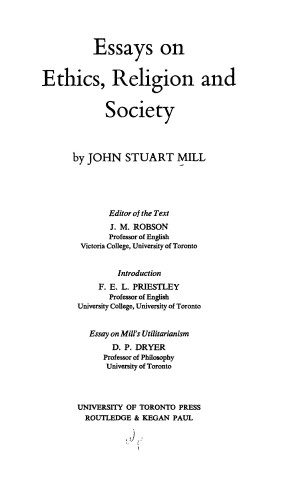
Front Page Titles (by Subject) WHEWELL ON MORAL PHILOSOPHY 1852 - The Collected Works of John Stuart Mill, Volume X - Essays on Ethics, Religion, and Society
Return to Title Page for The Collected Works of John Stuart Mill, Volume X - Essays on Ethics, Religion, and SocietyThe Online Library of LibertyA project of Liberty Fund, Inc.Search this Title:Also in the Library:
WHEWELL ON MORAL PHILOSOPHY 1852 - John Stuart Mill, The Collected Works of John Stuart Mill, Volume X - Essays on Ethics, Religion, and Society [1833]Edition used:The Collected Works of John Stuart Mill, Volume X - Essays on Ethics, Religion, and Society, ed. John M. Robson, Introduction by F.E.L. Priestley (Toronto: University of Toronto Press, London: Routledge and Kegan Paul, 1985).
Part of: Collected Works of John Stuart Mill, in 33 vols.About Liberty Fund:Liberty Fund, Inc. is a private, educational foundation established to encourage the study of the ideal of a society of free and responsible individuals. Copyright information:The online edition of the Collected Works is published under licence from the copyright holder, The University of Toronto Press. ©2006 The University of Toronto Press. All rights reserved. No part of this material may be reproduced in any form or medium without the permission of The University of Toronto Press. Fair use statement:This material is put online to further the educational goals of Liberty Fund, Inc. Unless otherwise stated in the Copyright Information section above, this material may be used freely for educational and academic purposes. It may not be used in any way for profit.
WHEWELL ON MORAL PHILOSOPHY
EDITOR’S NOTED&D, II (1867), 450-509, with footnote to title: “Westminster Review, October 1852.—1. ‘Lectures on the History of Moral Philosophy in England.’ By William Whewell, D.D., Master of Trinity College, and Professor of Moral Philosophy in the University of Cambridge. 1 vols. 8vo. [London: Parker,] 1852. 2. ‘Elements of Morality, including Polity.’ By the same Author. 2 vols. 8vo. [London: Parker,] 1845.” Reprinted from the Westminster and Foreign Quarterly Review, LVIII [n.s. II] (Oct., 1852), 349-85 and headed: “Art. II.—Whewell’s Moral Philosophy” with the same bibliographic information as in D&D. Identified in JSM’s bibliography as “A review of Whewell’s Lectures on the History of Moral Philosophy in England, & his Elements of Morality, in the Westminster Review new series No. 4 for October 1852” (MacMinn, 77). For a discussion of the relation between this article and some others in this volume, see the Textual Introduction, cxxii above, and the Preface to D&D, 493-4 below. JSM requested offprints of the article from John Chapman, the editor of the Westminster, but when only tear-sheets were sent, he refused the further offer of reprinting, saying that he did “not think it worth the expense” as he merely wished to give copies to friends (7 & 9/10/52; A.l.s. at Indiana University). In the one copy he retained he corrected the running-title on 359 from “Association” to “Asceticism” (Somerville College). The following text is collated with that in D&D (2nd ed.), and that in the Westminster. In the footnoted variants, D&D (2nd ed.) is indicated by “67”; D&D (1st ed.) by “59”; and the Westminster by “52”. Whewell on Moral Philosophyif the worth of Dr. Whewell’s writings could be measured by the importance and amplitude of their subjects, no writer of the age could vie with him in merit or usefulness. He has aspired to be not only the historian, but the philosopher and legislator, of almost all the great departments of human knowledge; reducing each to its first principles, and showing how it might be scientifically evolved from these as a connected whole. After endeavouring, in his History and Philosophy of the Inductive Sciences,[*] to place physics, and incidentally metaphysics, on a philosophic foundation, he has made an almost equally ambitious attempt on the subjects of morals and government, of which the two works before us are the results. He is thus entitled to the praise of having done his best to wipe off from the two endowed universities, in one of which he holds a high place, the reproach to which they have so long been justly liable, of neglecting the higher regions of philosophy. By his writings and influence, he has been an agent in that revival of speculation on the most difficult and highest subjects, which has been noticeable for some years past within as well as without the pale of Oxford and Cambridge. And inasmuch as mental activity of any kind is better than torpidity, and bad solutions of the great questions of philosophy are preferable to a lazy ignoring of their existence, whoever has taken so active a part as Dr. Whewell in this intellectual movement, may lay claim to considerable merit. Unfortunately it is not in the nature of bodies constituted like the English Universities, even when stirred up into something like mental activity, to send forth thought of any but one description. There have been universities (those of France and Germany have at some periods been practically conducted on this principle) which brought together into a body the most vigorous thinkers and the ablest teachers, whatever the conclusions to which their thinking might have led them. But in the English Universities no thought can find place, except that which can reconcile itself with orthodoxy. They are ecclesiastical institutions; and it is the essence of all churches to vow adherence to a set of opinions made up and prescribed, it matters little whether three or thirteen centuries ago. Men will some day open their eyes, and perceive how fatal a thing it is that the instruction of those who are intended to be the guides and governors of mankind should be confided to a collection of persons thus pledged. If the opinions they are pledged to were every one as true as any fact in physical science, and had been adopted, not as they almost always are, on trust and authority, but as the result of the most diligent and impartial examination of which the mind of the recipient was capable; even then, the engagement under penalties always to adhere to the opinions once assented to, would debilitate and lame the mind, and unfit it for progress, still more for assisting the progress of others. The person who has to think more of what an opinion leads to, than of what is the evidence of it, cannot be a philosopher, or a teacher of philosophers. Of what value is the opinion on any subject, of a man of whom every one knows that by his profession he must hold that opinion? and how can intellectual vigour be fostered by the teaching of those who, even as a matter of duty, would rather that their pupils were weak and orthodox, than strong with freedom of thought? Whoever thinks that persons thus tied are fitting depositaries of the trust of educating a people, must think that the proper object of intellectual education is not to strengthen and cultivate the intellect, but to make sure of its adopting certain conclusions: that, in short, in the exercise of the thinking faculty, there is something, either religion, or conservatism, or peace, or whatever it be, more important than truth. Not to dilate further on this topic, it is nearly inevitable, that when persons bound by the vows and placed in the circumstances of an established clergy, enter into the paths of higher speculation, and endeavour to make a philosophy, either purpose or instinct will direct them to the kind of philosophy best fitted to prop up the doctrines to which they are pledged. And when these doctrines are so prodigiously in arrear of the general progress of thought, as the doctrines of the Church of England now are, the philosophy resulting will have a tendency not to promote, but to arrest progress. Without the slightest wish to speak in disparagement of Dr. Whewell’s labours, and with no ground for questioning his sincerity of purpose, we think the preceding aremarka thoroughly applicable to his philosophical speculations. We do not say the intention, but certainly the tendency, of his efforts, is to shape the whole of philosophy, physical as well as moral, into a form adapted to serve as a support and a justification to any opinions which happen to be established. A writer who has gone beyond all his predecessors in the manufacture of necessary truths, that is, of propositions which, according to him, may be known to be true independently of proof; who ascribes this self-evidence to the larger generalities of all sciences (however little obvious at first) as soon as they have become familiar—was still more certain to regard all moral propositions familiar to him from his early years as self-evident truths. His Elements of Morality could be nothing better than a classification and systematizing of the opinions which he found prevailing among those who had been educated according to the approved methods of his own country; or, let us rather say, an apparatus for converting those prevailing opinions, on matters of morality, into reasons for themselves. This, accordingly, is what we find in Dr. Whewell’s volumes: while we have sought in vain for the numerous minor merits, which bgiveb a real scientific value to his previous works. If the Philosophy of the Inductive Sciences was, as we think, an erroneous philosophy, it contained much that was not unfit to find place in a better, and was often calculated to suggest deeper thoughts than it possessed of its own. But in the Elements of Morality he leaves the subject so exactly as he found it,—the book is so mere a catalogue of received opinions, containing nothing to correct any of them, and little which can work with any potency even to confirm them,—that it can scarcely be counted as anything more than one of the thousand waves on the dead sea of commonplace, affording nothing to invite or to reward a separate examination. We should not, therefore, have felt called upon to concern ourselves specially about it, if Dr. Whewell had not, in his more recent publication, Lectures on the History of Moral Philosophy in England, undertaken to characterize and criticise, from his own point of view, all other English writers on moral philosophy; and particularly those who derive their ethical conclusions, not from internal intuition, but from an external standard. So long as he contented himself with giving what we think bad reasons for common opinions, there was not much inducement to interfere with them; but assaults on the only methods of philosophising from which any improvement in ethical opinions can be looked for, ought to be repelled. And in doing this it is necessary to extend our comments to some of Dr. Whewell’s substantive opinions also. When he argues in condemnation of any external standard, and especially of utility, or tendency to happiness, as the principle or test of morality, it is material to examine how he gets on without it; how he fares in the attempt to construct a coherent theory of morals on any other basis. We shall make use of his larger work in so far only as it is evidence on this point. Even with the Lectures, considered as giving an account of English speculations on moral philosophy previous to the age of Bentham and Paley, it is not cour purposec to meddle: Hobbes, therefore, and Locke, must be left in the hands of Dr. Whewell, without any attempt either to correct his estimate of their opinions, or to offer any judgment of our own. This historical sketch suggests, however, one remark of an historical character, not new to any one who is conversant with the writings of English thinkers on ethical subjects. During the greater part of the eighteenth century, the received opinions in religion and ethics were chiefly attacked, as by Shaftesbury, and even by Hume, on the ground of instinctive feelings of virtue, and the theory of a moral taste or sense. As a consequence of this, the defenders of established opinions, both lay and clerical, commonly professed utilitarianism. To the many writers on the side of orthodoxy, of the utilitarian school, mentioned by Dr. Whewell, might be added several, of at least equal note, whom he has omitted; as John Brown, the author of Essays on the Characteristics; Soame Jenyns, and his more celebrated reviewer, Dr. Johnson; all of whom, as explicitly as Bentham, laid down the doctrine that utility is the foundation of morals. This series of writers attained its culmination in Paley, whose treatise, proclaiming without evasion or circumlocution, not only expediency as the end, but (a very different doctrine) simple self-interest as the motive, of virtue, and deducing from these premises all the orthodox conclusions, became the text-book of moral philosophy in one of the two Universities of the Church of England. But a change ensued, and the utilitarian doctrine, which had been the favourite theory of the defenders of orthodoxy, began to be used by its assailants. In the hands of the French philosophers, and in those of Godwin and of Bentham,—who, though earlier than Godwin in date, was later in acquiring popular influence,—a moral philosophy founded on utility led to many conclusions very unacceptable to the orthodox. For a whole generation, so effectual a fight was kept up against those conclusions, by bayonets in the field, and prosecutions in the courts of justice, that there seemed no necessity for taking much concern about the premises: but when those carnal weapons fell into disuse, and the spirit dwhichd had wielded them was laid—when the battle of established opinions in Church and State had again to be fought by argument, a demand arose for metaphysics and moral philosophy, of the kind most remote from that which appeared so full of danger to received opinions. Utility was now abjured as a deadly heresy, and the doctrine of à priori or self-evident morality, an end in itself, independent of all consequences, became the orthodox theory. Having once entered into this course, and gone in search of a philosophical system to be extracted from the mind itself, without any external evidence, the defenders of orthodoxy were insensibly led to seek their system where it exists in the most elaborate shape—in the German metaphysicians. It was not without reluctance that they found themselves engaged in this path; for German metaphysics in Germany lay under as grave a suspicion of religious scepticism, as the rival philosophy in England or France. But it was found on trial, that philosophy of this cast admitted of easy adaptation, and would bend to the very Thirty-nine Articles; as it is the essence of a philosophy which seeks its evidence in internal conviction, that it bears its testimony with equal ease for any conclusions in favour of which there is a predisposition, and is sceptical with the sceptical, and mystical with the mystical. Accordingly, the tone of religious metaphysics, and of the ethical speculations connected with religion, is now altogether Germanized; and Dr. Whewell, by his writings, has done no little to impress upon the metaphysics of orthodoxy this change of character. It has always been indistinctly felt that the doctrine of à priori principles is one and the same doctrine, whether applied to the ὂν or the δέον—to the knowledge of truth or to that of duty; that it belongs to the same general tendency of thought, to extract from the mind itself, without any outward standard, principles and rules of morality, and to deem it possible to discover, by mere introspection into oure minds, the laws of external nature. Both forms of this mode of thought attained a brilliant development in Descartes, the real founder of the modern anti-inductive school of philosophy. The Cartesian tradition was never lost, being kept alive by direct descent through Spinoza, Leibnitz, and Kant, to Schelling and Hegel; but the speculations of Bacon and Locke, and the progress of the experimental sciences, gave a long period of predominance to the philosophy of experience; and though many followed out that philosophy into its natural alliances, and acknowledged not only observation and experiment as rulers of the speculative world, but utility of the practical, others thought that it was scientifically possible to separate the two opinions, and professed themselves Baconians in the physical department, remaining Cartesians in the moral. It will probably be thought by posterity to be the principal merit of the German metaphysicians of the last and present age, that they have proved the impossibility of resting on this middle ground of compromise; and have convinced all thinkers of any force, that if they adhere to the doctrine of à priori principles of morals, they must follow Descartes and Hegel in ascribing the same character to the principles of physics. On the present occasion, it is only with the moral branch of the subject that we have to deal; and we shall begin by showing in what manner Dr. Whewell states the question between us. Schemes of morality, that is, modes of deducing the rules of human action, are of two kinds:—those which assert it to be the law of human action to aim at some external object, (external, that is, to the mind which aims,) as, for example, those which in ancient or modern times have asserted pleasure, or utility, or the greatest happiness of the greatest number, to be the true end of human action; and those which would regulate human action by an internal principle or relation, as conscience or a moral faculty, or duty, or rectitude, or the superiority of reason to desire. These two kinds of schemes may be described respectively as dependent and independent morality. Now, it is here held that independent morality is the true scheme. We maintain, with Plato, that reason has a natural and rightful authority over desire and affection; with Butler, that there is a difference of kind in our principles of action; with the general voice of mankind, that we must do what is right, at whatever cost of pain and loss. We deny the doctrine of the ancient Epicureans, that pleasure is the supreme good; of Hobbes, that moral rules are only the work of men’s mutual fear; of Paley, that what is expedient is right, and that there is no difference among pleasures except their intensity and duration; and of Bentham, that the rules of human action are to be obtained by casting up the pleasures which actions produce. But though we thus take our stand upon the ground of independent morality, as held by previous writers, we hope that we are (by their aid mainly) able to present it in a more systematic and connected form than has yet been done. (“Introductory Lecture,” [Lectures on the History of Moral Philosophy in England,] pp. ix-x.) There is in this mode of stating the question, great unfairness to the doctrine of “dependent morality,” as Dr. Whewell terms it, though the word independent is ffullyf as applicable to it as to the intuition doctrine. He appropriates to his own side of the question all the expressions, such as conscience, duty, rectitude, with which the reverential feelings of mankind towards moral ideas are associated, and cries goutg , I am for these noble things, you are for pleasure, or utility. We cannot accept this as a description of the matter in issue. Dr. Whewell is assuming to himself what belongs quite as rightfully to his antagonists. We are as much for conscience, duty, rectitude, as Dr. Whewell. The terms, and all the feelings connected with them, are as much a part of the ethics of utility as of hthat ofh intuition. The point in dispute is, what acts are the proper objects of those ifeelings; i whether we ought to take the feelings as we find them, as accident or design has made them, or whether the tendency of actions to promote happiness affords a test to which the feelings of morality should jconform.j In the same spirit, Dr. Whewell announces it as his opinion, as the side he takes in this great controversy, “that we must do what is right, at whatever cost of pain and loss.” As if this was not everybody’s opinion: as if it was not the very meaning of the word right. The matter in debate is, what is right, not whether what is right ought to be done. Dr. Whewell represents his opponents as denying an identical proposition, in order that he may claim a monopoly of high principle for his own opinions. The same unfairness pervades the whole phraseology. It is not only Dr. Whewell who “maintains, with Plato, that reason has a rightful authority over desire and affection.” Everybody maintains it; only, what is reason? and by what rule is it to guide and govern the desires and affections? The description of Bentham, as obtaining his rule of conduct by “casting up the pleasures which actions produce,” ought to be “casting up the pleasures and pains which actions produce:” a very different thing. As might be expected from the historical character of the Lectures, the discussion of opinions mostly assumes the form of criticism on writers. Dr. Whewell’s objections to utility, or the “greatest happiness,” as the standard of morals, are chiefly contained in his animadversions on Paley and on Bentham. It would be quite open to a defender of the principle of utility, to refuse encumbering himself with a defence of either of those authors. The principle is not bound up with what they have said in its behalf, nor with the degree of felicity which they may have shown in applying it. As for Paley, we resign him without compunction to the tender mercies of Dr. Whewell. It concerns Dr. Whewell more than ourselves to uphold the reputation of a writer, who, whatever principle of morals he professed, seems to have had no object but to insert it as a foundation underneath the existing set of opinions, ethical and political; who, when he had laid down utility as the fundamental axiom, and the recognition of general rules as the condition of its application, took his leave of scientific analysis, and betook himself to picking up utilitarian reasons by the wayside, in proof of all accredited doctrines, and in defence of most tolerated practices. Bentham was a moralist of another stamp. With him, the first use to be made of his ultimate principle, was to erect on it, as a foundation, secondary or middle principles, capable of serving as premises for a body of ethical doctrine not derived from existing opinions, but fitted to be their test. Without such middle principles, an universal principle, either in science or in morals, serves for little but a thesaurus of commonplaces for the discussion of questions, instead of a means of deciding them. If Bentham has been regarded by subsequent adherents of a morality grounded on the “greatest happiness,” as in a peculiar sense the founder of that system of ethics, it is not because, as Dr. Whewell imagines (p. 190), he either thought himself, or was thought by others, to be the “discoverer of the principle,” but because he was the first who, keeping clear of the direct and indirect influences of all doctrines inconsistent with it, deduced a set of subordinate generalities from utility alone, and by these consistently tested all particular questions. This great service, previously to which a scientific doctrine of ethics on the foundation of utility was impossible, has been performed by Bentham (though with a view to the exigencies of legislation more than to those of morals) in a manner, as far as it goes, eminently meritorious, and so as to indicate clearly the way to complete the scheme. We must at the same time qualify our approbation by adding, not that his practical conclusions kin moralsk were often wrong, for we think that as far as they went they were mostly right; but that there were large deficiencies and hiatuses in his scheme of human nature and life, and a consequent want of breadth and comprehension in his secondary principles, which led him often to deduce just conclusions from premises so narrow as to provoke many minds to a rejection of what was nevertheless truth. It is by his method chiefly that Bentham, as we think, justly earned a position in moral science analogous to that of Bacon in physical. It is because he was the first to enter into the right mode of working ethical problems, though he worked many of them, as Bacon did physical, on insufficient data. Dr. Whewell’s shafts, however, seldom touch Bentham where he is really vulnerable; they are mostly aimed at his strong points. Before commencing his attack on Bentham’s opinions, Dr. Whewell gives a sketch of his life. In this there is an apparent desire to be just to Bentham, as far as the writer’s opinions allow. But there is in some of the strictures a looseness of expression, lscarcelyl excusable in an extemporaneous lecture, and still less in a printed book. “He [Bentham] showed very early that peculiar one-sidedness in his mode of asserting and urging his opinions, which made him think all moderation with regard to his opponents superfluous and absurd” (p. 189). What is here called “one-sidedness in his mode of asserting and urging his opinions,” must mean one-sidedness in the opinions themselves. It could not be Bentham’s “mode of asserting his opinions,” that “made him think” whatever he did think. This is as if any one should say, “his speaking only English made him unable to understand French,” or “his peculiar habit of fighting made him think it superfluous and absurd to keep the peace.” Again (pp. 190-1), “Bentham appears to have been one of those persons to whom everything which passes through their own thoughts assumes quite a different character and value from that which the same thing had when it passed through the thoughts of other persons.” If a thought in a person’s own mind did not assume a different character from what the same thought had in other minds, people might as well think by deputy. A more serious injustice to Bentham is that of citing, as is constantly done in this volume, the book called Deontology, as the authentic exposition of Bentham’s philosophy of morals. Dr. Whewell would, no doubt, justify this by saying that the book in question is the only treatise expressly and exclusively on morals, which we have from Bentham. It is true that we have no other; but the Deontology was not, and does not profess to be written by Bentham.m Still less ought that book to be represented as the embodiment of the opinions and mental characteristics of all who share Bentham’s general conception of ethics. After charging the compiler of the Deontology with profound ignorance, and saying that it is almost “superfluous to notice misstatements so gross and partiality so blind,” Dr. Whewell adds that “such misrepresentations and such unfairness are the usual style of controversy of him [Bentham] and his disciples; and it is fit that we, in entering upon the consideration of their writings, should be aware of this.”[*] Who are the persons here included under the name of Bentham’s “disciples,” we are not enabled to judge; nor are we aware that Bentham ever had any disciples, in Dr. Whewell’s sense of the term. As far as our means of observation have gone, which nin this mattern are considerably greater than Dr. Whewell’s, those who, from the amount of their intellectual obligations to Bentham, would be the most likely to be classed by Dr. Whewell as Benthamites, were and are persons in an unusual degree addicted to judging and thinking for themselves; persons remarkable for learning willingly from all masters, but swearing blind fealty to none. It is also a fact, with which Dr. Whewell cannot be altogether unacquainted, that among them there have been men of the widest and most accurate acquirements in history and philosophy, against whom the accusation of ignorance of the opinions which they controverted would be as unfounded as the imputation of blind partiality. We protest against including them and Bentham in an imaginary sect, of which the Deontology is to be considered the gospel. Bentham’s merits or demerits must stand on what is contained in the books written by himself. Among these, the one in which the doctrine of utility is expressly discussed, and contrasted with the various ethical doctrines opposed to it, is the Introduction to the Principles of Morals and Legislation, published in 1789. On this Dr. Whewell comments as follows:— The first chapter of this work is ‘On the Principle of Utility:’ the second ‘On Principles adverse to that of Utility.’ These adverse principles are stated to be two: The Principle of Asceticism, and the Principle of Sympathy. [Bentham calls it the Principle of Sympathy and Antipathy, which is already a considerable difference.] The principle of asceticism is that principle which approves of actions in proportion as they tend to diminish human happiness, and, conversely, disapproves of them as they tend to augment it. The principle of sympathy is that which approves or disapproves of certain actions ‘merely because a man finds himself disposed to approve or disapprove of them, holding up that approbation or disapprobation as a sufficient reason for itself, and disclaiming the necessity of looking out for any extrinsic ground.’ And these two principles are, it seems, according to Bentham’s view, the only principles which are, or which can be, opposed to the principle of utility! Now it is plain that these are not only not fair representations of any principles ever held by moralists, or by any persons speaking gravely and deliberately, but that they are too extravagant and fantastical to be accepted even as caricatures of any such principles. For who ever approved of actions because they tend to make mankind miserable? or who ever said anything which could, even in an intelligible way of exaggeration, be so represented? . . . But who then are the ascetic school who are thus ridiculed? We could not, I think, guess from the general description thus given; but from a note, it appears that he had the Stoical philosophers and the religious ascetics in his mind. With regard to the Stoics, it would of course be waste of time and thought to defend them from such coarse buffoonery as this, which does not touch their defects, whatever these may be, [&c.] (Pp. 202-3.) Not solely for the due estimation of Bentham, but for the right understanding of the utilitarian controversy, it is important to know what the truth is, respecting the points here in issue between Bentham and Dr. Whewell. Undoubtedly no one has set up, in opposition to the “greatest happiness” principle, a “greatest unhappiness” principle, as the standard of virtue. But it was Bentham’s business not merely to discuss the avowed principles of his opponents, but to draw out those which, without being professed as principles, were implied in detail, or were essential to support the judgments passed in particular cases. His own doctrine being that the increase of pleasure and the prevention of pain were the proper ends of all moral rules, he had for his opponents all who contended that pleasure could ever be an evil or pain a good in itself, apart from its consequences. Now this, whatever Dr. Whewell may say, the religious ascetics really did. They held that self-mortification, or even self-torture, practised for its own sake, and not for the sake of any useful end, was meritorious. It matters not that they may have expected to be rewarded for these merits by consideration in this world, or by the favour of an invisible tyrant in a world to come. So far as this life was concerned, their doctrine required it to be supposed that pain was a thing to be sought, and pleasure to be avoided. Bentham generalized this into a maxim, which he called the principle of asceticism. The Stoics did not go so far as the ascetics; they stopped half-way. They did not say that pain is a good, and pleasure an evil. But they said, and boasted of saying, that pain is no evil, and pleasure no good: and this is all, and more than all, that Bentham imputes to them, as may be seen by any one who reads that chapter of his book. This, however, was enough to place them, equally with the ascetics, in direct opposition to Bentham, since they denied his supreme end to be an end at all. And hence he classed them and the ascetics together, as professing the direct negation of the utilitarian standard. In the other division of his opponents he placed those who, though they did not deny pleasure to be a good and pain an evil, refused to consider the pain or the pleasure which an action or a class of actions tends to produce, as the criterion of its morality. As the former category of opponents were described by Bentham as followers of the “principle of asceticism,” so he described these as followers of “the principle of sympathy and antipathy;” not because they had themselves generalized their principle of judgment, or would have acknowledged it when placed undisguised before them; but because, at the bottom of what they imposed on themselves and others as reasons, he could find nothing else; because they all, in one phrase or another, placed the test of right and wrong in a feeling of approbation or disapprobation, thus making the feeling its own reason and its own justification. This portion of Bentham’s doctrine can only be fairly exhibited in his own words. It is manifest that this [the principle of sympathy and antipathy] is rather a principle in name than in reality; it is not a positive principle of itself, so much as a term employed to signify the negation of all principle. What one expects to find in a principle is something that points out some external consideration as a means of warranting and guiding the internal sentiments of approbation and disapprobation: this expectation is but ill fulfilled by a proposition which does neither more nor less than hold up each of these sentiments as a ground and standard for itself. In looking over the catalogue of human actions (says a partisan of this principle) in order to determine which of them are to be marked with the seal of disapprobation, you need but to take counsel of your own feelings; whatever you find in yourself a propensity to condemn, is wrong for that very reason. For the same reason it is also meet for punishment: in what proportion it is adverse to utility, or whether it be adverse to utility at all, is a matter that makes no difference. In that same proportion also is it meet for punishment: if you hate much, punish much; if you hate little, punish little: punish as you hate. If you hate not at all, punish not at all: the fine feelings of the soul are not to be overborne and tyrannized by the harsh and rugged dictates of political utility. The various systems that have been formed concerning the standard of right and wrong, may all be reduced to the principle of sympathy and antipathy. One account may serve for all of them. They consist, all of them, in so many contrivances for avoiding the obligation of appealing to any external standard, and for prevailing upon the reader to accept of the author’s sentiment or opinion as a reason for itself. The phrase is different, but the principle the same. It is curious enough to observe the variety of inventions men have hit upon, and the variety of phrases they have brought forward, in order to conceal from the world, and if possible from themselves, this very general, and therefore very pardonable self-sufficiency. One man says, he has a thing made on purpose to tell him what is right and what is wrong, and that it is called a moral sense; and then he goes to work at his ease, and says, such a thing is right, and such a thing is wrong—why? ‘because my moral sense tells me it is.’ Another man comes and alters the phrase; leaving out moral, and putting in common in the room of it. He then tells you, that his common sense teaches him what is right and wrong, as much as the other’s moral sense did: meaning, by common sense, a sense of some kind or other, which, he says, is possessed by all mankind; the sense of those, whose sense is not the same as the author’s, being struck out of the account as not worth taking. This contrivance does better than the other; for a moral sense being a new thing, a man may feel about him a good while without being able to find it out; but common sense is as old as the creation; and there is no man but would be ashamed to be thought not to have as much of it as his neighbours. It has another great advantage; by appearing to share power, it lessens envy: for when a man gets up upon this ground, in order to anathematize those who differ from him, it is not by a sic volo sic jubeo, but by a velitis jubeatis. Another man comes, and says, that as to a moral sense indeed, he cannot find that he has any such thing; that, however, he has an understanding, which will do quite as well. This understanding, he says, is the standard of right and wrong: it tells him so and so. All good and wise men understand as he does: if other men’s understandings differ in any point from his, so much the worse for them; it is a sure sign they are either defective or corrupt. Another man says, that there is an eternal and immutable rule of right; that that rule of right dictates so and so; and then he begins giving you his sentiments upon anything that comes uppermost; and these sentiments (you are to take for granted) are so many branches of the eternal rule of right. Another man, or perhaps the same man (it’s no matter), says, that there are certain practices conformable, and others repugnant, to the fitness of things; and then he tells you, at his leisure, what practices are conformable and what repugnant; just as he happens to like a practice or dislike it. A great multitude of people are continually talking of the law of nature; and then they go on giving you their sentiments about what is right and what is wrong; and these sentiments, you are to understand, are so many chapters and sections of the law of nature. We have one philosopher who says, there is no harm in anything in the world but in telling a lie; and that if, for example, you were to murder your own father, this would only be a particular way of saying, he was not your father. Of course, when this philosopher sees anything that he does not like, he says, it is a particular way of telling a lie. It is saying, that the act ought to be done, or may be done, when, in truth, it ought not to be done. (Chap. ii.)[*] To this Dr. Whewell thinks it a sufficient answer to call it extravagant ridicule, and to ask, “Who ever asserted that he approved or disapproved of actions merely because he found himself disposed to do so, and that this was reason sufficient in itself for his moral judgments?”[†] Dr. Whewell will find that this by no means disposes of Bentham’s doctrine. Bentham did not mean that people “ever asserted” that they approved or condemned actions only because they felt disposed to do so. He meant that they do it without asserting it; that they find certain feelings of approbation and disapprobation in themselves, take for granted that these feelings are the right ones, and when called on to say anything in justification of their approbation or disapprobation, produce phrases which mean nothing but the fact of the approbation or disapprobation itself. If the hearer or reader feels in the same way, the phrases pass muster; and a great part of all the ethical reasoning in books and in the world is of this sort. All this is not only true, but cannot consistently be denied by those who, like Dr. Whewell, consider the moral feelings as their own justification. Dr. Whewell will doubtless say that the feelings they appeal to are not their own individually, but a part of universal human nature. Nobody denies that they say so: a feeling of liking or aversion to an action, confined to an individual, would have no chance of being accepted as a reason. The appeal is always to something which is assumed to belong to all mankind. But it is not of much consequence whether the feeling which is set up as its own standard is the feeling of an individual human being, or of a multitude. A feeling is not proved to be right, and exempted from the necessity of justifying itself, because the writer or speaker is not only conscious of it in himself, but expects to find it in other people; because instead of saying “I,” he says “you and I.” If it is alleged that the intuitive school require, as an authority for the feeling, that it should in fact be universal, we deny it. They assume the utmost latitude of arbitrarily determining whose votes deserve to be counted. They either ignore the existence of dissentients, or leave them out of the account, on the pretext that they have the feeling which they deny having, or if not, that they ought to have it. This falsification of the universal suffrage which is ostensibly appealed to, is not confined, as is often asserted, to cases in which the only dissentients are barbarous tribes. The same measure is dealt out to whole ages and nations, the most conspicuous for the cultivation and development of their mental faculties; and to individuals among the best and wisest of their respective countries. The explanation of the matter is, the inability of persons in general to conceive that feelings of right and wrong, which have been deeply implanted in their minds by the teaching they have from infancy received from all around them, can be sincerely thought by any one else to be mistaken or misplaced. This is the mental infirmity which Bentham’s philosophy tends especially to correct, and Dr. Whewell’s to perpetuate. Things which were really believed by all mankind, and for which all were convinced that they had the unequivocal evidence of their senses, have been proved to be false: as that the sun rises and sets. Can immunity from similar error be claimed for the moral feelings? when all experience shows that those feelings are eminently artificial, and the product of culture; that even when reasonable, they are no more spontaneous than the growth of corn and wine (which are quite as natural), and that the most senseless and pernicious feelings can as easily be raised to the utmost intensity by inculcation, as hemlock and thistles could be reared to luxuriant growth by sowing them instead of wheat. Bentham, therefore, did not judge too severely a kind of ethics whereby any implanted sentiment which is tolerably general may be erected into a moral law, binding, under penalties, on all mankind. The contest between the morality which appeals to an external standard, and that which grounds itself on internal conviction, is the contest of progressive morality against stationary—of reason and argument against the deification of mere opinion and habit. The doctrine that the existing order of things is the natural order, and that, being natural, all innovation upon it is criminal, is as vicious in morals, as it is now at last admitted to be in physics, and in society and government. Let us now consider Dr. Whewell’s objections to utility as the foundation of ethics. Let it be taken for granted, as a proposition which is true, if the terms which it involves be duly understood, that actions are right and virtuous in proportion as they promote the happiness of mankind; the actions being considered upon the whole, and with regard to all their consequences. Still, I say, we cannot make this truth the basis of morality, for two reasons: first, we cannot calculate all the consequences of any action, and thus cannot estimate the degree in which it promotes human happiness; second, happiness is derived from moral elements, and therefore we cannot properly derive morality from happiness. The calculable happiness resulting from actions cannot determine their virtue: first, because the resulting happiness is not calculable; and secondly, because the virtue is one of the things which determine the resulting happiness. (P. 210.) The first of these arguments is an irrelevant truism. “We cannot calculate all the consequences of any action.” If Dr. Whewell can point out any department of human affairs in which we can do all that would be desirable, he will have found something new. But because we cannot foresee everything, is there no such thing as foresight? Does Dr. Whewell mean to say that no estimate can be formed of consequences, which can be any guide for our conduct, unless we can calculate all consequences? that because we cannot predict every effect which may follow from a person’s death, we cannot know that the liberty of murder would be destructive to human happiness? Dr. Whewell, in his zeal against the morality of consequences, commits the error of proving too much. Whether morality is or is not a question of consequences, he cannot deny that prudence is; and if there is such a thing as prudence, it is because the consequences of actions can be calculated. Prudence, indeed, depends on a calculation of the consequences of individual actions, while for the establishment of moral rules it is only necessary to calculate the consequences of classes of actions—a much easier matter. It is certainly a very effectual way of proving that morality does not depend on expediency, to maintain that there is no such thing as expediency—that we have no means of knowing whether anything is expedient or not. Unless Dr. Whewell goes this length, to what purpose is what he says about the uncertainty of consequences? Uncertain or certain, we are able to guide ourselves by them, otherwise human life could not exist. And there is hardly any one concerned in the business of life, who has not daily to decide questions of expediency far more knotty than those which Dr. Whewell so coolly pronounces to be insoluble. But let us examine more closely what Dr. Whewell finds to say for the proposition, that “if we ask whether a given action will increase or diminish the total amount of human happiness, it is impossible to answer with any degree of certainty.” Take ordinary cases. I am tempted to utter a flattering falsehood: to gratify some sensual desire contrary to ordinary moral rules. How shall I determine, on the greatest happiness principle, whether the act is virtuous, or the contrary? In the first place, the direct effect of each act is to give pleasure, to another by flattery, to myself by sensual gratification; and pleasure is the material of happiness, in the scheme we are now considering. But by the flattering lie I promote falsehood, which is destructive of confidence, and so, of human comfort. Granted that I do this in some degree—although I may easily say that I shall never allow myself to speak falsely, except when it will give pleasure; and thus I may maintain that I shall not shake confidence in any case in which it is of any value. But granted that I do, in some degree, shake the general fabric of mutual human confidence by my flattering lie,—still the question remains, how much I do this: whether in such a degree as to overbalance the pleasure, which is the primary and direct consequence of the act. How small must be the effect of my solitary act upon the whole scheme of human action and habit! how clear and decided is the direct effect of increasing the happiness of my hearer! And in the same way we may reason concerning the sensual gratification. Who will know it? Who will be influenced by it of those who do know it? What appreciable amount of pain will it produce in its consequences, to balance the palpable pleasure, which, according to our teachers, is the only real good? It appears to me that it is impossible to answer these questions in any way which will prove, on these principles, mendacious flattery, and illegitimate sensuality, to be vicious and immoral. They may possibly produce, take in all their effects, a balance of evil; but if they do, it is by some process which we cannot trace with any clearness, and the result is one which we cannot calculate with any certainty, or even probability; and therefore, on this account, because the resulting evil of such falsehood and sensuality is not calculable or appreciable, we cannot, by calculation of resulting evil, show falsehood and sensuality to be vices. And the like is true of other vices; and, on this ground, the construction of a scheme of morality on Mr. Bentham’s plan is plainly impossible. (Pp. 210-12.) Dr. Whewell supposes his self-deceiving utilitarian to be very little master of his own principles. If the effect of a “solitary act upon the whole scheme of human action and habit” is small, the addition which the accompanying pleasure makes to the general mass of human happiness is small likewise. So small, in the great majority of cases, are both, that we have no scales to weigh them against each other, taken singly. We must look at them multiplied, and in large masses. The portion of the tendencies of an action which belong to it not individually, but as a violation of a general rule, are as certain and as calculable as any other consequences; oonlyo they must be examined not in the individual case, but in classes of cases. Take, for example, the case of murder. There are many persons to kill whom would be to remove men who are a cause of no good to any human being, of cruel physical and moral suffering to pseveralp , and whose whole influence tends to increase the mass of unhappiness and vice. Were such a man to be assassinated, the balance of traceable consequences would be greatly in favour of the act. The counter-consideration, on the principle of utility, is, that unless persons were punished for killing, and taught not to kill; that if it were thought allowable for any one to put to death at pleasure any human being whom he believes that the world would be well rid of, nobody’s life would be safe. To this Dr. Whewell answers— How does it appear that the evil, that is, the pain, arising from violating a general rule once, is too great to be overbalanced by the pleasurable consequences of that single violation? The actor says, I acknowledge the general rule—I do not deny its value; but I do not intend that this one act should be drawn into consequence. (Pp. 212-13.) But it does not depend on him whether or not it shall be drawn into consequence. If one person may break through the rule on his own judgment, the same liberty cannot be refused to others; and since no one could rely on the rule’s being observed, the rule would cease to exist. If a hundred infringements would produce all the mischief implied in the abrogation of the rule, a hundredth part of that mischief must be debited to each one of the infringements, though we may not be able to trace it home individually. And this hundredth part will generally far outweigh any good qexpected to ariseq from the individual act. We say generally, not universally; for the admission of exceptions to rules is a necessity equally felt in all systems of morality. To take an obvious instance, the rule against homicide, the rule against deceiving, the rule against taking advantage of superior physical strength, and various other important moral rules, are suspended against enemies in the field, and partially against malefactors in private life: in each case suspended as far as is required by the peculiar nature of the case. That the moralities arising from the special circumstances of the action may be so important as to overrule those arising from the class of acts to which it belongs, perhaps to take it out of the category of virtues into that of crimes, or vice versâ, is a liability common to all ethical systems. And here it may be observed that Dr. Whewell, in his illustration drawn from flattering lies, gives to the side he advocates a colour of rigid adherence to principle, which the fact does not bear out. Is none of the intercourse of society carried on by those who hold the common opinions, by means of what is here meant by “flattering lies?” Does no one of Dr. Whewell’s way of thinking say, or allow it to be thought, that he is glad to see a visitor whom he wishes away? Does he never ask acquaintances or relatives to stay when he would prefer them to go, or invite them when he hopes that they will refuse? Does he never show any interest in persons and things he cares nothing for, or send people away believing in his friendly feeling, to whom his real feeling is indifference, or even dislike? Whether these things are right, we are not now going to discuss. For our part, we think that flattery should be only permitted to those who can flatter without lying, as all persons of sympathizing feelings and quick perceptions can. At all events, the existence of exceptions to moral rules is no stumbling-block peculiar to the principle of utility. The essential is, that the exception should be itself a general rule; so that, being of definite extent, and not leaving the expediencies to the partial judgment of the agent in the individual case, it may not shake the stability of the wider rule in the cases to which the reason of the exception does not extend. This is an ample foundation for “the construction of a scheme of morality.” With respect to the means of inducing people to conform in their actions to the scheme so formed, the utilitarian system depends, like all other schemes of morality, on the external motives supplied by law and opinion, and the internal feelings produced by education or reason. It is thus no worse off in this respect than any other scheme—we might rather say, much better; inasmuch as people are likely to be more willing to conform to rules when a reason is given for them. Dr. Whewell’s second argument against the happiness principle is, that the morality of actions cannot depend on the happiness they produce, because the happiness depends on the morality. Why should a man be truthful and just? Because acts of veracity and justice, even if they do not produce immediate gratification to him and his friends in other ways (and it may easily be that they do not), at least produce pleasure in this way, that they procure him his own approval and that of all good men. To us this language is intelligible and significant; but the Benthamite must analyze it further. What does it mean according to him? A man’s own approval of his act, means that he thinks it virtuous. And therefore the matter stands thus. He (being a Benthamite) thinks it virtuous, because it gives him pleasure; and it gives him pleasure because he thinks it virtuous. This is a vicious circle, quite as palpable as any of those in which Mr. Bentham is so fond of representing his adversaries as revolving. And in like manner with regard to the approval of others. The action is virtuous, says the Benthamite, because it produces pleasure; namely, the pleasure arising from the approval of neighbours; they approve it and think it virtuous, he also says, because it gives pleasure. The virtue depends upon the pleasure, the pleasure depends upon the virtue. Here again is a circle from which there is no legitimate egress. We may grant that, taking into account all the elements of happiness—the pleasures of self-approval—of peace of mind and harmony within us, and of the approval of others—of the known sympathy of all good men;—we may grant that, including these elements, virtue always does produce an overbalance of happiness; but then we cannot make this moral truth the basis of morality, because we cannot extricate the happiness and the virtue the one from the other, so as to make the first, the happiness, the foundation of the second, the virtue. (Pp. 215-16.) In Dr. Whewell’s first argument against utility, he was obliged to assert that it is impossible for human beings to know that some actions are useful and others hurtful. In the present, he forgets against what principle he is combating, and draws out an elaborate argument against something else. What he now appears to be contending against, is the doctrine (whether really held by any one or not), that the test of morality is the greatest happiness of the agent himself. It argues total ignorance of Bentham, to represent him as saying that an action is virtuous because it produces “the approbation of neighbours,” and as making so “fluctuating” a thing as “public opinion,” and such a “loose and wide abstraction as education,” the “basis of morality.” When Bentham talks of public opinion in connexion with morality, he is not talking of the “basis of morality” at all. He was the last person to found the morality of actions upon anybody’s opinion of them. He founded it upon facts: namely, upon the observed tendencies of the actions. Nor did he ever dream of defining morality to be the self-interest of the agent. His “greatest happiness principle” was the greatest happiness of mankind, and of all sensitive beings. When he talks of education, and of “the popular or moral sanction,” meaning the opinion of our fellow-creatures, it is not as constituents or tests of virtue, but as motives to it; as means of making the self-interest of the individual accord with the greatest happiness principle.* Dr. Whewell’s remark, therefore, that the approval of our fellow-creatures, presupposing moral ideas, cannot be the foundation of morality, has no application against Bentham, nor against the principle of utility. It may, however, be pertinently remarked, that the moral ideas which this approval presupposes, are no other than those of utility and hurtfulness. There is no great stretch of hypothesis in supposing that in proportion as mankind are aware of the tendencies of actions to produce happiness or misery, they will like and commend the first, abhor and reprobate the second. How these feelings of natural complacency and natural dread and aversion directed towards actions, come to assume the peculiar character of what we term moral feelings, is not a question of ethics but of metaphysics, and very fit to be discussed in its proper place. Bentham did not concern himself with it. He left it to other thinkers. It sufficed him that the perceived influence of actions on human happiness is cause enough, both in reason and in fact, for strong feelings of favour to some actions and of hatred towards others. From the sympathetic reaction of these feelings in the imagination and self-consciousness of the agent, naturally arise the more complex feelings of self-approbation and self-reproach, or, to avoid all disputed questions, we will merely say of satisfaction and dissatisfaction with ourselves. All this must be admitted, whatever else may be denied. Whether the greatest happiness is the principle of morals or not, people do desire their own happiness, and do consequently like the conduct in other people which they think promotes it, and dislike that which visibly endangers it. This is absolutely all that Bentham postulates. Grant this, and you have his popular sanction, and its reaction on the agent’s own mind, two influences tending, in proportion to mankind’s enlightenment, to keep the conduct of each in the line which promotes the general happiness. Bentham thinks that there is no other true morality than this, and that the so-called moral sentiments, whatever their origin or composition, should be trained to act in this direction only. And Dr. Whewell’s attempt to find anything illogical or incoherent in this theory, only proves that he does not yet understand it. Dr. Whewell puts the last hand to his supposed refutation of Bentham’s principle, by what he thinks a crushing reductio ad absurdum. The reader might make a hundred guesses before discovering what this is. We have not yet got over our astonishment, not at Bentham, but at Dr. Whewell. See, he says, to what consequences your greatest-happiness principle leads! Bentham says that it is as much a moral duty to regard the pleasures and pains of other animals as those of human beings. We cannot resist quoting the admirable passage which Dr. Whewell cites from Bentham, with the most naïf persuasion that everybody will regard it as reaching the last pitch of paradoxical absurdity. Under the Gentoo and Mahometan religion the interests of the rest of the animal kingdom seem to have met with some attention. Why have they not, universally, with as much as those of human creatures, allowance made for the difference in point of sensibility? Because the laws that are, have been the work of mutual fear; a sentiment which the less rational animals have not had the same means as man has of turning to account. Why ought they not? No reason can be given. The day may come when the rest of the animal creation may acquire those rights which never could have been withholden from them but by the hand of tyranny. It may come one day to be recognised that the number of the legs, the villosity of the skin, or the termination of the os sacrum, are reasons insufficient for abandoning a sensitive being to the caprice of a tormentor. What else is it that should trace the insuperable line? Is it the faculty of reason, or perhaps the faculty of discourse? But a full-grown horse or dog is beyond comparison a more rational, as well as a more conversable animal, than an infant of a day, a week, or even a month old. But suppose the case were otherwise, what would it avail? The question is not, can they reason? nor, can they speak? but, can they suffer?[*] This noble anticipation, in 1780, of the better morality of which a first dawn has been seen in the laws enacted nearly fifty years afterwards against cruelty to animals, is in Dr. Whewell’s eyes the finishing proof that the morality of happiness is absurd! The pleasures of animals are elements of a very different order from the pleasures of man. We are bound to endeavour to augment the pleasures of men, not only because they are pleasures, but because they are human pleasures. We are bound to men by the universal tie of humanity, of human brotherhood. We have no such tie to animals. [Lectures, p. 223.] This then is Dr. Whewell’s noble and disinterested ideal of virtue. Duties, according to him, are only duties to ourselves and our like. We are to be humane to them, because we are human, not because we and they alike feel animal pleasures. . . . The morality which depends upon the increase of pleasure alone, would make it our duty to increase the pleasure of pigs or of geese rather than that of men, if we were sure that the pleasures we could give them were greater than the pleasures of men. . . . . It is not only not an obvious, but to most persons not a tolerable doctrine, that we may sacrifice the happiness of men provided we can in that way produce an overplus of pleasure to cats, dogs, and hogs. (Pp. 223-5.) It is “to most persons” in the Slave States of America not a tolerable doctrine that we may sacrifice any portion of the happiness of white men for the sake of a greater amount of happiness to black men. It would have been intolerable five centuries ago “to most persons” among the feudal nobility, to hear it asserted that the greatest pleasure or pain of a hundred serfs ought not to give way to the smallest of a nobleman. According to the standard of Dr. Whewell, the slavemasters and the nobles were right. They too felt themselves “bound” by a “tie of brotherhood” to the white men and to the nobility, and felt no such tie to the negroes and serfs. And if a feeling on moral subjects is right because it is natural, their feeling was justifiable. Nothing is more natural to human beings, nor, up to a certain point in cultivation, more universal, than to estimate the pleasures and pains of others as deserving of regard exactly in proportion to their likeness to rourselvesr . These superstitions of selfishness had the characteristics by which Dr. Whewell recognises his moral rules; and his opinion on the rights of animals shows that in this case at least he is consistent. We are perfectly willing to stake the whole question on this one issue. Granted that any practice causes more pain to animals than it gives pleasure to smans ; is that practice moral or immoral? And if, exactly in proportion as human beings raise their heads out of the slough of selfishness, they do not with one voice answer “immoral,” let the morality of the principle of utility be for ever condemned. There cannot be a fitter transition than this subject affords, from the Benthamic standard of ethics to that of Dr. Whewell. It is not enough to object to the morality of utility. It is necessary also to show that there is another and a better morality. This is what Dr. Whewell proposes to himself in his Introductory Lecture, and in the whole of his previous work, Elements of Morality. We shall now, therefore, proceed to examine Dr. Whewell’s achievements as the constructor of a scientific foundation for the theory of morals. “The moral rule of human action,” Dr. Whewell says, is that “we must do what is right.” (Lectures, p. xi.) Here, at all events, is a safe proposition; since to deny it would be a contradiction in terms. But what is meant by “right?” According to Dr. Whewell, “what we must do.” This, he says, is the very definition of right. The definition of rightful, or of the adjective right, is, I conceive, contained in the maxim which I have already quoted as proceeding from the general voice of mankind: namely this, that we must do what is right at whatever cost. That an action is right, is a reason for doing it, which is paramount to all other reasons, and overweighs them all when they are on the contrary side. It is painful; but it is right: therefore we must do it. It is a loss; but it is right: therefore we must do it. It is unkind; but it is right: therefore we must do it. These are self-evident [he might have said identical] propositions. That a thing is right, is a supreme reason for doing it. Right implies this supreme, unconquerable reason; and does this especially and exclusively. No other word does imply such an irresistible cogency in its effect, except in so far as it involves the same notion. What we ought to do, what we should do, that we must do, though it bring pain and loss. But why? Because it is right. The expressions all run together in their meaning. And this supreme rule, that we must do what is right, is also the moral rule of human action. (Pp. x-xi.) Right means that which we must do, and the rule of action is, that we must do what is right; that we must do that which we must do. This we will call vicious circle the first. But let us not press hardly on Dr. Whewell at this stage; perhaps he only means that the foundation of morals is the conviction that there is something which we must do at all risks; and he admits that we have still to find what this something is. “What is right; what it is that we ought to do, we must have some means of determining, in order to complete our moral scheme.” (P. xi.) Attempting then to pick out Dr. Whewell’s leading propositions, and exhibit them in connexion, we find, first, that “the supreme rule of human action, Rightness,” ought to control the desires and affections, or otherwise that these are “to be regulated so that they may be right.” (Pp. xii-xiii.) This does not help towards showing what is right. But secondly, we come to a “condition which is obviously requisite.” In order that the desires and affections which relate to “other men” may be right, “they must conform to this primary and universal condition, that they do not violate the rights of others. This condition may not be sufficient, but it is necessary.” (Pp. xiii-xiv.) This promises something. In tracing to its elements the idea of Right, the adjective, we are led to the prior, and it is to be presumed more elementary idea, of Rights, the substantive. But now, what are rights? and how came they to be rights? Before answering these questions, Dr. Whewell gives a classification of rights “commonly recognised among men.” [P. xiv.] He says, they are of five sorts, “those of person, property, family, state, and contract.” (P. xv.) But how do we discover that they are rights? and what is meant by calling them rights? Much to our surprise, Dr. Whewell refers us, on both these points, to the law. And he asks, “in what manner do we rise from mere legal rights to moral rightness?” and replies, “we do so in virtue of this principle: that the supreme rule of man’s actions must be a rule which has authority over the whole of man; over his intentions as well as his actions; over his affections, his desires, his habits, his thoughts, his wishes.” [P. xv.] We must not only not violate the rights of others, but we must not desire to violate them. “And thus we rise from legal obligation to moral duty; from legality to virtue; from blamelessness in the forum of man to innocence in the court of conscience.” [P. xvi.] And this Dr. Whewell actually gives as his scheme of morality. His rule of right is, to infringe no rights conferred by the law, and to cherish no dispositions which could make us desire such infringements! According to this, the early Christians, the religious reformers, the founders of all free governments, Clarkson, Wilberforce, and all enemies of the rights of slaveowners, must be classed among the wicked. If this is Dr. Whewell’s morality, it is the very Hobbism which he reprobates, and this in its worst sense. But though Dr. Whewell says that this is his morality, he presently unsays it. Our morality is not derived from the special commands of existing laws, but from the fact that laws exist, and from our classification of their subjects. Personal safety, property, contracts, family and civil relations, are everywhere the subjects of law, and are everywhere protected by law; therefore we judge that these things must be the subjects of morality, and must be reverently regarded by morality. But we are not thus bound to approve of all the special appointments with regard to those subjects, which may exist at a given time in the laws of a given country. On the contrary, we may condemn the laws as being contrary to morality. We cannot frame a morality without recognising property, and property exists through law; but yet the law of property, in a particular country, may be at variance with that moral purpose for which, in our eyes, laws exist. Law is the foundation and necessary condition of justice; but yet laws may be unjust, and when unjust ought to be changed. (P. xvii.) The practical enormities consequent on Dr. Whewell’s theory are thus got rid of; but when these are gone, there is nothing of the theory left. He undertook to explain how we may know what is right. It appeared at first that he was about to give a criterion, when he said that it is not right to violate legal rights. According to this, when we want to know what is right, we have to consult the law, and see what rights it recognises. But now it seems that these rights may be contrary to right; and all we can be sure of is, that it is right there should be rights of some sort. And we learn that, after all, it is for a “moral purpose” that in Dr. Whewell’s opinion “laws exist.” So that while the meaning of ought is that we ought to respect rights, it is a previous condition that these rights must be such as ought to be respected. Morality must conform to law, but law must first conform to morality. This is vicious circle the second. Dr. Whewell has broken out of the first; he has made, this time, a larger sweep; the curve he describes is wider, but it still returns into itself. An adherent of “dependent morality” would say that, instead of deriving right from rights, we must have a rule of right before it can be decided what ought to be rights; and that, both in law and in morals, the rights which ought to exist are those which for the general happiness it is expedient should exist. And Dr. Whewell anticipates that some one may even do him what he thinks the injustice of supposing this to be his opinion. He introduces an objector as saying, “that by making our morality begin from rights, we really do found it upon expediency, notwithstanding our condemnation of systems so founded. For, it may be said, rights such as property exist only because they are expedient.” Dr. Whewell hastens to repel this imputation; and here is his theory. “We reply as before, that rights are founded on the whole nature of man, in such a way that he cannot have a human existence without them. He is a moral being, and must have rights, because morality cannot exist where rights are not.” [Pp. xviii-xix.] Was ever an unfortunate metaphysician driven into such a corner? We wanted to know what morality is, and Dr. Whewell said that it is conforming to rights. We ask how he knows that there are rights, and he answers, because otherwise there could be no morality. This is vicious circle the third, and the most wonderful of the three. The Indians placed their elephant on the back of a tortoise, but they did not at the same time place the tortoise on the back of the elephant. Dr. Whewell has failed in what it was impossible to succeed in. Every attempt to dress up an appeal to intuition in the forms of reasoning, must break down in the same manner. The system must, from the conditions of the case, revolve in a circle. If morality is not to gravitate to any end, but to hang self-balanced in space, it is useless attempting to suspend one point of it upon another point. The fact of moral rules supposes a certain assemblage of ideas. It is to no purpose detaching these ideas one from another, and saying that one of them must exist because another does. Press the moralist a step farther, and he can only say that the other must exist because of the first. The house must have a centre because it has wings, and wings because it has a centre. But the question was about the whole house, and how it comes to exist. It would be much simpler to say plainly, that it exists because it exists. This is what Dr. Whewell is in the end obliged to come to; and he would have saved himself a great deal of bad logic, if he had begun with it.* So much as to the existence of moral rules: now as to what they are. We do not rest our rules of action upon the tendency of actions to produce the happiness of others, or of mankind in general; because we cannot solve a problem so difficult as to determine which of two courses of action will produce the greatest amount of human happiness: and we see a simpler and far more satisfactory mode of deducing such rules; namely, by considering that there must be such rules; that they must be rules for man; for man living among men; and for the whole of man’s being. Since we are thus led directly to moral rules, by the consideration of the internal condition of man’s being, we cannot think it wise to turn away from this tmethod,t and to try to determine such rules by reference to an obscure and unmanageable external condition, the amount of happiness produced. (P. xx.) If these were not Dr. Whewell’s own words, we should expect to be charged, as he charges Bentham, with caricature. This is given as a scientific statement of the proper mode of discovering what are the rules of morality! We are to “deduce such rules” from four considerations. First, “that there must be such rules;” a necessary preliminary, certainly. If we are to build a wall, it is because it has been previously decided that there must be a wall. But we must know what the wall is for; what end it is intended to serve; or we shall not know what sort of wall is required. What end are moral rules intended to serve? No end, according to Dr. Whewell. They do not exist for the sake of an end. To have them is part of man’s nature, like (it is Dr. Whewell’s own illustration) the circulation of the blood. It is now then to be inquired what rules are part of our nature. This is to be discovered from three things: that they must be “rules for man; for man living among men; and for the whole of man’s being.” This is only saying over again, in a greater number of words, what we want, not how we are to find it. First, they must be “rules for man;” but we are warned not to suppose that this means for man’s benefit; it only means that they are for man to obey. This leaves us exactly where we were before. Next, they are for “man living among men,” that is, for the conduct of man to men: but how is man to conduct himself to men? Thirdly, they are “for the whole of man’s being;” that is, according to Dr. Whewell’s explanation, they are for the regulation of our desires as well as of our actions; but what we wanted to know was, how we are to regulate our desires and our actions? Of the four propositions given as premises from which all moral rules are to be deduced, not one points to any difference between one kind of moral rules and another. Whether the rule is to love or to hate our neighbour, it will equally answer all Dr. Whewell’s conditions. These are the premises which are more “simple and satisfactory” than such “obscure and unmanageable” propositions, so utterly impossible to be assured of, as that some actions are favourable, and others injurious, to human happiness! Try a parallel case. Let it be required to find the principles of the art of navigation. Bentham says, we must look to an “external end;” getting from place to place on the water. No, says Dr. Whewell, there is a “simpler and more satisfactory” mode, viz. to consider that there must be such an art; that it must be for a ship; for a ship at sea; and for all the parts of a ship. Would Dr. Whewell prevail on any one to suppose that these considerations made it unnecessary to consider, with Bentham, what a ship is intended to do? This account is all we get from Dr. Whewell, in the Lectures, of the mode of discovering and recognising the rules of morality. But perhaps he succeeds better in doing the thing, than in explaining how it ought to be done. At all events, having written two volumes of Elements of Morality, he must have performed this feat, either well or ill; he must have found a way of “deducing moral rules.” We will now, therefore, dismiss Dr. Whewell’s generalities, and try to estimate his method, not by what he says about it, but by what we see him doing when he carries it into practice. We turn, then, to his Elements of Morality, and to the third chapter of that work, which is entitled, “Moral Rules exist necessarily.” And here we at once find something well calculated to surprise us. That moral rules must exist, was, it may be remembered, the first of Dr. Whewell’s four fundamental axioms; and has been presented hitherto as a law of human nature, requiring no proof. It must puzzle some of his pupils to find him here proving it; and still more, to find him proving it from utility. In enumerating and describing, as we have done, certain desires as among the most powerful springs of human action, we have stated that man’s life is scarcely tolerable if these desires are not in some degree gratified; that man cannot be at all satisfied without some security in such gratification; that without property, which gratifies one of these desires, man’s free agency cannot exist; that without marriage, which gratifies another, there can be no peace, comfort, tranquillity, or order. And the same may be said of all those springs of actions which we enumerated as mental desires. Without some provision for the tranquil gratification of these desires, society is disturbed, unbalanced, painful. The gratification of such desires must be a part of the order of the society. There must be rules which direct the course and limits of such gratification. Such rules are necessary for the peace of society. (Elements, Vol. I, pp. 32-3.) This is a very different mode of treating the subject from that which we observed in the Lectures. We are now among reasons: good or bad they may be, but still reasons. Moral rules are here spoken of as means to an end. We now hear of the peace and comfort of society; of making man’s life tolerable; of the satisfaction and gratification of human beings; of preventing a disturbed and painful state of society. This is utility—this is pleasure and pain. When real reasons are wanted, the repudiated happiness-principle is always the resource. It is true, this is soon followed by a recurrence to the old topics, of the necessity of rules “for the action of man as man,” and the impossibility to “conceive man as man without conceiving him as subject to rules.” [Vol. I, p. 33.] But any meaning it is possible to find in these phrases (which is not much) is all reflected from the utilitarian reasons given just before. Rules are necessary, because mankind would have no security for any of the things which they value, for anything which gives them pleasure or shields them from pain, unless they could rely on one another for doing, and in particular for abstaining from, certain acts. And it is true, that man could not be conceived “as man,” that is, with the average human intelligence, if he were unable to perceive so obvious an utility. Almost all the generalia of moral philosophy prefixed to the Elements are in like manner derived from utility. For example: that the desires, until subjected to general rules, bring mankind into conflict and opposition; but that, when general rules are established, the feelings which gather round these “are sources not of opposition, but of agreement;” that they “tend to make men unanimous; and that such rules with regard to the affections and desires as tend to control the repulsive and confirm the attractive forces which operate in human society; such as tend to unite men, to establish concord, unanimity, sympathy, agree with that which is the character of moral rules.” (Vol. I, p. 35.) This is Benthamism—even approaching to Fourierism. And again, in attempting a classification and definition of virtues, and a parallel one of duties corresponding to them. The definitions of both the one and the other are deduced from utility. After classing virtues under the several heads of benevolence, justice, truth, purity, and order, Benevolence is defined as “desire of the good of all men;” and in a wider sense, as the “absence of all the affections which tend to separate men, and the aggregate of the affections which unite them.” (Vol. I, pp. 137-8.) Justice, as “the desire that each person should have his own.” (P. 138.) Truth is defined “an agreement of the verbal expression with the thought,” and is declared to be a duty because “lying and deceit tend to separate and disunite men, and to make all actions implying mutual dependence, that is, all social action and social life, impossible.” (Pp. 139, 138-9.) Purity is defined “the control of the appetites by the moral sentiments and the reason.” [P. 139.] Order, as a conformity of our internal dispositions to the laws and to moral rules (why not rather to good laws, and good moral rules?) All these definitions, though very open to criticism in detail, are in principle utilitarian.* Though Dr. Whewell will not recognise the promotion of happiness as the ultimate principle, he deduces his secondary principles from it, and supports his propositions by utilitarian reasons as far as they will go. He is chiefly distinguished from utilitarian moralists of the more superficial kind, by this, that he ekes out his appeals to utility with appeals to “our idea of man as man;” and when reasons fail, or are not sufficiently convincing, then “all men think,” or “we cannot help feeling,” serves as a last resort, and closes the discussion. Of this hybrid character is the ethics of Dr. Whewell’s Elements of Morality. And in this he resembles all other writers of the intuitive school of umoralsu . They are none of them frankly and consistently intuitive. To use a happy expression of Bentham in a different case, they draw from a double fountain—utility, and internal conviction; the tendencies of actions, and the feelings with which mankind regard them. This is not a matter of choice with these writers, but of necessity. It arises from the nature of the morality of internal conviction. Utility, as a standard, is capable of being carried out singly and consistently; a moralist can deduce from it his whole system of ethics, without calling to his assistance any foreign principle. It is not so with one who relies on moral intuition; for where will he find his moral intuitions? How many ethical propositions can be enumerated, of which the most reckless assertor will venture to affirm that they have the adhesion of all mankind? Dr. Whewell declares unhesitatingly that the moral judgment of mankind, when it is unanimous, must be right. “What are universally held as virtues, must be dispositions in conformity with this [the supreme] law: what are universally reckoned vices, must be wrong.” [Vol. I, p. 164.] This is saying much, when we consider the worth, in other matters nearly allied to these, of what is complimentarily called the general opinion of mankind; when we remember what grovelling superstitions, what witchcraft, magic, astrology, what oracles, ghosts, what gods and demons scattered through all nature, were once universally believed in, and still are so by the majority of the human race. But where are these unanimously recognised vices and virtues to be found? Practices the most revolting to the moral feelings of some ages and nations do not incur the smallest censure from others; and it is doubtful whether there is a single virtue which is held to be a virtue by all nationsv, in the same sense, and with the same reservationsv . There are, indeed, some moralities of an utility so unmistakeable, so obviously indispensable to the common purposes of life, that as general rules mankind could no more differ about them than about the multiplication table; but even here, there is the widest difference of sentiment about the exceptions. The universal voice of mankind, so often appealed to, is universal only in its discordance. What passes for it is merely the voice of the majority, or, failing that, of any large number having a strong feeling on the subject; especially if it be a feeling of which they cannot give any account, and which, as it is not consciously grounded on any reasons, is supposed to be better than reasons, and of higher authority. With Dr. Whewell, a strong feeling, shared by most of those whom he thinks worth counting, is always an ultima ratio from which there is no appeal. He forgets that as much might have been pleaded, and in many cases might still be pleaded, in defence of the absurdest superstitions. It seems to be tacitly supposed that however liable mankind are to be wrong in their opinions, they are generally right in their feelings, and especially in their antipathies. On the contrary, there is nothing which it is more imperative that they should be required to justify by reasons. The antipathies of mankind are mostly derived from three sources. One of these is an impression, true or false, of utility. They dislike what is painful or dangerous, or what is apparently so. These antipathies, being grounded on the happiness principle, must be required to justify themselves by it. The second class of antipathies are against what they are taught, or imagine, to be displeasing to some visible or invisible power, capable of doing them harm, and whose wrath, once kindled, may be wreaked on those who tolerated, as well as on those who committed, the offence. The third kind of antipathies, often as strong as either of the others, are directed towards mere differences of opinion, or of taste. Any of the three, when nourished by education, and deriving confidence from mutual encouragement, assumes to common minds the character of a moral feeling. But to pretend that any such antipathy, were it ever so general, gives the smallest guarantee of its own justice and reasonableness, or has any claim to be binding on those who do not partake in the sentiment, is as irrational as to adduce the belief in ghosts or witches as a proof of their real existence. I am not bound to abstain from an action because another person dislikes it, however he may dignify his dislike with the name of disapprobation. We cannot takew leave of Dr. Whewell’s strictures on Bentham, without adverting to some observations made by him on Bentham’s character as a jurist rather than as a moralist. In this capacity Dr. Whewell does more justice to Bentham, than in the department of moral philosophy. But he finds fault with him for two things: first, for not sufficiently recognising what Dr. Whewell calls the historical element of legislation; and imagining “that to a certain extent his schemes of law might be made independent of local conditions.” [Lectures, p. 254.]x Dr. Whewell admits it to be part of Bentham’s doctrine, that different countries must to a certain extent have different laws; and is aware that he wrote an Essay on the Influence of Time and Place in Matters of Legislation; but thinks him wrong in maintaining that there should be a general plan, of which the details only should be modified by local circumstances; and contends, that different countries require different ground-plans of legislation. There is in every national code of law a necessary and fundamental historical element; not a few supplementary provisions which may be added or adapted to the local circumstances after the great body of the code has been constructed: not a few touches of local colouring to be put in after the picture is almost painted: but an element which belongs to law from its origin, and penetrates to its roots: a part of the intimate structure; a cast in the original design. The national views of personal status; property, and the modes of acquisition; bargains, and the modes of concluding them; family, and its consequences; government, and its origin; these affect even the most universal aspects and divisions of penal offences; these affect still more every step of the expository process which the civil law applies to rights in defining penal offences. (Lectures, p. 254.) What Dr. Whewell designates by the obscure and misleading expression, “an historical element,” and accuses Bentham of paying too little regard to, is the existing opinions and feelings of the people. These may, without doubt, in some sense be called historical, as being partly the product of their previous history; but whatever attention is due to those opinions and feelings in legislation, is due to them not as matter of history, but as social forces in present being. Now Bentham, in common with all other rational persons, admitted that a legislator is obliged to have regard to the opinions and feelings of the people to be legislated for; but with this difference, that he did not look upon those opinions and feelings as affecting, in any great degree, what was desirable to be done, but only what could be done. Take one of Dr. Whewell’s instances, “the national views of personal status.” The “national views” may regard slavery as a legitimate condition of human beings, and Mr. Livingston, in legislating for Louisiana, may have been obliged to recognise slavery as a fact, and to make provision for it, and for its consequences, in his code of laws; but he was bound to regard the equality of human beings as the foundation of his legislation, and the concession to the “historical element” as a matter of temporary expediency; and while yielding to the necessity, to endeavour, by all the means in his power, to educate the nation into better things. And so of the other subjects mentioned by Dr. Whewell—property, contracts, family, and government. The fact that, in any of these matters, a people prefer some particular mode of legislation, on historical grounds—that is, because they have been long used to it,—is no proof of any original adaptation in it to their nature or circumstances, and goes a very little way in recommendation of it as for their benefit now. But it may be a very important element in determining what the legislator can do, and still more, the manner in which he should do it: and in both these respects Bentham allowed it full weight. What he is at issue with Dr. Whewell upon, is in deeming it right for the legislator to keep before his mind an ideal of what he would do if the people for whom he made laws were entirely devoid of prejudice or accidental prepossession: while Dr. Whewell, by placing their prejudices and accidental prepossessions “at the basis of the system,” [Lectures, p. 255,] enjoins legislation not in simple recognition of existing popular feelings, but in obedience to them. The other objection made by Dr. Whewell to Bentham as a writer on legislation, (for we omit the criticism on his classification of offences, as too much a matter of detail for the present discussion,) is that he does not fully recognise “the moral object of law” (p. 257). Dr. Whewell says, in phraseology which we considerably abridge, that law ought not only to preserve and gratify man, but to improve and teach him: not only to take care of him as an animal, but to raise him to a moral life. Punishment, therefore, he says, “is to be, not merely a means of preventing suffering, but is also to be a moral lesson.” [Ibid.] But Bentham, as Dr. Whewell is presently forced to admit, says the same: and in fact carries this doctrine so far, as to maintain that legal punishment ought sometimes to be attached to acts for the mere purpose of stigmatizing them, and turning the popular sentiment against them. No one, more than Bentham, recognises that most important, but most neglected, function of the legislator, the office of an instructor, both moral and intellectual. But he receives no credit for this from Dr. Whewell, except that of being false to his principles; for Dr. Whewell seems to reckon it an impertinence in anybody to recognise morality as a good, who thinks, as Bentham does, that it is a means to an end. If any one who believes that the moral sentiments should be guided by the happiness of mankind, proposes that moral sentiments, so guided, should be cultivated and fostered, Dr. Whewell treats this as a deserting of utilitarian principles, and borrowing or stealing from his. As an example of “Bentham’s attempt to exclude morality, as such, in his legislation,” Dr. Whewell refers to “what he says respecting the laws of marriage, and especially in favour of a liberty of divorce by common consent.”[*] As this is the only opportunity Dr. Whewell gives his readers, of comparing his mode of discussing a specific moral question with Bentham’s, we shall devote a few words to it. Having quoted from Bentham the observation that a government which interdicts divorce “takes upon itself to decide that it understands the interests of individuals better than they do themselves,”[†] Dr. Whewell answers, that this is an objection to all laws: that in many other cases, “government, both in its legislation and administration, does assume that it understands the interests of individuals, and the public interest as affected by them, better than they do themselves.”[‡] The words which we have put in italics, adroitly change the question. Government is entitled to assume that it will take better care than individuals of the public interest, but not better care of their own interest. It is one thing for the legislator to dictate to individuals what they shall do for their own advantage, and another thing to protect the interest of other persons who may be injuriously affected by their acts. Dr. Whewell’s own instances ysuffice:y “What is the meaning of restraints imposed for the sake of public health, cleanliness, and comfort? Why are not individuals left to do what they like with reference to such matters? Plainly because carelessness, ignorance, indolence, would prevent their doing what is most for their own interest.” (P. 258.) Say rather, would lead them to do what is contrary to the interest of other people. The proper object of sanitary laws is not to compel people to take care of their own health, but to prevent them from endangering that of others. To prescribe by law, what they should do for their own health alone, would by most people be justly regarded as something very like tyranny. Dr. Whewell continues:— But is Mr. Bentham ready to apply consistently the principle which he thus implies, that in such matters individuals are the best judges of their own interests? Will he allow divorce to take place whenever the two parties agree in desiring it? . . . Such a facility of divorce as this, leaves hardly any difference possible between marriage and concubinage. If a pair may separate when they please, why does the legislator take the trouble to recognise their living together? [P. 259.] Apply this to other cases. If a man can pay his tailor when he and his tailor choose, why does the law take the trouble to recognise them as debtor and creditor? Why recognise, as partners in business, as landlords and tenants, as servants and employers, people who are not tied to each other for life? Dr. Whewell finds what he thinks an inconsistency in Bentham’s view of the subject. He thus describes Bentham’s opinions. Marriage for life is, he [Bentham] says, the most natural marriage: if there were no laws except the ordinary law of contracts, this would be the most ordinary arrangement. So far, good. But Mr. Bentham, having carried his argument so far, does not go on with it. What conclusion are we to suppose him to intend? This arrangement would be very general without law, therefore the legislator should pass a law to make it universal? . . . No. The very next sentence is employed in showing the absurdity of making the engagement one from which the parties cannot liberate themselves by mutual consent. And there is no attempt to reduce these arguments, or their results, to a consistency. (Pp. 259-60.) Dr. Whewell’s ideas of inconsistency seem to be peculiar. Bentham, he says, is of opinion, that in the majority of cases it is best for the happiness of married persons that they should remain together. Is it so? (says Dr. Whewell)—then why not force them to remain together, even when it would be best for their happiness to separate? Try again parallel cases. In choosing a profession, a sensible person will fix on one in which he will find it agreeable to remain; therefore, it should not be lawful to change a profession once chosen. A landlord, when he has a good tenant, best consults his own interest by not changing him; therefore, all tenancy should be for life. Electors who have found a good representative will probably do wisely in re-electing him; therefore, members of parliament should be irremovable. Dr. Whewell intended to show into what errors Bentham was led, by treating the question of marriage apart from “moral grounds.” Yet part of his complaint is that Bentham does consider moral grounds, which, according to Dr. Whewell, he has no right to do. If one married person maltreats the other to procure consent to a divorce,— Bentham’s decision is, that liberty should be allowed to the party maltreated and not to the other. . . . Now to this decision I have nothing to object: but I must remark, that the view which makes it tolerable is, its being a decision on moral grounds, such as Mr. Bentham would not willingly acknowledge. The man may not take advantage of his own wrong: that is a maxim which quite satisfies us. But Mr. Bentham, who only regards wrong as harm, would, I think, find it difficult to satisfy the man that he was fairly used. [P. 261.] Mr. Bentham would have found it difficult to conceive that any one attempting to criticise his philosophy could know so little of its elements. Dr. Whewell wonders what the reason can be, on Bentham’s principles, for not allowing a man to benefit by his own wrong. Did it never occur to him, that it is to take away from the man his inducement to commit the wrong? Finally, Dr. Whewell says, “No good rule can be established on this subject without regarding the marriage union in a moral point of view; without assuming it as one great object of the law to elevate and purify men’s idea of marriage; to lead them to look upon it as an entire union of interests and feelings, enjoyments and hopes, between the two parties.” [P. 262.] We cannot agree in the doctrine that it should be an object of the law to “lead men to look upon” marriage as being what it is not. Neither Be |

Titles (by Subject)