Econlib

The Library

Other Sites

Front Page arrow Titles (by Subject) arrow ESSAYS ON ETHICS, RELIGION AND SOCIETY - The Collected Works of John Stuart Mill, Volume X - Essays on Ethics, Religion, and Society

Return to Title Page for The Collected Works of John Stuart Mill, Volume X - Essays on Ethics, Religion, and Society

Search this Title:

Also in the Library:

Subject Area: Political Theory
Collection: The Collected Works of John Stuart Mill
Subject Area: Philosophy
Subject Area: Religion
Subject Area: Sociology
Order this book from Liberty Fund

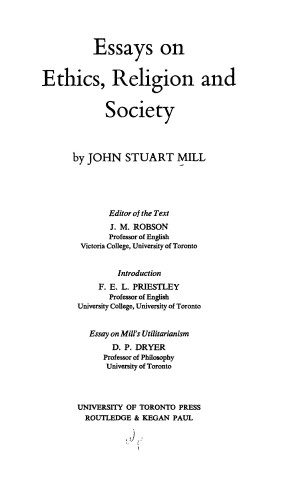
ESSAYS ON ETHICS, RELIGION AND SOCIETY - John Stuart Mill, The Collected Works of John Stuart Mill, Volume X - Essays on Ethics, Religion, and Society [1833]

Edition used:

The Collected Works of John Stuart Mill, Volume X - Essays on Ethics, Religion, and Society, ed. John M. Robson, Introduction by F.E.L. Priestley (Toronto: University of Toronto Press, London: Routledge and Kegan Paul, 1985).

Part of: Collected Works of John Stuart Mill, in 33 vols.

About Liberty Fund:

Liberty Fund, Inc. is a private, educational foundation established to encourage the study of the ideal of a society of free and responsible individuals.


ESSAYS ON ETHICS, RELIGION AND SOCIETY

REMARKS ON BENTHAM’S PHILOSOPHY

1833

EDITOR’S NOTE

Appendix B in Edward Lytton Bulwer, England and the English (London: Bentley, 1833), II, 321-44. Unsigned; not republished. Identified in JSM’s bibliography as “The ‘Remarks on Bentham’s Philosophy’ forming one of the Appendices to Bulwer’s ‘England and the English’ ” (MacMinn, 33). In the “Advertisement” (dated 9 July, 1833) to his work, Bulwer comments: “to another gentleman, qualified, perhaps before all men living, to judge profoundly of the philosophy of Bentham, I am . . . indebted for considerable aid in the sketch of that remarkable writer’s moral and legislative codes which will be found in the Appendix to the second volume . . .” (I, iii). For JSM’s attitude toward the Appendix, see the Textual Introduction, cxvi-cxvii above.

In the Somerville College copy of England and the English there are pencilled lines opposite passages on 339, 340, 341, and 344; against the passage on “interest” on 14 (in the text below) is written “very good”—these may be Harriet Taylor’s markings; they can hardly be JSM’s.

Remarks on Bentham’s Philosophy

it is no light task to give an abridged view of the philosophical opinions of one, who attempted to place the vast subjects of morals and legislation upon a scientific basis: a mere outline is all that can be attempted.

The first principles of Mr. Bentham’s philosophy are these;—that happiness, meaning by that term pleasure and exemption from pain, is the only thing desirable in itself; that all other things are desirable solely as means to that end: that the production, therefore, of the greatest possible happiness, is the only fit purpose of all human thought and action, and consequently of all morality and government; and moreover, that pleasure and pain are the sole agencies by which the conduct of mankind is in fact governed, whatever circumstances the individual may be placed in, and whether he is aware of it or not.

Mr. Bentham does not appear to have entered very deeply into the metaphysical grounds of these doctrines; he seems to have taken those grounds very much upon the showing of the metaphysicians who preceded him. The principle of utility, or as he afterwards called it “the greatest-happiness principle,”[*] stands no otherwise demonstrated in his writings, than by an enumeration of the phrases of a different description which have been commonly employed to denote the rule of life, and the rejection of them all, as having no intelligible meaning, further than as they may involve a tacit reference to considerations of utility. Such are the phrases “law of nature,” “right reason,” “natural rights,” “moral sense.” All these Mr. Bentham regarded as mere covers for dogmatism; excuses for setting up one’s own ipse dixit as a rule to bind other people. “They consist, all of them,” says he, “in so many contrivances for avoiding the obligation of appealing to any external standard, and for prevailing upon the reader to accept the author’s sentiment or opinion as a reason for itself.”[†]

This, however, is not fair treatment of the believers in other moral principles than that of utility. All modes of speech are employed in an ignorant manner, by ignorant people; but no one who had thought deeply and systematically enough to be entitled to the name of a philosopher, ever supposed that his own private sentiments of approbation and disapprobation must necessarily be well-founded, and needed not to be compared with any external standard. The answer of such persons to Mr. Bentham would be, that by an inductive and analytical examination of the human mind, they had satisfied themselves, that what we call our moral sentiments, (that is, the feelings of complacency and aversion we experience when we compare actions of our own or of other people with our standard of right and wrong,) are as much part of the original constitution of man’s nature as the desire of happiness and the fear of suffering: That those sentiments do not indeed attach themselves to the same actions under all circumstances, but neither do they, in attaching themselves to actions, follow the law of utility, but certain other general laws, which are the same in all mankind naturally; though education or external circumstances may counteract them, by creating artificial associations stronger than they. No proof indeed can be given that we ought to abide by these laws; but neither can any proof be given, that we ought to regulate our conduct by utility. All that can be said is, that the pursuit of happiness is natural to us; and so, it is contended, is the reverence for, and the inclination to square our actions by, certain general laws of morality.

Any one who is acquainted with the ethical doctrines either of the Reid and Stewart school, or of the German metaphysicians (not to go further back), knows that such would be the answer of those philosophers to Mr. Bentham; and it is an answer of which Mr. Bentham’s writings furnish no sufficient refutation. For it is evident, that these views of the origin of moral distinctions are not, what he says all such views are, destitute of any precise and tangible meaning; nor chargeable with setting up as a standard the feelings of the particular person. They set up as a standard what are assumed (on grounds which are considered sufficient) to be the instincts of the species, or principles of our common nature as universal and inexplicable as instincts.

To pass judgment on these doctrines, belongs to a profounder and subtler metaphysics than Mr. Bentham possessed. I apprehend it will be the judgment of posterity, that in his views of what, in the felicitous expression of Hobbes, may be called the philosophia prima,[*] it has for the most part, even when he was most completely in the right, been reserved for others to prove him so. The greatest of Mr. Bentham’s defects, his insufficient knowledge and appreciation of the thoughts of other men, shows itself constantly in his grappling with some delusive shadow of an adversary’s opinion, and leaving the actual substance unharmed.

After laying down the principle of Utility, Mr. Bentham is occupied through the most voluminous and the most permanently valuable part of his works, in constructing the outlines of practical ethics and legislation, and filling up some portions of the latter science (or rather art) in great detail; by the uniform and unflinching application of his own greatest-happiness principle, from which the eminently consistent and systematic character of his intellect prevented him from ever swerving. In the writings of no philosopher, probably, are to be detected so few contradictions—so few instances of even momentary deviation from the principles he himself has laid down.

It is perhaps fortunate that Mr. Bentham devoted a much larger share of his time and labour to the subject of legislation, than to that of morals; for the mode in which he understood and applied the principle of Utility, appears to me far more conducive to the attainment of true and valuable results in the former, than in the latter of these two branches of inquiry. The recognition of happiness as the only thing desirable in itself, and of the production of the state of things most favourable to happiness as the only rational end both of morals and policy, by no means necessarily leads to the doctrine of expediency as professed by Paley; the ethical canon which judges of the morality of an act or a class of actions, solely by the probable consequences of that particular kind of act, supposing it to be generally practised. This is a very small part indeed of what a more enlarged understanding of the “greatest-happiness principle” would require us to take into the account. A certain kind of action, as for example, theft, or lying, would, if commonly practised, occasion certain evil consequences to society: but those evil consequences are far from constituting the entire moral bearings of the vices of theft or lying. We shall have a very imperfect view of the relation of those practices to the general happiness, if we suppose them to exist singly, and insulated. All acts suppose certain dispositions, and habits of mind and heart, which may be in themselves states of enjoyment or of wretchedness, and which must be fruitful in other consequences, besides those particular acts. No person can be a thief or a liar without being much else: and if our moral judgments and feelings with respect to a person convicted of either vice, were grounded solely upon the pernicious tendency of thieving and of lying, they would be partial and incomplete; many considerations would be omitted, which are at least equally “germane to the matter;”[*] many which, by leaving them out of our general views, we may indeed teach ourselves a habit of overlooking, but which it is impossible for any of us not to be influenced by, in particular cases, in proportion as they are forced upon our attention.

Now, the great fault I have to find with Mr. Bentham as a moral philosopher, and the source of the chief part of the temporary mischief which in that character, along with a vastly greater amount of permanent good, he must be allowed to have produced, is this: that he has practically, to a very great extent, confounded the principle of Utility with the principle of specific consequences, and has habitually made up his estimate of the approbation or blame due to a particular kind of action, from a calculation solely of the consequences to which that very action, if practised generally, would itself lead. He has largely exemplified, and contributed very widely to diffuse, a tone of thinking, according to which any kind of action or any habit, which in its own specific consequences cannot be proved to be necessarily or probably productive of unhappiness to the agent himself or to others, is supposed to be fully justified; and any disapprobation or aversion entertained towards the individual by reason of it, is set down from that time forward as prejudice and superstition. It is not considered (at least, not habitually considered,) whether the act or habit in question, though not in itself necessarily pernicious, may not form part of a character essentially pernicious, or at least essentially deficient in some quality eminently conducive to the “greatest happiness.” To apply such a standard as this, would indeed often require a much deeper insight into the formation of character, and knowledge of the internal workings of human nature, than Mr. Bentham possessed. But, in a greater or less degree, he, and every one else, judges by this standard: even those who are warped, by some partial view, into the omission of all such elements from their general speculations.

When the moralist thus overlooks the relation of an act to a certain state of mind as its cause, and its connexion through that common cause with large classes and groups of actions apparently very little resembling itself, his estimation even of the consequences of the very act itself, is rendered imperfect. For it may be affirmed with few exceptions, that any act whatever has a tendency to fix and perpetuate the state or character of mind in which itself has originated. And if that important element in the moral relations of the action be not taken into account by the moralist as a cause, neither probably will it be taken into account as a consequence.

Mr. Bentham is far from having altogether overlooked this side of the subject. Indeed, those most original and instructive, though, as I conceive, in their spirit, partially erroneous chapters, on motives and on dispositions, in his first great work, the Introduction to the Principles of Morals and Legislation, open up a direct and broad path to these most important topics. It is not the less true that Mr. Bentham, and many others, following his example, when they came to discuss particular questions of ethics, have commonly, in the superior stress which they laid upon the specific consequences of a class of acts, rejected all contemplation of the action in its general bearings upon the entire moral being of the agent; or have, to say the least, thrown those considerations so far into the background, as to be almost out of sight. And by so doing they have not only marred the value of many of their speculations, considered as mere philosophical enquiries, but have always run the risk of incurring, and in many cases have in my opinion actually incurred, serious practical errors.

This incompleteness, however, in Mr. Bentham’s general views, was not of a nature materially to diminish the value of his speculations through the greater part of the field of legislation. Those of the bearings of an action, upon which Mr. Bentham bestowed almost exclusive attention, were also those with which almost alone legislation is conversant. The legislator enjoins or prohibits an action, with very little regard to the general moral excellence or turpitude which it implies; he looks to the consequences to society of the particular kind of action; his object is not to render people incapable of desiring a crime, but to deter them from actually committing it. Taking human beings as he finds them, he endeavours to supply such inducements as will constrain even persons of the dispositions the most at variance with the general happiness, to practise as great a degree of regard to it in their actual conduct, as can be obtained from them by such means without preponderant inconvenience. A theory, therefore, which considers little in an action besides that action’s own consequences, will generally be sufficient to serve the purposes of a philosophy of legislation. Such a philosophy will be most apt to fail in the consideration of the greater social questions—the theory of organic institutions and general forms of polity; for those (unlike the details of legislation) to be duly estimated, must be viewed as the great instruments of forming the national character; of carrying forward the members of the community towards perfection, or preserving them from degeneracy. This, as might in some measure be expected, is a point of view in which, except for some partial or limited purpose, Mr. Bentham seldom contemplates these questions. And this signal omission is one of the greatest of the deficiencies by which his speculations on the theory of government, though full of valuable ideas, are rendered, in my judgment, altogether inconclusive in their general results.

To these we shall advert more fully hereafter. As yet I have not acquitted myself of the more agreeable task of setting forth some part of the services which the philosophy of legislation owes to Mr. Bentham.

The greatest service of all, that for which posterity will award most honour to his name, is one that is his exclusively, and can be shared by no one present or to come; it is the service which can be performed only once for any science, that of pointing out by what method of investigation it may be made a science. What Bacon did for physical knowledge, Mr. Bentham has done for philosophical legislation. Before Bacon’s time, many physical facts had been ascertained; and previously to Mr. Bentham, mankind were in possession of many just and valuable detached observations on the making of laws. But he was the first who attempted regularly to deduce all the secondary and intermediate principles of law, by direct and systematic inference from the one great axiom or principle of general utility. In all existing systems of law, those secondary principles or dicta in which the essence of the systems resided, had grown up in detail, and even when founded in views of utility, were not the result of any scientific and comprehensive course of enquiry; but more frequently were purely technical; that is, they had grown out of circumstances purely historical, and, not having been altered when those circumstances changed, had nothing left to rest upon but fictions, and unmeaning forms. Take for instance the law of real property; the whole of which continues to this very day to be founded on the doctrine of feudal tenures, when those tenures have long ceased to exist except in the phraseology of West-minster Hall. Nor was the theory of law in a better state than the practical systems; speculative jurists having dared little more than to refine somewhat upon the technical maxims of the particular body of jurisprudence which they happened to have studied. Mr. Bentham was the first who had the genius and courage to conceive the idea of bringing back the science to first principles. This could not be done, could scarcely even be attempted, without, as a necessary consequence, making obvious the utter worthlessness of many, and the crudity and want of precision of almost all, the maxims which had previously passed everywhere for principles of law.

Mr. Bentham, moreover, has warred against the errors of existing systems of jurisprudence, in a more direct manner than by merely presenting the contrary truths. The force of argument with which he rent asunder the fantastic and illogical maxims on which the various technical systems are founded, and exposed the flagrant evils which they practically produce, is only equalled by the pungent sarcasm and exquisite humour with which he has derided their absurdities, and the eloquent declamation which he continually pours forth against them, sometimes in the form of lamentation, and sometimes of invective.

This then was the first, and perhaps the grandest achievement of Mr. Bentham; the entire discrediting of all technical systems; and the example which he set of treating law as no peculiar mystery, but a simple piece of practical business, wherein means were to be adapted to ends, as in any of the other arts of life. To have accomplished this, supposing him to have done nothing else, is to have equalled the glory of the greatest scientific benefactors of the human race.

But Mr. Bentham, unlike Bacon, did not merely prophesy a science; he made large strides towards the creation of one. He was the first who conceived with anything approaching to precision, the idea of a Code, or complete body of law; and the distinctive characters of its essential parts,—the Civil Law, the Penal Law, and the Law of Procedure. On the first two of these three departments he rendered valuable service; the third he actually created. Conformably to the habits of his mind, he set about investigating ab initio, a philosophy or science for each of the three branches. He did with the received principles of each, what a good code would do with the laws themselves;—extirpated the bad, substituting others; re-enacted the good, but in so much clearer and more methodical a form, that those who were most familiar with them before, scarcely recognized them as the same. Even upon old truths, when they pass through his hands, he leaves so many of his marks, that often he almost seems to claim the discovery of what he has only systematized.

In creating the philosophy of Civil Law, he proceeded not much beyond establishing on the proper basis some of its most general principles, and cursorily discussing some of the most interesting of its details. Nearly the whole of what he has published on this branch of law, is contained in the Traités de Législation, edited by M. Dumont.[*] To the most difficult part, and that which most needed a master-hand to clear away its difficulties, the nomenclature and arrangement of the Civil Code, he contributed little, except detached observations, and criticisms upon the errors of his predecessors. The “Vue Générale d’un Corps Complet de Législation,” included in the work just cited, contains almost all which he has given to us on this subject.

In the department of Penal Law, he is the author of the best attempt yet made towards a philosophical classification of offences. The theory of punishments (for which however more had been done by his predecessors, than for any other part of the science of law) he left nearly complete.

The theory of Procedure (including that of the constitution of the courts of justice) he found in a more utterly barbarous state than even either of the other branches; and he left it incomparably the most perfect. There is scarcely a question of practical importance in this most important department, which he has not settled. He has left next to nothing for his successors.

He has shown with the force of demonstration, and has enforced and illustrated the truth in a hundred ways, that by sweeping away the greater part of the artificial rules and forms which obtain in all the countries called civilized, and adopting the simple and direct modes of investigation, which all men employ in endeavouring to ascertain facts for their own private knowledge, it is possible to get rid of at least nine-tenths of the expense, and ninety-nine hundredths of the delay, of law proceedings; not only with no increase, but with an almost incredible diminution, of the chances of erroneous decision. He has also established irrefragably the principles of a good judicial establishment: a division of the country into districts, with one judge in each, appointed only for a limited period, and deciding all sorts of cases; with a deputy under him, appointed and removable by himself: an appeal lying in all cases whatever, but by the transmission of papers only, to a supreme court or courts, consisting each of only one judge, and stationed in the metropolis.

It is impossible within the compass of this sketch, to attempt any further statement of Mr. Bentham’s principles and views on the great science which first became a science in his hands.

As an analyst of human nature (the faculty in which above all it is necessary that an ethical philosopher should excel) I cannot rank Mr. Bentham very high. He has done little in this department, beyond introducing what appears to me a very deceptive phraseology, and furnishing a catalogue of the “springs of action,”[*] from which some of the most important are left out.

That the actions of sentient beings are wholly determined by pleasure and pain, is the fundamental principle from which he starts; and thereupon Mr. Bentham creates a motive, and an interest, corresponding to each pleasure or pain, and affirms that our actions are determined by our interests, by the preponderant interest, by the balance of motives. Now if this only means what was before asserted, that our actions are determined by pleasure and pain, that simple and unambiguous mode of stating the proposition is preferable. But under cover of the obscurer phrase a meaning creeps in, both to the author’s mind and the reader’s, which goes much farther, and is entirely false: that all our acts are determined by pains and pleasures in prospect, pains and pleasures to which we look forward as the consequences of our acts. This, as a universal truth, can in no way be maintained. The pain or pleasure which determines our conduct is as frequently one which precedes the moment of action as one which follows it. A man may, it is true, be deterred, in circumstances of temptation, from perpetrating a crime, by his dread of the punishment, or of the remorse, which he fears he may have to endure after the guilty act; and in that case we may say with some kind of propriety, that his conduct is swayed by the balance of motives; or, if you will, of interests. But the case may be, and is to the full as likely to be, that he recoils from the very thought of committing the act; the idea of placing himself in such a situation is so painful, that he cannot dwell upon it long enough to have even the physical power of perpetrating the crime. His conduct is determined by pain; but by a pain which precedes the act, not by one which is expected to follow it. Not only may this be so, but unless it be so, the man is not really virtuous. The fear of pain consequent upon the act, cannot arise, unless there be deliberation; and the man as well as “the woman who deliberates,” is in imminent danger of being lost.[†] With what propriety shrinking from an action without deliberation, can be called yielding to an interest, I cannot see. Interest surely conveys, and is intended to convey, the idea of an end, to which the conduct (whether it be act or forbearance) is designed as the means. Nothing of this sort takes place in the above example. It would be more correct to say that conduct is sometimes determined by an interest, that is, by a deliberate and conscious aim; and sometimes by an impulse, that is, by a feeling (call it an association if you think fit) which has no ulterior end, the act or forbearance becoming an end in itself.

The attempt, again, to enumerate motives, that is, human desires and aversions, seems to me to be in its very conception an error. Motives are innumerable: there is nothing whatever which may not become an object of desire or of dislike by association. It may be desirable to distinguish by peculiar notice the motives which are strongest and of most frequent operation; but Mr. Bentham has not even done this. In his list of motives, though he includes sympathy, he omits conscience, or the feeling of duty: one would never imagine from reading him that any human being ever did an act merely because it is right, or abstained from it merely because it is wrong. In this Mr. Bentham differs widely from Hartley, who, although he considers the moral sentiments to be wholly the result of association, does not therefore deny them a place in his system, but includes the feelings of “the moral sense” as one of the six classes into which he divides pleasures and pains.[*] In Mr. Bentham’s own mind, deeply imbued as it was with the “greatest-happiness principle,” this motive was probably so blended with that of sympathy as to be undistinguishable from it; but he should have recollected that those who acknowledge another standard of right and wrong than happiness, or who have never reflected on the subject at all, have often very strong feelings of moral obligation; and whether a person’s standard be happiness or anything else, his attachment to his standard is not necessarily in proportion to his benevolence. Persons of weak sympathies have often a strong feeling of justice; and others, again, with the feelings of benevolence in considerable strength, have scarcely any consciousness of moral obligation at all.

It is scarcely necessary to point out that the habitual omission of so important a spring of action in an enumeration professing to be complete, must tend to create a habit of overlooking the same phenomenon, and consequently making no allowance for it, in other moral speculations. It is difficult to imagine any more fruitful source of gross error; though one would be apt to suppose the oversight an impossible one, without this evidence of its having been committed by one of the greatest thinkers our species has produced. How can we suppose him to be alive to the existence and force of the motive in particular cases, who omits it in a deliberate and comprehensive enumeration of all the influences by which human conduct is governed?

In laying down as a philosophical axiom, that men’s actions are always obedient to their interests, Mr. Bentham did no more than dress up the very trivial proposition that all persons do what they feel themselves most disposed to do, in terms which appeared to him more precise, and better suited to the purposes of philosophy, than those more familiar expressions. He by no means intended by this assertion to impute universal selfishness to mankind, for he reckoned the motive of sympathy as an interest, and would have included conscience under the same appellation, if that motive had found any place in his philosophy, as a distinct principle from benevolence. He distinguished two kinds of interests, the self-regarding and the social: in vulgar discourse, the name is restricted to the former kind alone.

But there cannot be a greater mistake than to suppose that, because we may ourselves be perfectly conscious of an ambiguity in our language, that ambiguity therefore has no effect in perverting our modes of thought. I am persuaded, from experience, that this habit of speaking of all the feelings which govern mankind under the name of interests, is almost always in point of fact connected with a tendency to consider interest in the vulgar sense, that is, purely self-regarding interest, as exercising, by the very constitution of human nature, a far more exclusive and paramount control over human actions than it really does exercise. Such, certainly, was the tendency of Mr. Bentham’s own opinions. Habitually, and throughout his works, the moment he has shown that a man’s selfish interest would prompt him to a particular course of action, he lays it down without further parley that the man’s interest lies that way; and, by sliding insensibly from the vulgar sense of the word into the philosophical, and from the philosophical back into the vulgar, the conclusion which is always brought out is, that the man will act as the selfish interest prompts. The extent to which Mr. Bentham was a believer in the predominance of the selfish principle in human nature, may be seen from the sweeping terms in which, in his Book of Fallacies,[*] he expressly lays down that predominance as a philosophical axiom.

“In every human breast (rare and short-lived ebullitions, the result of some extraordinarily strong stimulus or excitement, excepted) self-regarding interest is predominant over social interest; each person’s own individual interest over the interests of all other persons taken together.” (Pp. 392-3.)

In another passage of the same work (p. 363) he says, “Taking the whole of life together, there exists not, nor ever can exist, that human being in whose instance any public interest he can have had will not, in so far as depends upon himself, have been sacrificed to his own personal interest. Towards the advancement of the public interest, all that the most public-spirited (which is as much as to say the most virtuous) of men can do, is to do what depends upon himself towards bringing the public interest, that is, his own personal share in the public interest, to a state as nearly approaching to coincidence, and on as few occasions amounting to a state of repugnance, as possible, with his private interests.”

By the promulgation of such views of human nature, and by a general tone of thought and expression perfectly in harmony with them, I conceive Mr. Bentham’s writings to have done and to be doing very serious evil. It is by such things that the more enthusiastic and generous minds are prejudiced against all his other speculations, and against the very attempt to make ethics and politics a subject of precise and philosophical thinking; which attempt, indeed, if it were necessarily connected with such views, would be still more pernicious than the vague and flashy declamation for which it is proposed as a substitute. The effect is still worse on the minds of those who are not shocked and repelled by this tone of thinking, for on them it must be perverting to their whole moral nature. It is difficult to form the conception of a tendency more inconsistent with all rational hope of good for the human species, than that which must be impressed by such doctrines, upon any mind in which they find acceptance.

There are, there have been, many human beings, in whom the motives of patriotism or of benevolence have been permanent steady principles of action, superior to any ordinary, and in not a few instances, to any possible, temptations of personal interest. There are, and have been, multitudes, in whom the motive of conscience or moral obligation has been thus paramount. There is nothing in the constitution of human nature to forbid its being so in all mankind. Until it is so, the race will never enjoy one-tenth part of the happiness which our nature is susceptible of. I regard any considerable increase of human happiness, through mere changes in outward circumstances, unaccompanied by changes in the state of the desires, as hopeless; not to mention that while the desires are circumscribed in self, there can be no adequate motive for exertions tending to modify to good ends even those external circumstances. No man’s individual share of any public good which he can hope to realize by his efforts, is an equivalent for the sacrifice of his ease, and of the personal objects which he might attain by another course of conduct. The balance can be turned in favour of virtuous exertion, only by the interest of feeling or by that of conscience—those “social interests,” the necessary subordination of which to “self-regarding” is so lightly assumed.

But the power of any one to realize in himself the state of mind, without which his own enjoyment of life can be but poor and scanty, and on which all our hopes of happiness or moral perfection to the species must rest, depends entirely upon his having faith in the actual existence of such feelings and dispositions in others, and in their possibility for himself. It is for those in whom the feelings of virtue are weak, that ethical writing is chiefly needful, and its proper office is to strengthen those feelings. But to be qualified for this task, it is necessary, first to have, and next to show, in every sentence and in every line, a firm unwavering confidence in man’s capability of virtue. It is by a sort of sympathetic contagion, or inspiration, that a noble mind assimilates other minds to itself; and no one was ever inspired by one whose own inspiration was not sufficient to give him faith in the possibility of making others feel what he feels.

Upon those who need to be strengthened and upheld by a really inspired moralist—such a moralist as Socrates, or Plato, or (speaking humanly and not theologically) as Christ; the effect of such writings as Mr. Bentham’s, if they be read and believed and their spirit imbibed, must either be hopeless despondency and gloom, or a reckless giving themselves up to a life of that miserable self-seeking, which they are there taught to regard as inherent in their original and unalterable nature.

Mr. Bentham’s speculations on politics in the narrow sense, that is, on the theory of government, are distinguished by his usual characteristic, that of beginning at the beginning. He places before himself man in society without a government, and, considering what sort of government it would be advisable to construct, finds that the most expedient would be a representative democracy. Whatever may be the value of this conclusion, the mode in which it is arrived at appears to me to be fallacious; for it assumes that mankind are alike in all times and all places, that they have the same wants and are exposed to the same evils, and that if the same institutions do not suit them, it is only because in the more backward stages of improvement they have not wisdom to see what institutions are most for their good. How to invest certain servants of the people with the power necessary for the protection of person and property, with the greatest possible facility to the people of changing the depositaries of that power, when they think it is abused; such is the only problem in social organization which Mr. Bentham has proposed to himself. Yet this is but a part of the real problem. It never seems to have occurred to him to regard political institutions in a higher light, as the principal means of the social education of a people. Had he done so, he would have seen that the same institutions will no more suit two nations in different stages of civilization, than the same lessons will suit children of different ages. As the degree of civilization already attained varies, so does the kind of social influence necessary for carrying the community forward to the next stage of its progress. For a tribe of North American Indians, improvement means, taming down their proud and solitary self-dependence; for a body of emancipated negroes, it means accustoming them to be self-dependent, instead of being merely obedient to orders: for our semi-barbarous ancestors it would have meant, softening them; for a race of enervated Asiatics it would mean hardening them. How can the same social organization be fitted for producing so many contrary effects?

The prevailing error of Mr. Bentham’s views of human nature appears to me to be this—he supposes mankind to be swayed by only a part of the inducements which really actuate them; but of that part he imagines them to be much cooler and more thoughtful calculators than they really are. He has, I think, been, to a certain extent, misled in the theory of politics, by supposing that the submission of the mass of mankind to an established government is mainly owing to a reasoning perception of the necessity of legal protection, and of the common interest of all in a prompt and zealous obedience to the law. He was not, I am persuaded, aware, how very much of the really wonderful acquiescence of mankind in any government which they find established, is the effect of mere habit and imagination, and, therefore, depends upon the preservation of something like continuity of existence in the institutions, and identity in their outward forms; cannot transfer itself easily to new institutions, even though in themselves preferable; and is greatly shaken when there occurs anything like a break in the line of historical duration—anything which can be termed the end of the old constitution and the beginning of a new one.

The constitutional writers of our own country, anterior to Mr. Bentham, had carried feelings of this kind to the height of a superstition; they never considered what was best adapted to their own times, but only what had existed in former times, even in times that had long gone by. It is not very many years since such were the principal grounds on which parliamentary reform itself was defended. Mr. Bentham has done much service in discrediting, as he has done completely, this school of politicians, and exposing the absurd sacrifice of present ends to antiquated means; but he has, I think, himself fallen into a contrary error. The very fact that a certain set of political institutions already exist, have long existed, and have become associated with all the historical recollections of a people, is in itself, as far as it goes, a property which adapts them to that people, and gives them a great advantage over any new institutions in obtaining that ready and willing resignation to what has once been decided by lawful authority, which alone renders possible those innumerable compromises between adverse interests and expectations, without which no government could be carried on for a year, and with difficulty even for a week. Of the perception of this important truth, scarcely a trace is visible in Mr. Bentham’s writings.*

It is impossible, however, to contest to Mr. Bentham, on this subject or on any other which he has touched, the merit, and it is very great, of having brought forward into notice one of the faces of the truth, and a highly important one. Whether on government, on morals, or on any of the other topics on which his speculations are comparatively imperfect, they are still highly instructive and valuable to any one who is capable of supplying the remainder of the truth; they are calculated to mislead only by the pretension which they invariably set up of being the whole truth, a complete theory and philosophy of the subject. Mr. Bentham was more a thinker than a reader; he seldom compared his ideas with those of other philosophers, and was by no means aware how many thoughts had existed in other minds, which his doctrines did not afford the means either to refute or to appreciate.

BLAKEY’S HISTORY OF MORAL SCIENCE

1833

EDITOR’S NOTE

Monthly Repository, VII (Oct., 1833), 661-9. Unsigned; not republished. The title is footnoted: “History of Moral Science. By Robert Blakey, Author of an Essay on Moral Good and Evil. 2 vols. 8vo. [London: Duncan,] 1833.” Identified in JSM’s bibliography as “A review of Blakey’s ‘History of Moral Science’ in the Monthly Repository for October 1833” (MacMinn, 34). In the brief account in the Autobiography (138) of his writings for the Monthly Repository, JSM does not mention this article. The writing of it can be dated fairly precisely by JSM’s letter (7/9/33) to W. J. Fox, editor of the Monthly Repository, in which he says: “I am ashamed to say I can give no hope that Blakey will be ready on Monday [9 Sept.]—though I think part of him will be.” Telling Carlyle (5/10/33) which of the articles in the October number are his, JSM writes: “one [is] a review of a foolish book by a man named Blakey, of Morpeth, called a History of Moral Science; for writing which he is utterly unfit, being a man who as you would say, has no eyes, only a pair of glasses and I will add, almost opake ones.” (Earlier Letters, XII, 177, 181.)

There are no corrections or alterations in the two Somerville College copies.

Blakey’s History of Moral Science

an ambitious title, and one which promises much; but the promises of title-pages are so seldom followed by performances! “Moral science” should naturally mean the science of morals. It were something to find that there is a writer alive who believes that such a science exists; and not only exists, but is in such a state of advancement that the time is come to write its history; who, consequently, is not only able to tell us the opinions of others, but has systematic ones of his own. For how should he write the history of a science, who has not constructed a consistent scheme of the science in its present state? The historian of moral philosophy must himself have a philosophy of morals; must have surveyed the field of ethics extensively enough, and with sufficient power of concatenation, to have arranged its truths (or whatever present themselves to his mind as such) into a connected series, following and flowing out of one another: thus much, at least, is implied in the name of science. But Mr. Blakey has no such thought. There are few ways in which a mind of little depth or compass is more apt to betray itself than by the use of big words to express small things; whoever does this innocently and without quackery, shows himself to be unfurnished with the larger idea for which he should have reserved his large phrase. By giving the name “History of Moral Science” to a book, which should have been called “Sketch of the Opinions of various Authors on the Foundation of Moral Obligation, with critical Remarks,” Mr. Blakey demonstrates how little meaning even the word “Science” has for him, since he considers the whole history of a science to be summed up in the controversial discussions concerning the first principle of it.

After a short preamble, and a few loose remarks about “the ancient systems of morality,” Mr. Blakey presents us with what professes to be a summary of the opinions of the following writers, concerning the first principle of ethics:—Hobbes, Cudworth, Bishop Cumberland, Locke, Archbishop King, Wollaston, Clarke, Shaftesbury, Mandeville, Bolingbroke and Pope, Soame Jenyns, Hutcheson, a Mr. Thomas Rutherford, Hume, Hartley and Priestley, Lord Kames, Bishop Butler, Dr. Ferguson, Dr. Price, Adam Smith, Paley, Gisborne, Bentham, Godwin, Dugald Stewart, Cogan, Dr. Thomas Brown, and a certain Dr. Dewar. All foreign authors whatever are then disposed of in a single chapter; and two chapters more are employed in promulgating such of the author’s own opinions as have not been sufficiently manifested by his strictures on other writers.

Mr. Blakey’s statement of the opinions of these various authors deserves the praise of honesty. He never perversely distorts an opinion, in the blindness of prejudice, or to serve a purpose. He generally treats the intentions and talents, even of those from whom he differs most, with justice and liberality. He does not insist upon fastening on them a meaning or consequence which they never contemplated; and he employs but sparingly the favourite weapon of the uncandid and the bigot, imputation of immoral tendency. But our commendation cannot go much further. It is not every man who can give an instructive view of other men’s opinions.

There are two modes of writing usefully concerning systems of philosophy: the one, suitable to a mind which is qualified to judge; the other, to one which can only describe. The intellect which can survey the wanderings of imperfect thinkers from a higher eminence of thought, commanding a view not only of the right track, but of all the by-ways of error, and all the fallacious appearances which seduce the unguarded to deviate into them—such a critic (we use the prostituted word only because we have no other) can not only estimate more justly, but can actually state more clearly and forcibly an author’s theory, than the author himself; can really understand it better; because he sees (what the author himself does not see) how the doctrine arose in the author’s own mind; of what peculiar position in regard to opportunities of observation, or of what peculiarity of intellect or of disposition, it is the natural consequence. Any thing like this we were not entitled to expect from Mr. Blakey; it supposes a philosopher, and such Mr. Blakey is not. But if this was impossible, the next thing to it in usefulness, though at a vast distance, would have been a condensed view of each system, not as it appears to a higher intelligence, but as it appeared to its author; such a statement of the author’s train of thought, of the series of his premises and his conclusions, as would be conveyed by a well-made abstract of his principal works, or as would be given by an intelligent disciple thoroughly conversant with his master’s doctrines. Mr. Blakey’s summaries by no means come up to this idea; they are vague and sketchy, and not only do not, to those who knew the doctrines before, exhibit them in any new light, but give no sufficiently distinct conception of them to those who knew them not. Often the conclusions are exhibited almost without the premises: and on the whole there is little to be learnt even by the merest tyro in philosophy, from these volumes, except a few generalities, and a few forms of expression. He is told in what words philosophers have expressed the results of their speculations, but though he may not be made positively to misunderstand, he is not made thoroughly to feel, the meaning in the philosopher’s own mind, to which the words are but an index, and often a most imperfect one.

An overweening self-confidence, and contemptuous assumption of superiority, in judging of the intellects of others, would be peculiarly unbecoming in a mind of Mr. Blakey’s calibre: and he cannot be accused of those faults; he mostly treats with due respect all who by their speculations have deserved any. To the liberal appreciation of merit which he commonly evinces, there are indeed exceptions; and, unfortunately, in the very cases in which there is most merit to appreciate. But this is a very different thing from arrogance. It is not because an author differs from Mr. Blakey, that Mr. Blakey deems scornfully of him; but because, in addition to differing from Mr. Blakey, he has been cried down by the world—that is to say, the English world. Over-reliance on our own judgment is one thing, over-reliance on the judgment of the world when in unison with our own, is another. The latter is the failing of a weaker, but certainly of a more modest mind. The misfortune is, that the contempt of those who have confidence enough to be scornful only when they are backed by a crowd, is aptest to fall upon those who are most in advance of their age. Mr. Blakey’s strongest expressions of disdain are divided between the association-philosophy as taught by Hartley, and the metaphysics of the German school. In other words, the only metaphysical doctrines which he utterly despises, are the two systems between which, and which only, almost every metaphysician, deserving the name, in all Europe, is now beginning to be convinced that it is necessary to choose: the two most perfect forms of the only two theories of the human mind which are, strictly speaking, possible. Both are alike worthless in Mr. Blakey’s eyes, because it has been the fashion among English writers to treat both with disrespect, and because he himself understands neither of them. The difference is, he pronounces the one unintelligible, because it is so to him; the other he flatters himself that he sees through and through, and can discern that there is nothing in it.

So little does Mr. Blakey comprehend of the theory which resolves all the phenomena of the mind into ideas of sensation connected together by the law of association, that he does not even see any thing peculiar in the doctrine. Association itself, he will not allow to be a distinct principle or fact in human nature. It is nothing more, he says, than remembrance; it has been known in all ages, as the faculty of memory. Just so we may conceive, on the appearance of Newton’s Principia,[*] some mind of the same character objecting to the theory of gravitation, that there was nothing in it but the ancient and familiar fact of weight.

If a person, [says Mr. Blakey,] will take the first volume of the treatise On Man, and read it carefully over, and whenever he finds the words association, associates, associating, &c. let him replace them with the words memory, remembered, remembrance, connected in his mind, and he will find that the sense of the various passages in which the former class of words are used, will remain as completely the same, when words descriptive of memory are thus employed.

(Vol. II, p. 124.)

Not so, Mr. Blakey. Memory and remembrance only denote the fact that somehow we do remember: association denotes that our remembrances (pardon the expression) suggest and recall one another in an order, determined by the order of succession of the facts remembered; or rather, determined partly by the order of succession, and partly by the more or less interesting nature, of those previous impressions. Cannot Mr. Blakey understand the difference between a phenomenon, and the law of the phenomenon? The reflexion of light, and of sound, is a fact; that the angle of reflexion is equal to the angle of incidence, is the law of that fact. And this law of nature may be something new to a person, even although he may have heard an echo, and seen his face in a mirror. In like manner a person may know that when we have seen an object or experienced a feeling, we remember it, (which is all that is expressed by the words faculty of memory,) and may, notwithstanding, have yet to learn that when we have seen two objects or had two feelings together, we think of them together, and not otherwise; and that the strength of their connexion in our remembrance, depends jointly upon the number of previous conjunctions in fact or in thought, and upon the intensity of the original impressions. Once for all, association is not memory, but the law of memory.

Now, the theory of the human mind of which Dr. Hartley was the principal author, maintains that this same law, which is the law of memory, namely, that the order of our thoughts follows the order of our sensations, is not only the law of memory, but the law of imagination, of belief, of reasoning, of the affections, of the will. This may not be true; but it is at least very different from every other theory. But Mr. Blakey knows so little about the Hartleian doctrine, that he propounds as a complete summary of it, the following proposition: The advocates of association state a simple fact, that there is a connexion amongst our ideas. (Vol. II, p. 126.) We exhort him to read Hartley; or a more recent work, which has done far more for Hartley’s theory, than Hartley himself, Mr. Mill’s Analysis of the Human Mind.[*]

As a specimen of argumentation which Mr. Blakey considers to be conclusive, we quote the following:

Association is the tendency of one idea to introduce another into the mind. Very well, then; but how do we come to set it down as a general fact, that one set of ideas has an invariable tendency to introduce another set of ideas? By experience, it must be answered. But what is experience? Why, it is the remembrance of that which is past.

[Vol. II, pp. 116-17.]

Therefore, association is nothing but memory.

We will treat Mr. Blakey with a specimen in return. The pretended science of chemistry is nothing but memory.

Chemistry is the properties of simple substances, and their various compounds. But how do we come to set it down as a general fact, that two substances, as oxygen and hydrogen, being compounded together, form a third substance, water? By experience, it must be answered. But what is experience? Why, it is the remembrance of that which is past. In what, therefore, does this chemistry differ from memory?

Mr. Blakey continues—

But to put this matter in as clear a light as possible, let us suppose that A is a present idea in the mind, and that it has a tendency to introduce another idea which has never been in the mind before, and which we will call B. To this tendency of A to introduce B into the mind, is given the name of association. Now how can we assert or deny any thing respecting the tendency of A to introduce B, till we have witnessed A’s power over B, and have had B present to the understanding? The very proposition that A has an influence over B implies that we have seen this tendency, and that B must have previously been in the mind, and consequently an object of memory. Thus we see then, when we speak about connexions among our ideas, we must consider them as connexions which have been known before; and therefore we ought to infer, that the treating of them comes within the province of memory, and not within any other intellectual power whatever.

(Vol. II, p. 117.)

What a paralogism; we might almost call it a bull. Yes, certainly, the proposition that A has a tendency to introduce B, implies that we have seen this tendency at some former time, because otherwise we should not know it: but the fact itself implies nothing of the kind. When A for the first time introduced B, “which had never been in the mind before,” B was not an object of memory; although it is so when we have observed and treasured up the occurrence. Because an event must be remembered before it can be talked about, Mr. Blakey imagines that it was a subject of memory when it first happened. It is upon the strength of such reasoning that he assumes such a tone as this:

What a dull and paralyzing effect has the reading of a book in which the principle of the association of ideas forms the philosophical dramatis personæ in the piece. . . . There is no way of getting through the book, without violating the rules of politeness by enjoying a smile at the expense of the system.

(Vol. II, p. 127.)

With much more of the same sort.

Of foreign authors Mr. Blakey seems to be profoundly ignorant. He affirms that in the majority of cases—

The continental philosophy of human nature presents to a well-constituted mind a repulsive aspect, and is profusely saturated with everything that is impure, ridiculous, profane, whimsical, and pernicious.

(Vol. II, p. 300.)

Meaning, we suppose, some French writers only, and those only in the eighteenth century. The celebrated theory of Malebranche he states thus, that “all things should be seen in God;” (Vol. II, p. 308) and he imagines that Candide[*] was written to support the doctrines which are put into the mouth of Pangloss! (Vol. II, p. 289.)

At the conclusion of his abstract of the opinions of previous authors, which, it is but justice to say, is in general much fairer, and even more intelligent, than might be supposed from the specimens which we have given, Mr. Blakey sums up the result of the examination in the following words:

All the systems we have examined may, I conceive, be referred to six distinct heads. 1st. The eternal and immutable nature of all moral distinctions. 2nd. That utility, public or private, is the foundation of moral obligation. 3rd. That all morality is founded upon the will of God. 4th. That a moral sense, feeling, or emotion, is the ground of virtue. 5th. That it is by supposing ourselves in the situation of others, or by a species of sympathetic mechanism, that we derive our notions of good and evil. And 6th, the doctrine of vibrations,* and the association of ideas.

(Vol. II, p. 317.)

After declaring that “there are none of these different systems that are not in some degree founded on truth,” and that “we cannot resolve all the moral feelings and habits of our nature into one general principle,” he assigns, nevertheless, his reasons for preferring to all the other theories the doctrine, “that virtue depends upon the will of God,” as made known by revelation. [Vol. II, pp. 319, 320.]

Mr. Blakey’s enumeration is illogical: it confounds two distinct, though nearly connected, questions; the standard or test of moral obligation, and the origin of our moral sentiments. It is one question what rule we ought to obey, and why; another question how our feelings of approbation and disapprobation actually originate. The former is the fundamental question of practical morals; the latter is a problem in mental philosophy. Adam Smith’s doctrine of sympathy which stands fifth, and the doctrine of association which stands sixth in Mr. Blakey’s list, are theories respecting the nature and origin of our feelings of morality. His second and third are theories respecting the rule or law by which we ought to guide our conduct. His first and fourth involve, or may be so understood as to involve, both considerations.

These several theories, therefore, are not exclusive of one another. It is possible, for instance, to hold with Hartley, that our feelings of morality originate in association, and with Bentham that our conduct, in all things which depend on our will, and among the rest, in the cultivation of those very feelings, should be guided by utility; or with our author, that the will of God is itself the foundation of the obligations of virtue. David Hume seems to have combined the recognition of utility as the standard or test of morality, with the belief of a moral sense, independent of association. Paley has no theory respecting the nature of moral feelings, but his notion of the moral law is compounded of the second and third of the theories enumerated by our author.

But of all those theories, whether ethical or metaphysical, whether declaring what our conduct should be, or what our feelings are, none surely is so utterly destitute of plausibility as Mr. Blakey’s own doctrine, that virtue is constituted by the will of God.

If we believe this, we believe that God does not declare what is good, and command us to do it, but that God actually makes it good. Good is whatever God makes it. What we call evil, is only evil because he has arbitrarily prohibited it. The countless myriads to whom he has never signified his will, are under no moral obligations. This doctrine takes away all motives to yield obedience to God, except those which induce a slave to obey his master. He must be obeyed because he is the stronger. He is not to be obeyed because he is good, for that implies a good which he could not have made bad by his mere will. If we had the misfortune to believe that the world is ruled by an evil principle, that there is no God, but only a devil, or that the devil has more power over us than God, we ought by this rule to obey the devil. Mr. Blakey is evidently quite unconscious of these consequences of his theory. But, that they are legitimate consequences who can doubt?

And this theory Mr. Blakey believes to rest upon the authority of scripture.

I venture to affirm, [says he,] that from Genesis to Revelation inclusive, there is not a single passage, which, when fairly examined, claims the attention and homage of mankind upon any other ground than what is implied in the command which accompanies it.

(Vol. II, p. 326.)

The scriptures, as Mr. Blakey himself says elsewhere, do not enter into speculative questions; they tell us what to do, not why. But do they not say perpetually, God is good, God is just, God is righteous, God is holy? And are we to understand by these affirmations nothing at all, but the identical and unmeaning proposition God is himself, or a proposition which has so little to do with morality as this, God is powerful? Has God in short no moral attributes? no attributes but those which the devil is conceived to possess in a smaller degree? and no title to our obedience but such as the devil would have, if there were a devil, and the universe were without God?

Mr. Blakey insists much upon the sublimity of the scriptures, and the perfection of scripture morality; considerations which tell strongly against his own doctrine; for if we are capable of recognising excellence in the commands of the Omnipotent, they must possess excellence independently of his command; and excellence discoverable by us even without revelation; for whatever reason can recognise when found, reason can find. If the morality of the scriptures is admirable because it conduces to happiness, this implies that the production of happiness is a legitimate purpose of morals: if because it accords with our sympathies, that implies that morality may be founded on sympathy. If the precepts of scripture have nothing intrinsically good, but are good solely by reason of the power from which they emanate, their character ought to be as mysterious and incomprehensible to us as the ceremonies of magic: nor could there on that supposition be any reason apparent to us, why we are not commanded to hate our neighbour instead of to love him.

Not being of opinion, with Mr. Blakey, that our reception of a philosophic doctrine ought to be determined, not solely by its truth, but by what we imagine respecting the arguments it may afford for or against our religious belief, we ought not, perhaps, to notice the claim which Mr. Blakey sets up for his doctrine, of being peculiarly favourable to the interests of revealed religion. But though such arguments go for nothing with those who can trust themselves to judge of the true and the false, who are resolved to believe the truth, whatever may be its consequences, and are not afraid of finding one truth irreconcilable with another; those who are diffident of their own intellectual powers, naturally dread any doctrine which they can be led to think tends to shake from under their feet, the foundation on which they have built all their hopes and purposes. Mr. Blakey, therefore, shall not be allowed the exclusive use of this argument. We tell him that his doctrine is more destructive to the foundations of Christianity, than any of the theories of moral obligation which he has enumerated; by taking away altogether its internal evidences, the only ones which are not common to it with a thousand superstitions. In Judea itself, both before and after Christ appeared, numbers of false Christs and charlatans of all descriptions had pretended to work miracles, and had been believed; believed not only by their proselytes, but by those who rejected them, and who ascribed their miraculous powers to the agency of evil spirits. If these impostors sunk, and were heard of no more, while Christianity spread itself over the earth, it was not that greater credence was given to the Christian miracles than to theirs; it was, that the simple-hearted men who gathered themselves round the founder of Christianity, far from believing the doctrines to be excellent because they came from God, believed them to come from God because they felt them to be excellent. The fervour of their love and admiration could not find fit utterance but in the phrase, “he spake as never man spake.”[*] Christianity had perished with its founder if Mr. Blakey’s theory had been true. The world has acknowledged him as sent of God, has believed him to be God, because there was a standard of morality by which man could test not the word of man merely, but what was vouched for as the word of God; because of that internal evidence, which according to the repeated declarations of Christ himself, ought to have been sufficient. It was out of the hardness of their hearts that they needed signs.[*] Had all been right within, the precepts themselves would have sufficed to prove their own origin.

We have expended more words than were perhaps necessary upon so preposterous a doctrine. Our excuse must be, the infinitely mischievous tendency of a theory of moral duty, according to which God is to be obeyed, not because God is good, nor because it is good to obey him, but from some motive or principle which might have dictated equally implicit obedience to the powers of darkness. Such a philosophy, in proportion as it is realized in men’s lives and characters, must extirpate from their minds all reverence, all admiration, and all conscience, and leave them only the abject feelings of a slave.

Such a theory cannot be combated too often; it should be warred against wherever it rears its head. But with regard to most of the other conflicting opinions respecting the primary grounds of moral obligation, it appears to us that a degree of importance is often attached to them, more than commensurate to the influence they really exercise for good or for evil. Doubtless they are important, as all questions in morals are important: a clear conception of the ultimate foundation of morality, is essential to a systematic and scientific treatment of the subject, and to the decision of some of its disputed practical problems. But the most momentous of the differences of opinion on the details of morality, have quite another origin. The real character of any man’s ethical system depends not on his first and fundamental principle, which is of necessity so general as to be rarely susceptible of an immediate application to practice; but upon the nature of those secondary and intermediate maxims, vera illa et media axiomata, in which, as Bacon observes, real wisdom resides.[†] The grand consideration is, not what any person regards as the ultimate end of human conduct, but through what intermediate ends he holds that his ultimate end is attainable, and should be pursued: and in these there is a nearer agreement between some who differ, than between some who agree, in their conception of the ultimate end. When disputes arise as to any of the secondary maxims, they can be decided, it is true, only by an appeal to first principles; but the necessity of this appeal may be avoided far oftener than is commonly believed; it is surprising how few, in comparison, of the disputed questions of practical morals, require for their determination any premises but such as are common to all philosophic sects.

SEDGWICK’S DISCOURSE

1835

EDITOR’S NOTE

“Professor Sedgwick’s Discourse on the Studies of the University of Cambridge,” D&D, I (2nd ed., 1867), 95-159, with footnote to title: “London Review, April 1835.” Reprinted from the London Review, I (Apr., 1835), 94-135, signed “A”. Original heading: “Art. V. Professor Sedgwick’s Discourse.—State of Philosophy in England. / A Discourse on the Studies of the University. By Adam Sedgwick, M.A., F.R.S.; Woodwardian Professor, and Fellow of Trinity College, Cambridge. [London: Parker,] 1834. 3d edit.” Identified in JSM’s bibliography as “A review of Sedgwick’s ‘Discourse on the Studies of the University,’ headed ‘Professor Sedgwick’s Discourse—State of Philosophy in England’, in the first number of the London Review (April, 1835)” (MacMinn, 43). The article, which he had begun writing by 14 October, 1834, was finished, presumably in an unrevised state, by 26 November (see JSM’s letters to J. P. Nichol on those dates, Earlier Letters, XII, 235 and 238). See also the footnote to 45 below, which describes a passage as “Written in 1834.” For JSM’s attitude to this article, and its relation to others in this volume, see the Textual Introduction, cxvii-cxx above.

The following text is collated with that in D&D (1st ed.), and that in the London Review. In the footnoted variants, D&D (2nd ed.) is indicated by “67”; D&D (1st ed.) by “59”; the London Review by “35”. There are no corrections or alterations in the Somerville College copies of D&D and the London Review.

Sedgwick’s Discourse

if we were asked for what end, above all others, endowed universities exist, or ought to exist, we should answer—To keep alive philosophy. This, too, is the ground on which, of late years, our own national endowments have chiefly been defended. To educate common minds for the common business of life, a public provision may be useful, but is not indispensable: nor are there wanting arguments,a not conclusive, yet of considerable strength, to show that it is undesirable. Whatever individual competition does at all, it commonly does best. All things in which the public are adequate judges of excellence, are best supplied where the stimulus of individual interest is the most active; and that is where pay is in proportion to exertion: not where pay is made sure in the first instance, and the only security for exertion is the superintendence of government; far less where, as in the English universities, even that security has been successfully excluded. But there is an education of which it cannot be pretended that the public are competent judges; the education by which great minds are formed. To rear up minds with aspirations and faculties above the herd,b capable of leading on their countrymen to greater achievements in virtue, intelligence, and social well-being; to do this, and likewise so to educate the leisured classes of the community generally, that they may participate as far as possible in the qualities of these superior spirits, and be prepared to appreciate them, and follow in their steps—these are purposes, requiring institutions of education placed above dependence on the immediate pleasure of that very multitude whom they are designed to elevate. These are the ends for which endowed universities are desirable; they are those which all endowed universities profess to aim at; and great is their disgrace, if, having undertaken this task, and claiming credit for fulfilling it, they leave it unfulfilled.

In what manner are these purposes—the greatest which any human institution can propose to itself—purposes which the English Universities must be fit for, or they are fit for nothing—performed by those universities?—Circumspice.

In the intellectual pursuits which form great minds, this country was formerly pre-eminent. England once stood at the head of European philosophy. Where stands she now? Consult the general opinion of Europe. The celebrity of England, in the present day, rests upon her docks, her canals, her railroads. In intellect she is distinguished only for a kind of sober good sense, free from extravagance, but also void of lofty aspirations; and for doing all those things which are best done where man most resembles a machine, with the precision of a machine. Valuable qualities, doubtless; but not precisely those by which cmankind raise themselvesc to the perfection of dtheird nature, or eachievee greater and greater conquests over the difficulties which encumber ftheirf social arrangements. Ask any reflecting person in France or Germany his opinion of England; whatever may be his own tenets—however friendly his disposition to us—whatever his admiration of our institutions, and gof some parts of our national characterg ; however alive to the faults and errors of his own countrymen, the feature which always strikes him in the English mind is the absence of enlarged and commanding views. Every question he finds discussed and decided on its own basis, however narrow, without any light thrown upon it from principles more extensive than itself; and no question discussed at all, unless parliament, or some constituted authority, is to be moved to-morrow or the day after to put it to the vote. Instead of the ardour of research, the eagerness for large and comprehensive inquiry, of the educated part of the French and German youth, what find we? Out of the narrow bounds of mathematical and physical science, not a vestige of a reading and thinking public engaged in the investigation of truth as truth, in the prosecution of thought for the sake of thought. Among hfewh except sectarian religionists—and what they are we all know—is there any interest in the great problem of man’s nature and life: among istill feweri is there any curiosity respecting the nature and principles of human society, the history or the philosophy of civilization; nor any belief that, from such inquiries, a single important practical consequence can follow. Guizot, the greatest admirer of England among the Continental philosophers, nevertheless remarks that, in England, even great events do not, as they do everywhere else, inspire great ideas.[*] Things, in England, are greater than the men who accomplish them.j

But perhaps this degeneracy is the effect of some cause over which the universities had no control, and against which they have been ineffectually struggling. If so, those bodies are wonderfully patient of being baffled. Not a word of complaint escapes any of their leading dignitaries—not a hint that their highest endeavours are thwarted, their best labours thrown away; not a symptom of dissatisfaction with the intellectual state of the national mind, save when it discards the boroughmongers, lacks zeal for the Church, or calls for the admission of Dissenters within their precincts. On the contrary, perpetual boasting how perfectly they succeed in accomplishing all that they attempt; endless celebrations of the country’s glory and happiness in possessing a youth so taught, so mindful of what they are taught. When any one presumes to doubt whether the universities are all that universities should be, he is not told that they do their best, but that the tendencies of the age are too strong for them; no—he is, with an air of triumph, referred to their fruits, and asked whether an education which has made English gentlemen what we see them, can be other than a good education? All is right so long as no one speaks of taking away their endowments, or encroaching upon their monopoly.* While they are thus eulogizing their own efforts, and the results of their efforts; philosophy—not any particular school of philosophy, but philosophy altogether—speculation of any comprehensive kind, and upon any deep or extensive subject—has been falling more and more into distastefulness and disrepute among the educated classes of England. Have those classes meanwhile learned to slight and despise these authorized teachers of philosophy, or ceased to frequent their schools? Far from it. The universities then may flourish, though the pursuits which are the end and justification of the existence of universities decay. The teacher thrives and is in honour, while that which he affects to teach vanishes from among mankind.

If the above reflections were to occur, as they well might, to an intelligent foreigner, deeply interested in the condition and prospects of English intellect, we may imagine with what avidity he would seize upon the publication before us. It is a discourse on the studies of Cambridge, by a Cambridge Professor, delivered to a Cambridge audience, and published at their request. It contains the opinion of one of the most liberal members of the University on the studies of the place; or, as we should rather say, on the studies which the place recommends, and which some few of its pupils actually prosecute. Mr. Sedgwick is not a mere pedant of a college, who defends the system because he has been formed by the system, and has never learned to see anything but in the light in which the system showed it to him. Though an intemperatek , he is not a bigoted, partisan of the body to which he belongs; he can see faults as well as excellences, not merely in their mode of teaching, but in some parts of what they teach. His intellectual pretensions, too, are high. lNotl of him can it be said that he aspires not to philosophy; he writes in the character of one to whom its loftiest eminences are familiar. Curiosity, therefore, cannot but be somewhat excited to know what he finds to say respecting the Cambridge scheme of education, and what notion may be formed of the place from the qualities he exhibits in himself, one of itsm favourable specimens.

Whatever be the value of Professor Sedgwick’s Discourse in the former of these two points of view, in the latter we have found it, on examination, to be a document of considerable importance. The Professor gives his opinion (for the benefit chiefly, he says, of the younger members of the University, but in a manner, he hopes, “not altogether unfitting to other ears”[*] ) on the value of several great branches of intellectual culture, and on the spirit in which they should be pursued. Not satisfied with this, he proclaims in his preface another and a still more ambitious purpose—the destruction of what nhas been termedn the Utilitarian theory of morals. “He has attacked the utilitarian theory of morals, not merely because he thinks it founded on false reasoning, but because he also believes that it produces a degrading effect on the temper and conduct of those who adopt it.”[†]

This is promising great things: to refute a theory of morals; and to trace its influence on the character and actions of those who embrace it. A better test of capacity for philosophy could not be desired. We shall see how Professor Sedgwick acquits himself of his two-fold task, and what were his qualifications for undertaking it.

From an author’s mode of introducing his subject, and laying the outlines of it before the reader, some estimate may generally be formed of his capacity for discussing it. In this respect, the indications afforded by Mr. Sedgwick’s commencement are not favourable. Before giving his opinion of the studies of the University, he had to tell us what those studies are. They are, first, mathematical and physical science; secondly, the classical languages and literature; thirdly (if some small matter of Locke and Paley deserve so grand a denomination), mental and moral science. For Mr. Sedgwick’s purpose, this simple mode of designating these studies would have been sufficiently precise; but if he was determined to hit off their metaphysical characteristics, it should not have been in the following style:—

The studies of this place, as far as they relate to mere human learning, divide themselves into three branches: First, the study of the laws of nature, comprehending all parts of inductive philosophy. Secondly, the study of ancient literature, or, in other words, of those authentic records which convey to us an account of the feelings, the sentiments, and the actions of men prominent in the history of the most famous empires of the ancient world: in these works we seek for examples and maxims of prudence and models of taste. Thirdly, the study of ourselves, considered as individuals and as social beings: under this head are included ethics and metaphysics, moral and political philosophy, and some other kindred subjects of great complexity, hardly touched on in our academic system, and to be followed out in the more mature labours of after life.

(P. 10.)

How many errors in expression and classification in one short passage! The “study of the laws of nature” is spoken of as one thing, “the study of ourselves” as another. In studying ourselves, are we not studying the laws of our nature? “All parts of inductive philosophy” are placed under one head; “ethics and metaphysics, moral and political philosophy,” under another. Are these no part of inductive philosophy? Of what philosophy, then, are they a part? Is not all philosophy, which is founded upon experience and observation, inductive?* What, again can Mr. Sedgwick mean by calling “ethics” one thing and “moral philosophy” another? Moral philosophy must be either ethics or a branch of metaphysics—either the knowledge of our duty, or the theory of the feelings with which we regard our duty. What a loose description, too, of ancient literature—where no description at all was required. The writings of the ancients are spoken of as if there were nothing in them but the biographies of eminent statesmen.

This want of power to express accurately what is conceived, almost unerringly denotes inaccuracy in the conception itself: such verbal criticism, therefore,o is far from unimportant. But the topics of a graver kind, which Mr. Sedgwick’s Discourse suggests, are fully sufficient to occupy us, and to them we shall henceforth confine ourselves.

The Professor’s survey of the studies of the University commences with “the study of the laws of nature,” or, to speak a more correct language, the laws of the material universe. Here, to a mind stored with the results of comprehensive thought, there lay open a boundless field of remark, of the kind most useful to the young students of the University. At the stage in education which they are supposed to have reached, the time was come for disengaging their minds from the microscopic contemplation of the details of the various sciences, and elevating them to the idea of Science as a whole—to the idea of human culture as a whole—of the place which those various sciences occupy in the former, and the functions which they perform in the latter. Though an actual analysis would have been impossible, there was room to present, in a rapid sketch, the results of an analysis, of pthe methodsp of the various physical sciences—q the processes by which they severally arrive at truth: the peculiar logic of each science, and the light thrown thereby upon universal logic: the various kinds and degrees of evidence upon which the truths of those sciences rest; how to estimate them; how to adapt our modes of investigation to them: how far the habits of estimating evidence, which these sciences engender, are applicable to other subjects, and to evidence of another kind; how far inapplicable. Hence the transition was easy to the more extensive inquiry, what these physical studies are capable of doing for the mind; which of the habits and powers that constitute a fine intellect those pursuits tend to cultivate; what are those which they do not cultivate those even (for such there are) which they tend to impede; by what other studies and intellectual exercises by what general reflections, or course of reading or meditation, those deficiencies may be supplied. The Professor might thus have shown (what it is usual only to declaim about) how highly a familiarity with mathematics, with dynamics, with even experimental physics and natural history, conduces both tor strength ands soundness oft understanding; and yet how possible it is to be master of all these sciences, and to be unable to put two ideas together with a useful result, on any other topic. The youth of the university might have been taught to set a just value on these attainments, yet to see in them, as branches of general education, what they really are—the early stages in the formation of a usuperioru mind; thev instruments of a higher culture. Nor would it have been out of place in such a discourse, though perhaps not peculiarly appropriate to this part of it, to have added a few considerations on the tendency of scientific pursuits in general; the influence of habits of analysis and abstraction upon the character:—how, without those habits, the mind is the slave of its own accidental associations, the dupe of every superficial appearance, and fit only to receive its opinions from authority:—on the other hand, how their exclusive wcultivationw , while it strengthens the associations which connect means with ends, effects with causes, tends to weaken many of those upon which our enjoyments and our social feelings depend; and by accustoming the mind to consider, in objects, chiefly the properties on account of which we refer them to classes and give them general names, leaves our conceptions of them as individuals, lame and meagre:—how, therefore, the corrective and antagonist principle to the pursuits which deal with objects only in the abstract, is to be sought in those which deal with them altogether in the concrete, clothed in properties and circumstances: real life in its most varied forms, poetry and art in all their branches.

These, and many kindred topics, a xtruex philosopher, standing in the place of Professor Sedgwick, would, as far as space permitted, have illustrated and insisted on. But the Professor’s resources supplied him only with a few trite commonplaces, on the high privilege of comprehending the mysteries of the natural world; the value of studies which give a habit of abstraction, and a “power of concentration;” the use of scientific pursuits in saving us from languor and vacuity; with other truths of ythat small calibrey . To these he adds, that “the study of the higher sciences is well suited to keep down a spirit of arrogance and intellectual pride,” by convincing us of “the narrow limitation of our faculties;”[*] and upon this peg he appends a dissertation on the evidences of design in the universe—a subject on which much originality was not to be hoped for, and the nature of which may be allowed to protect feebleness from any severity of comment.

The Professor’s next topic is the classical languages and literature. And here he begins by wondering. zIt is a common propensity of writers on natural theologyz to erect everything into a wonder. aTheya cannot consider theb greatness and wisdom of God, once for all, as proved, but cthink themselvesc bound to be finding fresh arguments for it in every chip or stone; and dthey thinkd nothing a proof of greatness unless etheye can wonder at it; and to most minds a wonder explained is a wonder no longer. Hence a sort of vague feeling, as if, to ftheirf conceptions, God would not be so great if he had made us capable of understanding more of the laws of his universe; and hence a reluctance to admit even the most obvious explanation, lest it should destroy the wonder.

The subject of Professor Sedgwick’s wonder is a very simple thing—the manner in which a child acquires a language.

I may recall to your minds, [says he,] the wonderful ease with which a child comprehends the conventional signs of thought formed between man and man—not only learns the meaning of words descriptive of visible things; but understands, by a kind of rational instinct, the meaning of abstract terms, without ever thinking of the faculty by which he comes to separate them from the names of mere objects of sense. The readiness with which a child acquires a language may well be called a rational instinct: for during the time that his knowledge is built up, and that he learns to handle the implements of thought, he knows no more of what passes within himself, that he does of the structure of the eye, or of the properties of light, while he attends to the impressions on his visual sense, and gives to each impression its appropriate name.

(P. 33.)

gIfg whatever we do without understanding the machinery by which we do it, be done by a rational instinct, we learn to dance by instinct: since few of the dancing-master’s pupils have ever heard of any one of the muscles which his instructions and their own sedulous practice give them the power to use. Do we grow wheat by “a rational instinct,” because we know not how the seed germinates in the ground? We know by experience, not by instinct, that it hdoes germinateh , and on that assurance we sow it. A child learns a language by the ordinary laws of association; by hearing the word spoken, on the various occasions on which the meaning denoted by it has to be conveyed. This mode of acquisition is better adapted for giving a loose and vague, than a precise, conception of the meaning of an abstract term; accordingly, most people’s conceptions of the meaning of many abstract terms in common use remain always loose and vague. The rapidity with which ichildren learni a language is not more wonderful than the rapidity with which jthey learnj so much else at an early age. It is a common remark, that we gain more knowledge in the first few years of life, without labour, than we ever kafterwardsk acquire by the hardest toil, in double the time. There are many causes to account for this; among which it is sufficient to specify, that lmuch ofl the knowledge we then acquire concerns our most pressing wants, and that our attention to outward impressions is not yet deadened by familiarity, nor distracted, as in grown persons, by a previously accumulated stock of inward mfeelings and ideasm .

Against the general tendency of the Professor’s remarks on the cultivation of the ancient languages, nthere is little to be saidn . We think with him, that “our fathers have done well in making classical studies an early and prominent part of liberal education” (p. 36). We fully coincide in his opinion, that “the philosophical and ethical works of the ancients deserve a much larger portion of our time than we” (meaning Cambridge) “have hitherto bestowed on them” (p. 39). We commend the liberality (for, in a professor of an English University, the liberality which admits the smallest fault in the university system of tuition deserves to be accounted extraordinary) of the following remarks:—

It is notorious, that during many past years, while verbal criticism has been pursued with so much ardour, the works to which I now allude (coming home, as they do, to the business of life; and pregnant, as they are, with knowledge well fitted to fortify the reasoning powers) have, by the greater number of us, hardly been thought of; and have in no instance been made prominent subjects of academic training. (P. 39.)

I think it incontestably true, that for the last fifty years our classical studies (with much to demand our undivided praise) have been too critical and formal; and that we have sometimes been taught, while straining after an accuracy beyond our reach, to value the husk more than the fruit of ancient learning: and if of late years our younger members have sometimes written prose Greek almost with the purity of Xenophon, or composed iambics in the finished diction of the Attic poets, we may well doubt whether time suffices for such perfection—whether the imagination and the taste might not be more wisely cultivated than by a long sacrifice to what, after all, ends but in verbal imitations.—In short, whether such acquisitions, however beautiful in themselves, are not gained at the expense of something better. This at least is true, that he who forgets that language is but the sign and vehicle of thought, and, while studying the word, knows little of the sentiment—who learns the measure, the garb, and fashion of ancient song, without looking to its living soul or feeling its inspiration—is not one jot better than a traveller in classic land, who sees its crumbling temples, and numbers, with arithmetical precision, their steps and pillars, but thinks not of their beauty, their design, or the living sculptures on their walls—or who counts the stones in the Appian way instead of gazing on the monuments of the ‘eternal city.’

(Pp. 37-8.)

The illustration which closes the above passage (though, as is often the case with illustrations, it does not illustrate) is rather pretty: a circumstance which we should be sorry not to notice, as, amid much straining, and many elaborate flights of imagination, we have not met with any other instance in which the Professor makes so near an approach to actual eloquence.

We have said that we go all lengths with our author in claiming for classical literature a place in education, at least equal to that commonly assigned to it. But though we think his opinion right, we think most of his reasons wrong. As, for example, the following:—

With individuals as with nations, the powers of imagination reach their maturity sooner than the powers of reason; and this is another proof that the severer investigations of science ought to be preceded by the study of languages; and especially of those great works of imagination which have become a pattern for the literature of every civilized tongue.

(P. 34.)

This dictum respecting Imagination and Reason is only not a truism, because it is, as Coleridge would say, a falsism. Does the Professor mean that oany “greato work of imagination”—the Paradise Lost, for instance—could have been produced at an earlier age, or by a less matured or less accomplished mind, than the Mécanique Céleste?[*] Does he mean that a learner can appreciate Æschylus or Sophocles before he is old enough to understand Euclid or Lacroix? In nations, again, the assertion, that imagination, in any but the vulgarest sense of the word, attains maturity sooner than reason, is so far from being