EconlibThe LibraryOther Sites |
Front Page Titles (by Subject) Mill's Utilitarianism - The Collected Works of John Stuart Mill, Volume X - Essays on Ethics, Religion, and Society
Return to Title Page for The Collected Works of John Stuart Mill, Volume X - Essays on Ethics, Religion, and SocietyThe Online Library of LibertyA project of Liberty Fund, Inc.Search this Title:Also in the Library:
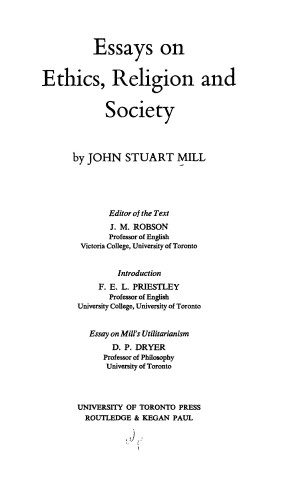
Mill’s Utilitarianism - John Stuart Mill, The Collected Works of John Stuart Mill, Volume X - Essays on Ethics, Religion, and Society [1833]Edition used:The Collected Works of John Stuart Mill, Volume X - Essays on Ethics, Religion, and Society, ed. John M. Robson, Introduction by F.E.L. Priestley (Toronto: University of Toronto Press, London: Routledge and Kegan Paul, 1985).
Part of: Collected Works of John Stuart Mill, in 33 vols.About Liberty Fund:Liberty Fund, Inc. is a private, educational foundation established to encourage the study of the ideal of a society of free and responsible individuals. Copyright information:The online edition of the Collected Works is published under licence from the copyright holder, The University of Toronto Press. ©2006 The University of Toronto Press. All rights reserved. No part of this material may be reproduced in any form or medium without the permission of The University of Toronto Press. Fair use statement:This material is put online to further the educational goals of Liberty Fund, Inc. Unless otherwise stated in the Copyright Information section above, this material may be used freely for educational and academic purposes. It may not be used in any way for profit.
Mill’s Utilitarianismthe majority of serious students of ethics today are utilitarians, and those who are not see utilitarianism as the chief position in need of amendment. John Stuart Mill’s writings on ethics, and especially on utilitarianism, are thus of vital contemporary interest and importance. More than any other thinker, Mill is responsible for laying down the principal directions ethics has taken since his day. He did not, however, embody his full views in any single volume or one set of writings, and the main lines in ethics which he sketched were worked out in detail only after his death by Henry Sidgwick. A generation later, G. E. Moore sought to refine upon Sidgwick’s results, and subsequent ethical theory has taken Moore’s work as its starting point. The most complete guide to undertaking a detailed examination of Mill’s ethical views is his Utilitarianism, and so I have used it as the basis of this introductory essay. His other essays on ethics are valuable as supplements to the opinions he puts forward in this work, and they are referred to where appropriate. Five main topics have been selected for detailed treatment in the discussion that follows. The first section sorts out some of Mill’s more important principles. Section II examines his dictum that the sole evidence that anything is desirable is that people desire it. In the third, consideration is given to what Mill holds that this evidence discloses. Section IV deals with Mill’s analysis of moral concepts. The discussion concludes with an examination of his views on the use of the principle of utility. I.THE PRINCIPLE OF UTILITYMill writes, “happiness is the sole end of human action, and the promotion of it the test by which to judge of all human conduct. . . .”1 He also makes it clear that the test is its promotion of happiness “to the greatest extent possible” (214). By such conduct Mill does not mean that which would promote happiness to the greatest extent conceivable, but that which would promote it to a greater extent than would any alternative. Mill also makes it clear that when he speaks of the promotion of happiness as “the test by which to judge of all human conduct,” the aspect of conduct of which he means that it is a test is whether it should be done.2 He thus holds that the test of whether something should be done is whether it would promote more happiness than would any alternative to it. Mill implies that if an action would satisfy this test, it should be done, and that if it would not, it is not one that should be done. Accordingly, the main principle which Mill maintains is that something should be done if and only if it would cause more happiness than would any alternative, and that something should not be done if and only if it would fail to cause as much happiness as would some alternative. The chief support Mill offers for this principle is that “happiness is desirable, and the only thing desirable, as an end. . .” (234). He distinguishes things desirable as a means and things desirable for their own sake. What is desirable for its own sake he speaks of as desirable as an end. He argues that it is because happiness is the only thing desirable for its own sake that the test of conduct generally is its promotion of happiness. The principle he employs in taking this step is that if there is one sort of thing which is alone desirable for its own sake, then the promotion of it is the test of all human conduct. By test of human conduct he means test of what should be done. An action is then one that should be done if and only if it satisfies this test. Mill thus takes it for granted that something should be done if and only if its consequences would be more desirable than would those of any alternative to it. From his main principle in turn Mill draws a conclusion about what it would be right to do and what it would be wrong to do. The question of whether it would be right or wrong to do a certain action is a question about its morality. Mill writes, “the morality of an individual action is . . . a question . . . of the application of a law to an individual case” (206). He thus holds that it would be wrong to do a certain action only if it would be at variance with a certain rule. If we ask what sort of rule he is referring to, Mill makes it clear that he means a rule that should generally be observed. By his main principle Mill has already given a general answer as to what should be done. In accordance with it he holds that a certain rule is one that should generally be observed if and only if its general observance would cause more happiness than would any alternative to its general observance.3 Mill thus maintains that it would be wrong to do a certain action only if it would be at variance with such a rule.4 Some prolixity is required to clarify what Mill understands by an action that would cause more happiness than any alternative to it.5 The only respect in which an action is thereby compared to its alternatives is its consequences, and the only consequences by which it is compared are those consisting of happiness and unhappiness. Mill writes, “By happiness is intended pleasure, and the absence of pain; by unhappiness, pain, and the privation of pleasure” (210). He states: “Of . . . philosophers who have taught that happiness is the end of life . . . [the] happiness which they meant was not a life of rapture; but moments of such, in an existence made up of few and transitory pains, many and various pleasures. . .” (215). Hence the only consequences of an action that are relevant are pleasures and pains. All the pleasures and pains among the consequences of an action are relevant, whether remote or near, whether experienced by humans or by other sentient creatures.6 If Mill held that the only relevant difference among pleasures and pains was whether one was greater than another, there would be only six possibilities for the total effects of an action. They would contain (1) an excess of pleasure over pain, (2) an excess of pain over pleasure, (3) an excess of neither, (4) pleasure and no pain, (5) pain and no pleasure, (6) neither pleasure nor pain. Mill argues, however, that pleasures and pains differ in a further respect which is relevant—some are more desirable than others.7 Accordingly, eight possibilities may be distinguished with regard to the total effects of an action: (1) They contain some pleasures and no pains. (2) They contain both pleasures and pains, and regardless of whether there is an excess of pleasure over pain, the pleasures are on the whole more desirable than the pains are undesirable. (3) They contain both pleasures and pains; neither the pleasures nor pains are of sorts such that the pleasures on the whole are more desirable than the pains are undesirable or such that the pains on the whole are more undesirable than the pleasures are desirable; but there is an excess of pleasure over pain. (4) They contain some pains and no pleasures. (5) They contain both pleasures and pains, and regardless of whether there is an excess of pain over pleasure, the pains are on the whole more undesirable than the pleasures are desirable. (6) They contain both pleasures and pains; neither the pleasures nor pains are of sorts such that the pleasures on the whole are more desirable than the pains are undesirable or such that the pains on the whole are more undesirable than the pleasures are desirable; but there is an excess of pain over pleasure. (7) They contain no pleasures or pains. (8) They contain both pleasures and pains, and regardless of whether there is an excess of pleasure over pain, of pain over pleasure, or an excess of neither, the pleasures and pains they contain are of sorts such that the pleasures on the whole are not more desirable than the pains are undesirable and such that the pains on the whole are not more undesirable than the pleasures are desirable. If (1) or (2) or (3) holds of a certain action, Mill would classify it as one that would cause an excess of happiness over unhappiness. If (4) or (5) or (6) holds, he would classify it as one that would cause an excess of unhappiness over happiness. If one of the other alternatives holds, he would classify an action as one that would cause an excess of neither. Having distinguished the possibilities for any action, taken by itself, we may notice how any two actions taken at random may stand to one another in these respects. Since there are three possibilities for each, there are nine possible combinations. Call one action A and the other B. (1) Both A and B would cause an excess of happiness. (2) A would cause an excess of happiness but B would cause an excess of neither. (3) A would cause an excess of happiness but B would cause an excess of unhappiness. (4) A would cause an excess of neither but B would cause an excess of happiness. (5) Both would cause an excess of neither. (6) A would cause an excess of neither but B would cause an excess of unhappiness. (7) A would cause an excess of unhappiness but B would cause an excess of happiness. (8) A would cause an excess of unhappiness but B would cause an excess of neither. (9) Both would cause an excess of unhappiness. Within (9) three possibilities are to be distinguished: (9.1) B would cause a greater excess of unhappiness. (9.2) Neither would cause a greater excess of unhappiness. (9.3) A would cause a greater excess of unhappiness. Also, within (1), that is, where both A and B would cause an excess of happiness, three possibilities are to be distinguished: (1.1) A would cause a greater excess of happiness. (1.2) Neither would cause a greater excess of happiness. (1.3) B would cause a greater excess of happiness. There are thus thirteen ways in which any two actions may stand to one another. These thirteen ways may be grouped into three. If (1.1), (2), (3), (6) or (9.1) obtains, Mill would say that A would cause more happiness than B or that B would cause less than A. If (1.3), (4), (7), (8) or (9.3) obtains, he would say that B would cause more happiness than A or that A would cause less than B. If any of the three remaining combinations obtains, he would say that either would cause as much happiness as the other. We have noticed three ways in which Mill would hold that any two actions taken at random could stand to one another. If any set of two or more actions is considered, we may notice three ways in which one of the actions of the set might stand to the others: (1) it would cause more happiness than any of the others, (2) it would cause less happiness than some of the others, (3) it would cause as much happiness as any of the others. The only sort of set of two or more actions to which Mill directs attention is that made up of a certain action and of the alternatives to it. This set includes whatever an agent would succeed in doing upon a given occasion if he tried hard enough, and excludes whatever he would not succeed in doing no matter how hard he tried. Accordingly, Mill would distinguish three ways in which an action may stand to the alternatives to it: (1) it would cause more happiness than any alternative, (2) it would cause less happiness than some alternative, (3) it would cause as much happiness as any alternative. So far attention has been paid to one set of features of which Mill’s main principle makes mention, apart from their role in it. There is a second set of features of actions which this principle mentions—whether it is one that should be done or one that should not. What Mill’s main principle asserts is a relation between features of the first set and features of the second. It asserts that something should be done if and only if it would cause more happiness than any alternative; that something should not be done if and only if it would cause less happiness than some alternative; and that a certain action is not one that should not be done if and only if it would cause as much happiness as any alternative. By his main principle Mill thus declares that a certain feature is a universal and peculiar feature of actions that should be done, and that a certain other feature is a universal and peculiar feature of actions that should not be done. It implies that whenever anyone judges that a certain action should be done, this is a condition that must be fulfilled for the judgment to be true. This is the case whether the judgment is about a past or future action, an actual or possible action, something done by oneself or another, or something done by an individual, a nation, or any group. Mill’s principle does not, however, imply that the only way by which anyone can know whether a certain action should be done is by seeking to make out whether it would cause more happiness than any alternative. Although Mill speaks of it as the “sole criterion,” his principle is quite compatible with using many other tests. It is compatible with using now one test and now another. Nor does Mill’s principle imply that it affords the only universal test by which to judge what should be done. All that it does imply is that whatever other test be used, it must yield results compatible with this principle. Mill’s principle does not supply the only test; it only lays down a condition to which any test must comply. Although Mill’s principle sets forth a universal and peculiar feature of actions that should be done, there is nothing about it which implies that this is the only universal and peculiar feature of such actions. It would be compatible with it to maintain, for instance, that something should be done if and only if it is commanded by God. Mill’s principle provides nothing that rules this out. Indeed, it is conceivable that there are ten thousand other universal and peculiar features of actions that should be done. One consequence which Mill draws from his principle is that it would be wrong to do a certain action only if it would violate a rule the general observance of which would cause more happiness. Many would agree with Mill in this. They would agree that whenever anyone does what is wrong, he is violating a rule the general observance of which would in fact cause more happiness. But they would not hold that this is the reason it would be wrong to do it. They would hold that the reason it is wrong to do any action is that it violates God’s law. They would urge that God wants his creatures to be happy and that because of this whoever disobeys God’s laws violates a law the general observance of which would cause more happiness. They would agree with Mill that by doing what is wrong someone violates a rule the general observance of which would cause more happiness. But they would say that it is not because of this that someone is doing wrong; it is rather because he breaks a rule laid down by God. There is nothing in this view incompatible with what we have so far seen of Mill’s main principle. When we notice how Mill deals with such a view, we find that he takes a further step. He holds not merely that someone does what is wrong only if he breaks a rule the general observance of which would cause more happiness, but also that what he does is wrong because it violates such a rule. Mill maintains not merely that those rules which should generally be observed would in fact cause more happiness, but also that it is because their general observance would cause more happiness that they should be observed. He does not thereby deny that by violating rules that should generally be observed, someone is disobeying God’s will. But he holds that the reason why a rule should be generally observed is not because it is prescribed by God but because its observance would cause more happiness.8 There is a further implication differentiating Mill from the view we have been considering. Those who maintain that the reason why a certain action is wrong is that it violates a rule laid down by God are committed to holding that if God should will something other than the happiness of his creatures, then an action would be wrong even though it would not violate a rule whose general observance would cause more happiness. Anyone who holds that an action is wrong because it violates a rule laid down by God is committed to holding that if there is no god or if he lays down no rules for men, then there is nothing which it would be wrong to do or wrong not to do. Mill not only holds that an action is wrong if it violates a rule the general observance of which would cause more happiness, he also contends that it is because it violates such a rule that an action is wrong. He thereby implies that even if God should will something other than the happiness of his creatures, or even if there is no god, an action would be wrong if it were to violate a rule the general observance of which would cause more happiness.9 In the first step, Mill asserts that a certain feature is a universal and peculiar feature of actions that should be done. In the second step, he states that it is because they have this feature that actions should be done. There is nothing incompatible between Mill’s principle and the view that something should be done if and only if it would bring about a greater realization of men’s capacities than would any alternative. But his principle is incompatible with the view that something should be done because it would have this result. Similarly, Mill’s principle is not incompatible with the view that something should be done if and only if it would bring about a greater fulfilment of human wants than would any alternative. But it is incompatible with the view that something should be done because it would have this result. One alternative to Mill’s principle is the view that something should be done because it would maximize human happiness. Another alternative to it is that something should be done because it would maximize the agent’s happiness. The former is the humanistic variant to Mill’s principle; the latter the egoistic variant to it. In contrast to both, Mill’s principle is the universalistic variant. Many other alternatives to Mill’s principle are conceivable. One view already noted is that which maintains that something should be done because it would maximize fulfilment of human wants. The universalistic variant to this view is that something should be done because it would maximize fulfilment of wants generally. The egoistic variant is that something should be done because it would maximize fulfilment of the agent’s wants. The theistic variant to this is that something should be done because it would maximize fulfilment of God’s wants. Still another alternative is the view that something should be done because it would maximize the fulfilment of human capacities. Two further conceivable views are the egoistic and universalistic variants of this. All such views differ from Mill’s principle in but one respect. They all agree that there is some feature which not only holds of every action that should be done and only of such, but which also constitutes the reason why it should be done. They all agree that this feature consists in a respect in which an action compares with its alternatives. They are also all agreed that this feature consists in how an action’s consequences would compare with those of its alternatives. These several views differ from each other and from Mill’s principle only in the sorts of consequences which they specify and the sorts of beings to whom they accrue. The chief support that Mill offers for his main principle, to vindicate it against such other views, is that happiness is the only thing desirable for its own sake. From this contention it does indeed follow that an action would have more desirable consequences than any alternative if and only if it would cause more happiness. But this contention does not by itself support his main principle. It does so only if a further premise is added, namely, that something should be done if and only if it would have more desirable consequences than any alternative. Mill does not explicitly avow this further premise. Yet, since he holds that the contention which he offers in support of his main principle does in fact support it, he may be presumed to take this premise for granted as not requiring any attention or defence. It then looks as if Mill contends that something should be done because it would cause more happiness, but that it is not only because of this that it should be done; that the reason in turn why what would cause more happiness should be done is that happiness is the only thing desirable for its own sake. One can at most speculate as to how Mill would meet this challenge. He might retort that the fact that an action would have more desirable consequences than any alternative could not be the ultimate reason why it should be done, since the ultimate reason why something should be done must consist in some other fact about it than the fact that it should be done, but in saying that an action would have more desirable consequences than any alternative, nothing more nor less is then said than that it should be done. Although it is not transparently evident that these are but two ways of saying the same thing, it is far from implausible to urge that by analysis they amount to the same. Two steps are involved in the analysis: (1) something should be done if and only if it would on the whole be more desirable for it to be done than any alternative; (2) it would on the whole be more desirable for something to be done than any alternative to it if and only if what would come of its being done would be more desirable than what would come of any alternative to it. If each of these is analytically true, nothing further is required. In behalf of the first step, the following may be urged. Whenever it is said that something should be done it is implied that it is capable of being done. It is also implied that it is capable of not being done, that is, that some alternatives are capable of being done in its stead. When it is said that something should be done, it is not only implied that it is one of a number of alternatives; it is also implied that it stands in a certain relation to the others. When it is said that something should be done, it is not implied that it would be more desirable for some alternative to it to be done; nor is it implied that it would be as desirable for some alternative to be done in its stead. What is rather implied is the denial of both these implications. When it is said that something should be done, it is thus implied that it would on the whole be more desirable for it rather than any alternative to be done.10 In behalf of the second step the following may be urged. It cannot be denied that an action may have consequences, and that whether it would be desirable for it to be done is affected by what would come of its being done. Nor can it be denied that the desirability of some alternative being done is affected by the desirability of what would come of it. It is then more desirable on the whole that one alternative rather than another be done if and only if what would come of the first would be more desirable than what would come of the other. Hence it would on the whole be more desirable for something to be done rather than any alternative if and only if what would come of it would be more desirable than what would come of any alternative. The chief premise that Mill offers in support of his main principle is that happiness is the only thing desirable for its own sake. This premise affords support only in conjunction with the added premise, that something should be done if and only if it would have more desirable consequences than any alternative. Consequently, Mill’s contention that happiness is the only thing desirable for its own sake cannot support his main principle against any sort of ethical theory which rejects the second premise. Against any such theory he seeks to vindicate his main principle by clearing up the relation of the conception of a wrong action and of an action which there is an obligation not to do to that of an action that should not be done.11 On the other hand, any sort of ethical theory that rejects Mill’s main principle but which holds that whether something should be done turns on how its consequences would compare with those of any alternative to it need not be incompatible with the second premise. To vindicate his main principle against any theory of that sort, it is sufficient for Mill to make good his contention that happiness is the only thing desirable for its own sake.12 Before we go on to examine how Mill seeks to make good this contention, certain implications of it may be noted. It implies that if A are the consequences of one action, X, and B the consequences of another action, Y, A would be more desirable for their own sake than B if and only if they would contain more happiness. It implies that if A should be the consequences of some other action than X, they would still be more desirable for their own sake than B. It thus implies that whether the consequences of an action are more desirable for their own sake than those of another does not depend on what action they are the consequences of. Mill’s contention also implies that if A are the consequences of a natural occurrence and B the consequences of another natural occurrence, A would still be more desirable for their own sake than B. This thus means that whether one set of consequences is more desirable for its own sake than another does not depend on what caused them. It does not depend on A or B being a set of consequences. Mill’s contention that happiness is the only thing desirable for its own sake has therefore a wider scope than his main principle. It implies that any state of affairs is more desirable for its own sake than another if and only if it contains more happiness than the other. When Mill is described as speaking of one state of affairs as “containing more happiness” than another, it must be borne in mind that this expression is used in the same sense as that in which he understands the consequences of one action as related to those of another when he regards one action as “causing more happiness” than the other. Accordingly, Mill’s contention that happiness is the only thing desirable for its own sake may be stated more fully as signifying that something is desirable for its own sake if and only if it is a state of affairs of one of three sorts: (1) a state containing some pleasure and no pain; (2) a state containing both pleasure and pain, but in which, whether or not there is an excess of pleasure over pain, the pleasures on the whole are more desirable than the pains are undesirable; (3) a state containing both pleasure and pain, and in which, although neither the pleasures nor pains are of sorts such that the pleasures on the whole are more desirable than the pains are undesirable or such that the pains on the whole are more undesirable than the pleasures are desirable, there is an excess of pleasure over pain. Mill likewise holds that something is undesirable for its own sake if and only if it is a state of affairs the opposite of one of these three. Mill’s contention implies that no inanimate thing or state of affairs made up only of inanimate things is desirable or undesirable for its own sake. It implies that no human being or human disposition is desirable or undesirable for its own sake. According to it, the only sort of matter that is desirable or undesirable for its own sake is a state of affairs comprising sentient beings. It implies that neither justice nor liberty nor peace is desirable for its own sake. It implies, moreover, that there is nothing desirable for its own sake save where there is life; and that there is nothing undesirable for its own sake save where there is life. Although Mill’s contention affirms a certain universal and peculiar feature of whatever is desirable for its own sake, it does not also state any such feature of whatever is desirable. While it implies that an inanimate thing, a human being, or justice or liberty or peace or life is not desirable for its own sake, it does not imply that none of these can be desirable for what will come of it. Mill’s contention implies that although a certain state of affairs is desirable for its own sake, it may still be undesirable; and even though a certain state of affairs is undesirable for its own sake, it may still be desirable, for what comes of it. Mill’s main principle implies that even if it would be undesirable for a certain action to be done, it would not follow that it should not be done. It implies that even if a certain action would have desirable effects, it should not be done, if some alternative to it would have more desirable effects. Mill’s principle implies that even though the consequences of a certain action would on the whole be undesirable for their own sake, it may still be the case that it should be done. This would be the case if the consequences of any alternative to it would be more undesirable for their own sake. II.THE EVIDENCE OF WHAT IS DESIRABLEmill’s argument to support his contention that happiness is the only thing desirable for its own sake contains two steps. In the first step he seeks to show that happiness is desirable; in the second, he seeks to show that it is the only thing desirable for its own sake. He writes, in the first step: The only proof capable of being given that an object is visible, is that people actually see it. . . . In like manner . . . the sole evidence it is possible to produce that anything is desirable, is that people do actually desire it. . . . No reason can be given why the general happiness is desirable, except that each person, so far as he believes it to be attainable, desires his own happiness. This, however, being a fact, we have . . . all the proof . . . which it is possible to require, that happiness is a good: that each person’s happiness is a good to that person, and the general happiness, therefore, a good to the aggregate of all persons. (234.) In the second step Mill acknowledges that men actually “do desire things which, in common language, are decidedly distinguished from happiness” (235). But he endeavours to show that “Whatever is desired otherwise than as a means to some end beyond itself, and ultimately to happiness, is desired as itself a part of happiness. . .” (237). Central to both steps in his argument is Mill’s contention that the sole evidence that anything is desirable is that it is desired. G. E. Moore urges that by asserting that the fact that something is desired is evidence that it is desirable, Mill is holding that if anything is desired it is desirable; and that by affirming that this is the sole evidence, Mill is holding that nothing is desirable unless desired. Moore also interprets Mill as inferring from this that “desirable” means “desired.” He points out, moreover, that Mill uses the words “good” and “desirable” interchangeably. Hence Moore contends that Mill is claiming that “good” means “desired.”13 Moore urges two objections against Mill: first, that “desirable” does not mean “desired,” and secondly, that even if something is desirable if and only if it is desired, it is fallacious to infer that “desirable” means “desired.” Both objections fail to apply to Mill; Mill does not draw the inference Moore attributes to him, nor does he maintain that “desirable” means “desired.” Mill also does not hold that “visible” means “seen.” Instead he asserts that the proof that something is visible is that it is seen. Similarly, what he affirms is that the sole evidence that anything is desirable is that it is desired. To this Moore urges two further objections, independent of the foregoing. The fact that something is desired would be evidence that it is desirable if and only if it is the case that from the mere fact that anything is desired it follows that it is also desirable. But from the mere fact that something is desired Moore objects that it does not follow that it is desirable. Moore does not question Mill’s contention that the fact that something is seen is proof that it is visible, for by “visible” is meant “capable of being seen.” He contends, however, that Mill is wholly unwarranted in arguing that “in like manner” the fact that a thing is desired is evidence that it is desirable, for he points out that by “desirable” is not meant “capable of being desired.” Just as “detestable” means not “capable of being detested” but “worthy of being detested,” so similarly, Moore urges, when something is said to be desirable, what is meant is that it ought to be desired, that it is worthy of being desired. From the fact that something is actually desired it does not follow that it ought to be desired. Moore urges a second objection against anyone who would try to save Mill’s dictum by holding that Mill uses “desirable” in it to mean “capable of being desired.” He points out that Mill puts forth this dictum to establish the conclusion that the general happiness is the only thing desirable for its own sake. If Mill is construed as using “desirable” in the sense of “capable of being desired” in his premise, Moore contends that his argument then becomes fallacious, since Mill does not use “desirable” in this sense in the conclusion. If anyone should still try to save Mill’s argument against this objection by urging that in the conclusion as well Mill means by “desirable,” “capable of being desired,” Moore contends that this will not do. He points out that in saying that happiness alone is desirable for its own sake, Mill makes it clear that he means that it alone is good for its own sake. Moore also points out that in saying that the general happiness alone is desirable for its own sake, Mill does not mean that it alone is capable of being desired for its own sake. Since Mill himself mentions that each person desires his own happiness, he acknowledges that men are capable of desiring something other than the general happiness for its own sake. Moore calls attention to another connection in which Mill makes this point. Mill remarks that it is a mistake to “confound the rule of action with the motive of it,” and continues, “ninety-nine hundredths of all our actions are done from other motives. . .” (219). Here too Mill makes it clear that, in saying that the general happiness is the only thing desirable for its own sake, he in no way holds that the only desire from which men can act or the only desire of which they are capable is desire for the general happiness.14 D. Raphael and E. W. Hall seek to defend Mill against these objections urged by Moore.15 They contend that Moore’s objections are beside the point, since they criticize Mill for doing something which he does not profess to do. They urge that Mill does not claim to prove that happiness is desirable because it is desired. They direct attention to what Mill has to say upon this matter. Mill writes, “The medical art is proved to be good, by its conducing to health. . . .” He generalizes, “Whatever can be proved to be good, must be so by being shown to be a means to something admitted to be good without proof” (207-208). Here Mill is saying two things: first, that whatever can be proved to be good can be so proved only by being shown conducive to something else that is good; second, that since something cannot be proved to be desirable for its own sake by being shown to be desirable as a means to something else, no proof can be given of what is desirable for its own sake. This conclusion Mill at once qualifies: “Questions of ultimate ends are not amenable to direct proof.” Mill still concedes that such questions are not amenable to what is “commonly understood by proof,” but he contends that they are amenable to a “larger meaning of the word proof. . . . Considerations may be presented capable of determining the intellect either to give or withhold assent.” Moore recognizes that Mill does not claim to give a proof of what things are desirable for their own sake in terms of what is commonly understood by proof. He agrees with Mill that no such proof can be given of what things are desirable for their own sake. Moore also agrees with Mill that considerations may be presented in favour of thinking that certain things and not others are desirable for their own sake. Raphael and Hall err in accusing Moore of taking Mill to be offering a proof in the “commonly understood” sense. Moore’s objection is rather that one consideration which Mill presents “to determine the intellect to give assent” to what is desirable is invalid. Because something is desired it does not follow that it is desirable. Hence the fact that something is desired does not constitute evidence that it is desirable. To make good his defence of Mill, Raphael must show that this consideration which Mill presents is not open to Moore’s objection. Raphael points out that in his Logic Mill maintains that whoever says that something should be done is recommending that it be done. Such a person, Mill writes, “speaks in rules, or precepts.”16 Mill continues, such “propositions . . . enjoin or recommend that something should be. They are . . . expressed by the words ought or should be.”17 Second, Raphael contends that Mill holds that “all rules or precepts are aimed at the promotion of ends.” He is referring to Mill’s remark, “All action is for the sake of some end, and rules of action, it seems natural to suppose, must take their whole character and colour from the end to which they are subservient” (206). Third, Raphael takes Mill as holding that “an ultimate end is that by reference to which we prove the propriety of adopting subordinate ends or particular rules.” He thereby construes Mill as maintaining that whenever men recommend something as desirable, their recommendations must ultimately have reference to an ultimate end. Finally, Raphael ascribes to Mill the view that “the ultimate end or criterion of human action is what human beings desire.”18 Accordingly, Raphael maintains that what Mill means by his dictum that “the sole evidence . . . that anything is desirable, is that people do actually desire it” is that when “we recommend . . . as ‘desirable’ . . . our recommendations must ultimately have reference to actual desires.”19 Raphael’s interpretation of Mill’s dictum fails to free it of the objection urged by Moore. For Moore urges that even if someone aims at a certain thing as an ultimate end, that is, as an end for its own sake, it still makes sense to ask whether that at which he aims is desirable for its own sake. From the fact that it is aimed at for its own sake, it does not follow that it is desirable for its own sake. Raphael also misrepresents Mill’s dictum, in construing it as maintaining that when anything is recommended as desirable, the recommendation must ultimately have reference to men’s desires. He construes it in this way by ascribing to Mill the view that when anything is recommended as desirable, it can be recommended only by reference to an ultimate end. Mill, however, does not hold that something can be shown to be desirable only by being shown to be a means to an ultimate end. He is instead concerned with how it is possible to make out what is desirable for its own sake. It is just in this connection that he puts forth his dictum. Mill not only speaks of what is desired and what is desirable. Again and again he speaks of ends. In doing so, he makes many statements reminiscent of Aristotle. Aristotle writes, “Every action and pursuit is thought to aim at some good; and for this reason the good has rightly been declared to be that at which all things aim. . . . Will not the knowledge of it, then, have a great influence on life?”20 In a similar vein, as we have seen, Mill says, “All action is for the sake of some end, and rules of action, it seems natural to suppose, must take their whole character and colour from the end to which they are subservient. When we engage in a pursuit, a clear and precise conception of what we are pursuing would seem to be the first thing we need. . . .” (206.) Mill also asserts, “Questions about ends are . . . questions what things are desirable.” The “sole evidence it is possible to produce that anything is desirable, is that people do actually desire it” (234). Aristotle writes, “If, then, there is some end of the things we do, which we desire for its own sake (everything else being desired for the sake of this) . . . this must be the good and the chief good.”21 In virtue of such similarities, the objection Moore urges against Mill is equally applicable to Aristotle’s arguments. Moore would contend that because there is that which is desired for its own sake, and all else that is desired is desired for the sake of it, it does not follow that it is desirable for its own sake, or that it alone is desirable for its own sake. Mill also writes, “happiness is desirable, and the only thing desirable, as end. . . .” Each of virtue, pleasure, money, power, and fame, “once desired as an instrument for the attainment of happiness, has come to be desired for its own sake. In being desired for its own sake it is, however, desired as part of happiness. The person is made, or thinks he would be made, happy by its mere possession. . . . Whatever is desired otherwise than as a means . . . to happiness, is desired as itself a part of happiness. . . .” (236-7.) Aristotle similarly writes, Not all ends are final ends. . . . Now we call that which is in itself worthy of pursuit more final than that which is worthy of pursuit for the sake of something else, and that which is never desirable for the sake of something else more final than the things that are desirable both in themselves and for the sake of that other thing, and therefore we call final without qualification that which is always desirable in itself and never for the sake of something else. Now such a thing happiness, above all else, is held to be; for this we choose always for itself and never for the sake of something else, but honour, pleasure, reason, and every virtue we choose indeed for themselves. . . , but we choose them also for the sake of happiness, judging that by means of them we shall be happy. Happiness, on the other hand, no one chooses for the sake of these, nor, in general, for anything other than itself.22 Here Aristotle distinguishes what is worthy of pursuit from what is pursued and what is desirable from what is desired. Yet in the third sentence he again exposes himself to Moore’s objection: because something is chosen for its own sake and never for the sake of something else, it does not follow that it is “worthy of pursuit,” “desirable in itself,” or “always desirable in itself.” In his Logic, Mill asserts: “Every art . . . enunciates the object aimed at, and affirms it to be a desirable object. The builder’s art assumes that it is desirable to have buildings. . . . The hygienic and medical arts assume, the one that the preservation of health, the other that the cure of disease, are fitting and desirable ends.”23 Aristotle similarly writes, “In different actions and arts . . . the good of each [is] that for whose sake everything else is done . . . the end.”24 To this Moore’s objection again applies. Undeniably that for the sake of which everything that is done in a certain sphere of activity is often something good, something desirable. But because there is that in a certain art or sphere of activity for the sake of which everything within it is done, it does not follow that it is desirable. Here it is to be noted that Mill is in complete accord with Moore’s objection. He follows up the last passage by writing, “To this art [the Art of Life] . . . all other arts are subordinate; since its principles are those which determine whether the special aim of any particular art is worthy and desirable.” Here Mill clearly recognizes that the fact that something is the aim of a certain pursuit in no way implies that that aim is desirable. Elsewhere Mill makes it quite clear that he holds that whether a certain pursuit should be engaged in depends not on what its aim is but on whether the consequences of engaging in it would be more desirable. The core of Moore’s objection to Mill’s dictum, on the evidence for what is desirable, is that from the fact that something is aimed at, it does not follow that it ought to be aimed at; and that from the fact that something is desired, it does not follow that it ought to be desired. Mill is in complete accord with Moore on the general point of which these are instances. He devotes his entire essay, “Nature,” to refuting the notion that nature, that which is, determines that which ought to be.25 Mill is also in full agreement with the specific point Moore urges in objection to him. Neither nature generally nor man’s own nature can determine what ought to be. Many a propensity is to be extirpated.26 Because men have a propensity or desire for something, it in no way follows that it ought to be desired. A further look may then be taken at Mill’s argument to see if it is free of Moore’s objection. In support of the conclusion that only happiness is desirable for its own sake, Mill urges that only happiness is desired for its own sake. Moore contends that in speaking of what is desirable for its own sake, Mill is speaking of what ought to be desired for its own sake. Moore objects that from the fact that something is desired it does not follow that it ought to be desired. We may then inquire what can be inferred from the premise that only happiness is desired for its sake. If something is incapable of being done, it cannot be the case that it ought to be done. Accordingly, (a) Only that which is capable of being desired for its own sake ought to be desired for its own sake. Moore does not question that whatever is desired for its own sake is capable of being desired for its own sake. Similarly, it seems that (b) Only that which is desired for its own sake is capable of being desired for its own sake. Completing the argument, (c) Only that which is desired for its own sake ought to be desired for its own sake. (d) Only happiness is desired for its own sake. (e) Hence, only happiness is desirable for its own sake. The question at issue is not whether (d) is correct, but whether (c) is. Statement (c) follows from (a) and (b), so what calls for scrutiny is (b). If something is desired for its own sake it follows that it is capable of being desired for its own sake. It does not in like manner hold, nor can it be inferred from this, that if something is alone desired for its own sake it alone is capable of being desired for its own sake. Mill, however, does not include (b) in his argument. He does not hold that whatever is visible is seen; he contends rather that only that which is seen is that for which there is evidence that it is capable of being seen. Mill is similarly concerned to determine whether there is evidence that anything other than happiness is capable of being desired for its own sake. He urges that the only evidence that is offered is that virtue, money, power, and fame are desired for their own sake. Mill does not reject this evidence. Instead, he seeks to show that when any of these is desired for its own sake, it is desired only as a part of happiness. Instead of (b), Mill would aver (b′) Only that which is desired for its own sake is that for which there is evidence that it is capable of being desired for its own sake. From (a) follows (a′) Only that for which there is evidence that it is capable of being desired for its own sake is that for which there is evidence that it ought to be desired for its own sake. From (b′) and (a′) follows (c′) Only that which is desired for its own sake is that for which there is evidence that it ought to be desired for its own sake. Moore objects to Mill’s dictum, on the evidence for what is desirable, by construing it as affirming that from the fact that something is desired it follows that it ought to be desired. Mill, however, does not hold that from the fact that something is desired, it follows that it ought to be desired. He does not maintain that whatever is desired ought to be desired; he speaks rather of the only evidence that something is desirable. Moore says that by “desirable” Mill means “ought to be desired,” and it is only on this interpretation that he raises his objection against Mill’s dictum. If Moore is correct in this, then what Mill’s dictum maintains is (c′). Moore’s objection against Mill’s dictum carries no weight against it; there is nothing incompatible in affirming (c′) and denying that whatever is desired ought to be desired. Moore is correct in pointing out that when Mill argues that happiness is the only thing desirable for its own sake, he means by “desirable” not “capable of being desired” but “good,” and that by “desirable for its own sake” he means “good in itself,” “intrinsically good.” Moore also contends that by “desirable” Mill, or anyone else, means “ought to be desired” or that which it would be good to desire. There is a fatal objection to this contention, at least in regard to Mill. Since Mill holds by his main principle that something ought to be done only if it would cause more happiness, he holds that something ought to be desired only if desiring it would cause more happiness. Hence if Mill is construed as meaning by “desirable,” “ought to be desired,” he would then be maintaining that the consequences of an action would be desirable only if desiring them would cause more happiness. But this is clearly not what Mill contends; for him the consequences of an action would be more desirable only if that action would cause more happiness. There is a further objection to contending that “desirable” means “ought to be desired,” which applies to Mill, or to anyone who agrees with him that something should be done only if its consequences would be more desirable. For he then holds that something ought to be desired only if the effects of desiring it would be more desirable. But if “desirable” is construed as “ought to be desired,” Mill would then have to say that the consequences of an action would be desirable only if desiring these consequences would have more desirable consequences. He would similarly have to say that the consequences of desiring the consequences of a certain action would be desirable only if desiring them in turn would have more desirable effects. And so on. But Mill clearly does not think that the desirability of the consequences of an action is affected by what would be the consequences of desiring these consequences, or by what would be the consequences of desiring the consequences of desiring the consequences of the action. He maintains that the consequences of an action would be more desirable only if it would cause more happiness. Moore overlooks certain differences between the conception of that which ought to be desired and the conception of that which is desirable. When it is said that something ought to be done, it is implied that there is some respect in which it stands in contrast to anything capable of being done instead of it. “Ought” is a superlative, as is also the conception of that which ought to be desired, but the adjective, “desirable,” is a positive term, which takes the comparative “more desirable” and the superlative “most desirable.” In accord with Mill’s assumption that something ought to be done only if what would come of it would be more desirable for its own sake, something ought to be desired for its own sake only if what would come of so desiring it would be more desirable for its own sake. Hence if something ought to be desired for its own sake, it does not follow that it would be desirable for its own sake; and because something would be desirable for its own sake, it does not follow that it ought to be desired for its own sake. Since Mill’s dictum on the evidence for what is desirable cannot be taken as a dictum on the evidence for what ought to be desired, it must be given some other interpretation than that set forth in the preceding paragraph. It is doubtful whether anyone sincerely believes that a certain thing should be done without feeling on the whole in favour of its being done. It is similarly extremely doubtful that anyone believes that something would be undesirable without feeling some displeasure at the thought of it, or that anyone is genuinely convinced that something would be desirable without to some measure feeling pleased at the thought of it. Someone may, indeed, believe that something would be desirable in a certain respect, and yet on the whole not be in favour of it, through thinking it undesirable in other respects. Nonetheless, Mill points out that no one feels pleased to some measure at the thought of a certain state of affairs, without feeling some desire for its occurrence (237). Someone does not therefore manage to convince another that something would be desirable unless he induces him to feel some desire for it. This suggests that what Mill may be maintaining by his dictum is that no one has evidence for believing something desirable unless he has some desire for it. If it is interpreted in this way, it may be objected that people often believe that others desire something, and desire it for its own sake, without thinking that it would be desirable for its own sake. It may also be objected that on occasion a man is well aware that he desires something for its own sake, but still does not think that it would be desirable. These objections merely show that someone may believe that something is desired without believing that it would be desirable. They do not show that anyone is ever convinced that something would be desirable without having some desire for it. There is a further objection to Mill’s dictum, if it is interpreted in this way. Someone has a desire for something whenever he believes it would be desirable. He has some desire for it, whether he is correct or mistaken in believing that it would be desirable. Consequently the fact that he has a desire for something cannot serve as evidence that what he believes would be desirable would really be such. What is rather the case is that the fact that someone believes that something would be desirable is evidence that he has some desire for it. Although the fact of something’s being desired cannot serve as evidence for the correctness of all judgments of what is desirable, it may still be the case that there are some such judgments for which it alone can serve as evidence. It is important to note the limitations which Mill himself places on the dictum that the only evidence that something is desirable is that it is desired. He does not hold that this is the evidence for all sorts of judgments of what is desirable. Nor does he claim that all desires are qualified to serve as evidence. Mill does not state that the only evidence that something is desirable as a means is that it is desired. He maintains that something is good as a means, desirable as a means, if and only if it would bring about something else that is desirable (207-8). He would contend that there is no evidence that it is desirable as a means unless there is evidence that it would have a certain effect. If something is desired in the belief that something desirable would come of it, Mill does not hold that such a desire is evidence that something desirable would come of it. He maintains that whether something is desired or not, it is desirable as a means just so long as it would have some desirable effects. He thus does not claim that the fact something is desired is either the sole evidence or even a part of the evidence to support a judgment that it is desirable as a means. Mill also does not hold that the fact that something is desired is the sole evidence to support a judgment that it is intrinsically desirable, that is, desirable for its own sake. On this point he writes, “No reason can be given why the general happiness is desirable, except that each person, so far as he believes it to be attainable, desires his own happiness. This, however, being a fact, we have . . . all the proof . . . that each person’s happiness is a good to that person, and the general happiness, therefore, a good to the aggregate of all persons.” (234). Countless critics have urged that it is fallacious for Mill to infer that since each desires his own happiness therefore everyone desires the general happiness. Mill, however, does not here infer that the general happiness is desired. What he argues, rather, is that it is desirable. In this passage he certainly claims that the fact that each desires his own happiness is evidence that the happiness of each is desirable. But he does not base his claim that the general happiness is desirable on the evidence that it is desired. In a letter he explains, “when I said that the general happiness is a good . . . I merely meant . . . to argue that since A’s happiness is a good, B’s a good, C’s a good, &c., the sum of all these goods must be a good.”27 Mill is holding that if the happiness of A is intrinsically desirable and the happiness of B is intrinsically desirable and the happiness of C is intrinsically desirable, then the “sum” of the happiness of A and the happiness of B and the happiness of C is intrinsically desirable. Put generally, what Mill is arguing is that a whole is intrinsically desirable if it is made up of components which are intrinsically desirable and which exceed intrinsically undesirable components. Mill does not hold that the fact that a whole is desired for its own sake is either necessary or sufficient evidence that it is made up of an excess of intrinsically desirable components. Thus a second sort of judgment to which Mill does not apply his dictum is a judgment that something is intrinsically desirable because it is a whole containing an excess of intrinsically desirable components. Moore and C. I. Lewis distinguish two further sorts of judgments of what is desirable to which Mill, for similar reasons, would not regard his dictum as applicable.28 It does not apply to a judgment that something is desirable because it is a component of something intrinsically desirable. For example, when he considers it by itself, a mountain climber may well regard the toil he undergoes in reaching a mountain peak as undesirable in itself. Yet he would regard it as desirable because it enhances the desirability of the experience of reaching the mountain top, making the venture far more desirable than it would have been had he reached the peak by helicopter. In considering his toil as desirable for this reason, the climber is making a judgment which in one respect resembles judging that something is desirable as a means. He regards it as desirable because of its relation to something else. In another respect it differs. When something is judged desirable as a means, it is merely claimed that it would bring about something else desirable, whereas the climber regards one component of an experience as desirable because its experienced quality enhances the desirability of the whole experience of which it is a part. Although Mill also distinguishes that which is desirable because a part of happiness from that which is desirable because a means to happiness, he fails to mention that the fact that someone desires something because he “thinks he would be made” happy by its mere possession, supplies no evidence that it would actually enhance his happiness (236). A fourth sort of judgment is exemplified by the lover of mountain scenery who regards a certain mountain as desirable because of the delight to be had in beholding it. He is not regarding the mere existence of the mountain as desirable for its own sake. He regards the mountain as desirable because the experience of beholding it is desirable. We have noticed four distinct ways in which something may be judged to be desirable: (1) as a means, (2) because it enhances the intrinsic desirability of something of which it is a part, (3) because it is an object of an intrinsically desirable experience, (4) intrinsically, because made up of an excess of intrinsically desirable components. By the fourth sort of judgment something is judged intrinsically desirable; by the other three, extrinsically desirable. All four sorts make the claim that something is desirable because it stands in a certain relation to something else. The evidence required for each is evidence that the relation obtains. Consequently no judgment of one of these sorts is one in which a desire for what is judged desirable is evidence of the correctness of the judgment. A fifth sort of judgment, fundamentally distinct from these four, is that something is intrinsically desirable independent of its relation to something else. For brevity, we may refer to such a judgment as a judgment of what is “desirable of itself.” Judgments of the other four sorts are logically dependent on judgments of this sort, for what they affirm to be desirable they imply is related in a certain way, directly or indirectly, to something desirable of itself. The fifth sort of judgment is logically independent of the other four. For someone to be assured whether he is correct in judging that something is desirable of itself, one preliminary is that he avoid confusing this judgment with the other four. For a judgment of this sort, it would be out of place to adduce the kind of evidence distinctively relevant to one of the four other sorts of judgments. When Mill speaks of desires as evidence of what is desirable, he would regard this dictum as holding only for judgments of the fifth sort. The same is true when he speaks of a preference for one sort of matter over another as evidence that the one is more desirable than the other. Even for judgments of the fifth sort Mill does not claim that every sort of desire or preference can serve as evidence. He does not hold that a desire for something qualifies as evidence if it rests on the belief that it would have desirable effects, or upon the beliefs on which judgments of the other three sorts rest. He contends that someone’s preference for one sort of matter over another does not qualify as evidence unless he has had experiences of matters of both sorts and his preference is based on such experiences (211). He would not hold that his preference is based on such experiences unless they led him to it. Mill would hold that a preference by someone who has had such experiences would not qualify as evidence unless he was gladder at the one than the other. He therefore maintains that a preference for one sort of matter over another qualifies as evidence so long as it rests on nothing but having had experiences of matters of both sorts and having been gladder at the one than the other. It may be presumed that Mill likewise holds that someone’s desire for something of a certain sort does not qualify as evidence unless it rests on experience of matters of that sort. When someone desires something, he prefers its existence to its non-existence. Since he argues that a preference for one matter over another does not qualify as evidence unless it rests on experience of matters of both sorts, Mill may be presumed to hold that someone’s desire for a certain thing does not qualify as evidence unless he has had experience of something of its sort, as well as some experience from which such a thing was absent. Mill would also hold that a desire by someone who had had such an experience would not qualify as evidence unless he was glad at what he experienced. He then holds that someone’s desire for something qualifies as evidence so long as it rests on nothing but having had experience of something of that sort and having been glad at it. It would serve as evidence for someone else, as well as for him who had the desire. Mill would certainly admit that if someone was glad at what he experienced because he expected that something desirable would come of it, or if his gladness was mediated by another of the four sorts of judgments distinguished above, such gladness would not count as evidence. For the same reason, if he was glad at it because of the kind of person he is, that is, because he desired things of that sort, his gladness would not count as evidence, if his desire in turn was mediated by any of the four other sorts of judgments. Someone’s gladness at what he experienced counts as evidence only if he was glad at it on its own account, only, that is, if his gladness was unaffected by any beliefs he has about its relation to other things. If this is a correct interpretation of Mill’s dictum, he then holds that someone’s preference or desire for something qualifies only secondarily as evidence, and that the primary evidence anyone has of what is desirable of itself is having experienced it and being glad at it. III.WHAT IS DESIRABLE FOR ITS OWN SAKEhaving fixed on what Mill holds is the only ultimate evidence of what is desirable, we may now turn to what he maintains such evidence discloses. Mill urges that no one is ever glad on its own account at some state which his experience has disclosed to him unless some pleasure occurred in it, and therefore that no one is led by such experiences to desire like states to come about unless he expects that they will be pleasant. He also urges that no one is ever sorry on its own account about some state with which his experience has acquainted him unless there was something painful in it. Accordingly, the first thing which Mill argues that the relevant evidence discloses is that nothing is desirable of itself unless it is a state in which some pleasure is experienced and nothing is undesirable of itself unless it is a state in which some pain is felt. Moore attacks Mill for maintaining that only pleasure is desired.29 He concedes that in instances of many desires, pleasure is one feature of that of which someone is desirous. But he urges that on such occasions, what someone looks forward to and is desirous of is a pleasant walk or a pleasant conversation with a certain person, a pleasant party with certain companions or a pleasant smoke. To this some retort that while sometimes a walk, sometimes a smoke, sometimes a party is desired, each is desired only for the sake of the pleasure it will afford, so that it is pleasure alone which is desired for its own sake. Against this others urge that while the pleasure is one element of what someone looks forward to when he desires a walk, a smoke, or a party, the walk or the smoke or the party is also a component of what he is desirous of. Aristotle points out that when someone desires a certain walk but is denied it and is provided something else that affords him pleasure, his desire for the walk remains unfulfilled.30 If pleasure alone were desired for its own sake, any pleasure would serve to fulfil a desire. Yet when someone desires a certain pleasant thing, his desire is fulfilled only by it, not by any pleasure at random. Secondly, Moore urges that on many occasions there is no expectation of pleasure characterizing that which someone is desirous of. Often someone desires to eat when hungry. While he feels pleasure at the prospect of eating, the prospect before his mind is simply that of eating certain things. A spectator watching a football game wants his team to score a goal. That of which he is thinking and of which he is desirous is its scoring. He has no thought of pleasure. When someone is struggling with a certain problem he desires a solution. No thought of pleasure is before his mind. Thirdly, Moore urges that although occasions are conceivable on which someone desires nothing but pleasure, if any occur, they are very rare; for what generally seems to be found is that someone is desirous of a pleasure of a certain sort, that is, a state characterized not only by pleasure but by other features as well. There is nothing in these objections put by Moore which Mill does not agree with or which is incompatible with the evidence he adduces for what is desirable. Mill does not hold that only pleasure is desired. He agrees that there are many occasions on which that of which someone is desirous includes no thought of pleasure. Mill points out that many things are desired as a means to a certain end, and he notices that when something is desired as a means, there is very often no thought of it as pleasant. Mill also does not maintain that whenever something is desired without thought of what will come of it, it may be described as being desired for its own sake. He points out that men often desire something simply because they are in the habit of pursuing it, and have no thought of what it will lead to. He adds, “any . . . person whose purposes are fixed, carries out his purposes without any thought of the pleasure he has in contemplating them, or expects to derive from their fulfilment . . .” (238). He does indeed contend that nothing is desired for its own sake unless it is expected that it will be a state of affairs in which some pleasure will be experienced. But he does not claim that there are any occasions upon which pleasure alone characterizes what is desired. Although he contends that only what is desired for its own sake is evidence of what is desirable of itself, he does not think that whenever someone desires something for its own sake this counts as evidence; he holds that a man’s desire of this sort counts as evidence only if it is based on experience of similar matters and he was glad on its own account at what he experienced. According to Mill, the evidence whether one matter is more desirable of itself than another is of the same kind. He urges that no one who has ever actually had experience of two occasions in which only pleasure of the same sort was felt is gladder on its own account about one than the other unless it was more pleasant. Nor, he argues, is anyone, who has had experience of two occasions in which only pain of the same sort was felt, sorrier on its own account about one than the other unless more pain was felt in it; and no one is led by such experiences to prefer one to another of that sort unless he expects it would be less painful. No one with experience of toothaches prefers of itself a more severe to a less severe toothache. Accordingly, Mill argues, the relevant evidence further shows that as between two states in which only pleasure of the same sort is felt, one is more desirable of itself than the other only if it is more pleasant; and as between two states in which only pain of the same sort is felt, one is more undesirable of itself than the other only if it is more painful. What evidence has someone in judging between states in which different sorts of pleasure or pain are felt? The same kind of evidence, Mill maintains. Someone has ultimate evidence for thinking the one more desirable of itself than the other only if he experienced both and was gladder at one than the other. Even though a toothache was more painful than a grief, someone has evidence for concluding that the grief was more undesirable of itself than the toothache if he experienced both and was sorrier at the grief. As between two painful states of different sorts Mill holds that the ultimate evidence that one was more undesirable of itself than the other is that someone who experienced both is sorrier at the one than the other. As between two pleasant states of different sorts he holds that regardless of whether one was more pleasant than the other, the ultimate evidence that it was more desirable of itself is that someone who experienced both was gladder at the one and is led by this to prefer, in the future, experiences like the one to experiences like the other. From this Mill ventures also to generalize what sorts of experiences are more desirable of themselves, independent of whether they are more pleasant: “the pleasures of the intellect, of the feelings and imagination, and of the moral sentiments [have] a much higher value as pleasures than . . . those of mere sensation,” than “bodily pleasures” (211). For such a generalization that compares sorts of pleasures, the experiences of many are clearly relevant: “Of two pleasures, if there be one to which all or almost all who have experience of both give a decided preference, irrespective of any feeling of moral obligation to prefer it, that is the more desirable pleasure” (211). In making the generalization that pleasant experiences of one sort are more desirable of themselves than those of another sort, Mill does not deny that a certain experience of a less desirable sort may be so much more pleasant than one of a more desirable sort as to be more desirable than it, or that certain painful experiences of a less undesirable sort may be so much more painful as to be more undesirable. He does not deny that a certain bodily agony may be more undesirable of itself than a certain grief. Here too Mill holds that the ultimate evidence someone has that the bodily agony was of such an intensity that it was more undesirable than the grief, is his having experienced both and being sorrier about the agony (213). Moore charges that Mill’s contention that some experiences are more desirable of themselves than others, even though not more pleasant, is inconsistent with his contention that nothing is desirable of itself unless it is a state in which some pleasure is experienced. Raphael seeks to free Mill of this charge of inconsistency by urging that Mill does not hold that it is possible “that a pleasure of higher quality may contain a lesser or no greater quantity of pleasure than a pleasure of lower quality.”31 Raphael continues, “Mill’s criterion is preference, and I think he would say that to prefer one pleasure to another is to desire it the more strongly. And since he says later, in Chapter IV, that to desire a thing is the same as to think it pleasant, it follows, on this view, that to prefer a thing is to think it more pleasant.” Mill certainly holds that whoever prefers one thing to another desires it more. He also writes, “desiring a thing and finding it pleasant . . . are . . . inseparable” (237). But he does not claim that no one desires one thing more than another unless he expects that it will be more pleasant. Instead he writes, If I am asked . . . what makes one pleasure more valuable than another, merely as a pleasure, except its being greater in amount, there is but one possible answer. . . . If one of the two is, by those who are competently acquainted with both, placed so far above the other that they prefer it, even though knowing it to be attended with a greater amount of discontent, . . . we are justified in ascribing to the preferred enjoyment a superiority in quality, so far outweighing quantity as to render it, in comparison, of small account. (211.) In pursuing the point further, Raphael gives up his contention that “the distinction of quality is, at bottom, the same as the distinction of quantity.” He no longer interprets Mill as holding that it is impossible for one experience to be more desirable of itself unless it is more pleasant. Instead, he takes Mill to mean that one experience is never in fact more desirable of itself unless it is more pleasant. In support of this, Raphael points out that when Mill remarks that it is “better to be Socrates dissatisfied than a fool satisfied,” Mill also denies that “this preference takes place at a sacrifice of happiness” (212). Raphael urges that although Socrates is dissatisfied and the fool not, it is consistent for Mill to maintain that Socrates is happier than the fool and his happiness more desirable, in so far as Socrates “enjoys a greater balance of pleasure over pain, than the fool.” Raphael does indeed show that in maintaining that it is better to be Socrates dissatisfied than a fool satisfied, it would be consistent for Mill to hold that no experience is more desirable of itself than another unless it is more pleasant. In making this point, however, Raphael fails to show that Mill does in fact maintain that one experience is more desirable of itself than another only if it is more pleasant. Mill speaks, instead, of “what makes one pleasure more valuable than another . . . except its being greater in amount”; he writes of being “justified in ascribing . . . a superiority in quality, so far outweighing quantity . . .” (211). In a journal of 1854, Mill remarks, “Quality as well as quantity of happiness is to be considered; less of a higher kind is preferable to more of a lower.”32 Raphael himself acknowledges that Mill would “say that a superior pleasure may be less intense than an inferior.” Moore, however, charges that “Mill’s judgment of preference, so far from establishing the principle that pleasure alone is good, is obviously inconsistent with it. . . . If one pleasure can differ from another in quality, that means, that a pleasure is something complex, something composed, in fact, of pleasure in addition to that which produces pleasure.”33 Mill is involved in no difficulty here. When he holds that only a pleasure is desirable of itself he is not holding that only the pleasantness of a pleasant experience is desirable. By a pleasure he understands a pleasant experience. He maintains that only a complex, that is, an experience having pleasantness as one of its features, is desirable of itself. The inconsistency with which Moore charges Mill is this: Mill, therefore, in admitting that a sensual indulgence can be directly judged to be lower than another pleasure, in which the degree of pleasure involved may be the same, is admitting that other things may be good, or bad, quite independently of the pleasure which accompanies them. . . . [I]f you say, as Mill does, that quality of pleasure is to be taken into account, then you are no longer holding that pleasure alone is good as an end, since you imply that something else, something which is not present in all pleasures, is also good as an end.34 This charge is easily rebutted. In holding that some experiences are more desirable of themselves than others, although not more pleasant, Mill certainly admits that the intrinsic desirability of an experience may be enhanced by other components of it than the pleasure enjoyed in it. He would therefore agree with Moore that such components “may be good . . . independently of the pleasure which accompanies them.” But Mill would hold that such components are desirable as contributing to the intrinsic desirability of the experience. He does not maintain that any experience is desirable of itself if it has such other components but is not also pleasant. Consequently, when Mill argues that the relevant evidence shows that nothing is desirable in itself unless it is a state in which some pleasure is enjoyed, it is not inconsistent for him to argue that the relevant evidence also shows that some pleasant experiences are more desirable of themselves although not more pleasant. One writer contends that Mill means by “ ‘pleasure,’ whatever is made the object of desire.”35 Mill, however, does not hold that whenever anyone desires something as a means—say, having a tooth extracted—it is to be described as a pleasure. Mill also mentions that men often desire something simply because they are in the habit of pursuing it and that “any . . . person whose purposes are fixed, carries out his purposes without any thought of . . . pleasure.” Another writer contends that Mill uses “pleasure” as “a technical term for whatever anyone desires for its own sake.”36 Mill, however, does not regard an enjoyable experience as any less a pleasure when it comes to a man without having been desired. He maintains that some experiences are desired for their own sake more than others although not more pleasant. Moreover, while he holds that there is no happiness without pleasure, he does not think that when someone desires happiness for its own sake, what he desires is to be described as a pleasure. Mill does not hold that the only things that are desirable of themselves are transient experiences in which pleasure alone is felt or that the only things that are undesirable of themselves are transient experiences in which pain alone is felt. He does not question that even if it involves both pleasure and pain, the whole of a man’s life, or some prolonged portion of it, may be desirable or undesirable of itself. We might expect Mill to hold that one portion of a man’s life is more desirable than another if the pleasant experiences comprising it are more pleasant and more numerous and the painful less painful and less numerous, provided these component experiences are not of more desirable sorts than others; and that in so far as some of the component experiences are of more desirable sorts than others, one portion of a man’s life is more desirable if its components are more desirable and its more desirable components are more numerous. In one passage Mill speaks as if one portion of a man’s life is happier and more desirable so long as these conditions alone are fulfilled. He writes, “. . . Greatest Happiness . . . is an existence exempt as far as possible from pain, and as rich as possible in enjoyments, both in point of quantity and quality. . . .” He immediately adds, “the test of quality, and the rule for measuring it against quantity, being the preference felt by those who, in their opportunities of experience . . . are best furnished with the means of comparison” (214). In this passage Mill speaks as if he regards the intrinsic desirability of a portion of a man’s life, taken on the whole, as dependent only on the intensity and intrinsic desirability of each of the several component pleasant and painful experiences and upon the proportion among them. Elsewhere, however, Mill does not maintain that there is immediate evidence for the intrinsic desirability only of momentary experiences. For he urges that evidence that a man’s happiness is desirable is furnished by the fact that he desires it (234). From what Mill says regarding preferences, it is clear that he would not hold that a man’s desire for happiness supplied evidence unless he had experience of the matters comprising happiness and was glad at them. Mill also urges that the evidence that one sort of life is more desirable of itself than another is preference (211). But he does not hold that a man’s preference is evidence that one “mode of existence” is on the whole more desirable of itself than another, unless his experience has acquainted him with both and he was gladder at one sort than the other. He then holds that the ultimate evidence that one portion of a man’s life was intrinsically more desirable than another is that he who had experience of both was gladder on the whole at it. Mill would not hold that someone’s being gladder at one portion of life is evidence that it was more desirable on the whole, unless he was acquainted with the many experiences comprising each. In what way would he take account of the component experiences? In looking back over a portion of his life, someone will look upon some experiences that were quite desirable of themselves as detracting from the desirability of the whole and will see others of little desirability in themselves as appreciably enhancing the desirability of the whole. In assessing the intrinsic desirability, on the whole, of a portion of a man’s life, the desirability of each component experience to be reckoned with is not the desirability it has of itself but its desirability as contributing to the intrinsic desirability of that portion of life on the whole. In desiring his own happiness henceforth, moreover, it is then reasonable for a man to rate any experience that may befall him not in terms of its intrinsic desirability but in terms of its desirability as enhancing the desirability of his life on the whole. When Mill speaks of the most desirable life for a man as an “existence exempt as far as possible from pain, and as rich as possible in enjoyments, both in quantity and quality,” he holds that a man’s life is intrinsically more desirable the greater the preponderance of intrinsically desirable experiences comprising it. It is indeed logically possible that the greater the preponderance of intrinsically desirable experiences comprising a man’s life the more it would also be made up of component experiences which enhanced its desirability on the whole. Yet it seems doubtful that this often in fact would be the case. Mill hardly faces this issue. At all events, he would hold that the reason why any experience is desirable as a component of happiness is not that it is desirable of itself but that it enhances the desirability of the life of which it is a part. It is doubtless not because he regards active pleasures as more pleasant or as of an intrinsically more desirable sort, but because he regards them as enhancing the desirability of life, that Mill speaks of a man’s happiness as greater if it includes “many and various pleasures, with a decided predominance of the active over the passive . . .” (215). Although Mill neglects to distinguish the desirability of a pleasant experience as a part of happiness from its desirability of itself, he uses this distinction with regard to other matters. Mill acknowledges that men desire for their own sake “things which, in common language, are decidedly distinguished from happiness” (235). He cites virtue, money, power, fame. In order to show that desires for these do not supply evidence that other things than happiness are intrinsically desirable, Mill seeks to argue that when any of these comes to be desired no longer as a means, it is desired only as a part of happiness. Moore urges three objections against this.37 He contends that “these admissions are . . . in . . . glaring contradiction with his argument that pleasure . . . is the only thing desired.” He reproaches Mill for holding that “ ‘money,’ these actual coins . . . are . . . a part of my pleasant feelings.” He condemns Mill for holding that “what is only a means to an end, is the same thing as a part of that end.” When Mill speaks of things desired as a part of happiness, he is not speaking of them as a part of pleasant feelings but as a part of “an existence made up of few and transitory pains, many and various pleasures. . .” (215). Mill’s contention that nothing is desired for its own sake save that which involves some pleasant experience is not contradicted by his contention that objects of desire are characterized by other features as well. Mill also does not claim that whatever is desired as a means to happiness is desired as a part of happiness. He claims rather that certain things desired as a means to happiness come through that association to be desired no longer as a means, and that when this has occurred, they are desired as a part of happiness. C. D. Broad attacks Mill for contending that originally human beings desire things because they expect them to be pleasant and later come to desire other things as well by association. He urges that “it is unlikely that” humans in early infancy “have the experience of desiring . . . for a reason at all.”38 But Mill does not hold that infants originally desire things only because they expect them to be pleasant. He points out that it is not the case that whatever even adults desire “they have the experience of desiring . . . for a reason.”39 Mill seeks to show that only happiness is intrinsically desirable by arguing that when anything else—virtue, fame, power, money—once desired as a means to happiness, comes to be desired for its own sake, it is desired only as a part of happiness. Even if that which is desired is in fact a part of “an existence made up of few and transitory pains, many and various pleasures,” this does not show that it is desired only as a part of happiness. Mill argues: “What was once desired as an instrument for the attainment of happiness, has come to be desired for its own sake. In being desired for its own sake it is, however, desired as part of happiness. The person is made, or thinks he would be made, happy by its mere possession. . . .” (236.) This argument is open to more serious objections. If Mill can succeed in showing that virtue, or fame, or power, or money comes to be desired only as a part of happiness, he can no longer hold that it is desired for its own sake. He then removes his ground for arguing that the “ingredients of happiness are very various, and each of them is desirable in itself. . .” (235). And even if he is successful in showing that each comes to be desired only as a part of happiness, this in no way establishes that each is desirable as a part of happiness. The fact that a certain individual desires money because “it has come to be itself a principal ingredient of the individual’s conception of happiness” or because he “thinks he would be made happy by its mere possession” does not show that his happiness would in fact be enhanced thereby. Mill is particularly concerned about virtue. He notices that a man is not virtuous unless he enjoys acting virtuously (239). Virtuous conduct is therefore not only desirable of itself; it is also a pleasant activity which is desirable because it enhances a man’s happiness. Mill also notices that men cannot be virtuous without acting disinterestedly (235). He urges that it is desirable that they be virtuous, for they then have dispositions leading them to do what is desirable (235). Mill hereby acknowledges that in this respect virtue is desirable as instrumental to happiness, not desirable as a component of happiness which enhances it. Although it is desirable that men be virtuous as a means to happiness, Mill notices that a man cannot be virtuous if he desires to be virtuous or to do what is virtuous as a means to happiness. A man cannot be virtuous unless he desires to do what is virtuous for its own sake. What appears to trouble Mill is how to acknowledge the disinterestedness of virtue without acknowledging that it is something other than happiness desired for its own sake, and therefore desirable for its own sake. The solution Mill adopts is that when a man desires virtue for its own sake, he desires it only as a part of happiness, that is, in the belief that it will enhance his happiness. This solution will not do. If a man desires to be virtuous because it will enhance his happiness, he falls short of being genuinely virtuous just as when he desires to be virtuous as a means to happiness. When a man desires to be virtuous he also hopes for happiness, but he does not desire to be virtuous out of the hope that it will yield him happiness. Mill overlooks another solution which his own line of reasoning affords. No one who considers the matter dispassionately regards it as desirable of itself that the virtuous suffer and the evil be meted out happiness. Mill maintains that only happiness or what includes happiness is intrinsically desirable. He also commonly speaks of only a life or an extended portion of a life as happy or unhappy. This raises a further issue. If Mill thinks that only a period of life comprising several component experiences can be happy or unhappy, he must then deny that any momentary pleasant experience is intrinsically desirable and that any transient painful experience is intrinsically undesirable. On the other hand, Mill holds that if someone who has had first-hand acquaintance with an experience is glad on its own account that it occurred, this is conclusive evidence that it was intrinsically desirable. He would hold that this evidence would not be upset if later someone would be gladder if that particular pleasant experience had not occurred because it detracted from the happiness of a period of life of which it was a part. Mill also seems to maintain that if, among its many consequences, the only effect that an action has on a certain man is to cause him some brief pleasure, it then causes him happiness. Even if the brief pleasure it caused him was such that it detracted from his happiness, Mill would have to admit that it was intrinsically desirable. He can then not continue to adhere to the contention that the relevant evidence shows that only happiness is intrinsically desirable. Mill would not be troubled by this qualification, for he can still maintain that happiness or what includes happiness is invariably intrinsically more desirable than that which does not. If Mill held that happiness is the only thing intrinsically desirable, he could not claim that the effects of one action are intrinsically more desirable than those of another if and only if it causes more happiness. But he can maintain this because he contends that the effects of one action are intrinsically more desirable than those of another if the one set of effects contains more happiness than does the other. Mill does not support this contention by direct appeal to the ultimate evidence for what is desirable but by inference from what it discloses. His inference is that since it is intrinsically desirable for A to be happy and intrinsically desirable for B to be happy and intrinsically desirable for C to be happy, it is intrinsically desirable for A and B and C each to be happy.40 While he would hold that the reason why any experience is desirable as a component of a certain man’s happiness is not that it is intrinsically desirable but that it enhances the desirability of his life on the whole, a like consideration does not apply regarding the “general happiness.” Mill contends that a state of affairs comprising the happiness and unhappiness of many beings is intrinsically more desirable the more happiness it comprises and the greater the preponderance of happiness over unhappiness within it. Some critics charge him with introducing an extraneous consideration when he adds Bentham’s dictum, “everybody to count for one, nobody for more than one.” Mill, however, points out that when this dictum is understood as asserting that “equal amounts of happiness are equally desirable, whether felt by the same or by different persons,” and that “one person’s happiness, supposed equal in degree (with the proper allowance made for kind), is counted for exactly as much as another’s,” all that is spelled out by it is that the preponderance of happiness over unhappiness be “both in point of quantity and quality” and in nothing else (257, 214). IV.ANALYSIS OF MORAL CONCEPTSwe have now to consider a further set of objections urged against Mill’s utilitarianism. It is urged that if it is correct, whenever someone could more effectively promote the general happiness by taking another’s automobile and continuing to use it without his consent, it would be quite right for him to do so. Whenever someone could make better use of another’s house or clothing or other possession, there would be nothing wrong in his stealing it. The fact that it belonged to another would be irrelevant. It is contended that utilitarianism rides roughshod over all rights, not only rights of property. If a wife and children are burdened with a cantankerous husband and father, it would be right for her to drown him secretly and replace him with another husband, if everybody affected would be happier in consequence. Since utilitarianism reckons only with consequences, it is also urged that it can find no place for what is fair or just, or for men being rewarded as they deserve. Because it is unfair of a father to provide for some of his children while neglecting the others, or for some to cheat on their income tax while deriving the advantages from those who make full returns, or for many to toil long hours with little returns while the idle and lazy enjoy an abundance of good things, or for one to receive the credit for what another has accomplished—all this is irrelevant, so long as the resultant enjoyment is maximized. If the happiness of a country is best realized by slavery, it is claimed that any appeal to the injustice of slavery or to men’s right to freedom are considerations of which utilitarianism can take no account.41 Utilitarianism is also criticized for holding that men have but one duty, to maximize enjoyment. This is not a duty to any specific persons. Humans and other animals are looked upon as only so many “dumping grounds” on which to bestow enjoyment. It is not denied that people have duties to promote the happiness of others, but what is urged is that they have duties to provide different sorts of happiness to different persons and other duties to certain persons than to promote their happiness.42 A man has a duty to afford his wife certain enjoyments which he does not have a duty to furnish other women. He has duties to his children which he does not owe to other children. The happiness which he owes his children is different from that which he owes his wife. When someone has hired a man to paint his house, he thinks that it is right to pay him because he has promised to. He does not reckon whether some alternative use of his money would more effectively promote the general happiness. It is urged that utilitarianism takes account only of consequences but that duties such as these arise from an antecedent relationship in which someone stands to certain persons. It is pointed out that besides these duties, men have duties which they owe to all men—to tell the truth, for instance. Granted that this duty may be outweighed on occasion by a more stringent obligation, it is argued that it does not cease whenever the general happiness would be more effectively promoted by neglecting it. It is not denied that by doing what is right a man very often does what will in fact promote the general happiness, but it is urged that utilitarianism is guilty of gross oversimplification, disregarding the diversity of considerations determining what is the right thing to do. In virtue of these it is contended that it is very often morally incumbent on a man to do a certain thing whether or not it would maximize the general happiness. Most of these objections are not to Mill’s contention that happiness is the only thing intrinsically desirable; they rather criticize Mill for contending that questions of right and wrong are questions of what would have the most desirable consequences. Mill seeks to cope with objections such as these by elucidating what is implied when it is asserted that it would be right or wrong or unjust to do a certain thing, and by analyzing what is meant when someone is said to have a right to s |

Titles (by Subject)