EconlibThe LibraryOther Sites |
Front Page Titles (by Subject) DE TOCQUEVILLE ON DEMOCRACY IN AMERICA [II] 1840 - The Collected Works of John Stuart Mill, Volume XVIII - Essays on Politics and Society Part I
Return to Title Page for The Collected Works of John Stuart Mill, Volume XVIII - Essays on Politics and Society Part IThe Online Library of LibertyA project of Liberty Fund, Inc.Search this Title:Also in the Library:
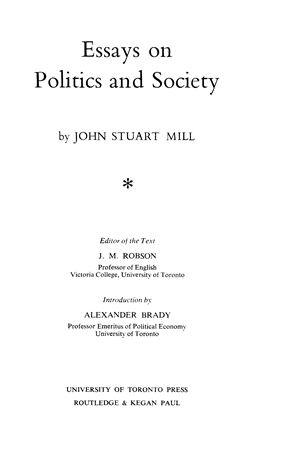
DE TOCQUEVILLE ON DEMOCRACY IN AMERICA [II] 1840 - John Stuart Mill, The Collected Works of John Stuart Mill, Volume XVIII - Essays on Politics and Society Part I [1832]Edition used:The Collected Works of John Stuart Mill, Volume XVIII - Essays on Politics and Society Part I, ed. John M. Robson, Introduction by Alexander Brady (Toronto: University of Toronto Press, London: Routledge and Kegan Paul, 1977).
Part of: Collected Works of John Stuart Mill, in 33 vols.About Liberty Fund:Liberty Fund, Inc. is a private, educational foundation established to encourage the study of the ideal of a society of free and responsible individuals. Copyright information:The online edition of the Collected Works is published under licence from the copyright holder, The University of Toronto Press. ©2006 The University of Toronto Press. All rights reserved. No part of this material may be reproduced in any form or medium without the permission of The University of Toronto Press. Fair use statement:This material is put online to further the educational goals of Liberty Fund, Inc. Unless otherwise stated in the Copyright Information section above, this material may be used freely for educational and academic purposes. It may not be used in any way for profit.
DE TOCQUEVILLE ON DEMOCRACY IN AMERICA [II]
EDITOR’S NOTEDissertations and Discussions, II (2nd ed.), 1-83, where it is headed “M. de Tocqueville on Democracy in America,” the title footnoted: “Edinburgh Review, October 1840.” Reprinted from ER, LXXII (Oct., 1840), 1-47, where it is unsigned, and headed: “Art. I.—1. De la Democratie en Amérique. Par Alexis de Tocqueville, Membre de l’Institut. 4 vols. 8vo. Paris: [Gosselin,] 1835-40. / 2. Democracy in America. By Alexis de Tocqueville, Member of the Institute of France. Translated byHenry Reeve, Esq., Barrister-at-Law. 4 vols. 8vo. London: [Saunders and Otley,] 1835-40.” Running title: “Democracy in America.” Identified in JSM’s bibliography as “A review of Tocqueville’s ‘Democracy in America’ in the Edinburgh Review for October 1840 (No. 145.)” (MacMinn, 52.) In the copy of the Edinburgh article in the Somerville College Library JSM has indicated three changes: two of them (see 163t-t and 192x-x, the latter being a correction of a typographical error) were adopted in the revised text; the third (164w-w) was further rewritten. For comment on the composition of this article and JSM’s relations with Tocqueville, see the Textual Introduction, lxxvi-lxxviii above. The following text, taken from D&D, II, 2nd ed., is collated with that in D&D, 1st ed., and that in the Edinburgh. In two places (174-5 and 200-4) JSM adapts parts of his “De Tocqueville on Democracy in America [I]” and “Duveyrier’s Political Views of French Affairs” (1846); these passages have been collated with their originals. In the footnoted variants, “67” indicates D&D, 2nd ed.; “59” indicates D&D, 1st ed.; “40” indicates Edinburgh Review; “Source” indicates Reeve’s translation of Tocqueville; “35” indicates “De Tocqueville on Democracy in America [I]”; and “46” indicates “Duveyrier’s Political Views.” In the references to De la Démocratie en Amérique, both Reeve’s translation and the original (identified as Tocqueville) are cited. De Tocqueville on Democracy in America [II]it has been the rare fortune of M. de Tocqueville’s book to have achieved an easy triumph, both over the indifference of our at once busy and indolent public to profound speculation, and over the particular obstacles which oppose the reception of speculations from a foreign, and above all from a French source. There is some ground for the remark often made upon us by foreigners, that the character of our national intellect is insular. The general movement of the European mind sweeps past us without our being drawn into it, or even looking sufficiently at it to discover in what direction it is tending; and if we had not a tolerably rapid original movement of our own, we should long since have been left in the distance. The French language is almost universally cultivated on this side of the Channel; a flood of human beings perpetually ebbs and flows between London and Paris; national prejudices and animosities are becoming numbered among the things that were; yet the revolution which has taken place in the tendencies of French thought, which has changed the character of the higher literature of France, and almost that of the French language, seems hitherto, as far as the English public are concerned, to have taken place in vain. At a time when the prevailing tone of French speculation is one of exaggerated reaction against the doctrines of the eighteenth century, French philosophy, with us, is still synonymous with Encyclopedism. The Englishmen may almost be numbered who are aware that France has produced any great names in prose literature since Voltaire and Rousseau; and while modern history has been receiving a new aspect from the labours of men who are not only among the profoundest thinkers, but the clearest and most popular writers of their age, even those of their works which are expressly dedicated to the history of our own country remain mostly untranslated, and in almost all cases unread. To this general neglect M. de Tocqueville’s book forms, however, as we have already said, a brilliant exception. Its reputation was as sudden, and is as extensive, in this country as in France, and in that large part of Europe which receives its opinions from France. The progress of political dissatisfaction, and the comparisons made between the fruits of a popular constitution on one side of the Atlantic, and of a mixed government with a preponderating aristocratic element on the other, had made the working of American institutions a party question. For many years, every book of travels in America had been a party pamphlet, or had at least fallen among partisans, and been pressed into the service of one party or of the other. When, therefore, a new book, of a grave and imposing character, on Democracy in America, made its appearance even on the other side of the British Channel, it was not likely to be overlooked, or to escape an attempt to convert it to party purposes. If ever political writer had reason to believe that he had laboured successfully to render his book incapable of such a use, M. de Tocqueville was entitled to think so. But though his theories are of an impartiality without example, and his practical conclusions lean towards Radicalism, some of his phrases are susceptible of a Tory application. One of these is “the tyranny of the majority.”[*] This phrase was forthwith adopted into the Conservative dialect, and trumpeted by Sir Robert Peel in his Tamworth oration, when, as booksellers’ advertisements have since frequently reminded us, he “earnestly requested the perusal” of the book by all and each of his audience.[†] And we believe it has since been the opinion of the country gentlemen that M. de Tocqueville is one of the pillars of Conservatism, and his book a definitive demolition of America and of Democracy. The error has done more good than the truth would perhaps have done; since the result is, that the English public now know and read the first philosophical book ever written on Democracy, as it manifests itself in modern society; a book, the essential doctrines of which it is not likely that any future speculations will subvert, to whatever degree they may modify them; while its spirit, and the general mode in which it treats its subject, constitute it the beginning of a new era in the scientific study of politics. The importance of M. de Tocqueville’s speculations is not to be estimated by the opinions which he has adopted, be these true or false. The value of his work is less in the conclusions, than in the mode of arriving at them. He has applied to the greatest question in the art and science of government, those principles and methods of philosophizing to which mankind are indebted for all the advances made by modern times in the other branches of the study of nature. It is not risking too much to affirm of these volumes, that they contain the first analytical inquiry into the ainfluences of Democracya . For the first time, that phenomenon is treated of as something which, being a reality in nature, and no mere mathematical or metaphysical abstraction, manifests itself by innumerable properties, not by some one only; and must be looked at in many aspects before it can be made the subject even of that modest and conjectural judgment, which is alone attainable respecting a fact at once so great and so new. Its consequences are by no means to be comprehended in one single description, nor in one summary verdict of approval or condemnation. So complicated and endless are their ramifications, that he who sees furthest into them willb, in general,b longest hesitate before finally pronouncing whether the good or the evil of its influence, on the whole, preponderates. M. de Tocqueville has endeavoured to ascertain and discriminate the various properties and tendencies of Democracy, the separate relations in which it stands towards the different interests of society, and the different moral and social requisites of human nature. In the investigation he has cof necessity left much undone,c and much which will be better done by those who come after him, and build upon his foundations. But he has earned the double honour of being the first to make the attempt, and of having done more towards the success of it than probably will ever again be done by any one individual. His method is, as that of a philosopher on such a subject must be—a combination of deduction with induction: his evidences are, laws of human nature, on the one hand; the example of America, and France, and other modern nations, so far as applicable, on the other. His conclusions never rest on either species of evidence alone, whatever he classes as an effect of Democracy, he has both ascertained to exist in those countries in which the state of society is democratic, and has also succeeded in connecting with Democracy by deductions à priori,dtending to showd that such would naturally be its influences upon beings constituted as mankind are, and placed in a world such as we know ours to be. If this be not the true Baconian and Newtonian method applied to society and government; if any better, or even any other be possible, M. de Tocqueville would be the first to say, candidus imperti: if not, he is entitled to say to political theorists, whether calling themselves philosophers or practical men, his utere mecum.[*] That part of Democracy in America which was first published, professes to treat of the political effects of Democracy: the seconde is devoted to its influence on society in the widest sense; on the relations of private life, on intellect, morals, and the habits and modes of feeling which constitute national character. The last is both a newer and a more difficult subject of inquiry than the first; there are fewer who are competent, or who will even think themselves competent, to judge M. de Tocqueville’s conclusions. But, we believe, no one, in the least entitled to an opinion, will refuse to him the praise of having probed the subject to a depth which had never before been sounded; of having carried forward the controversy into a wider and a loftier region of thought; and pointed out many questions essential to the subject which had not been before attended to: questions which he may or may not have solved, but of which, in any case, he has greatly facilitated the solution. The comprehensiveness of M. de Tocqueville’s views, and the impartiality of his feelings, have not led him into the common infirmity of those who see too many sides to a question—that of thinking them all equally important. He is able to arrive at a decided opinion. Nor has the more extensive range of considerations embraced in his Second Part, affected practically the general conclusions which resulted from his First. They may be stated as follows:—That Democracy, in the modern world, is inevitable; and that it is on the whole desirable; but desirable only under certain conditions, and those conditions capable, by human care and foresight, of being realized, but capable also of being missed. The progress and ultimate ascendancy of the democratic principle has in his eyes the character of a law of nature. He thinks it an inevitable result of the tendencies of a progressive civilization; by which expressions he by no means intends to imply either praise or censure. No human effort, no accident even, unless one which should throw back civilization itself, can avail, in his opinion, to defeat, or even very considerably to retard, this progress. But though the fact itself appears to him removed from human control, its salutary or baneful consequences do not. Like other great powers of nature, the tendency, though it cannot be counteracted, may be guided to good. Man cannot turn back the rivers to their source;[*] but it rests with himself whether they shall fertilize or lay waste his fields. Left to its spontaneous course, with nothing done to prepare before it that set of circumstances under which it can exist with safety, and to fight against its worse by an apt employment of its better peculiarities, the probable effects of Democracy upon human well-being, and upon whatever is best and noblest in human character, appear to M. de Tocqueville extremely formidable. But with as much of wise effort devoted to the purpose as it is not irrational to hope for, most of what is mischievous in its tendencies may, in his opinion, be corrected, and its natural capacities of good so far strengthened and made use of, as to leave no cause for regret in the old state of society, and enable the new one to be contemplated with calm contentment, if without exultation. It is necessary to observe that by Democracy M. de Tocqueville does not in general mean any particular form of government. He can conceive a Democracy under an absolute monarch. Nay, he entertains no small dread lest in some countries it should actually appear in that form. By Democracy, M. de Tocqueville understands equality of conditions; the absence of all aristocracy, whether constituted by political privileges, or by superiority in individual importance and social power. It is towards Democracy in this sense, towards equality between man and man, that he conceives society to be irresistibly tending. fTowardsf Democracy in the other, and more common sense, it may or may not be travelling. Equality of conditions tends naturally to produce a popular government, but not necessarily. Equality may be equal freedom, or equal servitude. America is the type of the first; France, he thinks, is in danger of falling into the second. The latter country is in the condition which, of all that civilized societies are liable to, he regards with the greatest alarm—a democratic state of society without democratic institutions. For, in democratic institutions, M. de Tocqueville sees not an aggravation, but a corrective, of the most serious evils incident to a democratic state of society. No one is more opposed than he is to that species of democratic radicalism, which would admit at once to the highest of political franchises, untaught masses who have not yet been experimentally proved fit even for the lowest. But the ever-increasing intervention of the people, and of all classes of the people, in their own affairs, he regards as a cardinal maxim in the modern art of government: and he believes that the nations of civilized Europe, though not all equally advanced, are all advancing, towards a condition in which there will be no distinctions of political rights, no great or very permanent distinctions of hereditary wealth; when, as there will remain no classes nor individuals capable of making head against the government, unless all are, and are fit to be, alike citizens, all will ere long be equally slaves. The opinion that there is this irresistible tendency to equality of conditions, is, perhaps, of all the leading doctrines of the book, that which most stands in need of confirmation to English readers. M. de Tocqueville devotes but little space to the elucidation of it. To French readers, the historical retrospect upon which it rests is familiar; and facts known to every one establish its truth, so far as relates to that country. But to the English public, who have less faith in irresistible tendencies, and who, while they require for every political theory an historical basis, are far less accustomed to link together the events of history in a connected chain, the proposition will hardly seem to be sufficiently made out. Our author’s historical argument is, however, deserving of their attention. Let us recollect the situation of France seven hundred years ago, when the territory was divided amongst a small number of families, who were the owners of the soil and the rulers of the inhabitants: the right of governing descended with the family inheritance from generation to generation; force was the only means by which man could act on man; and landed property was the sole source of power. Soon, however, the political power of the clergy was founded, and began to extend itself: the clergy opened its ranks to all classes, to the poor and the rich, the villein and the lord; equality penetrated into the government through the church, and the being who as a serf must have vegetated in perpetual bondage, took his place as a priest in the midst of nobles, and not unfrequently above the heads of kings. The different relations of men became more complicated and more numerous, as society gradually became more stable and more civilized. Thence the want of civil laws was felt; and the order of legal functionaries soon rose from the obscurity of gtheirg tribunals and their dusty chambers, to appear at the court of the monarch, by the side of the feudal barons in their ermine and their mail. Whilst the kings were ruining themselves by their great enterprises, and the nobles exhausting their resources by private wars, the lower orders were enriching themselves by commerce. The influence of money began to be perceptible in state affairs. The transactions of business opened a new road to power, and the financier rose to a station of political influence, in which he was at once flattered and despised. Gradually the spread of mental acquirements, and the increasing taste for literature and the arts, opened chances of success to talent, knowledge became a means of government, intelligence became a social power, and the man of letters took a part in the affairs of the state. The value attached to the privileges of birth decreased, in the exact proportion in which new paths were struck out to advancement. In the eleventh century nobility was beyond all price; in the thirteenth it might be purchased: it was conferred for the first time in 1270; and equality was thus introduced into the government through aristocracy itself. In the course of these seven hundred years, it sometimes happened that, in order to resist the authority of the crown, or to diminish the power of their rivals, the nobles granted a certain share of political rights to the people. Or, more frequently, the king permitted the inferior orders to enjoy a degree of power, with the intention of lowering the aristocracy. As soon as land was held on any other than a feudal tenure, and personal property began in its turn to confer influence and power, every improvement which was introduced in commerce or manufactures was a fresh element ofh equality of conditions. Henceforward every new discovery, every new want which igrew upi , and every new desire which craved satisfaction, was a step towards the universal level. The taste for luxury, the love of war, the sway of fashion, the most superficial as well as the deepest passions of the human heart, co-operated to enrich the poor and to impoverish the rich. From the time when the exercise of the intellect became a source of jpowerj and of wealth, it is impossible not to consider every addition to science, every fresh truth, every new idea, as a germ of power placed within the reach of the people. Poetry, eloquence, and memory, the grace of wit, the glow of imagination, the depth of thought, and all the gifts which are bestowed by Providence without respect of persons, turned to the advantage ofk democracy; and even when they were in the possession of its adversaries, they still served its cause, by lbringingl into relief the natural greatness of man; its conquests spread, therefore, with those of civilization and knowledge; and literature became an arsenal, where the poorest and the weakest could always find weapons to their hand. In perusing the pages of our history, we shall scarcely meet with a single great event, in the lapse of seven hundred years, which has not turned to the advantage of equality. The Crusades, and the wars with the English, decimated the nobles and divided their possessions; the erection of corporate towns introduced an element of democratic liberty into the bosom of feudal monarchy; the invention of fire-arms equalized the villein and the noble on the field of battle; printing opened the same resources to the minds of all classes; the post was established, so as to bring the same information to the door of the poor man’s cottage and to the gate of the palace; and Protestantism proclaimed that all men are alike able to find the road to heaven. The discovery of America offered a thousand new paths to fortune, and placed riches and power within the reach of the adventurous and the obscure. If we examine what mwas happeningm in France at intervals of fifty years, beginning with the eleventh century, we shall invariably perceive that a twofold revolution has taken place in the state of society. The noble has gone down on the social ladder, and the roturier has gone up; the one descends as the other rises. Every half century brings them nearer to each other. Nor is this phenomenon at all peculiar to France Whithersoever we turn our eyes, we witness the same continual revolution throughout the whole of Christendom. Everywhere the various occurrences of national existence have turned to the advantage of democracy; all men have aided it by their nexertions. Thosen who have intentionally laboured in its cause, and those who have served it unwittingly; those who have fought for it, and those who have declared themselves its opponents—have all been driven along in the same otracko , have all laboured to one end, some ignorantly and some unwillingly; all have been blind instruments in the hands of God. The gradual development of the equality of conditions is therefore a providential fact, and possesses all the characteristics of a Divine decree; it is universal, it is durable, it constantly eludes all human interference, and all events as well as all men contribute to its progress. Would it be wise to imagine that a social impulse which dates from so far back, can be checked by the efforts of a generation? Is it credible that the democracy which has annihilated the feudal system, and vanquished kings, will respect the pbourgeoisp and the capitalist? Will it stop now that it is grown so strong, and its adversaries so weak? It is not necessary that God himself should speak, in order to disclose to us the unquestionable signs of his will. We can discern them in the habitual course of nature, and in the invariable tendency of events. The Christian nations of our age seem to me to present a most alarming spectacle. The impulse which is bearing them along is so strong that it cannot be stopped, but it is not yet so rapid that it cannot be guided. Their fate is in their hands; yet a little while, and it may be so no longer. (Introduction to the First Part.) [Reeve, Vol. I, pp. xv-xxii; Tocqueville, Vol. I, pp. 4-10.]q That such has been the actual course of events in modern history, nobody can doubt, and as truly in England as in France. Of old, every proprietor of land was sovereign over its inhabitants, while the cultivators could not call even their bodily powers their own. It was by degrees only, and in a succession of ages, that their personal emancipation was effected, and their labour became theirs, to sell for whatever they could obtain for it. They became the rich men’s equals in the eye of the law; but the rich had still the making of the law, and the administering of it; and the equality was at first little more than nominal. The poor, however, could now acquire property; the path was open to them to quit their own class for a higher; their rise even to a considerable station, gradually became a common occurrence; and to those who acquired a large fortune, the other powers and privileges of aristocracy were successively opened, until hereditary honours have become less a power in themselves, than a symbol and ornament of great riches. While individuals thus continually rose from the mass, the mass itself multiplied and strengthened; the towns obtained a voice in public affairs; the many, in the aggregate, became even in property more and more a match for the few; and the nation became a power, distinct from the small number of individuals who once disposed even of the crown, and determined all public affairs at their pleasure. The Reformation was the dawn of the government of public opinion. Even at that early period, opinion was not formed by the higher classes exclusively; and while the publicity of all rStater transactions, the liberty of petition and public discussion, the press—and of late, above all, the periodical press—have rendered public opinion more and more the supreme power, the same causes have rendered the formation of it less and less dependent upon the initiative of the higher ranks. Even the direct participation of the people at large in the government had, in various ways, been greatly extended, before the political events of the last few years, when democracy has given so signal a proof of its progress in society, by the inroads it has been able to make into the political constitution. And in spite of the alarm which has been taken by the possessors of large property, who are far more generally opposed than they had been within the present generation to any additional strengthening of the popular element in the House of Commons, there is at this moment a much stronger party for a further parliamentary reform, than many good observers thought there was, twelve years ago, for that which has already taken place. But there is a surer mode of deciding the point than any historical retrospect. Let us look at the powers which are even now at work in society itself. To a superficial glance at the condition of our own country, nothing can seem more unlike any tendency to equality of condition. The inequalities of property are apparently greater than in any former period of history. Nearly all the land is parcelled out in great estates, among comparatively few families; and it is not the large, but the small properties, which are in process of extinction. A hereditary and titled nobility, more potent by their vast possessions than by their social precedency, are constitutionally and really one of the great powers in the state. To form part of their order is sthat whichs every ambitious man aspires ttot , as the crowning glory of a successful career. The passion for equality of which M. de Tocqueville speaks almost as if it were the great moral lever of modern times, is hardly known in this country even by name. On the contrary, all ranks seem to have a passion for inequality. The hopes of every person are directed to rising in the world, not to pulling the world down to him. The greatest enemy of the political conduct of the House of Lords, submits to their superiority of rank as he would to the ordinances of nature; and often thinks any amount of toil and watching repaid by a nod of recognition from one of their number. We have put the case as strongly as it could be put by an adversary, and have stated as facts some things which, if they have been facts, are giving visible signs that they will not always be so. If we look back even twenty years, we shall find that the popular respect for the higher classes is by no means the thing it was; and uthoughu all who are rising wish for the continuance of advantages which they themselves hope to share, there are among those who do not expect to rise, increasing indications that a levelling spirit is abroad, and political discontents, in whatever manner originating, show an increasing tendency to take that shape. But it is the less necessary to dwell upon these things, as well shall be satisfied with making out, in respect to the tendency to equality in England, much less than M. de Tocqueville contends for. We do not maintain that the time is drawing near when there will be no distinction of classes; but we do contend that the power of the higher classes, both in government and in society, is diminishing; while that of the middle and even the lower classes is increasing, and likely to increase. The constituent elements of political importance are property, intelligence, and the power of combination. In every one of these elements, is it the higher classes, or the other vportionsv of society, that have lately made and are continuing to make the most rapid advances? Even with regard to the element of property, there cannot be room for more than a momentary doubt. The class who are rich by inheritance, are so far from augmenting their fortunes, that it is much if they can be said to keep them up. A territorial aristocracy always live up to their means—generally beyond them. Our own is no exception to the rule; and as their control over the taxes becomes every day more restricted, and the liberal professions more overcrowded, they are condemned more and more to bear the burden of their own large families; which wit is not easy to do, compatibly with leavingw to the heir the means of keeping up, without becoming embarrassed, the old family establishments. It is matter of notoriety how severely the difficulty of providing for younger sons is felt even in the highest rank; and that, as a provision for daughters, alliances are now courted which would not have been endured a generation ago. The additions to the “money-power” of the higher ranks, consist of the riches of the novi homines[*] who are continually aggregated to that class from among the merchants and manufacturers, and occasionally from the professions. But many of these are merely successors to the impoverished owners of the land they buy; and the fortunes of others are taken, in the way of marriage, to pay off the mortgages of older families. Even with these allowances, no doubt the number of wealthy persons is steadily on the increase; but what is this to the accumulation of capitals and growth of incomes in the hands of the middle class? It is that class which furnishes all the accessions to the aristocracy of wealth; and for one who makes a large fortune, fifty acquire, without exceeding, a moderate competency, and leave their children to work, like themselves, at the labouring oar. In point of intelligence, it can still less be affirmed that the higher classes maintain the same proportional ascendancy as of old. They have shared with the rest of the world in the diffusion of information. They have improved, like all other classes, in the decorous virtues. Their humane feelings and refined tastes form in general a striking contrast to the coarse habits of the same class a few generations ago. But it would be difficult to point out what new idea in speculation, what invention or discovery in the practical arts, what useful institution, or what permanently valuable book. Great Britain has owed for the last hundred years to her hereditary aristocracy, titled or untitled;* —what great public enterprise, what important national movement in religion or politics, those classes have originated, or xhave so much as taken in itx the principal share. Considered in respect to active energies and laborious habits, to the stirring qualities which fit men for playing a considerable part in the affairs of mankind, few will say that our aristocracy have not deteriorated. It is, on the other hand, one of the commonplaces of the age, that knowledge and intelligence are spreading, in a degree which was formerly thought impossible, to the lower, and down even to the lowest rank. And this is a fact, not accomplished, but in the mere dawn of its accomplishment, and which has shown hitherto but a slight promise of its future fruits. It is easy to scoff at the kind of intelligence which is thus diffusing itself; but it is intelligence still. The knowledge which is power, is not the highest description of knowledge only: any knowledge which gives the habit of forming an opinion, and the capacity of expressing that opinion, constitutes a political power; and if combined with the capacity and habit of acting in concert, a formidable one. It is in this last element, the power of combined action, that the progress of the Democracy has been the most gigantic. What combination can do has been shown by an experiment, of now many years duration, among a people the most backward in civilization (thanks to English misgovernment) between the Vistula and the Pyrenees. Even on this side of the Irish Channel we have seen something of what could be done by Political Unions, Anti-Slavery Societies, and the like; to say nothing of the less advanced, but already powerful organization of the working classes, the progress of which has been suspended only by the temporary failure arising from the manifest impracticability of its present objects. And these various associations are not the machinery of democratic combination, but the occasional weapons which that spirit forges as it needs them. The real Political Unions of England are the Newspapers. It is these which tell every person what all other persons are feeling, and in what manner they are ready to act: it is by these that the people learn, it may truly be said, their own wishes, and through these that they declare them. The newspapers and the railroads are solving the problem of bringing the democracy of England to vote, like that of Athens, simultaneously in one agora; and the same agencies are rapidly effacing those local distinctions which rendered one part of our population strangers to another; and are making us more than ever (what is the first condition of a powerful public opinion) a homogeneous people. If America has been said to prove that in an extensive country a popular government may exist, England seems destined to afford the proof that after a certain stage in civilization it must; for as soon as the numerically stronger have the same advantages, in means of combination and celerity of movement, as the smaller number, they are the masters; and, except by their permission, no government can any longer exist. It may be said, doubtless, that though the aristocratic class may be no longer in the ascendant, the power by which it is succeeded is not that of the numerical majority; that the middle class in this country is as little in danger of being outstripped by the democracy below, as of being kept down by the aristocracy above; and that there can be no difficulty for that class, aided as it would be by the rich, in making head by its property, intelligence, and power of combination, against any possible growth of those elements of importance in the inferior classes; and in excluding the mass of mere manual labourers from any share in political rights, unless such a restricted and subordinate one as may be found compatible with the complete ascendancy of property. We are disposed partially to agree in this opinion. Universal suffrage is never likely to exist yand maintain itselfy where the majority are prolétaires; and we are not unwilling to believe that a labouring class in abject poverty, like za greatz part of our rural population, or which expends its surplus earnings in gin or in waste, like so much of the better paid population of the towns, may be kept politically in subjection, and that the middle classes are safe from the permanent rule of such a body, though perhaps not from its Swing outrages, or Wat Tyler insurrections. But this admission leaves the fact of a tendency towards democracy practically untouched. There is a democracy short of pauper suffrage; the working classes themselves contain a middle as well as a lowest class. Not to meddle with the vexata quæstio, whether the lowest class is or is not improving in condition, it is certain that a larger and larger body of manual labourers are rising above that class, and acquiring at once decent wages and decent habits of conduct. A rapidly increasing multitude of our working people are becoming, in point of condition and habits, whata the American working people are. And if our boasted improvements are of any worth, there must be a growing tendency in society and government to make this condition of the labouring classes the general one. The nation must be most slenderly supplied with wisdom and virtue, if it cannot do something to improve its own physical condition, to say nothing of its moral. It is something gained, that well-meaning persons of all parties now at length profess to have this end in view. But in proportion as it is approached to—in proportion as the working class becomes, what all proclaim their desire that it should be—well paid, well taught, and well conducted; in the same proportion will the opinions of that class tell, according to its numbers, upon the affairs of the country. Whatever portion of the class succeeds in thus raising itself, becomes a part of the ruling body; and if the suffrage be necessary to make it so, it will not be long without the suffrage. Meanwhile, we are satisfied if it be admitted, that the government of England is progressively changing from the government of a few, to the government, not indeed of the many, but of many;—from an aristocracy with a popular infusion, to the régime of the middle class. To most purposes, in the constitution of modern society, the government of a numerous middle class is democracy. Nay, it not merely is democracy, but the only democracy of which there is yet any example; what is called universal suffrage in America arising from the fact that America is all middle class; the whole people being in a condition, both as to education and pecuniary means, corresponding to the middle class here. The consequences which we would deduce from this fact will appear presently, when we examine M. de Tocqueville’s view of the moral, social, and intellectual influences of democracy. This cannot be done until we have briefly stated his opinions on the purely political branch of the question. To this part of our task we shall now proceed; with as much conciseness as is permitted by the number and importance of the ideas which, holding an essential place among the grounds of his general conclusions, have a claim not to be omitted even from the most rapid summary. We have already intimated that M. de Tocqueville recognises such a thing as a democratic state of society without a democratic government; a state in which the people are all equal, and subjected to one common master, who selects indiscriminately from all of them the instruments of his government. In this sense, as he remarks, the government of the Pasha of Egypt is a specimen of democracy; and to this type (with allowance for difference of civilization and manners) he thinks that all nations are in danger of approximating, in which the equalization of conditions has made greater progress than the spirit of liberty.[*] Now, this he holds to be the condition of France. The kings of France have always been the greatest of levellers; Louis XI, Richelieu, Louis XIV, alike laboured to break the power of the noblesse, and reduce all intermediate classes and bodies to the general level. After them came the Revolution, bringing with it the abolition of hereditary privileges, the emigration and dispossession of half the great landed proprietors, and the subdivision of large fortunes by the revolutionary law of inheritance. While the equalization of conditions was thus rapidly reaching its extreme limits, no corresponding progress of public spirit was taking place in the people at large. No institutions capable of fostering an interest in the details of public affairs were created by the Revolution: it swept away even those which despotism had spared; and if it admitted a portion of the population to a voice in the government, gave it them only on the greatest but rarest occasion—the election of the great council of the state. A political act, to be done only once in a few years, and for which nothing in the daily habits of the citizen has prepared him, leaves his intellect and moral dispositions very much as it found them; and the citizens not being encouraged to take upon themselves collectively that portion of the business of society which had been performed by the privileged classes, the central government easily drew to itself not only the whole local administration, but much of what, in countries like ours, is performed by associations of individuals. Whether the government was revolutionary or counter-revolutionary made no difference; under the one and the other, everything was done for the people, and nothing by the people. In France, consequently, the arbitrary power of the magistrate in detail is almost without limit. And when of late some attempts have been made to associate a portion of the citizens in the management of local affairs, comparatively few have been found, even among those in good circumstances, (anywhere but in the large towns,) who could be induced willingly to take any part in that management; who, when they had no personal object to gain, felt the public interest sufficiently their own interest, not to grudge every moment which they withdrew from their occupations or pleasures to bestow upon it. With all the eagerness and violence of party contests in France, a nation more passive in the hands of any one who is uppermost does not exist. M. de Tocqueville has no faith in the virtues, nor even in the prolonged existence, of a superficial love of freedom, in the face of a practical habit of slavery; and the question whether the French are to be a free people, depends, in his opinion, upon the possibility of creating a spirit and a habit of local self-government. M. de Tocqueville sees the principal source and security of American freedom, not so much in the election of btheb President and Congress by popular suffrage, as in the administration of nearly all the business of society by the people themselves. This it is which, according to him, keeps up the habit of attending to the public interest, not in the gross merely, or on a few momentous occasions, but in its dry and troublesome details. This, too, it is which enlightens the people; which teaches them by experience how public affairs must be carried on. The dissemination of public business as widely as possible among the people, is, in his opinion, the only means by which they can be fitted for the exercise of any share of power over the legislature; and generally also the only means by which they can be led to desire it. For the particulars of this education of the American people by means of political institutions, we must refer to the work itself; of which it is one of the minor recommendations, that it has never been equalled even as a mere statement and explanation of the institutions of the United States. The general principle to which M. de Tocqueville has given the sanction of his authority, merits more consideration than it has yet received from the professed labourers in the cause of national education. It has often been said, and requires to be repeated still oftener, that books and discourses alone are not education; that life is a problem, not a theorem: that action can only be learnt in action. A child learns to write its name only by a succession of trials; and is a man to be taught to use his mind and guide his conduct by mere precept? What can be learnt in schools is important, but not all-important. The main branch of the education of human beings is their habitual employment; which must be either their individual vocation, or some matter of general concern, in which they are called to take a part. The private money-getting occupation of almost every one is more or less a mechanical routine; it brings but few of his faculties into action, while its exclusive pursuit tends to fasten his attention and interest exclusively upon himself, and upon his family as an appendage of himself; making him indifferent to the public, to the more generous objects and the nobler interests, and, in his inordinate regard for his personal comforts, selfish and cowardly. Balance these tendencies by contrary ones; give him something to do for the public, whether as a vestryman, a juryman, or an elector; and, in that degree, his ideas and feelings are taken out of this narrow circle. He becomes acquainted with more varied business, and a larger range of considerations. He is made to feel that besides the interests which separate him from his fellow-citizens, he has interests which connect him with them, that not only the common weal is his weal, but that it partly depends upon his exertions. Whatever might be the case in some other constitutions of society, the spirit of a commercial people will be, we are persuaded, essentially mean and slavish, wherever public spirit is not cultivated by an extensive participation of the people in the business of government in detail; nor will the desideratum of a general diffusion of intelligence among either the middle or lower classes be realized, but by a corresponding dissemination of public functions and a voice in public affairs. Nor is this inconsistent with obtaining a considerable share of the benefits (and they are great) of what is called centralization. The principle of local self-government has been undeservedly discredited, by being associated with the agitation against the new poor-law.[*] The most active agency of a central authority in collecting and communicating information, giving advice to the local bodies, and even framing general rules for their observance, is no hindrance, but an aid, to making the local liberties an instrument of educating the people. The existence of such a central agency allows of intrusting to the people themselves, or to local bodies representative of them, many things of too great national importance to be committed unreservedly to the localities; and completes the efficacy of local self-government as a means of instruction, by accustoming the people not only to judge of particular facts, but to understand, and apply, and feel practically the value of, principles. The mode of administration provided for the English poor-laws by the late Act seems to us to be in its general conception almost theoretically perfect. And the extension of a similar mixture of central and local management to several other branches of administration, thereby combining the best fruits of popular intervention with much of the advantage of skilled supervision and traditional experience, would, we believe, be entitled to no mean rank in M. de Tocqueville’s list of correctives to the inconveniences of cDemocracyc . In estimating the effects of ddemocratic governmentd as distinguished from a edemocratic condition of societye . M. de Tocqueville assumes the state of circumstances which exists in America—a popular government in the fStatef , combined with popular local institutions. In such a government he sees great advantages, balanced by no inconsiderable evils. Among the advantages, one which figures in the foremost rank is that of which we have just spoken, the diffusion of intelligence; the remarkable impulse given by democratic institutions to the active faculties of that portion of the community who in other circumstances are the most ignorant, passive, and apathetic. These are characteristics of America which strike all travellers. Activity, enterprise, and a respectable amount of information, are not the qualities of a few among the American citizens, nor even of many, but of all. There is no class of persons who are the slaves of habit and routine. Every American will carry on his manufacture, or cultivate his farm, by the newest and best methods applicable to the circumstances of the case. The poorest American understands and can explain the most intricate parts of his country’s institutions; can discuss her interests, internal and foreign. Much of this may justly be attributed to the universality of easy circumstances, and to the education and habits which the first settlers in America brought with them; but our author is certainly not wrong in ascribing a certain portion of it to the perpetual exercise of the faculties of every man among the people, through the universal practice of submitting all public questions to his judgment. It is incontestable that the people frequently conduct public business very ill; but it is impossible that the people should take a part in public business without extending the circle of their ideas, and without quitting the ordinary routine of their mental goccupationsg . The humblest individual who is called upon to co-operate in the government of society, acquires a certain degree of self-respect; and, as he possesses power, minds more enlightened than his own offer him their services. He is canvassed by a multitude of claimants who need his support; and who, seeking to deceive him in a thousand different ways, instruct him hduring the processh . He takes a part in political undertakings which did not originate in his own conception, but which give him a igeneral taste for such undertakingsi . New ameliorations are daily suggested to him in the property which he holds in common with others, and this gives him the desire of improving that property which is peculiarly his own. He is, perhaps, neither happier nor better than those who came before him; but he is better informed and more active. I have no doubt that the democratic institutions of the United States, joined to the physical constitution of the country, are the cause (not the direct, as is so often asserted, but the indirect cause) of the prodigious commercial activity of the inhabitants. It is not engendered by the laws, but it proceeds from habits acquired through participation in making the laws. When the opponents of Democracy assert that a single individual performs the functions which he undertakes better than the government of the people at large, it appears to me that they are perfectly right. The government of an individual, supposing an equal degree of instruction on either side, has more constancy, more perseverance, than that of a multitude; more combination in its plans, and more perfection in its details; and is better qualified judiciously to discriminate the characters of the men it employs. If any deny this, they have never seen a democratic government, or have formed their opinion only upon a few instances. It must be conceded that even when local circumstances and the disposition of the people allow democratic institutions to subsist, they never display a regular and methodical system of government. Democratic liberty is far from accomplishing all the projects it undertakes with the skill of an jintelligentj despotism. It frequently abandons them before they have borne their fruits, or risks them when the consequences may prove dangerous; but in the end it produces greater results than any absolute government. It does fewer things well, but it does a greater number of things. Not what is done by a democratic government, but what is done under a democratic government by private agency, is really great. Democracy does not confer the most skilful kind of government upon the people, but it produces that which the most skilful governments are frequently unable to awaken, namely, an all-pervading and restless activity—a superabundant force—an energy which is never seen elsewhere, and which may, under favourable circumstances, beget the most amazing benefits. These are the true advantages of democracy. The other great political advantage which our author ascribes to Democracy, requires less illustration, because it is more obvious, and has been oftener treated of; that the course of legislation and administration tends always in the direction of the interest of the lgreatestl number. Although M. de Tocqueville is far from considering this quality of Democracy as the mpanaceam in politics which it has sometimes been supposed to be, he expresses his sense of its importance, if in measured, in no undecided terms. America does not exhibit to us what we see in the best mixed constitutions—the class interests of small minorities wielding the powers of legislation, in opposition both to the general interest and to the general opinion of the community; still less does she exhibit what has been characteristic of most representative governments, and is only gradually ceasing to characterize our own—a standing league of class interests—a tacit compact among the various knots of men who profit by abuses, to stand by one another in resisting reform. Nothing can subsist in America that is not recommended by arguments which, in appearance at least, address themselves to the interest of the many. However frequently, therefore, that interest may be mistaken, the direction of legislation towards it is maintained in the midst of the mistakes; and if a community is so situated or so ordered that it can “support the transitory action of bad laws, and can await without destruction the result of the general tendency of the laws,” that country, in the opinion of M. de Tocqueville, will prosper more under a democratic government than under any other.[*] But in aristocratic governments, the interest, or at best the honour and glory, of the ruling class, is considered as the public interest; and all that is most valuable to the individuals composing the subordinate classes, is apt to be immolated to that public interest with all the rigour of antique patriotism. The men who are intrusted with the direction of public affairs in the United States are frequently inferior, both in point of capacity and of morality, to those whom aristocratic institutions would raise to power. But their interest is identified and confounded with that of the majority of ntheirn fellow-citizens. They may frequently be faithless and frequently mistaken, but they will never systematically adopt a line of conduct hostile to the majority; and it is impossible that they should give a dangerous or an exclusive character to the government. The mal-administration of a democratic magistrate is, moreover, a mere isolated fact, the effects of which do not last beyond the short period for which he is elected. Corruption and incapacity do not act as common interests, which o connect men permanently with one another. A corrupt or an incapable magistrate will not concert his measures with another magistrate, simply because that individual is corrupt and incapable like himself; and these two men will never unite their endeavours to promote or screen the corruption or inaptitude of their remote posterity. The ambition and the manœuvres of the one will serve, on the contrary, to unmask the other. The vices of the magistrate in democratic states are usually those of his individual character. But, under aristocratic governments, public men are swayed by the interest of their order, which, if it is sometimes blended with the interests of the majority, is frequently distinct from them. This interest is a common and lasting bond which unites them together. It induces them to coalesce, and combine their efforts towards attaining an end which is not always the happiness of the greatest number; and it not only connects the persons in authority with each other, but links them also to a considerable portion of the governed, since a numerous body of citizens belongs to the aristocracy, without being invested with official functions. The aristocratic magistrate, therefore, finds himself supported in his own natural tendencies by a portion of society itself, as well as by the government of which he is a member. The common object which connects the interest of the magistrates in aristocracies with that of a portion of their pcotemporariesp , identifies it also with future generations of their order. They labour for ages to come as well as for their own time. The aristocratic magistrate is thus urged towards the same point by the passions of those who surround him, by his own, and, I might almost say, by those of his posterity. Is it wonderful that he should not resist? And hence it is that the class spirit often hurries along with it those whom it does not corrupt, and makes them unintentionally fashion society to their own particular ends, and qpre-fashionq it for their descendants. (Reeve, Vol. II, pp. 118-19; Tocqueville, Vol. II, pp. 111-13.)[*] These, then, are the advantages ascribed by our author to a democratic government. We are now to speak of its disadvantages. According to the opinion which is prevalent among the more cultivated advocates of democracy, one of its greatest recommendations is that by means of it the wisest and worthiest are brought to the head of affairs. The people, it is said, have the strongest interest in selecting the right men. It is presumed that they will be sensible of that interest; and, subject to more or less liability of error, will in the main succeed in placing a high, if not the highest, degree of worth and talent in the highest situations. M. de Tocqueville is of another opinion. He was forcibly struck with the general want of merit in the members of the American legislatures, and other public functionaries. He accounts for this, not solely by the people’s incapacity to discriminate merit, but partly also by their indifference to it. He thinks there is little preference for men of superior intellect, little desire to obtain their services for the public; occasionally even a jealousy of them, especially if they be also rich. They, on their part, have still less inclination to seek any such employment. Public offices are little lucrative, confer little power, and offer no guarantee of permanency: almost any other career holds out better pecuniary prospects to a man of ability and enterprise; nor will instructed men stoop to those mean arts, and those compromises of their private opinions, to which their less distinguished competitors willingly resort. The depositaries of power, after being chosen with little regard to merit, are, partly perhaps for that very reason, frequently changed. The rapid return of elections, and even a taste for variety, M. de Tocqueville thinks, on the part of electors (a taste not unnatural wherever little regard is paid to qualifications), produces a rapid succession of new men in the rlegislaturer , and in all public posts. Hence, on the one hand, great instability in the laws—every new comer desiring to do something in the short time she has before hims ; while, on the other hand, there is no political carrière—statesmanship is not a profession. There is no body of persons educated for public business, pursuing it as their occupation, and who transmit from one to another the results of their experience. There are no traditions, no science or art of public affairs. A functionary knows little, and cares less, about the principles on which his predecessor has acted; and his successor thinks as little about his. Public transactions are therefore conducted with a reasonable share indeed of the common sense and common information which are general in a democratic community, but with little benefit from specific study and experience; without consistent system, long-sighted views, or persevering pursuit of distant objects. This is likely enough to be a true picture of the American Government, but can scarcely be said to be peculiar to it: there are now few governments remaining, whether representative or absolute, of which something of the same sort might not be said. In no country where the real government resides in the minister, and where there are frequent changes of ministry, are far-sighted views of policy likely to be acted upon; whether the country be England or France, in the eighteenth century or in the nineteenth.*tuvCrude and ill-considered legislationv is the character of all governments whose laws are made and acts of administration performed impromptu, not in pursuance of a general design, but from the pressure of some present occasion; of all governments in which the ruling power is to any great extent exercised by persons not trained to government as a business.uw It is true that the governments which have been celebrated for their profound policy, have generally been aristocracies. But they have been very narrow aristocracies, consisting of so few members, that every member could personally participate in the business of administration. These are the governments which have a natural tendency to be administered steadily—that is, according to fixed principles. Every member of the governing body being trained to government as a profession, like other professions they respect precedent, transmit their experience from generation to generation, acquire and preserve a set of traditions, and all being competent judges of each other’s merits, the ablest easily rises to his proper level. The governmentsx of ancient Rome and modern Venice were of this character; and as all know, for ages conducted the affairs of those states with admirable constancy and skill, on fixed principles, often unworthy enough, but always eminently adapted to the ends of ythosey governments.wzWhen the governing body, whether itaconsistsa of the many or of a privileged class, is so numerous, that the large majority of it do not and cannot make the practice of government the main occupation of their lives, it isb impossible that there should be wisdom, foresight, and caution in the governing body itself. These qualities must be found, if found at all, not in the body, but in those whom the body trust.zcdThed opinion of a enumerouse ruling class is as fluctuating, as liable to be wholly given up to immediate impulses, as the opinion of the people. Witness the whole course of English history. All our laws have been made on temporary impulses. In fno country has the course of legislation been less directed to any steady and consistent purpose.fct g In so far as it is true that there is a deficiency of remarkable merit in h American public men (and our author allows that there is a large number of exceptions), the fact may perhaps admit of a less discreditable explanation. America needs very little government. She has no wars, no neighbours, no complicated international relations; no old society with its thousand abuses to reform; no half-fed and untaught millions iin want ofi food and guidance. Society in America requires little but to be let alone. The current affairs which her jgovernmentj has to transact can seldom demand much more than average capacity; and it may be in the Americans a wise economy, not to pay the price of great talents when common ones will serve their purpose. We make these remarks by way of caution, not of controversy. Like many other parts of our author’s doctrines, that of which we are now speaking affords work for a succession of thinkers and of accurate observers, and must in the main depend on future experience to confirm or refute it. We now come to that one among the dangers of Democracy, respecting which so much has been said, and which our author designates as “the despotism of the majority.” It is perhaps the greatest defect of M. de Tocqueville’s book, that from the scarcity of examples, his propositions, even when derived from observation, have the air of mere abstract speculations. He speaks of the tyranny of the majority in general phrases, but gives hardly any instances of it, nor much information as to the mode in which it is practically exemplified. The omission was in the present instance the more excusable, as the despotism complained of was, at that time, politically at least, an evil in apprehension more than in sufferance; and he was uneasy rather at the total absence of security against the tyranny of the majority, than at the frequency of its actual exertion. Events, however, which have occurred since the publication of the First Part of M. de Tocqueville’s work, give indication of the shape which tyranny is most likely to assume when exercised by a majority. It is not easy to surmise any inducements of interest, by which, in a country like America, the greater number could be led to oppress the smaller. When the majority and the minority are spoken of as conflicting interests, the rich and the poor are generally meant; but where the rich are content with being rich, and do not claim as such any political privileges, their interest and that of the poor are kgenerallyk the same: complete protection to property, and freedom in the disposal of it, are alike important to both. When, indeed, the poor are so poor that they can scarcely be worse off, respect on their part for rights of property which they cannot hope to share, is never safely to be calculated upon. But where all have property, either in enjoyment or in reasonable hope, and an appreciable chance of acquiring a large fortune; and where every man’s way of life proceeds on the confident assurance that, by superior exertion, he will obtain a superior reward; the importance of inviolability of property is not likely to be lost sight of. It is not affirmed of the Americans that they make laws against the rich, or unduly press upon them in the imposition of taxes. If a labouring class, less happily circumstanced, could prematurely force themselves into influence over our own legislature, there might then be danger, not so much of violations of property, as of undue interference with contracts; unenlightened legislation for the supposed interest of the many; laws founded on mistakes in political economy. A minimum of wages, or a tax on machinery, might be attempted: as silly and as inefficacious attempts might be made to keep up wages by law, as were so long made by the British legislature to keep them down by the same means. We have no wish to see the experiment tried, but we are fully convinced that experience would correct the one error as it has corrected the other, and in the same way; namely, by lcompletel practical failure. It is not from the separate interests, real or imaginary, of the majority, that minorities are in danger: but from its antipathies of religion, political party, or race; and experience in America seems to confirm what theory rendered probable, that the tyranny of the majority would not take the shape of tyrannical laws, but that of a dispensing power over all laws. The people of Massachusetts passed no law prohibiting Roman Catholic schools, or exempting Protestants from the penalties of incendiarism; they contented themselves with burning the Ursuline convent to the ground, aware that no jury would be found to redress the injury. In the same reliance the people of New York and Philadelphia sacked and destroyed the houses of the Abolitionists, and the schools and churches of their black fellow-citizens, while numbers who took no share in the outrage amused themselves with the sight. The laws of Maryland still prohibit murder and burglary; but in 1812, a Baltimore mob, after destroying the printing office of a newspaper which had opposed the war with England, broke into the prison to which the editors had been conveyed for safety, murdered one of them, left the others for dead; and the criminals were tried and acquitted. In the same city, in 1835, a riot which lasted four days, and the foolish history of which is related in M. Chevalier’s Letters,[*] was occasioned by the fraudulent bankruptcy of the Maryland Bank. It is not so much the riots, in such instances, that are deplorable; these might have occurred in any country: it is the impossibility of obtaining aid from an executive dependent on the mob, or justice from juries which formed part of it: it is the apathetic cowardly truckling of disapproving lookers-on; almost a parallel to the passive imbecility of the people of Paris, when a handful of hired assassins perpetrated the massacres of September. For where the majority is the sole power, and a power issuing its mandates in the form of riots, it inspires a terror which the most arbitrary monarch often fails to excite. The silent sympathy of the majority may support on the scaffold the martyr of one man’s tyranny; but if we would imagine the situation of a victim of the majority itself, we must look to the annals of religious persecution for a parallel. Yet, neither ought we to forget that even this lawless violence is not so great, because not so lasting, an evil, as tyranny through the medium of the law. A tyrannical law remains; because, so long as it is submitted to, its existence does not weaken the general authority of the laws. But in America, tyranny will seldom use the instrument of law, because mthere is in generalm no permanent class to be tyrannized over. The subjects of oppression are casual objects of popular resentment, who cannot be reached by law, but only by occasional acts of lawless power; and to tolerate these, if they ever became frequent, would be consenting to live without law. Already, in the United States, the spirit of outrage has raised a spirit of resistance to outrage; of moral resistance first, as was to be wished and expected: if that fail, physical resistance will follow. The majority, like other despotic powers, will be taught by experience that it cannot enjoy both the advantages of civilized society, and the barbarian liberty of taking men’s lives and property at its discretion. Let it once be generally understood that minorities will fight, and majorities will be shy of provoking them. The bad government of which there is any permanent danger under modern civilization, is in the form of bad laws and bad tribunals: government by the sic volo either of a king or a mob belongs to past ages, and can no more existn, for long together,n out of the pale of Asiatic barbarism. The despotism, therefore, of the majority within the limits of civil life, though a real evil, does not appear to us to be a formidable one. The tyranny which we fear, and which M. de Tocqueville principally dreads, is of another kind—a tyranny not over the body, but over the mind. It is the complaint of M. de Tocqueville, as well as of other travellers in America, that in no country does there exist less independence of thought. In religion, indeed, the varieties of opinion which fortunately prevailed among those by whom the colonies were settled, ohaveo produced a toleration in law and in fact extending to the limits of Christianity. If by ill fortune there had happened to be a religion of the majority, the case would probably have been different. On every other subject, when the opinion of the majority is made up, hardly any one, it is affirmed, dares to be of any other opinion, or at least to profess it. The statements are not clear as to the nature or amount of the inconvenience that would be suffered by any one who presumed to question a received opinion. It seems certain, however, that scarcely any person has that courage; that when public opinion considers a question as settled, no further discussion of it takes place; and that not only nobody dares (what everybody may venture upon in Europe) to say anything disrespectful to the public, or derogatory to its opinions, but that its wisdom and virtue are perpetually celebrated with the most servile adulation and sycophancy. These considerations, which were much dwelt on in the author’s First Part, are intimately connected with the views promulgated in his Second, respecting the influence of Democracy on pintellectp . The Americans, according to M. de Tocqueville, not only profess, but carry into practice, on all subjects except the fundamental doctrines of Christianity and Christian ethics, the habit of mind which has been so often inculcated as the one sufficient security against mental slavery—the rejection of authority, and the assertion of the right of private judgment. They regard the traditions of the past merely in the light of materials, and as “a useful study for doing otherwise and better.”[*] They are not accustomed to look for guidance either to the wisdom of ancestors, or to eminent qcotemporaryq wisdom, but require that the grounds on which they act shall be made level to their own comprehension. And, as is natural to those who govern themselves by common-sense rather than by science, their cast of mind is altogether unpedantic and practical; they go straight to the end, without favour or prejudice towards any set of means, and aim at the substance of things, with something like a contempt for form. From such habits and ways of thinking, the consequence which would be apprehended by some would be a most licentious abuse of individual independence of thought. The fact risr the reverse. It is impossible, as our author truly remarks, that mankind in general should form all their opinions for themselves: an authority from which they mostly derive them may be rejected in theory, but it always exists in fact. That law above them, which older societies have found in the traditions of antiquity, or in the dogmas of priests or philosophers, the Americans find in the opinions of one another. All being nearly equal in circumstances, and all nearly alike in intelligence and knowledge, the only authority which commands an involuntary deference is that of numbers. The more perfectly each knows himself the equal of every single individual, the more insignificant and helpless he feels against the aggregate mass, and the more incredible it appears to him that the opinion of all the world can possibly be erroneous. “Faith in public opinion,” says M. de Tocqueville, “becomes in such countries a species of religion, and the majority its prophet.”[†] The idea that the things which the multitude believe are still disputable, is no longer kept alive by dissentient voices; the right of private judgment, by being extended to the incompetent, ceases to be exercised even by the competent, and speculation becomes possible only within the limits traced, not as of old by the infallibility of Aristotle, but by that of “our free and enlightened citizens,” or “our free and enlightened age.” On the influence of Democracy upon the cultivation of science and art, the opinions of M. de Tocqueville are highly worthy of attention. There are many who, partly from theoretic considerations, and partly from the marked absence in America of original efforts in literature, philosophy, or the fine arts, incline to believe that modern democracy is fatal to them, and that wherever its spirit spreads they will take flight. M. de Tocqueville is not of this opinion. The example of America, as he observes, is not to the purpose, because America is, intellectually speaking, a province of England: a province in which the great occupation of the inhabitants is making money, because for that they have peculiar facilities, and are therefore, like the people of Manchester or Birmingham, for the most part contented to receive the higher branches of knowledge ready-made from the capital. In a democratic nation, which is also free, and generally educated, our author is far from thinking that there will be no public to relish or remunerate the works of science and genius. Although there will bes great shifting of fortunes, and no hereditary body of wealthy persons sufficient to form a class, there will be, he thinks, from the general activity and the absence of artificial barriers, combined with the inequality of human intelligence, a far greater number of rich individuals (infiniment plus nombreux) than in an aristocratic society.[*] There will be, therefore, though not so complete a leisure, yet a leisure extending perhaps to more persons; while from the closer contact and greater mutual intercourse between classes, the love of intellectual pleasures and occupations will spread downward very widely among those who have not the same advantages of leisure. Moreover, ttalentst and knowledge being in a democratic society the only means of rapid improvement in fortune, they will be, in the abstract at least, by no means undervalued; whatever measure of them any person is capable of appreciating, he will also be desirous of possessing. Instead, therefore, of any neglect of science and literature, the eager ambition which is universal in such a state of society takes that direction as well as others, and the number of those who cultivate these pursuits becomes “immense.”[†] It is from this fact—from the more active competition in the products of intellect, and the more numerous public to which they are addressed—that M. de Tocqueville deduces the defects with which the products themselves will be chargeable. In the multiplication of their quantity he sees the deterioration of their quality. Distracted by so great a multitude, the public can bestow but a moment’s attention on each; they will be adapted, therefore, chiefly for striking at the moment. Deliberate approval, and a duration beyond the hour, become more and more difficult of attainment. What is written for the ujudgmentu of a highly instructed few, amidst the abundance of writings may very probably never reach them; and their suffrage, which never gave riches, does not now confer even glory. But the multitude of buyers affords the possibility of great pecuniary success and momentary notoriety, for the work which is made up to please at once, and to please the many. Literature thus becomes not only a trade, but is carried on by the maxims usually adopted by other trades which live by the number, rather than by the quality, of their customers; that much pains need not be bestowed on commodities intended for the general market, and that what is saved in the workmanship may be more profitably expended in self-advertisement. There will thus be an immense mass of third and fourth-rate productions, and very few first-rate. Even the turmoil and bustle of a society in which every one is striving to get on, is in itself, our author observes, not favourable to meditation. “Il règne dans le sein de ces nations un petit mouvement incommode, une sorte de roulement incessant des hommes les uns sur les autres, qui trouble et distrait l’esprit sans l’animer et l’élever.”[*] Not to mention that the universal tendency to action, and to rapid action, directs the taste to applications rather than principles, and hasty approximations to truth rather than scientific accuracy in it. Passing now from the province of intellect to that of vsentiments and moralsv , M. de Tocqueville is of opinion that the general softening of manners, and the remarkable growth, in modern times, of humanity and philanthropy, are in great part the effect of the gradual progress of social equality. Where the different classes of mankind are divided by impassable barriers, each may have intense sympathies with his own class, more intense than it is almost possible to have with mankind in general; but those who are far below him in condition are so unlike himself, that he hardly considers them as human beings; and if they are refractory and troublesome, will be unable to feel for them even that kindly interest which he experiences for his more unresisting domestic cattle. Our author cites a well-known passage of Madame de Sévigné’s Letters, in exemplification of the want of feeling exhibited even by good sort of persons towards those with whom they have no fellow-feeling.[†] In America, except towards the slaves (an exception which proves the rule,) he finds the sentiments of philanthropy and compassion almost universal, accompanied by a general kindness of manner and obligingness of disposition, without much of ceremony and punctilio. As all feel that they are not above the possible need of the good-will and good offices of others, every one is ready to afford his own. The general equality penetrates also into the family relations: there is more intimacy, he thinks, than in Europe, between parents and children, but less, except in the earliest years, of paternal authority, and the filial respect which is founded on it. wThis, however, isw among the topics which we must omit, as well as the connexion which our author attempts to trace between equality of conditions and strictness of domestic morals, and some other remarks on domestic society in America, which do not appear to us to be of any considerable value. M. de Tocqueville is of opinion, that one of the tendencies of a democratic state of society is to make every one, in a manner, retire within himself, and concentrate his interests, wishes, and pursuits within his own business and household. The members of a democratic community are like the sands of the seashore, each very minute, and no one adhering to any other. There are no permanent classes, and therefore no esprit de corps; few hereditary fortunes, and therefore few local attachments, or outward objects consecrated by family feeling. A man feels little connexion with his neighbours, little with his ancestors, little with his posterity. There are scarcely any ties to connect any two men together, except the common one of country. Now, the love of country is not, in large communities, a passion of spontaneous growth. When a man’s country is his town, where his ancestors have lived for generations, of which he knows every inhabitant, and has recollections associated with every street and building—in which alone, of all places on the earth, he is not a stranger—which he is perpetually called upon to defend in the field, and in whose glory or shame he has an appreciable share, made sensible by the constant presence and rivalry of foreigners; in such a state of things patriotism is easy. It was easy in the ancient republics, or in modern Switzerland. But in great communities an intense interest in public affairs is scarcely natural, except to a member of an aristocracy, who alone has so conspicuous a position, and is so personally identified with the conduct of the government, that his credit and consequence are essentially connected with the glory and power of the nation he belongs to; its glory and power (observe,) not the well-being of the bulk of its inhabitants. It is difficult for an obscure person like the citizen of a xdemocracyx , who is in no way involved in the responsibility of public affairs, and cannot hope to exercise more than the minutest influence over them, to have the sentiment of patriotism as a living and earnest feeling. There beingy no intermediate objects for his attachments to fix upon, they fasten themselves on his own private affairs; and, according to national character and circumstances, it becomes his ruling passion either to improve his condition in life, or to take his ease and pleasure by the means which it already affords him. As, therefore, the state of society becomes more democratic, it is more and more necessary to nourish patriotism by artificial means; and of these none are so efficacious as free institutions—a large and frequent intervention of the citizens in the management of public business. Nor does the love of country alone require this encouragement, but every feeling which connects men either by interest or sympathy with their neighbours and fellow-citizens. Popular institutions are the great means of rendering general in a people, and especially among the richer classes, the desire of being useful in their generation; useful to the public, or to their neighbours without distinction of rank; as well as courteous and unassuming in their habitual intercourse. When the public is supreme, there is no man who does not feel the value of public good-will, or who does not endeavour to court it by drawing to himself the esteem and affection of those amongst whom he is to live. Many of the passions which congeal and keep asunder human hearts, are then obliged to retire, and hide below the surface. Pride must be dissembled; disdain does not break out; selfishness is afraid of itself. Under a free government, as most public offices are elective, the men whose elevated minds or aspiring hopes are too closely circumscribed in private life, constantly feel that they cannot do without the population which surrounds them. Men learn at such times to think of their fellow-men from ambitious motives, and they frequently find it, in a manner, their interest, to be forgetful of self. I may here be met by an objection, derived from electioneering intrigues, the meannesses of candidates, and the calumnies of their opponents. These are opportunities of animosity which occurz oftener, the more frequent elections become. Such evils are, doubtless, great, but they are transient, whereas the benefits which attend them remain. The desire of being elected may lead some men for a time to mutual hostility; but this same desire leads all men, in the long run, mutually to support each other; and if it happens that an election accidentally severs two friends, the electoral system brings a multitude of citizens permanently together who would always have remained unknown to each other. Freedom engenders private animosities, but despotism gives birth to general indifference. . . . A brilliant achievement may win for you the favour of a people at one stroke; but to earn the love and respect of the population which surrounds you, requires a long succession of little services and obscure good offices, a constant habit of kindness, and an established reputation for disinterestedness. Local freedom, then, which leads a great number of citizens to value the affections of their neighbours, and of those with whom they are in contact, perpetually draws men back to one another, in spite of the propensities which sever them; and forces them to render each other mutual assistance. In the United States, the more opulent citizens take great care not to stand aloof from the people, on the contrary, they constantly keep on easy terms with them; they listen to them; they speak to them every day. They know that the rich, in democracies, always stand in need of the poor; and that in democratic times a poor man’s attachment depends more on manner than on benefits conferred. The very magnitude of such benefits, by setting the difference of conditions in a strong light, causes a secret irritation to those who reap advantage from them; but the charm of simplicity of manners is almost irresistible. . . . This truth does not penetrate at once into the minds of the rich. They generally resist it as long as the democratic revolution lasts, and they do not acknowledge it immediately after that revolution is accomplished. They are very ready to do good to the people, but they still choose to keep them at arm’s length; they think that is sufficient, but they are mistaken. They might spend fortunes thus, without warming the hearts of the population around them; that population does not ask them for the sacrifice of their money, but of their pride. It would seem as if every imagination in the United States were on the stretch to invent means of increasing the wealth and satisfying the wants of the public. The best informed inhabitants of each district are incessantly using their information to discover new means of augmenting the general prosperity; and, when they have made any such discoveries, they eagerly surrender them to the mass of the people. . . . I have often seen Americans make great and real sacrifices to the public welfare; and I have a hundred times remarked that, in case of need, they hardly ever fail to lend faithful support to each other. The free institutions which the inhabitants of the United States possess, and the political rights of which they make so much use, remind every citizen, and in a thousand ways, that he ais a member ofa society. They batb every instant impress upon his mind the notion that it is the duty as well as the interest of men to make themselves useful to their fellow-creatures; and as he sees no particular reason for disliking them, since he is never either their master or their slave, his heart readily leans to the side of kindness. Men attend to the interests of the public, first by necessity, afterwards by choice; what was calculation becomes an instinct; and, by dint of working for the good of one’s fellow-citizens, the habit and the taste for serving them is at length acquired. Many people in France consider equality of conditions as one evil, and political freedom as a second. When they are obliged to yield to the former, they strive at least to escape from the latter. But I contend that, in order to combat the evils which equality may produce, there is only one effectual remedy—c political freedom. With regard to the tone of moral sentiment characteristic of democracy, M. de Tocqueville holds an opinion which we think deserves the attention of moralists. Among a class composed of persons who have been born into a distinguished position, the habitual springs of action will be very different from those of a democratic community. Speaking generally, (and making abstraction both of individual peculiarities, and of the influence of moral culture,) it may be said of the first, that their feelings and actions will be mainly under the influence of pride; of the latter, under that of interest. Now, as in an aristocratic society the elevated class, though small in number, sets the fashion in opinion and feeling, even virtue will, in that state of society, seem to be most strongly recommended by arguments addressing themselves to pride; in a democracy, by those which address themselves to self-interest. In the one, we hear chiefly of the beauty and dignity of virtue, the grandeur of self-sacrifice; in the other, of honesty the best policy, the value of character, and the common interest of every individual in the good of the whole. Neither the one nor the other of these modes of feeling, our author is well aware, constitutes moral excellence; which must have a deeper foundation than either the calculations of self-interest, or the emotions of self-flattery. But as an auxiliary to that higher principle, and as far as possible a substitute for it when it is absent, the latter of the two, in his opinion, though the least sentimental, will stand the most wear. The principle of enlightened self-interest is not a lofty one, but it is clear and sure. It does not aim at mighty objects, but it attains, without impracticable efforts, all those at which it aims. As it lies within the reach of all capacities, every one can without difficulty apprehend and retain it. By its adaptation to human weaknesses, it easily obtains great dominion; nor is its dominion precarious, since it employs self-interest itself to correct self-interest, and uses, to direct the passions, the very instrument which excites them. The doctrine of enlightened self-interest produces no great acts of self-sacrifice, but it suggests daily small acts of self-denial. By itself it cannot suffice to make a virtuous man, but it disciplines a multitude of citizens in habits of regularity, temperance, moderation, foresight, self-command; and if it does not at once lead men to virtue by their will, it draws them gradually in that direction by their habits. If the principle of “interest rightly understood” were to sway the whole moral world, extraordinary virtues would doubtless be more rare; but I think that gross depravity would then also be less common. That principle, perhaps, prevents some men from rising far above the level of mankind, but a great number of others, who were falling below that level, are caught and upheld by it. Observe some few individuals, they are lowered by it; survey mankind, it is raised. I am not afraid to say, that the principle of enlightened self-interest appears to me the best suited of all philosophical theories to the wants of the men of our time; and that I regard it as their chief remaining security against themselves. Towards it, therefore, the minds of the moralists of our age should turn, even should they judge it incomplete, it must nevertheless be adopted as necessary. No power upon earth can prevent the increasing equality of conditions from impelling the human mind to seek out what is useful, or from inclining every member of the community to concentrate his affections on himself. It must therefore be expected that personal interest will become more than ever the principal, if not the sole, spring of men’s actions; but it remains to be seen how each man will understand his personal interest. I do not think that the doctrine of self-interest, as it is professed in America, is self-evident in all its parts, but it contains a great number of truths so evident, that men, if they are but instructed, cannot fail to see them. Instruct them, then, at all hazards; for the age of implicit self-sacrifice and instinctive virtues is already flying far away from us, and the time is fast approaching when freedom, public peace, and social order itself, will not be able to exist without instruction. M. de Tocqueville considers a democratic state of society as eminently tending to give the strongest impulse to the fdesire off physical well-being. He ascribes this, not so much to the equality of conditions as to their mobility. In a country like America every one may acquire riches; no one, at least, is artificially impeded in |

Titles (by Subject)