EconlibThe LibraryOther Sites |
Front Page Titles (by Subject) RATIONALE OF REPRESENTATION 1835 - The Collected Works of John Stuart Mill, Volume XVIII - Essays on Politics and Society Part I
Return to Title Page for The Collected Works of John Stuart Mill, Volume XVIII - Essays on Politics and Society Part IThe Online Library of LibertyA project of Liberty Fund, Inc.Search this Title:Also in the Library:
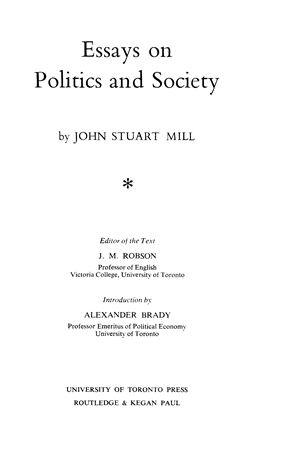
RATIONALE OF REPRESENTATION 1835 - John Stuart Mill, The Collected Works of John Stuart Mill, Volume XVIII - Essays on Politics and Society Part I [1832]Edition used:The Collected Works of John Stuart Mill, Volume XVIII - Essays on Politics and Society Part I, ed. John M. Robson, Introduction by Alexander Brady (Toronto: University of Toronto Press, London: Routledge and Kegan Paul, 1977).
Part of: Collected Works of John Stuart Mill, in 33 vols.About Liberty Fund:Liberty Fund, Inc. is a private, educational foundation established to encourage the study of the ideal of a society of free and responsible individuals. Copyright information:The online edition of the Collected Works is published under licence from the copyright holder, The University of Toronto Press. ©2006 The University of Toronto Press. All rights reserved. No part of this material may be reproduced in any form or medium without the permission of The University of Toronto Press. Fair use statement:This material is put online to further the educational goals of Liberty Fund, Inc. Unless otherwise stated in the Copyright Information section above, this material may be used freely for educational and academic purposes. It may not be used in any way for profit.
RATIONALE OF REPRESENTATION
EDITOR’S NOTELondon Review, I (July, 1835), 341-71 (equivalent to Westminster Review, XXX); headed: “Art IV. The Rationale of Political Representation. By the Author of ‘Essays on the Formation of Opinions,’ &c. &c. [Samuel Bailey.] London, 1835. Hunter, 8vo., pp. 436.” Signed “A”; republished in part as first section of “Appendix,” Dissertations and Discussions, I, 467-70. Running title: “Rationale of Representation.” Identified in JSM’s bibliography as “A review of Bailey’s ‘Rationale of Political Representation’ in the second number of the London Review (July 1835.)” (MacMinn, 44.) The copy of this article in the Somerville College Library has no corrections or emendations. Also in Somerville is a sewn, uncut offprint, without title, numbered 1-31, and signed “A”. (In the offprint, parts of which are reset, there are no corrections; some accidental variants appear [these are not accepted in the present text], the typographical error at 25.38 is retained, and two more are introduced.) The review is not mentioned in the Autobiography. For comment on the circumstances of its publication, see the Textual Introduction, lxxii-lxxiii above. In selecting a portion of this review for republication in “Appendix,” D&D, I, JSM made a few revisions (see 22-4 below). In the variant notes, “59” indicates D&D. 1st ed., 1859, “67” indicates ibid., 2nd ed., 1867. JSM also quotes from his “Remarks on Bentham’s Philosophy” (see 42-3 below); the changes are shown as variants, in which “33” indicates “Remarks on Bentham’s Philosophy.” Rationale of Representationthis is the work of a writer who, in the difficult art of making philosophy popular, has excelled most of his contemporaries; and his present is not inferior to the best of his former productions. The theoretical grounds of Representative Government, and the solutions of the more momentous of its practical problems, are laid down by our author, in the spirit which is now nearly universal among the more advanced thinkers on the subject, but with a felicity of adaptation to the wants of the most numerous class of readers, which is peculiarly his own. In addition to this, several popular fallacies, of most extensive prevalence, and infecting the very elements of political speculation, are refuted, conclusively and forcibly, and with as much depth of philosophy as the purpose required. The thoughts succeed one another in the most lucid order. The style is perspicuity itself. To a practised student in abstract speculation, it will appear diffuse; but this, in a book intended for popularity, is far from being a defect. To common readers a condensed style is always cramped and obscure: they want a manner of writing which shall detain them long enough upon each thought to give it time to sink into their minds. Our author is not, indeed, entitled to the transcendant praise due to those who, like Hobbes or Bacon, employ at pleasure either the power of condensation or that of enlargement; dwelling on the idea until it has made its way into the understanding, and then clenching it by one of those striking images, or of those pregnant and apophthegmatic expressions, which sum up whole paragraphs in a line, and engrave the meaning as with a burning steel upon the imagination. But if our author’s style does not come up to this exalted standard, it is easy, flowing, always unaffected, and has the greatest of merits, that to which all other excellencies of manner are merely subsidiary—that of perfectly expressing whatever he has occasion to express by it. The work consists of an Introduction, and six Chapters: “On the proper Object and Province of Government;” “On the Grounds of Preference for a Representative Government;” “On the Representative Body;” “On the Electoral Body;” “On Elections;” and “On the Introduction of Changes in Political Institutions;” with two supplementary essays “On Political Equality,” and “On Rights.” This programme gives a correct indication of the scope and purpose of the book. It is rightly termed “The Rationale of Political Representation,” not “The Rationale of Government.” It attempts an outline of a part only of the philosophy of government, not the whole. The philosophy of government, a most extensive and complicated science, would comprise a complete view of the influences of political institutions; not only their direct, but what are in general so little attended to, their indirect and remote influences: how they affect the national character, and all the social relations of a people; and reciprocally, how the state of society, and of the human mind, aids, counteracts, or modifies the effects of a form of government, and promotes or impairs its stability. Such is not the design of this work; and, considered in this comprehensive sense, the science itself is in its infancy.* But the advantages of a representative government, and the principles on which it must be constructed in order to realise those advantages, form a branch of the subject, the theory of which, so far as one branch can be considered separately from the rest, may be regarded as nearly perfect; and to the exposition of this, the work before us is dedicated. It must be admitted also, that this one branch of the inquiry runs parallel, for a considerable distance, to the main trunk. The reasons for having a representative government, and the reasons for having a government at all, are, to a very considerable extent, identical. The ends or uses of government are indeed multifarious, since we may include among them all benefits, of whatever kind, to the existence of which government is indispensable; but the first and most fundamental of all, the only one the importance of which literally amounts to necessity, is to enable mankind to live in society without oppressing and injuring one another. And the need of a representative government rests upon precisely the same basis. As mankind, in a state of society, have need of government, because, without it, every strong man would oppress his weaker neighbour; so mankind, in a state of government, have need of popular representation, because, without it, those who wielded the powers of government would oppress the rest. Of this fundamental truth an acute sense is manifested by our author. He rests the necessity of a popular government upon one primary axiom: “That men will, in the majority of cases, prefer their own interest to that of others, when the two are placed in competition.” (P. 68.) Whoever denies this, denies the principle on which, it is most certain, he himself habitually acts, when the interest at stake happens to be his own. It is the principle which all persons, when at liberty to follow their inclinations, uniformly observe in the guardianship of their own property. They do not appoint an agent, with liberty to do as he pleases, and without reserving the power of instantaneous dismissal. If they did, they would expect that the obligations of his trust would be disregarded, when in competition either with the interest of his pocket or with that of his ease. “From this principle,” says our author, “that men will prefer their own interest to that of others, when the two are placed in competition, it follows, that the interest of the community at large will be uniformly consulted only when they have the regulation of their own affairs.” [P. 69.] But since government cannot be performed by the community en masse; since “it is implied in the very notion of government, that a few are invested with authority over the rest; since, from the nature of the case, the legislative power must be lodged in the hands of a few; and as the few possessing it will be tempted in a thousand ways to sacrifice the public good to their own private interest;” [pp. 69, 70-1] here is but one resource: It becomes essentially requisite to place them in such a position that their own interest, and the public good, shall be identified. The simple expedient which meets this is to make the office of legislator dependent on the will of the people. If his power were irresponsible, if it were subject to no direct control, if the improper exercise of it were not followed by evil consequences to the possessor, it would be inevitably abused; the public good would be neglected, and his own habitually preferred; but by the simple expedient of rendering the continuance of his power dependent on his constituents, his interest is forced into coincidence with theirs. Any sinister advantage which he might derive from the power intrusted to him would cease with the loss of the office, and he would have no inducement to pursue an advantage of that kind, if by so doing he unavoidably subjected himself to dismissal. Such is the general theory of political representation. An individual, under the title of a representative, is delegated by the people to do that which they cannot do in their own persons, and he is determined in his acts to consult the public good, by the power which they retain of dismissing him from the office. (P. 71.) One might have imagined, that if any propositions on public affairs deserved the character of maxims of common sense, these did. Views of human affairs more practical and business-like, more in accordance with the received rules of prudence in private life, it would be difficult to find. These doctrines, nevertheless, or at least the possibility of drawing any conclusions from them, have met with questioners. That human beings will commonly prefer their own interests to those of other people, and that the way to secure fidelity to a trust is to make the trustee’s interest coincide with his duty, have been classed among propositions which are either not true, or, if true at all, only in a sense in which they are insignificant and unmeaning. Nor has the assertion been made of these doctrines alone, but of all propositions relating to the motives of human actions. “When we pass,” it has been said, “beyond maxims which it is impossible to deny without a contradiction in terms, and which therefore do not enable us to advance a single step in practical knowledge, it is not possible to lay down a single general rule respecting the motives which influence human actions.”[*] Such was the doctrine maintained in a memorable article in the Edinburgh Review, by a writer, all whose ingenuity and brilliancy would not have made his subsequent fortunes what they have been, but for the grateful acceptance which this doctrine found in influential quarters. Our author has no great difficulty in disposing of this theory: Nothing [says he] can be more extraordinary than an assertion of this kind, in an age when, at all events, the nature of moral inquiries is better understood than formerly, however insignificant may have been our progress in the inquiries themselves. It is extraordinary, too, as having appeared in a work which is in the habit of favouring its readers with articles of distinguished ability on political economy, a science founded on “general rules respecting the motives which influence human actions,” and which is, further, in the habit of drawing out long deductions from such general rules. Whoever turns over its pages may find inferences constantly made from propositions like the following: “commercial countries will resort to the cheapest market;” “high duties on imported articles inevitably cause smuggling;” “unusually large profits in any trade attract capital to it;” “a rise in the price of corn forces capital on inferior soils.” It would almost seem as if the reviewer was not aware that all these are general rules respecting the actions of men. To take the last proposition: we might conclude from his own doctrine, that he regarded the high price of corn as a physical agent propelling a material substance, called capital, upon a sterile field; and had forgotten that the proposition is an elliptical expression, under which is couched a law respecting human motives, and which virtually asserts, that when men become willing to give more money for corn, other men will be willing to grow it on land before uncultivated. Political economy abounds with such laws; the common business of life abounds with them; every trade, every profession, legislation itself, abounds with them. Is not the whole system of penal legislation founded on the general rule, that if a punishment is denounced against any given act, there will be fewer instances of the commission of that act than if no penalty were annexed to it? Can there be a proposition which comes more decidedly under the designation of a general rule respecting the motives which influence human actions? Can there be a more certain law in physics, and can there be one more fertile in practical consequences? The very term, efficacy of punishment, is only an abridged expression of this law of human nature; it implies a general rule respecting the motives which influence human actions, and a rule on which all mankind unhesitatingly and habitually proceed, both in national legislation and private management. (Pp. 16-18.) He then shows, by copious examples, what it is strange should require to be exemplified in order to be understood—that a general proposition may be of the greatest practical moment, although not absolutely true without a single exception; and that in managing the affairs of great aggregations of human beings, we must adapt our rules to the nine hundred and ninety-nine cases, and not to the thousandth extraordinary case, “ ’Tis certain,” says Hume (in a remarkable passage quoted by our author), “that general principles, however intricate they may seem, must always, if they are just and sound, prevail in the general course of things, though they may fail in particular cases; and it is the chief business of philosophers to regard the general course of things. I may add, that it is also the chief business of politicians, especially in the domestic government of the state, when the public good, which is or ought to be their object, depends on the concurrence of a multitude of causes—not as in foreign politics, upon accidents and chances, and the caprices of a few persons.”[*] “The views of political reasoning here advocated,” continues our author, “might be confirmed by an appeal to some of our ablest writers;” and among other apt quotations, he adds two from Burke, whom Conservatives of all denominations glorify as an oracle, because on one great occasion his prejudices coincided with theirs, but for whose authority they have not a shadow of respect when it tells against their vulgar errors. Far [says our author] from regarding deductions from human nature as vain or frivolous, or leading to what are usually honoured by the designation of wild theories, he considers such deductions as opposed to speculative views, and as proceeding on experience Thus, in his Letter to the Sheriffs of Bristol, speaking of the plan of pacification pursued in 1776, in reference to our colonies, he says, “That plan being built on the nature of man, and the circumstances and habits of the two countries, and not on any visionary speculations, perfectly answered its end.”[†] And in his Speech on Economical Reform he tells the House, “I propose to economize by principle, that is, I propose to put affairs into that train, which experience points out as the most effectual from the nature of things, and from the constitution of the human mind.”[*] (Pp. 30-1.) If principles of politics cannot be founded, as Burke says, “on the nature of man,” on what can they be founded? On history? But is there a single fact in history which can be interpreted but by means of principles drawn from human nature? We will suppose your fact made out: the thing happened (we will admit) as you affirm it did; but who shall tell what produced it?—the only question you want answered. On this subject our author has some instructive remarks, which we regret that our limits do not permit us to quote, as well as to corroborate by some others which we think necessary to complete the analysis of the subject. It is well worthy to be treated in a separate article. It may be interesting to collate with our author’s refutation of the Edinburgh Reviewer, what the writer, who was the principal object of the reviewer’s attack, has deemed it needful to say in his defence. This is to be found in pp. 277 to 292 of a recent volume, entitled A Fragment on Mackintosh,[†] where it is shown that the necessity of identification of interest between the rulers and the ruled, and the probability (amounting practically to certainty) that, in so far as that identification is incomplete, the rulers will pursue their separate interest, to the detriment of the ruled, has been recognised as the foundation of political wisdom by almost all its greatest masters, ancient and modern. Well may the writer exclaim—“It is mortifying to find one’s self under the necessity of vindicating the wisdom of ages” against what he calls (not too severely) “pitiful objections.”[‡] aFrombthisb principle, of the necessity of identifying the interest of the government with that of the people, most of the practical maxims of a representative government are corollaries. All popular institutions are means towards rendering the identity of interest more complete. We say more complete, because (and this it is important to remark) perfectly complete it can never be. An approximation is all that is, in the nature of things, possible. By pushing to its utmost extent the accountability of governments to the people, you indeed take away from them the power of prosecuting their own interests at the expense of the people by force, but you leave to them the whole range and compass of fraud. An attorney is accountable to his client, and removable at his client’s pleasure; but we should scarcely say that his interest is identical with that of his client. When the accountability is perfect, the interest of rulers approximates more and more to identity with that of the people, in proportion as the people are more enlightened. The identity would be perfect, only if the people were so wise, that it should no longer be practicable to employ deceit as an instrument of government: a point of advancement only one stage below that at which they could do without government altogether; at least, without force, and penal sanctions, not (of course) without guidance, and organized co-operation. Identification of interest between the rulers and the ruled, being, therefore, in a literal sense, impossible to be realized, cmust notc be spoken of as a condition which a government must absolutely fulfil; but as an end to be incessantly aimed at, and approximated to as nearly as circumstances render possible, and as is compatible with the regard due to other ends. For dthed identity of interest, even if it were wholly attainable, not being the sole requisite of good government, expediency may require that we should sacrifice some portion of it, or (to speak more precisely) content ourselves with a somewhat less approximation to it than might possibly be attainable, for the sake of some other end. The only end, liable occasionally to conflict with that which we have been insisting on, and at all comparable to it in importance—the only other condition essential to good government—is this: That it be government by a select body, not by the epeoplee collectively: That political questions be not decided by an appeal, either direct or indirect, to the judgment or will of an uninstructed mass, whether of gentlemen or of clowns; but by the deliberately-formed opinions of a comparatively few, specially educated for the task. This is an element of good government which has existed, in a greater or less degree, in some aristocracies, though unhappily not in our own; and has been the cause of whatever reputation for prudent and skilful administration those governments have enjoyed. It has seldom been found in any aristocracies but those which were avowedly such. Aristocracies in the guise of monarchies (such as those of England and France) have very generally been aristocracies of idlers; while the others (such as Rome, Venice, and Holland) might partially be considered as aristocracies of experienced and laborious men. fBut of all governments, ancient or modernf , the one by which this excellence is possessed in the most eminent degree is the government of Prussia—a gmostg powerfully and hskilfully organized aristocracy of allh the most highly educated men in the kingdom. The British government in India partakes (with considerable modifications) of the same character. iWherei this principle has been combined with other fortunate circumstances, and particularly (as in Prussia) with circumstances rendering the popularity of the government almost a necessary condition of its security, a very considerable degree of good government has occasionally been produced, jevenj without any express accountability to the people. Such fortunate circumstances, however, are seldom to be reckoned upon. But though the principle of government by persons specially brought up to it will not suffice to produce good government, good government cannot be had without it; and the grand difficulty in politics will for a long time be, how best to conciliate the two great elements on which good government depends; to combine the greatest amount of the advantage derived from the independent judgment of a specially instructed kFew, with the greatest degree of the security for rectitude of purpose derived from rendering those Few responsible to the Many. What is necessary, however, to make the two ends perfectly reconcilable, is a smaller matter than might at first sight be supposed. It is not necessary that the Manyk should themselves be perfectly wise; it is sufficient, if they be duly sensible of the value of superior wisdom. It is sufficient if they be aware, that the majority of political questions turn upon considerations of which they, and all persons not trained for the purpose, must necessarily be very imperfect judges; and that their judgment must in general be exercised rather upon the characters and talents of the persons whom they appoint to decide these questions for them, than upon the questions themselves. They would then select as their representatives those whom the general voice of the instructed pointed out as the most instructed; and would retain them, so long as no symptom was manifested in their conduct of being under the influence of interests or of feelings at variance with the public welfare. This implies no greater wisdom in the people than the very ordinary wisdom, of knowing what things they are and are not sufficient judges of. If the bulk of any nation possess a fair share of this wisdom, the argument for universal suffrage, so far as respects that people, is irresistible: for, the experience of ages, and especially of all great national emergencies, bears out the assertion, that whenever the multitude are really alive to the necessity of superior intellect, they rarely fail to distinguish those who possess it.a The opinions which we have been stating are substantially those of our author: from whose pages we now proceed to exemplify their application. From the principle that the interest of the ruling body should be as closely as possible identified with that of the people, follow most of the conclusions respecting the constitution of the supreme legislature, which are commonly contended for by the thorough reformers. Such are—first, that the utmost possible publicity should be given to the proceedings of parliament: secondly, that its members should be elected at stated periods: thirdly, that these periods should be short; sufficiently so, to render the sense of responsibility a perpetual, not an occasional feeling. Our author thinks, with most of the complete reformers, that three years are “the longest period consistent with a salutary sense of accountableness.” (P. 203.) Fourthly, the votes at elections must be so taken, as to express the real sentiments of the electors, and not the sentiments merely of some person who has the means of bribing or of coercing them. This, where there are great inequalities of fortune, and where the majority of all classes but the richest are more or less in a dependent condition, requires that the votes be taken in secret. All these topics are handled in our author’s best manner. We shall quote one passage from near the end of the discussion on the ballot; and should have extended our quotation, had not the subject been so recently and so fully treated by ourselves.[*] After replying to some of the common objections on the ballot, our author says— The great opposition to secret voting does not, however, arise from the consideration of its being unmanly or un-English, or leading to insincerity and deception, but from a deeper source—from a feeling which many who entertain it perhaps would not avow even to themselves, although others make no scruple of publicly declaring it. The higher classes fear to commit the election of legislators to the genuine sentiments of the people. They have so long exercised a power over the community, by means of the brute force of rank and riches applied to the hopes and fears of those below them, that they have accustomed themselves to regard it as a salutary and even necessary control. It has relieved them too from a great part of the trouble of being intelligent, active, and virtuous. They have found it much easier to arrive at the office of legislator, by throwing away a few thousand pounds for a seat, or ejecting a few miserable tenants as a terror to the rest, than by winning affection through their virtues, or commanding esteem by their superior intelligence and well-directed activity. To men accustomed to domineer over the wills of their fellow-creatures, it is intolerably irksome to be reduced to the necessity of appealing to their understandings. Having been obliged to concede, nevertheless, a more popular system of representation, having been reduced to the necessity of ostensibly yielding the elective franchise to those who never before possessed it, they are unwilling to trust the real exercise of it to the parties on whom it is conferred by law. They consent to confide the privilege to a popular constituency, but only as instruments to receive a direction from a higher guidance. They cannot bear the idea for a moment of trusting the machinery to work by its own inherent power. They therefore oppose a system of voting which would snatch this domination out of their hands—which would really give to the people what the law professes to bestow upon them, which would effect what has never yet been effected in this country, that the issue of the elections should express the genuine sense of the constituent body. Here indeed would be an end to all the despotic sway of rank and riches; by this would be established the fatal necessity of combining them with moral and intellectual excellence: on this system there would be a lamentable predominance conferred on talents and virtues. Those theretore do perfectly right to oppose the ballot, who fear that it would annihilate that unjust influence in elections which they have hitherto enjoyed from mere wealth and station; who are apprehensive that to maintain themselves on the vantage-ground where they have been set down by fortune, they would have to task all their faculties: who recoil from the labour of thought, and shrink from the hardship of being useful. All those, in a word, who wish to retain any unfair domination over others in the business of elections, should rouse themselves to resist the adoption of the ballot, as utterly destructive of the object of their desires. (Pp. 296-8.) We believe this to be a true picture of the feelings of at least the most powerful class among the enemies of popular institutions. Experience proves but too truly, that “to men accustomed to domineer over the wills of their fellow-creatures, it is intolerably irksome to be reduced to the necessity of appealing to their understandings.” The hands which have ruled by force will not submit to rule by persuasion. A generation at least must elapse, before an aristocracy will consent to seek by fair means the power they have been used to exercise by foul. And yet, their portion of importance under popular institutions is no niggardly one, unless made so by their own perverseness. In every country where there are rich and poor, the administration of public affairs would, even under the most democratic constitution, be mainly in the hands of the rich; as has been the case in all the republics of the old world, ancient and modern. Not only have the wealthy and leisured classes ten times the means of acquiring personal influence, ten times the means of acquiring intellectual cultivation, which any other person can bring into competition with them; but the very jealousies, supposed to be characteristic of democracy, conspire to the same result. Men are more jealous of being commanded by their equals in fortune and condition, than by their superiors. Political power will generally be the rich man’s privilege, as heretofore; but it will no longer be born with him, nor come to him, as heretofore, while he is asleep. He must not only resign all corrupt advantage from its possession, but he must pay the price for it of a life of labour. More than this: he must consent to associate with his poorer fellow-citizens, as if there existed between him and them something like human feelings, and must give over treating them as if they were a race to be kept coldly at a distance—a sort of beings connected with him by a less tie of sympathy than the brute animals of his household. Under really popular institutions, the higher classes must give up either this anti-social and inhuman feeling, or their political influence. Surely no good, hardly even any rational person, to whom the alternative was offered, would hesitate about the choice. Is it not, then, a melancholy reflection, that in England (and in England, we believe, alone, among the great European nations) the youth of the aristocratic classes are even more intensely aristocratic than their fathers—more wedded to all that is most noxious in the privileges of their class—animated by a more violent hostility to those tendencies of their age, in accommodating themselves to which lies their sole chance of either being at ease in it, or exercising any beneficial influence over it? And how deeply ought this thought to impress upon us the necessity, the pressing and immediate necessity, of a radical reform in those institutions of education, which mould these youthful minds, and cherish, when they ought to counteract, the baneful influences exercised over them by the accident of their social position? The question, Who should compose the constituency? is the next which presents itself. This is rather a more complicated question than any of the preceding, having to be decided by a compromise between conflicting considerations. By making the members of the sovereign legislature elective, by sending them back to their constituents at short intervals, and by taking the votes in secret, we provide for the identity of their interest with that of the electors. But what if the interest of the electors differs from that of the community? We have then only an oligarchy of electors, instead of an oligarchy of senators. There is not the slightest reason for supposing that the former oligarchy will be less tenacious of its separate interest than the other, or less ready to sacrifice the public interest to it. Not only must the interest of the representatives be made, so far as possible, coincident with that of the electors, but the interest of the electors must be made coincident with the interest of the whole people. If this principle were to be followed out, without limitation from any other principle, it would, we conceive, lead to universal suffrage. Imposing authorities, it is true, have held that a portion of the people may be found, much less than the whole, whose interest, so far as government is concerned, is identical with that of the whole. A portion might undoubtedly be found, less than the whole, whose interest would generally lie in good government, and only occasionally in bad. But complete identity of interest appears to us to be unattainable: (we are speaking, of course, as our argument requires, of selfish interest.)* The identity which is contended for cannot be identity in all things, but only in those which properly fall within the province of government. The payers of wages, for instance, and the receivers, have opposite interests on the question of high or low wages; but as this is a question in which the interference of government cannot be really beneficial to either, the interest of both, so far as relates to the purposes of government, is (it may be contended) the same. Admitting, however (which is more than we are prepared to admit), that there exists no mode in which the middle classes could really benefit their selfish interests at the expense of the poorer class, by means of their exclusive possession of the government; still, when there is a real diversity of interest between two parties, although confined to matters with which law cannot beneficially interfere, and the powers of law are in the hands of one party, it is rarely that we do not witness some attempt, well or ill advised, to make those powers instrumental to the peculiar purposes of the one party; and if these purposes are not thereby compassed, yet the interests of the other party often suffer exceedingly by the means used to compass them. Such, for example, were the laws against combinations of workmen;[*] and the laws which have existed at some periods of our history, fixing a maximum of wages. Nor is the evil annihilated although the excluded be a minority: the small number of the oppressed diminishes the profits of oppression, but does not always weaken the feelings which lead to it. Is the interest of the free blacks in the northern states of America the same with that of the whites? If so, why are they a kind of outcasts? So long, therefore, as any person capable of an independent will is excluded from the elective franchise, we cannot think that the evils of misgovernment, in so far as liable to arise from a diversity of interest between the ruling body and the community, are entirely guarded against. There are, however, other evils to be contended with, besides those arising from diversity of interest; and granting, that, by the exclusion of one class from the suffrage, something must be given up of the identity of interest between the constituency and the entire community, yet if some purpose of more than equivalent utility be attained by the sacrifice, it may still be advisable. And this, in our author’s opinion, is the case. He proposes that a certain portion of identity of interest should be sacrificed, for the sake of obtaining a higher average degree of intelligence. That this is an object worth attaining at some cost, nobody will deny. A certain measure of intelligence in the electors is manifestly indispensable: a much larger measure would be eminently desirable; and if any test, even an approximative one, could be obtained of its existence, without trenching too much upon the identity of interest, the exclusion from the franchise of all who could not pass that test would add to the securities for good government. But when our author contends that such an approximative test may be found in the possession of a certain amount of property, we can only partially agree with him. It is but fair to quote the passage. We must admit at once, that it [the possession of property] is a very inexact criterion [of knowledge;] and in regard to some classes, no criterion at all. It is not true that knowledge is in proportion to wealth. A man of 50,000l. a year would probably be found less intelligent and capable of discrimination than a man of 1000l. Great wealth relaxes the motives to exertion, and efficient knowledge is not to be attained without labour. Place a man in boundless affluence, and (to use a phrase of a masterly writer) you shelter and weather-fend him from the elements of experience.[*] When, however, we descend lower in the scale, we find a different result. People who are raised above the necessity of manual toil can afford to cultivate their minds, and have time and motives for giving some attention to the acquisition of knowledge. One of the first effects of wealth on those who acquire it, is a desire to bestow a liberal education on their children, which of itself tends to maintain a superiority on the side of the rich. Knowledge, like many other things, is an article not readily acquired without pecuniary expense, nor yet without leisure; and, as a general rule, those who can afford to make the necessary outlay of time and money will have the greatest quantity of the commodity. Thus, people of two hundred a year will be found on the average to possess more extensive knowledge than people of fifty pounds a year, and the possessors of two thousand more than those of two hundred Numerous exceptions to this rule will present themselves; but it is sufficient that it prevails on the whole, and affords the best criterion which we can obtain. If it holds on the whole, it will be practically useful. (Pp. 231-2.) These propositions must, we think, be greatly qualified. They are true until we rise above the class which cannot read, or which never does read, and consequently takes no interest in political affairs; for though the intelligence of many people does not come to them by reading, the habit of applying that intelligence to public matters commonly does. But when, ascending in the scale, we reach a class which habitually reads, especially which reads newspapers, we suspect that we attain as high an average of intelligence as is to be found in any class not expressly bred and educated for some intellectual profession. We are speaking, of course, of England: in any country possessing a really national education, both for rich and poor, the case, we allow, would be different. But in this country, and at this time, between an average Birmingham gun-maker, an average London shopkeeper, and an average country gentleman, we suspect the differences of intelligence are more apparent than real. The land-holder, we find, has just as little foresight of the consequences of his actions; miscalculates as egregiously in his own conduct, both public and private; hates just as intensely all who, from however patriotic motives, set themselves against any of the things which he likes; despises as sincerely, under the name of theorists and visionaries, all who see farther than himself; is as incapable of feeling the force of any arguments which conflict with his own opinion of his immediate and direct interest. These are the tests of intelligence, and not the being able to repeat Propria quœ maribus.[*] If the bulk of our operative manufacturers are to be excluded from the suffrage, it must be, we suspect, on quite other grounds than inferiority of intelligence to those who are permitted to exercise it. We have never been able to understand why, if the real object in excluding poverty were to exclude ignorance and vice, the test should not be applied to ignorance and vice directly, and not to something which is a mere presumption of their existence. It would be easy to exclude all who cannot read, write, and cipher. If a higher test be desirable, there would be no great difficulty in contriving it. If there were here (as there are in Prussia, and as there would be in every country where the good of the people was cared for) schools for all, under the superintendence of the state, the test might be a certificate from the teacher at the public or some other school, of having passed creditably through it. A test of morality would, in the present state of society, be not so easy to devise; something, however, might be done towards it. To have been seen drunk, during the year previous, might be a disqualification at the annual registry. To have received parish relief during the same time, might be equally so. Conviction for any criminal offence might disqualify for a longer period, or for ever. The most rational argument which we can conceive, for the exclusion of those who are called persons of no property, would be founded, not on inferiority of intellect, but on difference in apparent interest. All classes (it might be said) are in a most imperfect state of intelligence and knowledge; so much so, that they cannot be expected to be, and, as experience shows, hardly ever are, accessible to any views of their own ultimate interest which rest upon a train of reasoning. Since, then, it is certain that those who enjoy the franchise will exercise it in the manner dictated, not by their real and distant, but by their apparent and immediate interest, let us at least select, as the depositaries of power, those whose apparent and immediate interest is allied with the great principles on which society rests, the security of property, and the maintenance of the authority of law. These, we are sure, are safe in the hands of the possessors of property: an equal regard for them on the part of those without property would suppose a much higher degree of intelligence, since the latter benefit by them so much less obviously and directly, though not less really, than the former. This places the question on a distinct and tangible issue; namely, whether the body of the operatives, or that portion of the body whom the rest follow, do in fact entertain opinions or feelings at variance with any of the primary principles of good government. This is a question not of argument, but of fact; and as such we think the question of universal suffrage ought always to be considered. That the prevalence of such mischievous opinions and feelings, and the difficulty of eradicating them where they exist, are vastly exaggerated, we have good reason to be assured: to what extent they really are entertained, we have no means of accurately knowing; and our belief is, that almost all persons of what are called the educated classes, if they have any opinion on the point, have it without evidence. Happily there is no necessity for a speedy decision of the question. Many important things are yet to be done, before universal suffrage can even be brought seriously into discussion: and it will probably never be introduced, unless preceded by such improvements in popular education as will greatly weaken the apprehensions at present entertained of it. The middle classes, too, if freed from the coercive power of the rich, have an interest absolutely identical with that of the community on all the questions likely to engage much of the attention of parliament for many years to come; and no one is disposed to deny that we ought cautiously to feel our way, and watch well the consequences of each extension of the suffrage before venturing upon another. With a people like the English, whose feelings are not apt to be kindled by an abstract principle, but only by a practical grievance, very ordinary prudence would enable us to stop short at the point where good government is practically attained. We return to the volume before us, from which we shall not again permit ourselves to stray so far. Our author brings forward, with the prominence which justly belongs to them, several of the requisites of a well-constituted representative government, the importance of which is still far from being adequately felt. One is, that the supreme legislature should be relieved from the weight of purely local business which now oppresses it, by the establishment of subordinate representative assemblies. Every district, [says he,] would not only send representatives to the supreme assembly, but have its own domestic legislature for provincial purposes; in which all matters relating to its roads, bridges, prisons, court-houses, and assessments, and other points concerning itself alone, might be determined. In England, at present, large sums are collected under the name of county rates, and expended (frequently with lavish profusion) under the control of the magistrates at quarter-sessions, who virtually do part of what is here assigned to a district assembly; while of the rest, some is neglected, and some is done in a hasty and slovenly manner by Parliament. Such a district assembly would be the proper body to take cognizance of all projects for canals, rail-roads, gas-works, water-works, and other undertakings, which, on account of trespassing on private property, could not be executed without the authority of the law. Every one must see at a glance how great would be the relief to the national legislature, if all these minor matters were resigned to other bodies more competent to deal with them. Nec deus intersit nisi dignus vindice nodus,[*] should be the principle of the supreme assembly. It should rigorously abstain from doing what can be done as well or better without its interference, and direct its undivided energies to those points which involve the welfare of the whole empire, or which subordinate powers are incompetent to effect. On all the subjects mentioned as the proper business of subordinate authorities, the supreme legislature might pass general regulations in strict accordance with the principle here maintained. It might enact, for instance, certain general provisions in regard to the making of canals; but whether a particular canal should be made between two towns in Yorkshire might be left for Yorkshire itself to decide. The supreme legislature would also determine the objects and define the powers of the subordinate legislatures, and be the ultimate court of appeal in all cases of difference and difficulty amongst them. It is evidently one of the worst possible arrangements, that the time of the supreme legislative assembly, which would find ample occupation in the preparation and perfecting of general enactments, should be taken up with matters of only local interest, and sometimes of merely individual concern; that it should be occupied with bills for changing names, alienating estates, supplying towns with water and lighting them by gas. While this continues to be the case, it is both morally and physically impossible there can be that degree of excellence in legislation, which the present state of knowledge admits. It is a system which acts injuriously in both directions; a system on which neither enactments of a local nor those of a national kind can possibly be of the same beneficial character as if the preparation of them were devolved on separate assemblies. (Pp. 93-5.) On this question, which has already occupied ourselves, and to which we shall return again and again, this is not the place to enlarge. Another change for which our author earnestly contends, is a large reduction in the numbers of the House of Commons. This had already been advocated by Mr. Bulwer, in his England and the English,[*] and was one of the many points in which that valuable work was in advance of the public mind. “Large assemblies,” our author justly observes [p. 161], “are unfit for deliberation;” and the immense consumption of the time of parliament, and neglect of the real business of the nation, which arises from the struggles of several hundred men, of few ideas and many words, to give their vocabulary an airing, is gradually forcing upon thinking persons the conviction, that, as our author proposes, the House should be reduced to one-half or one-third of its present numbers. A step, though but a small one, was made towards this important improvement by the first Reform Bill,[†] which broke in upon the magical number, 658; and it is to be regretted that the principle was given up, in deference to the most hypocritical clamour ever raised by Tories under the false pretence of zeal for popular rights. To diminish the number of the members of the House of Commons was treated as diminishing the amount of popular representation! As well might it be said, that the Spartans had twice as much government as we have, because they had two kings, while we have but one. Popular government does not consist in having the work done by more hands than are necessary to do it, but in having those hands, whether few or many, subject to popular control. To the other strong reasons for reducing the numbers of the House, will sooner or later be added one of economy. We mean, of course, when the members are paid—a change to which we shall certainly come, and of which our author is a warm advocate: This expedient, [says he,] seems to be required at all events, in order to secure the services of the ablest men, and to give the greatest intensity to the motives which impel the mind of the legislator to apply itself to the difficulties of the task, as well as to enhance the vigilance of the constituent body, by teaching them the value of his services, and of their own suffrages, in a way which the dullest amongst them can understand. Under such an arrangement, men of energetic and comprehensive minds, trained to vigorous personal and intellectual exertion, but who are obliged to devote themselves to pursuits yielding a profitable return, and are consequently at present either excluded from the legislature, or are mere cyphers in it, would be, with all their faculties, at the command of the public. Men of this description, so gifted, and so placed above private cares, would be invaluable; for instead of giving that lazy gentlemanly attention to public questions, which, in their own apprehension at least, is all that can be reasonably expected from unpaid representatives living in luxurious opulence; or that casual and intermitting, and brief attendance on their duties, which is all that professional practitioners can bestow, they would make their legislative functions the business of their lives. Strenuous intellectual exertion, except in the case of a few extraordinary minds to which it is a pleasure, as severe corporeal exercise is to a man of great muscular strength, is irksome, and seldom habitually undertaken without a powerful external motive. It is surely policy in a nation to furnish this motive for due application to national affairs. (Pp. 193-4.) In nearly all ages and countries, popular governments have found it for their interest that all the functionaries whom they employ should be paid. The unpaid is apt to become the self-paid, and to cost dearest of all: his work, at the best, is dilettante work, and is put aside from the smallest call of business or pleasure. Moreover, an unpaid legislature and an unpaid magistracy are institutions essentially aristocratic: contrivances for keeping legislation and judicature in the hands exclusively of those who can afford to serve without pay. This in itself may seem but a small consideration: the important matter is not by whom we are governed, but how:—with due securities for their being properly qualified, we should not complain, although the whole legislature were composed of millionnaires. But those securities are themselves weakened, by narrowing the range of the people’s choice. It is matter of general remark, how few able men have appeared of late years in parliament. What wonder? when, of the able men whom the country produces, nine-tenths at least are of the class who cannot serve without pay; and, for the first time since the constitution assumed its modern form, the members of the House of Commons are now practically unpaid. The rich have advantages in their leisure, and command of the means of instruction, which will render it easy for them, whenever they exert themselves, to be the ablest men in the community. That they do not take this trouble, is precisely because they are not exposed to the competition of the non-rich. Let in that competition upon them, if you would have them improve. In political, as in all other occupations, if you would stimulate exertion, you must throw open all monopolies. If the members of the legislature were paid, legislation would become—what, to be well discharged, it must become—a profession: the study and the occupation of a laborious life. On this point our author’s remarks are well worthy of an attentive perusal: While the current of life flows on smoothly, the interest which each individual has in good government evidently makes little impression on his imagination, it consists, for the most part, of small fractions of benefit scarcely appreciable, of protection from evils, to which, as they are prevented from occurring, he is insensible; of advantages, which, to a superficial view, accrue to him only under particular circumstances, such as redress of wrong when he has occasion to appeal to the law. Most people are therefore supine and indifferent as to the general course of domestic policy, and especially indifferent as to the intellectual qualifications and conduct of their representatives. Their minds want awakening to the difficulty and importance of sound and accurate and systematic legislation. They may rest assured, that, in our complicated state of society, it is a business which requires as long and assiduous preparation as any profession which can be named; and as entire devotion to it, when its duties are once undertaken, as the calling of a lawyer or a physician, a merchant or an engineer. One chief reason why there are so many needless, blundering, crude, mischievous, and unintelligible enactments, is, that men have not dedicated themselves to legislation as a separate study or profession, but have considered it to be a business which might be played with in their hours of leisure from pursuits requiring intense exertion. (Pp. 186-7.) Political science is perhaps that department of intellectual exertion which requires the greatest powers of mind, and the intensest application. Its facts are multifarious and complicated, often anomalous and contradictory, and demanding the guidance of clear principles, its principles are many of them abstruse, and to be developed only by long and close processes of reasoning; and the application of these principles requires the sagacity of quick observation and long experience. The whole business calls for that familiarity of mind with the subject, which can be the result of nothing but habitual daily devotion to it. In making laws, too, not only is there a demand for powers of mind to cope with the disorder and complication of facts, and the abstruseness of reasoning, but there ought to be also a complete mastery of language, that nice and delicate instrument of thought and communication, by the clumsy handling of which so much confusion and uncertainty is yearly produced in legislative enactments. Every word in a law is of importance; every sentence ought to exhibit that perfectness of expression which is to be looked for only from the skill and caution of undistracted minds. Well might Bentham observe, that the words of a law ought to be weighed like diamonds. Is this, then, a matter to be dealt with by an exhausted professional man in what should be his hours of recreation? Can such a one be competent to a task hard enough for the mind which comes to it every day with all its vigour fresh, all its perspicacity undimmed, its spirit of activity unworn, and its feelings of interest unabsorbed? Is the refuse of an individual’s time and abilities what a people are to be content with from a representative to whom they confide the determination of measures in which their prosperity is deeply implicated? Is this sufficient for governing the destinies of a great nation? (Pp. 184-6.) Our author carries the practical application of this doctrine so far, as to propose (though, as he says, with some diffidence) that freedom from other business or professional avocation should be an indispensable qualification for being chosen a member of parliament. There is no doubt that it ought to be a strong recommendation, but we would not exact it by express law. It will occasionally happen, though, under a better system, much less often than at present, that half the time of one competitor is of more value than the whole time of another; and when the electoral body is rightly constituted, we know not why its choice should be fettered. We would not give power by handfuls with one hand, and take it back in spoonfuls with the other. If the people can be trusted at all, it is not in the estimation of these obvious grounds of disqualification that they are likely to be found deficient.* In the present state of society, the effect of the provision which our author desires to introduce would, we fear, be seriously mischievous: it would throw the whole business of legislation, and of control over the executive, into the hands of the idlers; excluding from parliament almost the only persons who bring habits of application and capacity for business into it. This objection, no doubt, would not exist, or at least not in the same degree, under the increased responsibility to the people which our author’s argument contemplates. Neither would we, with our author [p. 181], require as a legal qualification “maturity of years,” beyond that which is now required. It will not, we suppose, be denied that a young man may render good service in Parliament; and if so, it may be that you have no other person who will render it as well. It might be proper enough to treat youth as a disqualification, if we were sure of finding old men suitable to our purpose: but considering the scarcity of fit men at any age, and the abundance of unfit men at all ages, we would not risk depriving ourselves of even one of the former for the sake of shutting out myriads of the latter. If your electors are likely persons to choose an unfit man, no sweeping rule of exclusion will prevent them from finding one. Nor do we see in so strong a light as our author the danger to be guarded against. It is not probable that, under any system but one of private nomination, very young men would ever compose any considerable proportion of the legislature: already the Reform Bill is understood to have excluded from the House most of the idle young men of family who formerly composed so large a portion of it: when, too, provincial assemblies, properly representative of the people, shall have been established, young men will serve their apprenticeship to public business there rather than in parliament. Those who are chosen in spite of so strong a ground of just prejudice, are likely to be among the ablest of their years; and, at least in an age of movement, it is not among young men that the greatest measure of political incapacity is usually found. It is true, as our author says, that “in legislation, as in other arts, there is a tact, a nicety of judgment, an intuitive apprehension of the relations of things, a wisdom which age, indeed, does not always bring, but which age alone can bestow.” [P. 180.] But the young members will not be called upon to be the actual framers of laws: they will only assist in judging of them. The general spirit and direction of the proceedings of the House will be determined by that immense majority of its members who will always be persons of mature years; and it would not be altogether useless to counteract the apathy and prejudice of age by a small infusion even of the conceit and dogmatism of youth. Age is naturally conservative, and unless some weight be placed in the other scale, there will be danger lest the timid and sluggish should give too much of their character to the entire mass. Our author strongly condemns the degrading practice of canvassing. In a healthy state of moral feeling, to solicit an elector would be deemed an exactly similar insult to that of soliciting a juror. If the moral sentiments of the community had not been debased on this point by the long prevalence of a corrupt practice, they would feel that there was something not only degrading but ludicrous in the procedure of a candidate, who circulates himself from house to house for the purpose of soliciting votes from electors as so many gracious boons. On the supposition that the candidate happens to be really the best man for the office, it is asking them to have the condescension and kindness to consult their own interest out of pure favour to him. On the supposition that he is otherwise, it is craving them to be so exceedingly liberal and obliging as to disregard their own interest, and give a preference to his. In the one case, the request bears no mark of wisdom; in the other, none of modesty: in both cases, it is utterly inconsistent with manly independence. It is true, that what is called canvassing does not necessarily assume this form. A candidate, when personally visiting the electors at their own homes, may limit himself to an explanation of his opinions, and to a proper and dignified exposition of his qualifications for the office, without stooping to the ludicrousness or servility of craving as a boon what ought to be either withheld, or given because it is the interest at once and the duty of the elector to give it. But even in this case, mark the inefficiency, the uselessness, of a personal visit; consider in what degree the candidate can set forth his pretensions in the few minutes which he can dedicate to the task of enlightening the minds of the individual electors on the subject of his merits and opinions. How degrading soever the procedure may be, there is some purpose answered by visiting a man, even for a few minutes, with the view of prevailing on him to give a promise, a few minutes may suffice for obtaining from him a yes or a no: but to devote to him only so brief a period, with the view of enabling him to form a judgment of the qualifications of the candidate, is a fruitless sacrifice of time and labour, for a purpose which can be effectually accomplished by public addresses. Of this folly few, it may be presumed, are guilty. The usual object of a personal canvass is to sway the will, not to guide or enlighten the judgment; and it must be admitted to produce in general a considerable effect. The more servile the candidate shows himself to be, the freer from scruples, from dignity, and self-respect, the fuller of artifices in adapting himself to the feelings and prejudices of the electors, so much the greater is his success likely to prove. In every way in which the system of canvassing can be regarded, it is evil: there is nothing to recommend it; and if it prevails in any country where public sentiment does not promise to put it down, it perhaps might be put down with advantage by a legal prohibition. The experiment of prohibiting candidates and their friends from canvassing has been tried by some public charitable institutions in the election of their officers, and has proved decidedly beneficial in the few instances which have occurred since the adoption of the rule. (Pp. 305-8.) We can add nothing to this masterly exposure. Our author is no less decided in his condemnation of the practice of giving instructions to representatives, and of requiring pledges from candidates. We fully concur in his sentiments. The business of the constituency is to select as their representative the person best qualified, morally and intellectually, to form a sound judgment of his own on political questions; and having done this, they are not to require him to act according to their judgment, any more than they require a physician to prescribe for them according to their own notions of medicine. Whenever we employ a man to do what his superior knowledge enables him to do better than ourselves, it is because the superiority of his knowledge, combined with his weaker disposition to promote our interest, will, on the whole produce a better result than our inferior knowledge, coupled with our stronger disposition. So it is when we appoint a political deputy: we can obtain the benefit of his services only by encountering the risk of trusting him. The advantage we look for at his hands is incompatible with retaining the direction of his conduct. (P. 127.) It is not, then, to the power of instructing their representative, that constituents are to look for an assurance that his efforts will be faithfully applied to the public service, for that would be inconsistent with the most enlightened legislation; but it is to the power of reducing him from the elevation to which their suffrages have raised him. What properly belongs to them is not a power of directing, but of checking, not a power of previous dictation, but a power of reward and punishment on a review of what he has done. The object to be obtained is not to compel the representative to decide agreeably to the opinions of his constituents, for that would be compelling him often to decide against his better judgment: but it is to force him to decide with a single view to the public good, and, at the same time, to obtain the full benefit of his intelligence. It is by leaving him unshackled with positive instructions, while he is subject to the ultimate tribunal of the opinion of his constituents, that the end in view is to be accomplished, of bringing into action, in the proceedings of the legislature, the greatest practicable quantity of intelligence, under the guidance of the purest disposition to promote the welfare of the community. The relation between a representative and his constituents may be illustrated by a reference to the analogical relation which exists, and to which we have already slightly adverted, in the mutual circumstances of the physician and his patients. The security which patients have for the best application of the physician’s skill does not arise from any ability of theirs to direct his practice, but from the circumstance of having in their own hands the power of choice. In the nature of the case they must place great confidence in his conduct, if they would obtain the benefit of his knowledge. When they select him, they are guided by such evidence as is within their reach respecting his qualifications. They may not always make the wisest choice; because, not being competent judges of the science, they must depend, in a great measure, on collateral facts, or evidence of an indirect character, and are sometimes swayed by irrelevant motives; but the power of selection and dismissal is the most effectual means of securing the best services of those whom they choose; and there can be little doubt that, on the system of each individual selecting his own medical attendant, and trusting to his discretion, patients fare better than on any other plan. And although they cannot antecedently judge of the medical treatment necessary in their case, nor direct the curative process, yet after recovery they can frequently form a tolerable estimate of the skill which has been evinced, and can always appreciate the care and attention of the practitioner; whence there are evidently strong inducements acting on his mind to please and benefit his patients. (Pp. 129-31.) We consider this point, as we have intimated in a former passage, to be fundamental; and to constitute, in reality, the test whether a people be ripe for the sound exercise of the power of complete control over their governors, or not. The parallel holds exactly between the legislator and the physician. The people themselves, whether of the high or the low classes, are, or might be, sufficiently qualified to judge, by the evidence which might be brought before them, of the merits of different physicians, whether for the body politic or natural; but it is utterly impossible that they should be competent judges of different modes of treatment. They can tell that they are ill; and that is as much as can rationally be expected from them. Intellects specially educated for the task are necessary to discover and apply the remedy. But though the principle that electors are to judge of men, and representatives of measures (as a king or a minister appoints a general, but does not instruct him when and how to fight) is of the very essence of a representative government, we cannot dissemble the fact, that it is a principle almost entirely inapplicable to the peculiar situation of this kingdom at the present moment. How can electors be required to repose in their representatives any trust which they can possibly withhold, when, for the purpose of purifying a political system which swarms with abuses, the circumstances of society oblige them to employ as their agents men of the very classes for whose benefit all abuses exist, and of whose disposition to reform any one particle of those abuses which it is possible to preserve they feel the most well-grounded doubts? Who can blame the exaction of pledges from such a man as the honorable member for St. Andrew’s,[*] under the circumstances in which those pledges were exacted?* We assume, of course, that the constituency had not the option of electing a better man. If they had, they have themselves to blame for not making use of it. For, in the words of a passage quoted by our author from Roscommon’s Letters for the Press—“When we have to employ our fellow-creatures in any office, we should in general act more wisely were we to choose those who possess qualities adapted to it, than were we to attempt to bend unsuitable qualities to our purposes, by the force of motives applied for the occasion.”[*] “There is one general consideration,” says our author, “which deserves to be urged on electors, in their choice of a representative: they must take the trouble to choose a fit man, and not expect a man to become fit for the situation by being placed in it.” (P. 427.) In the chapter “On the Introduction of Changes in Political Institutions,” our author takes the opportunity of combating the celebrated doctrine of Lord Holland and Sir James Mackintosh, that “governments are not made, but grow.”[†] This maxim was probably suggested by the numerous examples of political reformers whose institutions have been ephemeral, for want of having a sufficient hold upon the respect of the people to command steady obedience, or upon their affections, to be defended with any zeal against assault. But because governments, like other works of human contrivance, may be constructed with insufficient foresight and skill, does it follow that foresight and skill are utterly unavailing, and that no governments can hope for the support of the people’s affections in times of civilization, but those produced by the fortuitous concourse of atoms in ages of barbarism? The doctrine is not only philosophically, but even historically false. The laws of Moses, those of Mahomet, were made, and did not grow: they had, it is true, the direct sanction of religious faith; but the laws of Lycurgus, the laws of Solon, were made, and were as durable as any laws which grew have hitherto been found. Those of Lycurgus, indeed, stand in history a monumentum ære perennius[*] of the practicability of Utopianism. Each of the North American colonies made a government: the whole of them confederated have also made a government—no bad example hitherto of adaptation to the wants of the people who live under it. Frederic of Prussia made a whole system of institutions, which still exists, and an excellent one. Bonaparte made another, which also in substance still exists, though an abominable one. All these governments, in so far as they have have had any stability, had it because they were adapted to the circumstances and wants of their age. That such adaptation can be made by preconceived and systematic design, every one of them is an example. All that there is of truth in the favourite doctrine of Sir James Mackintosh amounts to a truism, which in theory has never been overlooked, howsoever in practice it may have been disregarded: That legislators and political reformers must understand their own age: That they must consider, not only what is best in itself, but what the people will bear; not only what laws to make, but how to make the people obey them: That they must forbear to establish any thing which, to make it work, requires the continued and strenuous support of the people themselves, unless, either in the ancient habits of the people, or at least in their durable and strenuous convictions, a principle exists which can be enlisted in favour of the new institution, and induce them to give it that hearty assistance without which it must speedily become inoperative. What has usually been wanting to the due observance of this maxim has been, not the recognition of it, but a sufficient practical sense, how great an element of stability that government wants which has not the authority of time: lHowl very much of the really wonderful acquiescence of mankind in any government which they find established is the effect of mere habit and imagination, and therefore depends upon the preservation of something like continuity of existence in the institutions, and identity in their outward forms; cannot transfer itself easily to new institutions, even though in themselves preferable; and is greatly shaken when there occurs anything like a break in the line of historical duration—anything which can be termed the end of the old constitution and the beginning of a new one.m The very fact that a certain set of political institutions already exist, have long existed, and have become associated with all the historical recollections of a people, is in itself, as far as it goes, a property which adapts them to that people, and gives them a great advantage over any new institutions in obtaining that ready and willing resignation to what has once been decided by lawful authority, which alone renders possible those innumerable compromises between adverse interests and expectations, without which no government could be carried onn a year, and with difficulty even for a week.* It is scarcely necessary to say that, in this country, and at this time, the danger is not lest such considerations as the above should have too little, but lest they should have too much, weight. In the supplementary discourses of our author, on Political Equality, and on Rights, there are many just observations on the confusion which has been introduced into political reasoning by the use of vague and declamatory expressions as substitutes for a distinct appeal to the good of the community. Our author, however, while proposing to banish the words “natural rights” from philosophical discussion, makes an attempt, in which we do not think him quite successful, to discover a rational meaning for the phrase. Without doubt, as in the case of all other phrases which mankind use, there is something in their minds which they are endeavouring to express by it; but we hardly think that our author is looking for this in the right place. The subject, however, would lead us too far for the present occasion. Having said so much of what the work before us does contain, we cannot conclude without drawing the author’s attention to one thing which it should have contained and does not. He has met and overthrown many of the fallacies by which the delivering over of the powers of government to partial interests is wont to be defended; but he has nowhere directly faced the master fallacy of all, the theory of class-representation, though it is one which attacks the very foundation of his doctrines. The theory in question maintains, that a good popular representation should represent, not the people, but all the various classes or interests among the people. The landed interest, it is said, should be represented, the mercantile interest should be represented; the monied, manufacturing, shipping interests, the lawyers, the clergy—each of these bodies should command the election of a certain number of members of the legislature; and the bulk of the people, it is commonly added, should also have the nomination of a certain small number of representatives. The essence of this system is, that it proposes to place a small fraction only of the ruling body under any inducements from their position to consult the general interest of the community; while it renders all the remainder the mere attorneys of certain small knots and confederacies of men, each of which, the theory itself admits, has a private interest of its own, which sinister interest, if it possessed the undivided control of the legislature, it would ruthlessly pursue, to the complete sacrifice of the general interest. The expectation then is, that because the ruling power is divided among several of these knots, instead of being wholly bestowed upon one of them, they, instead of combining, as they have the strongest motives to do, and sharing the benefits of misrule among them, will, with an incapacity of pursuing their obvious interest, unknown to any tribe of savages, employ their whole exertions in protecting the community against one another. Whether this be likely to be the fact let English history speak; for England has been ruled by a class-representation ever since the revolution. We subjoin an apologue, from a speech delivered in 1826, which shadows forth very faithfully what has been the course of history in this particular.* The ready answer to the doctrine of representation of interests is, that representation of separate and sinister interests we do not want. The only interest which we wish to be consulted is the general interest, and that, therefore, is the only one which we desire to see represented. How this, in the actual circumstances of a country, can best be accomplished, is the only question; and it must be decided by the considerations already adduced. What, in contradistinction to a representation of classes, every rational person does wish to see exemplified in Parliament, is not the interests, but the peculiar position, and opportunities of knowledge, of all the classes whom the theory enumerates, and many more; not in order that partial interests may, but in order that they may not, be consulted. The first desideratum is, to place every member of the legislature under the most complete responsibility to the community at large, which the state of civilization of the community renders consistent with other necessary ends. The second is, to compose the legislature, in as large a proportion as possible, of persons so highly cultivated, intellectually and morally, as to be free from narrow or partial views, and from any peculiar bias. But as such persons are rarely to be found in sufficient numbers, it is doubtless desirable that the remainder of the body should be of as miscellaneous a composition as possible (consistently with accountability to the people), in order that the twist of one person may be neutralized by the contrary twist of another; and if the individuals must be biassed, the evil be at least avoided of having them all biassed one way. An indistinct perception of this truth, is what gives all its plausibility to the doctrine of class-representation. But the principle thus stated, needs no especial provision to be made for it in a scheme of representation. The diversity of local circumstances, and the varying spirit of local constituencies, provide for it sufficiently. Recommending this important subject to the consideration of our author in his next edition, we take leave of him; cordially wishing that his country may be enriched with many similar productions from his pen, and regretting that he has not yet obtained the opportunity he sought, of proclaiming in the House of Commons the great principles which this work will contribute so largely to diffuse. That he failed to obtain that opportunity is anything but creditable, all circumstances considered, to the electors of the great and important town for which he offered himself as a candidate. We trust that, ere long, some liberal constituency will claim for itself the honour which his own townsmen knew not how to appreciate. [* ]The most important contribution which has been made for many years to the Philosophy of Government, in this extensive sense of the term, is the recent work of M. Alexis de Tocqueville, De la Démocratie en Amérique [2 vols. Paris: Gosselin, 1835]; a book, the publication of which constitutes an epoch in the kind of writing to which it belongs. A minute analysis of this admirable work will be given in our next Number. [J. S. Mill, “De Tocqueville on Democracy in America [I],” London Review, I (Oct., 1835), 85-129. Printed below, pp. 47-90.] The Tory writers have already, we perceive, attempted to press it into their service, as an attack upon Democracy: in opposition both to the author’s avowed opinions, and to his purpose expressly declared in the work itself, M. de Tocqueville’s views are eminently favourable to Democracy, though his picture, like every true picture of anything, exhibits the shadows as well as the bright side; and as it keeps back nothing, supplies materials from which Democracy may, as suits the purpose of a writer, be either attacked or defended, and, we may add, better attacked and better defended than it could ever have been before. [[*] ]Thomas Babington Macaulay, “Mill’s Essay on Government,” Edinburgh Review, XLIX (March, 1829), 186-7. [[*] ]David Hume, “Of Commerce,” in Essays and Treatises on Several Subjects, 2 vols. (London: Cadell, 1793), Vol. I, p. 251. [[†] ]Edmund Burke, “A Letter to John Farr and John Harris, Esqs. Sheriffs of the City of Bristol, on the Affairs of America,” in Works, 8 vols. (London: Dodsley and Rivington, 1792-1827), Vol. II, p. 145. [[*] ]Edmund Burke, “Speech on . . . a plan for the better security of the independence of Parliament, and the oeconomical reformation of the Civil and other establishments,” in Works, Vol. II, p. 217. [[†] ]James Mill, A Fragment on Mackintosh (London: Baldwin and Cradock, 1835). [[‡] ]Ibid., pp. 288-9. [a-a]24 [reprinted as first part of “Appendix,” Dissertations and Discussions, I, 467-70, below, pp. 648-50] [b-b]59,67 the [c-c]59,67 ought not to [d-d]59,67 this [e-e]59,67 public [f-f]59,67 Of all modern governments, however [g-g]-67 [h-h]59,67 strongly organized aristocracy of [i-i]59,67 When [j-j]-59,67 [k-k]59,67 few . . . few . . . many . . . many [[*] ]See James Mill. “The Ballot—A Dialogue.” London Review, I (April, 1835), 201-53. [* ]Take, for instance, the strongest of all cases, and one in which nobody ever doubted the propriety of the exclusion—the case of children. Is it true that their interest is completely identical with that of their parents? Certainly not: the child is interested in being secured, in so far as security is attainable, against the parent’s cruelty, the parent’s caprice, the parent’s weak indulgence, the parent’s avarice, and, in at least nine cases out of ten, the parent’s indolence and negligence, which disregards the child’s good when in competition with the parent’s ease. It may be said, that all these kinds of misconduct are inconsistent with the real happiness of the parent, and that the parent’s interest, rightly understood, and the child’s, are the same. And so also has it been said, that the true interest of kings is the same with that of their subjects. There is as much truth in the one doctrine as in the other. Both are true in a certain sense: both kings and parents would enjoy greater happiness on the whole, if they could learn to find it in the happiness of those under their charge. But this is a capacity seldom acquired after an early age; and those who have not acquired it, would not gain the pleasures of benevolence, even were they to forego those of selfishness. If a father be by character a bad and selfish man, it is not true that his happiness may not be promoted by tyrannizing over his children. We by no means seek to infer that parents in general treat their children no better than kings treat their subjects, or that there is not a far greater coincidence of interest. We only deny that the coincidence is anything like perfect. But if it be not perfect between parents and children, still less can it be so in any other case. [[*] ]See 39 & 40 George III, c. 106 (1800). [[*] ]Samuel Taylor Coleridge, “Pitt,” in James Gillman, The Life of Samuel Taylor Coleridge, 2 vols. (London: Pickering, 1838), Vol. I, p. 199. [[*] ]The rubric for the section on masculine nouns in traditional grammars. See, e.g., An Introduction to the Latin Tongue (Eton: Pote and Williams, 1806), p. 63. [[*] ]Horace, Ars Poetica, in Satires, Epistles, and Ars Poetica. Ed. H. Rushton Fairclough (London: Heinemann, New York: Putnam’s Sons, 1926), p. 466 (l. 191). [[*] ]Edward Lytton Bulwer, England and the English. 2 vols. (London: Bentley, 1833). [[†] ]See 2 & 3 William IV, c. 45 (1832). [* ]In the impressive words of our author’s argument on the ballot. “If the electoral body is not to be trusted, there must be something wrong in its composition; for if it is rightly constituted, the more faithfully the votes represent its sentiments the better: but on the supposition that it is wrongly constituted, the course of true policy is clear. The right way of correcting an evil is, if practicable, to remove its cause, and not to resort to some expedient for counteracting the mischief as it is continually evolved from its unmolested source. If the electoral body is composed of such unsuitable elements, that, if left to itself, the perpetual result would be the election of improper representatives, and consequent bad legislation, there cannot be a simpler or more effectual plan than altering the constitution of that body.” (Pp. 281-2.) [[*] ]Andrew Johnston. [* ]The long duration of parliaments, which renders it impossible to discard an unfaithful representative when found out, is also an important consideration. [[*] ]Francis Roscommon (pseud.), Letters for the Press: on the Feelings, Passions, Manners, and Pursuits of Men (London: Wilson, 1832), p. 82. [[†] ]See, e.g., Sir James Mackintosh, The History of England, 10 vols. (London: Longman, Rees, Orme, Brown, & Green, 1830-40), Vol. I, p. 72. [[*] ]Horace, “Carmina Liber III, xxx,” in Odes and Epodes (Latin and English). Trans. C. E. Bennett (London: Heinemann; New York: Macmillan, 1914), p. 278 (l. 1). [l-l]33 He [Bentham] was not, I am persuaded, aware, how [m]33 [paragraph] The constitutional writers of our own country, anterior to Mr. Bentham, had carried feelings of this kind to the height of a superstition, they never considered what was best adapted to their own times, but only what had existed in former times, even in times that had long gone by. It is not very many years since such were the principal grounds on which parliamentary reform itself was defended. Mr. Bentham has done much service in discrediting, as he has done completely, this school of politicians, and exposing the absurd sacrifice of present ends to antiquated means; but he has, I think, himself fallen into a contrary error. [n]33 for [* ][J. S. Mill, in] Bulwer’s England and the English, App. [B] to Vol. II [pp. 342-3 Reprinted, “Remarks on Bentham’s Philosophy,” in Collected Works, Vol. X, p. 17]. [* ]“Once upon a time there happened an insurrection among the beasts. The little beasts grew tired of being eaten by the great ones. The goatish, sheepish, and swinish multitude grew weary of the sway of the ‘intellectual and virtuous.’ They demanded to be governed by equal laws, and, as a security for those laws, to have the protection of a representative government. The Lion, finding himself hard pressed, called together the aristocracy of the forest, and they jointly offered a rich reward to whoever could devise a scheme for extricating them from their embarrassment. The Fox offered himself, and his offer being accepted, went forth to the assembled multitude, and addressed them thus: ‘You demand a representative government: nothing can be more reasonable—absolute monarchy is my abhorrence. But you must be just in your turn. It is not numbers that ought to be represented, but interests. The tigerish interest should be represented, the wolfish interest should be represented, all the other great interests of the country should be represented, and the great body of the beasts should be represented. Would you, because you are the majority, allow no class to be represented except yourselves? My royal master has an objection to anarchy, but he is no enemy to a rational and well-regulated freedom, if you forthwith submit, he grants you his gracious pardon and a class representation.’ The people, delighted to have got the name of a representation, quietly dispersed, and writs were issued to the different interests to elect their representatives. The tigers chose six tigers, the panthers six panthers, the crocodiles six crocodiles, and the wolves six wolves. The remaining beasts, who were only allowed to choose six, chose by common consent six dogs. The Parliament was opened by a speech from the Lion, recommending unanimity. When this was concluded, the Jackal, who was Chancellor of the Exchequer, introduced the subject of the Civil List; and, after a panegyric on the royal virtues, proposed a grant, for the support of those virtues, of a million of sheep a-year. The proposition was received with acclamations from the ministerial benches. The Tiger, who was at that time in opposition, made an eloquent speech, in which he enlarged upon the necessity of economy, inveighed against the profusion of ministers, and moved that his Majesty be humbly requested to content himself with half a million. The Dogs declared, that as kings must eat, they had no objection to his Majesty’s devouring as many dead sheep as he pleased: but vehemently protested against his consuming any of their constituents alive. This remonstrance was received with a general howl. |

Titles (by Subject)