EconlibThe LibraryOther Sites |
Front Page Titles (by Subject) Introduction - The Collected Works of John Stuart Mill, Volume XVIII - Essays on Politics and Society Part I
Return to Title Page for The Collected Works of John Stuart Mill, Volume XVIII - Essays on Politics and Society Part IThe Online Library of LibertyA project of Liberty Fund, Inc.Search this Title:Also in the Library:
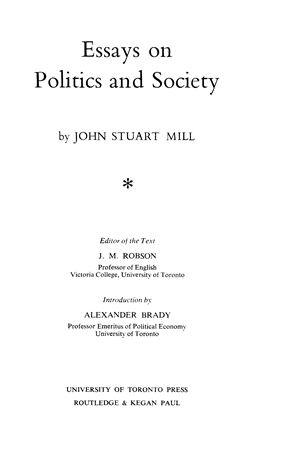
Introduction - John Stuart Mill, The Collected Works of John Stuart Mill, Volume XVIII - Essays on Politics and Society Part I [1832]Edition used:The Collected Works of John Stuart Mill, Volume XVIII - Essays on Politics and Society Part I, ed. John M. Robson, Introduction by Alexander Brady (Toronto: University of Toronto Press, London: Routledge and Kegan Paul, 1977).
Part of: Collected Works of John Stuart Mill, in 33 vols.About Liberty Fund:Liberty Fund, Inc. is a private, educational foundation established to encourage the study of the ideal of a society of free and responsible individuals. Copyright information:The online edition of the Collected Works is published under licence from the copyright holder, The University of Toronto Press. ©2006 The University of Toronto Press. All rights reserved. No part of this material may be reproduced in any form or medium without the permission of The University of Toronto Press. Fair use statement:This material is put online to further the educational goals of Liberty Fund, Inc. Unless otherwise stated in the Copyright Information section above, this material may be used freely for educational and academic purposes. It may not be used in any way for profit.
The Collected Edition of the works of John Stuart Mill has been planned and is being directed by an editorial committee appointed from the Faculty of Arts and Science of the University of Toronto, and from the University of Toronto Press. The primary aim of the edition is to present fully collated texts of those works which exist in a number of versions, both printed and manuscript, and to provide accurate texts of works previously unpublished or which have become relatively inaccessible. Editorial Committee j. m. robson,General Editor v. w. bladen, alexander brady, j. c. cairns, j. b. conacher d. p. dryer, s. hollander, r. f. mcrae, f. e. l. priestley, marsh jeanneret, francess halpenny, jean houston Introductionjohn stuart mill’s development as a political and social thinker may be divided into at least three periods, with the first two largely determining the course and character of the third. The first embraces his youthful apprenticeship in and passionate proselytizing for the utilitarianism in which from childhood he had been carefully nurtured by his father and Bentham. His career as a young and orthodox utilitarian extended to his mental crisis in 1826 at the age of twenty. The second period began with his recovery from the crisis (1826-30) and terminated with the dissolution of the Philosophic Radicals as a distinct party towards the end of the 1830s. In this crucial period of his life Mill refashioned his thinking under a variety of intellectual and emotional influences. The final period comprised the remaining thirty-three years of his career (1840-73), when he published his major works, including A System of Logic, Principles of Political Economy, On Liberty, and Considerations on Representative Government. THE YOUNG UTILITARIANmill’s own account of his extraordinary education is a classic in the intellectual history of the last century. This is not the place to describe the rigorous pedagogic experiment to which he was subjected, other than to note its apparent effectiveness in making him, as he admitted, a reasoning machine with impressive powers for analysis and a reverence for facts and principles. It was ostensibly designed by his father to enable him to think for himself, although independent thought was not its immediate result. The highly precocious boy who at sixteen (in 1822) founded the Utilitarian Society had already faithfully absorbed in his father’s study and from the writings and tutelage of Bentham a philosophy of ethics and politics wherein utility was the supreme criterion. He related how he felt as a youth after reading Dumont’s translation of Bentham’s treatise on legislation: “When I laid down the last volume of the Traité I had become a different being. . . . I now had opinions; a creed, a doctrine, a philosophy; in one among the best senses of the word, a religion; the inculcation and diffusion of which could be made the principal outward purpose of a life.”1 With obvious zealotry Mill was now ambitious to reform the affairs of mankind to conform with utilitarian canons. Fired by the influence of his father and Bentham, he engaged in a crusade to carry the torch of rationalism and utilitarianism into every sector of British life. In devotion he no less than Karl Marx had a sense of historic mission. His obvious instrument was journalism, which in his opinion was to modern Europe what political oratory had been to Athens and Rome. At seventeen he began eagerly dashing off letters and articles to newspapers and periodicals, arguing for the specific changes that utilitarians then sought: civil and criminal law reform, population restriction, a free press, a free economy, destruction of monopoly wherever present, abolition of colonial slavery, parliamentary reform, and a redress of Irish grievances. From the outset he wrote less to earn a living than to fulfil a mission and convert a public. In 1823 his father had secured his appointment as a clerk in the East India Company, where in the next thirty-five years he rose to high office and enjoyed ample freedom and adequate income to study and champion those causes to which he was dedicated. His position in time gave him not merely an invaluable independence but a practical experience in coping with complex human situations in the sub-continent on the other side of the globe. The empiricist here had a congenial opportunity to reinforce his theories with a special experience of public affairs. In later life he wrote: the occupation accustomed me to see and hear the difficulties of every course, and the means of obviating them, stated and discussed deliberately, with a view to execution; it gave me opportunities of perceiving when public measures, and other political facts, did not produce the effects which had been expected of them, and from what causes; above all it was valuable to me by making me, in this portion of my activity, merely one wheel in a machine, the whole of which had to work together. . . . I became practically conversant with the difficulties of moving bodies of men, the necessities of compromise, the art of sacrificing the non-essential to preserve the essential. I learnt how to obtain the best I could, when I could not obtain everything. . . .2 Two years after Mill founded the Utilitarian Society, Bentham and a few friends launched the Westminster Review as an official organ for utilitarian ideas. In its first four years (1824-28) Mill, despite his youth, was a frequent contributor on a wide range of themes, which he treated in the spirit of utilitarian orthodoxy. He criticized the follies of aristocratic rule in Britain and Ireland, the illusions of chivalry formerly associated with aristocracy, the vested interests of great landowners in corn and game laws, and the ills of a faulty journalism. He strove to liberate the English press from the trammels of an abused and arbitrary law of libel and the burden of press duties.3 Mill like his father and other contemporary Radicals saw in the freedom of the press the essential instrument for mobilizing opinion, breaking down resistance to reform, and creating that degree of popular discontent which would compel the aristocratic government to make substantial concessions. He was naturally inspired by his father’s famous essay on “Liberty of the Press,” first published in 1821 as a supplement to the Encyclopaedia Britannica. He accepted his parent’s uncompromising belief that no special laws should exist to hamper the freedom of newspapers to print facts and advance opinions to protect the people against the tyranny of a government.4 In 1826 when Mill was twenty he entered the shadows of a mental crisis, which lasted for months, and has been variously assessed and explained by biographers. It is easy to accept the traditional and simple view that it resulted from prolonged and excessive work. Mill had recently undertaken the prodigious task of editing the five volumes of Bentham’s Rationale of Judicial Evidence, contributed to newspapers and journals, debated in the societies with which he was associated, tutored his brothers and sisters at home, and dealt with official duties at India House. Yet there was more involved than heavy work and physical exhaustion. In the Autobiography he blames a faulty education which cultivated his intellect but starved his feelings and aesthetic yearnings. His faith in the efficacy of utilitarian thought was evidently shaken, and it is symptomatic that on this, unlike other occasions, he failed to seek from his father guidance, sympathy, or compassion. He had secretly begun to rebel against certain elements in the philosophy of James Mill and Jeremy Bentham and felt compelled to work out alone an intellectual accommodation with his inheritance. A. W. Levi has advanced a Freudian explanation of the mental crisis and its disappearance.5 Whether we accept this view or not, Mill’s illness marked a milestone in his intellectual development. He awoke to deficiencies in the eighteenth-century utilitarian thought in which he had been indoctrinated, and to repair them sought guidance from other and varied sources, including a constellation of new friends and new mentors. In the fourteen years after 1826 the orthodox utilitarian was transformed into an eclectic liberal who in no sense repudiated all his inheritance but modified and combined it with many fresh ideas and methods of thought demanded in a world gripped by change where truth, as he saw it, must be many-sided. He found for depression an early antidote in Wordsworth’s tranquil and contemplative poetry, which supplied something which had been lacking in his father’s rigorous educational regime—a cultivation of feeling inspired by natural beauty. Yet the Wordsworthian culture of the feelings was at the time merely one of a medley of influences.6 Even Macaulay’s caustic criticism in the Edinburgh Review of his father’s Essay on Government persuaded Mill that although Macaulay himself was faulty in philosophy, he scored valid points against the narrowness of his father’s political thought and its neglect of significant springs in the conduct of modern man.7 The thinkers, very different from his father and Bentham, who gave him intellectual stimulus in the early 1830s were the Saint-Simonians, Comte, Coleridge, Carlyle, and Tocqueville. He appreciated the fact that these writers emphasized the significance of history and a philosophy of history, and endorsed the idea that each state of society and the human mind tended to produce that which succeeded it, with modifications dictated by circumstances. At the same time, the whirl of change in events and ideas impressed him with the relativity of political institutions; each different stage in human society must have different institutions. Further, as he put it, “government is always either in the hands, or passing into the hands, of whatever is the strongest power in society, and . . . what this power is, does not depend on institutions, but institutions on it. . . .”8 Not the least fascinating circumstance in the shaping of Mill’s thought in the early 1830’s was his coming under different streams of influence and endeavouring to reconcile them or to select from each some element or elements of significance. This process was admirably illustrated in the letter to John Sterling in October 1831.9 He discussed here contemporary Toryism and Liberalism, and distinguished between the contrary types of speculative and practical Toryism, but oddly failed to recognize the significant reformism of men like Huskisson and Peel. “Practical Toryism,” he said, “simply means, being in, and availing yourself of your comfortable position inside the vehicle without minding the poor devils who are freezing outside. . . . Such Toryism is essentially incompatible with any large and generous aspirations. . . .” Yet this is the Toryism that appealed to the privileged classes of his day, who had little faith in human improvement, unlike his friends the speculative Tories—Wordsworth, Coleridge, and Southey. These wanted an ideal Toryism, an ideal King, Lords, and Commons, the old England as opposed to the new, an England as she might be, not as she is. They represented a reverence for government in the abstract, sensible that it is good for man to be ruled; to submit both his body & mind to the guidance of a higher intelligence & virtue. It is therefore the direct antithesis of liberalism, which is for making every man his own guide & sovereign master, & letting him think for himself & do exactly as he judges best for himself, giving other men leave to persuade him if they can by evidence, but forbidding him to give way to authority; and still less allowing them to constrain him more than the existence & tolerable security of every man’s person and property renders indispensably necessary. It is difficult to conceive a more thorough ignorance of man’s nature, & of what is necessary for his happiness or what degree of happiness & virtue he is capable of attaining than this system implies.10 These sentiments may seem somewhat uncharacteristic of one renowned as spokesman of British nineteenth-century liberalism. They reflect his thinking at a critical period when he was striving to assess the changing winds of current opinion. At the same time they also reflect an enduring element: his doubts about the average man’s capacity unaided to cope wisely with the complex problems of citizenship. In combining his earlier utilitarian doctrines with those of new intellectual associates, Mill saw politics as an immensely important part of the structure of society, since only through political activity could men maximize their moral and social potentiality. The institutional contrivances of the state, being interwoven with the main facets of economic and social life, were comprehensible only in the context of the whole. Politics reflected the character of economic and social systems and the ethical values men held. Culture and politics were thus inseparable, political progress and social progress interdependent. Some years later, in a letter to John Chapman, Mill expressed in general terms a view that for him had become axiomatic: I understand by Sociology not a particular class of subjects included within Politics, but a vast field including it—the whole field of enquiry & speculation respecting human society & its arrangements, of which the forms of government, & the principles of the conduct of governments are but a part. And it seems to me impossible that even the politics of the day can be discussed on principle, or with a view to anything but the exigencies of the moment, unless by setting out from definite opinions respecting social questions more fundamental than what is commonly called politics.11 IDEAS AND ACTIVITY, 1830-40the varied intellectual stimuli that Mill experienced after his mental crisis helped to shape the mould of his political thought in that turbulent and confused era of the 1830s. However much he strayed from the strict path of his father’s thought, he remained in agreement with the main legal and political reforms sought by James Mill and the Philosophic Radicals. In his journalism he still advocated extensive changes in the laws, the parliamentary system, and the whole system of government to reduce what, in his opinion, was the baneful influence of the aristocracy on the major aspects of British society. He endeavoured to arouse the Radicals in and out of parliament to form a powerful party that either alone or allied with progressive Whigs could shape public policies on reformist lines. In a letter to Edward Lytton Bulwer in March 1838 he summarized his political ambitions in the preceding years: I have never had any other notion of practical policy, since the radicals were numerous enough to form a party, than that of resting on the whole body of radical opinion, from the whig-radicals at one extreme, to the more reasonable & practical of the working classes, & the Benthamites, on the other. I have been trying ever since the reform bill to stimulate, so far as I had an opportunity, all sections of the parliamentary radicals to organize such a union & such a system of policy. . . .12 Yet despite his genuine zeal, Mill found the task of trying to achieve unity among the Radicals frustrating. They were splintered into stubborn factions, and no parliamentary leader with the requisite qualities emerged to unite them. They constituted a party of many lieutenants without a general. For a short interval Mill pinned his hopes on Lord Durham, who left the Whig ministry, undertook the Canadian mission, surrounded himself with Radical advisers like Charles Buller and Gibbon Wakefield, and produced a report that was a Radical rather than a Whig or Tory document. But Mill’s hopes and designs for Durham’s leadership or indeed for the future of the party were soon shattered by adverse events, including the serious illness and death of Durham and Mill’s own inability to sustain much longer the heavy financial and other burdens of the London and Westminster Review, the organ for radical causes. By 1840 he had virtually ceased to be a leading counsellor to Radical politicians, although his interest in utilitarian reform continued unabated. Significantly, in the 1830s Mill was not absorbed exclusively in British political ideas and activities. In contrast with his father, who disliked France and the French, he was early influenced by French thinkers and fascinated by the dialectic of French politics. In 1829 he told a Parisian friend that he admired his countrymen because they were open to ideas and more ready than the English to act on them.13 Never perhaps was his Francophile enthusiasm more pronounced than in 1830. On the collapse of the Bourbon monarchy he hurried to Paris, mixed freely with young revolutionaries and Saint-Simonian leaders, shared the excitement and joy of his French friends in what they assumed was the triumph of revolution over aristocratic politics and ultramontane theology, and returned to England with a renewed zest for reforms.14 Mill’s political hopes for France resembled those for Britain: a political regime on utilitarian lines, a widely representative assembly, a liberal franchise, a free press, free associations, popular education, and an enlightened public. However, the revolution of 1830 became a dismal disappointment. The monarchy of Louis Philippe, wedded to narrow commercial and financial groups, was unwilling to jeopardize for the sake of reform its powers and privileges, and at every step opposed major changes. From London Mill closely and anxiously followed events, and between 1830 and 1834 in successive articles in the Examiner poured out his bitterness.15 Mill’s severe disenchantment left an imprint on his political thinking throughout the 1830s and even later. Although he did not lose liberal convictions or a belief in representative government, he now doubted that large electorates could make sound decisions without the positive leadership of enlightened minorities. An extended suffrage, however important in itself, alone could not prevent the continuance of self-interested oligarchies whether of the aristocracy or middle class. His doubts and fears at the time about representative institutions and democracy were evident in numerous articles. Seven of these are included in the present volume, beginning with the review articles on The Use and Abuse of Some Political Terms by George Cornewall Lewis and Rationale of Political Representation by Samuel Bailey.16 LEWIS AND BAILEYLewis was a man of Mill’s own age, equipped with similar precocious erudition, and of utilitarian sympathies. His book dealt with the relation of logic to politics, a topic in which Mill was then too deeply interested to treat casually. Two years later he confessed to Carlyle that his review was an outgrowth from his own mind and the truest he had ever written—that is, it was no mere product of an orthodox utilitarian schooling.17 He commended Lewis’s attempt to bring a lucid logic into the language of politics, since slovenly thinking and equivocal words were together the bane of political discussion. But he took strong exception to certain points, of which the most important concerned rights. Lewis, following his teacher John Austin, argued that all rights are creations of law and the will of the sovereign. To call anything a right which is not enforceable in the courts is an abuse of language. In contrast Mill emphasized the reality of moral rights. He contended that, in saying that no man has a moral right to think as he pleases, for he ought to inform himself and think justly, Dr. Johnson refers to a right Lewis evidently fails to comprehend. Yet for Mill a right in the Johnsonian sense is no abuse of terms; it is good logic and good English. Rights are the correlatives of obligations and duties, and moral as well as legal rights have a necessary and significant place in the contemporary state. It is a moral right of subjects to be well-governed and a moral duty of the sovereign to govern well. The focus of this criticism is the mischief inherent in unduly simplified and inflexible concepts. Mill reacts here against the rigidity of some utilitarian logicians. His further complaint concerned the apparent and unjustified contempt with which Lewis disposed of Locke and Rousseau for assuming an unhistorical and fictitious state of nature and a social contract. Mill believed that it was inconsequential whether anything like a state of nature existed. The real issue was the extent to which as an hypothesis it shed light on the fact of a morality outside the law to which men could appeal. To Mill as to Locke such morality was important. Independent states in relations with one another remained in a state of nature, without a common superior, but responsive to moral obligations and duties. However unskilfully formulated, the old theories of the social contract and the inalienable rights of man in Mill’s opinion had a rightful place in the evolution of political liberty and justice by indicating a pragmatic limit on the power of the sovereign. He concluded his review of Lewis’s book by emphasizing the necessity of recognizing, despite all the linguistic differences, the close relationship between ideas of different political thinkers, and also the possibility of combining them into a whole. In reviewing Samuel Bailey’s Rationale of Political Representation, Mill in effect summarized his own ideas on the subject. Sharing the views of the Sheffield Radical, he employed the book to illustrate what for him were the requisites of sound representative government. In his argument he reverted to the cherished utilitarian dogma of his father that in politics it was essential to achieve the closest possible identification of interest between rulers and ruled. But this, he thought, was feasible only if decisions were made, not by the uninstructed multitude, but by a carefully selected body commanding special knowledge and techniques and accountable to the public. Strict accountability would help to ensure that rulers pursued the interests of the people rather than their own. Admittedly the task of overcoming the inbred chicanery and low cunning of politicians was difficult. It could not be accomplished simply by institutional machinery without a massive and prolonged public enlightenment. His fear of a sudden flood of new and ignorant voters made him cautious about any rapid extension of the franchise: “no one is disposed,” he wrote, “to deny that we ought cautiously to feel our way, and watch well the consequences of each extension of the suffrage before venturing upon another” (32). (This and subsequent parenthetical references are to the text of the present edition.) This caution extended even to his favourite cause of women’s enfranchisement. Despite a passionate belief in female suffrage, he thought in 1835 that its public advocacy would serve no practical purpose (29n). Although wary about changes in the franchise, Mill supported many reforms in political machinery in harmony with orthodox Philosophic Radicalism: the secret ballot, triennial parliaments, publicity for parliamentary proceedings, payment of members and their professionalization, reduction in the size of the House of Commons to render it more efficient, and the creation of strong local government which he assumed would reduce the burdens of the national parliament. He also proposed a radical change in the House of Lords to destroy it as a rigid barrier to reforms fashioned in the Commons. He would abolish its hereditary principle and select its membership from the lower house. By such changes he hoped to transform Britain’s government from an aristocracy into a special kind of democracy led by an enlightened few.18 He said little about the enlightened few beyond emphasizing that they consist of those specially endowed with public spirit and educated to conduct a thoughtful direction of national affairs: the fittest persons whom the existing society could produce. He believed that since 1688 the landed aristocracy had governed England badly: it reflected the attitudes of unimaginative dilettantes incapable of the rigorous intellect that government needed, and it was fettered by its own enormous wealth and special privileges. Anxious to protect its own position, it could do little to bridge the chasm between the social classes, which increasingly endangered a Britain subject to the new powerful pressures of nineteenth-century industrialism. To Mill its strength and effectiveness seemed inferior to those of the aristocracy of Prussia (23-4). Through his reform programme Mill hoped to create a new and independent ruling class of paid and professional parliamentarians freed from electoral pledges. He believed that unpaid legislators and magistrates sustained the monopoly power of the aristocracy because aristocrats could usually afford to serve without pay (35). Among the Radicals the issue of pledges provoked acrimonious debate. In 1832 Mill had irritated some in arguing that, although in cases of constitutional change pledges might sometimes be justified, they were in general bad. “The sovereignty of the people,” he wrote, “is essentially a delegated sovereignty. Government must be performed by the few, for the benefit of the many. . . .”19 The same view he repeated in the “Rationale of Representation,” contending that electors are obligated to select representatives fully qualified to form sound decisions on public matters. They must not expect that those they elect should act slavishly in parliament according to popular judgment any more than patients expect a physician to cure their ills according to their own chosen ideas of medicine (40). For Mill, pledges conflicted with the essence of representative government. Voters were free to reward or punish, by re-election or rejection, a representative at the end of his term, but to shackle him from the outset with inflexible instructions would cripple his powers of initiative and responsibility. AMERICA, TOCQUEVILLE, AND DEMOCRACYAs a British radical, Mill from youth was profoundly interested in the United States. For him and most of his fellow utilitarians the republic was a unique experiment of a democracy in action, and hence important for all European liberals. Unlike the Tory writers of the Quarterly Review, they looked to America to demonstrate the virtues of democracy, and abundant praise of the United States became their orthodox practice. They admired it for experimenting with new social ideas, rejecting an established church, extending franchise laws, promoting popular education, recognizing a free press, and believing in a free economy. Such was Jeremy Bentham’s enthusiasm for America that to Andrew Jackson he described himself as “more of a United Statesman than an Englishman.” For him and his disciples the republic seemed to apply the principle of utility more assiduously than did Britain. It is hardly surprising, therefore, that between 1835 and 1840 Mill wrote three leading articles on America: two lengthy reviews in 1835 and 1840 on the separate parts of Tocqueville’s Democracy in America and in 1836 an essay on the state of American society as depicted in five contemporary volumes. In these essays he endeavoured not merely to illustrate the work of a new and major political thinker, but also to portray the democratic society of the United States compared with the aristocratic regimes of Europe. In doing this under the weighty influence of Tocqueville, he clarified and matured his own thought on the merits and faults of democracy. Hence his two essays on Tocqueville are highly significant in the evolution of his thinking. Almost the same age, although of different social backgrounds, the two men had much in common. Both were convinced that the new industrial age was destined to affect profoundly society and politics. Both were interested in the shape of things to come, in the trend to equality, and in democracy as almost an inevitable force of nature that must be adjusted to human circumstances and needs. Both believed that it alone could diffuse the spirit of a vigorous citizenship and sense of community throughout the whole national state. Yet they were also deeply concerned about its inherent defects and anxious to remedy them. “Man cannot turn back the rivers to their source,” wrote Mill, “but it rests with himself whether they shall fertilize or lay waste his fields” (158). Tocqueville’s idea of democracy was more loosely defined than Mill’s. He referred to it less often as a particular form of government than as an equality of social conditions, without elements of aristocracy and privilege, the kind of equality which was best exemplified in the United States. Equality of conditions might exist under an absolute ruler, and Tocqueville feared that in some countries, including his own France, it might emerge solely in that form. Mill, on the other hand, applied the term democracy more consistently to a form of government in which the people constitutionally exercised a dominant sway. He was fully aware, however, that democratic government had wide social implications, and a large measure of social equality was a natural accompaniment. In his two reviews Mill welcomed Tocqueville’s book as a landmark in the literature of politics, hailing the first part as among “the most remarkable productions of our time” (57). He saw its author, in his wide-ranging thought, as comparable to Montesquieu. His praise for the second part was equally enthusiastic. It was “the first philosophical book ever written on Democracy, as it manifests itself in modern society.”20 The reasons for this laudation are found in the grand sweep of Tocqueville’s sociological description and perception and his penetrating comments on democracy, its mixed properties and tendencies, the dangers it confronted, and the different demands it made on mankind. For Mill method was hardly less important than content. In Tocqueville he saw the new kind of political scientist he was ambitious to be himself, quick to probe the varied social forces that mould man’s political conduct, skilful in combining deduction and induction, and adept in applying comparative methods to the facts of society and government. In his first essay, especially, Mill employed long quotations to illustrate Tocqueville’s views on American democracy and society and on the operation of its institutions. He acted like a modest chairman, briefly introducing a speaker and giving him abundant time to elaborate his theme, confident in the speaker’s mastery of the subject. But his quotations in both essays indicate his deep interest in certain aspects of Tocqueville’s account, especially the role of a numerical majority and its influences on individual and national life. Anxiously he scrutinized how far in practice Americans respected the principle of true democracy as defined in “The Rationale of Representation.” He was hardly encouraged by his findings. The people often directly governed rather than merely exerting an ultimate control over government. He learned from Tocqueville how widely delegation had replaced representation (74). Electors, however poorly informed, often laid down conditions that their representatives were compelled to respect. The majority was unmistakably dominant, constantly and aggressively asserted its will, shaped the character of opinion, and lived in perpetual adoration of itself. It was little comfort for Mill to read Tocqueville’s verdict that he knew of no country with less independence of mind and less real freedom of discussion than the United States (81). No monarch had such power over opinion as the popular majority. Tocqueville admitted that the majority refrained from attacking the property and material interests of the rich minority, but it otherwise imposed a despotic yoke on public opinion, on independent thought, and hence on individuality of character. In view of his previous generous admiration for America, Mill doubtless wished that the evidence was different, but could not escape the compelling force of Tocqueville’s critical picture. Yet, although he accepted most of Tocqueville’s strictures on American institutions, he sometimes tried to moderate and excuse them. In the first part of his work Tocqueville concluded that the American electors were disposed to choose mediocrities rather than able candidates, owing partly to their own limited education and understanding and partly to the insatiable envy that most men had for their superiors. Mill feared that this charge, if true, meant that his own belief in a talented élite to guide and instruct the democracy was unlikely to be justified. He thought he found, however, in the facts furnished by Tocqueville a situation less discouraging than had at first appeared. In critical times able Americans assumed a positive leadership. In ordinary times, unfortunately, the range of public activity was too restricted to attract men of ambition and talent. Mill believed that this situation would eventually improve with the advance of education, general enlightenment, and the social needs of America.21 He was much less pessimistic than Tocqueville about democracy’s falling under the control of the mediocre. In his first review Mill also questioned Tocqueville’s assertion that aristocracy had qualities of prudence and steadiness absent in democracy. The steadiness of an aristocracy, he said, was commonly expressed in a tenacious grip on its own cherished privileges. Its strength of will, as English history illustrated, was shaped by its class interests, and its opinions tended to fluctuate with its immediate impulses and needs (77-9). Mill’s main criticism in his second essay was well taken: Tocqueville, in failing to define democracy with precision, sometimes confused its effects with those of a commercial civilization in general. As a nation progresses in industry and wealth, its manufactures expand, its capital grows, its class structure changes, and the intermediate group between poor and rich, comprised of artisans and middle class, multiplies. This may seem to make, as Tocqueville believed, a trend to equalization, but it could be merely one of many consequences from augmented industry and wealth, which created a highly complex society without necessarily furthering political freedom and democratic equality. Mill doubted whether in itself a commercial civilization, aside from other influences, necessarily equalized conditions among men. At any rate it failed to do so in Britain. There, he wrote, “The extremes of wealth and poverty are wider apart, and there is a more numerous body of persons at each extreme, than in any other commercial community” (193). Owing to their abundant children, the poor remained poor, while the laws tended to keep large concentrations of capital together, and hence the rich remained rich. Great fortunes were accumulated and seldom distributed. In this respect, Mill thought, Britain stood in contrast to the United States, although in commercial prosperity and industrial growth she was similar. However ready to accept Tocqueville’s belief in the passion for equality as a dynamic factor in modern industrial nations, Mill in comparing Britain and the United States saw and illustrated other influences. He agreed with Tocqueville that in the two countries the middle classes were remarkably alike in structure and aspirations. Both experienced social instability, the restless drive of individuals to improve their lot, the ceaseless pursuit of wealth, and the enlargement of the middle class through constant recruitment from below. But in one respect they differed. Britain, unlike America, had a governing and landed aristocracy, and also a leisured class and a learned class, larger and more significant in influence than their counterparts in the republic. Such class features produced between the two countries differences in the quality of political life. Mill admitted that in Britain profound changes then occurring narrowed the divergences. The strongholds of aristocratic powers were weakening. The House of Lords, for all its pretensions and authority, failed to defeat the Reform Bill. Peers were now influenced by bourgeois opinion and even taste. The edifice of government might still rest on an impressive aristocratic base, but its transformation had begun, and Mill and the Philosophic Radicals were determined that it must be carried to ultimate success. It is needless to dwell on differences in opinion between Mill and Tocqueville, since the dissimilarities are less important than what the men shared in common, Mill saw Tocqueville as he saw himself—a leader in the great transition of thought between the eighteenth and nineteenth centuries and a contributor of social insights and ideas to those who desired for Europe a new liberal age. In his Autobiography he described how Tocqueville more effectively than any other contemporary depicted the virtues of democracy as well as its perils. He admitted that his French friend reinforced his own fears about the political tyranny of popular opinion and influenced him in shifting his ideal from that of pure democracy to its modified form later presented in Considerations on Representative Government.22 Both men observed in America harsh forms of popular tyranny, not in laws, but in what Mill called the dispensing power over all law. “The people of Massachusetts,” he remarked, “passed no law prohibiting Roman Catholic schools, or exempting Protestants from the penalties of incendiarism; they contented themselves with burning the Ursuline convent to the ground, aware that no jury would be found to redress the injury” (177). In these cases popular tyranny was expressed not merely in the action of mobs, incited by the passions of religion, party, or race, but by the inability of the administrative and judicial organs to work effectively owing to their direct dependence on popular opinion. Mill, like Tocqueville, saw in the democratic majority perennial threats to what for both were supreme values: individuality, intellectual variety, effective minority opinions, and the spontaneous initiatives derived from individuals and groups. For Mill these values remained an enduring element in his liberal philosophy and pervaded On Liberty. Their implications for national development were manifest. But no single rule or set of concepts could determine the same development for all nations. Each nation must pursue a course appropriate to the varied interests, circumstances, and temperament of its citizens. Years before Mill had criticized Comte’s folly in assuming a single law of evolution for all nations, a criticism he never retracted.23 Mill no less than Tocqueville was eager to recognize the main political corollaries of these liberal ideas. He emphasized the importance for individuals of fostering and preserving combinations or associations to promote mutual protection and common causes, such as political unions, antislavery societies, and the like. He saw the freedom of combination as intimately joined to that of the press. “The real Political Unions of England,” he wrote, “are the Newspapers. It is these which tell every person what all other persons are feeling, and in what manner they are ready to act.” (165.) He evidently did not foresee that sometimes newspapers might also become the instruments of a democratic despotism. He likewise agreed with Tocqueville in extolling the value of local government as a means for extending among the people the management of public business, training them in self-rule, and enlarging their scope for political freedom. He here reflected his faith that under democracy politics becomes a form of adult education. He was hardly less confident than Tocqueville that the spirit and habit of local autonomy was a primary source of American freedom and would no less promote freedom in other democracies. Finally, in his second article on Tocqueville he also expressed the conviction that in a mass democracy, whether in Europe or America, it was essential to bolster influences that countervailed those of the mass. For him the evil was not the preponderance of a democratic class in itself, but of any class, especially when it lacked intellectual cultivation (196). He believed with Tocqueville that the overwhelming dominance of a single class would always predispose it to establish a deadening uniformity in the style and texture of life for the whole society. This would mean an intellectually static community resembling that of China as understood in Europe at the time. Mill, like Tocqueville, remained apprehensive that in an industrial and commercial age democracy would impoverish the national culture by imposing on it a single and inflexible set of mass values. Although he admitted that public opinion must rule, he speculated that to form the best public opinion, there should exist somewhere a great social support for opinions and sentiments different from those of the mass. The shape which that support may best assume is a question of time, place, and circumstance; but (in a commercial country, and in an age when, happily for mankind, the military spirit is gone by) there can be no doubt about the elements which must compose it: they are, an agricultural class, a leisured class, and a learned class. (199.) These sentiments, tinged with Coleridgean conservatism, may have seemed strange and unwelcome to some fellow Philosophic Radicals, but by 1840 his associates in the movement had learned that his Benthamite orthodoxy had long since disappeared. It may be added that Mill did not remain convinced that the existence of a leisured class was of pre-eminent importance. In 1847 he wrote to John Austin: I have even ceased to think that a leisured class, in the ordinary sense of the term, is an essential constituent of the best form of society. What does seem to me essential is that society at large should not be overworked, nor over-anxious about the means of subsistence, for which we must look to the grand source of improvement, repression of population, combined with laws or customs of inheritance which shall favour the diffusion of property instead of its accumulation in masses.24 At this time Mill was working on his Principles of Political Economy, and the healing virtues of the stationary state were fresh and vivid in his mind. In his essay on the “State of Society in America” Mill expressed not merely some additional reflections on the American experiment, but also briefly raised questions on how environment determines a nation’s politics, how nations could benefit from one another’s experience through a science of comparative institutions, and how American society was judged by European observers in the doubtful light of their own prejudices, especially hostility to popular rule. He was strongly convinced that the American form of democracy must be directly related to the special character of American society, moulded by a wide variety of forces: abundant natural wealth, a fast growing population, a remarkable opportunity for all classes to raise their standards of living, the absence of aggressive neighbours, the lack of a leisured class except in the southern states, and the inheritance of a language and culture from a parent nation three thousand miles away. Its experiment in politics was scarcely comprehensible apart from the interplay of these numerous influences, all of which, although seldom the product of government, impinged directly on government. They were not all favourable to the success of democracy. To Mill the United States was a classic demonstration of the intimate bonds between social circumstances and political forms. Characteristic is the sentence: “High wages and universal reading are the two elements of democracy; where they co-exist, all government, except the government of public opinion, is impossible” (99). Mill held that the high premium on labour in North America meant that the common man was not merely well remunerated but also had to be consulted about his government. Likewise the general literacy of the Puritans, originally cherished as a means for reading Holy Writ, had become the invaluable medium for political and forensic debates whereby the Americans established and sustained their freedoms. Thus with the strokes of a broad brush Mill explained to readers in the London Review American democracy in terms of environment, history, and social conditions. He may have provided an unduly simplified version of reality, but it was well calculated to correct the partisan bias of the many itinerant writers who came and went across the Atlantic. “CIVILIZATION”Mill’s long essay, “Civilization,” is closely related to those on America and the ideas of Tocqueville. It reflects the same concern over certain profound changes then occurring or about to occur in society and their significance for the individual and his government. Alexander Bain thought Mill’s definition of civilization inadequate and much of his article merely a Philosophic Radical’s criticism of contemporary British society.25 Mill explicitly restricted use of the term to institutions and practices different from those of the savage. “Whatever be the characteristics of what we call savage life,” he wrote, “the contrary of these, or the qualities which society puts on as it throws off these, constitute civilization” (120). A modern anthropologist may be even less likely than Bain to feel satisfied with this definition. Yet whatever its deficiency it in no way hampered Mill in discussing that in which he was principally interested—certain aspects of contemporary Britain on which he had strong opinions. He advocated reform in many established institutions, ideas, and prejudices. He recognized that in every country civilization exhibits ill as well as salutary traits, and both he scrutinized. Civilized men, unlike savages, have clustered in great and fixed concentrations, acted together in large bodies for common purposes, and proceeded from one material achievement to another. They have created populous cities, developed specialized industries, accepted fully the division of labour, expanded channels of trade, improvised techniques of production, and applied science to the cultivation of the soil. Thus they have augmented their material comforts and satisfactions as well as their pleasures in social intercourse. Mill welcomed the general results of this onward thrust of civilization, but was disturbed by some of its features, and especially by the passing of power increasingly from individuals and small groups of individuals to the masses, whose importance grew while that of individuals shrank. The characteristic product of modern material civilization has been a mass society, which Mill no less than Tocqueville feared. “When the masses become powerful,” he wrote, “an individual, or a small band of individuals, can accomplish nothing considerable except by influencing the masses; and to do this becomes daily more difficult, from the constantly increasing number of those who are vying with one another to attract public attention” (126). Not the least interesting part of his essay is a sketch of the possible strategy whereby the literate and educated elements of the population might guide the masses or create a rival power to them. He believed that an effective civilization is possible only through the capacity of individuals to combine for common ends. Combination, as in trade unions and benefit societies, had already made the workers more powerful. Combination and compromise also could enlarge the influence of the literate middle class, demolish old barriers between all classes, and extend the range of law and justice. English educational institutions were imperfectly organized for their task, and he feared the advent of democracy before the people were sufficiently educated and ready to shoulder their responsibilities. He censured the ancient English universities for failing to make the present rulers grasp what had to be done in reform to avoid the worst features of mass domination. In pursuing narrow sectarian ends, as in the exclusion of Dissenters, the universities were ignoring political realities.26 They must moreover extend their scope to serve a larger proportion of the population, and at the same time sponsor more through research in the manner of the German universities. In his targets for criticism Mill included the Established Church. For this ancient instrument of national religion and culture he had little reverence, partly because he was not a believer, and partly because its intimate alliance with the aristocracy had bolstered conservative forces hostile to reform. Evident throughout his essay is what Matthew Arnold called Mill’s insensitivity to religion, especially dogmatic religion. On this subject he was explicit: “The principle itself of dogmatic religion, dogmatic morality, dogmatic philosophy, is what requires to be rooted out” (144). For him the Establishment in particular was too sectarian, too protective of its own institutional monopoly, and too much a prop of the existing social order. With satisfaction he witnessed the shrinkage of its power as other religious bodies secured a greater public freedom. In 1829 he described to Gustave d’Eichthal the immense significance of Catholic emancipation. “It forms an era in civilization. It is one of those great events, which periodically occur, by which the institutions of a country are brought into harmony with the better part of the mind of that country. . . .”27 He was gratified that the Established Church and its ally the aristocracy had suffered a defeat, for he felt the emancipation had dealt a fatal blow in general to exclusion from political rights on grounds of religion. As a sequel to this event, Mill was inclined in the early 1830s to predict an imminent collapse of the power of the Church. Here his perception failed him. He greatly underestimated the Church’s resilience, vitality, and capacity for change and survival, as he also misunderstood the human feelings that helped to sustain it. In turning from the general aspects of contemporary civilization to its moral effects. Mill generalized freely about the imponderables in individual conduct. He thought that civilization relaxed individual energy and tended to focus it within the narrow sphere of the individual’s money-getting pursuits. He believed that in the civilized milieu the individual received so many elements of security and protection for himself, family, and property, that he depended less on his own unaided initiatives and exertions. This profound change in man’s spirit and temper was illustrated in all phases of society, including literature and the arts, which now tended to lose their older distinct and enduring standards. As literacy spread, good literature diminished. The influence of superior minds over the multitude weakened. “The individual,” wrote Mill, “becomes so lost in the crowd, that though he depends more and more upon opinion, he is apt to depend less and less upon well-grounded opinion; upon the opinion of those who know him. An established character becomes at once more difficult to gain, and more easily to be dispensed with” (132). In Mill’s view it was now only in small communities that the valuable influence of public opinion could be demonstrated. In discussing the advance of civilization Mill attempted no confident and systematic balance-sheet of gains and losses for mankind. In his own age of transition he evidently felt that his chief task as a utilitarian reformer was to concentrate on augmenting the gains and minimizing the losses in the best way possible. To this end his reformist recommendations were directed. “ESSAYS ON GOVERNMENT”The one remaining selection in this volume illustrative of Mill’s political ideas in the decade 1830-40 is a brief review of Essays on Government (1840). The author of this slender volume was an anonymous radical who believed in republican government, universal suffrage, the ballot, and rule by a natural aristocracy composed of those with wisdom and virtue whom the community selected in contrast to the existing aristocracy of birth and wealth. Mill found in the book no deep or original thought, but simply some rather naïve current thinking about democracy. The machinery constituted for choosing a natural aristocracy does not necessarily secure one. Unlike the author, Mill was not confident that the people would either know where to find natural aristocrats or select them as rulers when they found them. Further he saw in the book contradictions between the principal prerequisites for good government. It insisted that the government must conform to the opinion of the governed, and also that the rulers must be the wisest and best persons in the community. Would the wise ones consent to rule in conformity with the opinions of the less wise? Dissatisfied with the book’s ambiguities, Mill summed up his own position: We think that democracy can govern: it can make its legislators its mere delegates, to carry into effect its preconceived opinions. We do not say that it will do so. Whether it will, appears to us the great question which futurity has to resolve; and on the solution of which it depends whether democracy will be that social regeneration which its partisans expect, or merely a new form of bad government, perhaps somewhat better, perhaps somewhat worse, than those which preceded it. (152.) MATURE VIEWS, 1840-73two related themes dominated Mill’s political thought from 1840 to his death: the invention and maintenance of institutions that would efficiently express the sanction of citizens for what rulers did in their name; and the appropriate role of the state in furthering human betterment in a Britain hurrying deeper into the industrial age. On the first theme his Considerations on Representative Government summarized most of his thinking over many years and became his chief classic in political science, providing a practical and liberal guide to nineteenth-century man searching for stable and competent government. On his second theme, however, Mill produced no equivalent single volume, although of cardinal importance were his On Liberty and his Principles of Political Economy in its successive editions. Illuminating also on this subject are his occasional writings and speeches, especially those on Ireland. In the last century some Englishmen viewed Ireland as a social laboratory where it was necessary to try special experiments not tolerable at home. Mill in particular was ready to enlarge greatly the agenda of government to combat Ireland’s indigenous and lingering poverty. CIVIL SERVICE REFORMIn the seven years before Considerations on Representative Government appeared, Mill produced some papers that foreshadowed the arguments in his major essay. First in time was the submission, requested by Sir Charles Trevelyan, then Assistant Secretary to the Treasury, which strongly commended the Northcote-Trevelyan Report for advocating the recruitment of civil servants, not by the casual methods of political patronage, but by open competitive examinations. For Mill this genuine reform harmonized with his long-held conviction that representative government could be efficient only if conducted by the country’s best-educated and orderly minds. On reading the report he quickly dispatched a characteristic comment to Harriet: “it is as direct, uncompromising, & to the point, without reservation, as if we had written it.”28 Apart from placing administration under the control of competent and professional officials, he hoped that the new mode of recruitment would strengthen existing political institutions by opening public positions to the competition of all classes and persons, thus diminishing the traditional sway of the aristocracy and privileged classes. This in turn, he thought, would extend intellectual cultivation and encourage talented individuals. Sir Charles Trevelyan, an unshakably determined man, was not content simply to submit a report. To overcome troublesome opposition he carefully primed the press, solicited the opinions of influential individuals likely to support it (Mill being one), and printed them in a special blue book, Papers on the Reorganisation of the Civil Service. Yet his effort won little immediate success. The proposals were bitterly resisted, and their supporters had to be content with piecemeal reforms until their final triumph under Gladstone in 1870.29 PARLIAMENTARY REFORMIt is evident from Mill’s correspondence that throughout the 1850s he thought frequently about the contentious issue of parliamentary reform. The outcome was a pamphlet and a major article, both published in 1859: Thoughts on Parliamentary Reform and “Recent Writers on Reform.” The first of these was largely written in 1853 with subsequent revisions and additions. In it he argued that since the Reform Bill British opinion had profoundly changed. A new and restless public came to believe that a further improvement in parliamentary representation was a national necessity. An unremitting trial of strength between the progressive and stationary forces confronted all party leaders, who were compelled to recognize that out of the ceaseless dialectic of debate change must come. For them the main issue was its extent and timing. In the light of this situation, Mill in his pamphlet attempted to formulate his own electoral programme in seven main proposals: grouping of small boroughs into districts, gradual steps to universal male and female suffrage, electioneering reform to free candidates from expenses amounting to a burdensome property qualification, a minimal educational requirement for the franchise, plural voting based on educational attainments, representation of minorities through the cumulative vote, and rejection of the ballot, which had not yet become a part of British electoral law. Some of these topics naturally figured more prominently in public discussion than others, and it is needless here to examine Mill’s arguments on all of them. His proposal to protect the views of minorities through the cumulative vote became obsolete a month after the publication of Thoughts on Parliamentary Reform, with the appearance of Thomas Hare’s Election of Representatives. Hare’s book, discussed below, promptly convinced Mill. In March 1859 he enthusiastically wrote to its author: “You appear to me to have exactly, and for the first time, solved the difficulty of popular representation; and by doing so, to have raised up the cloud of gloom and uncertainty which hung over the futurity of representative government and therefore of civilization.”30 Henceforth he was committed to Hare’s scheme of electoral reform, with its preferential and transferable vote, calculated quota, and transformation of the country into a single constituency. To him it seemed the best protection for minorities that parliament could provide. Mill’s proposals in Thoughts on Parliamentary Reform had in the preceding years evolved through prolonged discussions with his wife, who then greatly influenced his thinking. His suggested educational qualification for the franchise, and his rejection of the secret ballot provoked much controversy. On the first of these, he argued that a minimal education test must accompany a universal franchise. In view of the high value he consistently placed on a trained intelligence, he found it impossible to accept the equality of educated and uneducated electors. If it is asserted that all persons ought to be equal in every description of right recognized by society, I answer, not until all are equal in worth as human beings. It is the fact, that one person is not as good as another; and it is reversing all the rules of rational conduct, to attempt to raise a political fabric on a supposition which is at variance with fact Putting aside for the present the consideration of moral worth, . . . a person who cannot read, is not as good, for the purpose of human life, as one who can. (323.) Taking off from a premise that rejected the old radical dogma of “one man one vote,” Mill argued that all adult men and women who passed an education test should be enfranchised, but those with superior training should receive plural or extra voting power, even to the extent of some individuals having three or more votes. In this Mill’s logic may have been impeccable, but the political practicability of his proposal was a different matter. The passion for equality that Tocqueville saw as part and parcel of the democratic movement was unlikely to render possible the kind of voting that Mill described. He himself appeared to have doubts. In the same year he admitted to John Elliot Cairnes that his proposal for plural voting on the basis of intellectual qualification was intended “not as an immediately practical measure but as a standard of theoretical excellence.”31 Yet on the same matter he commented to Alexander Bain: “One must never suppose what is good in itself to be visionary because it may be far off. . . . We must remember too that the numerical majority are not the politically strongest force yet. The point to be decided is, how much power is to be yielded to them; & justice always affords the best basis for a compromise, which even if only temporary may be eminently useful.”32 On the issue of the ballot, Mill in Thoughts on Parliamentary Reform publicly expressed for the first time his volte-face from a position stoutly held in the 1830s. In the earlier period, he, like other Philosophic Radicals, had extolled the ballot as scarcely less important than an extended franchise in overthrowing the ruling oligarchy in Britain. Without it the franchise might mean little. For him and his associates it became virtually a symbol of their radicalism. Secret voting, once established, was expected to demolish the political power of the aristocracy and privileged classes, and hence open the road for the march of the Radical party. It would protect tenants from coercion by landlords, customers from coercion by shopkeepers and vice versa, employees from coercion by employers, and the general public from coercion by miscellaneous and often sinister interests of every kind. It would benefit the people in that comprehensive way so dear to the Radicals. In 1837 Mill told Tocqueville with simplistic assurance that with the ballot “reform will have finally triumphed: the aristocratical principle will be completely annihilated, & we shall enter into a new era of government.”33 He then believed that in the country there was a deep radicalism which without the ballot was repressed. Two years later, in a letter to John M. Kemble, he wrote in more moderate terms, but still considered the ballot essential for the success of the radical cause.34 In defending his change of mind in the 1850s, Mill argued that when earlier he and the Philosophic Radicals had first advocated the ballot they were justified by the circumstances of the time. Many voters were then artfully manipulated by landlords and employers, and unable to declare their real convictions in an open election. Twenty-five years later, however, the conditions were different. No longer were the rich the masters of the country. The middle classes and workers were less subservient to those above them, felt their own strength, and resented attempts by others to coerce them. In the larger electorates the real evil now lay in the selfish partialities of the voter himself, which reduced his concern for the general interest. Open voting, Mill thought, might best correct this egocentric attitude, foster a wholesome sense of public responsibility, and emphasize the vote as a trust for which the voter was accountable to the community. Social circumstances had unquestionably changed, but for most Liberals the changes had failed to diminish the practical advantages of the ballot as a means for moderating the influences of wealth and power. Mill and his wife thus fell singularly out of step with the main army of reformers, who persistently advocated this change until its final triumph under Gladstone in 1872. Competent studies of the electoral system in this period seem to support the practical utility of the ballot.35 The few remaining active Philosophic Radicals, like George Grote and Francis Place, deplored Mill’s change of view. Place, often critical of Mill, was specially irritated by his pronounced shift of opinion on the ballot. “If James Mill,” he wrote bitterly, “could have anticipated that his son John Stuart should preach so abominable a heresy . . . he would have cracked his skull.”36 Place charged Mill with a shocking inconsistency, but on his part Mill thought mere consistency a minor virtue. Where circumstances change a situation, he would argue, then it is only common sense to alter one’s view of it. In “Recent Writers on Reform” Mill examined the ideas of three contemporary writers on parliamentary institutions in the 1850s, selected for their distinction and the importance of their ideas: John Austin, James Lorimer, and Thomas Hare. Austin had been one of Mill’s oldest friends, under whom as a youth he had studied law, and whose ability he greatly admired. Yet Austin, although a disciple of Bentham, had in later years become conservative and estranged from Mill, who in particular was disturbed by his vehement criticism of the French revolutionary government of 1848. In his Plea for the Constitution Austin displayed a hostility to further parliamentary reform in the conviction that it was likely to destroy the delicate balance of the existing constitution and the appropriate attitudes of mind which facilitated its operation. The constitution, he believed, combined democratic and aristocratic elements. The electors were a democratic body, while the elected in the main constituted a remarkably skilled, devoted, and aristocratic governing class, who throughout a long span of time had acquired and were still able to apply the arts of ruling a country they understood. This version of the British system combined with a laudation of the governing aristocracy was something that since the 1820s Mill had consistently condemned. On finding it in the pages of Austin he criticized it afresh, although, evidently out of respect for his old friend, his condemnation was moderate. He was content to show that the aristocratic classes, who had an opportunity to become instructed and trained statesmen, had frittered away their opportunities. Historically, they were less effective than the open aristocracy of Rome or the closed aristocracy of Venice. He noted Austin’s point that parliamentary reform was needless because the existing elected members of the lower house were already fully alert to the requirements of sound legislation and able to draft it. But Mill replied that, aside from law-making, parliament had another role. The House of Commons as the grand council of the entire nation must contain spokesmen to discuss the critical issues that divide the community and reflect the diverse shades of opinion in all classes. The most numerous class in the kingdom, that of the workers, had a moral right to representation to avoid having its affairs disposed of in its absence. He did not believe that recognizing this right of the workers and shopkeepers would produce all the disastrous social consequences that Austin took for granted. By contrast, Mill had some reason for satisfaction with James Lorimer’s Political Progress Not Necessarily Democratic, for Lorimer was hardly less hostile than himself to the domination of the majority, accepted universal suffrage, but also favoured plural votes for certain citizens, although his criterion for them differed from Mill’s. He thought that a man’s social status, whether that of a peer or a labourer, should determine his voting power. This thesis Mill rejected as a dangerous sophistry, since it assumed that society must bend to forces created by itself, whereas he was conviced that men must intelligently try to mould society into something better, and his proposal for plural votes was intended to help the educated in doing so. In Lorimer’s work he was specially gratified with one feature: the rejection of current demands for the representation of interests. Mill expressed his own characteristic view that whenever interests are not identical with the general interest, the less they are represented the better. “What is wanted is a representation, not of men’s differences of interest, but of the differences in their intellectual points of view. Shipowners are to be desired in Parliament, because they can instruct us about ships, not because they are interested in having protecting duties.” (358.) Mill had no intention of suggesting that ideas can always be divorced from interests. As a reformer of society he knew better. He was trying to emphasize, as he did frequently, the necessity for cultivating an overriding and dispassionate sense of a public interest, which in his opinion was the prime purpose of a representative government. The most important part of Mill’s article dealt with Thomas Hare’s book and the electoral mechanism it recommended to ensure for minorities a parliamentary voice equal to their strength. Hare appeared to solve a problem in representation that had worried Mill for a quarter of a century: how the domination by an electoral majority could be mitigated and a real image of the nation’s varied groups be expressed. It was only by solving this problem that true rather than false democracy could be achieved. He unhesitantly welcomed Hare’s departure from the principle of strict territorial representation, hitherto dominant in the constitution of the Commons. No longer would it be necessary for a candidate to gain or keep his seat by those “time-serving arts, and sacrifices of his convictions to the local or class prejudices and interests of any given set of electors” (366). Through the transferable vote he could appeal to a wider electorate, while on their part electors could enjoy a larger range in the choice of candidates, and thus achieve, as Mill said, a more personal rather than local representation. He expected that the quality of candidates would greatly improve, the tone of public debate rise, and the inducements of a parliamentary career for talented men increase. He enthusiastically wrote to Hare in December, 1859: “If the Americans would but adopt your plan (which I fear they never will) the bad side of their government and institutions, namely the practical exclusion of all the best minds from political influence, would soon cease. Let us hope that in the old country (thanks to you) democracy will come in this better form.”37 Mill was confident that with the implementation of Hare’s proposals any ill consequences of universal suffrage would be greatly diminished and even the plural voting he had recommended might become unnecessary. He hoped that the system could be accepted without prolonged delay, for reasons he confided to Henry Fawcett in February 1860: “It is an uphill race, and a race against time, for if the American form of democracy overtakes us first, the majority will no more relax their despotism than a single despot would.”38 Mill’s hopes for an early acceptance of the new principles were singularly unrealistic. Yet for the remainder of his life he continued to be an undaunted advocate of the single transferable vote and constantly encouraged and helped his friends like Hare and Fawcett in their efforts. Although women’s suffrage and the Hare system of electoral reform were not the sole practical causes that occupied him in the 1860s, they were pre-eminent in appeal, and when in the House of Commons he strove to further both. Despite his efforts parliament never took the action he wanted, and the reasons are not far to seek. At the time when Mill was advocating a new electoral system, party managers gradually began to remould the organization of the two major parties to render them more disciplined and effective instruments for shaping policies and winning elections. For them the Hare-Mill electoral ideas seemed too revolutionary, too complicated, and their effects on party fortunes too uncertain to be acceptable. Hence, except for some of their members, they showed little interest in proportional representation of the type that Mill supported and were unwilling to incorporate it as an essential element in their political plans. Gladstone, for example, although in some reforms he was evidently influenced by Mill, rejected proportional representation when he considered electoral changes. This is not to say, however, that Mill’s ideas lacked influence. Even into the twentieth century, his basic idea, as stated in Representative Government, continued to incite the interest of many: in a democracy, any and every section must be represented, not disproportionately, but proportionately. A majority of the electors should always have a majority of the representatives; a minority of electors should always have a minority of representatives. “CONSIDERATIONS ON REPRESENTATIVE GOVERNMENT”Considerations on Representative Government brings together many of Mill’s views expressed in earlier writings, especially those on the domination of majorities, the proposals of Thomas Hare, the folly of extracting pledges from parliamentarians, the superiority of public voting, the equity of female suffrage, and the desirability of plural votes for the educated.39 But the book is more than a résumé of previous opinions. It contains some of the author’s most effective arguments on political liberalism and it assesses the liabilities no less than the assets of what for Mill was the best form of government. It has usually been rated as one of the most influential appraisals of the subject written in Victorian England, though to a modern political analyst it has some deficiencies. It says little about the social and economic environment in which the institutions are expected to operate, although Mill was well aware of social forces and class struggles. Another work of the same decade, the English Constitution by Walter Bagehot, has perhaps since received more profuse acclaim, especially for elegance of style, but, except on the subject of Crown and parliament, Bagehot’s range was narrower and his probing of problems less profound and original.40 It is not proposed here to examine and evaluate in detail the contents of its eighteen chapters, but merely to comment on salient features. At the outset Mill attempts to distinguish the two contemporary forms of political speculation. The first postulated politics as a practical art, the product of invention and contrivance, concerned with means and ends and the devices for persuading citizens to accept them. It considered government a machine and a matter of rational choice, an opinion congenial to many British utilitarians. The second viewed government as less a machine than a living social organism, evolving like organisms in natural history. Emerging from simple situations, it grows spontaneously under the shaping influences of environment and the habits, instincts, and unconscious wants and desires of mankind This theory was much cherished by Conservatives in Britain. Mill believes that neither theory alone explains the nature of politics. Each has elements of truth; each in itself can mislead. But both together help to further political comprehension. For him the essential fact is that political institutions, as the work of men, depend on will and thought, and are subject to the errors as well as the wisdom of human judgment. Unlike trees, which once planted grow while men sleep, they are controlled by the constant decisions and participation of individuals, exposed to a host of influences. “It is what men think, that determines how they act” (382). He rejects the idea that any people is capable of operating any type of political system. A bewildering medley of circumstances usually determines the nature and outlook of a country’s government. For a system to be successful, the people must be willing to accept it, do whatever ensures its survival, and strive to fulfil its purposes. Representative government makes heavy demands on the energy and initiative of citizens, requiring in particular self-discipline, moderation, and a spirit of compromise. It can succeed only when, in a favourable environment, the citizens have the qualities requisite to operate it. Mill admits that until relatively recent times a free and popular government was rarely possible outside a city community because physical conditions failed to permit the emergence and propagation of a cohesive public opinion. These views were not new to him in the 1860s. In his Autobiography he relates that some thirty years earlier he had seen representative democracy as a question of time, place, and circumstance.41 Mill viewed government as primarily an instrument to further the improvement of mankind, and to this end representative institutions are ideally the best, although hitherto human progress has often been served by efficient regimes that did not represent the people. An autocracy which successfully curbs a lawless and turbulent populace may for an interval provide an essential prerequisite for the order and progress of civilization: the ingrained habits and spirit of obedience to law. At critical times enlightened despots can achieve concrete social advances that may be less feasible under representative institutions, which permit powerful vested interests to block reform. Nevertheless, for Mill the most desirable form of government, provided the people are willing and able to fulfil its conditions, is representative, because it offers the maximum opportunity for fostering men’s intelligence, virtue, and happiness. But at the same time he admits that where the people are morally and mentally unfit for this demanding form of rule, it may become an instrument of tyranny, and popular elections less a security against misgovernment than an additional wheel in its machinery (378). Even in the progressive democracies many men are content to be passive in public affairs. Absorbed in private cares and satisfactions, they patiently endure social evils and surrender to the pressure of circumstances. Usually present, however, are an energetic and active few who express thought, advocate innovations, and encourage provocative debate, thus making progress possible. Representative institutions enable these few to thrash out differences and reach workable agreements for the common good. With characteristic sober optimism Mill describes the competitive and restless spirit of liberal society as he perceives it in the nineteenth century: “All intellectual superiority is the fruit of active effort. Enterprise, the desire to keep moving, to be trying and accomplishing new things for our own benefit or that of others, is the parent even of speculative, and much more of practical, talent. . . . The character which improves human life is that which struggles with natural powers and tendencies, not that which gives way to them.” (407.) Electoral Machinery, Responsibility, and ExpertiseIn Representative Government, Mill is principally concerned with three institutional features: the electoral machinery, the structure of a responsible national government, and the paramount role of a professional and expert class in administration and law-making. The first of these themes, which he had earlier explored in articles, emphasizes his distinction between true and false democracy. True democracy represents all, and not merely the majority. In it the different interests, opinions, and grades of intellect are heard, and by weight of character and strength of argument influence the rest.42 This democracy is achieved by reforming the electoral system according to the proposals of Thomas Hare, by ensuring that everyone, male and female alike, has a voice (although not an equal voice) in the voting process, and by fostering education from infancy through life. Mill believes that the expansion of democratic rights in itself exerts a pervasive educational influence. He accepts Tocqueville’s belief that American democracy fostered both a robust patriotism and an active intelligence. “No such wide diffusion of the ideas, tastes, and sentiments of educated minds,” he writes, “has ever been seen elsewhere, or even conceived as attainable” (468). He strongly holds this view, although in earlier essays on the United States he also acknowledged in the American electorate a narrow and intolerant mentality. Although Mill at times fluctuates between trust and distrust of democracy, he always believes in its potentiality to improve men. Active citizenship can usually nourish the qualities that good citizenship demands, draw out human resources otherwise dormant, and advance the lot of mankind. In discussing the executive in the representative system, Mill is the empiricist and Benthamite, who is eager to accept innovations but clearly places a high value on what has been tested by experience. He sanctions the parliamentary executive, which the British developed through common sense and the accidents of a long history. Indeed, he gives scant attention to any other system except the American, which affords him merely a basis for contrasts. With brevity and acumen he discusses precepts that must govern a responsible and effective executive. “It should be apparent to all the world, who did everything, and through whose default anything was left undone. Responsibility is null when nobody knows who is responsible,” (520.) But it is equally true that in many counsellors there is wisdom. A single individual even in his own business seldom judges right, and still less in that of the public. These and related points, he thinks, are woven into the fabric of British parliamentary practice. Distinguishing between policy and administration, he is anxious that in the latter highly trained minds should save democracy from errors. He fears that the popular tolerance of mediocrity impairs the competence and quality of the state. In defending the Northcote-Trevelyan Report on the civil service he had advocated the recruitment of officials through competitive examinations from the ablest brains in the country, irrespective of social class. This case he confidently argues afresh in Representative Government (529-33) and defends it for every democratic state. In 1869 he writes to an American correspondent that “the appointments to office, without regard to qualifications, are the worst side of American institutions: the main cause of what is justly complained of in their practical operation, and the principal hindrance to the correction of what is amiss; as well as a cause of ill-repute to democratic institutions all over the world.”43 Even in Britain he saw a too common inclination to ignore in officials the need for special qualifications: “Unless a man is fit for the gallows, he is thought to be about as fit as other people for almost anything” (427). Critical of British complacency and aristocratic casualness, he constantly extols the professional and the expert above the amateur and the dilettante. His zeal for professional skills extends from administration to lawmaking. In his opinion a large and unwieldy parliament can no more legislate than administer. His Benthamite conscience was hurt by the haphazard and often dilatory manner in which British laws were made, with little concern for whether they fitted logically into the existing legal structure. His remedy was a legislative commission, composed of those who from assiduous study and long experience acquired an expertise in drafting bills which parliament could pass, reject, or return for further consideration (430-2). A legislature in Mill’s opinion should not itself draft law, but merely ensure its competent drafting. He suggests that on their appointment members of the commission should become life peers and thus enlarge the element of expertise in the House of Lords. In his chapter on second chambers, however, he emphasizes that the House of Lords should not be considered the main instrument for tempering the ascendancy of the majority in the lower house, a task better achieved through the electoral reforms that he and Thomas Hare advocated. As a drafting body, Mill’s legislative commission resembled the Parliamentary Counsel to the Treasury established by Gladstone in 1869, but Mill would have given to permanent experts more power than any House of Commons was ever likely to concede. His sympathy always seemed stronger for the men in Whitehall than for those in Westminster, for the officials rather than the politicians. More than a quarter of Representative Government is devoted to four topics that may seem somewhat marginal to the main subject of the book. But because for Mill they are important and illustrate cardinal features of his liberalism they merit separate discussion. Local GovernmentIn both On Liberty and Representative Government Mill extols local institutions as essential for the welfare and education of the people. They permit citizens to acquire invaluable experience in working for common ends, introduce them to the skills and ethics of collaboration, and are an indispensable preparatory school for the democratic state. In Britain, moreover, such institutions are a necessary auxiliary to the national parliament itself, which otherwise would become harassed and strained by tasks better left to local bodies, visible and sensitive to local electorates and directly accountable to them. A robust municipal system, Mill believed, would nourish a responsible public spirit and foster among the citizenry the political enlightenment essential for an extended franchise and a viable democracy. In these views Mill was faithful to the utilitarian and radical tradition, drawing inspiration from Bentham who had emphasized the inherent value of local government and the necessity for its overhaul in England. He shared an early and lifelong friendship with Edwin Chadwick, a zealous and energetic Benthamite and the chief architect of municipal reform in the 1830s and 1840s. In 1833 he saw Chadwick as “one of the most remarkable men of our time in the practical art of Government. . . .”44 He had ample reasons for praising his friend, although Chadwick incurred much unpopularity for an apparently uncompassionate attitude towards the administration of the Poor Law and for centralist prejudices. The two men freely consulted, exchanged general ideas, and usually agreed on policy. Mill supported the major innovations that were deeply indebted to Chadwick’s utilitarian thought and ingenuity; in particular the Poor Law Amendment Act of 1834, the Corporations Act of 1835, and the Public Health Act of 1848, each of which was a conspicuous landmark in the evolution of new forms of local administration and service. When in 1861 Mill came to write his chapter on local government he surveyed a scene of increasing complexity and baffling confusion. The rapid growth of industry and population had created massive urban concentrations of people clamouring for new and varied services. The different municipal bodies launched in the 1830s and 1840s were busily trying to cope with the problems of a social cauldron. The Boards of Poor Law Guardians, the borough councils, and the numerous ad hoc boards and commissions responsible for specific services all attempted to give a new meaning to municipal rule in a changing society. But in the counties the ancient system of appointed justices of the peace meeting in Quarter Sessions still survived. On this institution Mill as a faithful Radical is caustic: The mode of formation of these bodies is most anomalous, they being neither elected, nor, in any proper sense of the term, nominated, but holding their important functions, like the feudal lords to whom they succeeded, virtually by right of their acres. . . . The institution is the most aristocratic in principle which now remains in England: far more so than the House of Lords, for it grants public money and disposes of important public interests, not in conjunction with a popular assembly, but alone. (537.) He would correct the deficiencies of county government through elected county councils to replace the Quarter Sessions, a reform not achieved until 1888. Mill also attacks the cluttering proliferation of boards and commissions which needlessly fragmented and confused English civic life. He anticipates the Royal Sanitary Commission’s Report of 1871 and the critical verdict that England suffered from a chaos of local authorities and a chaos of local rates.45 He advocates consolidation of the existing services (such as paving, lighting, water supply, and drainage) under a single elected council rather than leaving them under separate ad hoc commissions. In brief, he recommends for all the local business of a town one body, whose members should be chosen only by ratepayers. He criticizes the subdivision of London into several independent units, each jealously clinging to responsibility for providing the same services, and thus preventing co-operation. Like other of Mill’s ideas in Representative Government, this one played a practical part in his parliamentary career when, a few years later, he introduced the first proposal for a London Corporation.46 Mill had pronounced convictions on the relations of central and local governments, believing that the central authority’s principal task was to give instructions and that of the local authority to apply them. Action must be localized, though knowledge, to be useful to all citizens in the kingdom, should be centralized. In the public interest a close partnership between the two levels of government is imperative. The central government should designate a specific department to act as a responsible guardian, adviser, and critic, scrutinizing everything done in local areas and making its fund of special knowledge available to those who need it. It should in particular supervise those matters of national interest left to local administration, but its power should be limited to compelling local officers to obey the laws enacted for their guidance. His chief example for this type of supervision is that of the Poor Law Board over the Local Guardians. In their standard work on local government, Josef Redlich and Francis Hirst remark that Bentham’s “idea of centralisation was interpreted, modified, and adapted to English needs by Mill and not till it was adapted by Mill was it fully adopted by England.”47 His influence on local government clearly asserted itself in the years after 1871 with the organization of an efficient central authority for doing what he had long advocated, supervising municipal rule. In these ideas he demonstrates his type of utilitarian thought at its best, especially in taking traditional English institutions and adapting them to the necessities of a new industrial age. NationalityMill’s discussion of nationality, unlike his discussion of local government, might at the time have seemed of little relevance to Britain’s domestic politics. But in the wider perspective of her relations with continental Europe it was important. The idea of a self-conscious nationality emerged as a revolutionary force in transforming European politics after the French Revolution, and in Mill’s opinion Britain could not elude its wide-ranging effects. His chapter on the subject is brief, little more than half the length of that on local government, perhaps too brief for him to render full justice to the magnitude and complexity of the theme. In “Coleridge” and A System of Logic he had viewed nationality as an essential condition for a stable political society, but emphasized that he did not mean nationality in the vulgar sense.48 In the interval between these writings and the appearance of Representative Government Mill saw nationality in Europe grow stronger in influence, more militant, and more uncompromising. It was manifested in a people through a powerful sense of community and an anxiety to live under one government. It was fostered by a variety of influences, such as identity of race, a common homeland, common language, common religion, and a common sense of history. “But the strongest of all is identity of political antecedents: the possession of a national history, and consequent community of recollections; collective pride and humiliation, pleasure and regret, connected with the same incidents in the past” (546). This passage has been quoted and requoted. Yet in his brief sketch Mill does not explain precisely how, why, and when the actual unifying sense of a common national history arises, especially in cases like Germany and Italy, where for generations deep political divergences expressed in a plethora of small states seemed more conspicuous than unity.49 Mill took a definite position on the relations of nationality to democracy. “Where the sentiment of nationality exists in any force, there is a primâ facie case for uniting all the members of the nationality under the same government, and a government to themselves apart. This is merely saying that the question of government ought to be decided by the governed.” To this remark he adds another no less revealing: “Free institutions are next to impossible in a country made up of different nationalities” (547). In brief, democracy works best in a uni-national state of like-minded people. He contends that different nationalities, speaking different languages, would hamper the crystallizing of public opinion on which successful representative institutions depend. Social fragmentation and divisiveness would result from the presence of separate leaders of different nationalities. The same books, newspapers, pamphlets, and speeches would fail to circulate throughout all sectors of the society. Each nationality would thus differently assess facts and differently express opinions. Such differences, when sharp enough, would favour despotism rather than freedom. Politicians for their own advantage and power would exploit mutual antipathies. Mill makes two far-reaching qualifications to his principle that the boundaries of state and nation should coincide. First, circumstances may sometimes render it difficult or impossible to implement: for example, in parts of Europe, notably the Austrian Empire, nationalities were so intricately intermingled as to make separate national states impracticable. In such cases the people affected must make a virtue of necessity and tolerantly accept life together under regimes of equal rights and equal laws. Second, it is often socially advantageous for a small nationality, rather than pursuing political independence, to merge in a larger one. He thinks it preferable for a Breton or Basque to become a part of the richly-endowed French nation than “to sulk on his own rocks, the half-savage relic of past times, revolving in his own little mental orbit, without participation or interest in the general movement of the world” (549). He believes that this also applies to the Welshman and the Scottish Highlander. Whatever his sympathy for such small nations, he is confident that their members would reap cultural benefits from close association with the larger nation, and in return confer benefits. In this type of situation it is essential for the weaker to receive not only equal justice but equal consideration, and thus help to blend qualities inherent in the different nationalities to the advantage of mankind. Mill’s qualifications to his main thesis on state and nation are often forgotten while his general thesis is remembered. They are manifest in his treatment of the contentious national problem of Ireland. This Mill discussed in a sparse single paragraph in Representative Government, but in subsequent writings he said much on the subject, and notably in his pamphlet England and Ireland.50 Mill recognizes that the nationality of the Irish had never been absorbed in the larger nationality of Britain, as Bretons and Alsatians had been absorbed in that of France. For this result he gives two reasons: the Irish are numerous enough to constitute in themselves a respectable nationality and had for generations nursed a deep enduring enmity towards England because of its harsh methods of rule. His comments in Representative Government suggest that Mill believed that recent improvements in British policy had reduced Irish hostility, and in the future even more harmonious relations between the two countries might be expected. Hence he omits discussion of whether Ireland’s distinct nationality requires a separate statehood, as his general principle would imply. Seven years later, however, in England and Ireland, he is more pessimistic. In the interval a severe agrarian depression and Irish agitations for land reform had failed to win an adequate response from the British parliament. The consequent rise of a revolutionary Fenian movement committed to tactics of violence to achieve independence worsened and embittered relations between the two countries. Mill now wrote a sombre criticism of British rulers: “What seems to them the causelessness of the Irish repugnance to our rule, is the proof that they have almost let pass the last opportunity they are ever likely to have of setting it right. They have allowed what once was indignation against particular wrongs, to harden into a passionate determination to be no longer ruled on any terms by those to whom they ascribe all their evils. Rebellions are never really unconquerable until they have become rebellions for an idea.”51 Nevertheless, despite the inflamed sense of Irish nationality. Mill desires that the two countries should remain united. Their affairs are intimately intertwined in trade, population movements, and international security. Geography makes it easier for them to exist within one state rather than two. But the imperative condition for doing so successfully is that English rulers radically change their attitude towards Ireland. In making laws for that island they must resolve to recognize Irish circumstances and satisfy Irish interests no less than their own. In particular, Mill argues, they should introduce sweeping agrarian reforms, leaving Irish peasants in permanent possession of their land, subject to fixed charges. In 1867, he told a correspondent that his guiding principle was: “To declare openly on all suitable occasions that England is bound either to govern Ireland so that Ireland shall be satisfied with her government, or to set Ireland free to govern herself.”52 He still hoped that it would be unnecessary to apply to Ireland the principle of one state for one nation, but, if English rulers failed in their duty, this would be inescapable. Mill’s association of nationality with the idea of democratic and free government has held a prominent place in the literature of modern nationalism. Koppel S. Pinson asserts that Representative Government, translated into the language of subject nationalities, “had a tremendous influence on the shaping of nationalist ideology.” |

Titles (by Subject)